


The Prognostic Significance of the Second Predominant Histological Pattern in Resected Early-Stage Lung Adenocarcinoma: A Retrospective Cohort Analysis

 ,
,
Abstract
1. Introduction
2. Materials and Methods
2.1. Study Design and Patient Selection
2.2. Surgical and Pathological Evaluation
2.3. Follow-Up and Outcome Definitions
2.4. Statistical Analysis
3. Results
3.1. Patient and Tumor Characteristics
3.2. Prevalence and Features of the Second Predominant Pattern
3.3. Survival Outcomes and Univariate Analysis
3.4. Impact of Second Predominant Pattern on Survival: Multivariable Analysis
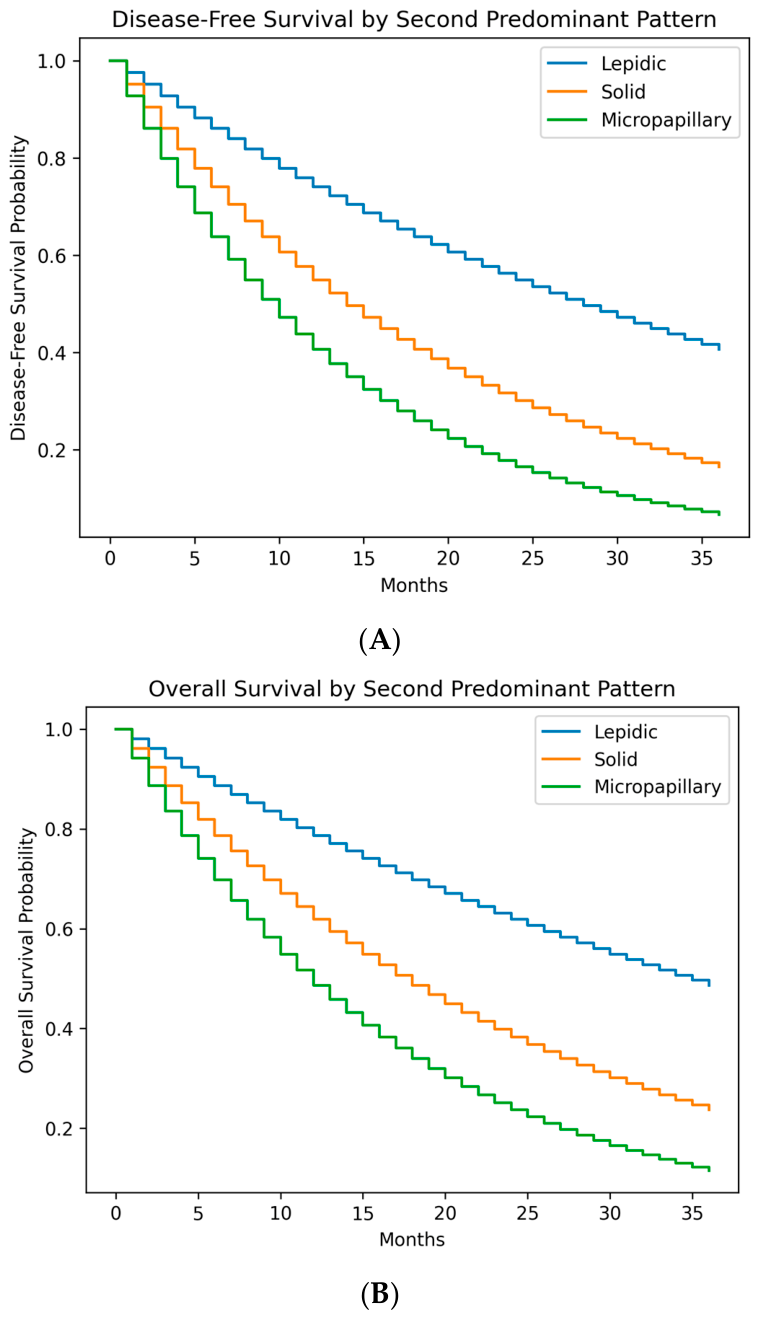
- Lepidic Second Component: Was an independent favorable prognostic factor for both OS (HR 0.70, 95% CI 0.52–0.95, p = 0.022) and DFS (HR 0.62, 95% CI 0.41–0.93, p = 0.021).
- Micropapillary Second Component: Was the strongest independent adverse prognostic factor, associated with a significantly increased risk of death (HR 1.81, 95% CI 1.24–2.64, p = 0.002) and recurrence (HR 2.03, 95% CI 1.32–3.12, p = 0.001).
- Solid Second Component: Showed a significant independent association with worse DFS (HR 1.45, 95% CI 1.01–2.08, p = 0.043) and a non-significant trend towards worse OS (HR 1.32, 95% CI 0.92–1.89, p = 0.136).
4. Discussion
5. Conclusions
Author Contributions
Funding
Institutional Review Board Statement
Informed Consent Statement
Data Availability Statement
Conflicts of Interest
References
- Siegel, R.L.; Kratzer, T.B.; Giaquinto, A.N.; Sung, H.; Jemal, A. Cancer statistics, 2025. CA Cancer J. Clin. 2025, 75, 10–45. [Google Scholar] [CrossRef] [PubMed]
- Postmus, P.E.; Kerr, K.M.; Oudkerk, M.; Senan, S.; Waller, D.A.; Vansteenkiste, J.; Escriu, C.; Peters, S.; ESMO Guidelines Committee. Early and locally advanced non-small-cell lung cancer (NSCLC): ESMO Clinical Practice Guidelines for diagnosis, treatment and follow-up. Ann. Oncol. 2017, 28, iv1–iv21. [Google Scholar] [CrossRef] [PubMed]
- Ujiie, H.; Kadota, K.; Chaft, J.E.; Buitrago, D.; Sima, C.S.; Lee, M.C.; Huang, J.; Travis, W.D.; Rizk, N.P.; Rudin, C.M.; et al. Solid Predominant Histologic Subtype in Resected Stage I Lung Adenocarcinoma Is an Independent Predictor of Early, Extrathoracic, Multisite Recurrence and of Poor Postrecurrence Survival. J. Clin. Oncol. 2015, 33, 2877–2884. [Google Scholar] [CrossRef] [PubMed]
- WHO Classification of Tumours Editorial Board. Thoracic tumours. In WHO Classification of Tumours Series, 5th ed.; International Agency for Research on Cancer: Lyon, France, 2021; Volume 5. [Google Scholar]
- Moreira, A.L.; Ocampo, P.S.; Xia, Y.; Zhong, H.; Russell, P.A.; Minami, Y.; Cooper, W.A.; Yoshida, A.; Bubendorf, L.; Papotti, M.; et al. A Grading System for Invasive Pulmonary Adenocarcinoma: A Proposal from the International Association for the Study of Lung Cancer Pathology Committee. J. Thorac. Oncol. 2020, 15, 1599–1610. [Google Scholar] [CrossRef] [PubMed]
- Travis, W.D.; Brambilla, E.; Noguchi, M.; Nicholson, A.G.; Geisinger, K.R.; Yatabe, Y.; Beer, D.G.; Powell, C.A.; Riely, G.J.; Van Schil, P.E.; et al. International association for the study of lung cancer/American thoracic society/European respiratory society international multidisciplinary classification of lung adenocarcinoma. J. Thorac. Oncol. 2011, 6, 244–285. [Google Scholar] [CrossRef] [PubMed]
- Warth, A.; Muley, T.; Meister, M.; Stenzinger, A.; Thomas, M.; Schirmacher, P.; Schnabel, P.A.; Budczies, J.; Hoffmann, H.; Weichert, W. The novel histologic International Association for the Study of Lung Cancer/American Thoracic Society/European Respiratory Society classification system of lung adenocarcinoma is a stage-independent predictor of survival. J. Clin. Oncol. 2012, 30, 1438–1446. [Google Scholar] [CrossRef] [PubMed]
- Nitadori, J.; Bograd, A.J.; Kadota, K.; Sima, C.S.; Rizk, N.P.; Morales, E.A.; Rusch, V.W.; Travis, W.D.; Adusumilli, P.S. Impact of Micropapillary Histologic Subtype in Selecting Limited Resection vs Lobectomy for Lung Adenocarcinoma of 2cm or Smaller. J. Natl. Cancer Inst. 2013, 105, 1212–1220. [Google Scholar] [CrossRef] [PubMed]
- Bertoglio, P.; Aprile, V.; Ventura, L.; Cattoni, M.; Nachira, D.; Lococo, F.; Perez, M.R.; Guerrera, F.; Minervini, F.; Querzoli, G.; et al. Impact of High-Grade Patterns in Early-Stage Lung Adenocarcinoma: A Multicentric Analysis. Lung 2022, 200, 649–660. [Google Scholar] [CrossRef] [PubMed]
- Wang, Y.; Hu, J.; Sun, Y.; Lu, Y. Micropapillary or solid component predicts worse prognosis in pathological IA stage lung adenocarcinoma: A meta-analysis. Medicine 2023, 102, e36503. [Google Scholar] [CrossRef] [PubMed]
- Mäkinen, J.M.; Laitakari, K.; Johnson, S.; Mäkitaro, R.; Bloigu, R.; Lappi-Blanco, E.; Kaarteenaho, R. Nonpredominant lepidic pattern correlates with better outcome in invasive lung adenocarcinoma. Lung Cancer 2015, 90, 568–574. [Google Scholar] [CrossRef] [PubMed]
- Bertoglio, P.; Querzoli, G.; Ventura, L.; Aprile, V.; Cattoni, M.A.; Nachira, D.; Lococo, F.; Perez, M.R.; Guerrera, F.; Minervini, F.; et al. Prognostic impact of lung adenocarcinoma second predominant pattern from a large European database. J. Surg. Oncol. 2021, 123, 560–569. [Google Scholar] [CrossRef] [PubMed]
- Detterbeck, F.C.; Boffa, D.J.; Kim, A.W.; Tanoue, L.T. The Eighth Edition Lung Cancer Stage Classification. Chest 2017, 151, 193–203. [Google Scholar] [CrossRef] [PubMed]
- De Leyn, P.; Dooms, C.; Kuzdzal, J.; Lardinois, D.; Passlick, B.; Rami-Porta, R.; Turna, A.; Schil, P.V.; Venuta, F.; Waller, D.; et al. Revised ESTS guidelines for preoperative mediastinal lymph node staging for non-small-cell lung cancer. Eur. J. Cardiothorac. Surg. 2014, 45, 787–798. [Google Scholar] [CrossRef] [PubMed]
- Zhao, Y.; Wang, R.; Shen, X.; Pan, Y.; Cheng, C.; Li, Y.; Shen, L.; Zhang, Y.; Li, H.; Zheng, D.; et al. Minor components of micropapillary and solid subtypes in lung adenocarcinoma are predictors of lymph node metastasis and poor prognosis. Ann. Surg. Oncol. 2016, 23, 2099–2105. [Google Scholar] [CrossRef] [PubMed]
- Remon, J.; Soria, J.C.; Peters, S. Early and locally advanced non-small-cell lung cancer: An update of the ESMO Clinical Practice Guidelines focusing on diagnosis, staging, systemic and local therapy. Ann. Oncol. 2021, 32, 1637–1642. [Google Scholar] [CrossRef] [PubMed]
- Wu, Y.-L.; Tsuboi, M.; He, J.; John, T.; Grohe, C.; Majem, M.; Goldman, J.W.; Laktionov, K.; Kim, S.-W.; Kato, T.; et al. Osimertinib in Resected EGFR-Mutated Non-Small-Cell Lung Cancer. N. Engl. J. Med. 2020, 383, 1711–1723. [Google Scholar] [CrossRef] [PubMed]
- Li, R.; Qiu, J.; Li, Z.; Li, H.; Tang, Z.; Yu, W.; Tian, H.; Sun, Z. Prognostic significance and survival benefits of postoperative adjuvant chemotherapy in patients with stage IA lung adenocarcinoma with non-predominant micropapillary components. World J. Surg. Oncol. 2024, 22, 32. [Google Scholar] [CrossRef] [PubMed]
- Xing, X.; Li, L.; Sun, M.; Zhu, X.; Feng, Y. A combination of radiomic features, clinic characteristics, and serum tumor biomarkers to predict the possibility of the micropapillary/solid component of lung adenocarcinoma. Ther. Adv. Respir. Dis. 2024, 18, 17534666241249168. [Google Scholar] [CrossRef] [PubMed]
- Messa, F.; Siciliani, A.; Piccioni, G.; Leonardi, B.; Ciccone, A.M.; D’Andrilli, A.; Andreetti, C.; Menna, C.; Vanni, C.; Baccarini, A.E.; et al. Prognostic Factors of Non-Predominant-Lepidic Lung Adenocarcinoma Presenting as Ground Glass Opacity: Results of a Multicenter Study. J. Pers. Med. 2024, 14, 153. [Google Scholar] [CrossRef] [PubMed]

| Characteristic | Value |
|---|---|
| Demographics | |
| Age, years (mean ± SD) | 70.2 ± 8.1 |
| Male Sex, n (%) | 57 (60.0) |
| Surgical Data | |
| Surgical Approach, n (%): | |
| VATS/RATS | 65 (68.4) |
| Open Thoracotomy | 30 (31.6) |
| Type of Resection, n (%): | |
| Lobectomy | 82 (86.3) |
| Segmentectomy | 13 (13.7) |
| Pathological Data | |
| Tumor Size, cm (mean ± SD) | 2.3 ± 1.1 |
| Pathological Stage (8th ed.), n (%): | |
| 0/IA1–IA3 | 56 (58.9) |
| IB | 15 (15.8) |
| IIA/IIB | 24 (25.3) |
| Predominant Pattern, n (%): | |
| Acinar | 48 (50.5) |
| Lepidic | 23 (24.2) |
| Solid | 14 (14.7) |
| Papillary | 7 (7.4) |
| Micropapillary | 3 (3.2) |
| IASLC Grade, n (%): | |
| G1 | 25 (26.3) |
| G2 | 55 (57.9) |
| G3 | 15 (15.8) |
| Visceral Pleural Invasion, n (%) | 18 (18.9) |
| STAS present, n (%) | 22 (23.2) |
| Second Predominant Pattern | n | % of Total Cohort | % of Patients with a 2nd Component |
|---|---|---|---|
| Lepidic | 29 | 30.5 | 52.7 |
| Solid | 18 | 18.9 | 32.7 |
| Micropapillary | 10 | 10.5 | 18.2 |
| Acinar | 8 | 8.4 | 14.5 |
| Papillary | 0 | 0 | 0 |
| Any Second Component | 55 | 57.9 | 100 |
| No Second Component | 40 | 42.1 | - |
| Model/Variable | Overall Survival | Disease-Free Survival | ||
|---|---|---|---|---|
| HR (95% CI) | p-Value | HR (95% CI) | p-Value | |
| Model 1: Lepidic 2nd Comp. | ||||
| Lepidic Second Component | 0.70 (0.52–0.95) | 0.022 | 0.62 (0.41–0.93) | 0.021 |
| Pathological Stage II (vs. 0/I) | 2.11 (1.30–3.42) | 0.002 | 2.45 (1.55–3.88) | <0.001 |
| IASLC Grade 3 (vs. G1/G2) | 1.85 (1.15–2.98) | 0.011 | 2.10 (1.38–3.20) | 0.001 |
| Model 2: Solid 2nd Comp. | ||||
| Solid Second Component | 1.32 (0.92–1.89) | 0.136 | 1.45 (1.01–2.08) | 0.043 |
| Pathological Stage II (vs. 0/I) | 2.25 (1.42–3.56) | 0.001 | 2.58 (1.70–3.91) | <0.001 |
| IASLC Grade 3 (vs. G1/G2) | 1.78 (1.08–2.93) | 0.024 | 2.05 (1.31–3.21) | 0.002 |
| Model 3: Micropap. 2nd Comp. | ||||
| Micropap. Second Component | 1.81 (1.24–2.64) | 0.002 | 2.03 (1.32–3.12) | 0.001 |
| Pathological Stage II (vs. 0/I) | 2.02 (1.27–3.22) | 0.003 | 2.33 (1.55–3.51) | <0.001 |
| IASLC Grade 3 (vs. G1/G2) | 1.65 (0.99–2.75) | 0.055 | 1.82 (1.15–2.89) | 0.011 |
Disclaimer/Publisher’s Note: The statements, opinions and data contained in all publications are solely those of the individual author(s) and contributor(s) and not of MDPI and/or the editor(s). MDPI and/or the editor(s) disclaim responsibility for any injury to people or property resulting from any ideas, methods, instructions or products referred to in the content. |
© 2026 by the authors. Licensee MDPI, Basel, Switzerland. This article is an open access article distributed under the terms and conditions of the Creative Commons Attribution (CC BY) license.
Share and Cite
Ghisalberti, M.; Salvicchi, A.; Galgano, A.; Reale, R.; Catelli, C.; Luzzi, L.; Paladini, P. The Prognostic Significance of the Second Predominant Histological Pattern in Resected Early-Stage Lung Adenocarcinoma: A Retrospective Cohort Analysis. J. Clin. Med. 2026, 15, 3815. https://doi.org/10.3390/jcm15103815
Ghisalberti M, Salvicchi A, Galgano A, Reale R, Catelli C, Luzzi L, Paladini P. The Prognostic Significance of the Second Predominant Histological Pattern in Resected Early-Stage Lung Adenocarcinoma: A Retrospective Cohort Analysis. Journal of Clinical Medicine. 2026; 15(10):3815. https://doi.org/10.3390/jcm15103815
Chicago/Turabian StyleGhisalberti, Marco, Alberto Salvicchi, Angela Galgano, Rossella Reale, Chiara Catelli, Luca Luzzi, and Piero Paladini. 2026. "The Prognostic Significance of the Second Predominant Histological Pattern in Resected Early-Stage Lung Adenocarcinoma: A Retrospective Cohort Analysis" Journal of Clinical Medicine 15, no. 10: 3815. https://doi.org/10.3390/jcm15103815
APA StyleGhisalberti, M., Salvicchi, A., Galgano, A., Reale, R., Catelli, C., Luzzi, L., & Paladini, P. (2026). The Prognostic Significance of the Second Predominant Histological Pattern in Resected Early-Stage Lung Adenocarcinoma: A Retrospective Cohort Analysis. Journal of Clinical Medicine, 15(10), 3815. https://doi.org/10.3390/jcm15103815

