Common Variable Immune Deficiency and Pregnancy: Improving Outcomes Through Multidisciplinary Care

 ,
,
Abstract
1. Introduction
2. Materials and Methods
2.1. Literature Review
2.1.1. Electronic Database Search
- (1)
- CVID: “Common Variable Immunodeficiency,” “CVID,” “Hypogammaglobulinemia,” “Antibody Deficiency,” and related variations;
- (2)
- Pregnancy: “Pregnancy,” “Pregnant,” “Gestation,” “Maternal,” “Antenatal,” “Prenatal,” “Perinatal,” “Obstetric,” “Delivery,” “Childbirth,” “Postpartum”;
- (3)
- Management: “Disease Management,” “Treatment,” “Therapy,” “Care,” “Monitoring,” “Protocol,” “Guideline,” “Immunoglobulin,” “IVIG,” “SCIG,” “Prophylaxis,” “Antibiotic,” “Antimicrobial.”
2.1.2. Study Selection Process
2.1.3. Data Extraction and Quality Assessment
2.2. Retrospective Chart Review
Data Collection and Extraction
3. Results
3.1. Narrative Review
3.1.1. Immunoglobulin Replacement Therapy
3.1.2. Antimicrobial Prophylaxis
3.1.3. Maternal Outcomes
3.1.4. Neonatal Outcomes
3.2. Retrospective Review
4. Discussion
4.1. Preconception Counseling
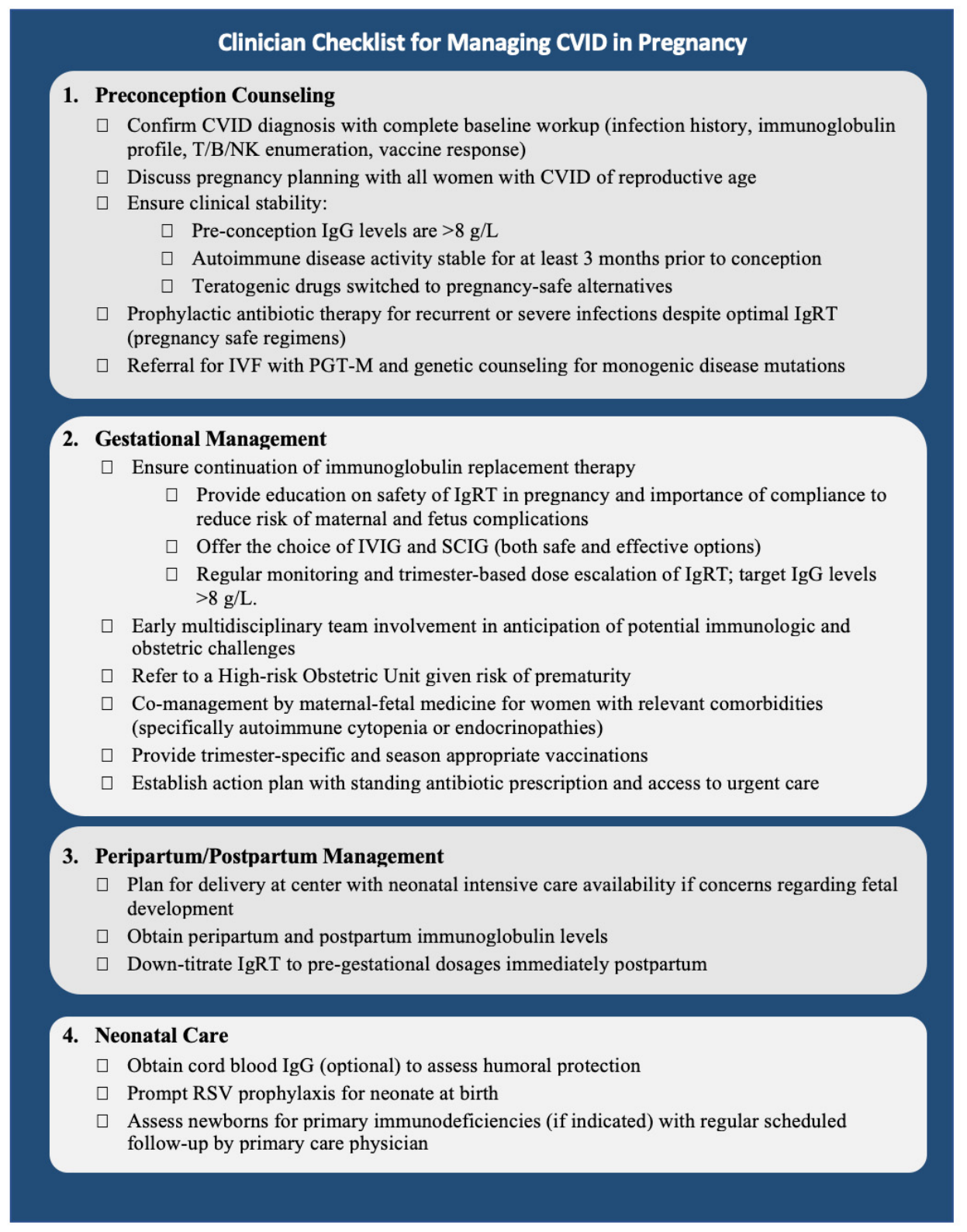
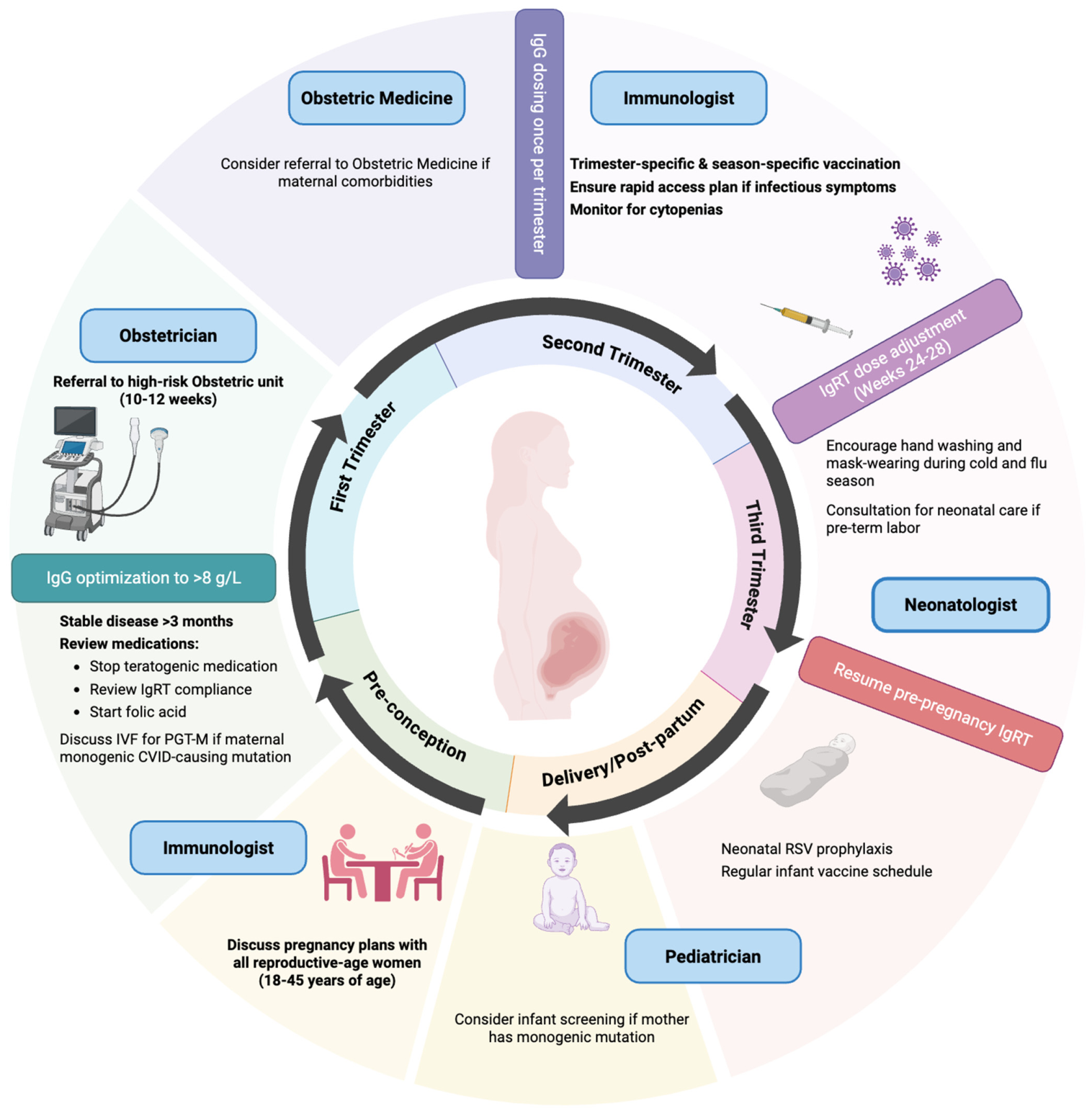
- Confirm CVID diagnosis with complete baseline workup (infection history, immunoglobulin profile, T/B/NK enumeration, vaccine response);
- Discuss pregnancy planning with all women with CVID of reproductive age;
- Ensure clinical stability: pre-conception IgG > 8 g/L; autoimmune disease activity stable for ≥3 months; teratogenic medications switched to pregnancy-safe alternatives;
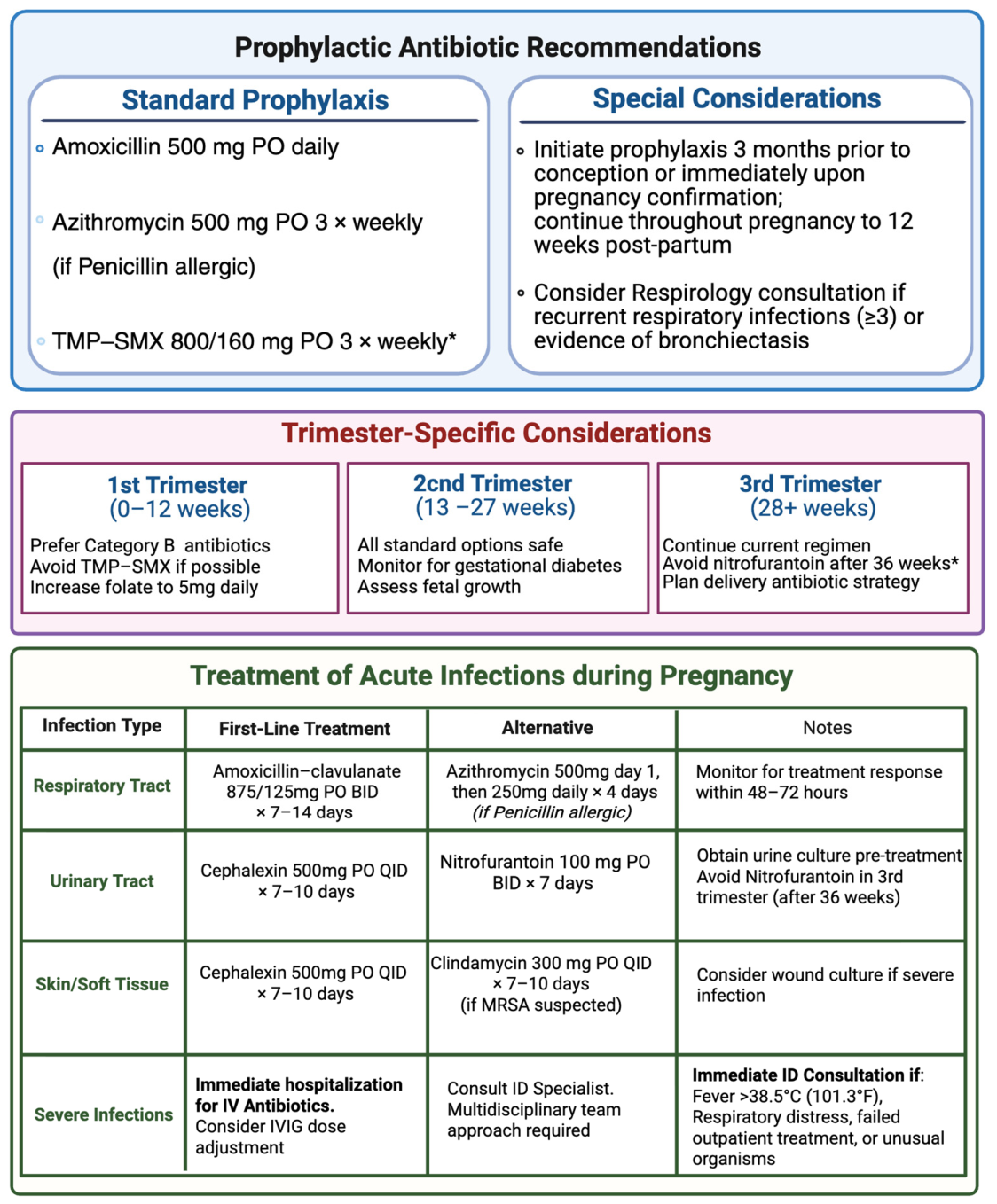
- Initiate prophylactic antibiotics for recurrent or severe infections despite optimal IgRT (pregnancy-safe regimens);
- Refer for IVF with PGT-M and genetic counseling when monogenic, CVID-causing mutations are identified.
4.2. Gestational Management
- Continue IgRT throughout pregnancy; offer choice of IVIG or SCIG (both safe and effective);
- Monitor IgG monthly, with trimester-based dose escalation targeting IgG > 8 g/L;
- Engage the multidisciplinary team (immunology, maternal-fetal medicine, obstetrics) early;
- Refer to a high-risk obstetric unit given the risk of prematurity;
- Co-manage with maternal-fetal medicine for relevant comorbidities (autoimmune cytopenia, endocrinopathies);
- Provide trimester-specific and season-appropriate vaccinations;
- Establish an action plan with standing antibiotic prescription and access to urgent care.
4.3. Peripartum/Post-Partum Management
- Plan delivery at a center with neonatal intensive care availability when fetal-development concerns are present;
- Obtain peripartum and post-partum maternal IgG levels;
- Down-titrate IgRT to pre-gestational dosing in the immediate post-partum period.
4.4. Neonatal Care
- Obtain cord-blood IgG (optional) to assess humoral protection;
- Consider neonatal RSV prophylaxis at birth (e.g., maternal RSVpreF vaccination history, nirsevimab);
- Assess newborns for primary immunodeficiencies where indicated, with scheduled follow-up by the primary care physician.
- (1)
- Immunoglobulin replacement therapy:
- (2)
- Multidisciplinary management:
- (3)
- Vaccinations:
4.5. Limitations and Future Directions
5. Conclusions
Supplementary Materials
Author Contributions
Funding
Institutional Review Board Statement
Informed Consent Statement
Data Availability Statement
Acknowledgments
Conflicts of Interest
References
- Zhang, S.; Cunningham-Rundles, C. Primary Antibody Immunodeficiency and the Pregnant Patient. Immunol. Allergy Clin. N. Am. 2023, 43, 133–144. [Google Scholar] [CrossRef] [Scilit] [PubMed]
- Seminario, G.; Gonzalez-Serrano, M.E.; Aranda, C.S.; Grumach, A.S.; Segundo, G.R.S.; Regairaz, L.; Cardona, A.A.; LASID Registry Group; Becerra, J.C.A.; Poli, C.; et al. The Latin American Society for Immunodeficiencies Registry. J. Clin. Immunol. 2024, 45, 28. [Google Scholar] [CrossRef] [Scilit] [PubMed]
- Ameratunga, R.; Gillis, D.; Steele, R. Diagnostic criteria for common variable immunodeficiency disorders. J. Allergy Clin. Immunol. Pract. 2016, 4, 1017–1018. [Google Scholar] [CrossRef] [Scilit]
- Bonilla, F.A.; Barlan, I.; Chapel, H.; Costa-Carvalho, B.T.; Cunningham-Rundles, C.; de la Morena, M.T.; Espinosa-Rosales, F.J.; Hammarström, L.; Nonoyama, S.; Quinti, I.; et al. International Consensus Document (ICON): Common Variable Immunodeficiency Disorders. J. Allergy Clin. Immunol. Pract. 2016, 4, 38–59. [Google Scholar] [CrossRef] [Scilit]
- Mallart, E.; Francoise, U.; Driessen, M.; Blanche, S.; Lortholary, O.; Lefort, A.; Caseris, M.; Fischer, A.; Mahlaoui, N.; Charlier, C.; et al. Pregnancy in primary immunodeficiency diseases: The PREPI study. J. Allergy Clin. Immunol. 2023, 152, 760–770. [Google Scholar] [CrossRef] [Scilit] [PubMed]
- Gundlapalli, A.V.; Scalchunes, C.; Boyle, M.; Hill, H.R. Fertility, pregnancies and outcomes reported by females with common variable immune deficiency and hypogammaglobulinemia: Results from an internet-based survey. J. Clin. Immunol. 2015, 35, 125–134. [Google Scholar] [CrossRef] [Scilit]
- Murray, C.; Santangeli, E.; Mockler, D.; Townsend, K.; Seidel, M.G.; Burns, S.O.; ESID Clinical Working Party. A scoping review of clinical management guidelines in inborn errors of immunity. J. Allergy Clin. Immunol. 2025, 156, 1715–1724. [Google Scholar] [CrossRef] [Scilit]
- Kalkan, F.; Yeşillik, S.; Demirel, F.; Selçuk, A.; İnan, M.İ.; Sönmez, E.; Balaban, Y.; Kartal, Ö. Pregnancy and lactation in patients with common variable immunodeficiency: A single center experience. Allergol. Immunopathol. 2026, 54, 62–69. [Google Scholar] [CrossRef] [Scilit]
- Manson, A.L.; Zaheri, S.; Kelleher, P.; Wakelin, S.; Nelson-Piercy, C.; Seneviratne, S.L.; Cooper, N. Management of granulomatous common variable immunodeficiency diagnosed in pregnancy: A case report. J. Perinatol. 2012, 32, 387–389. [Google Scholar] [CrossRef] [Scilit]
- Danieli, M.G.; Moretti, R.; Pettinari, L.; Gambini, S. Management of a pregnant woman with common variable immunodeficiency and previous reactions to intravenous IgG administration. BMJ Case Rep. 2012, 2012, bcr2012007594. [Google Scholar] [CrossRef] [Scilit]
- Kralickova, P.; Kurecova, B.; Andrys, C.; Krcmova, I.; Jilek, D.; Vlkova, M.; Litzman, J. Pregnancy Outcome in Patients with Common Variable Immunodeficiency. J. Clin. Immunol. 2015, 35, 531–537. [Google Scholar] [CrossRef] [Scilit] [PubMed]
- Marasco, C.; Venturelli, A.; Rao, L.; Vacca, A.; Carratù, M.R. Management of common variable immunodeficiency by subcutaneous IgG self-administration during pregnancy—A case report. Clin. Case Rep. 2017, 5, 1309–1311. [Google Scholar] [CrossRef] [Scilit]
- Sheikhbahaei, S.; Sherkat, R.; Camacho-Ordonez, N.; Khoshnevisan, R.; Kalantari, A.; Salehi, M.; Nazemian, S.S.; Nasr-Esfahani, M.H.; Klein, C. Pregnancy, child bearing and prevention of giving birth to the affected children in patients with primary immunodeficiency disease; a case-series. BMC Pregnancy Childbirth 2018, 18, 299. [Google Scholar] [CrossRef] [Scilit]
- Egawa, M.; Kanegane, H.; Imai, K.; Morio, T.; Miyasaka, N. Intravenous immunoglobulin (IVIG) efficiency in women with common variable immunodeficiency (CVID) decreases significantly during pregnancy. J. Matern. Fetal Neonatal Med. 2019, 32, 3092–3096. [Google Scholar] [CrossRef] [Scilit]
- Borte, M.; Raffac, S.; Hrubisko, M.; Jahnz-Rozyk, K.; Garcia, E.; McCoy, B.; Chavan, S.; Nagy, A.; Yel, L. Long-term safety of facilitated subcutaneous immunoglobulin treatment in pregnant women with primary immunodeficiency diseases: Results from a registry study. Immunotherapy 2022, 14, 609–616. [Google Scholar] [CrossRef] [Scilit] [PubMed]
- Gardulf, A.; Andersson, E.; Lindqvist, M.; Hansen, S.; Gustafson, R. Rapid subcutaneous IgG replacement therapy at home for pregnant immunodeficient women. J. Clin. Immunol. 2001, 21, 150–154. [Google Scholar] [CrossRef] [Scilit]
- Muanda, F.T.; Sheehy, O.; Bérard, A. Use of trimethoprim-sulfamethoxazole during pregnancy and risk of spontaneous abortion: A nested case control study. Br. J. Clin. Pharmacol. 2018, 84, 1198–1205. [Google Scholar] [CrossRef] [Scilit]
- Abu-Raya, B.; Michalski, C.; Sadarangani, M.; Lavoie, P.M. Maternal Immunological Adaptation During Normal Pregnancy. Front. Immunol. 2020, 11, 575197. [Google Scholar] [CrossRef] [Scilit]
- Banjar, S.; Kadour, E.; Khoudja, R.; Ton-Leclerc, S.; Beauchamp, C.; Beltempo, M.; Dahan, M.H.; Gold, P.; Jacques Kadoch, I.; Jamal, W.; et al. Intravenous immunoglobulin use in patients with unexplained recurrent pregnancy loss. Am. J. Reprod. Immunol. 2023, 90, e13737. [Google Scholar] [CrossRef] [Scilit] [PubMed]
- D’Mello, R.J.; Hsu, C.D.; Chaiworapongsa, P.; Chaiworapongsa, T. Update on the Use of Intravenous Immunoglobulin in Pregnancy. Neoreviews 2021, 22, e7–e24. [Google Scholar] [CrossRef] [Scilit]
- Pavan-Ramos, T.; Willy-Fabro, A.P.; Rozalem, A.C.; Lessa Mazzucchelli, J.T.; Carvalho, B.C. IgG serum levels in CVID patients during pregnancy. World Allergy Organ. J. 2015, 8, A157. [Google Scholar] [CrossRef] [Scilit]
- Palmeira, P.; Quinello, C.; Silveira-Lessa, A.L.; Zago, C.A.; Carneiro-Sampaio, M. IgG placental transfer in healthy and pathological pregnancies. Clin. Dev. Immunol. 2012, 2012, 985646. [Google Scholar] [CrossRef] [Scilit] [PubMed]
- Moral Moral, P.; Garcia-Bustos, V.; Balastegui-Martin, H.; Martínez Mercader, S.; Bracke, C.; Mateu, L.; Solanich, X.; Antolí, A.; Carrillo-Linares, J.L.; Robles-Marhuenda, Á.; et al. Real-world patterns of immunoglobulin replacement therapy for infection prevention in common variable immunodeficiency: A multicenter nationwide study. Front. Immunol. 2025, 16, 1640290. [Google Scholar] [CrossRef] [Scilit]
- Genest, G.; Banjar, S.; Almasri, W.; Beauchamp, C.; Benoit, J.; Buckett, W.; Dzineku, F.; Gold, P.; Dahan, M.H.; Jamal, W.; et al. Immunomodulation for unexplained recurrent implantation failure: Where are we now? Reproduction 2023, 165, R39–R60. [Google Scholar] [CrossRef] [Scilit]
- Pradhan, J.; Mallick, S.; Mishra, N.; Tiwari, A.; Negi, V.D. Pregnancy, infection, and epigenetic regulation: A complex scenario. Biochim. Biophys. Acta Mol. Basis Dis. 2023, 1869, 166768. [Google Scholar] [CrossRef] [Scilit]
- Madhi, S.A.; Kampmann, B.; Simões, E.A.F.; Zachariah, P.; Pahud, B.A.; Radley, D.; Sarwar, U.N.; Shittu, E.; Llapur, C.; Pérez Marc, G.; et al. Preterm birth frequency and associated outcomes from the MATISSE maternal trial of the bivalent respiratory syncytial virus prefusion F protein vaccine. Obstet. Gynecol. 2025, 145, 147–156. [Google Scholar] [CrossRef] [Scilit] [PubMed]
- Williams, T.C.; Marlow, R.; Cunningham, S.; Drysdale, S.B.; Groves, H.E.; Hunt, S.; Iskander, D.; Liu, X.; Lyttle, M.D.; Mpamhanga, C.D.; et al. Bivalent prefusion F vaccination in pregnancy and respiratory syncytial virus hospitalisation in infants in the UK: A multicentre, test-negative, case-control study. Lancet Child. Adolesc. Health 2025, 9, 655–662. [Google Scholar] [CrossRef] [Scilit]
- Wells, G.A.; Shea, B.; O’Connell, D.; Peterson, J.; Welch, V.; Losos, M.; Tugwell, P. The Newcastle-Ottawa Scale (NOS) for Assessing the Quality of Nonrandomized Studies in Meta-Analyses; Ottawa Hospital Research Institute: Ottawa, ON, Canada, 2011; Available online: http://www.ohri.ca/programs/clinical_epidemiology/oxford.asp (accessed on 8 April 2025).



| First Author/Year | Study Design Country | No. of Patients | Inclusion Criteria | Type of Immunoglobulin | Outcome | Recommendations |
|---|---|---|---|---|---|---|
| Manson 2012 [9] | Case Report Retrospective Year of study not specified United Kingdom | 1 patient 2 pregnancies 2 live births | 34-year-old patient diagnosed with granulomatous CVID 24 GW of second pregnancy (low Ig levels, impaired vaccine response to tetanus, recurrent respiratory tract infections since childhood) | IVIG (type not specified), started 15 g/month (0.27 g/kg) at 26 GW, increased to 22 g (0.4 g/kg) at 32 weeks and to 30 g (0.54 g/kg) at 37 GW | The patient had an uncomplicated term pregnancy prior to CVID diagnosis Second pregnancy complicated by deep vein thrombosis and pseudomonas bacteremia at 24 GW. IVIG started at 26 GW. Cholestasis of pregnancy at 37 weeks. Urgent C-section for placental abruption, post-partum hemorrhage requiring uterine artery embolization Healthy male infant | Consider CVID pregnancies high-risk Increase IgRT dose to maintain stable IgG levels |
| Danieli 2012 [10] | Case Report Retrospective January 2011–February 2012 Italy | 1 patient 2 pregnancies 1 live birth 1 miscarriage | 42-year-old patient with CVID (longstanding recurrent upper respiratory tract infections, pan-hypogammaglobulinemia, impaired tetanus vaccine response) | 10% liquid IVIG; then, Privigen® (0.6 g/kg/month) | Patient had one spontaneous miscarriage at 8 weeks while on IVIG Post-miscarriage: recurrent infusion reaction to IVIG and discontinuation of therapy Second pregnancy: Alternative IgRT (Privigen® 10%; 0.6 g/kg/month) started at 18 GW with premedication and slow infusion rate; IgG levels maintained > 10 mg/dL Term; healthy boy (40 GW), breast fed Privigen decreased to 0.4 g/month post-partum | Privigen® preparation is well tolerated in patients with adverse reactions to IVIG IVIG is necessary to prevent maternal/fetal infections Dose increased must be considered in pregnancy |
| Kralickova 2015 [11] | Cohort study Retrospective Year of study not specified Czech Republic | 50 patients 115 pregnancies 88 live births (92 children, 2 sets of twins) 12 miscarriages 3 stillbirths 11 pregnancy terminations (9 by choice, 2 for congenital anomalies) 1 ectopic pregnancy | Group A (n = 85): pregnancies occurring before CVID manifestations Group B (n = 14): pregnancies occurring after first CVID symptoms but before IgRT Group C (n = 16): pregnancies occurring in women with established CVID and on IgRT | Not specified | Higher rates of preterm labor, eclampsia and pre-eclampsia, low birth weight offspring, and stillbirths in CVID patients compared to the general population Higher rates of antibiotic use during pregnancy in Group B Higher rates of antibiotic administration to offspring 0–12 months in Group B IVIG and scIg were equally effective in preventing infectious complications | Consider CVID pregnancies high-risk pregnancies Continue IgRT during pregnancy Increase IgRT dose to maintain stable trough IgG levels |
| Marasco 2017 [12] | Case Report Retrospective 2008–2012 Italy | 1 patient 2 pregnancies 2 live births | 36-year-old patient diagnosed with CVID after second pregnancy (recurrent respiratory infections, pan-hypogammaglobulinemia, impaired tetanus vaccine response) | Hizentra® 20% 8 g/week (0.4 g/kg/month) started at CVID diagnosis, increased to 10 g/week at 28 weeks until delivery | First pregnancy complicated by ITP prior to CVID diagnosis Later diagnosis of CVID (recurrent respiratory infections, low immunoglobulin levels, impaired tetanus vaccine response) Second pregnancy on SCIG uncomplicated, term birth; healthy girl | Increase IgRT dose during 3rd trimester to maintain stable IgG levels SCIG is safe during pregnancy |
| Sheikhbahaei 2018 [13] | Case Series Retrospective Year of study not specified Iran | 3 patients 3 live births | 9 patients with PID 3 pregnant patients with CVID | IgRT not specified | One patient on 0.4 g/kg/3 week IVIG had ITP and increased to 0.8 g/kg/3 week in 2nd trimester. Term; healthy child Patient with CVID and autoimmune hepatitis, off IgRT (allergy), stopped Cellcept® and prednisone at diagnosis of pregnancy (with normalization of liver enzymes). Eclampsia at 24 weeks, conservatively managed with delivery at 38 GW One patient with CVID had previous pregnancy prior to diagnosis, which was complicated by recurrent pneumonia and severe dyspnea throughout pregnancy | Untreated CVID can increase risk of adverse maternal and fetal outcomes (infections, ITP, eclampsia) Increase IgRT dose during pregnancy |
| Egawa 2019 [14] | Case Series Retrospective January 2007–December 2016 Japan | 4 patients 9 pregnancies 8 live births 1 miscarriage | Pregnant patients with CVID on IgRT | ‘10% liquid IVIG’ (Japan Blood Products Organization) and/or Hizentra 20% Target IgG Target IgG level 10 mg/dL | One patient had a 12-week miscarriage and 3 healthy pregnancies Patients with IgG levels <10 mg/dL had more recurrent infections No other adverse obstetrical or perinatal adverse events | Increase IgG dose during pregnancy IVIG: shorten interval to every 2 weeks from 28–35 weeks and weekly from 36 weeks to delivery scIg: shorten dosing interval to twice per week after 28 weeks until delivery, add IVIG in patients not maintaining target IgG levels |
| Mallart 2023 [5] | Retrospective observational, monocentric study 1966–2022 France | 51 patients with ‘primary antibody deficiency’ 119 pregnancies 82 live births 27 miscarriages 2 ectopic pregnancies 2 pregnancies losses > 20 weeks 7 voluntary pregnancy terminations, 1 medical termination of pregnancy | Patients with ‘primary antibody deficiency’ 31 patients became pregnant while on IgRT | Not specified | Better outcomes in pregnancies treated with IgRT 68/78 (87%) term birth 10/78 (17%) pre-term birth (32–37 weeks 7/78 (3%) extreme pre-term birth (<32 weeks) 16% low birth weight (<10th percentile) 7/69 (10%) infection during neonatal period | Trimester-specific and season-specific vaccination Multidisciplinary care Discontinue teratogenic medication and substitute when possible Increase IgRT during pregnancy if IgG levels are ‘low’ |
Disclaimer/Publisher’s Note: The statements, opinions and data contained in all publications are solely those of the individual author(s) and contributor(s) and not of MDPI and/or the editor(s). MDPI and/or the editor(s) disclaim responsibility for any injury to people or property resulting from any ideas, methods, instructions or products referred to in the content. |
© 2026 by the authors. Licensee MDPI, Basel, Switzerland. This article is an open access article distributed under the terms and conditions of the Creative Commons Attribution (CC BY) license.
Share and Cite
Alyaqout, F.; Aw, M.; Saleh, E.; Lee, D.; Polito, V.; Fein, M.; Tsoukas, C.; Alizadehfar, R.; Genest, G. Common Variable Immune Deficiency and Pregnancy: Improving Outcomes Through Multidisciplinary Care. J. Clin. Med. 2026, 15, 3810. https://doi.org/10.3390/jcm15103810
Alyaqout F, Aw M, Saleh E, Lee D, Polito V, Fein M, Tsoukas C, Alizadehfar R, Genest G. Common Variable Immune Deficiency and Pregnancy: Improving Outcomes Through Multidisciplinary Care. Journal of Clinical Medicine. 2026; 15(10):3810. https://doi.org/10.3390/jcm15103810
Chicago/Turabian StyleAlyaqout, Fatemah, Michael Aw, Eisa Saleh, Derek Lee, Vanessa Polito, Michael Fein, Christos Tsoukas, Reza Alizadehfar, and Genevieve Genest. 2026. "Common Variable Immune Deficiency and Pregnancy: Improving Outcomes Through Multidisciplinary Care" Journal of Clinical Medicine 15, no. 10: 3810. https://doi.org/10.3390/jcm15103810
APA StyleAlyaqout, F., Aw, M., Saleh, E., Lee, D., Polito, V., Fein, M., Tsoukas, C., Alizadehfar, R., & Genest, G. (2026). Common Variable Immune Deficiency and Pregnancy: Improving Outcomes Through Multidisciplinary Care. Journal of Clinical Medicine, 15(10), 3810. https://doi.org/10.3390/jcm15103810