1. Introduction
Asthma is the most common chronic noncommunicable disease among children, characterized by chronic airway inflammation and hyperresponsiveness that can lead to recurrent coughing, wheezing, chest tightness, and shortness of breath. It represents a global health concern, affecting approximately 14% of children worldwide—a prevalence significantly higher than the 7.7% rate observed in adults [
1]. In fact, over one-third of adults with asthma first developed the condition during childhood [
2]. Allergic asthma is the most common phenotype in pediatric asthma, characterized by eosinophilic airway inflammation associated with sensitization to various allergens via specific immunoglobulin E (sIgE) antibodies, as confirmed by serological test or skin prick test.
Asthma exacerbations are the most common cause of asthma-related hospitalizations and can be life-threatening for children. Untreated exacerbations increase the risk of chronic obstructive pulmonary disease in adulthood. Asthma remains a major problem in China, with childhood prevalence increasing by over 50% every decade [
3]. Although the incidence of asthma exacerbations has slightly decreased in recent years with increased focus on children’s health, the growing number of children with asthma continues to drive increases in asthma-related hospitalizations and deaths among children. Therefore, greater efforts are needed to reduce the incidence of asthma exacerbations in children. Sensitization to airborne allergens correlates with severe asthma and severe asthma exacerbations [
4]. While allergen avoidance proves challenging in clinical practice, mounting evidence suggests tangible clinical benefits from reducing allergen exposure in sensitized patients when achievable. These clinical benefits include fewer days with persistent asthma symptoms, reduced hospitalizations, and decreased asthma-related unscheduled emergency or outpatient visits [
5]. Thus, the timely identification of asthma patients and investigation of their potential sensitization to airborne allergens is particularly important.
In China, the burden of allergic diseases is especially severe, with over 45 million asthma cases and an estimated 200 million individuals suffering from allergic rhinitis, though a substantial proportion remain undiagnosed [
6]. The pattern of allergen sensitization among Chinese individuals is highly complex, driven by significant regional variations in allergen distribution and population susceptibility [
7]. Previous studies have reported that house dust mites are prevalent in southern and eastern China, while pollen allergies are common in western and northern regions [
8]. The prevalence of dust mite allergy among patients with allergic diseases varies from 11.21% in Northeast China to 40.79% in South China. Dust mite allergy contributes to the development of allergic rhinitis and asthma [
9]. A study conducted in the northern grasslands of China found that the most common types of pollen among pollen-induced allergic rhinitis patients were
Artemisia plants,
Chenopodium plants, and
climbing Humulus [
10]. In this study, we measured sIgE levels of 18 common allergens (including
Dermatophagoides pteronyssinus,
House dust,
Cat dander,
Dog dander, and others) in 30,565 children. These measurements provide a more accurate understanding of their sensitization to different allergens. The findings will reveal the primary allergens causing allergies in children in West China, which is crucial for developing targeted prevention and treatment strategies.
In summary, this study aims to describe the prevalence and patterns of aeroallergen sensitization in a hospital-based pediatric population from West China by measuring sIgE levels. These descriptive findings are intended to generate hypotheses and provide foundational data that may inform the design of future, targeted interventional studies on allergy prevention and asthma management in this region.
2. Materials and Methods
The data were retrospectively collected from pediatric outpatients who were treated at West China Second University Hospital from 1 August 2024 to 31 July 2025. Our hospital is a medical center in the western region of China, and its service area covers the entire western region. This study complies with the Declaration of Helsinki, and no personally identifiable information is included in the full text. It was approved by the West China Second University Hospital Ethical Committee (Approval no. 2023.407). The date when we collected the data was after the ethics approval was granted.
The age groups of the children were categorized as follows: infants and toddlers (<3 years), preschool children (3–<6 years), and school-age children (6–14 years) [
11]. Data were sourced from hospital information systems, laboratory information systems, electronic medical records, and other databases. For subjects who underwent multiple tests during the study period, only the first test record was included.
The sIgE assay for pediatric patients used an enzyme-linked immunosorbent assay (HOB Biotech Group Corp., Ltd., Suzhou, Jiangsu, China), performed on a fully automated enzyme-linked immunosorbent analyzer, URANUS AE95 (Aikang MedTech Co., Ltd., Shenzhen, Guangdong, China). All pediatric patients provided 4 mL of venous blood collected in disposable vacuum tubes (Becton, Dickinson and Company, Franklin Lakes, NJ, USA). Samples were centrifuged at 3500 rpm for 5 min to separate serum, which was then tested for allergens using the ELISA capture method. The panel included 18 allergens: inhaled indoor allergens (
Dermatophagoides farinae,
Dermatophagoides pteronyssinus,
House Dust,
Dog dander,
Cat dander,
Cockroach,
Alternaria,
Penicillium punctatus,
Aspergillus fumigatus) and inhalant outdoor allergens (
Humulus japonicus,
Betula platyphylla,
Sycamore,
Cottonwood,
Cupressus,
Pine,
Mugwort,
Common ragweed,
Willow). Procedures followed the instrument and kit instructions. Prior to conducting the test, we verified the performance of both the kit and the instrument. This verification assessed parameters including the detection limit, precision, carryover contamination rate and clinical concordance, following the quality specifications of the International Organization for Standardization (ISO) 15189 [
12] for medical laboratories. The laboratory also performs daily internal quality control with manufacturer-supplied materials. Furthermore, it participates in the external quality assessment scheme administered by the National Clinical Research Center in China. These measures ensure the accuracy of the results. Results were graded and interpreted according to international standards [
13]. The standard diagnostic threshold for allergen sensitization is set at 0.35 IU/mL; if the level exceeds this threshold, it is considered that the individual is allergic to the allergen. If the level of an aeroallergen was 0.35 IU/mL or more, the test result for that aeroallergen was defined as positive, and positive cases were defined as those where one aeroallergen was positive.
Data processing was performed using GraphPad Prism 8.0 and SPSS software (v27). Count data were expressed as case numbers or percentages. The positive rates for aeroallergens were calculated using the total number of tested children in each category (such as season, gender or age group). Comparisons of rates were performed using the chi-square test or exact probability method, with p < 0.05 considered statistically significant. Given the exploratory and descriptive nature of our study, we did not apply a formal correction for multiple comparisons, such as the Bonferroni method. This approach was taken to minimize the risk of Type II errors. It also helped prevent the potential masking of meaningful patterns in the data.
3. Results
This retrospective analysis evaluated the allergen sensitization profiles of 30,565 pediatric patients (17,513, 57.30% male; 13,052, 42.70% female; male/female ratio 1.34:1) who presented to our hospital.
Table 1 shows the descriptive statistics of the number of patients during the study period. In terms of age, 15,538 patients (50.84%) were school-age children. This was followed by preschool children, 7989 (26.14%); the least number of patients were infants and toddlers, 7038 (23.03%).
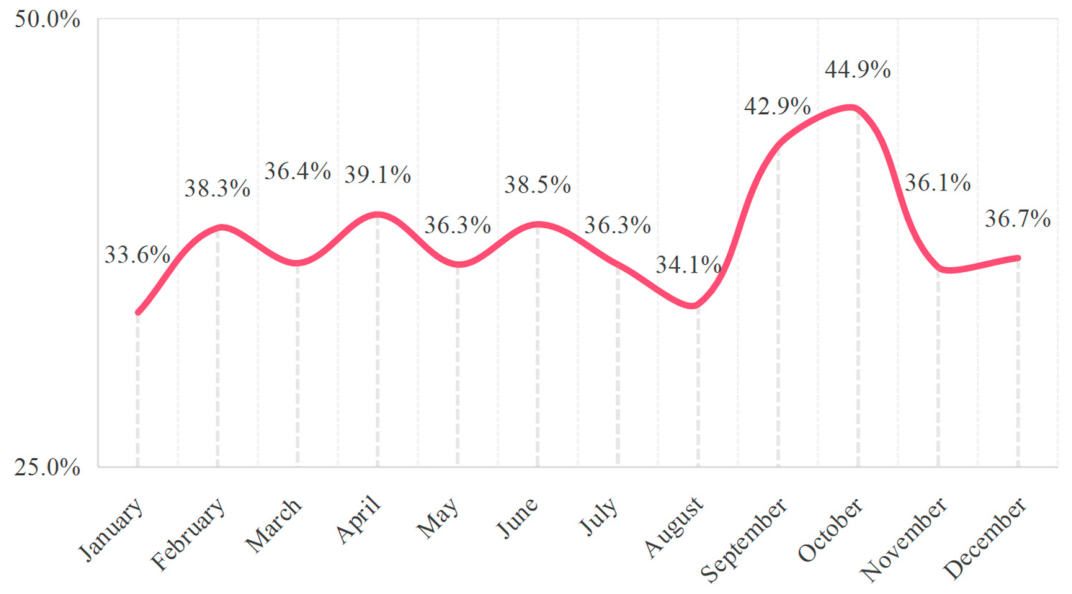
The overall positive rate for sIgE to allergens in 30,565 children was 37.7% (11,524/30,565). The monthly positive rate was calculated using the total number of tested children in each corresponding month. It was shown in
Figure 1. The spring positivity rate was 37.3% (3283/8797), the summer positivity rate was 36.2% (3086/8528), the autumn positivity rate was 41.2% (2878/6977), and the winter positivity rate was 36.4% (2277/6263). The difference in positivity rates between spring and summer was not statistically significant (RR = 1.015, 95% CI: 0.987–1.044; χ
2 = 1.06,
p = 0.29). The difference between spring and winter was not statistically significant (RR = 1.011, 95% CI: 0.985–1.037; χ
2 = 0.67,
p = 0.41). The difference between summer and winter was not statistically significant (RR = 0.998, 95% CI: 0.972–1.025; χ
2 = 0.02,
p = 0.88). Among the four seasons, autumn exhibited the highest positive rate. Comparisons between autumn and spring, summer, and winter all showed statistically significant differences (RR = 1.056, 95% CI: 1.023–1.090; χ
2 = 11.03,
p < 0.01; RR = 1.072, 95% CI: 1.039–1.107; χ
2 = 18.41,
p < 0.01; RR = 1.059, 95% CI: 1.029–1.091; χ
2 = 14.64,
p < 0.01).
Indoor allergens included
Dermatophagoides farinae,
Dermatophagoides pteronyssinus,
House dust,
Dog dander,
Cat dander,
Cockroach,
Alternaria,
Penicillium punctatus, and
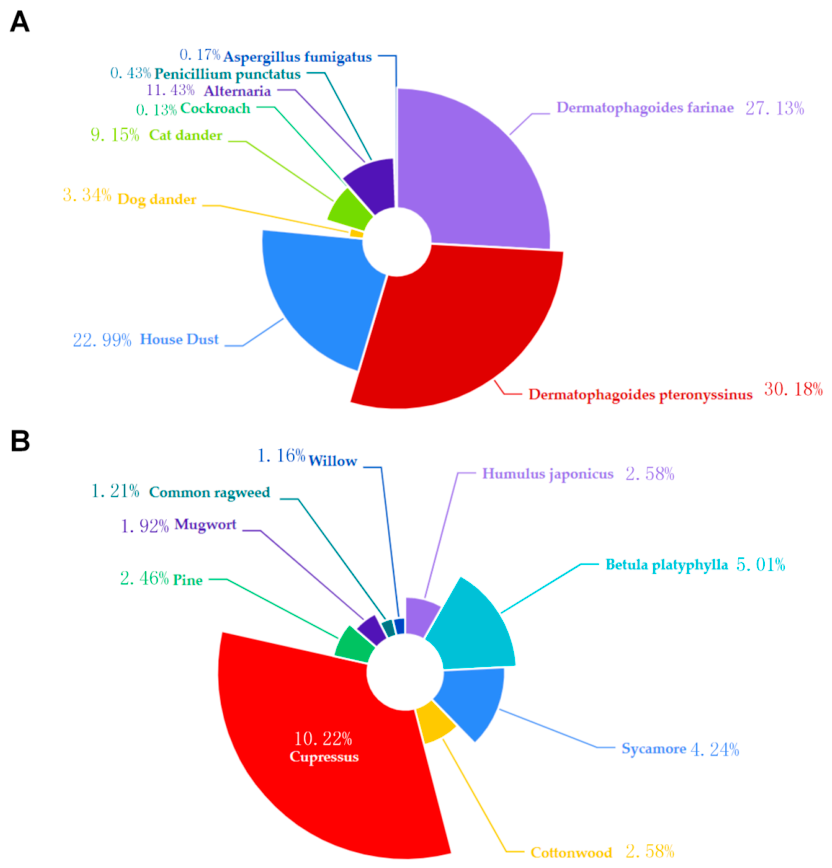
Aspergillus fumigatus, which showed positive rates of 27.13%, 30.18%, 22.99%, 3.34%, 9.15%, 0.13%, 11.43%, 0.43%, and 0.17%, respectively, among the total number of tested individuals. Among outdoor allergens, the positive rates for
Humulus japonicus,
Betula platyphylla,
Sycamore,
Cottonwood,
Cupressus,
Pine,
Mugwort,
Common ragweed, and
Willow were 2.58%, 5.01%, 4.24%, 2.58%, 10.22%, 2.46%, 1.92%, 1.21%, and 1.16%, respectively. Among indoor allergens, the top three positive rates were
Dermatophagoides pteronyssinus (
Dermatophagoides pteronyssinus vs.
Dermatophagoides farinae, RR = 1.053, 95% CI: 1.034–1.073; χ
2 = 29.46,
p < 0.01),
Dermatophagoides farinae (
Dermatophagoides farinae vs.
House dust, RR = 1.083, 95% CI: 1.062–1.103; χ
2 = 64.16,
p < 0.01), and
House dust (
House dust vs.
Alternaria, RR = 1.336, 95% CI: 1.312–1.360; χ
2 = 776.2,
p < 0.01) (
Figure 2A). Among outdoor allergens, the top three positive rates were
Cupressus (
Cupressus vs.
Betula platyphylla, RR = 1.342, 95% CI: 1.283–1.403; χ
2 = 118.6,
p < 0.01),
Betula platyphylla (
Betula platyphylla vs.
Sycamore, RR = 1.083, 95% CI: 1.008–1.164; χ
2 = 4.36,
p < 0.05), and
Sycamore (
Sycamore vs.
Cottonwood, RR = 1.243, 95% CI: 1.158–1.335; χ
2 = 28.01,
p < 0.01) (
Figure 2B). The highest
Dermatophagoides pteronyssinus positivity rate among indoor allergens was significantly higher than the highest
Cupressus positivity rate among outdoor allergens, with a statistically significant difference between the two (RR = 1.183, 95% CI: 1.172–1.195; χ
2 = 749.5,
p < 0.01). Among indoor and outdoor allergens,
Dermatophagoides pteronyssinus had the highest positive rate (
Dermatophagoides pteronyssinus vs.
Dermatophagoides farinae, RR = 1.053, 95% CI: 1.034–1.073; χ
2 = 29.46,
p < 0.01), while
Cockroach and
Aspergillus fumigatus had the lowest positive rates. The difference between the two was not statistically significant (RR = 1.219, 95% CI: 0.755–1.968; χ
2 = 0.62,
p = 0.43).
Comparison of total positive rates for allergen-sIgE among children of different age groups revealed that the total positive rate for infants and toddlers was 18.81% (1324/7038), for preschool children 40.28% (3218/7989), and for school-age children 48.51% (7537/15,538). Statistically significant differences in total allergen sIgE positivity rates across age groups were observed (χ
2 = 857.4,
p < 0.01). Specifically, the difference between infants/toddlers and preschool children was statistically significant (RR = 0.750, 95% CI: 0.733–0.769; χ
2 = 445.8,
p < 0.01). The difference in total positive rates between infants/toddlers and school-age children was statistically significant (RR = 0.809, 95% CI: 0.799–0.819; χ
2 = 858.8,
p < 0.01). The difference between preschool children and school-age children was also statistically significant (RR = 0.942, 95% CI: 0.928–0.957; χ
2 = 54.6,
p < 0.01). Distribution of allergens in different age groups is shown in
Table 2. Among children of the same age group, the indoor allergen positivity rate for infants and toddlers was 17.59% (1238/7038), significantly higher than the outdoor allergen positivity rate of 1.22% (86/7038). Among preschool children, the indoor allergen positivity rate of 33.25% (2656/7989) was higher than the outdoor allergen positivity rate of 7.03% (562/7989). The indoor allergen positivity rate among school-age children (40.54%, 6299/15,538) was higher than the outdoor rate (7.97%, 1238/15,538), with statistically significant differences (infants and toddlers: RR = 7.698, 95% CI: 6.270–9.450; χ
2 = 921.3,
p < 0.01; preschool children: RR = 2.863, 95% CI: 2.652–3.091; χ
2 = 1148.0,
p < 0.01; school-age children: RR = 3.044, 95% CI: 2.889–3.207; χ
2 = 2783.0,
p < 0.01).
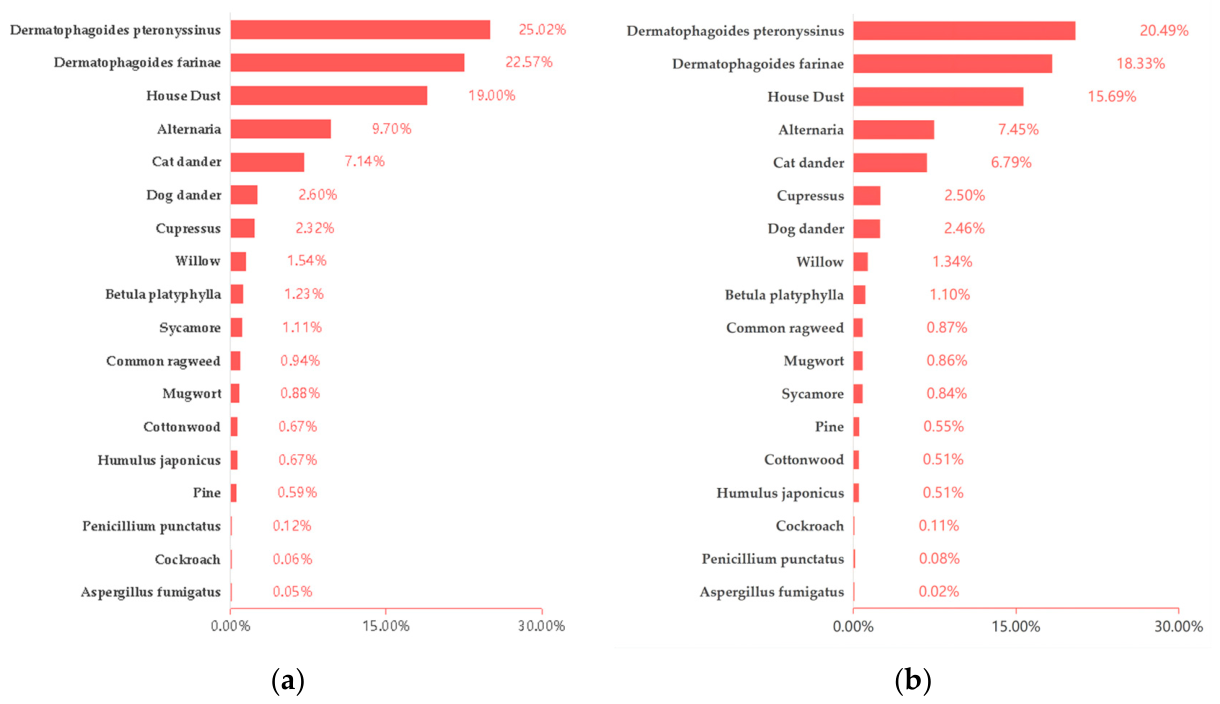
Comparing children of different genders, the overall positive rate for males was 39.76% (6964/17,513), significantly higher than the 34.90% (4555/13,052) observed in females (RR = 1.055, 95% CI: 1.037–1.074; χ
2 = 34.31,
p < 0.01). Allergen positivity rates for males and females were shown in
Figure 3a and
Figure 3b, respectively. For
Dermatophagoides farinae (RR = 1.087, 95% CI: 1.064–1.111; χ
2 = 53.92,
p < 0.01),
Dermatophagoides pteronyssinus (RR = 1.084, 95% CI: 1.062–1.106; χ
2 = 54.23,
p < 0.01),
House dust (RR = 1.080, 95% CI: 1.056–1.106; χ
2 = 39.83,
p < 0.01),
Alternaria (RR = 1.110, 95% CI: 1.077–1.144; χ
2 = 40.12,
p < 0.01), and
Sycamore (RR = 1.114, 95% CI: 1.023–1.213; χ
2 = 5.23,
p < 0.05), the positive rates were significantly higher in males than in females. However, for
Willow (RR = 1.057, 95% CI: 0.980–1.140; χ
2 = 1.93,
p = 0.16),
Common ragweed (RR = 1.033, 95% CI: 0.937–1.140; χ
2 = 0.41,
p = 0.52),
Mugwort (RR = 1.010, 95% CI: 0.912–1.120; χ
2 = 0.04,
p = 0.84),
Dog dander (RR = 1.023, 95% CI: 0.964–1.086; χ
2 = 0.55,
p = 0.46),
Cat dander (RR = 1.021, 95% CI: 0.984–1.060; χ
2 = 1.22,
p = 0.27), and
Cockroach (RR = 0.698, 95% CI: 0.432–1.129; χ
2 = 3.05,
p = 0.08),
Humulus japonicus (RR = 1.113, 95% CI: 0.998–1.241; χ
2 = 3.16,
p = 0.08),
Betula platyphylla (RR = 1.047, 95% CI: 0.962–1.140; χ
2 = 1.06,
p = 0.30),
Cottonwood (RR = 1.113, 95% CI: 0.998–1.241; χ
2 = 3.16,
p = 0.08),
Cupressus (RR = 0.968, 95% CI: 0.907–1.034; χ
2 = 0.98,
p = 0.32),
Pine (RR = 1.031, 95% CI: 0.912–1.167; χ
2 = 0.23,
p = 0.63),
Penicillium punctatus (RR = 1.182, 95% CI: 0.927–1.508; χ
2 = 1.38,
p = 0.24), and
Aspergillus fumigatus (RR = 1.309, 95% CI: 0.944–1.815; χ
2 = 1.54,
p = 0.22) showed no statistically significant differences in positive rates among children of different genders.
4. Discussion
The results of this study indicate that the overall sIgE positivity rate for allergens among 30,565 children in this research was 37.7%, with pronounced seasonal variation. The positivity rate peaked in autumn, significantly higher than in spring, summer, and winter, while no statistically significant differences were observed among spring, summer, and winter. The higher positivity rate observed in autumn is likely multifactorial. Although our study does not establish causality, we hypothesize that this may be related to regional climatic conditions favoring
house dust mite proliferation and overlapping pollen seasons (e.g.,
Mugwort,
Common ragweed) [
14]. Furthermore, the differences in healthcare-seeking behavior or physician testing thresholds across seasons cannot be ruled out as contributing factors. These interpretations remain speculative and require confirmation through environmental monitoring and longitudinal studies. The combination of these factors may have increased the likelihood of children being exposed to allergens, thereby raising the positive rate of allergen tests.
The study identified the sensitization characteristics of indoor and outdoor allergens among children: indoor allergen positivity rates were generally higher than outdoor allergens, with
Dermatophagoides pteronyssinus,
Dermatophagoides farinae, and
House dust emerging as core indoor allergens. The results were consistent with those from another hospital survey conducted in southern China. The sensitization to
house dust mites (
D. pteronyssinus and
D. farinae) was the most common [
15]. Among outdoor allergens,
Cupressus,
Betula platyphylla, and
Sycamore ranked among the top three, and the positivity rate for the highest indoor allergens (
Dermatophagoides pteronyssinus) was significantly higher than that for the highest outdoor allergens (
Cupressus). This finding aligned with previous studies on sensitization patterns across different regions of China and also showed regional specificity: house dust mites, globally recognized as the primary indoor allergen, dominate both northern and southern China [
16,
17]. In contrast, the high positivity rates for pollen allergens such as Cupressus and
Betula platyphylla are strongly correlated with the rich vegetation characteristic of western regions [
18]. These results had identified key focus areas for our future research on indoor and outdoor allergens in this region.
Allergy prevalence rates show a significant upward trend across age groups: school-age children exhibit the highest overall positive rate, followed by preschool children and infants/toddlers, with statistically significant differences between all age cohorts. Furthermore, indoor allergen positivity rates exceed outdoor allergen rates across all age groups. This pattern may be linked to the developmental maturity of children’s immune systems, their activity ranges, and the cumulative effects of allergen exposure, although these mechanisms were not directly tested in our study. Infants and toddlers have underdeveloped immune systems and primarily remain in the home environment, which could contribute to lower sensitization rates [
19]. As children progress from preschool to school age, their activities expand across multiple settings, potentially increasing exposure to diverse allergens. Concurrently, their immune systems mature, enhancing specific immune responses to allergens and progressively raising sensitization detection rates. The elevated sensitization rate among school-age children indicated this age group was a high-risk period for allergy-related diseases (such as asthma and allergic rhinitis). Clinicians should intensify screening efforts for this population to achieve early detection and intervention. Our results demonstrated the sensitization status of different age groups, providing a basis for the screening of high-risk populations with allergies.
This study found that male children had a significantly higher overall positive rate for allergen-specific IgE than females. Specifically, males had higher positive rates than females for five allergens:
Dermatophagoides farinae,
Dermatophagoides pteronyssinus,
house dust,
Alternaria, and
Sycamore. However, no statistically significant gender differences were observed for the remaining 13 allergens. From a physiological perspective, estrogen may promote the production of IgE, while androgens may have an inhibitory effect, which may increase women’s susceptibility to certain allergens [
20]. From a behavioral perspective, boys typically engage in outdoor activities more frequently and intensely than girls [
21], thereby increasing their exposure to outdoor allergens. Although the overall positive rate of sIgE in boys was significantly higher than that in girls, our data could not determine the underlying mechanism. Behavioral differences (such as outdoor activity patterns) may also play a role, but this remains speculative. Further research is needed to distinguish between biological factors and environmental factors.
Understanding children’s patterns of sensitization to specific allergens allows identification of high-risk populations and informs targeted interventions to minimize exposure. Accumulating evidence from longitudinal cohort studies suggests that rigorously applied multimodal environmental control measures are associated with delayed onset and reduced severity of allergic disease in susceptible children. Our research has revealed specific patterns of aeroallergen sensitization among children of different ages and sexes in this region. These descriptive findings may help generate hypotheses for future environmental and interventional studies, but they do not directly inform prevention or control strategies for asthma.
Our results have pointed out the direction for future clinical and public health studies on the management of childhood allergies. Given that the peak period of allergic reactions occurs in autumn, it is possible to investigate whether the occurrence of allergies can be reduced by strengthening indoor environmental control (such as dehumidification, hot water cleaning of bedding, and using dust-proof covers) before and during this season [
22,
23]. And should clinicians maintain a low threshold for sIgE testing in children presenting with cough or wheezing in autumn? Is it necessary to implement age-based preventive measures, such as infants and toddlers benefit from home-focused
dust mite reduction, while preschool and school-age children require additional attention to collective settings such as schools and kindergartens (regular cleaning, ventilation, hygiene education)? The positive rate of sIgE for boys was higher, and they may require earlier and more frequent screening [
24]. From a public health perspective, can urban greening policies reduce planting of highly allergenic trees (
Cupressus,
Betula platyphylla,
Sycamore) in areas with high pediatric allergy prevalence, thereby reducing the exposure to allergens [
25]?
When interpreting these findings, several limitations warrant careful consideration: (1) We evaluated only the 18 most common respiratory allergens, excluding other clinically relevant pediatric allergens. Furthermore, since the antigens used in the testing were crude extracts, the possibility of cross-reactivity cannot be completely ruled out. (2) The single-center, hospital-based nature of the study means our sample consists of children who sought medical care; most participants sought medical care because they were experiencing allergic symptoms, which may have led to an overestimation of allergic reactions compared to the actual prevalence in the general population of this region. The findings may not be directly generalizable to the general pediatric population of West China. (3) Although we reported the basic demographic variables of age and gender, we acknowledge that the lack of more comprehensive clinical and demographic data is a major limitation. Information such as detailed clinical history, lifestyle habits, specific geographic origin within western China, and socioeconomic status was not systematically collected. The absence of these variables limits our ability to conduct a more detailed analysis of risk factors associated with sensitization patterns and restricts a comprehensive description of the clinical background of the sensitized population. In future epidemiological studies, we will adopt a standardized, prospective data collection process to incorporate these additional parameters. (4) A positive sIgE result indicates immunological sensitization, not a definitive clinical allergy diagnosis, and this distinction is critical for proper interpretation of our findings. This fundamental premise limits the scope of application of these epidemiological data in clinical decision-making or preventive health strategies. (5) No multivariable adjustment was performed given the descriptive scope of the study, and all reported associations were crude and descriptive; they have not been adjusted for potential confounders and should not be interpreted as independent or causal associations. Some statistical comparisons involved non-independent observations (e.g., the same child could be sensitized to multiple allergens), which we now acknowledge as a limitation of allergen-level analysis. Furthermore, and last but not least, to avoid Type II errors (i.e., false-negative results), this study did not perform multiple corrections; this decision may increase the risk of false-positive results. Therefore, future studies should employ more accurate statistical methods.





 ,
,