Preeclampsia as an Independent and Major Risk Factor for Significant Postpartum Depression Symptomatology: Results from a Prospective Cohort Study

 ,
,
Abstract
1. Introduction
2. Materials and Methods
3. Results
3.1. Characteristics of the Patients
3.2. Model Building for PPD Symptomatology
4. Discussion
5. Conclusions
Author Contributions
Funding
Institutional Review Board Statement
Informed Consent Statement
Data Availability Statement
Acknowledgments
Conflicts of Interest
References
- Brown, M.A.; Magee, L.A.; Kenny, L.C.; Karumanchi, S.A.; McCarthy, F.P.; Saito, S.; Hall, D.R.; Warren, C.E.; Adoyi, G.; Ishaku, S. Hypertensive disorders of pregnancy: ISSHP classification, diagnosis, and management recommendations for international practice. Hypertension 2018, 72, 24–42. [Google Scholar] [CrossRef] [PubMed]
- Magee, L.A.; Brown, M.A.; Hall, D.R.; Gupte, S.; Hennessy, A.; Karumanchi, S.A.; Kenny, L.C.; McCarthy, F.; Myers, J.; Poon, L.C.; et al. The 2021 International Society for the Study of Hypertension in Pregnancy classification, diagnosis & management recommendations for international practice. Pregnancy Hypertens 2022, 27, 148–169. [Google Scholar] [CrossRef] [PubMed]
- Bellamy, L.; Casas, J.P.; Hingorani, A.D.; Williams, D.J. Pre-eclampsia and risk of cardiovascular disease and cancer in later life: Systematic review and meta-analysis. BMJ 2007, 335, 974. [Google Scholar] [CrossRef] [PubMed]
- Bokslag, A.; van Weissenbruch, M.; Mol, B.W.; de Groot, C.J.M. Preeclampsia; short and long-term consequences for mother and neonate. Early Hum. Dev. 2016, 102, 47–50. [Google Scholar] [CrossRef]
- Rana, S.; Lemoine, E.; Granger, J.P.; Karumanchi, S.A. Preeclampsia: Pathophysiology, challenges, and perspectives. Circ. Res. 2019, 124, 1094–1112. [Google Scholar] [CrossRef]
- O’Hara, M.W.; Wisner, K.L. Perinatal mental illness: Definition, description and aetiology. Best. Pract. Res. Clin. Obstet. Gynaecol. 2014, 28, 3–12. [Google Scholar] [CrossRef]
- Woody, C.A.; Ferrari, A.J.; Siskind, D.J.; Whiteford, H.A.; Harris, M.G. A systematic review and meta-regression of the prevalence and incidence of perinatal depression. J. Affect. Disord. 2017, 219, 86–92. [Google Scholar] [CrossRef]
- Stein, A.; Pearson, R.M.; Goodman, S.H.; Rapa, E.; Rahman, A.; McCallum, M.; Howard, L.M.; Pariante, C.M. Effects of perinatal mental disorders on the fetus and child. Lancet 2014, 384, 1800–1819. [Google Scholar] [CrossRef]
- Slomian, J.; Honvo, G.; Emonts, P.; Reginster, J.Y.; Bruyère, O. Consequences of maternal postpartum depression: A systematic review of maternal and infant outcomes. Womens Health 2019, 7, 138. [Google Scholar] [CrossRef]
- Gjerdingen, D.K.; Yawn, B.P. Postpartum depression screening: Importance, methods, barriers, and recommendations for practice. J. Am. Board. Fam. Med. 2007, 20, 280–288. [Google Scholar] [CrossRef]
- Silverman, M.E.; Reichenberg, A.; Savitz, D.A.; Cnattingius, S.; Lichtenstein, P.; Hultman, C.M.; Larsson, H.; Sandin, S. The risk factors for postpartum depression: A population-based study. Depress. Anxiety 2017, 34, 178–187. [Google Scholar] [CrossRef] [PubMed]
- Yildiz, P.D.; Ayers, S.; Phillips, L. The prevalence of posttraumatic stress disorder in pregnancy and after birth: A systematic review and meta-analysis. J. Affect. Disord. 2017, 208, 634–645. [Google Scholar] [CrossRef] [PubMed]
- Blom, E.A.; Jansen, P.W.; Verhulst, F.C.; Hofman, A.; Raat, H.; Jaddoe, V.W.; Coolman, M.; Steegers, E.A.P.; Tiemeier, H. Perinatal complications increase the risk of postpartum depression. The Generation R Study. BJOG 2010, 117, 1390–1398. [Google Scholar] [CrossRef] [PubMed]
- Sep, S.; Verbeek, J.; Koek, G.; Smits, L.; Spaanderman, M.; Peeters, L. Clinical differences between early-onset HELLP syndrome and early-onset preeclampsia during pregnancy and at least 6 months postpartum. Am. J. Obstet. Gynecol. 2010, 202, 271.e1–271.e5. [Google Scholar] [CrossRef]
- Dowlati, Y.; Herrmann, N.; Swardfager, W.; Liu, H.; Sham, L.; Reim, E.K.; Lanctôt, K.L. A meta-analysis of cytokines in major depression. Biol. Psychiatry 2010, 67, 446–457. [Google Scholar] [CrossRef]
- Miller, A.H.; Maletic, V.; Raison, C.L. Inflammation and its discontents: The role of cytokines in the pathophysiology of major depression. Biol. Psychiatry 2009, 65, 732–741. [Google Scholar] [CrossRef]
- Miller, G.E.; Chen, E.; Zhou, E.S. If it goes up, must it come down? Chronic stress and the hypothalamic–pituitary–adrenocortical axis in humans. Psychol. Bull. 2007, 133, 25–45. [Google Scholar] [CrossRef]
- Bloch, M.; Schmidt, P.J.; Danaceau, M.; Murphy, J.; Nieman, L.; Rubinow, D.R. Effects of gonadal steroids in women with a history of postpartum depression. Am. J. Psychiatry 2000, 157, 924–930. [Google Scholar] [CrossRef]
- Satapathy, P.; Gaidhane, A.M.; Vadia, N.; Menon, S.V.; Chennakesavulu, K.; Panigrahi, R.; Bushi, G.; Singh, M.; Sah, S.; Turkar, A.; et al. Exposure to violence and risk of hypertensive disorders in pregnancy: Systematic review and meta-analysis. Eur. J. Obstet. Gynecol. Reprod. Biol. X 2025, 26, 100398. [Google Scholar] [CrossRef]
- Yim, I.S.; Tanner Stapleton, L.R.; Guardino, C.M.; Hahn-Holbrook, J.; Dunkel Schetter, C. Biological and psychosocial predictors of postpartum depression: Systematic review and call for integration. Annu. Rev. Clin. Psychol. 2015, 11, 99–137. [Google Scholar] [CrossRef]
- Lahti-Pulkkinen, M.; Girchenko, P.; Tuovinen, S.; Sammallahti, S.; Reynolds, R.; Lahti, J.; Heinonen, K.; Lipsanen, J.; Hamalainen, E.; Villa, P.M.; et al. Maternal Hypertensive Pregnancy Disorders and Mental Disorders in Children. Hypertension 2020, 75, 1429–1438. [Google Scholar] [CrossRef] [PubMed]
- Ye, Y.; Chen, L.; Xu, J.; Dai, Q.; Luo, X.; Shan, N.; Qi, H. Preeclampsia and Its Complications Exacerbate Development of Postpartum Depression: A Retrospective Cohort Study. Biomed. Res. Int. 2021, 2021, 6641510. [Google Scholar] [CrossRef] [PubMed]
- Cox, J.L.; Holden, J.; Sagovsky, R. Detection of postnatal depression. Development of the 10-item Edinburgh Postnatal Depression Scale. Br. J. Psychiatry 1987, 150, 782–786. [Google Scholar] [CrossRef] [PubMed]
- Wallis, A.; Fernandez, R.; Oprescu, F.; Cherecheş, R.; Zlati, A.; Dungy, C. Validation of a Romanian scale to detect antenatal depression. Open Med. 2012, 7, 216–223. [Google Scholar] [CrossRef][Green Version]
- Levis, B.; Negeri, Z.; Sun, Y.; Benedetti, A.; Thombs, B.D. DEPRESsion Screening Data (DEPRESSD) EPDS Group. Accuracy of the Edinburgh Postnatal Depression Scale (EPDS) for screening to detect major depression among pregnant and postpartum women: Systematic review and meta-analysis of individual participant data. BMJ 2020, 371, m4022. [Google Scholar] [CrossRef]
- Mbarak, B.; Kilewo, C.; Kuganda, S.; Sunguya, B.F. Postpartum depression among women with pre-eclampsia and eclampsia in Tanzania; a call for integrative intervention. BMC Pregnancy Childbirth 2019, 19, 270. [Google Scholar] [CrossRef]
- Shang, J.; Hackett, M.L.; Harris, K.; Woodward, M.; Roberts, L.M.; Zhang, P.; Henry, A. Mental health in the two years following hypertensive and normotensive pregnancy: The Postpartum, Physiology, Psychology and Paediatric follow-up (P4) cohort study. Pregnancy Hypertens. 2024, 35, 43–50. [Google Scholar] [CrossRef]
- Soehl, J.R.; Anthony, K.; Matovina, C.N.; Ward, L.G.; Stroud, L.R.; Miller, E.S. Association between antepartum admission and postpartum depressive symptoms. Am. J. Obstet. Gynecol. MFM 2024, 6, 101518. [Google Scholar] [CrossRef]
- Burton, G.J.; Redman, C.W.; Roberts, J.M.; Moffett, A. Pre-eclampsia: Pathophysiology and clinical implications. BMJ 2019, 366, l2381. [Google Scholar] [CrossRef]
- Morris, G.; Walder, K.; Berk, M.; Carvalho, A.F.; Marx, W.; Bortolasci, C.C.; Yung, A.R.; Puri, B.K.; Maes, M. Intertwined associations between oxidative and nitrosative stress and endocannabinoid system pathways: Relevance for neuropsychiatric disorders. Prog. Neuropsychopharmacol. Biol. Psychiatry 2022, 114, 110481. [Google Scholar] [CrossRef]
- Trifu, S.; Vladuti, A.; Popescu, A. The neuroendocrinological aspects of pregnancy and postpartum depression. Acta Endocrinol. 2019, 15, 410–415. [Google Scholar] [CrossRef]
- American College of Obstetricians and Gynecologists (ACOG). Screening for Perinatal Mental Health. Practice Bulletin No. 238, 2023. Available online: https://www.acog.org/clinical/clinical-guidance/clinical-practice-guideline/articles/2023/06/screening-and-diagnosis-of-mental-health-conditions-during-pregnancy-and-postpartum (accessed on 1 November 2025).
- Hoedjes, M.; Berks, D.; Vogel, I.; Franx, A.; Bangma, M.; Darlington, A.S.; Visser, W.; Duvekot, J.J.; Habbema, J.D.; Steegers, E.A.; et al. Postpartum depression after mild and severe preeclampsia. J. Womens Health 2011, 20, 1535–1542. [Google Scholar] [CrossRef]
- Liu, C.H.; Zhang, H.Y.; Wang, F.; Mu, S.S.; Wen, F.Y. Anxiety and hypertensive disorders of pregnancy: Epidemiology, mechanisms, and management strategies. World J. Psychiatry 2025, 15, 105944. [Google Scholar] [CrossRef]
- Caropreso, L.; de Azevedo Cardoso, T.; Eltayebani, M.; Frey, B.N. Preeclampsia as a risk factor for postpartum depression and psychosis: A systematic review and meta-analysis. Arch. Womens Ment. Health 2020, 23, 493–505. [Google Scholar] [CrossRef]
- Roberts, L.; Henry, A.; Harvey, S.B.; Homer, C.S.E.; Davis, G.K. Depression, anxiety and posttraumatic stress disorder six months following preeclampsia and normotensive pregnancy: A P4 study. BMC Pregnancy Childbirth 2022, 22, 108. [Google Scholar] [CrossRef]


| Characteristics | Normotensive Group N = 147 | Preeclampsia Group N = 33 | p-Value | ||||
|---|---|---|---|---|---|---|---|
| N | % | Mean ± SD and Median (IQR) | N | % | Mean ± SD and Median (IQR) | ||
| Age | 30.66 ± 7.4 32 (24–37) | 28.39 ± 7.02 27 (22–34.5) | 0.098 b | ||||
| Highest education | 0.556 c | ||||||
| 57 | 38.8 | 15 | 45.5 | |||
| 90 | 61.2 | 18 | 54.5 | |||
| Parity | 0.848 c | ||||||
| 66 | 44.9 | 14 | 42.4 | |||
| 81 | 55.1 | 19 | 57.6 | |||
| Environment | 0.681 c | ||||||
| 100 | 68 | 24 | 72.7 | |||
| 47 | 32 | 9 | 27.3 | |||
| Marital status | 0.532 c | ||||||
| 102 | 69.4 | 25 | 75.8 | |||
| 45 | 30.6 | 8 | 24.2 | |||
| BMI prepregnancy | 27.46 ± 3.79 27.5 (25.1–29.5) | 27.89 ± 4.37 27.5 (24.7–31.1) | 0.716 a | ||||
| Systolic blood pressure (mmHg) | 123.7 ± 12.43 121 (114–128) | 138.45 ± 14.24 139 (127–148.5) | <0.0001 b | ||||
| Diastolic blood pressure (mmHg) | 77.09 ± 10.0 77 (69–83) | 85.85 ± 10.74 86 (78.5–94) | <0.0001 b | ||||
| History_preeclampsia, yes | 7 | 4.8 | 4 | 12.1 | 0.120 d | ||
| FamilyHistory_preeclampsia, yes | 29 | 19.7 | 9 | 27.3 | 0.350 c | ||
| Chronic hypertension, yes | 26 | 17.7 | 11 | 33.3 | 0.057 c | ||
| Diabetes prepregnancy, yes | 11 | 7.5 | 7 | 21.2 | 0.026 c | ||
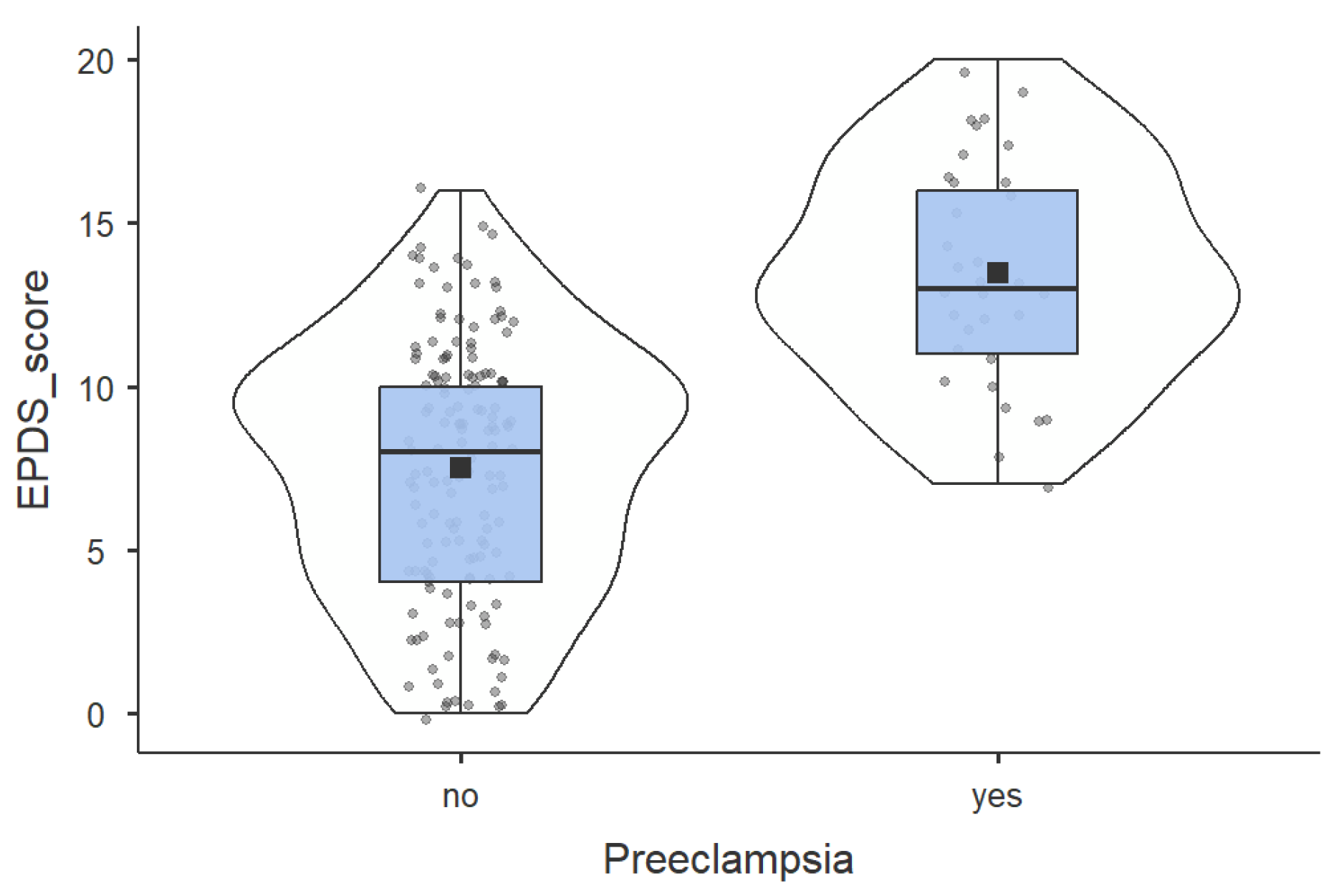
| EPDS | 7.51 ± 3.93 8 (4–10) | 13.48 ± 3.83 13 (11–16) | <0.0001 b | ||||
| PPD symptomatology | 14 | 9.5 | 20 | 60.6 | <0.0001 c | ||
| Smoking, yes | 27 | 18.4 | 2 | 6.1 | 0.115 d | ||
| Alcohol, yes | 6 | 4.1 | 0 | 0 | 0.594 d | ||
| Variable | COR (95% CI) | p-Value | AOR (95% CI) | p-Value |
|---|---|---|---|---|
| Preeclampsia (Ref: Normotensive) | 14.6 (6.01–35.6) | <0.001 | 12.74 (5.1–31.7) | 0.031 |
| Age (per 1 year increase) | 0.97 (0.92–1.02) | 0.252 | 0.99 (0.93–1.05) | 0.759 |
| Education (Ref: High School) | 1.06 (0.5–2.27) | 0.876 | ||
| Marital status (Ref: unmarried) | 1.77 (0.72–4.37) | 0.208 | ||
| Environment (Ref: rural) | 1.10 (0.49–2.5) | 0.812 | ||
| Chronic hypertension (Ref: No) | 2.64 (1.16–6.02) | 0.018 | 1.96 (0.73–5.29) | 0.182 |
| Diabetes prepregnancy (Ref: No) | 3.18 (1.13–8.95) | 0.022 | 1.8 (0.49–6.58) | 0.372 |
| History preeclampsia (Ref: No) | 1.67 (0.42–6.65) | 0.437 | ||
| FamilyHistory_preeclampsia (Ref: No) | 1.76 (0.75–4.09) | 0.188 | ||
| Parity (Ref: primiparous) | 0.98 (0.46–2.09) | 0.966 | ||
| Smoking (Ref: No) | 0.88 (0.31–2.49) | 0.805 | ||
| Alcohol (Ref: No) | 0.31 (0.02–5.7) | 0.229 |
Disclaimer/Publisher’s Note: The statements, opinions and data contained in all publications are solely those of the individual author(s) and contributor(s) and not of MDPI and/or the editor(s). MDPI and/or the editor(s) disclaim responsibility for any injury to people or property resulting from any ideas, methods, instructions or products referred to in the content. |
© 2026 by the authors. Licensee MDPI, Basel, Switzerland. This article is an open access article distributed under the terms and conditions of the Creative Commons Attribution (CC BY) license.
Share and Cite
Holbanel, L.-M.; Turcu-Stiolica, A.; Glavan, D.G.; Toma, S.C.; Cernea, N. Preeclampsia as an Independent and Major Risk Factor for Significant Postpartum Depression Symptomatology: Results from a Prospective Cohort Study. J. Clin. Med. 2026, 15, 395. https://doi.org/10.3390/jcm15010395
Holbanel L-M, Turcu-Stiolica A, Glavan DG, Toma SC, Cernea N. Preeclampsia as an Independent and Major Risk Factor for Significant Postpartum Depression Symptomatology: Results from a Prospective Cohort Study. Journal of Clinical Medicine. 2026; 15(1):395. https://doi.org/10.3390/jcm15010395
Chicago/Turabian StyleHolbanel, Larisa-Mihaela, Adina Turcu-Stiolica, Daniela Gabriela Glavan, Sebastian Constantin Toma, and Nicolae Cernea. 2026. "Preeclampsia as an Independent and Major Risk Factor for Significant Postpartum Depression Symptomatology: Results from a Prospective Cohort Study" Journal of Clinical Medicine 15, no. 1: 395. https://doi.org/10.3390/jcm15010395
APA StyleHolbanel, L.-M., Turcu-Stiolica, A., Glavan, D. G., Toma, S. C., & Cernea, N. (2026). Preeclampsia as an Independent and Major Risk Factor for Significant Postpartum Depression Symptomatology: Results from a Prospective Cohort Study. Journal of Clinical Medicine, 15(1), 395. https://doi.org/10.3390/jcm15010395