When Should Physicians Consider Referring Elderly Patients with Suspected PFO-Related Stroke for Device Closure?



Abstract
1. Introduction
2. Materials and Methods
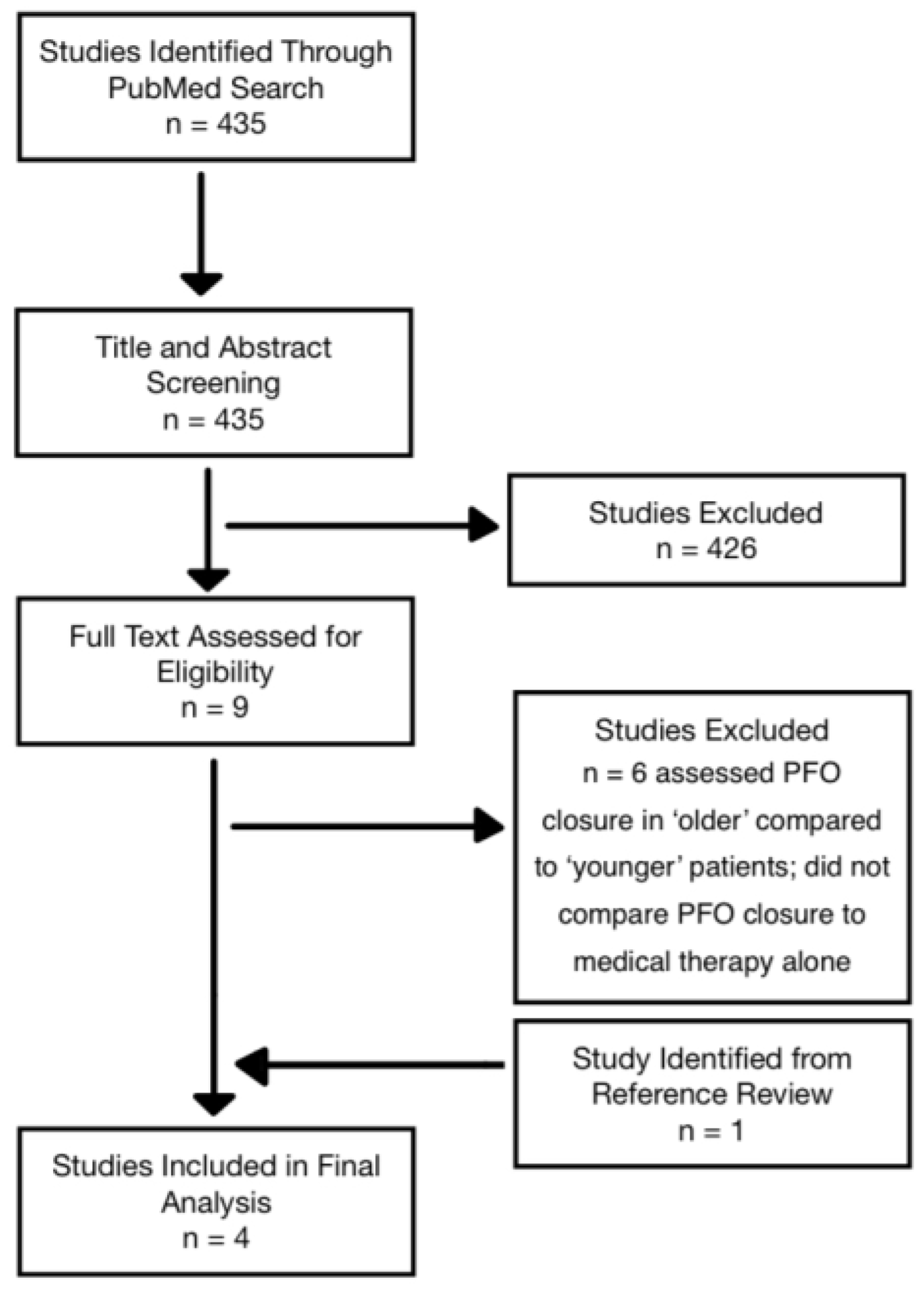
2.1. Literature Search and Paper Selection
2.2. Analysis
3. Results
3.1. Quality of Included Studies
3.2. Secondary Outcomes
4. Discussion
4.1. Summary of Evidence
4.2. Comparison with Current Guideline Recommendations
4.3. Strengths
4.4. Limitations of Trial Evidence
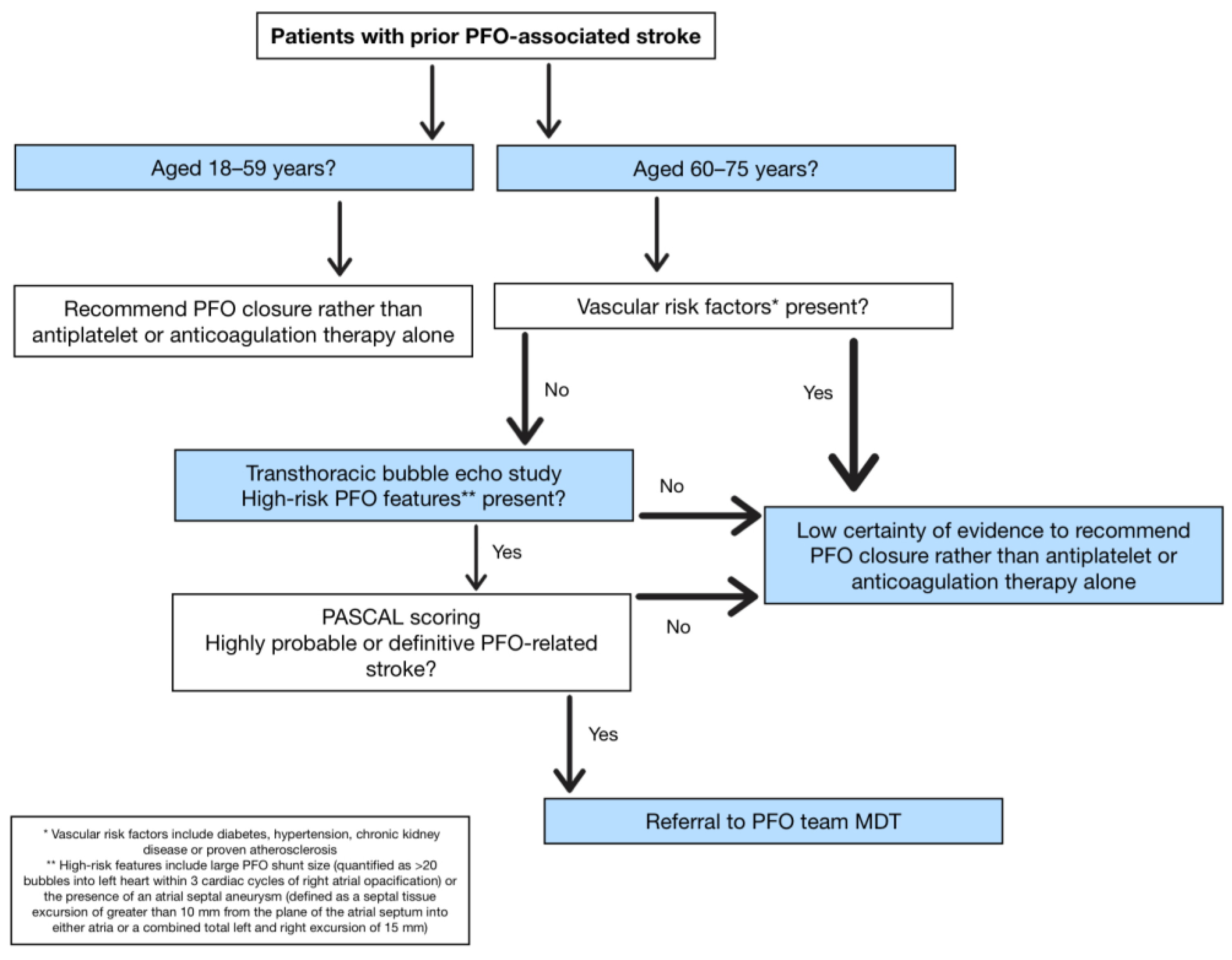
5. Recommendations and Clinical Implications
- standardised medical and closure protocols
- predefined upper age limits
- consistent ITT reporting
- stratification by high-risk PFO anatomy
- robust follow-up and adherence reporting
6. Conclusions
Author Contributions
Funding
Institutional Review Board Statement
Informed Consent Statement
Data Availability Statement
Conflicts of Interest
Abbreviations
| ESC | European Society of Cardiology |
| PFO | Patent foramen ovale |
| NHS | National Health Service |
| RoPE | Risk of paradoxical embolism |
| RCT | Randomised controlled trial |
| TIA | Transient ischaemic attack |
| AF | Atrial fibrillation |
| mRS | Modified Rankin scale |
| RR | Relative risk |
| MTA | Medical therapy alone |
| ASA | Atrial septum aneurysm |
| IS | Ischaemic stroke |
| MRI | Magnetic resonance imaging |
| MRA | Magnetic resonance angiography |
| CTA | Computed tomography angiography |
| SOP | Standard operating procedure |
| HTN | Hypertension |
| CAD | Coronary artery disease |
| MI | Myocardial infarction |
| CKD | Chronic kidney disease |
| DVT | Deep vein thrombosis |
| PE | Pulmonary embolism |
| CI | Confidence interval |
| IQR | Interquartile range |
| HR | Hazard ratio |
| PASCAL | PFO-associated stroke causal likelihood |
Appendix A

| Poli et al., 2021 [10] | Kwon et al., 2021 [9] | Chen et al., 2023 [8] | Lee et al., 2024 [7] | |
|---|---|---|---|---|
| Name | PFOG | DEFENSE | PFOT | PFOSK |
| Place | Germany | South Korea | Taiwan | South Korea |
| Type of study | Prospective case series | Randomised controlled trial | Prospective cohort | Retrospective cohort |
| Aim | Compare interventional and medical PFO management in cryptogenic IS/TIA patients, including patients > 60 years | Investigate the benefit of PFO closure in elderly adults | Investigate the efficacy and safety of PFO closure in non-elderly and elderly patients | Assess whether PFO closure is also beneficial in elderly patients |
| Recruiting period | Consecutive patients between March 2012 and September 2016 | September 2011–October 2017 | January 2013–October 2021 | Consecutive patients between January 2008 and December 2020 |
| Inclusion criteria | Acute IS or TIA and PFO diagnosis High-risk PFO 2 | IS within the previous six months and a high-risk PFO with no other identifiable causes | Cryptogenic IS or cryptogenic TIA, PFO and aged over 18 years | Aged ≥60 years with cryptogenic IS diagnosed with PFO |
| Exclusion criteria | N/A 1 | Significant (≥50%) cerebral artery steno-occlusion or lacunar infarcts | Diagnosed with pulmonary arteriovenous malformation according to the transcatheter procedure Follow-up period of <6 months | Other identifiable mechanisms of stroke Large-artery disease (≥50% steno-occlusion in the intracranial or extracranial arteries) Significant atherothrombosis (plaque thickness of ≥4 mm) in the thoracic aorta Cardiac origin of embolism—presence of cardiac condition with a high embolic risk, such as atrial fibrillation, valvular heart disease (presence of a prosthetic valve or moderate-to-severe rheumatic mitral stenosis), acute myocardial infarction with a mural thrombus, endocarditis or systolic heart failure with an ejection fraction of ≤40% Stroke caused by small vessel disease (defined as a <1.5 cm in diameter, deep vessel) infarction, without evidence of relevant large artery disease or cardiac embolism |
| PFO closure device and medical management | Amplatzer PFO occluder 25 or 35 mm Performed after median 54 days after index TIA or IS DOAC or heparin-bridging therapy DAPT aspirin and clopidogrel regime after closure SAPT after 3 or 6 months once residual shunt or thrombi excluded | Amplatzer PFO occluder Recommended DAPT (aspirin 100 mg/day with clopidogrel 75 mg/day) for at least 6 months after closure | Cardia PFO Occluder Recommended antiplatelet regimes included aspirin (100 mg once daily) or clopidogrel (75 mg once daily) alone and DAPT Oral anticoagulant (warfarin or non-vitamin K antagonist oral anticoagulant) would be administered to patients diagnosed with periprocedural AF | Amplatzer PFO Occluder, Cocoon PFO Occluder and Figulla Flex II PFO Occluder Recommended for DAPT regimen (aspirin 100 mg/day with clopidogrel 75 mg/day) for at least 6 months after closure |
| Medical therapy alone (MTA) | SAPT or oral anticoagulation preferably with DOAC | Antiplatelet or anticoagulation chosen by local investigator Antiplatelet therapy included aspirin, aspirin with clopidogrel 75 mg/day or aspirin with cilostazol 200 mg/day Warfarin was used to maintain the target international normalised ratio of 2.0 to 3.0 | Antiplatelet regimes included aspirin (100 mg once daily) or clopidogrel (75 mg once daily) alone and DAPT Oral anticoagulant (warfarin or non-vitamin K antagonist oral anticoagulant) would be administered to patients diagnosed with periprocedural AF | Antiplatelet or anticoagulation therapy closed by attending physician |
| Patient allocation | According to institution SOP—age cut off of 70 years old for interventional management of high risk PFO; individual clinical considerations | Randomised 1:1 | Eligible for PFO closure unless there was active bleeding, allergy to radiographic contrast, acute pulmonary oedema or active systemic infection The multidisciplinary stroke team would discuss the potential benefits and risks of PFO closure with the family or patient in a shared decision-making conference | Decision to choose between PFO closure or medical therapy for an individual was made through consensus, accounting for the interpretation of neurological and cardiac imaging, the possibility of other sources of cardiac embolism, the presence of comorbidities, assessment of PFO morphology and the procedural risk of PFO closure at each centre |
| Sample size (intention-to-treat) | All patient within study Closure 157 MTA 37 | ≥60 years old Closure 13 MTA 21 | ≥60 years old Closure 35 MTA 43 | ≥60 years old Closure 161 MTA 276 |
| Baseline characteristic differences between groups | When comparing high-risk PFO in >60 years closure median age 66, MTA median age 75 MTA group had higher rates of diabetes, smoking history Vascular risk factors more common in MTA group | No significant differences | Significantly greater number had small shunts in MTA group 62.8% vs. 20% in closure | MTA group had older median age 96.2 years vs. 66.2 years in closure group Greater stroke risk factors in MTA group—not individually significantly different but may be different when combined MTA group had lower frequency of large shunt size 51.8% vs. 88.2% in closure Within closure group, 19 did not have large shunts |
| Adherence to treatment | 28 from closure had MTA (17 on patient decision, 11 by physician recommendation) 17 from MTA had closure (7 on patient decision, 10 by physician recommendation) | 7 in initial parent study declined closure—no data on age subgroup analyses | N/A 1 | In MTA group, 2.2% had no antithrombotic therapy at 30 days after stroke |
| Characteristics of crossovers | Larger shunts, less frequent ASA, more commonly primary TIA rather than IS, less frequent diabetes and prior CAD/MI, more frequent HTN and hyperlipidaemia, in patients who crossed over to MTA compared to non-crossovers Younger, larger shunt, fewer ASA, more commonly primary TIA, less frequent hyperlipidaemia, diabetes and CAD or prior MI, in patients who crossed over to closure compared to non-crossovers | N/A 1 | N/A 1 | N/A 1 |
| Follow-up period | Mean 2.8 years | Median 4.4 years closure group Median 2.5 years MTA group | Mean 2.5 years | Median 3.9 years |
| Reported results | As-treated analysis 146 underwent closure 48 had MTA—19 SAPT, 23 DOAC, 6 phenprocoumon Comparing high-risk PFO in >60 years 43 closure vs. 28 MTA IS recurrence 7% closure vs. 4% MTA RR 1.95 0.21–17.85 All other events—not IS, TIA, systemic embolism or PFO related death—7% closure, 18% MTA RR 0.49 0.12–2.02 | Intention-to-treat analysis DAPT—most common in MTA SAPT most used after closure Difference in recurrent IS or TIA—2-year event rate, 24.6%; HR, 7.36; 95% CI, 0.28 to 195.81; log-rank p = 0.07 When compared for those over 70—higher difference 2-year event rate, 80%; HR, 11.64; 95% CI, 0.43 to 318.81; log-rank p = 0.03 4 events in MTA group over 60—3 IS, 1 TIA 0 in closure | Recurrent TIA, IS and all-cause mortality was 8.6% closure vs. 23.3% MTA, approaching statistical significance, HR 0.26 0.07–1.01 p = 0.051 PFO closure had a numerically higher probability of a favourable outcome at 180 days in the elderly (OR 2.09, 95% CI 0.76–6.25, p= 0.185), but not significant Among the elderly, the PFOC group had a lower median mRS at 180 days than the non-PFOC group (IQR 0–2 vs. 0–3, p = 0.002) | Most common at 30 days after stroke was antiplatelet alone for both groups Risk of IS or TIA was significantly lower in the PFO closure group HR 0.52; 95% CI 0.29–0.95; p = 0.034 Rates of IS outcomes were more prominent in patients with a high-risk PFO 3; the PFO closure group showed significantly lower risks of recurrent IS (HR: 0.36; 95% CI: 0.18–0.75; p = 0.006) and the composite outcome of IS or TIA (HR: 0.36; 95% CI: 0.19–0.69; p = 0.002) Risk of death (HR 0.19; 95% CI 0.04–0.81; p = 0.025) and the composite outcome of IS, TIA or systemic embolisation (HR 0.55; 95% CI 0.31–0.99; p = 0.046) were significantly lower in the PFO closure group Rate of AF was higher in the PFO closure group (HR 2.28; 95% CI 1.08–4.82; p = 0.030) |
| Result | Closure group had a non-significantly higher risk of recurrence in >60-year-olds | Benefit of closure is greater in those years old than in younger patients | No statistically significant difference between groups but some benefit of closure for over ≥60-year-olds Majority of MTA group had small shunt size and may not be eligible for interventional closure | Reduced risk of recurrent IS or TIA in closure group 60 years old, more significant in those with high-risk PFO Differences in baseline characteristics may confound results |
References
- Pristipino, C.; Sievert, H.; D’Ascenzo, F.; Mas, J.L.; Meier, B.; Scacciatella, P.; Hildick-Smith, D.; Gaita, F.; Toni, D.; Kyrle, P.; et al. European position paper on the management of patients with patent foramen ovale. General approach and left circulation thromboembolism. Eur. Heart J. 2019, 40, 3182–3195. [Google Scholar] [CrossRef] [PubMed]
- NHS England. Clinical Commissioning Policy: Percutaneous Patent Foramen Ovale Closure for the Prevention of Recurrent Cerebral Embolic Stroke in Adults (Around the Age 60 Years and Under); NHS England: London, UK, 2019; Available online: https://www.england.nhs.uk/commissioning/wp-content/uploads/sites/12/2019/07/Clinical-Commissioning-Policy_Percutaneous-patent-foraman-ovale-closure-for-the-prevention-of-recurrent-cerebr.pdf (accessed on 2 April 2025).
- Kavinsky, C.J.; Szerlip, M.; Goldsweig, A.M.; Amin, Z.; Boudoulas, K.D.; Carroll, J.D.; Coylewright, M.; Elmariah, S.; MacDonald, L.A.; Shah, A.P.; et al. SCAI guidelines for the management of patent foramen ovale. J. Soc. Cardiovasc. Angiogr. Interv. 2022, 1, 100039. [Google Scholar] [CrossRef] [PubMed]
- Alsheikh-Ali, A.A.; Thaler, D.E.; Kent, D.M. Patent foramen ovale in cryptogenic stroke: Incidental or pathogenic? Stroke 2009, 40, 2349–2355. [Google Scholar] [CrossRef]
- Handke, M.; Harloff, A.; Olschewski, M.; Hetzel, A.; Geibel, A. Patent foramen ovale and cryptogenic stroke in older patients. N. Engl. J. Med. 2007, 357, 2262–2268. [Google Scholar] [CrossRef] [PubMed]
- Mazzucco, S.; Li, L.; Rothwell, P.M. Prognosis of cryptogenic stroke with patent foramen ovale at older ages and implications for trials: A population-based study and systematic review. JAMA Neurol. 2020, 77, 1279–1287. [Google Scholar] [CrossRef] [PubMed]
- Lee, P.H.; Kim, J.-S.; Song, J.-K.; Kwon, S.U.; Kim, B.J.; Lee, J.S.; Sun, B.J.; Woo, J.S.; Ann, S.H.; Suh, J.W.; et al. Device closure or antithrombotic therapy after cryptogenic stroke in elderly patients with high-risk patent foramen ovale. J. Stroke 2024, 26, 242–251. [Google Scholar] [CrossRef] [PubMed]
- Chen, P.-L.; Wang, C.-S.; Huang, J.-A.; Fu, Y.-C.; Liao, N.-C.; Hsu, C.-Y.; Wu, Y.-H. Patent foramen ovale closure in non-elderly and elderly patients with cryptogenic stroke: A hospital-based cohort study. Front. Neurol. 2023, 14, 1190011. [Google Scholar] [CrossRef] [PubMed]
- Kwon, H.; Lee, P.H.; Song, J.-K.; Kwon, S.U.; Kanga, D.-W.; Kim, J.S. Patent foramen ovale closure in old stroke patients: A subgroup analysis of the DEFENSE-PFO trial. J. Stroke 2021, 23, 289–292. [Google Scholar] [CrossRef] [PubMed]
- Poli, S.; Siebert, E.; Mbroh, J.; Poli, K.; Krumbholz, M.; Mengel, A.; Greulich, S.; Härtig, F.; Müller, K.A.L.; Bocksch, W.; et al. Closure or medical therapy of patent foramen ovale in cryptogenic stroke: Prospective case series. Neurol. Res. Pract. 2021, 3, 16. [Google Scholar] [CrossRef] [PubMed]
- Patent Foramen Ovale in Patients with Cryptogenic Stroke: To Close or Not to Close. Available online: https://www.escardio.org/Councils/Council-for-Cardiology-Practice-(CCP)/Cardiopractice/Patent-foramen-ovale-in-patients-with-cryptogenic-stroke-to-close-or-not-to-close (accessed on 25 October 2025).
- Silvestry, F.E.; Cohen, M.S.; Armsby, L.B.; Burkule, N.J.; Fleishman, C.E.; Hijazi, Z.M.; Lang, R.M.; Rome, J.J.; Wang, Y. Guidelines for the Echocardiographic Assessment of Atrial Septal Defect and Patent Foramen Ovale: From the American Society of Echocardiography and Society for Cardiac Angiography and Interventions. J. Am. Soc. Echocardiogr. 2015, 28, 910–958. [Google Scholar] [CrossRef]
- Kent, D.M.; Saver, J.L.; Kasner, S.E.; Nelson, J.; Carroll, J.D.; Chatellier, G.; Derumeaux, G.; Furlan, A.J.; Herrmann, H.C.; Jüni, P.; et al. Heterogeneity of treatment effects in an analysis of pooled individual patient data from randomized trials of device closure of patent foramen ovale after stroke. JAMA 2021, 326, 2277–2286. [Google Scholar] [CrossRef] [PubMed]


| Search Terms |
|---|
| (Patent foramen ovale) OR (PFO) OR (foramen ovale) |
| AND (Closure) OR (Occlu *) OR (Surg *) |
| AND (High risk) OR (Elderly) OR (Older) OR (Old) |
| AND case reports OR clinical study OR clinical trial OR observational trial OR randomised controlled trial |
| AND English language |
| AND year 2015:2025 |
| AND humans |
| Poli et al., 2021 [10] | Kwon et al., 2021 [9] | Chen et al., 2023 [8] | Lee et al., 2024 [7] | |
|---|---|---|---|---|
| Name | PFOG | DEFENSE | PFOT | PFOSK |
| Place | Germany | South Korea | Taiwan | South Korea |
| Type of Study | Prospective case series | Randomised controlled trial | Prospective cohort | Retrospective cohort |
| Aim | Compare interventional and medical PFO-management in cryptogenic IS/TIA patients, including patients > 60 years | Investigate the benefit of PFO closure in elderly adults | Investigate the efficacy and safety of PFO closure in non-elderly and elderly patients | Assess whether PFO closure is also beneficial in elderly patients |
| Inclusion Criteria | Acute IS or TIA and PFO diagnosis High-risk PFO 1 | IS within the previous six months and a high-risk PFO with no other identifiable causes | Cryptogenic IS or cryptogenic TIA, PFO and aged over 18 years | Aged ≥ 60 years with cryptogenic IS diagnosed with PFO |
| PFO Closure Device and Medical Management | Amplatzer PFO-occluder 25 or 35 mm Performed after median 54 days after index TIA or IS DAPT aspirin and clopidogrel regime after closure SAPT after 3 or 6 months once residual shunt or thrombi excluded | Amplatzer PFO Occluder Recommended DAPT (aspirin 100 mg/day with clopidogrel 75 mg/day) for at least 6 months after closure | Cardia PFO Occluder Recommended antiplatelet regimes included aspirin (100 mg once a day) or clopidogrel (75 mg once a day) alone and DAPT. Oral anticoagulant (warfarin or non-vitamin K antagonist oral anticoagulant) would be administered to patients diagnosed with periprocedural AF | Amplatzer PFO Occluder, Cocoon PFO Occluder and Figulla Flex II PFO Occluder Recommended for DAPT regimen (aspirin 100 mg/day with clopidogrel 75 mg/day) for at least 6 months after closure |
| Medical Therapy Alone (MTA) | SAPT or oral anticoagulation preferably with DOAC | Antiplatelet or anticoagulation chosen by local investigator Antiplatelet therapy included aspirin, aspirin with clopidogrel 75 mg/day or aspirin with cilostazol 200 mg/day Warfarin was used to maintain the target international normalised ratio of 2.0 to 3.0 | As medical regime above | Antiplatelet or anticoagulation therapy closed by attending physician |
| Patient Allocation | According to institution SOP—age cut off of 70 years old for interventional management of high-risk PFO; individual clinical considerations | Randomised 1:1 | Eligible for PFO closure unless there was active bleeding, allergy to radiographic contrast, acute pulmonary oedema or active systemic infection. Multidisciplinary assessment of potential benefits and risks of PFO closure with patient-shared decision-making | Decision to choose between PFO closure or medical therapy for an individual was made through consensus, accounting for the interpretation of neurological and cardiac imaging, the possibility of other sources of cardiac embolism, the presence of comorbidities, assessment of PFO morphology and the procedural risk of PFO closure at each centre |
| Poli et al., 2021 [10] | Kwon et al., 2021 [9] | Chen et al., 2023 [8] | Lee et al., 2024 [7] | |
|---|---|---|---|---|
| Name | PFOG | DEFENSE | PFOT | PFOSK |
| Sample size (intention-to-treat) | All patient within study Closure 157 MTA 37 | ≥60 years old Closure 13 MTA 21 | ≥60 years old Closure 35 MTA 43 | ≥60 years old Closure 161 MTA 276 |
| Baseline characteristic differences between groups | When comparing high-risk PFO 2 in >60 years, closure median age 66, MTA median age 75 MTA group had higher rates of diabetes, smoking history Vascular risk factors more common in MTA group | No significant differences | Significantly greater number had small shunts in MTA group 62.8% vs. 20% in closure | MTA group had older median age 96.2 years vs. 66.2 years in closure group Greater stroke risk factors in MTA group—not individually significantly different but may be different when combined MTA group had lower frequency of large shunt size 51.8% vs. 88.2% in closure Within closure group, 19 did not have large shunts |
| Adherence to treatment | 28 from closure had MTA (17 on patient decision, 11 by physician recommendation) 17 from MTA had closure (7 on patient decision, 10 by physician recommendation) | 7 in initial parent study declined closure—no data on age subgroup analyses | N/A 1 | In MTA group, 2.2% had no antithrombotic therapy at 30 days after stroke |
| Follow-up period | Mean 2.8 years | Median 4.4 years closure group Median 2.5 years MTA group | Mean 2.5 years | Median 3.9 years |
| Reported results of ischaemic events | As-treated analysis 146 underwent closure 48 had MTA Comparing high-risk PFO in >60 years 43 closure vs. 28 MTA IS recurrence 7% closure vs. 4% MTA RR 1.95 0.21–17.85 All other events—not IS, TIA, systemic embolism or PFO related death—7% closure, 18% MTA RR 0.49 0.12–2.02 | Intention-to-treat analysis DAPT—most common in MTA SAPT most used after closure Difference in recurrent IS or TIA—2-year event rate, 24.6%; HR, 7.36; 95% CI, 0.28 to 195.81; log-rank p = 0.07 When compared for those over 70—higher difference 2-year event rate, 80%; HR, 11.64; 95% CI, 0.43 to 318.81; log-rank p = 0.03 4 events in MTA group over 60—3 IS, 1 TIA 0 in closure | Recurrent TIA, IS and all-cause mortality was 8.6% closure vs. 23.3% MTA, approaching statistical significance, HR 0.26 0.07–1.01 p = 0.051 PFO closure had a numerically higher probability of a favourable outcome at 180 days in the elderly (OR 2.09, 95% CI 0.76–6.25, p= 0.185), but not significant | Most common at 30 days after stroke was antiplatelet alone for both groups Risk of IS or TIA was significantly lower in the PFO closure group HR 0.52; 95% CI 0.29–0.95; p = 0.034 Rates of IS outcomes were more prominent in patients with a high-risk PFO 3; the PFO closure group showed significantly lower risks of recurrent IS (HR: 0.36; 95% CI: 0.18–0.75; p = 0.006) and the composite outcome of IS or TIA (HR: 0.36; 95% CI: 0.19–0.69; p = 0.002) Risk of death (HR 0.19; 95% CI 0.04–0.81; p = 0.025) and the composite outcome of IS, TIA or systemic embolisation (HR 0.55; 95% CI 0.31–0.99; p = 0.046) were significantly lower in the PFO closure group |
| RoPE Score | ||
| Age (years) | Points | |
| 18–29 | 5 | |
| 30–39 | 4 | |
| 40–49 | 3 | |
| 50–59 | 2 | |
| 60–69 | 1 | |
| ≥70 | 0 | |
| Characteristic | ||
| No history of hypertension | 1 | |
| No history of diabetes | 1 | |
| No history of stroke/transient ischaemic attack | 1 | |
| Non-smoker | 1 | |
| Cortical infarct on imaging | 1 | |
| Total score ≥ 7—stroke likely to be cause by PFO (≥72% probability) | ||
| PASCAL Score | ||
| High-risk PFO features | RoPE score > 7 | PFO-related stroke |
| Straddling thrombus | Yes | Definitive |
| No | Definitive | |
| ASA or large shunt size AND PE or DVT preceding index infarct | Yes | Highly probable |
| No | Probable | |
| ASA AND/OR large shunt | Yes | Probable |
| No | Possible | |
| Small shunt with no ASA | Yes | Probable |
| No | Unlikely | |
Disclaimer/Publisher’s Note: The statements, opinions and data contained in all publications are solely those of the individual author(s) and contributor(s) and not of MDPI and/or the editor(s). MDPI and/or the editor(s) disclaim responsibility for any injury to people or property resulting from any ideas, methods, instructions or products referred to in the content. |
© 2025 by the authors. Licensee MDPI, Basel, Switzerland. This article is an open access article distributed under the terms and conditions of the Creative Commons Attribution (CC BY) license.
Share and Cite
Varia, A.; Roberts, D. When Should Physicians Consider Referring Elderly Patients with Suspected PFO-Related Stroke for Device Closure? J. Clin. Med. 2026, 15, 294. https://doi.org/10.3390/jcm15010294
Varia A, Roberts D. When Should Physicians Consider Referring Elderly Patients with Suspected PFO-Related Stroke for Device Closure? Journal of Clinical Medicine. 2026; 15(1):294. https://doi.org/10.3390/jcm15010294
Chicago/Turabian StyleVaria, Alisha, and David Roberts. 2026. "When Should Physicians Consider Referring Elderly Patients with Suspected PFO-Related Stroke for Device Closure?" Journal of Clinical Medicine 15, no. 1: 294. https://doi.org/10.3390/jcm15010294
APA StyleVaria, A., & Roberts, D. (2026). When Should Physicians Consider Referring Elderly Patients with Suspected PFO-Related Stroke for Device Closure? Journal of Clinical Medicine, 15(1), 294. https://doi.org/10.3390/jcm15010294