Left Bundle Branch Area Pacing in Cardiac Resynchronization Therapy: How Does It Compare to Biventricular Pacing in Terms of Electrocardiographic Parameters and Procedural Outcomes?

Abstract
1. Introduction
2. Materials and Methods
2.1. Study Design and Population
2.2. Consent
2.3. Implantation Technique and Device Programming for LBBAP-CRT
2.4. Implantation Technique and Device Programming for BVP-CRT
2.5. Study Procedures and Device Follow-Up Protocol
2.6. Statistical Analysis and Risk Stratification
3. Results
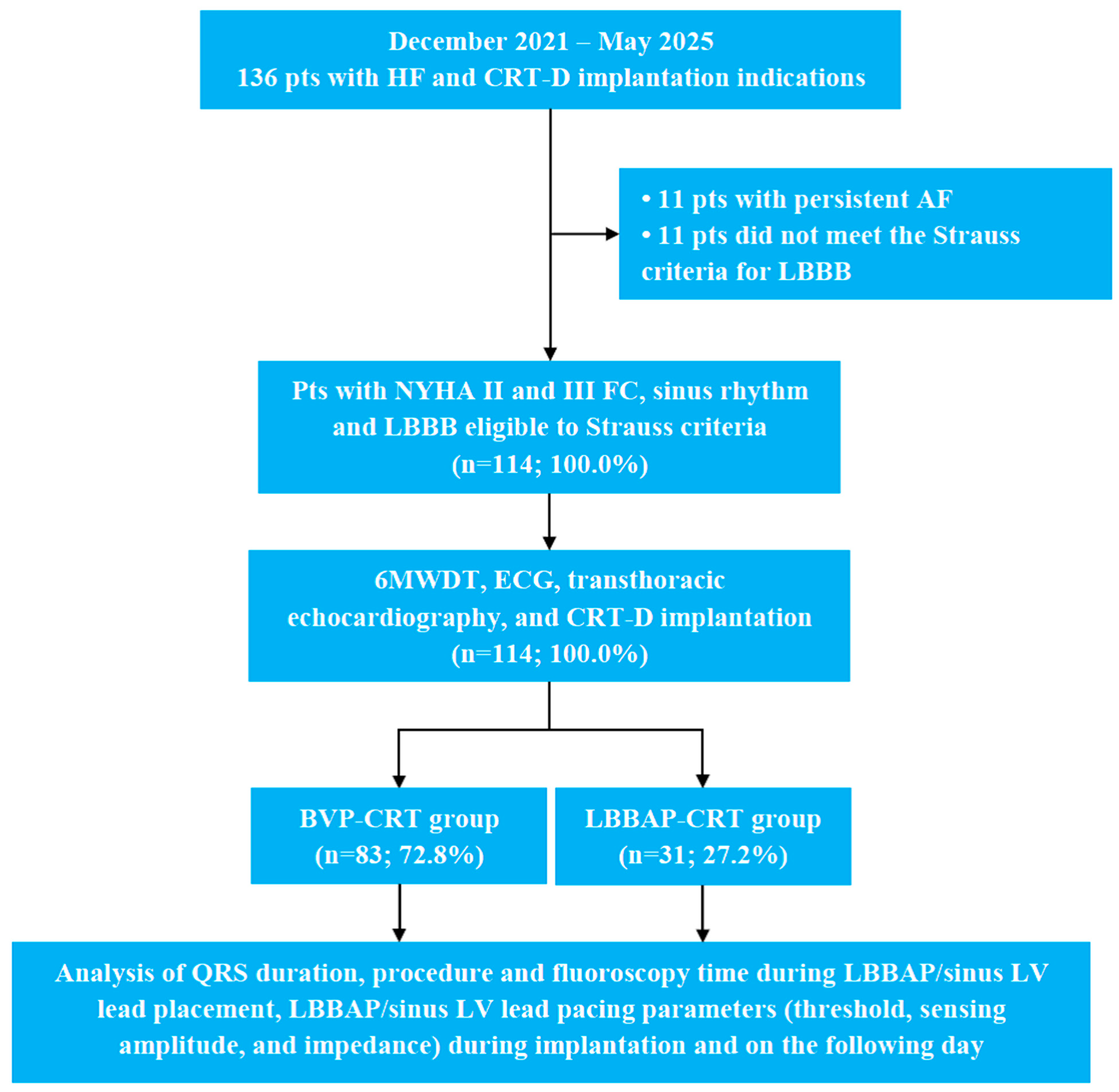
3.1. Patient Enrollment and Group Allocation
3.2. Procedural Outcomes and Early Post-Implantation Device Assessment

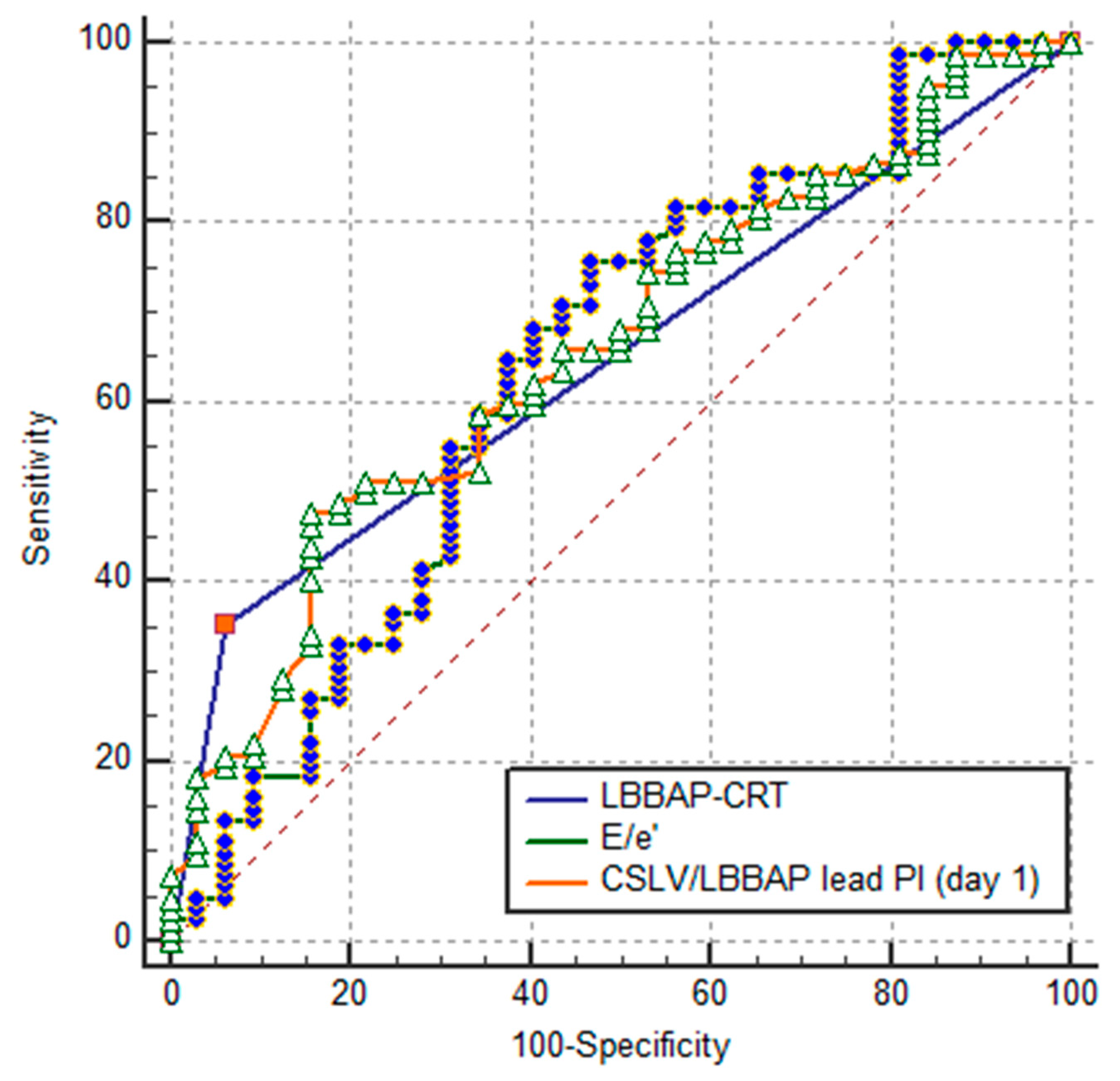
3.3. Risk Stratification by Optimal Pacing Threshold Analysis
4. Discussion
4.1. Novelty of the Study, Clinical Implications and Future Perspectives
4.2. Study Limitations
5. Conclusions
Author Contributions
Funding
Institutional Review Board Statement
Informed Consent Statement
Data Availability Statement
Conflicts of Interest
Abbreviations
| ARNI | Angiotensin Receptor Neprilysin Inhibitor |
| AUC | Area Under the ROC Curve |
| AV | Atrioventricular |
| BVP | Biventricular Pacing |
| CI | Confidence Interval |
| CRT | Cardiac Resynchronization Therapy |
| CRT-D | CRT-defibrillator |
| ECG | Electrocardiography |
| HF | Heart Failure |
| IVS | Interventricular Septum |
| LBBAP | Left Bundle Branch Area Pacing |
| LBBB | Left Bundle Branch Block |
| LV | Left Ventricular |
| LVAT | Left Ventricular Activation Time |
| LVEF | Left Ventricular Ejection Fraction |
| M | Mean |
| Me | Median |
| NYHA | New York Heart Association |
| OR | Odds ratio |
| RA | Right Atrial |
| ROC | Receiver Operating Characteristic |
| RV | Right Ventricle |
| SD | Standard Deviation |
References
- Cleland, J.G.; Daubert, J.C.; Erdmann, E.; Freemantle, N.; Gras, D.; Kappenberger, L.; Tavazzi, L. Cardiac Resynchronization-Heart Failure (CARE-HF) Study Investigators. The effect of cardiac resynchronization on morbidity and mortality in heart failure. N. Engl. J. Med. 2005, 352, 1539–1549. [Google Scholar] [CrossRef]
- Glikson, M.; Nielsen, J.C.; Kronborg, M.B.; Michowitz, Y.; Auricchio, A.; Barbash, I.M.; Barrabés, J.A.; Boriani, G.; Braunschweig, F.; Brignole, M.; et al. ESC Scientific Document Group. 2021 ESC Guidelines on cardiac pacing and cardiac resynchronization therapy. Eur. Heart J. 2021, 42, 3427–3520. [Google Scholar] [CrossRef]
- Vijayaraman, P.; Sharma, P.S.; Cano, Ó.; Ponnusamy, S.S.; Herweg, B.; Zanon, F.; Jastrzebski, M.; Zou, J.; Chelu, M.G.; Vernooy, K.; et al. Comparison of Left Bundle Branch Area Pacing and Biventricular Pacing in Candidates for Resynchronization Therapy. J. Am. Coll. Cardiol. 2023, 82, 228–241. [Google Scholar] [CrossRef]
- Hua, J.; Chen, Y.; Yu, J.; Xiong, Q.; Xia, Z.; Xia, Z.; Huang, Q.; Kong, Q.; Chen, H.; Zhang, Y.; et al. Long-term outcomes of left bundle branch area pacing versus biventricular pacing in patients with heart failure and complete left bundle branch block. Heart Vessel. 2022, 37, 1162–1174. [Google Scholar] [CrossRef]
- Jastrzębski, M.; Kiełbasa, G.; Cano, O.; Curila, K.; Heckman, L.; De Pooter, J.; Chovanec, M.; Rademakers, L.; Huybrechts, W.; Grieco, D.; et al. Left bundle branch area pacing outcomes: The multicentre European MELOS study. Eur. Heart J. 2022, 43, 4161–4173. [Google Scholar] [CrossRef]
- Huang, W.; Chen, X.; Su, L.; Wu, S.; Xia, X.; Vijayaraman, P. A beginner’s guide to permanent left bundle branch pacing. Heart Rhythm. 2019, 16, 1791–1796. [Google Scholar] [CrossRef]
- Huang, W.; Wu, S.; Vijayaraman, P.; Su, L.; Chen, X.; Cai, B.; Zou, J.; Lan, R.; Fu, G.; Mao, G.; et al. Cardiac Resynchronization Therapy in Patients With Nonischemic Cardiomyopathy Using Left Bundle Branch Pacing. JACC Clin. Electrophysiol. 2020, 6, 849–858. [Google Scholar] [CrossRef]
- Vijayaraman, P.; Ponnusamy, S.; Cano, Ó.; Sharma, P.S.; Naperkowski, A.; Subsposh, F.A.; Moskal, P.; Bednarek, A.; Dal Forno, A.R.; Young, W.; et al. Left Bundle Branch Area Pacing for Cardiac Resynchronization Therapy: Results From the International LBBAP Collaborative Study Group. JACC Clin. Electrophysiol. 2021, 7, 135–147. [Google Scholar] [CrossRef]
- Wang, Y.; Zhu, H.; Hou, X.; Wang, Z.; Zou, F.; Qian, Z.; Wei, Y.; Wang, X.; Zhang, L.; Li, X.; et al. Randomized Trial of Left Bundle Branch vs Biventricular Pacing for Cardiac Resynchronization Therapy. J. Am. Coll. Cardiol. 2022, 80, 1205–1216. [Google Scholar] [CrossRef]
- De Pooter, J.; Wauters, A.; Van Heuverswyn, F.; Le Polain de Waroux, J.B. A Guide to Left Bundle Branch Area Pacing Using Stylet-Driven Pacing Leads. Front. Cardiovasc. Med. 2022, 21, 844152. [Google Scholar] [CrossRef]
- Stiles, M.K.; Fauchier, L.; Morillo, C.A.; Wilkoff, B.L. 2019 HRS/EHRA/APHRS/LAHRS focused update to 2015 expert consensus statement on optimal implantable cardioverter-defibrillator programming and testing. J. Interv. Card. Electrophysiol. 2020, 59, 135–144. [Google Scholar] [CrossRef]
- Leventopoulos, G.; Nastouli, K.M.; Bozika, M.; Papastavrou, E.; Apostolos, A.; Koros, R.; Perperis, A.; Koniari, I.; Vlassopoulou, N.; Chronopoulos, P.; et al. Understanding LOT-CRT: Current Insights, Limitations, and Our Center’s Experience. J. Clin. Med. 2025, 14, 3025. [Google Scholar] [CrossRef]
- Mamedova, A.I.; Prihod’ko, N.A.; Lubimceva, T.A.; Kozlenok, A.V.; Lebedev, D.S. Mechanical dyssynchrony in patients with chronic heart failure and left bundle branch block. Sib. J. Clin. Exp. Med. 2024, 39, 72–79. [Google Scholar] [CrossRef]
- Wang, Y.; Gu, K.; Qian, Z.; Hou, X.; Chen, X.; Qiu, Y.; Jiang, Z.; Zhang, X.; Wu, H.; Chen, M.; et al. The efficacy of left bundle branch area pacing compared with biventricular pacing in patients with heart failure: A matched case-control study. J. Cardiovasc. Electrophysiol. 2020, 31, 2068–2077. [Google Scholar] [CrossRef]
- Lin, J.; Hu, Q.; Chen, K.; Dai, Y.; Chen, R.; Sun, Q.; Zhou, Y.; Yan, L.; Lu, W.; Li, Y.; et al. Relationship of paced left bundle branch pacing morphology with anatomic location and physiological outcomes. Heart Rhythm. 2021, 18, 946–953. [Google Scholar] [CrossRef]
- Upadhyay, G.A.; Vijayaraman, P.; Nayak, H.M.; Verma, N.; Dandamudi, G.; Sharma, P.S.; Saleem, M.; Mandrola, J.; Genovese, D.; Oren, J.W.; et al. On-treatment comparison between corrective His bundle pacing and biventricular pacing for cardiac resynchronization: A secondary analysis of the His-SYNC Pilot Trial. Heart Rhythm. 2019, 16, 1797–1807. [Google Scholar] [CrossRef]
- Singh, R.; Devabhaktuni, S.; Ezzeddine, F.; Simon, J.; Khaira, K.; Dandamudi, G. His-bundle pacing: A novel treatment for left bundle branch block-mediated cardiomyopathy. J. Cardiovasc. Electrophysiol. 2020, 31, 2730–2736. [Google Scholar] [CrossRef]
- Zanon, F.; Baracca, E.; Aggio, S.; Pastore, G.; Boaretto, G.; Cardano, P.; Marotta, T.; Rigatelli, G.; Galasso, M.; Carraro, M.; et al. A feasible approach for direct his-bundle pacing using a new steerable catheter to facilitate precise lead placement. J. Cardiovasc. Electrophysiol. 2006, 17, 29–33. [Google Scholar] [CrossRef]
- Akhtar, Z.; Sohal, M.; Kontogiannis, C.; Harding, I.; Zuberi, Z.; Bajpai, A.; Norman, M.; Pearse, S.; Beeton, I.; Gallagher, M.M. Anatomical variations in coronary venous drainage: Challenges and solutions in delivering cardiac resynchronization therapy. J. Cardiovasc. Electrophysiol. 2022, 33, 1262–1271. [Google Scholar] [CrossRef]
- Vlachakis, P.K.; Theofilis, P.; Apostolos, A.; Kordalis, A.; Sideris, S.; Leventopoulos, G.; Mountantonakis, S.E.; Kollias, G.; Leontsinis, I.; Drakopoulou, M.; et al. Conduction system pacing in heart failure: Time for a paradigm shift? Heart Fail. Rev. 2025, 30, 365–380. [Google Scholar] [CrossRef]
- Matteucci, A.; Pignalberi, C.; Pandozi, C.; Magris, B.; Meo, A.; Russo, M.; Galeazzi, M.; Schiaffini, G.; Aquilani, S.; Di Fusco, S.A.; et al. Prevention and Risk Assessment of Cardiac Device Infections in Clinical Practice. J. Clin. Med. 2024, 13, 2707. [Google Scholar] [CrossRef]
- Matteucci, A.; Bonanni, M.; Massaro, G.; Chiricolo, G.; Stifano, G.; Forleo, G.B.; Biondi-Zoccai, G.; Sangiorgi, G. Treatment with gentamicin-impregnated collagen sponges in reducing infection of implantable cardiac devices: 10-year analysis with propensity score matching. Rev. Port. Cardiol. 2023, 42, 711–717. [Google Scholar] [CrossRef]
- Ponnusamy, S.S.; Muthu, G.; Kumar, M.; Bopanna, D.; Anand, V.; Kumar, S. Mid-term feasibility, safety and outcomes of left bundle branch pacing-single center experience. J. Interv. Card. Electrophysiol. 2021, 60, 337–346. [Google Scholar] [CrossRef]
- Vijayaraman, P.; Longacre, C.; Kron, J.; Subzposh, F.; Zimmerman, P.; Butler, K.; Crossley, G.H.; Ellenbogen, K.A. Conduction system pacing associated with reduced heart failure hospitalizations and all-cause mortality compared with traditional right ventricular pacing in the Medicare population. Heart Rhythm. 2025, 22, 735–743. [Google Scholar] [CrossRef]
- Ding, J.W.; Jiang, Y.A.; Wang, Q.T.; Chu, G.; Yao, J.H.; Dai, G.Q.; Chen, J.; Ding, H.S. Left bundle branch area pacing prevails over His bundle pacing for heart failure patients undergoing atrioventricular node ablation in permanent atrial fibrillation: A network meta-analysis. J. Interv. Card. Electrophysiol. 2025, 68, 1363–1372. [Google Scholar] [CrossRef]



| Characteristics | Overall Population (n = 114) | BVP-CRT Group (n = 83) | LBBAP-CRT Group (n = 31) | p2–3 |
|---|---|---|---|---|
| 1 | 2 | 3 | ||
| Age, year, M ± SD | 61.4 ± 11.0 | 59.8 ± 11.2 | 60.7 ± 8.4 | 0.386 |
| Male gender, n (%) | 83 (72.8) | 55 (66.3) | 28 (90.3) | 0.066 |
| Ischemic heart failure, n (%) | 36 (31.6) | 25 (30.1) | 11 (35.5) | 0.585 |
| Non-ischemic heart failure, n (%) | 56 (49.1) | 45 (54.2) | 11 (35.5) | 0.076 |
| Mixed etiology of heart failure, n (%) | 22 (19.3) | 13 (15.7) | 9 (29.0) | 0.109 |
| Coronary artery stenting in anamnesis, n (%) | 32 (28.1) | 22 (26.5) | 10 (32.2) | 0.545 |
| 6 min walk distance test, m, M ± SD | 296.7 ± 66.5 | 295.5 ± 64.5 | 299.9 ± 72.3 | 0.709 |
| Systolic blood pressure, mmHg, M ± SD | 120.0 ± 9.0 | 120.1 ± 6.0 | 119.6 ± 14.4 | 0.944 |
| Diastolic blood pressure, mmHg, M ± SD | 74.7 ± 6.2 | 74.8 ± 4.7 | 74.4 ± 9.3 | 0.816 |
| Body mass index, kg/m2, M ± SD | 28.3 ± 5.2 | 28.4 ± 5.2 | 27.8 ± 5.2 | 0.424 |
| Estimated GFR, mL/min/1.73 m2, M ± SD | 72.5 ± 19.2 | 72.0 ± 18.4 | 74.0 ± 21.5 | 0.539 |
| New York Heart Association functional class of heart failure: | ||||
| II, n (%) | 56 (49.1) | 40 (48.2) | 16 (51.6) | 0.746 |
| III, n (%) | 58 (50.9) | 43 (51.8) | 15 (48.4) | 0.746 |
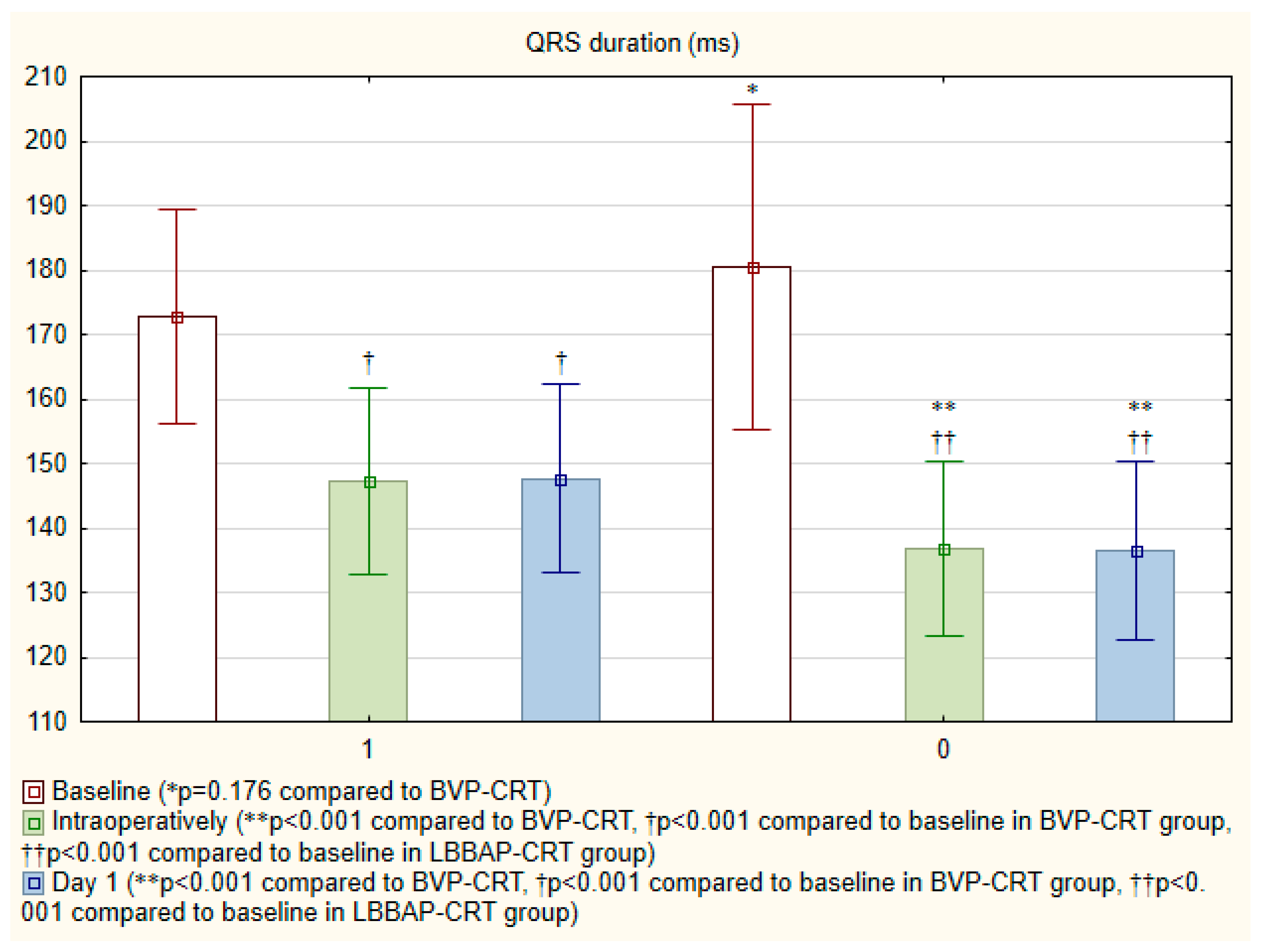
| QRS duration, ms, M ± SD | 174.8 ± 19.5 | 172.7 ± 16.6 | 180.5 ± 25.4 | 0.176 |
| LVESV, ml, M ± SD | 170.3 ± 54.8 | 174.4 ± 52.5 | 159.2 ± 59.8 | 0.111 |
| Left ventricular ejection fraction, %, M ± SD | 28.7 ± 4.9 | 28.2 ± 5.0 | 30.3 ± 4.5 | 0.042 |
| E/e′, Me [Q1; Q3] | 11.9 [8.8; 17.6] | 12.0 [8.2; 17.6] | 11.6 [9.1; 18.8] | 0.923 |
| Pre-implantation arrhythmias: | ||||
| Paroxysmal atrial fibrillation, n (%) | 34 (29.8) | 27 (32.5) | 7 (22.6) | 0.304 |
| Sustained ventricular tachycardia, n (%) | 9 (7.9) | 5 (6.0) | 4 (12.9) | 0.227 |
| Ventricular fibrillation, n (%) | 4 (3.5) | 3 (3.6) | 1 (3.2) | 0.920 |
| Paroxysmal SVT, n (%) | 3 (2.6) | 2 (2.4) | 1 (3.2) | 0.809 |
| Comorbidities: | ||||
| Diabetes mellitus, n (%) | 24 (21.1) | 15 (18.1) | 9 (29.0) | 0.203 |
| Dyslipidemia, n (%) | 59 (51.8) | 49 (59.0) | 10 (32.2) | 0.011 |
| Stroke, n (%) | 5 (4.4) | 4 (4.8) | 1 (3.2) | 0.713 |
| Smoking, n (%) | 39 (34.2) | 25 (30.1) | 14 (45.2) | 0.133 |
| Therapy: | ||||
| Beta-blockers, n (%) | 108 (94.7) | 80 (96.4) | 28 (90.3) | 0.199 |
| Loop diuretics, n (%) | 69 (60.5) | 50 (60.2) | 19 (61.3) | 0.922 |
| Mineralocorticoid receptor antagonists, n (%) | 108 (94.7) | 78 (94.0) | 30 (96.8) | 0.559 |
| ACEIs, n (%) | 42 (36.8) | 31 (37.3) | 11 (35.5) | 0.855 |
| Antiplatelet agents, n (%) | 65 (57.0) | 47 (56.6) | 18 (58.1) | 0.891 |
| Lipid-lowering treatment, n (%) | 93 (81.6) | 70 (84.3) | 23 (74.2) | 0.216 |
| ARNI, n (%) | 54 (47.4) | 36 (43.4) | 18 (58.1) | 0.164 |
| Angiotensin II receptor blockers, n (%) | 15 (13.2) | 15 (18.1) | 0 (0.0) | 0.011 |
| Amiodarone, n (%) | 51 (44.7) | 39 (47.0) | 12 (38.7) | 0.431 |
| Anticoagulants, n (%) | 44 (38.6) | 33 (39.7) | 11 (35.5) | 0.678 |
| Ivabradine, n (%) | 4 (3.5) | 4 (4.8) | 0 (0.0) | 0.215 |
| SGLT2Is, n (%) | 102 (89.5) | 72 (86.7) | 30 (96.8) | 0.122 |
| Data | Overall Cohort (n = 114) | BVP-CRT Group (n = 83) | LBBAP-CRT Group (n = 31) | p2–3 |
|---|---|---|---|---|
| 1 | 2 | 3 | ||
| CSLV/LBBAP lead implantation duration, min, Me [Q1; Q3] | 23.0 [19.0; 26.4] | 23.8 [20.0; 27.0] | 22.0 [16.0; 25.8] | 0.167 |
| Fluoroscopy time for CSLV/LBBAP lead implantation, min, Me [Q1; Q3] | 5.0 [3.3; 6.7] | 5.0 [3.3; 6.6] | 5.0 [4.0; 8.7] | 0.642 |
| Pacing threshold of CSLV/LBBAP lead: | ||||
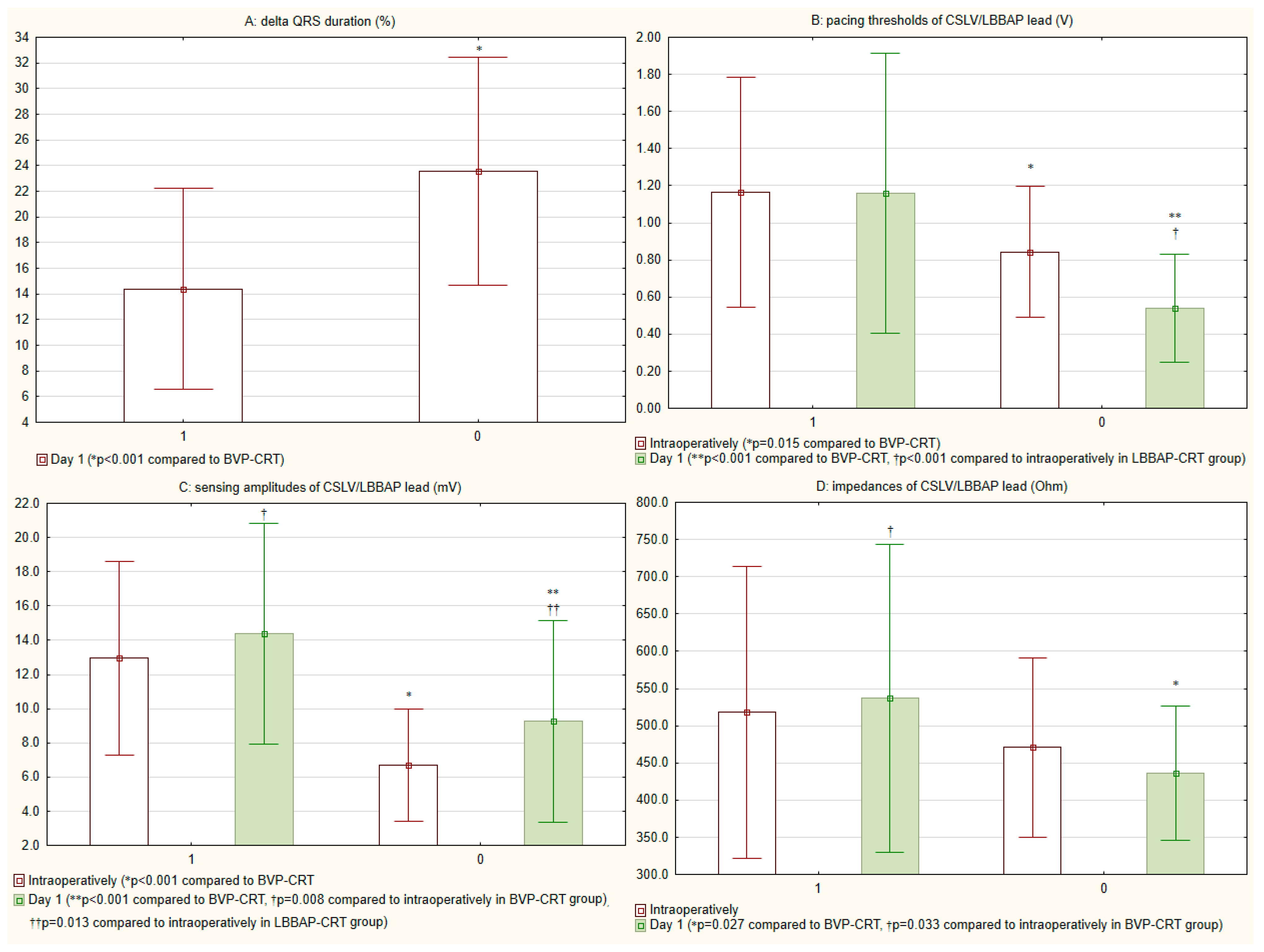
| Implant, V, M ± SD | 1.08 ± 0.58 | 1.16 ± 0.62 | 0.84 ± 0.35 | 0.015 |
| First day after implantation, V, M ± SD | 0.99 ± 0.72 | 1.16 ± 0.76 | 0.54 ± 0.30 | <0.001 |
| Sensing amplitude of CSLV/LBBAP lead: | ||||
| Implant, mV, M ± SD | 11.2 ± 5.8 | 12.9 ± 5.6 | 6.7 ± 3.3 | <0.001 |
| First day after implantation, mV, M ± SD | 13.0 ± 6.7 | 14.4 ± 6.4 | 9.2 ± 5.9 | <0.001 |
| Impedance of CSLV/LBBAP lead: | ||||
| Implant, Ohm, M ± SD | 505.2 ± 179.7 | 518.1 ± 196.4 | 470.6 ± 120.5 | 0.491 |
| First day after implantation, Ohm, M ± SD | 509.6 ± 187.8 | 537.1 ± 207.0 | 436.2 ± 90.3 | 0.027 |
| LVAT, ms, M ± SD | - | - | 68.9 ± 12.6 | - |
| Paced QRS duration: | ||||
| Implant, ms, M ± SD | 144.4 ± 15.0 | 147.2 ± 14.6 | 136.7 ± 13.5 | <0.001 |
| First day after implantation, ms, M ± SD | 144.6 ± 15.2 | 147.6 ± 14.6 | 136.5 ± 13.7 | <0.001 |
| Delta QRS duration: | ||||
| Implant, %, M ± SD | 16.9 ± 9.1 | 14.4 ± 7.8 | 23.5 ± 8.9 | <0.001 |
| First day after implantation, %, M ± SD | 16.9 ± 9.1 | 14.4 ± 7.8 | 23.6 ± 8.9 | <0.001 |
| Procedural complications: | ||||
| Total, n (%) | 15 (13.2) | 15 (18.1) | 0 (0.0) | 0.011 |
| Coronary vein dissection, n (%) | 2 (1.8) | 2 (2.4) | 0 (0.0) | 0.385 |
| Phrenic nerve stimulation, n (%) | 12 (10.5) | 12 (14.4) | 0 (0.0) | 0.026 |
| CSLV/LBBAP lead dislocation, n (%) | 1 (0.9) | 1 (2.4) | 0 (0.0) | 0.541 |
Disclaimer/Publisher’s Note: The statements, opinions and data contained in all publications are solely those of the individual author(s) and contributor(s) and not of MDPI and/or the editor(s). MDPI and/or the editor(s) disclaim responsibility for any injury to people or property resulting from any ideas, methods, instructions or products referred to in the content. |
© 2025 by the authors. Licensee MDPI, Basel, Switzerland. This article is an open access article distributed under the terms and conditions of the Creative Commons Attribution (CC BY) license.
Share and Cite
Atabekov, T.; Krivolapov, S.; Batalov, R.; Popov, S. Left Bundle Branch Area Pacing in Cardiac Resynchronization Therapy: How Does It Compare to Biventricular Pacing in Terms of Electrocardiographic Parameters and Procedural Outcomes? J. Clin. Med. 2026, 15, 200. https://doi.org/10.3390/jcm15010200
Atabekov T, Krivolapov S, Batalov R, Popov S. Left Bundle Branch Area Pacing in Cardiac Resynchronization Therapy: How Does It Compare to Biventricular Pacing in Terms of Electrocardiographic Parameters and Procedural Outcomes? Journal of Clinical Medicine. 2026; 15(1):200. https://doi.org/10.3390/jcm15010200
Chicago/Turabian StyleAtabekov, Tariel, Sergey Krivolapov, Roman Batalov, and Sergey Popov. 2026. "Left Bundle Branch Area Pacing in Cardiac Resynchronization Therapy: How Does It Compare to Biventricular Pacing in Terms of Electrocardiographic Parameters and Procedural Outcomes?" Journal of Clinical Medicine 15, no. 1: 200. https://doi.org/10.3390/jcm15010200
APA StyleAtabekov, T., Krivolapov, S., Batalov, R., & Popov, S. (2026). Left Bundle Branch Area Pacing in Cardiac Resynchronization Therapy: How Does It Compare to Biventricular Pacing in Terms of Electrocardiographic Parameters and Procedural Outcomes? Journal of Clinical Medicine, 15(1), 200. https://doi.org/10.3390/jcm15010200