Toxic Epidermal Necrolysis and Steven–Johnson Syndrome During the Postpartum Period: A Literature Review with a Rare Case Presentation

 , , , and
Abstract
1. Introduction
2. Case Report
3. Review
TEN/SJS During Pregnancy
4. Discussion
5. Conclusions
Author Contributions
Funding
Institutional Review Board Statement
Informed Consent Statement
Data Availability Statement
Conflicts of Interest
Abbreviations
| AGEP | Acute Generalized Exanthematous Pustulosis |
| CRP | C-Reactive Protein |
| CS | Cesarean Section |
| CTG | Cardiotocography |
| EM | Erythema Multiforme |
| GBS | Group-B Streptococcus. |
| HIV | Human Immunodeficiency Virus |
| IVIG | Intravenous Immunoglobulins |
| MHC | Major Histocompatibility Complex |
| MIRM | Mycoplasma-Induced Rash and Mucositis |
| NSAIDs | Non-Steroidal Anti-Inflammatory Drugs |
| SJS | Stevens–Johnson Syndrome |
| SSSS | Staphylococcal Scalded Skin Syndrome |
| BSA | Total Body Surface Area |
| TEN | Toxic Epidermal Necrolysis |
References
- Yao, L.M.; Su, X.; Liu, L.L.; Qi, Y.N.; Wei, B.; Ma, R.; Du, X.Q. Recent developments in the research of Stevens-Johnson syndrome and toxic epidermal necrolysis: Pathogenesis, diagnosis and treatment. Eur. J. Med. Res. 2025, 30, 453. [Google Scholar] [CrossRef]
- Watanabe, Y.; Hama, N. Recent advances in the diagnosis and treatment of Stevens-Johnson syndrome/toxic epidermal necrolysis. Allergol. Int. 2025, 74, 345–355. [Google Scholar] [CrossRef] [PubMed]
- Saito, Y.; Abe, R. New insights into the diagnosis and management of Stevens-Johnson syndrome and toxic epidermal necrolysis. Curr. Opin. Allergy Clin. Immunol. 2023, 23, 271–278. [Google Scholar] [CrossRef] [PubMed]
- Westergren, A.; Edin, K.; Lindkvist, M.; Christianson, M. Exploring the medicalisation of childbirth through women’s preferences for and use of pain relief. Women Birth 2021, 34, e118–e127. [Google Scholar] [CrossRef]
- Kırlı, G.; Kaya, Ş.D. Medicalization of female life stages: A qualitative research. BMC Health Serv. Res. 2025, 25, 322. [Google Scholar] [CrossRef]
- Prins, C.; Kerdel, F.A.; Padilla, R.S.; Hunziker, T.; Chimenti, S.; Viard, I.; Mauri, D.N.; Flynn, K.; Trent, J.; Margolis, D.J.; et al. Treatment of toxic epidermal necrolysis with high-dose intravenous immunoglobulins: Multicenter retrospective analysis of 48 consecutive cases. Arch. Dermatol. 2003, 139, 26–32. [Google Scholar] [CrossRef]
- Mahto, B.; Thapa, M.; Padhye, S. Toxic Epidermal Necrolysis A Diagnostic Dilemma in Puerperium: A Case Report. JNMA J. Nepal Med. Assoc. 2019, 57, 382–384. [Google Scholar] [CrossRef]
- Simetka, O.; Michalec, I.; Crkvenjas, Z.N.; Klosova, H.; Janackova, L.; Klat, J. Toxic epidermal necrolysis complicating antibiotic treatment of puerperal endometritis: A case report. Ginekol. Pol. 2015, 86, 315–317. [Google Scholar] [CrossRef] [PubMed]
- Kechichian, E.; Dupin, N.; Wetter, D.A.; Ortonne, N.; Agbo-Godeau, S.; Chosidow, O. Erythema multiforme. EClinicalMedicine 2024, 77, 102909. [Google Scholar] [CrossRef]
- Czarnecka-Operacz, M.; Jenerowicz, D.; Szulczyńska-Gabor, J.; Teresiak-Mikołajczak, E.; Szyfter-Harris, J.; Bowszyc-Dmochowska, M. Vesicular Contact Reaction May Progress into Erythema Multiforme. Acta Dermatovenerol. Croat. 2016, 24, 307–309. [Google Scholar]
- Knight, L.; Todd, G.; Muloiwa, R.; Matjila, M.; Lehloenya, R.J. Stevens Johnson Syndrome and Toxic Epidermal Necrolysis: Maternal and Fetal Outcomes in Twenty-Two Consecutive Pregnant HIV Infected Women. PLoS ONE 2015, 10, e0135501. [Google Scholar] [CrossRef] [PubMed]
- Dube, N.; Adewusi, E.; Summers, R. Risk of nevirapine-associated Stevens-Johnson syndrome among HIV-infected pregnant women: The Medunsa National Pharmacovigilance Centre, 2007–2012. S. Afr. Med. J. 2013, 103, 322–325. [Google Scholar] [CrossRef]
- Sharma, A.N.; Hedayati, B.; Mesinkovska, N.A.; Worswick, S. Stevens-Johnson syndrome and toxic epidermal necrolysis in pregnant patients: A systematic review. Int. J. Women’s Dermatol. 2020, 6, 239–247. [Google Scholar] [CrossRef] [PubMed]
- Menacker, F.; Declercq, E.; Macdorman, M.F. Cesarean Delivery: Background, Trends, and Epidemiology. Semin. Perinatol. 2006, 30, 235–241. [Google Scholar] [CrossRef]
- Antoine, C.; Young, B.K. Cesarean section one hundred years 1920-2020: The Good, the Bad and the Ugly. J. Perinat. Med. 2020, 49, 5–16. [Google Scholar] [CrossRef] [PubMed]
- Lamont, R.F.; Sobel, J.D.; Kusanovic, J.P.; Vaisbuch, E.; Mazaki-Tovi, S.; Kim, S.K.; Uldbjerg, N.; Romero, R. Current debate on the use of antibiotic prophylaxis for cesarean section: Antibiotic prophylaxis for cesarean section. BJOG Int. J. Obstet. Gynaecol. 2011, 118, 193–201. [Google Scholar] [CrossRef]
- Yang, X.J.; Sun, S.S. Comparison of maternal and fetal complications in elective and emergency cesarean section: A systematic review and meta-analysis. Arch. Gynecol. Obstet. 2017, 296, 503–512. [Google Scholar] [CrossRef] [PubMed]
- Qian, Y.; Qian, G.; Ni, H.; Zhu, D.; Gu, W.; Cai, X. Effect of timing of antibiotic use on premature rupture of membranes and its impact on reproductive tract infection and fetal membrane cell scorching indicators. Afr. J. Reprod. Health 2024, 28, 139–147. [Google Scholar] [CrossRef] [PubMed]
- Pătrașcu, A.I.; Vâță, D.; Temelie-Olinici, D.; Mocanu, M.; Guguluș, D.L.; Marinescu, M.; Stafie, L.; Tarcău, B.-M.; Creţu, I.; Popescu, I.-A.; et al. Skin Lesions with Loss of Tissue and Cutaneous-Onset Sepsis: The Skin Infection-Sepsis Relationship. Diagnostics 2024, 14, 659. [Google Scholar] [CrossRef]
- Pulido-Pérez, A.; Bergón-Sendín, M.; Suárez-Fernández, R.; Muñoz-Martín, P.; Bouza, E. Skin and sepsis: Contribution of dermatology to a rapid diagnosis. Infection 2021, 49, 617–629. [Google Scholar] [CrossRef]
- Tsai, T.Y.; Huang, I.H.; Chao, Y.C.; Li, H.; Hsieh, T.S.; Wang, H.H.; Huang, Y.T.; Chen, C.Y.; Cheng, Y.C.; Kuo, P.H.; et al. Treating toxic epidermal necrolysis with systemic immunomodulating therapies: A systematic review and network meta-analysis. J. Am. Acad. Dermatol. 2021, 84, 390–397. [Google Scholar] [CrossRef] [PubMed]
- Hsieh, M.H.; Watanabe, T.; Aihara, M. Recent Dermatological Treatments for Stevens-Johnson Syndrome and Toxic Epidermal Necrolysis in Japan. Front. Med. 2021, 8, 636924. [Google Scholar] [CrossRef] [PubMed] [PubMed Central]
- Liao, S.Q.; Yan, Z.R.; Lin, L.W.; Deng, M.; Xiao, G.J.; Gao, P.Y. Plasmapheresis for refractory toxic epidermal necrolysis unresponsive to conventional therapy: A case report and literature review. Front. Immunol. 2025, 16, 1579349. [Google Scholar] [CrossRef]
- Han, F.; Zhang, J.; Guo, Q.; Feng, Y.; Gao, Y.; Guo, L.; Hou, Y.; An, J.; Wang, X.; Yan, B.; et al. Successful treatment of toxic epidermal necrolysis using plasmapheresis: A prospective observational study. J. Crit. Care 2017, 42, 65–68. [Google Scholar] [CrossRef] [PubMed]
- Martinez Villarreal, J.D.; Cardenas-de la Garza, J.A.; Ionescu, M.A.; Tatu, A.L.; Busila, C.; Mokni, M.; Saenz Medina, L.M.; Delgado Jasso, S.M.; Poletti, E.D.; Tomecki, K.J. Stevens-Johnson Syndrome and Toxic Epidermal Necrolysis: A Review of Current Management and Innovative Therapies. Int. J. Dermatol. 2025, 64, 1164–1172. [Google Scholar] [CrossRef] [PubMed]
- Surowiecka, A.; Barańska-Rybak, W.; Strużyna, J. Multidisciplinary Treatment in Toxic Epidermal Necrolysis. Int. J. Environ. Res. Public Health 2023, 20, 2217. [Google Scholar] [CrossRef]
- Schiller, C.E.; Meltzer-Brody, S.; Rubinow, D.R. The role of reproductive hormones in postpartum depression. CNS Spectr. 2015, 20, 48–59. [Google Scholar] [CrossRef] [PubMed]
- Wu, X.; Jin, R. Effects of postpartum hormonal changes on the immune system and their role in recovery. Acta Biochim. Pol. 2025, 72, 14241. [Google Scholar] [CrossRef]
- Song, I.H.; Kim, Y.A.; Heo, S.H.; Bang, W.S.; Park, H.S.; Choi, Y.H.; Lee, H.; Seo, J.-H.; Cho, Y.; Jung, S.W.; et al. The Association of Estrogen Receptor Activity, Interferon Signaling, and MHC Class I Expression in Breast Cancer. Cancer Res. Treat. 2022, 54, 1111–1120. [Google Scholar] [CrossRef]
- Tinoco, J.C.; Saunders, H.I.; Werner, L.R.; Sun, X.; Chowanec, E.I.; Heard, A.; Chalise, P.; Vahrenkamp, J.M.; Wilson, A.E.; Liu, C.-X.; et al. Progesterone receptor-dependent downregulation of MHC class I promotes tumor immune evasion and growth in breast cancer. J. Immunother. Cancer 2025, 13, e010179. [Google Scholar] [CrossRef]
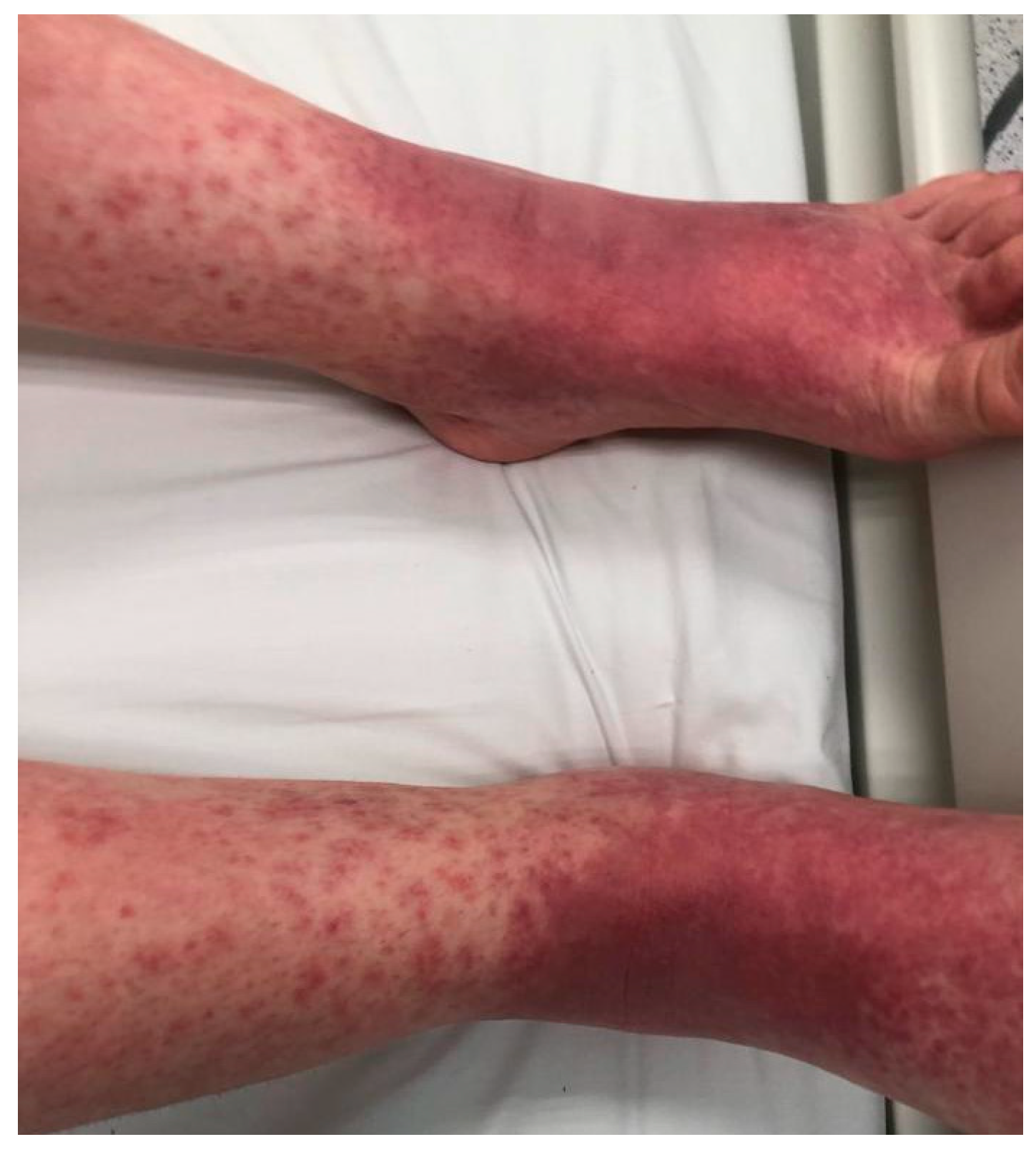


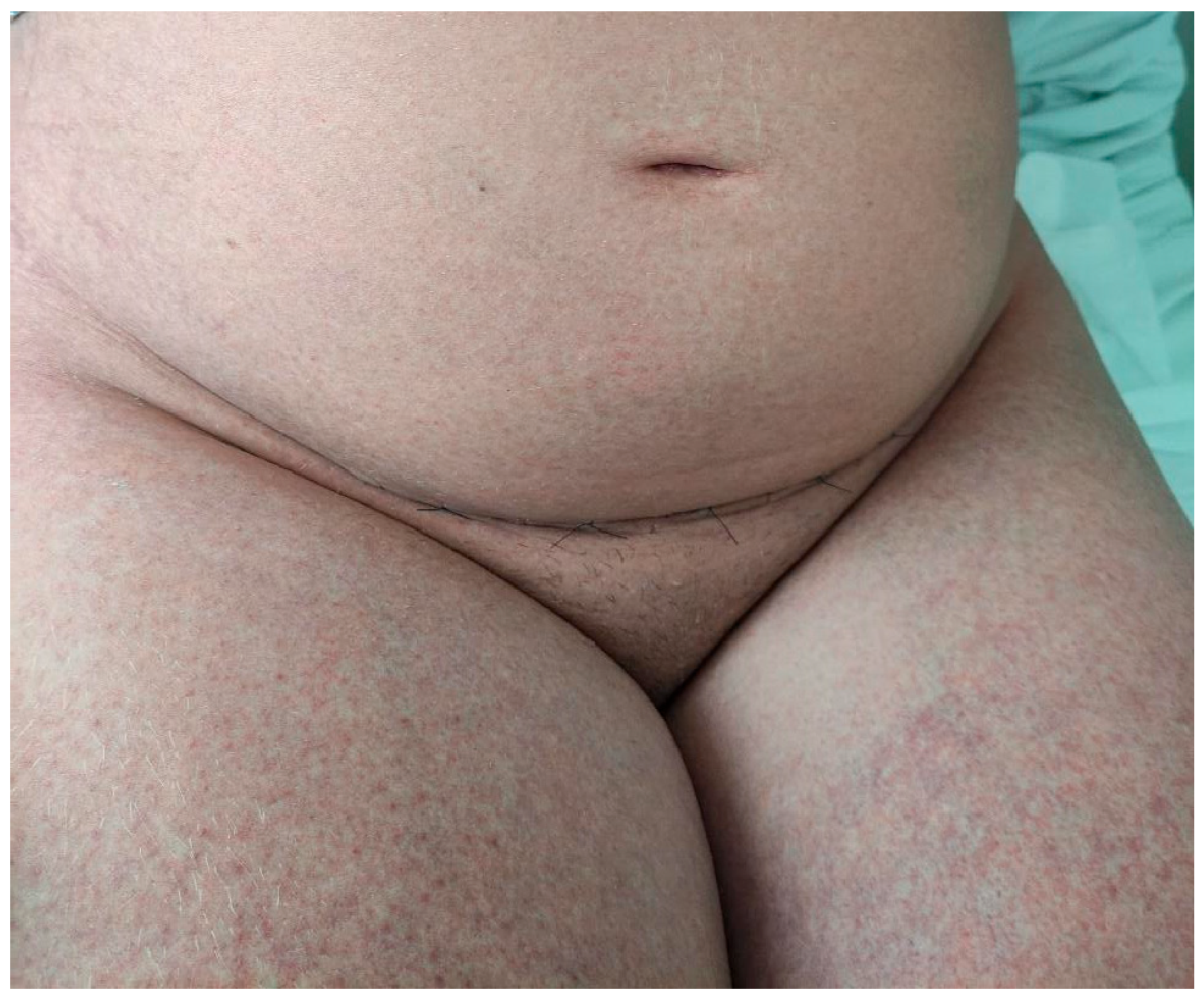

| Timeline (Days) | 1. | 2. | 3. | 4. | 5. | 6. | 7. | 8. | 9. | 10. | 11. | 12. | 13. | 14. | 15. |
|---|---|---|---|---|---|---|---|---|---|---|---|---|---|---|---|
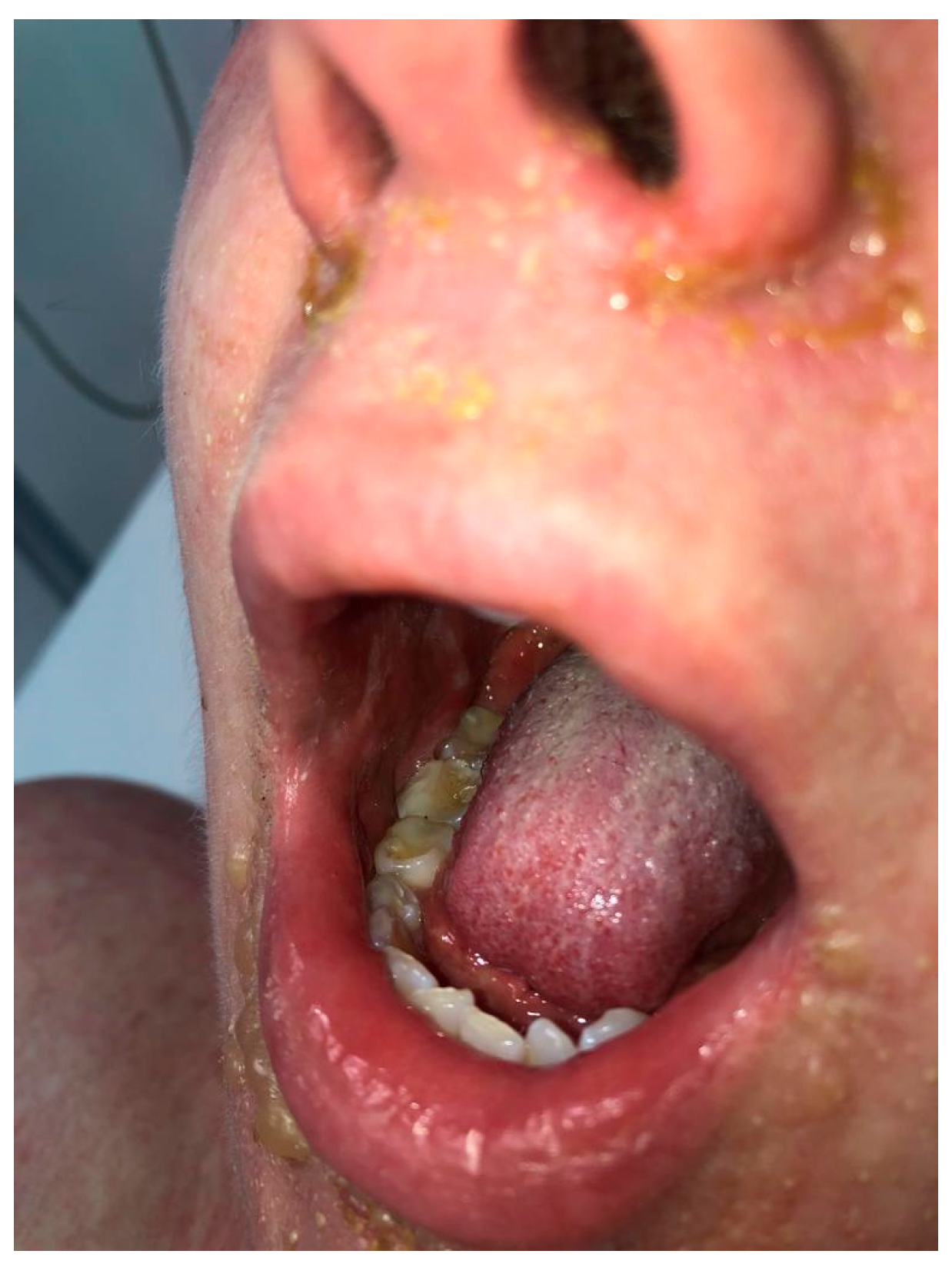
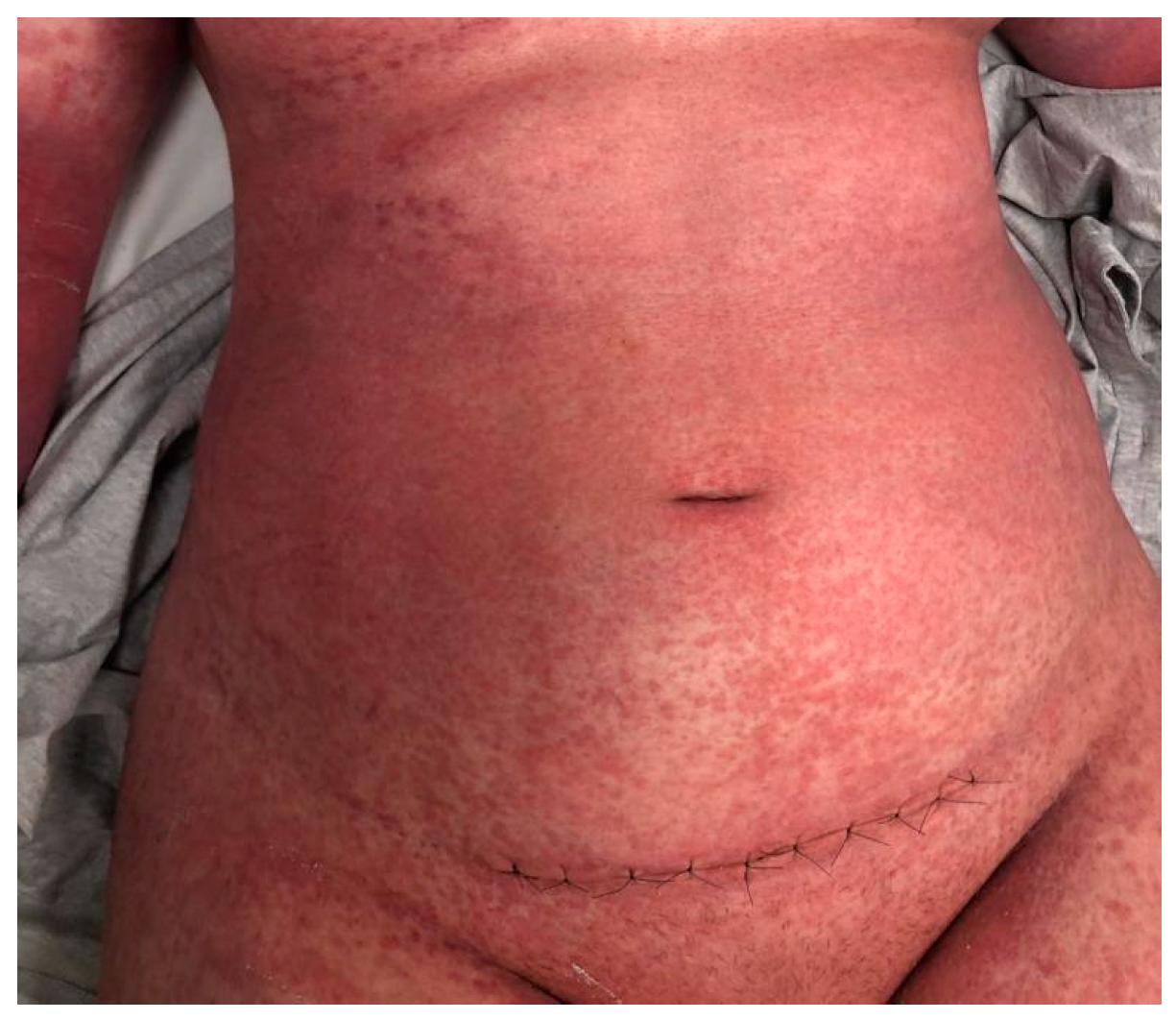
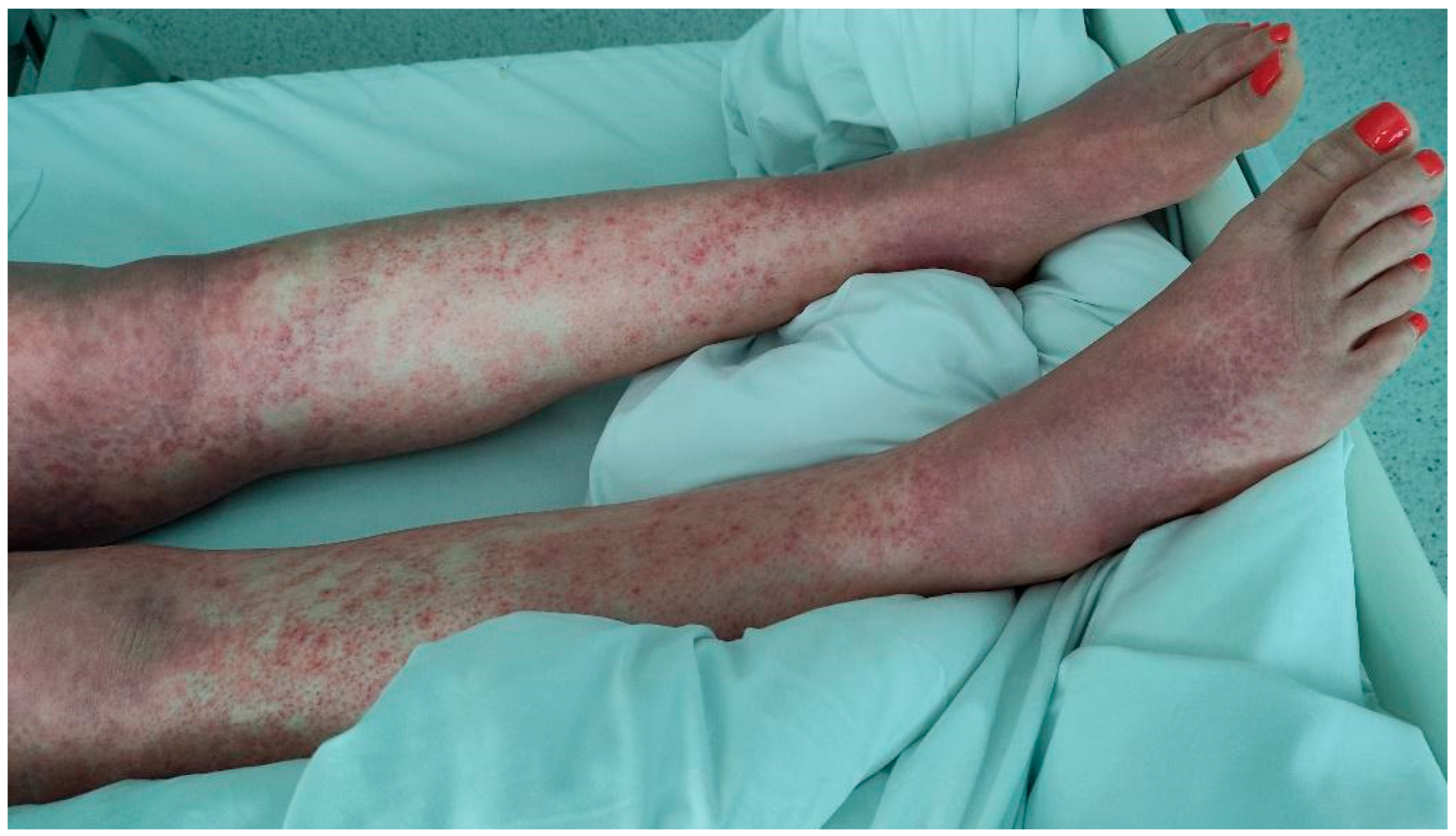
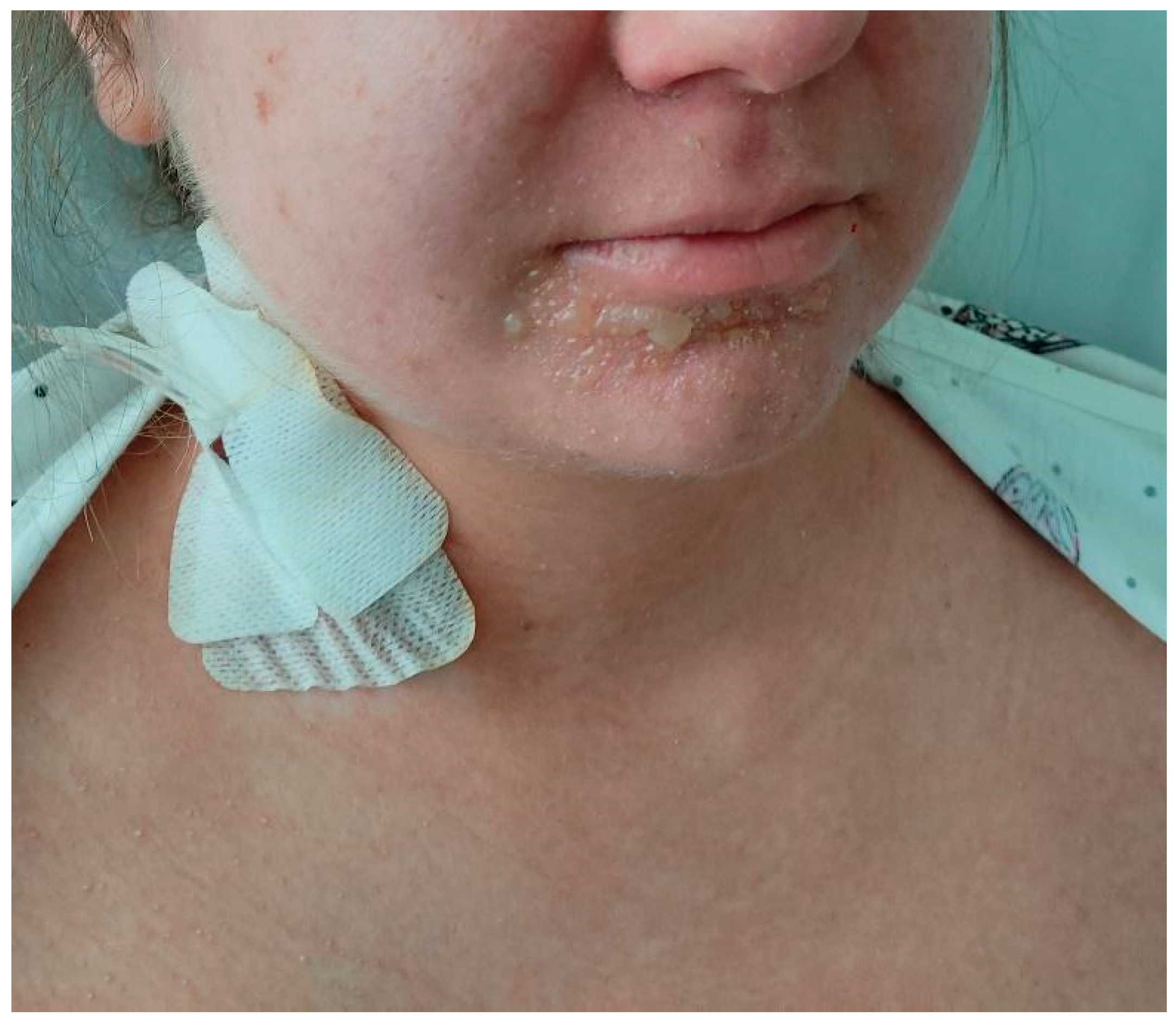
| Medical Intervention and differential diagnosis | Admission to Obstetrics Department | Cesarean section (CS) due to fetal distress | 1st day post CS | 2nd day post CS Cervical swab result: Ureaplasma urealiticum | 3rd day post CS Suspicion of a mild allergic reaction to Ampicillin | 4th day post CS Dermatology and allergology consultation | 5th day post CS Suspicion of sepsis Bacterial blood cultures Broad-spectrum antibiotics | 6th day post CS Dermatology & Microbiology consultation Suspicion of TEN/SJS/SSSS | 6th day post CS Dermatology consultation Confirmation of TEN | 7th day post CS Dermatology and ophthalmology consultation 1st day of IVIG | 8th day post CS 2nd day of IVIG | 9th day post CS 3rd day of IVIG | 10th day post CS Dermatology consultation | 11th day post CS | 12th day post CS Qualification for discharge |
| Patient’s condition | Stable, Preterm rupture of membranes | Stable | Stable | Stable | Initial skin reaction: 20 min after Ampicillin i.v. | Exacerbation of skin lesions | Further exacerbation of skin lesions, febrile, weakness | Further exacerbation of skin lesions | Further exacerbation of skin lesions | Stabilization of skin lesions | Stabilization of skin lesions General improvement | Stabilization of skin lesions General improvement | Stable | Stable | Stable |
| Location of skin lesions | - | - | - | - | Chest, abdomen | Chest, abdomen | Chest, abdomen, upper and lower extremities | Chest, abdomen, upper and lower extremities, face | Chest, abdomen, upper and lower extremities, face | Chest, abdomen, upper and lower extremities, face | Chest, abdomen, upper and lower extremities, face | No new lesions, epithelization | No new lesions, epithelization | No new lesions, epithelization | No new lesions, epithelization |
| Character of skin lesions | - | - | - | - | Maculopapular rash | Maculopapular rash | Maculopapular rash Petechiae | Maculopapular rash Petechiae | Fluid-filled blisters Maculopapular rash Petechiae | Fluid-filled blisters Maculopapular rash Petechiae | Fluid-filled blisters Maculopapular rash Petechiae | Healing of fluid-filled blisters epithelization | Healing of fluid-filled blisters epithelization | Healing of fluid-filled blisters epithelization | Predominantly healed fluid-filled blisters epithelization |
| Pharmacotherapy | Oxytocin | Ampicillin Ceftriaxone Spinal anesthesia Ibuprofen Paracetamol | Ampicillin Paracetamol Ibuprofen Enoxaparin | Ampicillin Azithromycin Ibuprofen Paracetamol Enoxaparin | Ampicillin cessation Azithromycin Ibuprofen Paracetamol Cetirizine Enoxaparin | Azithromycin Ibuprofen cessation Paracetamol Cetirizine Cutivate ointment Enoxaparin | Azithromycin Paracetamol Cetirizine Cutivate ointment Prednisone Clemastine Hydrocortisone Enoxaparin Clindamycin Metronidazole | Azithromycin Paracetamol Cetirizine Cutivate ointment Prednisone Clemastine Hydrocortisone Enoxaparin Clindamycin Metronidazole | Paracetamol Cetirizine Cutivate ointment Prednisone Clemastine Hydrocortisone Enoxaparin Clindamycin Metronidazole | Paracetamol Cetirizine Cutivate ointment Prednisone Clemastine Hydrocortisone Enoxaparin Clindamycin Metronidazole | Paracetamol Cetirizine Cutivate ointment Prednisone Clemastine Hydrocortisone Enoxaparin Clindamycin Metronidazole | Paracetamol Cetirizine Cutivate ointment Prednisone Clemastine Hydrocortisone Enoxaparin Clindamycin Metronidazole | Paracetamol Cutivate ointment Prednisone Enoxaparin Clindamycin Metronidazole Methyldopa | Paracetamol Cutivate ointment Prednisone Enoxaparin Methyldopa | Paracetamol Cutivate ointment Prednisone Enoxaparin Methyldopa |
| Vital signs Blood pressure (BP mm/Hg) Heart rate (HR) Oxygen Saturation (Sat. O2%) Body Temperature (Temp. °C) | BP 130/80 HR 90 Sat. O2 100% Temp. 36.8 °C | BP 120/70 HR 80 Sat. O2 100% Temp. 36.7 °C | BP 115/77 HR 85 Sat. O2 100% Temp. 36.8 °C | BP 120/70 HR 80 Sat. O2 100% Temp. 36.7 °C | BP 110/70 HR 92 Sat. O2 100% Temp. 36.8 °C | BP 115/72 HR 90 Sat. O2 100% Temp. 36.9 °C | BP 99/60 HR 130 Sat. O2 99% Temp. 40 °C | BP 100/63 HR 120 Sat. O2 99% Temp. 38.8 °C | BP 110/60 HR 110 Sat. O2 99% Temp. 38.0 °C | BP 112/65 HR 100 Sat. O2 99% Temp. 37.1 °C | BP 110/59 HR 101 Sat. O2 99% Temp. 37.2 °C | BP 119/60 HR 98 Sat. O2 99% Temp. 37.0 °C | BP 130/83 HR 76 Sat. O2 100% Temp. 36.8 °C | BP 122/70 HR 70 Sat. O2 100% Temp. 36.6 °C | BP 110/65 HR 64 Sat. O2 100% Temp. 36.6 °C |
| Hemoglobin [g/dL] Normal value 12–15 | 12.4 | 11.9 | 11.9 | - | - | - | 12.2 | 12.8 | 10.2 | 10.8 | - | 8.9 | - | - | 10.8 |
| White blood cells [×109/L] Normal value 4–10 | 11.97 | 16.67 | 16.68 | - | - | - | 17.68 | 19.32 | 12.38 | 10.03 | - | 9.43 | - | - | 8.22 |
| C-reactive protein [mg/L] Normal value 0–5 | 21 | 22 | 26 | 18 | 24 | - | 106 130 | 182 | 223 | 126 | - | 44 | 18 | - | - |
| Procalcitonin Normal value 0.00–0.5 | - | - | - | - | - | - | 0.12 | 0.4 | - | - | - | - | - | - | - |
| D-Dimer [ug/L] Normal value <500 | - | - | - | - | - | - | 12,230 | 35,900 | 17,524 | - | - | 3281 | - | - | - |
| Creatinine [mg/dL} Normal value 0.55–1.02 | - | - | - | - | - | - | 0.96 | 1.07 | 0.85 | 0.77 | - | - | - | - | - |
| LDH [U/L] Normal value 125–220 | - | - | - | - | - | 450 | 270 | - | - | - | - | - | - | - | - |
| Suspected Diagnosis | Findings Supporting the Diagnosis | Findings Against the Diagnosis |
|---|---|---|
| Stevens–Johnson Syndrome/Toxic Epidermal Necrolysis (SJS/TEN) |
|
|
| Drug-induced exanthema (morbilliform eruption) |
|
|
| Acute Generalized Exanthematous Pustulosis (AGEP) |
|
|
| Staphylococcal Scalded Skin Syndrome (SSSS) |
|
|
| Mycoplasma-Induced Rash and Mucositis (MIRM) |
|
|
| Postpartum Sepsis |
|
|
| Suspected Drug | Delay from Initial Drug Component Intake to Onset of Reaction | Drug Present in the Body on Index Day | Prechallenge/Rechallenge | Dechallenge | Type of Drug | Other Cause | ALDEN Score | Causal Link |
|---|---|---|---|---|---|---|---|---|
| Ampicillin | Likely +1 | Definite 0 | Not done/unknown 0 | Neutral 0 | Associated +2 | N/A | 3 | Possible |
| Azithromycin | Likely +1 | Definite 0 | Not done/unknown 0 | Negative −2 | Strongly associated +3 | N/A | 2 | Possible |
| Ceftriaxone | Likely +1 | Doubtful −1 | Not done/unknown 0 | Neutral 0 | Strongly associated 3+ | N/A | 3 | Possible |
| Enoxaparin | Likely +1 | Definite 0 | Not done/unknown 0 | Negative −2 | Not suspected −1 | N/A | −2 | Very unlikely |
| Ibuprofen | Likely +1 | Definite 0 | Negative −2 | Neutral 0 | Strongly associated +3 | N/A | 2 | Possible |
| Oxytocin | Likely +1 | Excluded −3 | Not done/unknown 0 | Neutral 0 | Not suspected −1 | N/A | −3 | Very unlikely |
| Paracetamol | Likely +1 | Definite 0 | Negative −2 | Negative −2 | Associated +2 | N/A | −1 | Very Unlikely |
| SCORTEN | ABCD-10 | ||
|---|---|---|---|
| Feature | Score | Feature | Score |
| Age ≥ 40 years | 0 | Age ≥ 50 years | 0 |
| Serum bicarbonate level (<20 mmol/L) | 0 | Serum bicarbonate level (<20 mmol/L) | 0 |
| Cancer or hematologic malignancy | 0 | Active cancer | 0 |
| - | - | Dialysis prior to admission | 0 |
| BSA > 10% | 0 | BSA > 10% | 0 |
| Heart rate ≥ 120 bpm | 0 | - | - |
| Serum urea level (>10 mmol/L) | 0 | - | - |
| Serum glucose level (>14 mmol/L) | 0 | - | - |
| Total score | 0–estimated mortality rate–3.2% | Total score | 0–estimated mortality rate–2.3% |
Disclaimer/Publisher’s Note: The statements, opinions and data contained in all publications are solely those of the individual author(s) and contributor(s) and not of MDPI and/or the editor(s). MDPI and/or the editor(s) disclaim responsibility for any injury to people or property resulting from any ideas, methods, instructions or products referred to in the content. |
© 2025 by the authors. Licensee MDPI, Basel, Switzerland. This article is an open access article distributed under the terms and conditions of the Creative Commons Attribution (CC BY) license.
Share and Cite
Mazur-Ejankowska, N.K.; Ejankowski, M.; Grzybowska, M.E.; Żółkiewicz, J.; Gostkowska, E.; Barańska-Rybak, W.; Wydra, D.G. Toxic Epidermal Necrolysis and Steven–Johnson Syndrome During the Postpartum Period: A Literature Review with a Rare Case Presentation. J. Clin. Med. 2026, 15, 17. https://doi.org/10.3390/jcm15010017
Mazur-Ejankowska NK, Ejankowski M, Grzybowska ME, Żółkiewicz J, Gostkowska E, Barańska-Rybak W, Wydra DG. Toxic Epidermal Necrolysis and Steven–Johnson Syndrome During the Postpartum Period: A Literature Review with a Rare Case Presentation. Journal of Clinical Medicine. 2026; 15(1):17. https://doi.org/10.3390/jcm15010017
Chicago/Turabian StyleMazur-Ejankowska, Natalia Katarzyna, Maciej Ejankowski, Magdalena Emilia Grzybowska, Jakub Żółkiewicz, Ewa Gostkowska, Wioletta Barańska-Rybak, and Dariusz Grzegorz Wydra. 2026. "Toxic Epidermal Necrolysis and Steven–Johnson Syndrome During the Postpartum Period: A Literature Review with a Rare Case Presentation" Journal of Clinical Medicine 15, no. 1: 17. https://doi.org/10.3390/jcm15010017
APA StyleMazur-Ejankowska, N. K., Ejankowski, M., Grzybowska, M. E., Żółkiewicz, J., Gostkowska, E., Barańska-Rybak, W., & Wydra, D. G. (2026). Toxic Epidermal Necrolysis and Steven–Johnson Syndrome During the Postpartum Period: A Literature Review with a Rare Case Presentation. Journal of Clinical Medicine, 15(1), 17. https://doi.org/10.3390/jcm15010017