Late-Preterm and Early-Term Respiratory Morbidity in Infants Born Primarily via Elective Caesarean Section

 , , and
Abstract
1. Introduction
2. Materials and Methods
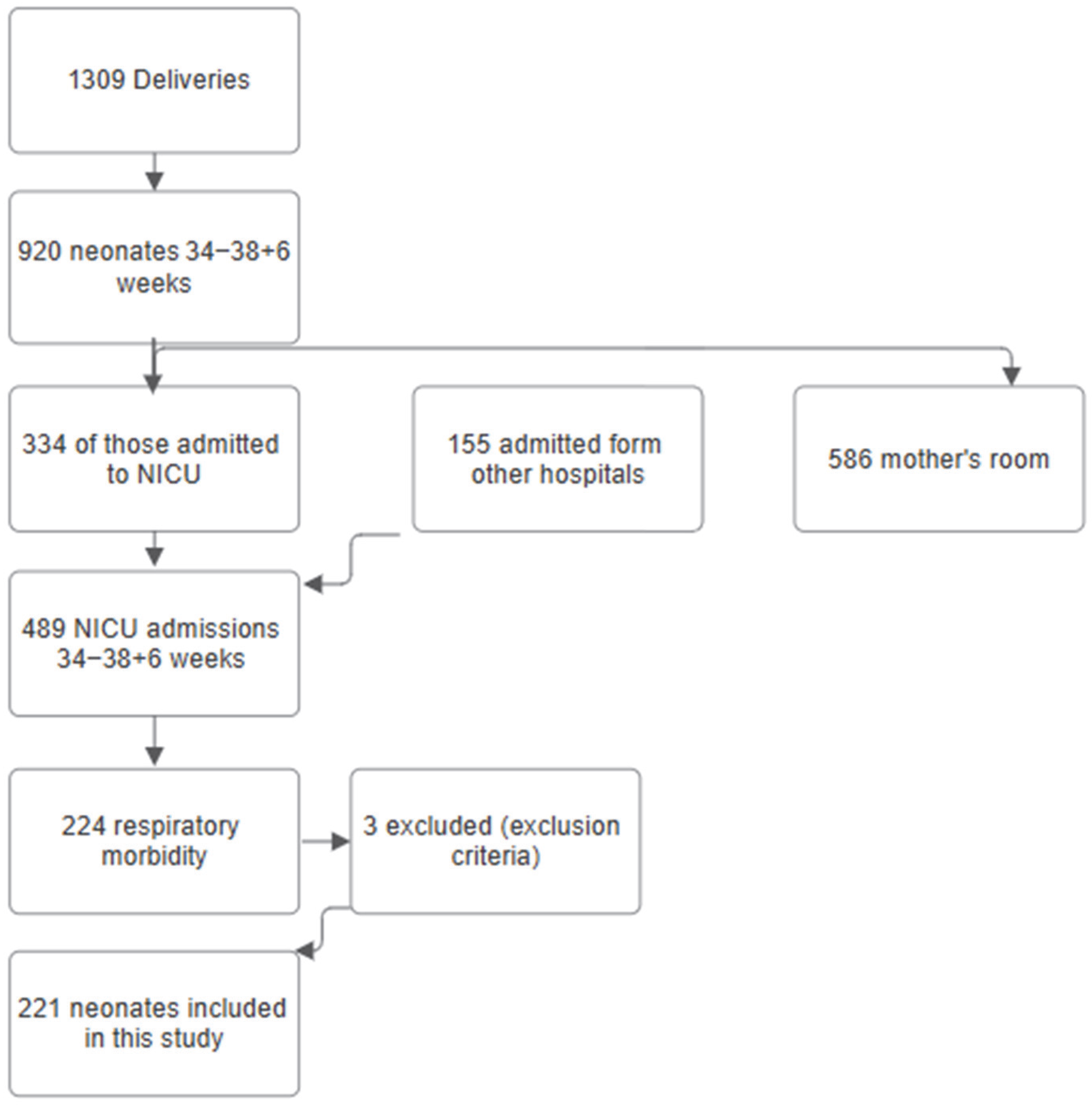
- Infants born at 34 to 38 + 6 weeks of gestation
- NICU admission
- Respiratory distress (any)
- Infants not fulfilling the above criteria
- Infants with congenital anomalies (such as trisomy, congenital heart disease, central nervous system anomaly, etc.)
- Infants with congenital infections
2.1. Ventilation Practice
2.2. Statistical Analysis
3. Results
3.1. Demographics
3.2. Analyses
Comparison of Ventilated and Non-Ventilated Infants
4. Discussion
5. Conclusions
Author Contributions
Funding
Institutional Review Board Statement
Informed Consent Statement
Data Availability Statement
Acknowledgments
Conflicts of Interest
Abbreviations
| NICU | Neonatal Intensive Care Unit |
| UHP | University Hospital of Patras |
| CS | Cesarean Section |
| FiO2 | Fraction of Inspired Oxygen |
| PN | Parenteral Nutrition |
| IQR | Interquartile Range |
| RDS | Respiratory Distress Syndrome |
| ACOG | American College of Obstetrics and Gynecologists |
| FIGO | International Federation of Gynecology and Obstetrics |
| SPs | Surfactant Proteins |
| NA | Non-applicable |
| CO2 | Carbon Dioxide |
| aRR | adjusted risk ratio |
References
- Boyle, E.M.; Mielewczyk, F.J.; Mulvaney, C. Late preterm and early term birth: Challenges and dilemmas in clinical practice. Semin. Fetal Neonatal Med. 2024, 29, 101564. [Google Scholar] [CrossRef]
- Mcintire, D.D.; Leveno, K.J. Neonatal Mortality and Morbidity Rates in Late Preterm Births Compared With Births at Term LEVEL OF EVIDENCE: II. Obstet. Gynecol. 2008, 111, 35–41. [Google Scholar] [CrossRef]
- Dimitriou, G.; Fouzas, S.; Georgakis, V.; Vervenioti, A.; Papadopoulos, V.G.; Decavalas, G.; Mantagos, S. Determinants of morbidity in late preterm infants. Early Hum. Dev. 2010, 86, 587–591. [Google Scholar] [CrossRef]
- Yeganegi, M.; Bahrami, R.; Azizi, S.; Marzbanrad, Z.; Hajizadeh, N.; Mirjalili, S.R.; Saeida-Ardekani, M.; Lookzadeh, M.H.; Alijanpour, K.; Aghasipour, M.; et al. Caesarean section and respiratory system disorders in newborns. Eur. J. Obstet. Gynecol. Reprod. Biol. X 2024, 23, 100336. [Google Scholar] [CrossRef] [PubMed]
- Mylonas, I.; Friese, K. The indications for and risks of elective cesarean section. Dtsch. Arztebl. Int. 2015, 112, 489–495. [Google Scholar] [CrossRef] [PubMed]
- Wladimiroff, J.; Tsiapakidou, S.; Mahmood, T.; Velebil, P. Caesarean section rates across Europe and its impact on specialist training in Obstetrics: A qualitative review by the Standing Committee of Hospital Visiting Programme for Training Recognition of the European Board and College of the Obstetrics and Gynaecology (EBCOG). Eur. J. Obstet. Gynecol. Reprod. Biol. 2025, 304, 77–83. [Google Scholar] [CrossRef] [PubMed]
- Bardisa, J.B.; Díaz, C.V.; Berenguer, M.J.F. Does early surfactant improve outcome in late preterm newborn? Retrospective study in a neonatal intensive care unit. Med. Intensive 2025, 49, 502161. [Google Scholar] [CrossRef]
- Cornette, L.; Mulder, A.; Debeer, A.; Malfilâtre, G.; Rigo, V.; Cools, F.; Danhaive, O. Surfactant use in late preterm infants: A survey among Belgian neonatologists. Eur. J. Pediatr. 2021, 180, 885–892. [Google Scholar] [CrossRef]
- Shapiro-Mendoza, C.K.; Tomashek, K.M.; Kotelchuck, M.; Barfield, W.; Nannini, A.; Weiss, J.; Declercq, E. Effect of late-preterm birth and maternal medical conditions on newborn morbidity risk. Pediatrics 2008, 121, e223–e232. [Google Scholar] [CrossRef]
- Boyle, E.M.; Roehr, C.C. Optimising the management of respiratory distress in late preterm and early term babies. Infant 2022, 18, 137–141. [Google Scholar]
- Figueras, F.; Gratacós, E. Update on the diagnosis and classification of fetal growth restriction and proposal of a stage-based management protocol. Fetal Diagn. Ther. 2014, 36, 86–98. [Google Scholar] [CrossRef]
- Tranquilli, A.L.; Dekker, G.; Magee, L.; Roberts, J.; Sibai, B.; Steyn, W.; Zeeman, G.; Brown, M. The classification, diagnosis and management of the hypertensive disorders of pregnancy: A revised statement from the ISSHP. Pregnancy Hypertens. 2014, 4, 97–104. [Google Scholar] [CrossRef]
- Stock, S.J.; Thomson, A.J.; Papworth, S. Antenatal corticosteroids to reduce neonatal morbidity and mortality: Green-top Guideline No. 74. BJOG 2022, 129, e35–e60. [Google Scholar] [CrossRef]
- Dong, Y.; Speer, C.P. Late-onset neonatal sepsis: Recent developments. Fetal Neonatal Ed. 2015, 100, F257–F263. [Google Scholar] [CrossRef]
- Ramaswamy, V.V.; Abiramalatha, T.; Bandyopadhyay, T.; Boyle, E.; Roehr, C.C. Surfactant therapy in late preterm and term neonates with respiratory distress syndrome: A systematic review and meta-analysis. Arch. Dis. Child. Fetal Neonatal Ed. 2022, 107, 393–397. [Google Scholar] [CrossRef] [PubMed]
- Sweet, D.G.; Carnielli, V.P.; Greisen, G.; Hallman, M.; Klebermass-Schrehof, K.; Ozek, E.; Pas, A.T.; Plavka, R.; Roehr, C.C.; Saugstad, O.D.; et al. European Consensus Guidelines on the Management of Respiratory Distress Syndrome: 2022 Update. Neonatology 2023, 120, 3–23. [Google Scholar] [CrossRef] [PubMed]
- Kontopanos, A.; Tsakiridis, I.; Dagklis, T.; Boureka, E.; Mamopoulos, A.; Athanasiadis, A. Cesarean section rates in each region of Greece: A retrospective analysis. HJOG 2023, 22, 35–44. [Google Scholar] [CrossRef]
- Condò, V.; Cipriani, S.; Colnaghi, M.; Bellù, R.; Zanini, R.; Bulfoni, C.; Parazzini, F.; Mosca, F. Neonatal respiratory distress syndrome: Are risk factors the same in preterm and term infants? J. Matern.—Fetal Neonatal Med. 2017, 30, 1267–1272. [Google Scholar] [CrossRef]
- Ramachandrappa, A.; Jain, L. Elective Cesarean Section: It’s Impact on Neonatal Respiratory Outcome. Clin. Perinatol. 2008, 35, 373–393. [Google Scholar] [CrossRef]
- Hansen, A.K.; Wisborg, K.; Uldbjerg, N.; Henriksen, T.B. Risk of respiratory morbidity in term infants delivered by elective caesarean section: Cohort study. BMJ (Clin. Res. Ed.) 2008, 336, 85–87. [Google Scholar] [CrossRef] [PubMed]
- Tita, A.T.; Landon, M.B.; Spong, C.Y.; Lai, Y.; Leveno, K.J.; Varner, M.W.; Moawad, A.H.; Caritis, S.N.; Meis, P.J.; Wapner, R.J. Timing of Elective Repeat Cesarean Delivery at Term and Neonatal Outcomes. N. Engl. J. Med. 2009, 360, 111–120. [Google Scholar] [CrossRef]
- Tefera, M.; Assefa, N.; Mengistie, B.; Abrham, A.; Teji, K.; Worku, T. Elective cesarean section on term pregnancies has a high risk for neonatal respiratory morbidity in developed countries: A systematic review and meta-analysis. Front. Pediatr. 2020, 8, 286. [Google Scholar] [CrossRef]
- De Luca, R.; Boulvain, M.; Irion, O.; Berner, M.; Pfister, R.E. Incidence of early neonatal mortality and morbidity after late-preterm and term cesarean delivery. Pediatrics 2009, 123, e1064–e1071. [Google Scholar] [CrossRef] [PubMed]
- Gouyon, J.B.; Ribakovsky, C.; Ferdynus, C.; Quantin, C.; Sagot, P.; Gouyon, B. Severe respiratory disorders in term neonates. Paediatr. Perinat. Epidemiol. 2008, 22, 22–30. [Google Scholar] [CrossRef] [PubMed]
- Stylianou-Riga, P.; Boutsikou, T.; Kouis, P.; Kinni, P.; Krokou, M.; Ioannou, A.; Siahanidou, T.; Iliodromiti, Z.; Papadouri, T.; Yiallouros, P.K.; et al. Maternal and neonatal risk factors for neonatal respiratory distress syndrome in term neonates in Cyprus: A prospective case–control study. Ital. J. Pediatr. 2021, 47, 129. [Google Scholar] [CrossRef] [PubMed]
- American College of Obstetricians and Gynecologists’ Committee on Obstetric Practice; Society for Maternal-Fetal Medicine. Medically Indicated Late-Preterm and Early-Term Deliveries, ACOG Committee Opinion. Obstet. Gynecol. 2021, 138, e35–e39. [Google Scholar] [CrossRef]
- Htun, Z.T.; Hairston, J.C.; Gyamfi-Bannerman, C.; Marasch, J.; Ribeiro, A.P.D. Antenatal corticosteroids: Extending the practice for late-preterm and scheduled early-term deliveries? Children 2021, 8, 272. [Google Scholar] [CrossRef] [PubMed]
- Samouilidis, A.; Beltsios, E.T.; Mavrovounis, G.; Adamou, A.; Belios, I.; Hadjivasilis, A.; Pantazopoulos, I.; Agouridis, A.P. The Use of Antenatal Dexamethasone in Late Preterm and Term Pregnancies to Improve Neonatal Morbidity and Mortality: A Systematic Review and Meta-Analysis. Cureus 2022, 14, e27865. [Google Scholar] [CrossRef]
- Gyamfi-Bannerman, C.; Zupancic, J.A.F.; Sandoval, G.; Grobman, W.A.; Blackwell, S.C.; Tita, A.T.N.; Reddy, U.M.; Jain, L.; Saade, G.R.; Rouse, D.J.; et al. Cost-effectiveness of Antenatal Corticosteroid Therapy vs No Therapy in Women at Risk of Late Preterm Delivery: A Secondary Analysis of a Randomized Clinical Trial. JAMA Pediatr. 2019, 173, 462–468. [Google Scholar] [CrossRef]
- Räikkönen, K.; Gissler, M.; Kajantie, E. Associations between Maternal Antenatal Corticosteroid Treatment and Mental and Behavioral Disorders in Children. JAMA—J. Am. Med. Assoc. 2020, 323, 1924–1933. [Google Scholar] [CrossRef]
- Yao, T.-C.; Chang, S.-M.; Wu, C.-S.; Tsai, Y.-F.; Sheen, K.-H.; Hong, X.; Chen, H.-Y.; Wu, A.C.; Tsai, H.-J. Association between antenatal corticosteroids and risk of serious infection in children: Nationwide cohort study. BMJ 2023, 382, e075835. [Google Scholar] [CrossRef] [PubMed]
- Räikkönen, K.; Gissler, M.; Kajantie, E.; Tapiainen, T. Antenatal corticosteroid treatment and infectious diseases in children: A nationwide observational study. Lancet Reg. Health 2023, 35, 100750. [Google Scholar] [CrossRef]
- Garmany, T.H.; A Wambach, J.; Heins, H.B.; Watkins-Torry, J.M.; Wegner, D.J.; Bennet, K.; An, P.; Land, G.; Saugstad, O.D.; Henderson, H.; et al. Population and disease-based prevalence of the common mutations associated with surfactant deficiency. Pediatr. Res. 2008, 63, 645–649. [Google Scholar] [CrossRef]
- Jo, H.S. Genetic risk factors associated with respiratory distress syndrome. Korean J. Pediatr. 2014, 57, 157–163. [Google Scholar] [CrossRef]
- Tsitoura, M.E.I.; Stavrou, E.F.; Maraziotis, I.A.; Sarafidis, K.; Athanassiadou, A.; Dimitriou, G. Surfactant protein A and B gene polymorphisms and risk of respiratory distress syndrome in late-preterm neonates. PLoS ONE 2016, 11, e0166516. [Google Scholar] [CrossRef] [PubMed]
- Shuai, X.; Li, X.; Wu, Y. Prediction for late-onset sepsis in preterm infants based on data from East China. Front. Pediatr. 2022, 10, 924014. [Google Scholar] [CrossRef]
- Ma, X.-L.; Xu, X.-F.; Chen, C.; Yan, C.-Y.; Liu, Y.-M.; Liu, L.; Xiong, H.; Sun, H.-Q.; Lai, J.-P.; Yi, B.; et al. Epidemiology of respiratory distress and the illness severity in late preterm or term infants: A prospective multi-center study. Chin. Med. J. (Engl.) 2010, 123, 2776–2780. [Google Scholar] [CrossRef]
- Stylianou-Riga, P.; Boutsikou, T.; Kouis, P.; Michailidou, K.; Kinni, P.; Sokou, R.; Iliodromiti, Z.; Pitsios, C.; Yiallouros, P.K.; Iacovidou, N. Epidemiology, risk factors, clinical presentation and complications of late-onset neonatal sepsis among preterm neonates in Cyprus: A prospective case-control study. BMC Pediatr. 2024, 24, 50. [Google Scholar] [CrossRef]
- Zafar, N.; Wallace, C.M.; Kieffer, P.; Schroeder, P.; Schootman, M.; Hamvas, A. Improving Survival of Vulnerable Infants Increases Neonatal Intensive Care Unit Nosocomial Infection Rate. Arch. Pediatr. Adolesc. Med. 2001, 155, 1098–1104. [Google Scholar] [CrossRef]
- Sharma, R.; Baheti, S. Outcome of neonatal ventilation: A prospective and cross-sectional study in tertiary care centre. Int. J. Contemp. Pediatr. 2017, 4, 1820. [Google Scholar] [CrossRef][Green Version]


| Clinical Characteristics (Prenatal, Perinatal) of Admitted Infants | Median (IQR) or n (%) |
|---|---|
| Maternal diabetes | 50 (23) |
| Maternal hypertension | 21 (10) |
| Intrauterine growth retardation | 20 (9) |
| Maternal age (years) | 31 (25–35) |
| Maternal smoking | 12 (5) |
| Antenatal corticosteroids | 104 (47) |
| Multiple pregnancy | 31 (14) |
| Outborn | 86 (39) |
| Cesarean Section | 196 (89) |
| Elective Cesarean Section | 144 (65) |
| Female sex | 79 (36) |
| Gestational age (weeks) | 35.8 (34.7–37.4) |
| Birth weight (kg) | 2.63 (2.25–3.04) |
| Birth weight (z-score) | −0.30 (−1.14–0.78) |
| Apgar score at 5 min | 9 (9–10) |
| Apgar score at 10 min | 10 (10–10) |
| Admission temperature (°C) | 36.6 (36.3–36.9) |
| Invasively ventilated | 88 (40) |
| Duration of ventilation (hours) | 1 (0–16) |
| Duration of non-invasive support (hours) | 1 (0–6) |
| Duration of supplemental oxygen (hours) | 10 (4–26) |
| Maximum required fraction of inspired oxygen (%) | 40 (30–47) |
| Duration of antibiotics (days) | 5 (3–7) |
| Duration of parenteral nutrition (days) | 3 (2–5) |
| Early-onset sepsis | 8 (3.6) |
| Late-onset sepsis | 33 (15) |
| Ventilated, n = 88 | Not Ventilated, n = 133 | p Value | |
|---|---|---|---|
| Maternal diabetes 1 | 21 (24) | 29 (22) | 0.869 |
| Maternal hypertension 1 | 12 (14) | 9 (7) | 0.091 |
| Intrauterine growth retardation 1 | 10 (11) | 10 (8) | 0.472 |
| Maternal age (years) 2 | 31 (7.5) | 31 (10.5) | 0.560 |
| Maternal smoking 1 | 5 (6) | 7 (5) | 1.000 |
| Antenatal corticosteroids 1 | 36 (41) | 68 (51) | 0.036 |
| Multiple pregnancy 1 | 8 (9) | 23 (17) | 0.112 |
| Outborn 1 | 36 (41) | 50 (38) | 0.673 |
| Cesarean Section 1 | 78 (89) | 118 (89) | 0.642 |
| Female sex 1 | 29 (33) | 50 (38) | 0.567 |
| Gestational age (weeks) 2 | 35 (2) | 36 (2.25) | 0.174 |
| Birth weight (kg) 2 | 2.660 (650) | 2.620 (930) | 0.230 |
| Birth weight (z-score) 2 | −0.32 (−1.18 to 0.75) | −0.28 (−1.10 to 0.78) | 0.685 |
| Apgar score at 5 min 2 | 9 (1) | 9 (1) | 0.897 |
| Apgar score at 10 min 2 | 10 (1) | 10 (1) | 0.151 |
| Admission temperature (°C) 2 | 36.6 (0.6) | 36.6 (0.5) | 0.844 |
| Duration of ventilation (hours) * | 19 (12–60) | - | NA |
| Duration of non-invasive support (hours) 2 | 0 (0–11) | 0 (0,0) | <0.001 |
| Duration of supplemental oxygen (hours) 2 | 76 (30–138) | 9 (4–23) | <0.001 |
| Maximum required fraction of inspired oxygen (%) 2 | 50 (40–60) | 35 (30–40) | <0.001 |
| Duration of antibiotics (days) 2 | 7 (5–7) | 3 (3–5) | <0.001 |
| Duration of parenteral nutrition (days) 2 | 4 (1–6) | 2 (1–3) | <0.001 |
| Late-onset sepsis 1 | 23 (26) | 10 (8) | <0.001 |
Disclaimer/Publisher’s Note: The statements, opinions and data contained in all publications are solely those of the individual author(s) and contributor(s) and not of MDPI and/or the editor(s). MDPI and/or the editor(s) disclaim responsibility for any injury to people or property resulting from any ideas, methods, instructions or products referred to in the content. |
© 2025 by the authors. Licensee MDPI, Basel, Switzerland. This article is an open access article distributed under the terms and conditions of the Creative Commons Attribution (CC BY) license.
Share and Cite
Arvaniti, A.; Papachatzi, E.; Magriplis, E.; Antonakopoulos, N.; Antonakis, L.; Dimitriou, G.; Dassios, T. Late-Preterm and Early-Term Respiratory Morbidity in Infants Born Primarily via Elective Caesarean Section. J. Clin. Med. 2026, 15, 126. https://doi.org/10.3390/jcm15010126
Arvaniti A, Papachatzi E, Magriplis E, Antonakopoulos N, Antonakis L, Dimitriou G, Dassios T. Late-Preterm and Early-Term Respiratory Morbidity in Infants Born Primarily via Elective Caesarean Section. Journal of Clinical Medicine. 2026; 15(1):126. https://doi.org/10.3390/jcm15010126
Chicago/Turabian StyleArvaniti, Anthoula, Eleni Papachatzi, Emmanuella Magriplis, Nikolaos Antonakopoulos, Leonidas Antonakis, Gabriel Dimitriou, and Theodore Dassios. 2026. "Late-Preterm and Early-Term Respiratory Morbidity in Infants Born Primarily via Elective Caesarean Section" Journal of Clinical Medicine 15, no. 1: 126. https://doi.org/10.3390/jcm15010126
APA StyleArvaniti, A., Papachatzi, E., Magriplis, E., Antonakopoulos, N., Antonakis, L., Dimitriou, G., & Dassios, T. (2026). Late-Preterm and Early-Term Respiratory Morbidity in Infants Born Primarily via Elective Caesarean Section. Journal of Clinical Medicine, 15(1), 126. https://doi.org/10.3390/jcm15010126