Rethinking Mechanical Ventilation: Can Ventilation Mode Influence Long-Term Cognitive Outcomes in ICU Patients with COVID-19?

 , ,
, ,  , , and
Abstract
1. Introduction
2. Materials and Methods
2.1. Data Collection
2.2. Inspection of the Raw Data
2.2.1. Variables Used
2.2.2. Group Allocation
2.3. Preregistered Analyses
- GlobCogPerf is the global cognition performance score.
- DoV is the number of days of ventilation.
- The moderator is either the patient’s age (years) or the patient’s CogRes (score)
- a: represents the relationship between DoV and GlobCogPerf (the main effect of the DoV).
- b: represents the relationship between the moderator and GlobCogPerf (the main effect of the moderator).
- c: represents the moderating effect of the moderator on the relationship between DoV and GlobCogPerf (the interaction effect between DoV and moderator).
2.4. Statistics
3. Results
3.1. Demographic and Clinical Variables per Group
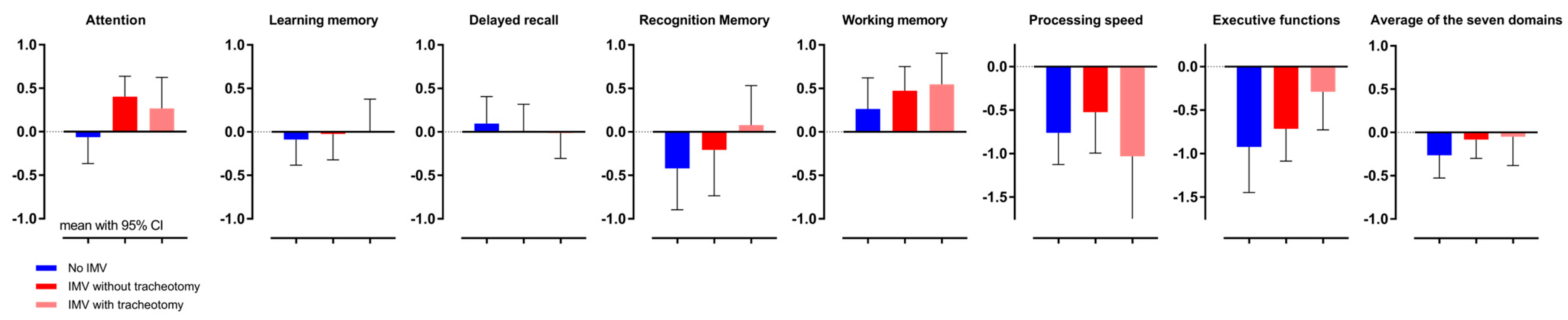
3.2. Cognitive Performance (CogPerf) per Group
- -
- Patients who did not receive IMV (n = 29) showed lower average z-scores than those who did receive IMV (n = 51), but this difference was not statistically significant: t(78) = 1.3, p = 0.21, Cohen’s d = 0.28.
- -
- Patients with tracheostoma (n = 24) showed average z-scores comparable to those without tracheostoma (n = 27): t(49) = 0.18; p = 0.86, Cohen’s d = 0.05.
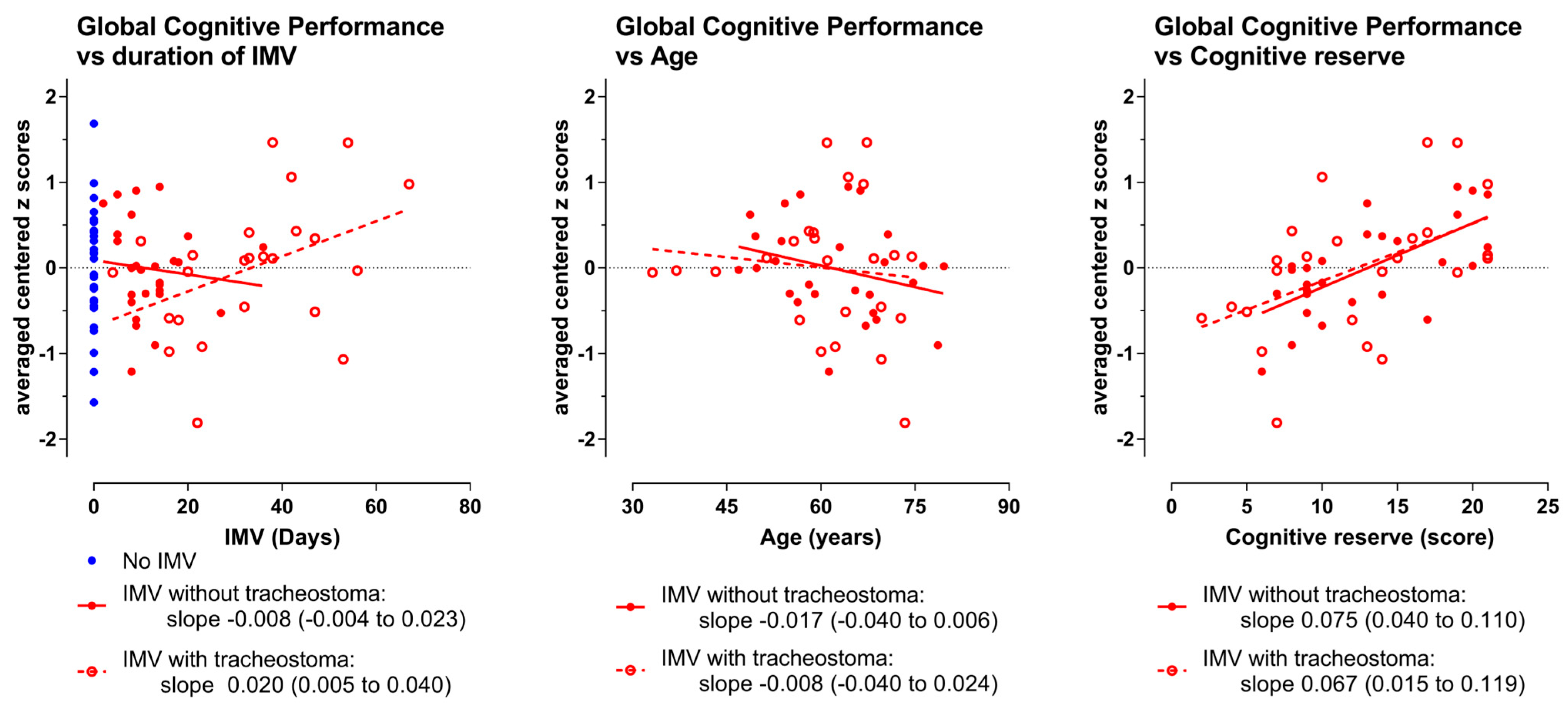
3.3. Main Analyses: GlobCogPerf Versus IMV Days, Moderator Age
- For the IMV group without a tracheostoma (n = 27):
- For the IMV group with tracheostoma (n = 24):
3.4. Exploratory Analyses
3.4.1. GlobCogPerf Versus IMV Days, Moderator Cognitive Reserve
- For the IMV group without a tracheostoma (n = 27):
- For the IMV group with tracheostoma (n = 24):
3.4.2. CogPerf per Domain: IMV Days, Moderators Age, Cognitive Reserve
- Regarding days of ventilation (DoV) per domain:
- Regarding age (Age) per domain:
- Regarding cognitive reserve (CogRes) per domain:
3.4.3. Per Delirium: GlobCogPerf Versus IMV Days, Moderators Age, and Cognitive Reserve
4. Discussion
5. Conclusions
Supplementary Materials
Author Contributions
Funding
Institutional Review Board Statement
Informed Consent Statement
Data Availability Statement
Acknowledgments
Conflicts of Interest
Abbreviations
| APACHE II | Acute Physiology and Chronic Health Evaluation II |
| ARDS | acute respiratory distress syndrome |
| CCI | Charlson Comorbidity Index |
| CRQ | Cognitive Reserve Questionnaire |
| CogPerf | cognitive performance |
| CogRes | cognitive reserve |
| DoV | days or duration of ventilation |
| GlobCogPerf | global cognitive performance |
| ICU | intensive care unit |
| IMV | invasive mechanical ventilation |
| NPV | negative pressure ventilation |
| PPV | positive pressure ventilation |
| VABI | ventilator-associated brain injury |
References
- van Rijn, C.; Jongsma, M.; Souren, P.; Coulthard, M.G.; Godoy González, M.; Gonzalo, M.S.F. What Is the Relation Between Duration of Mechanical Ventilation on the Intensive Care and Cognitive Functioning One Year After ICU Discharge, and What Is the Effect of Age on This Relation. OSF. 11 September 2024. Available online: https://osf.io/jw49m/overview (accessed on 18 January 2026).
- Godoy-González, M.; Navarra-Ventura, G.; Gomà, G.; de Haro, C.; Espinal, C.; Fortià, C.; Ridao, N.; Miguel Rebanal, N.; Oliveras-Furriols, L.; Subirà, C.; et al. Objective and subjective cognition in survivors of COVID-19 one year after ICU discharge: The role of demographic, clinical, and emotional factors. Crit. Care 2023, 27, 188. [Google Scholar] [CrossRef] [PubMed]
- Pandharipande, P.P.; Girard, T.D.; Jackson, J.C.; Morandi, A.; Thompson, J.L.; Pun, B.T.; Brummel, N.E.; Hughes, C.G.; Vasilevskis, E.E.; Shintani, A.K.; et al. Long-term cognitive impairment after critical illness. N. Engl. J. Med. 2013, 369, 1306–1316. [Google Scholar] [CrossRef] [PubMed]
- Bassi, T.G.; Rohrs, E.C.; Reynolds, S.C. Systematic review of cognitive impairment and brain insult after mechanical ventilation. Crit. Care 2021, 25, 99. [Google Scholar] [CrossRef]
- Liu, Y.; Cai, X.; Fang, R.; Peng, S.; Luo, W.; Du, X. Future directions in ventilator-induced lung injury associated cognitive impairment: A new sight. Front. Physiol. 2023, 14, 1308252. [Google Scholar] [CrossRef]
- Tingey, J.L.; Dasher, N.A.; Bunnell, A.E.; Starosta, A.J. Intensive care-related cognitive impairment: A biopsychosocial overview. PMR 2022, 14, 259–272. [Google Scholar] [CrossRef] [PubMed]
- Duloquin, G.; Pommier, T.; Georges, M.; Giroud, M.; Guenancia, C.; Béjot, Y.; Laurent, G.; Rabec, C. Is COVID-19 Infection a Multiorganic Disease? Focus on Extrapulmonary Involvement of SARS-CoV-2. J. Clin. Med. 2024, 13, 1397. [Google Scholar] [CrossRef]
- Araújo, N.; Silva, I.; Campos, P.; Costa, A.; Lopes, C.; Seco, M.; Costa, A.R.; Calejo, M.M.; Pais, M.J.; Pereira, S.; et al. Cognitive impairment 2 years after mild to severe SARS-CoV-2 infection in a population-based study with matched-comparison groups. Sci. Rep. 2025, 15, 24335. [Google Scholar] [CrossRef]
- Porhomayon, J.; El-Solh, A.A.; Adlparvar, G.; Jaoude, P.; Nader, N.D. Impact of Sedation on Cognitive Function in Mechanically Ventilated Patients. Lung 2016, 194, 43–52. [Google Scholar] [CrossRef]
- Bose, S.; Kelly, L.; Shahn, Z.; Novack, L.; Banner-Goodspeed, V.; Subramaniam, B. Sedative polypharmacy mediates the effect of mechanical ventilation on delirium in critically ill COVID-19 patients: A retrospective cohort study. Acta Anaesthesiol. Scand. 2022, 66, 1099–1106. [Google Scholar] [CrossRef]
- Kohler, J.; Borchers, F.; Endres, M.; Weiss, B.; Spies, C.; Emmrich, J.V. Cognitive Deficits Following Intensive Care. Dtsch. Arztebl. Int. 2019, 116, 627–634. [Google Scholar] [CrossRef]
- Schwab, K.; Schwitzer, E.; Qadir, N. Postacute Sequelae of COVID-19 Critical Illness. Crit. Care Clin. 2022, 38, 455–472. [Google Scholar] [CrossRef]
- Ramnarain, D.; Pouwels, S.; Fernández-Gonzalo, S.; Navarra-Ventura, G.; Balanzá-Martínez, V. Delirium-related psychiatric and neurocognitive impairment and the association with post-intensive care syndrome—A narrative review. Acta Psychiatr. Scand. 2023, 147, 460–474. [Google Scholar] [CrossRef]
- Nedergaard, H.K.; Jensen, H.I.; Stylsvig, M.; Olsen, H.T.; Korkmaz, S.; Strøm, T.; Toft, P. Effect of Nonsedation on Cognitive Function in Survivors of Critical Illness. Crit. Care Med. 2020, 48, 1790–1798. [Google Scholar] [CrossRef]
- Bassi, T.; Taran, S.; Girard, T.D.; Robba, C.; Goligher, E.C. Ventilator-associated Brain Injury—VABI: A New Priority for Research in Mechanical Ventilation. Am. J. Respir. Crit. Care Med. 2024, 209, 1186–1188. [Google Scholar] [CrossRef] [PubMed]
- van Rijn, C.M.; Roberts, J.H.M.; Coulthard, M.G.; Lambert, H.J.; McKeown, D.S.; Howard, D.J.; van Egmond, J. Negative Pressure Ventilation Can Prevent Ventilator-associated Brain Injury. Am. J. Respir. Crit. Care Med. 2024, 210, 954–955. [Google Scholar] [CrossRef] [PubMed]
- Chen, C.; Zhang, Z.; Chen, T.; Peng, M.; Xu, X.; Wang, Y. Prolonged mechanical ventilation-induced neuroinflammation affects postoperative memory dysfunction in surgical mice. Crit. Care 2015, 19, 159. [Google Scholar] [CrossRef] [PubMed]
- Frisvold, S.; Coppola, S.; Ehrmann, S.; Chiumello, D.; Guérin, C. Respiratory challenges and ventilatory management in different types of acute brain-injured patients. Crit. Care 2023, 27, 247. [Google Scholar] [CrossRef]
- Moller, J.T.; Cluitmans, P.; Rasmussen, L.S.; Houx, P.; Rasmussen, H.; Canet, J.; Rabbitt, P.; Jolles, J.; Larsen, K.; Hanning, C.D.; et al. Long-term postoperative cognitive dysfunction in the elderly ISPOCD1 study. ISPOCD investigators. International Study of Post-Operative Cognitive Dysfunction. Lancet 1998, 351, 857–861. [Google Scholar] [CrossRef]
- Pennings, C.H.; Van Boxtel, M.; De Korte-De Boer, D.; Buhre, W.; Vossen, C.J. Anaesthesia as a risk factor for long-term cognitive decline: Results of the prospective MAAS cohort study. Eur. J. Anaesthesiol. 2025, 42, 468–477. [Google Scholar] [CrossRef]
- Longrois, D.; Kubis, N.; Holcman, D. How should clinicians interpret these results? Eur. J. Anaesthesiol. 2025, 42, 385–388. [Google Scholar] [CrossRef]
- Vutskits, L.; Xie, Z. Lasting impact of general anaesthesia on the brain: Mechanisms and relevance. Nat. Rev. Neurosci. 2016, 17, 705–717. [Google Scholar] [CrossRef]
- Belrose, J.C.; Noppens, R.R. Anesthesiology and cognitive impairment: A narrative review of current clinical literature. BMC Anesthesiol. 2019, 19, 241. [Google Scholar] [CrossRef]
- Wilson, R.S.; Yu, L.; Lamar, M.; Schneider, J.A.; Boyle, P.A.; Bennett, D.A. Education and cognitive reserve in old age. Neurology 2019, 92, e1041–e1050. [Google Scholar] [CrossRef]
- Costas-Carrera, A.; Sánchez-Rodríguez, M.M.; Cañizares, S.; Ojeda, A.; Martín-Villalba, I.; Primé-Tous, M.; Rodríguez-Rey, M.A.; Segú, X.; Valdesoiro-Pulido, F.; Borras, R.; et al. Neuropsychological functioning in post-ICU patients after severe COVID-19 infection: The role of cognitive reserve. Brain Behav. Immun. Health 2022, 21, 100425. [Google Scholar] [CrossRef]
- Foreman, L.; Child, B.; Saywell, I.; Collins-Praino, L.; Baetu, I. Cognitive reserve moderates the effect of COVID-19 on cognition: A systematic review and meta-analysis of individual participant data. Neurosci. Biobehav. Rev. 2025, 171, 106067. [Google Scholar] [CrossRef]
- Hampshire, A.; Azor, A.; Atchison, C.; Trender, W.; Hellyer, P.J.; Giunchiglia, V.; Husain, M.; Cooke, G.S.; Cooper, E.; Lound, A.; et al. Cognition and Memory after Covid-19 in a Large Community Sample. N. Engl. J. Med. 2024, 390, 806–818. [Google Scholar] [CrossRef]
- Crivelli, L.; Palmer, K.; Calandri, I.; Guekht, A.; Beghi, E.; Carroll, W.; Frontera, J.; García-Azorín, D.; Westenberg, E.; Winkler, A.S.; et al. Changes in cognitive functioning after COVID-19: A systematic review and meta-analysis: A systematic review and meta-analysis. Alzheimers Dement. 2022, 18, 1047–1066. [Google Scholar] [CrossRef] [PubMed]
- Taquet, M.; Skorniewska, Z.; De Deyn, T.; Hampshire, A.; Trender, W.R.; Hellyer, P.J.; Chalmers, J.D.; Ho, L.P.; Horsley, A.; Marks, M.; et al. Cognitive and psychiatric symptom trajectories 2–3 years after hospital admission for COVID-19: A longitudinal, prospective cohort study in the UK. Lancet Psychiatry 2024, 11, 696–708. [Google Scholar] [CrossRef]
- Elboraay, T.; Ebada, M.A.; Elsayed, M.; Aboeldahab, H.A.; Salamah, H.M.; Rageh, O.; Elmallahy, M.; Aboelfarh, H.E.; Mansour, L.S.; Nabil, Y.; et al. Long-term neurological and cognitive impact of COVID-19: A systematic review and meta-analysis in over 4 million patients. BMC Neurol. 2025, 25, 250. [Google Scholar] [CrossRef] [PubMed]
- Aderinto, N.; Olatunji, G.; Kokori, E.; Ogieuhi, I.J.; Yusuf, I.A.; Egbunu, E.; Ukoaka, B.M.; Babalola, A.E.; Adefusi, T.O.; Aboje, J.E.; et al. COVID-19 and cognitive impairment: A review of the emerging evidence. Discov. Ment. Health 2025, 5, 56. [Google Scholar] [CrossRef] [PubMed]
- Adingupu, D.D.; Soroush, A.; Hansen, A.; Twomey, R.; Dunn, J.F. Brain hypoxia, neurocognitive impairment, and quality of life in people post-COVID-19. J. Neurol. 2023, 270, 3303–3314. [Google Scholar] [CrossRef]
- Ferrucci, R.; Dini, M.; Rosci, C.; Capozza, A.; Groppo, E.; Reitano, M.R.; Allocco, E.; Poletti, B.; Brugnera, A.; Bai, F.; et al. One-year cognitive follow-up of COVID-19 hospitalized patients. Eur. J. Neurol. 2022, 29, 2006–2014. [Google Scholar] [CrossRef]
- Pohlc, R.; Wolff, D.; Özkan, E.; Sprenger, A.A.; Hasenpusch, C.; Wesenberg, J.; Düzel, E.; Apfelbacher, C. Prevalence and incidence of cognitive impairment following acute respiratory distress syndrome of any cause: A systematic review and meta-analysis. Crit. Care 2025, 29, 164. [Google Scholar] [CrossRef]
- Alemanno, F.; Houdayer, E.; Parma, A.; Spina, A.; Del Forno, A.; Scatolini, A.; Angelone, S.; Brugliera, L.; Tettamanti, A.; Beretta, L.; et al. COVID-19 cognitive deficits after respiratory assistance in the subacute phase: A COVID-rehabilitation unit experience. PLoS ONE 2021, 16, e0246590. [Google Scholar] [CrossRef] [PubMed]
- Rapin, A.; Calmus, A.; Pradeau, C.; Taiar, R.; Belassian, G.; Godefroy, O.; Carazo-Mendez, S.; Boyer, F.C. Effect of oxygen therapy duration on cognitive impairment 12 months after hospitalization for SARS-COV-2 infection. J. Rehabil. Med. 2023, 55, jrm12609. [Google Scholar] [CrossRef] [PubMed]
- Lin, W.C.; Chen, C.W.; Wang, J.D.; Tsai, L.M. Is tracheostomy a better choice than translaryngeal intubation for critically ill patients requiring mechanical ventilation for more than 14 days? A comparison of short-term outcomes. BMC Anesthesiol. 2015, 15, 181. [Google Scholar] [CrossRef] [PubMed]
- Kapp, C.M.; Latifi, A.; Feller-Kopman, D.; Atkins, J.H.; BenOr, E.; Dibardino, D.; Haas, A.R.; Thiboutot, J.; Hutchinson, C.T. Sedation and Analgesia in Patients Undergoing Tracheostomy in COVID-19, a Multi-Center Registry. J. Intensive Care Med. 2021, 37, 240–247. [Google Scholar] [CrossRef]
- Wallen, T.E.; Elson, N.C.; Singer, K.E.; Hayes, H.V.; Salvator, A.; Droege, C.A.; Nomellini, V.; Pritts, T.A.; Goodman, M.D. Tracheostomy decreases continuous analgesia and sedation requirements. J. Trauma Acute Care Surg. 2022, 93, 545–551. [Google Scholar] [CrossRef]
- Kotfis, K.; van Diem-Zaal, I.; Williams Roberson, S.; Sietnicki, M.; van den Boogaard, M.; Shehabi, Y.; Ely, E.W. The future of intensive care: Delirium should no longer be an issue. Crit. Care 2022, 26, 200. [Google Scholar] [CrossRef]
- Hinkle, C.E.; Davis, J.D.; Arias, I.; Goldstein, A.; Daiello, L.; Margolis, S.A. Anticholinergic and sedative medication use in older patients with cognitive concerns. J. Am. Geriatr. Soc. 2024, 72, 2792–2799. [Google Scholar] [CrossRef]
- Girard, T.D. Sedation, Delirium, and Cognitive Function After Critical Illness. Crit. Care Clin. 2018, 34, 585–598. [Google Scholar] [CrossRef]
- Chanques, G.; Kress, J.P. Delirium Related to Sedation: Prevention Strategies and Patient Perspectives. Intensive Care Med. 2025, 51, 1894–1897. [Google Scholar] [CrossRef]
- Fu, X.; Wang, L.; Wang, G.; Liu, X.; Wang, X.; Ma, S.; Miao, F. Delirium in elderly patients with COPD combined with respiratory failure undergoing mechanical ventilation: A prospective cohort study. BMC Pulm. Med. 2022, 22, 266. [Google Scholar] [CrossRef]
- Kotfis, K.; Kress, J.P.; Slooter, A.J.C. Delirium versus encephalopathy: A call for precise terminology. Intensive Care Med. 2025. Epub ahead of printing. [Google Scholar] [CrossRef]
- Schulte, P.J.; Warner, D.O.; Martin, D.P.; Deljou, A.; Mielke, M.M.; Knopman, D.S.; Petersen, R.C.; Weingarten, T.N.; Warner, M.A.; Rabinstein, A.A.; et al. Association Between Critical Care Admissions and Cognitive Trajectories in Older Adults. Crit. Care Med. 2019, 47, 1116–1124. [Google Scholar] [CrossRef]
- Collet, M.O.; Egerod, I.; Thomsen, T.; Wetterslev, J.; Lange, T.; Ebdrup, B.H.; Perner, A. Risk factors for long-term cognitive impairment in ICU survivors: A multicenter, prospective cohort study. Acta Anaesthesiol. Scand. 2021, 65, 92–99. [Google Scholar] [CrossRef]
- Fernández-Gonzalo, S.; Navarra-Ventura, G.; Bacardit, N.; Gomà Fernández, G.; de Haro, C.; Subirà, C.; López-Aguilar, J.; Magrans, R.; Sarlabous, L.; Aquino Esperanza, J.; et al. Cognitive phenotypes 1 month after ICU discharge in mechanically ventilated patients: A prospective observational cohort study. Crit. Care 2020, 24, 618. [Google Scholar] [CrossRef]
- Fernández-Gonzalo, S.; Godoy-González, M.; Navarra-Ventura, G.; Berenguer-Llergo, A.; Jodar, M.; Blanch, L.; López-Aguilar, J. Cognitive Reserve and Cluster Analysis: New Pieces in the Puzzle of Cognitive Impairment after ICU? Am. J. Respir. Crit. Care Med. 2025, 211, 647–650. [Google Scholar] [CrossRef] [PubMed]
- van Egmond, J.; Booij, L.H.D.J. The role of pleural pressure in inducing pneumothorax and other adverse effects of positive pressure ventilation. J. Thorac. Dis. 2024, 16, 8103–8109. [Google Scholar] [CrossRef] [PubMed]
- Howard, D.J.; Couldhard, M.G. Positive Pressure Ventilation for Respiratory Disease—A flawed, non-physiological solution. Further evidence from COVID-19. Med. Res. Arch. 2025, 13, 4. [Google Scholar] [CrossRef]
- Exovent Development Group. Exovent: A study of a new negative-pressure ventilatory support device in healthy adults. Anaesthesia 2021, 76, 623–628. [Google Scholar] [CrossRef] [PubMed]
- Howard, D.; Coulthard, M.G.; Speight, C.; Grocott, M. Negative pressure ventilation for COVID-19 respiratory failure: A phoenix from the ashes? Arab. Board Med. J. 2022, 23, 5–13. [Google Scholar] [CrossRef]
- Thomasian, N.M.; Wunsch, H. Historical and Potential Modern Uses of Negative-Pressure Ventilation for Critically Ill Patients. Respir. Care 2025, 70, 1466–1475. [Google Scholar] [CrossRef] [PubMed]
- Roberts, J.H.M.; Vanhoutte, J.; Howard, D.J.; van Rijn, C.M.; van Egmond, J.; On behalf of the Exovent Developing Group. Negative pressure ventilation, an umbrella against ventilator induced lung injury. Intensive Care Med. 2024, 50, 800–801. [Google Scholar] [CrossRef] [PubMed]



| Independent Variables | Dependent Variables |
|---|---|
| Invasive Mechanical Ventilation (days) | Attention Index |
| Tracheostomy (yes/no) | Learning Memory Index |
| Age (years) | Delayed Recall Index |
| Cognitive Reserve (score) | Recognition Memory Index |
| CCI comorbidity (score) | Working Memory Index |
| APACHE II (score) | Processing speed Index |
| Delirium (yes/no) | Executive Functions Index |
| Model | R2 | Adjusted R2 | Sig. F Change p | Cohen’s f2 | Coeff. a DoV | p | Coeff. b Mod. | p | Coeff. c Interact. | p | |
|---|---|---|---|---|---|---|---|---|---|---|---|
| Without tracheostoma | |||||||||||
| 1 | DoV only | 0.011 | −0.280 | 0.600 | 0.011 | −0.008 | 0.600 | ||||
| 2 | DoV, Age, (DoV × Age) | 0.090 | −0.290 | 0.385 | 0.099 | −0.004 | 0.788 | −0.160 | 0.186 | 0.001 | 0.773 |
| 3 | DoV, CogRes, (DoV × GogRes) | 0.467 | 0.397 | 0.001 | 0.875 | −0.005 | 0.743 | 0.077 | 0.0002 | −0.002 | 0.509 |
| With tracheostoma | |||||||||||
| 1 | DoV only | 0.170 | 0.133 | 0.045 | 0.205 | 0.020 | 0.045 | ||||
| 2 | DoV, Age,(DoV × Age) | 0.240 | 0.125 | 0.418 | 0.315 | 0.025 | 0.045 | −0.009 | 0.545 | 0.001 | 0.328 |
| 3 | DoV, CogRes, (DoV × GogRes) | 0.403 | 0.313 | 0.037 | 0.674 | 0.016 | 0.088 | 0.067 | 0.011 | <0.001 | 0.939 |
Disclaimer/Publisher’s Note: The statements, opinions and data contained in all publications are solely those of the individual author(s) and contributor(s) and not of MDPI and/or the editor(s). MDPI and/or the editor(s) disclaim responsibility for any injury to people or property resulting from any ideas, methods, instructions or products referred to in the content. |
© 2026 by the authors. Licensee MDPI, Basel, Switzerland. This article is an open access article distributed under the terms and conditions of the Creative Commons Attribution (CC BY) license.
Share and Cite
van Rijn, C.M.; Godoy-González, M.; Fernández-Gonzalo, S.; Souren, P.; Coulthard, M.G.; Howard, D.J.; Jongsma, M.L.A. Rethinking Mechanical Ventilation: Can Ventilation Mode Influence Long-Term Cognitive Outcomes in ICU Patients with COVID-19? J. Clin. Med. 2026, 15, 898. https://doi.org/10.3390/jcm15020898
van Rijn CM, Godoy-González M, Fernández-Gonzalo S, Souren P, Coulthard MG, Howard DJ, Jongsma MLA. Rethinking Mechanical Ventilation: Can Ventilation Mode Influence Long-Term Cognitive Outcomes in ICU Patients with COVID-19? Journal of Clinical Medicine. 2026; 15(2):898. https://doi.org/10.3390/jcm15020898
Chicago/Turabian Stylevan Rijn, Clementina M., Marta Godoy-González, Sol Fernández-Gonzalo, Pierre Souren, Malcolm G. Coulthard, David J. Howard, and Marijtje L. A. Jongsma. 2026. "Rethinking Mechanical Ventilation: Can Ventilation Mode Influence Long-Term Cognitive Outcomes in ICU Patients with COVID-19?" Journal of Clinical Medicine 15, no. 2: 898. https://doi.org/10.3390/jcm15020898
APA Stylevan Rijn, C. M., Godoy-González, M., Fernández-Gonzalo, S., Souren, P., Coulthard, M. G., Howard, D. J., & Jongsma, M. L. A. (2026). Rethinking Mechanical Ventilation: Can Ventilation Mode Influence Long-Term Cognitive Outcomes in ICU Patients with COVID-19? Journal of Clinical Medicine, 15(2), 898. https://doi.org/10.3390/jcm15020898