Review

Clinical Outcomes of Rotational Atherectomy in the Drug-Eluting Stent Era

1
Cardiovascular Research Institute for Intractable Disease, College of Medicine, The Catholic University of Korea, Seoul 06591, Republic of Korea
2
Department of Cardiology, Daejeon St. Mary’s Hospital, College of Medicine, The Catholic University of Korea, Seoul 06591, Republic of Korea
3
Department of Cardiology, St. Vincent’s Hospital, College of Medicine, The Catholic University of Korea, Seoul 06591, Republic of Korea
*
Author to whom correspondence should be addressed.
These authors contributed equally to this work.
J. Clin. Med. 2025, 14(7), 2199; https://doi.org/10.3390/jcm14072199
Submission received: 31 January 2025 / Revised: 4 March 2025 / Accepted: 14 March 2025 / Published: 24 March 2025
(This article belongs to the Special Issue Clinical Advances and Challenges in Interventional Cardiology)

Abstract

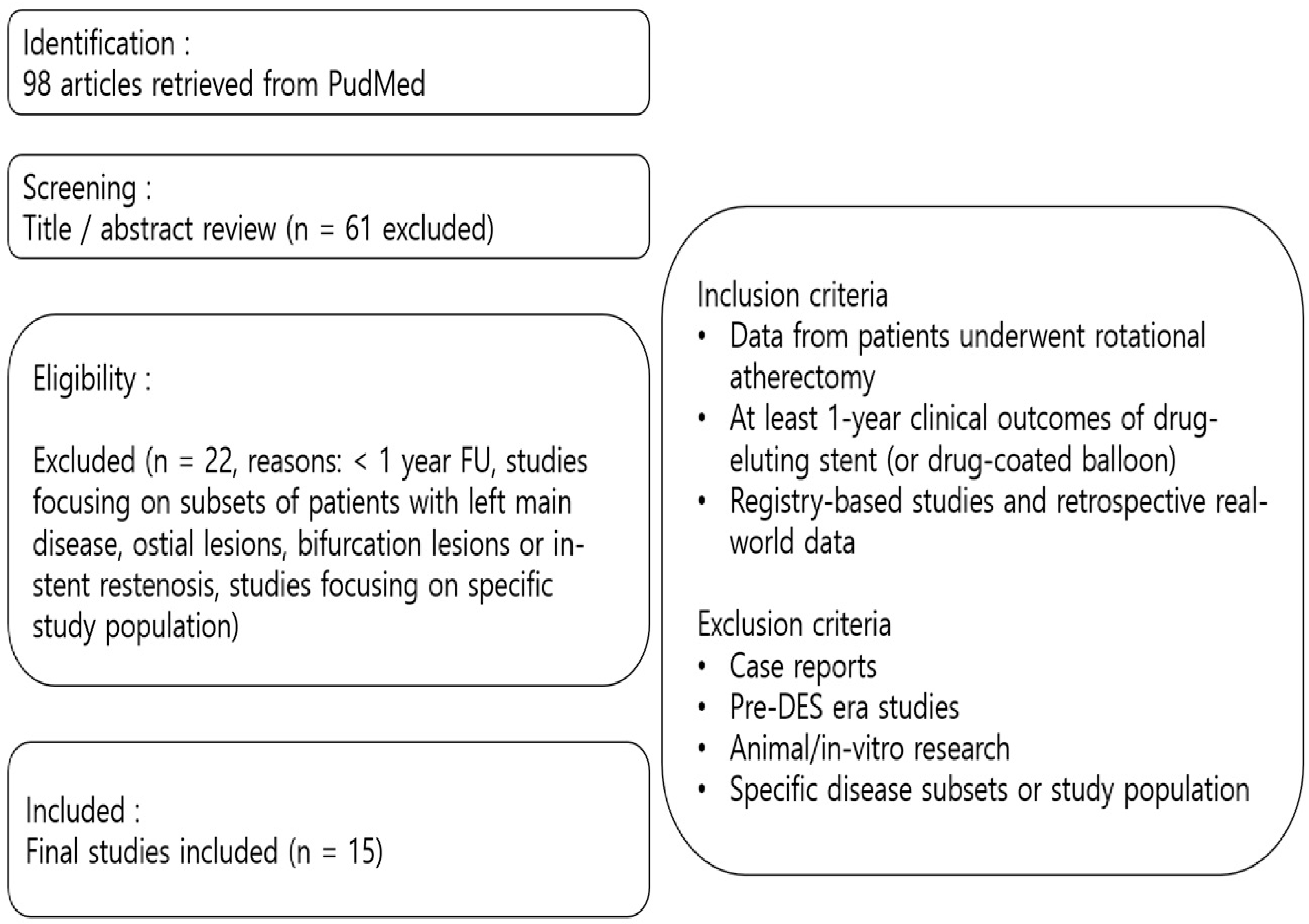
Background: The increasing prevalence of severe calcified coronary artery disease has expanded the role of rotational atherectomy (RA) in percutaneous coronary intervention (PCI). In the drug-eluting stent (DES) era, RA remains a key tool for complex lesion modification. This review focuses on its clinical outcomes and evolving indications. Methods: This review was conducted as a narrative review, focusing on the most relevant clinical studies regarding RA in the DES era. Articles were identified through a systematic PubMed search. Results: Comparing to early-generation DES, new-generation DES (NG-DES) demonstrate superior outcomes due to thinner struts and biocompatible polymers. RA plays a critical role in challenging scenarios, including chronic total occlusions and de novo small vessel lesions. Despite these advances, further randomized controlled trials are needed to validate the long-term safety and efficacy of RA-based strategies. Conclusions: This review highlights the clinical outcomes of RA in the DES era and its evolving role in contemporary cardiology. RA has shown promising potential for broader clinical applications in complex coronary artery disease. However, critical knowledge gaps remain. Further research is needed to refine RA-based strategies.
Keywords: percutaneous coronary intervention; rotational atherectomy; outcomes; indication percutaneous coronary intervention; rotational atherectomy; outcomes; indication