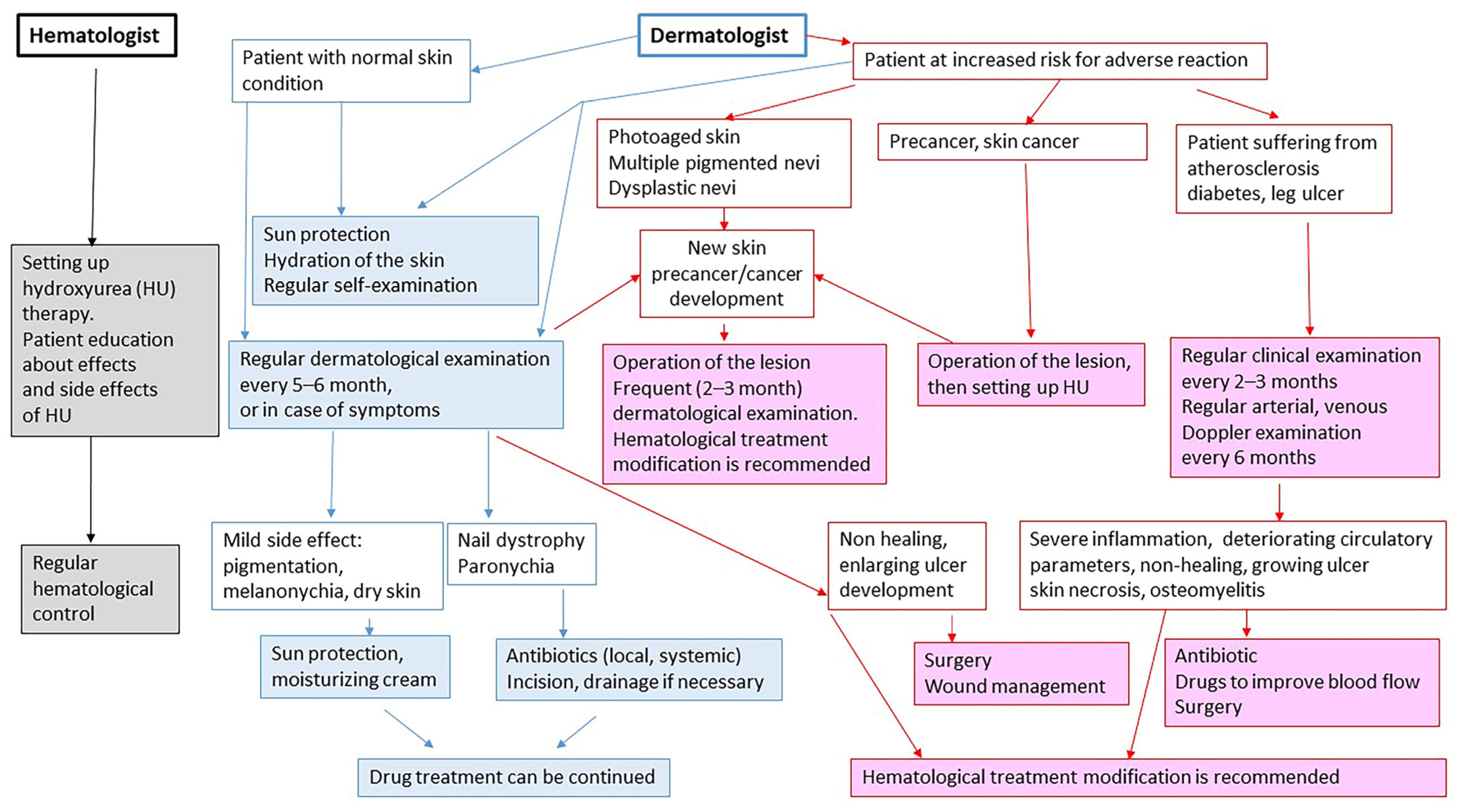
Limb Salvage After Deep Tissue Infection Associated with Hydroxyurea Therapy and Recommendations for a Follow-Up Protocol in Patients Treated with Hydroxyurea



Abstract
1. Introduction
2. Case Presentation
3. Discussion
3.1. Skin Lesions Induced by Hydroxyurea
3.2. Non-Healing Ulcer, Deep Tissue Involvement Associated with Hydroxyurea Therapy
4. Conclusions
Author Contributions
Funding
Institutional Review Board Statement
Informed Consent Statement
Data Availability Statement
Acknowledgments
Conflicts of Interest
Abbreviations
| CRP | C-reactive protein |
| HU | hydroxyurea |
| JAK | Janus kinase |
| WBC | white blood cell count |
References
- McGann, P.T.; Ware, R.E. Hydroxyurea therapy for sickle cell anemia. Expert Opin. Drug Saf. 2015, 14, 1749–1758. [Google Scholar] [CrossRef]
- Singh, A.; Xu, Y.J. The Cell Killing Mechanisms of Hydroxyurea. Genes 2016, 7, 99. [Google Scholar] [CrossRef]
- Yarbro, J.W. Mechanism of action of hydroxyurea. Semin. Oncol. 1992, 19 (Suppl. S9), 1–10. [Google Scholar]
- Morton, D.; Reed, L.; Huang, W.; Marcek, J.M.; Austin-LaFrance, R.; Northcott, C.A.; Schelling, S.H.; Enerson, B.E.; Tomlinson, L. Toxicity of hydroxyurea in rats and dogs. Toxicol. Pathol. 2015, 43, 498–512. [Google Scholar] [CrossRef]
- Kennedy, B.J.; Smith, L.R.; Goltz, R.W. Skin changes secondary to hydroxyurea therapy. Arch Dermatol. 1975, 111, 183–187. [Google Scholar] [CrossRef]
- Yanamandra, U.; Sahu, K.K.; Malhotra, P.; Varma, S. Photodermatosis secondary to hydroxyurea. BMJ Case Rep. 2014, 2014, bcr2014205974. [Google Scholar] [CrossRef]
- Bulte, C.A.; Hoegler, K.M.; Kutlu, O.; Khachemoune, A. Hydroxyurea: A reappraisal of its cutaneous side effects and their management. Int. J. Dermatol. 2021, 60, 810–817. [Google Scholar] [CrossRef]
- Xu, Y.; Liu, J. Hydroxyurea-induced cutaneous squamous cell carcinoma: A case report. World J. Clin. Cases 2019, 7, 4091–4097. [Google Scholar] [CrossRef] [PubMed]
- Best, P.J.; Daoud, M.S.; Pittelkow, M.R.; Petitt, R.M. Hydroxyurea-induced leg ulceration in 14 patients. Ann. Intern. Med. 1998, 128, 29–32. [Google Scholar] [CrossRef] [PubMed]
- Dissemond, J.; Korber, A. Hydroxyurea-induced ulcers on the leg. CMAJ 2009, 180, 1132. [Google Scholar] [CrossRef] [PubMed]
- Nguyen, T.V.; Margolis, D.J. Hydroxyurea and lower leg ulcers. Cutis 1993, 52, 217–219. [Google Scholar]
- Sirieix, M.E.; Debure, C.; Baudot, N.; Dubertret, L.; Roux, M.E.; Morel, P.; Frances, C.; Loubeyres, S.; Beylot, C.; Lambert, D.; et al. Leg ulcers and hydroxyurea: Forty-one cases. Arch. Dermatol. 1999, 135, 818–820. [Google Scholar] [CrossRef]
- Weinlich, G.; Schuler, G.; Greil, R.; Kofler, H.; Fritsch, P. Leg ulcers associated with long-term hydroxyurea therapy. J. Am. Acad. Dermatol. 1998, 39, 372–374. [Google Scholar] [CrossRef]
- Soya, E.; Makowski, C.; Blaise, S. Leg ulcer induced by hydroxycarbamide in sickle cell disease: What is the therapeutic impact? Int. Wound J. 2019, 16, 897–902. [Google Scholar] [CrossRef] [PubMed]
- Alshurafa, A.; Alkhatib, M.; Abu-Tineh, M.; Yassin, M.A. Sickle cell leg ulcer successfully managed by hyperbaric oxygen: A case report. Front. Med. 2023, 10, 1171971. [Google Scholar] [CrossRef] [PubMed]
- McKeage, K. Ruxolitinib: A Review in Polycythaemia Vera. Drugs 2015, 75, 1773–1781. [Google Scholar] [CrossRef] [PubMed]
- Esteve, E.; Roger, M.; Nguyen, P.; Kalis, B. A case for diagnosis: Ulceration of the skin caused by hydrea. Ann. Dermatol. Venereol. 1996, 123, 271–272. [Google Scholar]
- Stahl, R.L.; Silber, R. Vasculitic leg ulcers in chronic myelogenous leukemia. Am. J. Med. 1985, 78, 869–872. [Google Scholar] [CrossRef]
- Tarumoto, T.; Imagawa, S.; Hotta, T.; Ohmine, K.; Nagai, T.; Takatoku, M.; Komatsu, N.; Hatake, K.; Ozawa, K. A case of bilateral heel ulcers associated with hydroxyurea therapy for chronic myelogenous leukemia. Jpn. J. Clin. Oncol. 2000, 30, 159–162. [Google Scholar] [CrossRef]
- Montefusco, E.; Alimena, G.; Gastaldi, R.; Carlesimo, O.A.; Valesini, G.; Mandelli, F. Unusual dermatologic toxicity of long-term therapy with hydroxyurea in chronic myelogenous leukemia. Tumori 1986, 72, 317–321. [Google Scholar] [CrossRef]
- Lopes, F.C.; Ferreira, R.; Albuquerque, D.M.; Silveira, A.A.; Costa, R.; Soares, R.; Costa, F.F.; Conran, N. In vitro and in vivo anti-angiogenic effects of hydroxyurea. Microvasc. Res. 2014, 94, 106–113. [Google Scholar] [CrossRef]
- Boyd, A.S.; Neldner, K.H. Hydroxyurea therapy. J. Am. Acad. Dermatol. 1991, 25, 518–524. [Google Scholar] [CrossRef]
- Randi, M.L.; Ruzzon, E.; Tezza, F.; Luzzatto, G.; Fabris, F. Toxicity and side effects of hydroxyurea used for primary thrombocythemia. Platelets 2005, 16, 181–184. [Google Scholar] [CrossRef] [PubMed]
- Swain, D. Treating a rare foot ulcer caused by hydroxyurea. Podiatry Today 2014, 27. Available online: https://www.hmpgloballearningnetwork.com/site/podiatry/treating-rare-foot-ulcer-caused-hydroxyurea (accessed on 25 November 2025).
- Berlanga-Acosta, J.A.; Guillen-Nieto, G.E.; Rodriguez-Rodriguez, N.; Mendoza-Mari, Y.; Bringas-Vega, M.L.; Berlanga-Saez, J.O.; Garcia Del Barco Herrera, D.; Martinez-Jimenez, I.; Hernandez-Gutierrez, S.; Valdes-Sosa, P.A. Cellular Senescence as the Pathogenic Hub of Diabetes-Related Wound Chronicity. Front. Endocrinol. 2020, 11, 573032. [Google Scholar] [CrossRef] [PubMed]
- Beros, A.; Sluyter, J.; Scragg, R.K.R. Association of arterial stiffness and neuropathy in diabetes: A systematic review and meta-analysis. BMJ Open Diabetes Res. Care 2023, 11, e003140. [Google Scholar] [CrossRef]
- Swoboda, L.; Held, J. Impaired wound healing in diabetes. J. Wound Care 2022, 31, 882–885. [Google Scholar] [CrossRef]
- Polk, C.; Sampson, M.M.; Roshdy, D.; Davidson, L.E. Skin and Soft Tissue Infections in Patients with Diabetes Mellitus. Infect. Dis. Clin. N. Am 2021, 35, 183–197. [Google Scholar] [CrossRef]

Disclaimer/Publisher’s Note: The statements, opinions and data contained in all publications are solely those of the individual author(s) and contributor(s) and not of MDPI and/or the editor(s). MDPI and/or the editor(s) disclaim responsibility for any injury to people or property resulting from any ideas, methods, instructions or products referred to in the content. |
© 2025 by the authors. Licensee MDPI, Basel, Switzerland. This article is an open access article distributed under the terms and conditions of the Creative Commons Attribution (CC BY) license (https://creativecommons.org/licenses/by/4.0/).
Share and Cite
Badak, É.; Bodnár, E.; Virág, L.; Remenyik, É.; Szabó, É. Limb Salvage After Deep Tissue Infection Associated with Hydroxyurea Therapy and Recommendations for a Follow-Up Protocol in Patients Treated with Hydroxyurea. J. Clin. Med. 2025, 14, 8637. https://doi.org/10.3390/jcm14248637
Badak É, Bodnár E, Virág L, Remenyik É, Szabó É. Limb Salvage After Deep Tissue Infection Associated with Hydroxyurea Therapy and Recommendations for a Follow-Up Protocol in Patients Treated with Hydroxyurea. Journal of Clinical Medicine. 2025; 14(24):8637. https://doi.org/10.3390/jcm14248637
Chicago/Turabian StyleBadak, Éva, Edina Bodnár, László Virág, Éva Remenyik, and Éva Szabó. 2025. "Limb Salvage After Deep Tissue Infection Associated with Hydroxyurea Therapy and Recommendations for a Follow-Up Protocol in Patients Treated with Hydroxyurea" Journal of Clinical Medicine 14, no. 24: 8637. https://doi.org/10.3390/jcm14248637
APA StyleBadak, É., Bodnár, E., Virág, L., Remenyik, É., & Szabó, É. (2025). Limb Salvage After Deep Tissue Infection Associated with Hydroxyurea Therapy and Recommendations for a Follow-Up Protocol in Patients Treated with Hydroxyurea. Journal of Clinical Medicine, 14(24), 8637. https://doi.org/10.3390/jcm14248637