The Role of Complement Activation in Diabetic Nephropathy: Current Insights and Future Directions

Abstract
1. Introduction
2. DN Overview
- Renal hyperfunction and hypertrophy;
- Mesangial expansion;
- Onset of microalbuminuria;
- Overt proteinuria, which may or may not be accompanied by nodular glomerulosclerosis;
- End-stage fibrosis.
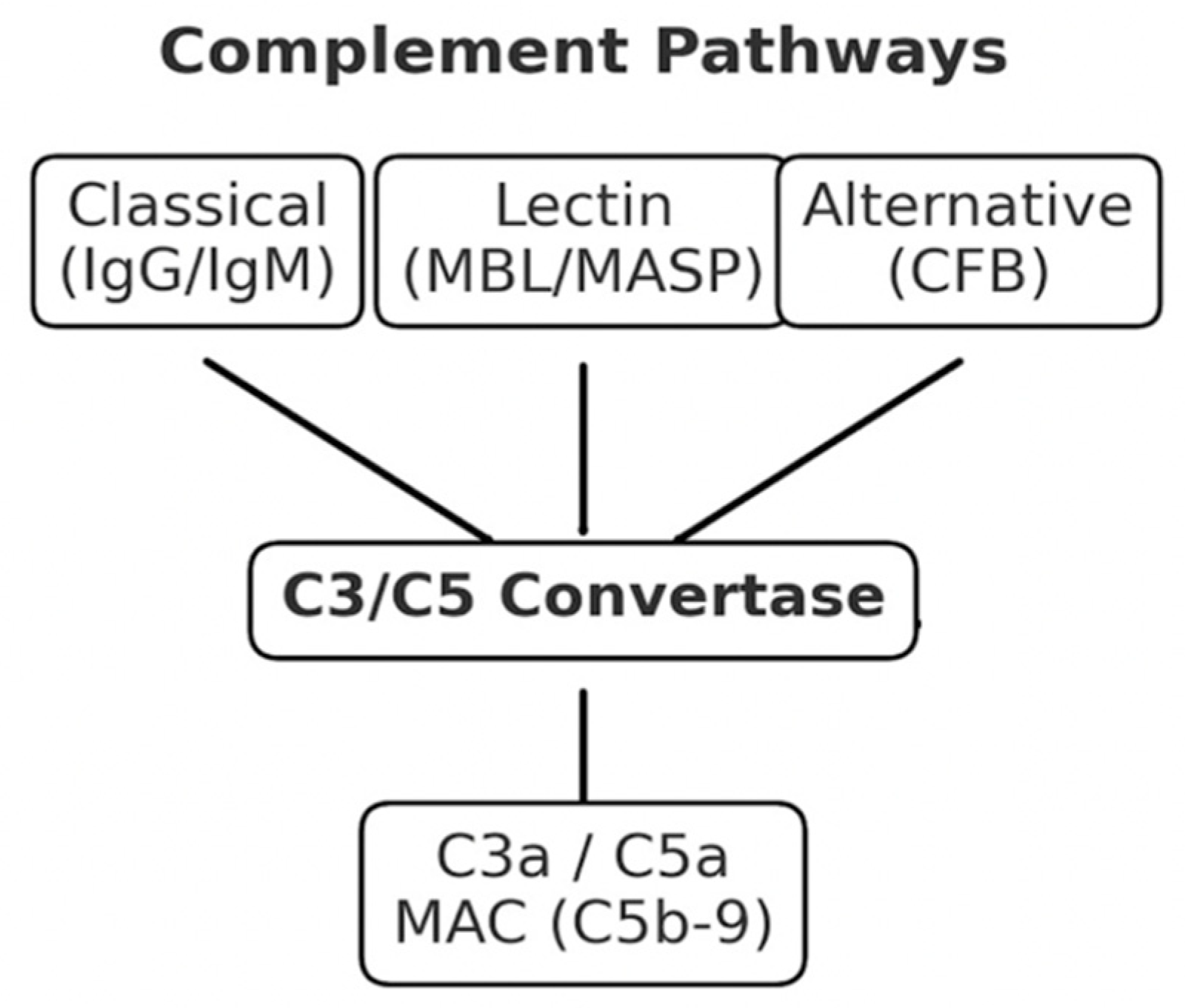
3. Complement System Overview
4. Pathway-Specific Activation in DN
5. The Lectin Pathway
6. Classical Pathway
7. Alternative Pathway
8. The Role of Effector and Regulatory Molecules in the Activation of the Complement System in DN
9. C3a and C5a Are Pro-Inflammatory and Profibrotic Anaphylatoxins
10. C5b-9 (Membrane Attack Complex)
11. C7 and Additional Regulatory Proteins
12. Urinary Proteomics: Non-Invasive Fingerprint of Intrarenal Complement Activation
13. Serum Proteomics: Complement Dysregulation and Disease Monitoring
14. Biopsy and Tissue Proteomics: Local Complement Synthesis in the Kidney
15. Integrated Interpretation and Clinical Implications
16. Metabolic–Complement Crosstalk in Diabetic Nephropathy
17. Conclusions
Author Contributions
Funding
Data Availability Statement
Acknowledgments
Conflicts of Interest
References
- Pavkov, M.E.; Collins, A.J.; Coresh, J.; Nelson, R.G. Kidney Disease in Diabetes. In Diabetes in America, 3rd ed.; Cowie, C.C., Casagrande, S.S., Menke, A., Eds.; National Institute of Diabetes and Digestive and Kidney Diseases (US): Bethesda, MD, USA, 2018; Chapter 22. [Google Scholar] [PubMed]
- Fineberg, D.; Jandeleit-Dahm, K.; Cooper, M. Diabetic Nephropathy: Diagnosis and Treatment. Nat. Rev. Endocrinol. 2013, 9, 713–723. [Google Scholar] [CrossRef]
- Webster, A.C.; Nagler, E.V.; Morton, R.L.; Masson, P. Chronic Kidney Disease. Lancet 2017, 389, 1238–1252. [Google Scholar] [CrossRef]
- Van der Meer, I.M.; Ruggenenti, P.; Remuzzi, G. The Diabetic CKD Patient—A Major Cardiovascular Challenge. J. Ren. Care 2010, 36 (Suppl. 1), 34–46. [Google Scholar] [CrossRef]
- Mallamaci, F.; Tripepi, G. Risk Factors of Chronic Kidney Disease Progression: Between Old and New Concepts. J. Clin. Med. 2024, 13, 678. [Google Scholar] [CrossRef]
- Krolewski, A.S. Progressive Renal Decline: The New Paradigm of Diabetic Nephropathy in Type 1 Diabetes. Diabetes Care 2015, 38, 954–962. [Google Scholar] [CrossRef]
- Parving, H.H.; Lewis, J.B.; Ravid, M.; Remuzzi, G.; Hunsicker, L.G. Prevalence and Risk Factors for Microalbuminuria in a Referred Cohort of Type II Diabetic Patients: A Global Perspective. Kidney Int. 2006, 69, 2057–2063. [Google Scholar] [CrossRef]
- Hou, G.; Dong, Y.; Jiang, Y.; Wenbo, Z.; Zhou, L.; Cao, S.; Li, W. Immune Inflammation and Metabolic Interactions in the Pathogenesis of Diabetic Nephropathy. Front. Endocrinol. 2025, 16, 1602594. [Google Scholar] [CrossRef]
- Jin, Q.; Liu, T.; Qiao, Y.; Liu, D.; Yang, L.; Mao, H.; Ma, F.; Wang, Y.; Peng, L.; Zhan, Y. Oxidative Stress and Inflammation in Diabetic Nephropathy: Role of Polyphenols. Front. Immunol. 2023, 14, 1185317. [Google Scholar] [CrossRef] [PubMed]
- Schleicher, E.D.; Weigert, C. Role of the Hexosamine Biosynthetic Pathway in Diabetic Nephropathy. Kidney Int. Suppl. 2000, 77, S13–S18. [Google Scholar] [CrossRef] [PubMed]
- Cao, Z.; Cooper, M.E. Pathogenesis of Diabetic Nephropathy. J. Diabetes Investig. 2011, 2, 243–247. [Google Scholar] [CrossRef] [PubMed]
- Singh, R.; Barden, A.; Mori, T.; Beilin, L. Advanced Glycation End-Products: A Review. Diabetologia 2001, 44, 129–146. [Google Scholar] [CrossRef] [PubMed]
- Yamagishi, S. Role of Advanced Glycation End Products (AGEs) and Receptor for AGEs (RAGE) in Vascular Damage in Diabetes. Exp. Gerontol. 2011, 46, 217–224. [Google Scholar] [CrossRef] [PubMed]
- Busch, M.; Franke, S.; Rüster, C.; Wolf, G. Advanced Glycation End-Products and the Kidney. Eur. J. Clin. Investig. 2010, 40, 742–755. [Google Scholar] [CrossRef]
- Axelgaard, E.; Østergaard, J.A.; Haxha, S.; Thiel, S.; Hansen, T.K. Global Autorecognition and Activation of Complement by Mannan-Binding Lectin in a Mouse Model of Type 1 Diabetes. Mediat. Inflamm. 2017, 2017, 9403754. [Google Scholar] [CrossRef]
- Hevey, R.; Pouw, R.B.; Harris, C.; Ricklin, D. Sweet Turning Bitter: Carbohydrate Sensing of Complement in Host Defence and Disease. Br. J. Pharmacol. 2021, 178, 2802–2822. [Google Scholar] [CrossRef] [PubMed]
- Ghosh, P.; Sahoo, R.; Vaidya, A.; Chorev, M.; Halperin, J.A. Role of Complement and Complement Regulatory Proteins in the Complications of Diabetes. Endocr. Rev. 2015, 36, 272–288. [Google Scholar] [CrossRef]
- Bus, P.; Chua, J.S.; Klessens, C.Q.F.; Zandbergen, M.; Wolterbeek, R.; van Kooten, C.; Trouw, L.A.; Bruijn, J.A.; Baelde, H.J. Complement Activation in Patients with Diabetic Nephropathy. Kidney Int. Rep. 2018, 3, 302–313. [Google Scholar] [CrossRef] [PubMed]
- Jiao, Y.; Jiang, S.; Wang, Y.; Yu, T.; Zou, G.; Zhuo, L.; Li, W. Activation of Complement C1q and C3 in Glomeruli Might Accelerate the Progression of Diabetic Nephropathy: Evidence from Transcriptomic Data and Renal Histopathology. J. Diabetes Investig. 2022, 13, 839–849. [Google Scholar] [CrossRef]
- Jiang, S.; Jiao, Y.; Zou, G.; Gao, H.; Zhuo, L.; Li, W. Activation of Complement Pathways in Kidney Tissue May Mediate Tubulointerstitial Injury in Diabetic Nephropathy. Front. Med. 2022, 9, 845679. [Google Scholar] [CrossRef]
- Woroniecka, K.I.; Park, A.S.D.; Mohtat, D.; Thomas, D.B.; Pullman, J.M.; Susztak, K. Transcriptome Analysis of Human Diabetic Kidney Disease. Diabetes 2011, 60, 2354–2369. [Google Scholar] [CrossRef]
- Genovese, F.; Jerums, G.; Hovind, P.; Macisaac, R.J.; Mischak, H.; Nielsen, S.E.; Panagiotopoulos, S.; Persson, F.; Rossing, P. Urinary Proteomics in Diabetic Nephropathy: Pathways, Biomarkers and Mechanistic Insights. Proteom. Clin. Appl. 2020, 14, e1900074. [Google Scholar]
- Deng, Y.; Li, N.; Wu, Y.; Wang, M.; Yang, S.; Zheng, Y.; Deng, X.; Xiang, D.; Zhu, Y.; Xu, P.; et al. Global, Regional, and National Burden of Diabetes-Related Chronic Kidney Disease From 1990 to 2019. Front. Endocrinol. 2021, 12, 672350. [Google Scholar] [CrossRef]
- Koye, D.N.; Magliano, D.J.; Nelson, R.G.; Pavkov, M.E. The Global Epidemiology of Diabetes and Kidney Disease. Adv. Chronic Kidney Dis. 2018, 25, 121–132. [Google Scholar] [CrossRef]
- Ghaderian, S.B.; Hayati, F.; Shayanpour, S.; Beladi Mousavi, S.S. Diabetes and End-Stage Renal Disease; A Review Article on New Concepts. J. Ren. Inj. Prev. 2015, 4, 28–33. [Google Scholar] [CrossRef] [PubMed]
- Hoogeveen, E.K. The Epidemiology of Diabetic Kidney Disease. Kidney Dial. 2022, 2, 433–442. [Google Scholar] [CrossRef]
- Mogensen, C.E.; Christensen, C.K.; Vittinghus, E. The Stages in Diabetic Renal Disease—With Emphasis on the Stage of Incipient Diabetic Nephropathy. Diabetes 1983, 32 (Suppl. 2), 64–78. [Google Scholar] [CrossRef] [PubMed]
- Krolewski, A.S.; Niewczas, M.A.; Skupien, J.; Gohda, T.; Smiles, A.; Eckfeldt, J.H.; Doria, A.; Warram, J.H. Early Progressive Renal Decline Precedes the Onset of Microalbuminuria and Its Progression to Macroalbuminuria. Diabetes Care 2014, 37, 226–234. [Google Scholar] [CrossRef]
- Vistisen, D.; Andersen, G.S.; Hulman, A.; Persson, F.; Rossing, P.; Jørgensen, M.E. Progressive Decline in Estimated Glomerular Filtration Rate in Patients with Diabetes After Moderate Loss in Kidney Function—Even Without Albuminuria. Diabetes Care 2019, 42, 1886–1894. [Google Scholar] [CrossRef]
- Tang, W.-H.; Hung, W.-C.; Wang, C.-P.; Wu, C.-C.; Hsuan, C.-F.; Yu, T.-H.; Hsu, C.-C.; Cheng, Y.-A.; Chung, F.-M.; Lee, Y.-J.; et al. The Lower Limit of Reference of Urinary Albumin/Creatinine Ratio and the Risk of Chronic Kidney Disease Progression in Patients with Type 2 Diabetes Mellitus. Front. Endocrinol. 2022, 13, 858267. [Google Scholar] [CrossRef]
- Kang, Y.S.; Cha, J.J.; Hyun, Y.Y.; Cha, D.R. Novel Therapeutic Perspectives in Diabetic Nephropathy. Immune Netw. 2018, 18, e18. [Google Scholar]
- Flyvbjerg, A. The Role of the Complement System in Diabetic Nephropathy. Nat. Rev. Nephrol. 2017, 13, 311–318. [Google Scholar] [CrossRef] [PubMed]
- Li, X.-Q.; Chang, D.-Y.; Chen, M.; Zhao, M.-H. Complement Activation in Patients with Diabetic Nephropathy. Diabetes Metab. 2019, 45, 248–253. [Google Scholar] [CrossRef] [PubMed]
- Saran, R.; Robinson, B.; Abbott, K.C.; Agodoa, L.Y.C.; Albertus, P.; Ayanian, J.; Balkrishnan, R.; Bragg-Gresham, J.; Cao, J.; Chen, J.L.T.; et al. US Renal Data System 2019 Annual Data Report: Epidemiology of Kidney Disease in the United States. Am. J. Kidney Dis. 2020, 75 (Suppl. 1), A6–A7. [Google Scholar] [CrossRef]
- American Diabetes Association Professional Practice Committee. 2. Diagnosis and Classification of Diabetes: Standards of Care in Diabetes—2025. Diabetes Care 2025, 48 (Suppl. 1), S27–S49. [Google Scholar] [CrossRef]
- Satirapoj, B.; Adler, S.G. Prevalence and Management of Diabetic Nephropathy in Western Countries. Kidney Dis. 2015, 1, 61–70. [Google Scholar] [CrossRef]
- Walport, M.J. Complement. First of Two Parts. N. Engl. J. Med. 2001, 344, 1058–1066. [Google Scholar] [CrossRef] [PubMed]
- Barnum, S.R.; Schein, T.N. (Eds.) The Complement Facts Book, 2nd ed.; Academic Press: Cambridge, MA, USA, 2018. [Google Scholar]
- Mathern, D.R.; Heeger, P.S. Molecules Great and Small: The Complement System. Clin. J. Am. Soc. Nephrol. 2015, 10, 1636–1650. [Google Scholar] [CrossRef]
- Merle, N.S.; Church, S.E.; Fremeaux-Bacchi, V.; Roumenina, L.T. Complement System Part I—Molecular Mechanisms of Activation and Regulation. Front. Immunol. 2015, 6, 262. [Google Scholar] [CrossRef]
- Dunkelberger, J.; Song, W.C. Complement and Its Role in Innate and Adaptive Immune Responses. Cell Res. 2010, 20, 34–50. [Google Scholar] [CrossRef]
- Garred, P.; Genster, N.; Pilely, K.; Bayarri-Olmos, R.; Rosbjerg, A.; Ma, Y.J.; Skjoedt, M.-O. A Journey through the Lectin Pathway of Complement—MBL and Beyond. Immunol. Rev. 2016, 274, 74–97. [Google Scholar] [CrossRef]
- Thiel, S. Complement Activating Soluble Pattern Recognition Molecules with Collagen-Like Regions, MBL, Ficolins and CL-11, and Their Roles in Complement Activation. Immunobiology 2007, 212, 322–335. [Google Scholar]
- Banda, N.K.; Takahashi, M.; Takahashi, K.; Stahl, G.L.; Hyatt, S.; Glogowska, M.; Wiles, T.A.; Endo, Y.; Fujita, T.; Holers, V.M.; et al. Mechanisms of Mannose-Binding Lectin-Associated Serine Proteases-1/3 Activation of the Alternative Pathway of Complement. Mol. Immunol. 2011, 49, 281–289. [Google Scholar] [CrossRef]
- Harboe, M.; Mollnes, T.E. The Alternative Complement Pathway Revisited. J. Cell. Mol. Med. 2008, 12, 1074–1084. [Google Scholar] [CrossRef] [PubMed]
- Ricklin, D.; Hajishengallis, G.; Yang, K.; Lambris, J.D. Complement: A Key System for Immune Surveillance and Homeostasis. Nat. Immunol. 2010, 11, 785–797. [Google Scholar] [CrossRef] [PubMed]
- Zipfel, P.F.; Skerka, C. Complement Regulators and Inhibitory Proteins. Nat. Rev. Immunol. 2009, 9, 729–740. [Google Scholar] [CrossRef] [PubMed]
- Axelgaard, E.; Østergaard, J.A.; Thiel, S.; Hansen, T.K. Diabetes Is Associated with Increased Autoreactivity of Mannan-Binding Lectin. J. Diabetes Res. 2017, 2017, 6368780. [Google Scholar] [CrossRef]
- Hansen, T.K.; Tarnow, L.; Thiel, S.; Steffensen, R.; Parving, H.H.; Flyvbjerg, A. Association between Mannose-Binding Lectin and Diabetic Nephropathy: A Review of Clinical and Experimental Findings. Clin. Immunol. 2004, 111, 128–133. [Google Scholar]
- Gaya da Costa, M.; Poppelaars, F.; Berger, S.P.; Daha, M.R.; Seelen, M.A. The Lectin Pathway in Renal Disease: Old Concept and New Insights. Nephrol. Dial. Transplant. 2018, 33, 2073–2079. [Google Scholar] [CrossRef]
- Thurman, J.M. Complement in Kidney Disease: Core Concepts and Clinical Implications. Semin. Nephrol. 2013, 33, 543–554. [Google Scholar]
- Ling, M.; Murali, M. Analysis of the Complement System in the Clinical Immunology Laboratory. Clin. Lab. Med. 2019, 39, 579–590. [Google Scholar] [CrossRef]
- Zhao, S.Q.; Hu, Z. Mannose-Binding Lectin and Diabetic Nephropathy in Type 1 Diabetes. J. Clin. Lab. Anal. 2016, 30, 345–350. [Google Scholar] [CrossRef] [PubMed]
- Ninichuk, V.; Clauss, S.; Kulkarni, O.; Anders, H.J. Tubular Atrophy, Interstitial Fibrosis and Complement Activation in Diabetic Nephropathy. Am. J. Pathol. 2007, 170, 1219–1229. [Google Scholar]
- Martin, M.; Blom, A.M. Complement in the Kidney: New Perspectives on an Old Theme. Nat. Rev. Nephrol. 2016, 12, 417–430. [Google Scholar]
- Dobó, J.; Kocsis, A.; Farkas, B.; Demeter, F.; Cervenak, L.; Gál, P. The Lectin Pathway of the Complement System—Activation, Regulation, Disease Connections and Interplay with Other (Proteolytic) Systems. Int. J. Mol. Sci. 2024, 25, 1566. [Google Scholar] [CrossRef] [PubMed]
- Cedzyński, M.; Kilpatrick, D.C.; Świerzko, A.S. Mannose-Binding Lectin. In The Complement FactsBook, 2nd ed.; Barnum, S., Schein, T., Eds.; Academic Press: London, UK, 2018; pp. 33–43. [Google Scholar]
- Cai, K.; Ma, Y.; Wang, J.; Nie, W.; Guo, J.; Zhang, M.; Yang, Y.; Chen, J.; Han, F. Mannose-Binding Lectin Activation Is Associated with the Progression of Diabetic Nephropathy in Type 2 Diabetes Mellitus Patients. Ann. Transl. Med. 2020, 8, 1399. [Google Scholar] [CrossRef]
- Sogawa, Y.; Nagasu, H.; Kidokoro, K.; Itano, S.; Hirakawa, Y.; Takahashi, M.; Kuwagata, S.; Satoh, M.; Sasaki, T.; Sasaki, Y. Urinary Complement Components as Novel Biomarkers for Diabetic Nephropathy. Diabetes Res. Clin. Pract. 2021, 173, 108682. [Google Scholar]
- Guan, L.Z.; Tong, Q.; Xu, J. Elevated Serum Levels of Mannose-Binding Lectin and Diabetic Nephropathy in Type 2 Diabetes. PLoS ONE 2015, 10, e0119699. [Google Scholar] [CrossRef]
- Rizvi, S.; Raza, S.T.; Mahdi, F. Association of Genetic Variants with Diabetic Nephropathy. World J. Diabetes 2014, 5, 809–816. [Google Scholar] [CrossRef]
- Zhang, N.; Zhuang, M.; Ma, A.; Wang, G.; Cheng, P.; Yang, Y.; Wang, X.; Zhang, J.; Chen, X.; Lu, M. Association of Levels of Mannose-Binding Lectin and the MBL2 Gene with Type 2 Diabetes and Diabetic Nephropathy. PLoS ONE 2013, 8, e83059. [Google Scholar] [CrossRef]
- Huang, Y.; Xu, J.; Wu, X.; Chen, X.; Bai, X.; Zhuang, Y.; Fang, J.; Lin, X. High Expression of Complement Components in the Kidneys of Type 2 Diabetic Rats with Diabetic Nephropathy. Front. Endocrinol. 2019, 10, 459. [Google Scholar] [CrossRef]
- Abdelwahab, M.M.; Mohammed, E.M.; Hussein, S.; Elsisy, R.I.I.; Mahmoud, H.M. Urinary and Tissue Immunohistochemical Expression of Complement Activation Products among Diabetic Nephropathy Patients in Different Stages. Egypt. J. Hosp. Med. 2022, 89, 7009–7018. [Google Scholar] [CrossRef]
- Sun, Z.-J.; Li, X.-Q.; Chang, D.-Y.; Wang, S.-X.; Liu, G.; Chen, M.; Zhao, M.-H. Complement Deposition on Renal Histopathology of Patients with Diabetic Nephropathy. Diabetes Metab. 2019, 45, 363–368. [Google Scholar] [CrossRef]
- Jiang, S.; Di, D.; Yuanyuan, J.; Guming, Z.; Hongmei, G.; Wenge, L. Complement Deposition Predicts Worsening Kidney Function and Underlines the Clinical Significance of the 2010 Renal Pathology Society Classification of Diabetic Nephropathy. Front. Immunol. 2022, 13, 868127. [Google Scholar] [CrossRef]
- Imai, N.; Nishi, S.; Alchi, B.; Ueno, M.; Fukase, S.; Arakawa, M.; Saito, K.; Takahashi, K.; Gejyo, F. Immunohistochemical Evidence of Activated Lectin Pathway in Kidney Allografts with Peritubular Capillary C4d Deposition. Nephrol. Dial. Transplant. 2006, 21, 2589–2595. [Google Scholar] [CrossRef]
- Noris, M.; Remuzzi, G. Overview of Complement Activation and Regulation. Semin. Nephrol. 2013, 33, 479–492. [Google Scholar] [CrossRef]
- Lu, Q.; Hou, Q.; Cao, K.; Sun, X.; Liang, Y.; Gu, M.; Xue, X.; Zhao, A.Z.; Dai, C. Complement Factor B in High Glucose-Induced Podocyte Injury and Diabetic Kidney Disease. JCI Insight 2021, 6, e147716. [Google Scholar] [CrossRef] [PubMed]
- Xin, Y.; Hertle, E.; van der Kallen, C.J.H.; Schalkwijk, C.G.; Stehouwer, C.D.; van Greevenbroek, M.M. Associations of Dicarbonyl Stress with Complement Activation: The CODAM Study. Diabetologia 2020, 63, 1032–1042. [Google Scholar] [CrossRef]
- Rossing, K.; Mischak, H.; Parving, H.H.; Christensen, P.K.; Walden, M.; Hillmann, M.; Zürbig, P.; Novak, J.; Good, D.M.; Delles, C.; et al. Urinary Proteomics in Diabetes and CKD: Diabetic Nephropathy Revisited. Nephrol. Dial. Transplant. 2008, 23, 4060–4066. [Google Scholar]
- Pontillo, C.; Filip, S.; Borràs, D.M.; Mullen, W.; Vlahou, A.; Mischak, H. CE-MS-Based Proteomics in Biomarker Discovery and Clinical Application. Proteomics Clin. Appl. 2015, 9, 322–334. [Google Scholar] [CrossRef]
- Zürbig, P.; Mischak, H. Capillary Electrophoresis Coupled to Mass Spectrometry for Biomarker Discovery and Diagnosis of Kidney Diseases. Contrib. Nephrol. 2008, 160, 107–126. [Google Scholar] [CrossRef] [PubMed]
- Zheng, J.M.; Jiang, Z.H.; Chen, D.J.; Wang, S.S.; Zhao, W.J.; Li, L.J. Pathological Significance of Urinary Complement Activation in Diabetic Nephropathy: A Full View from the Development of the Disease. J. Diabetes Investig. 2019, 10, 738–744. [Google Scholar] [CrossRef] [PubMed]
- Zhao, L.; Zhang, Y.; Liu, F.; Yang, H.; Zhong, Y.; Wang, Y.; Li, S.; Su, Q.; Tang, L.; Bai, L.; et al. Urinary Complement Proteins and Risk of End-Stage Renal Disease: Quantitative Urinary Proteomics in Patients with Type 2 Diabetes and Biopsy-Proven Diabetic Nephropathy. J. Endocrinol. Investig. 2021, 44, 2709–2723. [Google Scholar] [CrossRef] [PubMed]
- Shadid, A.; Hok, K.D.; Domozhirov, A.Y.; Weng-Mills, T.; Doursout, M.F.; Banda, N.K.; Restrepo, M.I.; Shivshankar, P. Enigmatic Roles of Complement Anaphylatoxin Signaling in Health and Disease. Immune Netw. 2025, 25, e32. [Google Scholar] [CrossRef]
- Morita, Y.; Ikeguchi, H.; Nakamura, J.; Hotta, N.; Yuzawa, Y.; Matsuo, S. Complement Activation Products in the Urine from Proteinuric Patients. J. Am. Soc. Nephrol. 2000, 11, 700–707. [Google Scholar] [CrossRef]
- Zürbig, P.; Jerums, G.; Hovind, P.; MacIsaac, R.J.; Mischak, H.; Nielsen, S.E.; Panagiotopoulos, S.; Persson, F.; Rossing, P. Urinary Proteomics for Early Diagnosis in Diabetic Nephropathy. Diabetes 2012, 61, 3304–3313. [Google Scholar] [CrossRef] [PubMed]
- Kissling, S.; Schwotzer, N.; Moser, M.; Froissart, M.; Fakhouri, F. Urinary sC5b-9 Is Better Linked to Albuminuria Than to Intrarenal Inflammation in Common Kidney Disease. Kidney Int. Rep. 2024, 9, 3335–3337. [Google Scholar] [CrossRef]
- Peng, Q.; Li, K.; Sacks, S.H.; Zhou, W. The Role of Anaphylatoxins C3a and C5a in Regulating Innate and Adaptive Immune Responses. Inflamm. Allergy Drug Targets 2009, 8, 236–246. [Google Scholar] [CrossRef]
- Ahmed, S.; Alsayed, A.; Aref, M.; Alkot, A. Complement 3a and Complement 5a as Biochemical Markers in Diabetic Nephropathy. Int. J. Med. Arts 2024, 6, 4597–4606. [Google Scholar] [CrossRef]
- Gao, S.; Cui, Z.; Zhao, M.H. The Complement C3a and C3a Receptor Pathway in Kidney Diseases. Front. Immunol. 2020, 11, 1875. [Google Scholar] [CrossRef]
- Buelli, S.; Imberti, B.; Morigi, M. The Complement C3a and C5a Signaling in Renal Diseases: A Bridge between Acute and Chronic Inflammation. Nephron 2024, 148, 712–723. [Google Scholar] [CrossRef]
- Peng, Q.; Wu, W.; Wu, K.Y.; Cao, B.; Qiang, C.; Li, K.; Sacks, S.H.; Zhou, W. The C5a/C5aR1 Axis Promotes Progression of Renal Tubulointerstitial Fibrosis in a Mouse Model of Renal Ischemia/Reperfusion Injury. Kidney Int. 2019, 96, 117–128. [Google Scholar] [CrossRef] [PubMed]
- Yiu, W.H.; Li, R.X.; Wong, D.W.L.; Wu, H.J.; Chan, K.W.; Chan, L.Y.Y.; Leung, J.C.K.; Lai, K.N.; Sacks, S.H.; Zhou, W.; et al. Complement C5a Inhibition Moderates Lipid Metabolism and Reduces Tubulointerstitial Fibrosis in Diabetic Nephropathy. Nephrol. Dial. Transplant. 2018, 33, 1323–1332. [Google Scholar] [CrossRef] [PubMed]
- Tan, S.M.; Snelson, M.; Østergaard, J.A.; Coughlan, M.T. The Complement Pathway: New Insights into Immunometabolic Signaling in Diabetic Kidney Disease. Antioxid. Redox Signal. 2022, 37, 781–801. [Google Scholar] [CrossRef]
- Li, H.D.; You, Y.K.; Shao, B.Y.; Wu, W.F.; Wang, Y.F.; Guo, J.B.; Meng, X.M.; Chen, H. Roles and Crosstalks of Macrophages in Diabetic Nephropathy. Front. Immunol. 2022, 13, 1015142. [Google Scholar] [CrossRef]
- Atanes, P.; Ruz-Maldonado, I.; Pingitore, A.; Hawkes, R.; Liu, B.; Zhao, M.; Huang, G.C.; Persaud, S.J.; Amisten, S. C3aR and C5aR1 act as key regulators of human and mouse beta-cell function. Cell. Mol. Life Sci. 2018, 75, 715–726. [Google Scholar] [CrossRef]
- Tang, Z.; Lu, B.; Hatch, E.; Sacks, S.H.; Sheerin, N.S. C3a Mediates Epithelial-to-Mesenchymal Transition in Proteinuric Nephropathy. J. Am. Soc. Nephrol. 2009, 20, 593–603. [Google Scholar] [CrossRef]
- Koopman, J.J.E.; van Essen, M.F.; Rennke, H.G.; de Vries, A.P.J.; van Kooten, C. Deposition of the Membrane Attack Complex in Healthy and Diseased Human Kidneys. Front. Immunol. 2021, 11, 599974. [Google Scholar] [CrossRef]
- Qiu, W.; Zhang, Y.; Liu, X.; Zhou, J.; Li, Y.; Zhou, Y.; Shan, K.; Xia, M.; Che, N.; Feng, X.; et al. Sublytic C5b-9 Complexes Induce Proliferative Changes of Glomerular Mesangial Cells in Rat Thy-1 Nephritis through TRAF6-Mediated PI3K-Dependent Akt1 Activation. J. Pathol. 2012, 226, 619–632. [Google Scholar] [CrossRef]
- Morita, Y.; Ikeguchi, H.; Nakamura, J.; Hotta, N. Sublytic C5b-9 Induces Transforming Growth Factor-β Expression and Promotes Sclerosis in Rat Glomeruli. Am. J. Pathol. 2005, 166, 1781–1790. [Google Scholar]
- Gao, L.; Zhang, Y.; Qiu, W.; Xu, W.; Feng, X.; Ren, J.; Jiang, X.; Wang, H.; Zhao, D.; Wang, Y. Effects of PI3-K/Akt Short Hairpin RNA on Proliferation, Fibronectin Production and Synthesis of Thrombospondin-1 and Transforming Growth Factor-β1 in Glomerular Mesangial Cells Induced by Sublytic C5b-9 Complexes. Cell Prolif. 2009, 42, 83–93. [Google Scholar] [CrossRef] [PubMed]
- Liu, Y. Cellular and Molecular Mechanisms of Renal Fibrosis. Nat. Rev. Nephrol. 2011, 7, 684–696. [Google Scholar] [CrossRef]
- Kendall, R.T.; Feghali-Bostwick, C.A. Fibroblasts in Fibrosis: Novel Roles and Mediators. Front. Pharmacol. 2014, 5, 123. [Google Scholar] [CrossRef]
- Mayorca-Guiliani, A.E.; Leeming, D.J.; Henriksen, K.; Mortensen, J.H.; Nielsen, S.H.; Anstee, Q.M.; Sanyal, A.J.; Karsdal, M.A.; Schuppan, D. ECM Formation and Degradation during Fibrosis, Repair, and Regeneration. NPJ Metab. Health Dis. 2025, 3, 25. [Google Scholar] [CrossRef]
- Wijaya, C.; Burns, C.; Hall, S.; Farmer, M.; Jones, D.; Rowlandson, M.; Choi, P.; Formby, M.; de Malmanche, T. Measurement of Complement Activation via Plasma-Soluble C5b-9: Comparison with Terminal Complement Complex Staining in a Series of Kidney Biopsies. Kidney Blood Press. Res. 2023, 48, 220–230. [Google Scholar] [CrossRef]
- Sircar, M.; Rosales, I.A.; Selig, M.K.; Xu, D.; Zsengeller, Z.K.; Stillman, I.E.; Libermann, T.A.; Karumanchi, S.A.; Thadhani, R.I. Complement 7 Is Up-Regulated in Human Early Diabetic Kidney Disease. Am. J. Pathol. 2018, 188, 2147–2154. [Google Scholar] [CrossRef]
- Guo, H.; Yan, Z.; Hu, Y.; Huang, X.; Pan, C. Complement C7 Is Specifically Expressed in Mesangial Cells and Is a Potential Diagnostic Biomarker for Diabetic Nephropathy and Is Regulated by miR-494-3p and miR-574-5p. Diabetes Metab. Syndr. Obes. 2021, 14, 3077–3088. [Google Scholar] [CrossRef] [PubMed]
- Qin, X.; Goldfine, A.; Krumrei, N.; Grubissich, L.; Acosta, J.; Chorev, M.; Hays, A.P.; Halperin, J.A. Glycation Inactivation of the Complement Regulatory Protein CD59: A Possible Role in the Pathogenesis of the Vascular Complications of Human Diabetes. Diabetes 2004, 53, 2653–2661. [Google Scholar] [CrossRef] [PubMed]
- Ghosh, P.; Vaidya, A.; Sahoo, R.; Goldfine, A.; Herring, N.; Bry, L.; Chorev, M.; Halperin, J.A. Glycation of the Complement Regulatory Protein CD59 Is a Novel Biomarker for Glucose Handling in Humans. J. Clin. Endocrinol. Metab. 2014, 99, E999–E1006. [Google Scholar] [CrossRef]
- Mizuno, M.; Suzuki, Y.; Ito, Y. Complement Regulation and Kidney Diseases: Recent Knowledge of the Double-Edged Roles of Complement Activation in Nephrology. Clin. Exp. Nephrol. 2018, 22, 3–14. [Google Scholar] [CrossRef] [PubMed]
- Pelletier, K.; Bonnefoy, A.; Chapdelaine, H.; Pichette, V.; Lejars, M.; Madore, F.; Brachemi, S.; Troyanov, S. Clinical Value of Complement Activation Biomarkers in Overt Diabetic Nephropathy. Kidney Int. Rep. 2019, 4, 797–805. [Google Scholar] [CrossRef]
- Alsaad, K.O.; Herzenberg, A.M. Distinguishing Diabetic Nephropathy from Other Causes of Glomerulosclerosis: An Update. J. Clin. Pathol. 2007, 60, 18–26. [Google Scholar] [CrossRef]
- Drachenberg, C.B.; Papadimitriou, J.C.; Chandra, P.; Haririan, A.; Mendley, S.; Weir, M.R.; Rubin, M.F. Epidemiology and Pathophysiology of Glomerular C4d Staining in Native Kidney Biopsies. Kidney Int. Rep. 2019, 4, 1555–1567. [Google Scholar] [CrossRef]
- Rayego-Mateos, S.; Morgado-Pascual, J.L.; Opazo-Ríos, L.; Guerrero-Hue, M.; García-Caballero, C.; Vázquez-Carballo, C.; Mas, S.; Sanz, A.B.; Herencia, C.; Mezzano, S.; et al. Pathogenic Pathways and Therapeutic Approaches Targeting Inflammation in Diabetic Nephropathy. Int. J. Mol. Sci. 2020, 21, 3798. [Google Scholar] [CrossRef]
- Guo, Y.; Song, Z.; Zhou, M.; Yang, Y.; Zhao, Y.; Liu, B.; Zhang, X. Infiltrating Macrophages in Diabetic Nephropathy Promote Podocyte Apoptosis via the TNF-α–ROS–p38MAPK Pathway. Oncotarget 2017, 8, 53276–53287. [Google Scholar] [CrossRef]
- Kesarwani, V.; Bukhari, M.H.; Kahlenberg, J.M.; Wang, S. Urinary Complement Biomarkers in Immune-Mediated Kidney Diseases. Front. Immunol. 2024, 15, 1357869. [Google Scholar] [CrossRef]
- Mühlig, A.K.; Keir, L.S.; Abt, J.C.; Heidelbach, H.S.; Horton, R.; Welsh, G.I.; Meyer-Schwesinger, C.; Licht, C.; Coward, R.J.; Fester, L.; et al. Podocytes Produce and Secrete Functional Complement C3 and Complement Factor H. Front. Immunol. 2020, 11, 1833. [Google Scholar] [CrossRef]
- Yang, Z.; Chen, L.; Huang, Y.; Dong, J.; Yan, Q.; Li, Y.; Qiu, J.; Li, H.; Zhao, D.; Liu, F.; et al. Proteomic Profiling of Laser Capture Microdissection Kidneys from Diabetic Nephropathy Patients. J. Chromatogr. B Analyt. Technol. Biomed. Life Sci. 2024, 1243, 124231. [Google Scholar] [CrossRef] [PubMed]
- Tserga, A.; Saulnier-Blache, J.S.; Palamaris, K.; Pouloudi, D.; Gakiopoulou, H.; Zoidakis, J.; Schanstra, J.P.; Vlahou, A.; Makridakis, M. Complement Cascade Proteins Correlate with Fibrosis and Inflammation in Early-Stage Type 1 Diabetic Kidney Disease in the Ins2Akita Mouse Model. Int. J. Mol. Sci. 2024, 25, 1387. [Google Scholar] [CrossRef] [PubMed]
- Wilson, P.C.; Wu, H.; Kirita, Y.; Uchimura, K.; Ledru, N.; Rennke, H.G.; Welling, P.A.; Waikar, S.S.; Humphreys, B.D. The Single-Cell Transcriptomic Landscape of Early Human Diabetic Nephropathy. Proc. Natl. Acad. Sci. USA 2019, 116, 19619–19625. [Google Scholar] [CrossRef] [PubMed]
- Sari-Ak, D.; Con, F.; Helvaci, N.; Yelkenci, H.E.; Kural, A.; Can, O.; Beker, M.C. Exploring the Proteomic Signature of Diabetic Nephropathy: Implications for Early Diagnosis and Treatment. Life 2025, 15, 1312. [Google Scholar] [CrossRef]


| Complement Component | Pathway/Function | Role in DN |
|---|---|---|
| C1q/C4/C2 | Classical pathway initiation | Activated by glycated or oxidised self-antigens; promotes glomerular inflammation. |
| MBL/MASP-1/MASP-2 | Lectin pathway | High levels in diabetic serum and kidneys; correlation with albuminuria and DN progression. |
| C3 | Central activation molecule (all pathways) | Overexpressed in glomeruli and tubules; C3a drives inflammation and fibrosis; urinary C3 fragments predict eGFR decline. |
| C5/C5a/C5b-9 (MAC) | Terminal phase | Promotes mesangial and tubular injury; sublytic MAC induces cytokine and extracellular matrix production. |
| C7 | MAC component | Anchors MAC to cell membranes; overexpressed in DN, linked to glomerular and interstitial damage. |
| Factor B/Properdin | Alternative pathway amplification | Upregulated in diabetic kidneys; enhances C3 convertase stability and local complement deposition. |
| Factor H | Soluble regulator of the alternative pathway | Glycation impairs function, leading to uncontrolled complement activation; reduced serum and urinary levels in DN. |
| CD55 (DAF) | Membrane-bound inhibitor of C3/C5 convertases | Downregulated under hyperglycemia; its loss of expression increases complement-mediated cytotoxicity. |
| CD59 | Membrane-bound inhibitor of MAC formation | Reduced expression in diabetic kidneys; loss of expression correlates with C5b-9 deposition and fibrosis severity. |
Disclaimer/Publisher’s Note: The statements, opinions and data contained in all publications are solely those of the individual author(s) and contributor(s) and not of MDPI and/or the editor(s). MDPI and/or the editor(s) disclaim responsibility for any injury to people or property resulting from any ideas, methods, instructions or products referred to in the content. |
© 2025 by the authors. Licensee MDPI, Basel, Switzerland. This article is an open access article distributed under the terms and conditions of the Creative Commons Attribution (CC BY) license (https://creativecommons.org/licenses/by/4.0/).
Share and Cite
Kotsalas, N.; Fouza, A.; Daoudaki, M. The Role of Complement Activation in Diabetic Nephropathy: Current Insights and Future Directions. J. Clin. Med. 2025, 14, 8589. https://doi.org/10.3390/jcm14238589
Kotsalas N, Fouza A, Daoudaki M. The Role of Complement Activation in Diabetic Nephropathy: Current Insights and Future Directions. Journal of Clinical Medicine. 2025; 14(23):8589. https://doi.org/10.3390/jcm14238589
Chicago/Turabian StyleKotsalas, Nikolaos, Ariadni Fouza, and Maria Daoudaki. 2025. "The Role of Complement Activation in Diabetic Nephropathy: Current Insights and Future Directions" Journal of Clinical Medicine 14, no. 23: 8589. https://doi.org/10.3390/jcm14238589
APA StyleKotsalas, N., Fouza, A., & Daoudaki, M. (2025). The Role of Complement Activation in Diabetic Nephropathy: Current Insights and Future Directions. Journal of Clinical Medicine, 14(23), 8589. https://doi.org/10.3390/jcm14238589