Article

Outcomes of MagLev LVAD Support in Patients Requiring Preoperative Continuous Renal Replacement Therapy


Division of Cardiothoracic Surgery, Department of Surgery, Emory University School of Medicine, Atlanta, GA 30345, USA
*
Author to whom correspondence should be addressed.
These authors contributed equally to these work.
J. Clin. Med. 2025, 14(23), 8502; https://doi.org/10.3390/jcm14238502 (registering DOI)
Submission received: 21 October 2025 / Revised: 26 November 2025 / Accepted: 26 November 2025 / Published: 30 November 2025
(This article belongs to the Special Issue Patient-Oriented Treatments for Heart Failure)

Abstract

Background/Objectives: Acute Kidney Injury (AKI) requiring continuous renal replacement therapy (CRRT) has historically been a contraindication for left ventricular assist device (LVAD) implantation. However, advancements in magnetically levitated (MagLev) LVADs warrant reevaluation. Methods: A retrospective review of adult LVAD recipients at a tertiary center (2009–2024) was performed. Patients were stratified by preoperative CRRT status and LVAD type. Baseline characteristics and perioperative morbidity, Kaplan–Meier survival estimates, restrictive mean survival time (RMST), and Cox proportional hazards models were assessed. Results: Among 312 MagLev LVAD recipients, 22 (7.1%) required preoperative CRRT. Compared to non-CRRT patients, the CRRT group had higher illness severity (INTERMACS 1 or 2: 95% vs. 71%, p = 0.019). Despite this, preoperative CRRT was not associated with worse mortality within the MagLev cohort at 30 days (9.1% vs. 7.9%), 1 year (18.2% vs. 17.9%), or 2 years (31.8% vs. 20.7%; p = 0.31). RMST at 1 year was also similar (305 vs. 311 days; p = 0.85). In contrast, patients on CRRT receiving non-MagLev devices had significantly worse outcomes, with 30-day, 1-year, and 2-year mortality rates of 57.1%, 71.4%, and 78.6%, respectively. RMST analysis showed a 170-day survival advantage at 1 year for MagLev vs. non-MagLev CRRT patients (p < 0.01). Conclusions: In this single-center cohort, preoperative CRRT was not associated with higher mortality among MagLev LVAD recipients and may challenge traditional contraindications against LVAD therapy. Further investigations using larger cohorts are necessary to further evaluate these findings and delineate patient subgroups that may derive the greatest clinical benefit.

1. Introduction

Left ventricular assist devices (LVADs) are a life-saving treatment option for patients with advanced heart failure [1,2,3,4]. Acute kidney injury (AKI), particularly in patients requiring continuous renal replacement therapy (CRRT), is a known risk factor for increased mortality following LVAD implantation [5,6,7,8]. The mechanisms contributing to this elevated risk are multifactorial and include perioperative hemodynamic instability, right ventricular failure, renal venous congestion, and ischemic or inflammatory injury leading to impaired renal recovery [3,4,5,9,10]. International guidelines align with this data and classify dialysis as a Class III contraindication for LVAD use as destination therapy [11].
In recent years, advancements in CRRT technology and the introduction of magnetically levitated (MagLev) LVADs have reshaped the management of advanced heart failure [1]. MagLev devices use a fully suspended rotor without mechanical bearings, reducing friction and shear stress on circulating blood [12,13]. Compared with older axial-flow pumps, this design improves hemocompatibility and durability, lowering the risk of pump thrombosis and hemolysis [1,13,14]. Although all second- and third-generation LVADs provide continuous rather than truly pulsatile flow, MagLev systems incorporate a rapid, programmed rotor speed modulation that creates an artificial pulse to reduce pump stasis [1,14]. These design features enhance hemodynamic stability and may help mitigate end-organ injury, including acute kidney injury (AKI), in appropriately selected patients [3,4,9]. Careful patient selection and optimization strategies have demonstrated improved 1-year survival in patients with severe renal insufficiency undergoing LVAD implantation [11,15]. However, data on outcomes in MagLev LVAD recipients dependent on CRRT preoperatively remains limited. The current study provides a contemporary analysis of survival and clinical trajectories in this high-risk cohort, offering insights into the use of modern LVAD therapy for critically ill patients. This study was motivated by institutional observations and prior reports suggesting that some patients with preoperative CRRT dependence may achieve meaningful recovery following MagLev LVAD implantation compared to prior generation LVADs. We hypothesized that the enhanced hemocompatibility and stable flow profile of MagLev devices could improve perioperative tolerance and survival in this high-risk population.

2. Materials and Methods

This single-center, retrospective cohort study evaluated all adults (≥18 years) who underwent LVAD implantation at Emory University Hospital, a tertiary academic center, between February 2009 and February 2024 using the Society of Thoracic Surgeons (STS) Interagency Registry for Mechanically Assisted Circulatory Support (INTERMACS) and Adult Cardiac Surgery (ACSD) databases. All patients meeting these criteria were included, with no exclusion criteria applied. Patients were stratified into groups by preoperative CRRT requirement and LVAD type (MagLev vs. non-MagLev). Baseline demographics and additional clinical and operative characteristics were obtained from these databases. The primary outcome measure was mortality at 30 days, 1 year, and 2 years post-implantation. Secondary outcomes included perioperative morbidity.
Preoperative characteristics included age, body mass index (BMI), comorbidities, New York Heart Association (NYHA) Class, INTERMACS profile, cardiac output, left ventricular end-diastolic diameter (LVEDD), right ventricular function, device strategy, and baseline renal function. Baseline renal function was assessed using the most recent serum creatinine value obtained either prior to or during the index hospitalization, and before device implantation, CRRT initiation, and the onset of AKI. Estimated glomerular filtration rate (eGFR) was calculated using the CKD-EPI 2021 equation and summarized as median and interquartile range. The INTERMACS profile was used as a validated marker for patient prognosis [16]. Perioperative morbidity was assessed during the index hospitalization and included stroke (neurological deficit persisting for more than 24 h), reoperation for persistent bleeding, and stage 3 AKI. Postoperative acute kidney injury (AKI) was defined based on STS database criteria indicating new initiation of renal replacement therapy during the index hospitalization, which correspond to the Kidney Disease: Improving Global Outcomes (KDIGO) stage 3 AKI classification [17]. Patients known to be receiving preoperative dialysis were identified; however detailed data were not available to determine whether these patients had end-stage kidney disease on chronic dialysis or were dually listed for combined heart-kidney transplantation. Additional postoperative complications included mechanical ventilation greater than 24 h.
Descriptive statistics were used to summarize demographic data. Continuous variables were reported as median ± interquartile range, while categorical variables were summarized as frequencies and percentages. Group comparisons were conducted using Wilcoxon rank sum, chi-square, or Fisher exact tests as appropriate. Kaplan–Meier survival analysis with log-rank testing was used to compare survival at 30 days, 1 year, and 2 years; cumulative mortality (events/N) was also reported, and restricted mean survival time (RMST) was calculated to account for the small sample size. Multivariable Cox proportional hazards models were constructed to assess the association between preoperative CRRT use and overall mortality up to two years among MagLev recipients. Covariates included INTERMACS 1–2 profile (disease severity), ECMO use, renal function (serum creatinine and BUN), and hemodynamic parameters (LVEDD and cardiac output). Inclusion of further covariates was limited due to model instability given the limited sample size. All statistical analyses and figure generations were performed using RStudio (R version 4.3.1; R Foundation for Statistical Computing, Vienna, Austria). This was a retrospective evaluation of de-identified data and the Institutional Review Board (IRB) granted a waiver of informed consent based on the provided documentation.

3. Results

3.1. Preoperative Characteristics of MagLev Patients with vs. Without CRRT

As shown in Table 1, a total of 312 patients underwent MagLev LVAD implantation, including 22 (7.1%) who required preoperative CRRT. An additional 220 patients received non-MagLev LVADs over the specified time period, of which, 14 (6.4%) required preoperative CRRT. Compared to non-CRRT MagLev patients (290 patients), the MagLev CRRT group had higher acuity, reflected by a higher prevalence of INTERMACS Profiles 1 and 2 (95% vs. 71%, p = 0.019). Hemodynamically, they had higher native cardiac output (5.02 vs. 4.02 L/min, p < 0.011) prior to MagLev implantation. They were also more likely to have received preoperative mechanical circulatory support with ECMO (24% vs. 5.5%, p = 0.009). No significant difference was seen in right ventricular function between the two groups, with the majority having mild to moderate dysfunction. The baseline characteristics and preoperative clinical variables are summarized in Table 1.

3.2. Peri-Operative Patient Morbidity

No significant differences were seen in rates of stroke, AKI, reoperation for bleeding, mechanical ventilation greater than 24 h, or deep sternal wound infections between MagLev LVAD compared to non-MagLev LVAD recipients (Table 2). Within the MagLev cohort, perioperative complication rates also did not differ significantly between CRRT-dependent and non-CRRT patients. New postoperative dialysis was required in 8 (2.7%) of MagLev LVAD patients without preoperative CRRT. Additional baseline characteristics and postoperative outcomes for the non-MagLev, non-CRRT cohort, which were not part of the primary analysis, are provided in the Supplementary Materials (Tables S1 and S2).

3.3. Long-Term Mortality and Post-Operative Renal Function
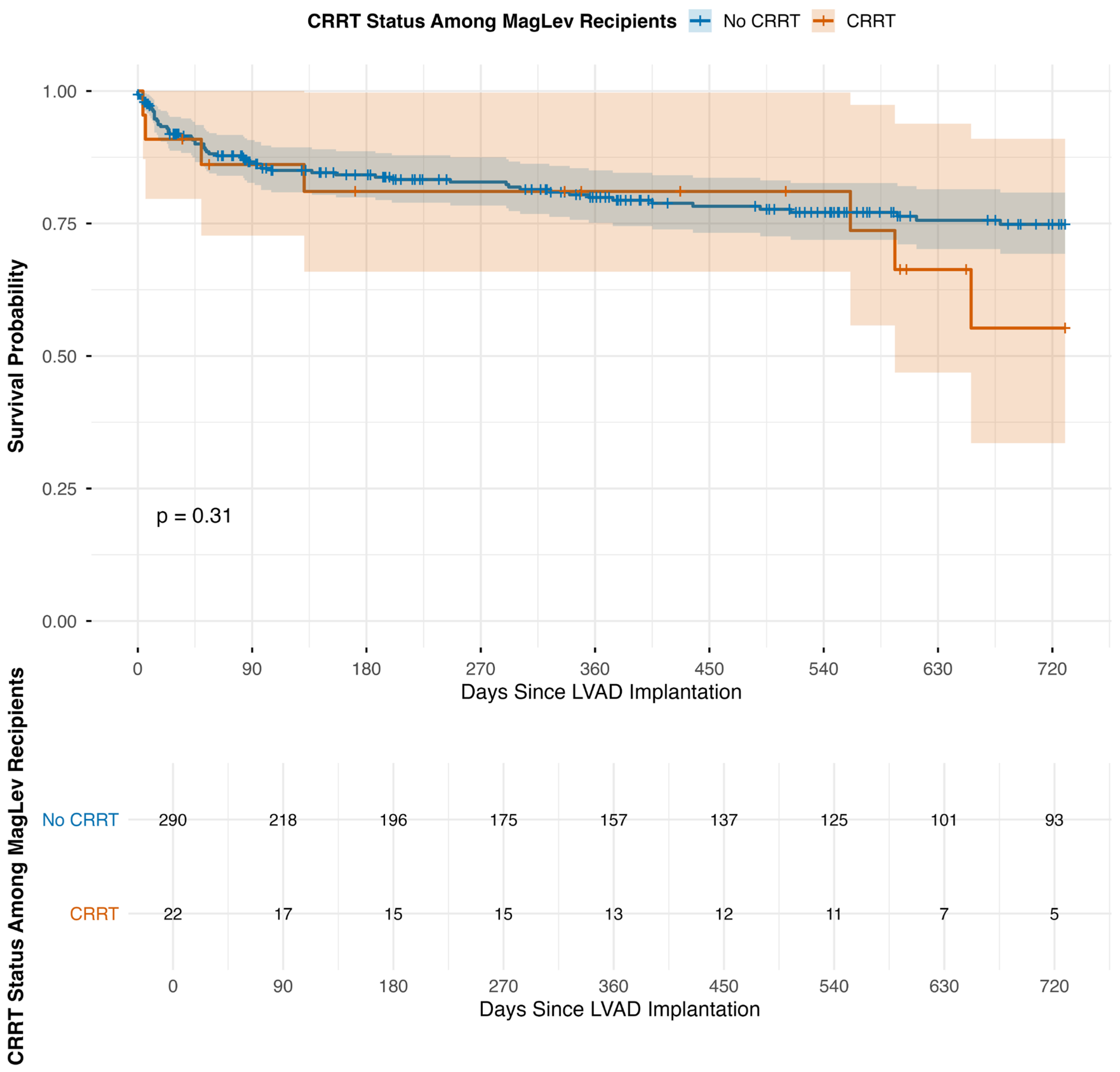
Kaplan–Meier survival curves (Figure 1) demonstrated no significant differences in all-cause mortality between MagLev LVAD patients with and without preoperative CRRT. At 30 days, mortality was 9.1% in the CRRT group compared with 7.9% in the non-CRRT group, 18.2% versus 17.9% at 1 year, and 31.8% versus 20.7% at 2 years (p = 0.31). While these comparisons did not reach statistical significance, it is important to interpret them in the context of the small CRRT + MagLev cohort (n = 22), which led to wide confidence intervals and limited statistical power to detect modest differences in long-term outcomes. Cumulative incidence estimates are shown in Table 3.
Figure 1. Survival of MagLev LVAD patients stratified by pre-implantation CRRT dependence at 30 days, 1 year, and 2 years.
Jcm 14 08502 g001
Table 3. Cumulative Incidence Estimates of 30-Day, 1-Year, and 2-Year Mortality Stratified by LVAD Type and CRRT Status.
Group Total Number of
Patients
Deaths at 30 DaysDeaths at 1 YearDeaths at 2 Years30-Day
Mortality
(Incident/N) (%)
1-Year
Mortality
(Incident/N) (%)
2-Year
Mortality (Incident/N) (%)
A. MagLev LVAD Patients by CRRT Status
MagLev (Non-CRRT)2902352607.9%17.9%20.7%
MagLev + CRRT222479.1%18.2%31.8%
B. All CRRT Recipients by LVAD Type
Non-MagLev + CRRT148101157.1%71.4%78.6%
MagLev + CRRT222478.7%17.4%30.4%
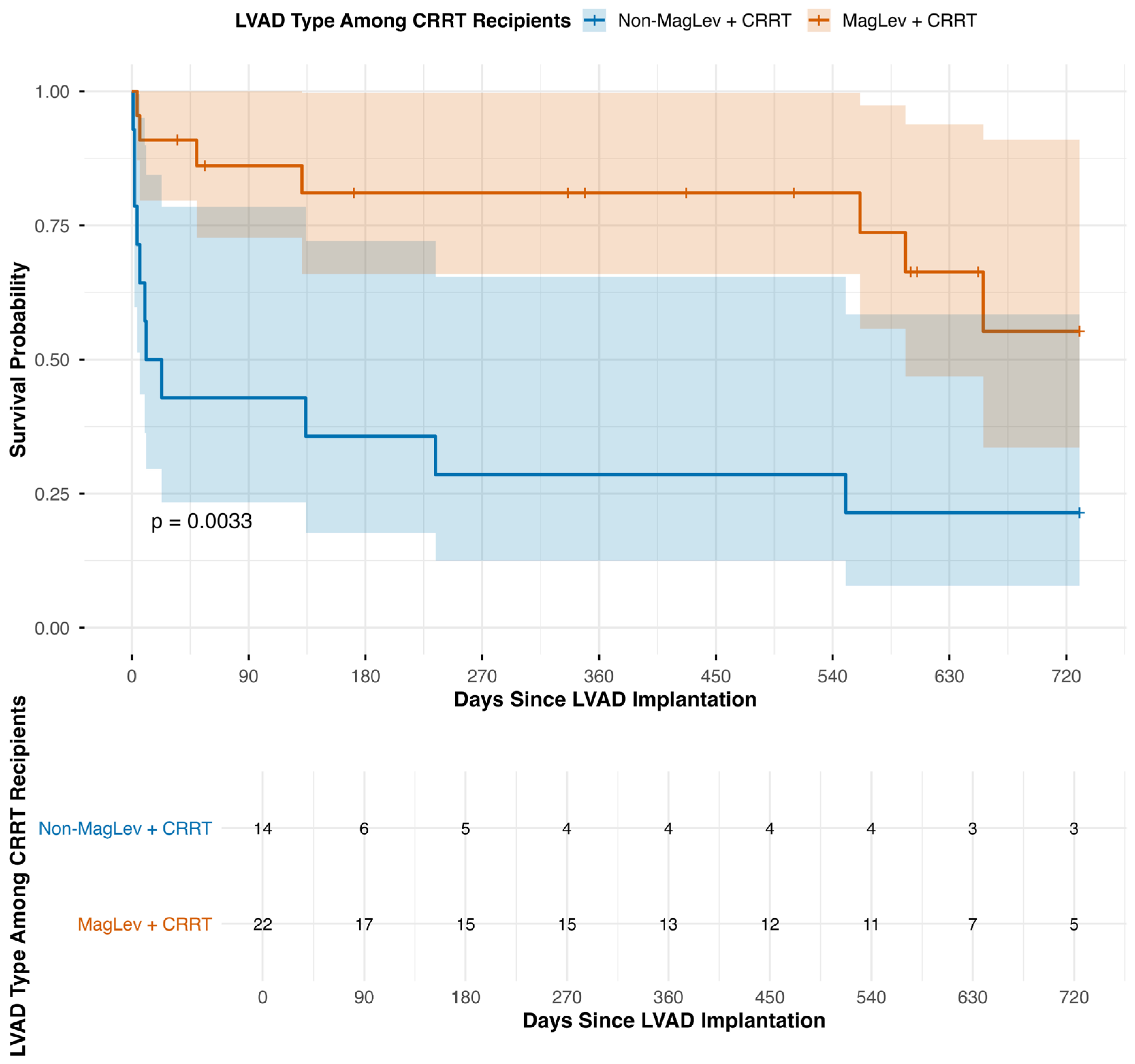
The restricted RMST for CRRT versus non-CRRT MagLev patients was similar across time points: 27.7 vs. 28.5 days at 30 days (Δ = −0.8; p = 0.61), 305 vs. 311 days at 1 year (Δ = −5; p = 0.85), and 571 vs. 592 days at 2 years (Δ = −21; p = 0.72). Meanwhile, among patients requiring CRRT, non-MagLev devices were associated with substantially higher mortality than MagLev devices (30-day: 57.1% vs. 8.7%; 1-year: 71.4% vs. 17.4%; 2-year: 78.6% vs. 30.4%; Figure 2). Correspondingly, RMST values were lower for non-MagLev devices—17.1 vs. 27.7 days at 30 days, 135 vs. 305 days at 1 year, and 226 vs. 571 days at 2 years (Δ = 11, 171, and 345 days; all p < 0.01).
Figure 2. Survival of LVAD patients (both MagLev and non-MagLev) stratified by pre-implantation CRRT dependence at 30 days, 1 year, and 2 years after device implantation.
Jcm 14 08502 g002
In the multivariable Cox proportional hazards model restricted to MagLev recipients (Table 4), the need for CRRT was not associated with increased mortality (HR = 1.22, 95%: CI 0.50–2.95; p = 0.66). Higher pre-operative creatinine was independently associated with worse survival (HR = 0.59, 95% CI: 0.35–0.99; p = 0.045), while other covariates, including INTERMACS 1–2 profile, ECMO use, BUN, LVEDD, and cardiac output, were not significant predictors. Additional data, including annual LVAD implantation by device type and mortality outcomes stratified by device strategy, are provided in the Supplementary Materials (Tables S3 and S4).

4. Discussion

The current study suggests that patients requiring continuous renal replacement therapy (CRRT) may be potential candidates for LVAD therapy, particularly with magnetically levitated devices. Historically, severe renal dysfunction has been associated with poor outcomes following LVAD implantation, leading guidelines to discourage its use as destination therapy for these patients [2,8,10,18]. However, our data indicate that MagLev LVAD recipients dependent on CRRT at time of implantation can achieve morbidity and survival rates comparable to those of non-CRRT recipients and is markedly a clear departure from outcomes observed in patients with older-generation (non-MagLev) LVADs.
The survival benefit observed in CRRT patients with MagLev LVADs compared to non-MagLev LVADs may be attributable to several factors. In the five-year follow-up of the landmark MOMENTUM 3 trial, MagLev LVAD recipients demonstrated lower rates of hemocompatibility-related adverse events (e.g., nonsurgical bleeding, thromboembolic events, pump thrombosis, neurologic complications) and lower overall mortality (hazard ratio: 0.72) relative to those with earlier generation axial-flow pumps (non-MagLev) [1,12,13]. The improved outcomes with MagLev LVADs are attributed primarily to their fully levitated rotor design, which eliminates mechanical bearings and minimizes blood–surface interaction, thereby reducing shear stress and thrombogenic potential [12,13,14]. These design improvements optimize flow paths, increase blood-flow gaps, and enhance surface hemodynamics, contributing to an improved hemocompatibility profile and better clinical outcomes compared with earlier-generation devices [19,20].
Renal recovery after LVAD implantation has been described for patients with acute or chronic cardiorenal syndrome, wherein reduced cardiac output, venous congestion, and neurohormonal imbalance exacerbate kidney dysfunction [3,4,9,10]. By augmenting cardiac output and reducing central venous pressures, LVADs often improve renal perfusion in those whose renal impairment is primarily driven by compromised hemodynamics rather than intrinsic kidney pathology.
Despite the encouraging results, several limitations warrant consideration. Firstly, this is a single-institution retrospective study, raising the possibility of selection bias, incomplete data acquisition, and restricted generalizability. Additionally, the historical practice of avoiding LVAD implantation in patients with significant renal impairment likely contributed to the relatively small proportion of CRRT-dependent individuals in our cohort, limiting the power for more granular subgroup analyses. The present study also used serum creatinine-based criteria to define AKI, as urine output data were unavailable. Consequently, milder or transient cases of AKI may have been underdiagnosed, potentially leading to an underestimation of the overall incidence of perioperative AKI among patients not receiving CRRT. Finally, our data sources may not have consistently differentiated acute-on-chronic kidney failure from isolated acute kidney injury, which could have influenced the observed patterns of renal recovery after implantation. Importantly, as an observational study, these findings demonstrate associations rather than causation, and should therefore be interpreted as hypothesis-generating. Although this study reports one of the largest contemporary experiences of MagLev LVAD use in CRRT-dependent patients, the overall sample size remains small, emphasizing the need for additional multicenter studies with larger cohorts, and ultimately, prospective clinical trials to better define outcomes and guide management strategies for patients with advanced kidney disease undergoing LVAD implantation. Moreover, these future investigations could better identify subpopulations within this high-risk group that may derive the most benefit, as well as those for whom LVAD therapy may be less advantageous. Finally, long-term outcomes beyond two years were not captured in sufficient detail, underscoring the importance of extended follow-up to determine the durability of clinical benefits and to characterize potential late complications in this vulnerable population.

5. Conclusions

This study suggests that CRRT dependence does not necessarily portend adverse outcomes in patients undergoing MagLev LVAD implantation. Improvements in device technology and a growing understanding of the interplay between cardiac and renal pathophysiology appear to have expanded the range of patients eligible for durable mechanical support. With growing experience and ongoing device advancements, LVAD therapy could become a more feasible option for patients with severe renal dysfunction, though the evidence remains limited. Further research should investigate which patients on renal replacement therapy may be appropriate candidates for LVAD implantation, incorporating comprehensive risk stratification analyses that consider kidney disease history, comorbidities, and organ dysfunction to better inform patient selection and optimize outcomes.

Supplementary Materials

The following supporting information can be downloaded at: https://www.mdpi.com/article/10.3390/jcm14238502/s1.

Author Contributions

All authors made substantial contributions to the study conception, design, data acquisition, analysis, and writing. Conceptualization: C.L.H., C.J.R., I.M.K. and J.L.C.; Methodology: C.L.H., C.J.R., I.M.K. and J.L.C.; Data Curation: C.L.H., C.J.R., I.M.K., A.T., J.D.P., S.S.R. and J.L.C.; Formal Analysis: C.L.H., C.J.R., I.M.K., S.E.S. and J.L.C.; Writing—Original Draft Preparation: C.L.H., C.J.R., I.M.K., S.E.S., A.T. and J.L.C.; Writing—Review & Editing: C.L.H., C.J.R., I.M.K., S.E.S., A.T., J.D.P., S.S.R., M.E.H., M.M.B., M.A.D. and J.L.C.; Visualization: C.L.H., C.J.R., A.T. and J.L.C.; Supervision: J.L.C.; Funding Acquisition: J.L.C. All authors have read and agreed to the published version of the manuscript.

Funding

This research received no external funding.

Institutional Review Board Statement

The study was conducted in accordance with the Declaration of Helsinki and approved by the Institutional Review Board of Emory University (IRB STUDY00006788 on 10 February 2023).

Informed Consent Statement

This was a retrospective evaluation of de-identified data and that the Institutional Review Board (IRB) granted a waiver of informed consent, as supported by the provided documentation.

Data Availability Statement

The original contributions presented in this study are included in the article/Supplementary Materials. Further inquiries can be directed to the corresponding author.

Acknowledgments

This research was supported in part by the National Center for Advancing Translational Sciences of the National Institutes of Health (NIH) under Award Numbers UL1TR002378 and KL2TR002381, as well as the Carlyle Fraser Heart Center.

Conflicts of Interest

The authors declare no conflicts of interest. The funders had no role in the design of the study; in the collection, analyses, or interpretation of data; in the writing of the manuscript; or in the decision to publish the results.

Abbreviations

The following abbreviations are used in this manuscript:
ACSDAdult Cardiac Surgery Database
AKIAcute Kidney Injury
BMIBody mass index
BUNBlood urea nitrogen
CRRTContinuous renal replacement therapy
ECMOExtracorporeal Membrane Oxygenation
eGFREstimated glomerular filtration rate
IABPIntra-aortic balloon pump
INTERMACSInteragency Registry for Mechanically Assisted Circulatory Support
KDIGOKidney Disease: Improving Global Outcomes
LVADLeft ventricular assist device
LVEDDLeft ventricular end-diastolic diameter
MagLevMagnetically levitated
MCSMechanical circulatory support
NYHANew York Heart Association
RVADRight ventricular assist device
RVEFRight ventricular ejection fraction
STSSociety of Thoracic Surgeons

References

  1. Mehra, M.R.; Goldstein, D.J.; Uriel, N. Two-Year Outcomes with a Magnetically Levitated Cardiac Pump in Heart Failure. N. Engl. J. Med. 2018, 378, 1386–1395. [Google Scholar] [CrossRef] [PubMed]
  2. Bansal, N.; Hailpern, S.M.; Katz, R. Outcomes Associated with Left Ventricular Assist Devices Among Recipients with and Without End-stage Renal Disease. JAMA Intern. Med. 2018, 178, 204–209. [Google Scholar] [CrossRef] [PubMed]
  3. Roehm, B.; Vest, A.R.; Weiner, D.E. Left Ventricular Assist Devices, Kidney Disease, and Dialysis. Am. J. Kidney Dis. 2018, 71, 257–266. [Google Scholar] [CrossRef] [PubMed]
  4. Kirklin, J.K.; Naftel, D.C.; Kormos, R.L. Quantifying the effect of cardiorenal syndrome on mortality after left ventricular assist device implant. J. Heart Lung Transplant. 2013, 32, 1205–1213. [Google Scholar] [CrossRef] [PubMed]
  5. Nair, A.; Lamba, H. Left Ventricular Assist Devices and Renal Ramifications. J. Am. Heart Assoc. 2023, 12, e028450. [Google Scholar] [CrossRef] [PubMed]
  6. Dalia, T.; Chan, W.C.; Sauer, A.J. Outcomes in Patients with Chronic Kidney Disease and End-stage Renal Disease and Durable Left Ventricular Assist Device: Insights From the United States Renal Data System Database. J. Card. Fail. 2022, 28, 1604–1614. [Google Scholar] [CrossRef] [PubMed]
  7. Butler, J.; Geisberg, C.; Howser, R. Relationship between renal function and left ventricular assist device use. Ann. Thorac. Surg. 2006, 81, 1745–1751. [Google Scholar] [CrossRef] [PubMed]
  8. Sandner, S.E.; Zimpfer, D.; Zrunek, P. Renal function and outcome after continuous flow left ventricular assist device implantation. Ann. Thorac. Surg. 2009, 87, 1072–1078. [Google Scholar] [CrossRef] [PubMed]
  9. Kamboj, M.; Kazory, A. Left Ventricular Assist Device and the Kidney: Getting to the Heart of the Matter. Blood Purif. 2019, 48, 289–298. [Google Scholar] [CrossRef] [PubMed]
  10. Ibrahim, M.; Croix, G.R.; Lacy, S.; Chaparro, S. Impact of Renal Dysfunction on Outcomes after Left Ventricular Assist Device: A Systematic Review. Int. J. Heart Fail. 2021, 3, 69–77. [Google Scholar] [CrossRef] [PubMed]
  11. Feldman, D.; Pamboukian, S.V.; Teuteberg, J.J. The 2013 International Society for Heart and Lung Transplantation Guidelines for mechanical circulatory support: Executive summary. J. Heart Lung Transplant. 2013, 32, 157–187. [Google Scholar] [CrossRef] [PubMed]
  12. Uriel, N.; Colombo, P.C.; Cleveland, J.C. Hemocompatibility-Related Outcomes in the MOMENTUM 3 Trial at 6 Months: A Randomized Controlled Study of a Fully Magnetically Levitated Pump in Advanced Heart Failure. Circulation 2017, 135, 2003–2012. [Google Scholar] [CrossRef] [PubMed]
  13. Mehra, M.R.; Goldstein, D.J.; Cleveland, J.C. Five-Year Outcomes in Patients with Fully Magnetically Levitated vs. Axial-Flow Left Ventricular Assist Devices in the MOMENTUM 3 Randomized Trial. JAMA 2022, 328, 1233–1242. [Google Scholar] [CrossRef] [PubMed]
  14. Mehra, M.R. The burden of haemocompatibility with left ventricular assist systems: A complex weave. Eur. Heart J. 2017, 40, 673–677. [Google Scholar] [CrossRef] [PubMed]
  15. Pasrija, C.; Tran, D.; George, P. Left ventricular assist device implantation may be feasible in appropriately selected patients with severe renal insufficiency. J. Thorac. Cardiovasc. Surg. 2020, 159, 1307–1319. [Google Scholar] [CrossRef] [PubMed]
  16. Kittleson, M.M.; Shah, P.; Lala, A. INTERMACS profiles and outcomes of ambulatory advanced heart failure patients: A report from the REVIVAL Registry. J. Heart Lung Transplant. 2020, 39, 16–26. [Google Scholar] [CrossRef] [PubMed]
  17. Kellum, J.A. KDIGO clinical practice guideline for acute kidney injury. Kidney Int. Suppl. 2012, 2, 1–138. [Google Scholar]
  18. Lamba, H.K.; Musfee, F.I.; Chatterjee, S. The influence of preoperative dialysis on survival after continuous-flow left ventricular assist device implantation. Interact. Cardiovasc. Thorac. Surg. 2022, 34, 470–477. [Google Scholar] [CrossRef] [PubMed]
  19. Wiegmann, L.; Thamsen, B.; de Zelicourt, D.; Granegger, M.; Boes, S.; Schmid Daners, M.; Meboldt, M.; Kurtcuoglu, V. Fluid Dynamics in the HeartMate 3: Influence of the Artificial Pulse Feature and Residual Cardiac Pulsation. Artif. Organs 2019, 43, 363–376. [Google Scholar] [CrossRef] [PubMed]
  20. Stohr, E.J.; Ji, R.; Mondellini, G.; Braghieri, L.; Akiyama, K.; Castagna, F.; Pinsino, A.; Cockcroft, J.R.; Silverman, R.H.; Trocio, S.; et al. Pulsatility and flow patterns across macro- and microcirculatory arteries of continuous-flow left ventricular assist device patients. J. Heart Lung Transplant. 2023, 42, 1223–1232. [Google Scholar] [CrossRef] [PubMed]
Table 1. Baseline characteristics prior to implantation among magnetically levitated left ventricular (MagLev) device implantation recipients.
Baseline CharacteristicNon-CRRT
N = 290 1
CRRT
N = 22 1
p-Value 2
Age (years)51.56 ± 12.7848.35 ± 14.010.431
Sex (Male %) 0.630
          Female83 (29%)5 (23%)
          Male202 (71%)17 (77%)
          Missing50
BMI (kg/m2)28.65 ± 8.4327.61 ± 5.700.936
          Missing01
Diabetes Mellitus127 (45%)7 (32%)0.273
          Missing50
Hypertension222 (78%)15 (68%)0.297
          Missing50
Chronic Lung Disease 0.037
          No143 (49%)10 (45%)
          Mild/Moderate110 (38%)6 (27%)
          Severe22 (7.6%)6 (27%)
          Other/Unknown15 (5.2%)0 (0%)
Cerebrovascular Disease81 (28%)7 (32%)0.807
          Missing50
Peripheral Arterial Disease12 (4.2%)3 (14%)0.083
          Missing50
Immunocompromised State16 (5.6%)3 (14%)0.146
          Missing50
Renal Characteristics
Creatinine (mg/dL) *1.65 ± 0.961.95 ± 0.850.032
BUN (mmol/L)11.76 ± 6.808.50 ± 6.510.005
          Missing01
eGFR (mL/min/1.73 m2)53 (38, 76)40 (32, 66)0.074
eGFR Category (mL/min/1.73 m2) 0.2
          ≥60118 (41%)7 (32%)
          45–5963 (22%)2 (9.1%)
          30–4468 (24%)9 (41%)
          <3036 (13%)4 (18%)
          Unknown50
Cardiac Characteristics
Heart Failure Etiology 0.115
          Congenital/Other3 (1.0%)0 (0%)
          Ischemic60 (21%)5 (23%)
          Non-ischemic218 (75%)14 (64%)
          Other Cardiomyopathy4 (1.4%)1 (4.5%)
          Unknown5 (1.7%)2 (9.1%)
NYHA Class III or IV 0.067
          No19 (6.6%)4 (18%)
          Yes271 (93%)18 (82%)
INTERMACS Profile 1–2 0.019
          No83 (29%)1 (4.8%)
          Yes207 (71%)20 (95%)
          Missing01
LVEDD (cm)6.80 ± 1.136.33 ± 0.910.020
          Missing11
RVEF Group 0.662
          Normal51 (18%)2 (9.1%)
          Mild/Moderate156 (54%)12 (55%)
          Severe38 (13%)3 (14%)
          Unknown45 (16%)5 (23%)
Cardiac Output (L/min)4.02 ± 1.195.02 ± 1.740.011
          Missing322
Cardiac Arrhythmia 0.372
          No94 (32%)8 (36%)
          Yes132 (46%)12 (55%)
          Unknown64 (22%)2 (9.1%)
Resuscitation ≤ 1 h 0.312
          No281 (99%)21 (95%)
          Yes—Within 1 h of the start of the procedure4 (1.4%)1 (4.5%)
          Missing50
Preoperative MCS
ECMO16 (5.5%)5 (24%)0.009
          Missing01
IABP 34 (12%)4 (19%)0.304
          Missing01
RVAD 3 (1.0%)1 (4.8%)0.245
          Missing01
LVAD Planned Strategy 0.083
          Bridge to Transplant88 (30%)7 (32%)
          Destination Therapy202 (70%)14 (64%)
          Other/Unknown0 (0%)1 (4.5%)
1 Data are presented as mean ± standard deviation, median (interquartile range), or number (percentage), as appropriate. 2 Wilcoxon rank sum test; Fisher’s exact test. * Preoperative creatinine was collected prior to device implantation, CRRT, and onset of AKI. Abbreviations: BMI, body mass index; BUN, blood urea nitrogen; CRRT, continuous renal replacement therapy; ECMO, extracorporeal Membrane Oxygenation; eGFR, estimated glomerular filtration rate; IABP, intra-aortic balloon pump; INTERMACS, Interagency Registry for Mechanically Assisted Circulatory Support; LVEDD, left ventricular end-diastolic diameter; NYHA, New York Heart Association; RVEF, right ventricular ejection fraction; RVAD, right ventricular assist device.
Table 2. Peri-operative morbidity among MagLev LVAD implantation recipients stratified by device generation and preoperative CRRT usage.
(A) MagLev LVADs: CRRT vs. Non-CRRT
OutcomeNon-CRRT
N = 290 1
CRRT
N = 22 1
p-Value 2
Stroke13 (5.8%)1 (5.3%)>0.999
Reoperation due to bleeding 19 (8.5%)1 (5.3%)>0.999
Stage 3 AKI *58 (26%)
Mechanical ventilation > 24 h133 (60%)14 (74%)0.328
Postoperative Dialysis Requirement44 (76%)2 (67%)>0.999
(B) CRRT Cohort: MagLev vs. Non-MagLev
OutcomeNon-MagLev
N = 14 1
MagLev
N = 22 1
p-Value 2
Stroke1 (11%)1 (5.3%)>0.999
Reoperation due to bleeding 2 (22%)1 (5.3%)0.234
Stage 3 AKI *0 (0%)
Mechanical ventilation > 24 h6 (67%)14 (74%)>0.999
Postoperative Dialysis Requirement 0 (0%)2 (67%)>0.999
1 n = (%). 2 Fisher’s exact test. * Captures new postoperative dialysis initiation. This variable is not applicable to patients receiving preoperative CRRT, who by definition already met the criteria for KDIGO Stage 3 AKI prior to implantation.
Table 4. Multivariable Cox Proportional Hazards Model for Mortality Among MagLev Recipients.
Variable Hazard Ratio (95% CI) p-Value
Preoperative CRRT 1.22 (0.50–2.95) 0.6605
INTERMACS 1–2 1.71 (0.92–3.16) 0.0885
Preoperative ECMO 0.96 (0.34–2.70) 0.9427
Preoperative Creatinine 0.59 (0.35–0.99) 0.0448
BUN (mmol/L) 1.05 (0.99–1.11) 0.0790
LVEDD (cm) 0.87 (0.69–1.10) 0.2382
Cardiac Output (L/min) 1.17 (0.97–1.41) 0.1076
Disclaimer/Publisher’s Note: The statements, opinions and data contained in all publications are solely those of the individual author(s) and contributor(s) and not of MDPI and/or the editor(s). MDPI and/or the editor(s) disclaim responsibility for any injury to people or property resulting from any ideas, methods, instructions or products referred to in the content.