Psychosomatic Profiles and Their Association with Health Behaviors in Patients with Inflammatory Bowel Disease (IBD) and Low Disease Activity

 ,
,  ,
,  , ,
, ,
Abstract
1. Introduction
- IBD patients with low disease activity will show distinct psychosomatic syndrome profiles that can be grouped into meaningful clusters.
- After controlling for disease-related variables, the presence of one or more psychosomatic syndromes is associated with:
- a reduction in the frequency and intensity of physical activity;
- poorer dietary habits;
- higher alcohol consumption;
- more detrimental smoking behaviors.
2. Materials and Methods
2.1. Participants and Procedure
2.2. Assessment
2.3. Materials
2.3.1. Sociodemographic and Clinical Variables
2.3.2. Psychosomatic Syndromes
2.3.3. Lifestyle-Related Behaviors
2.4. Data Analysis
Exploratory Analyses
3. Results
3.1. Sample Characteristics
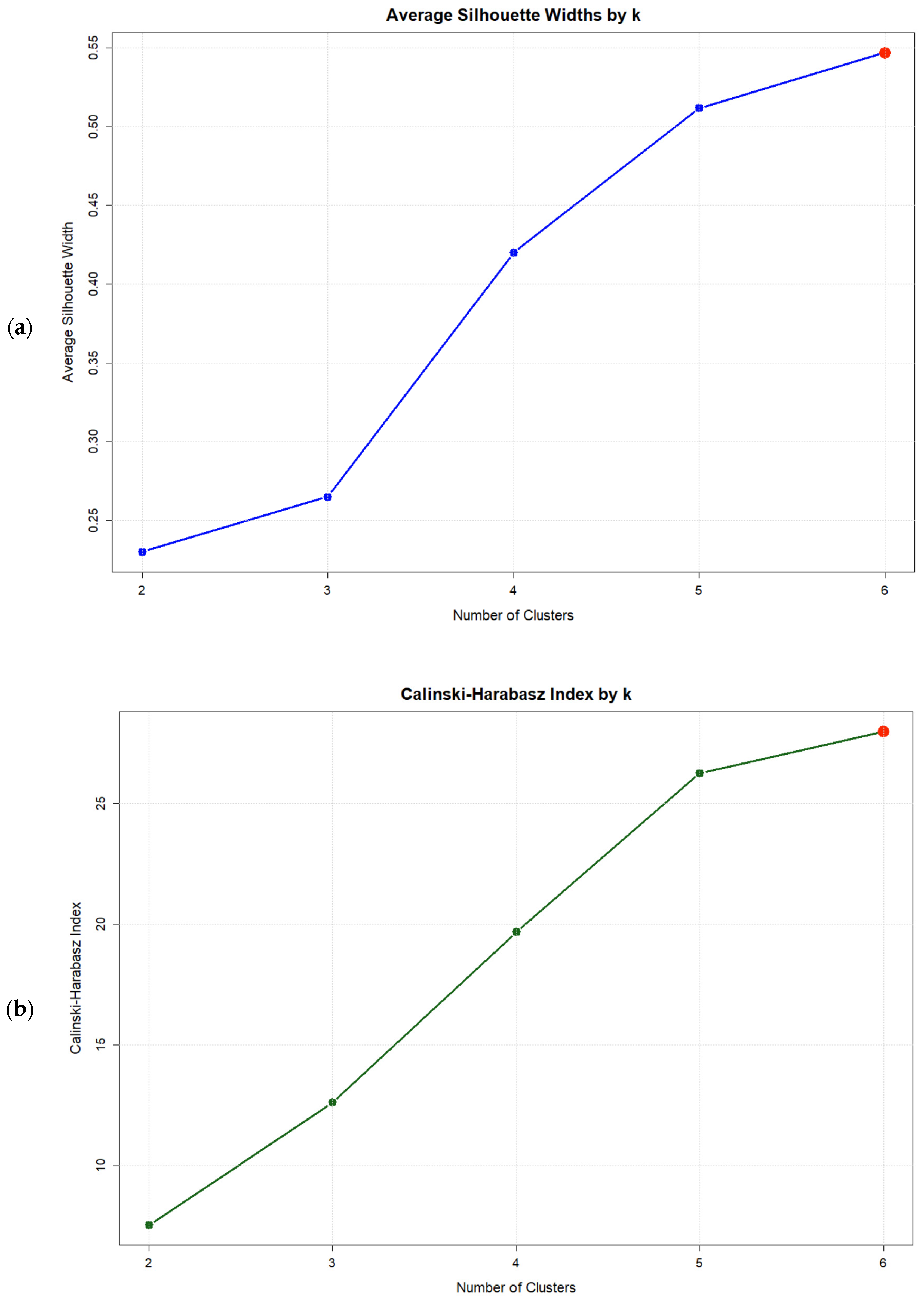
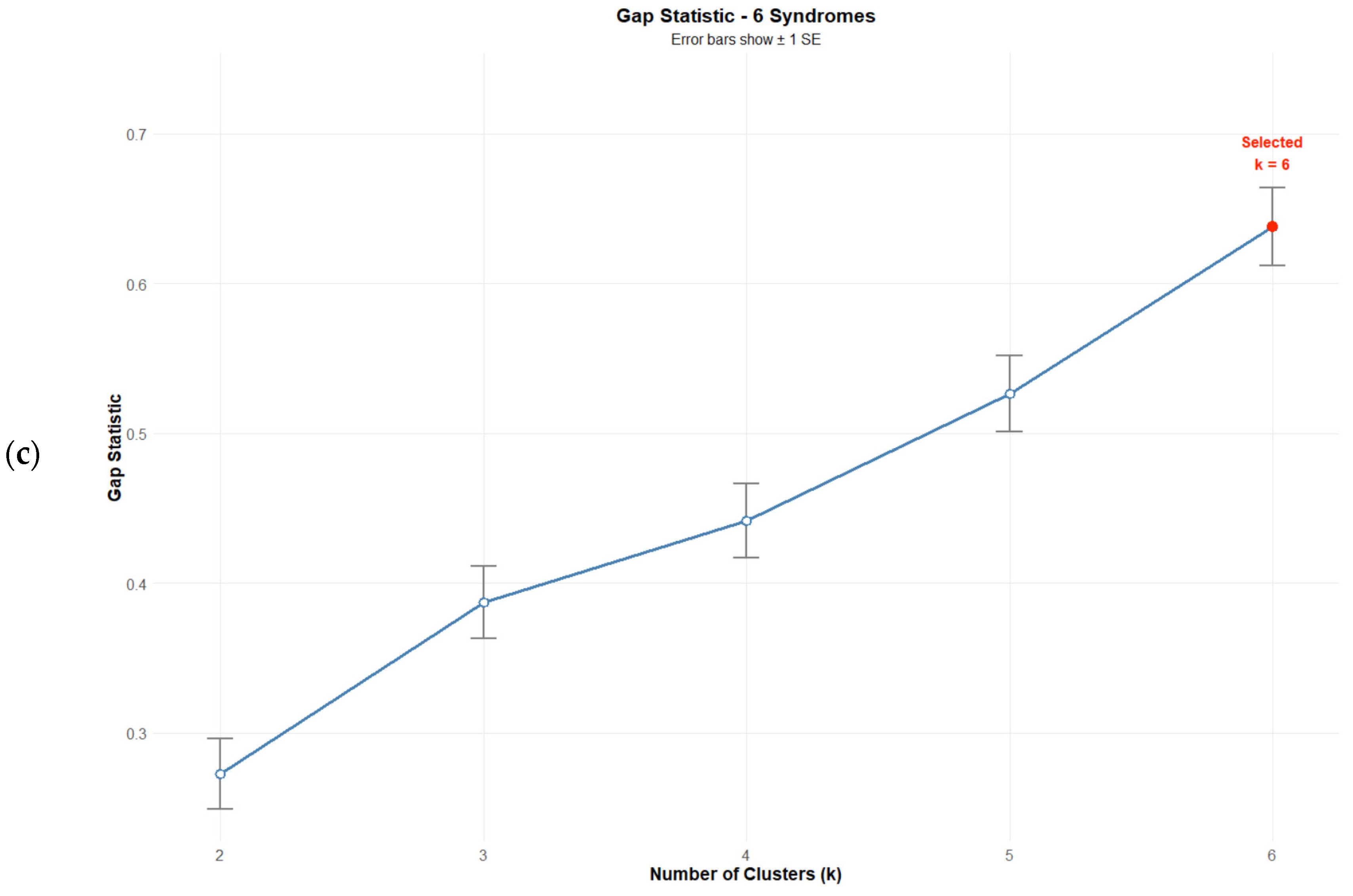
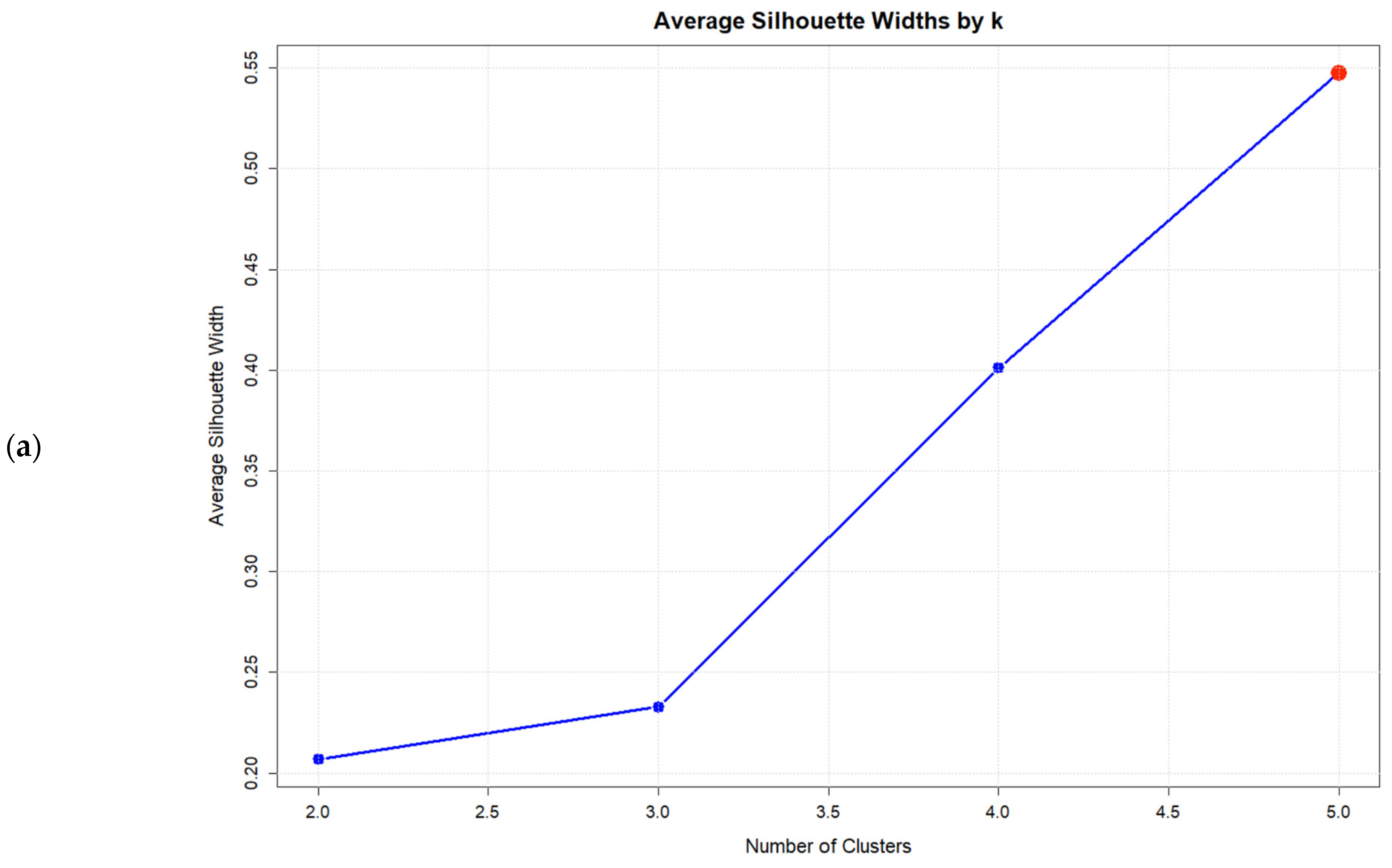
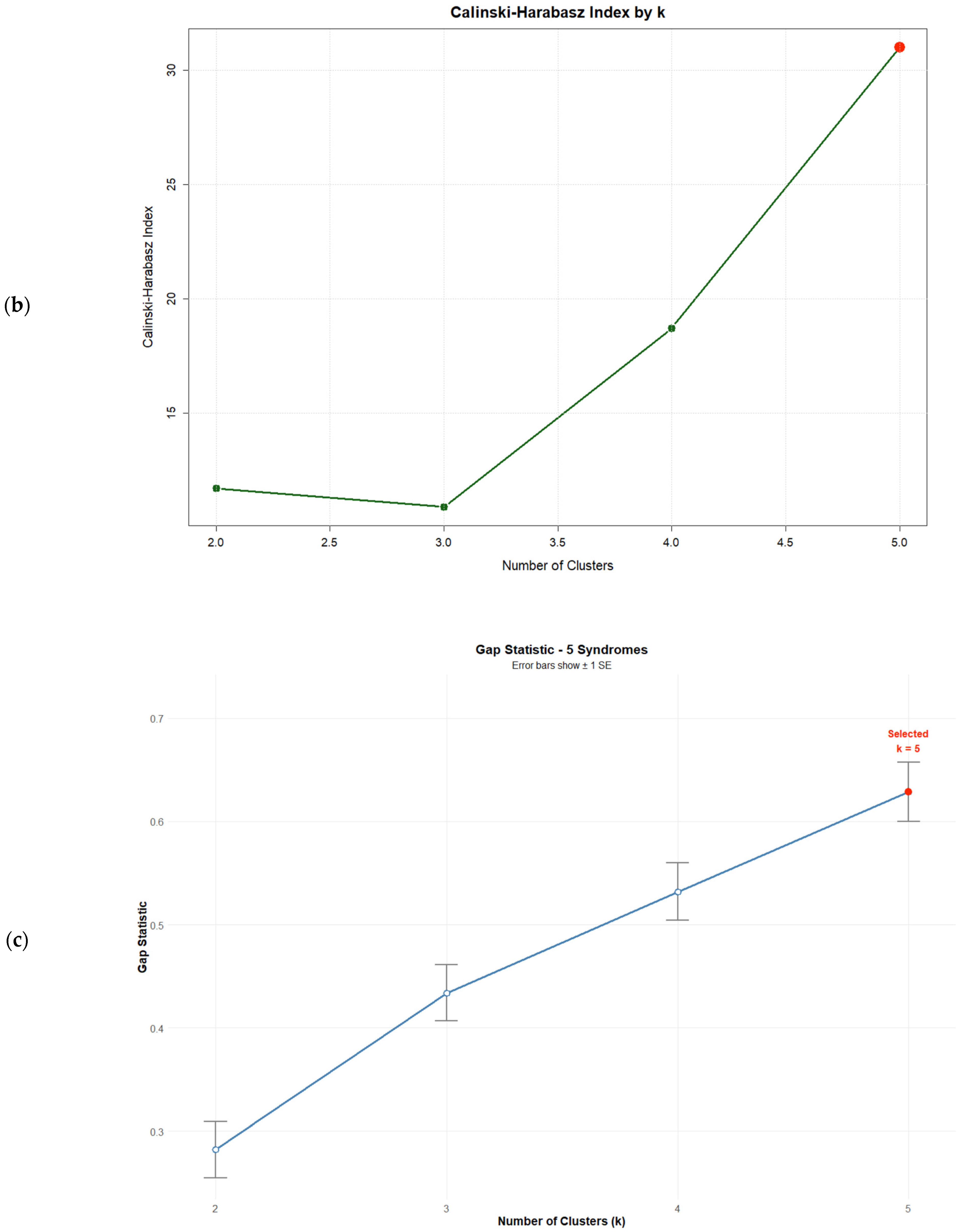
3.2. Clustering Sensitivity Analysis
- Cluster 1 maintained similar profiles in both analyses, featuring high prevalence of irritable mood and type A behavior;
- Alexithymia-dominant profiles were represented by cluster 3 (6-syndrome solution) and cluster 2 (5-syndrome solution);
- Demoralization combined with allostatic overload appeared as cluster 5 (6-syndrome) versus cluster 4 (5-syndrome);
- Type A behavior associated with alexithymia characterized cluster 6 (6-syndrome) versus cluster 5 (5-syndrome);
- Partial correspondence was observed between cluster 4 of the 6-syndrome solution (allostatic overload and type A behavior with demoralization) and Cluster 3 of the 5-syndrome solution (allostatic Overload with type A Behavior).
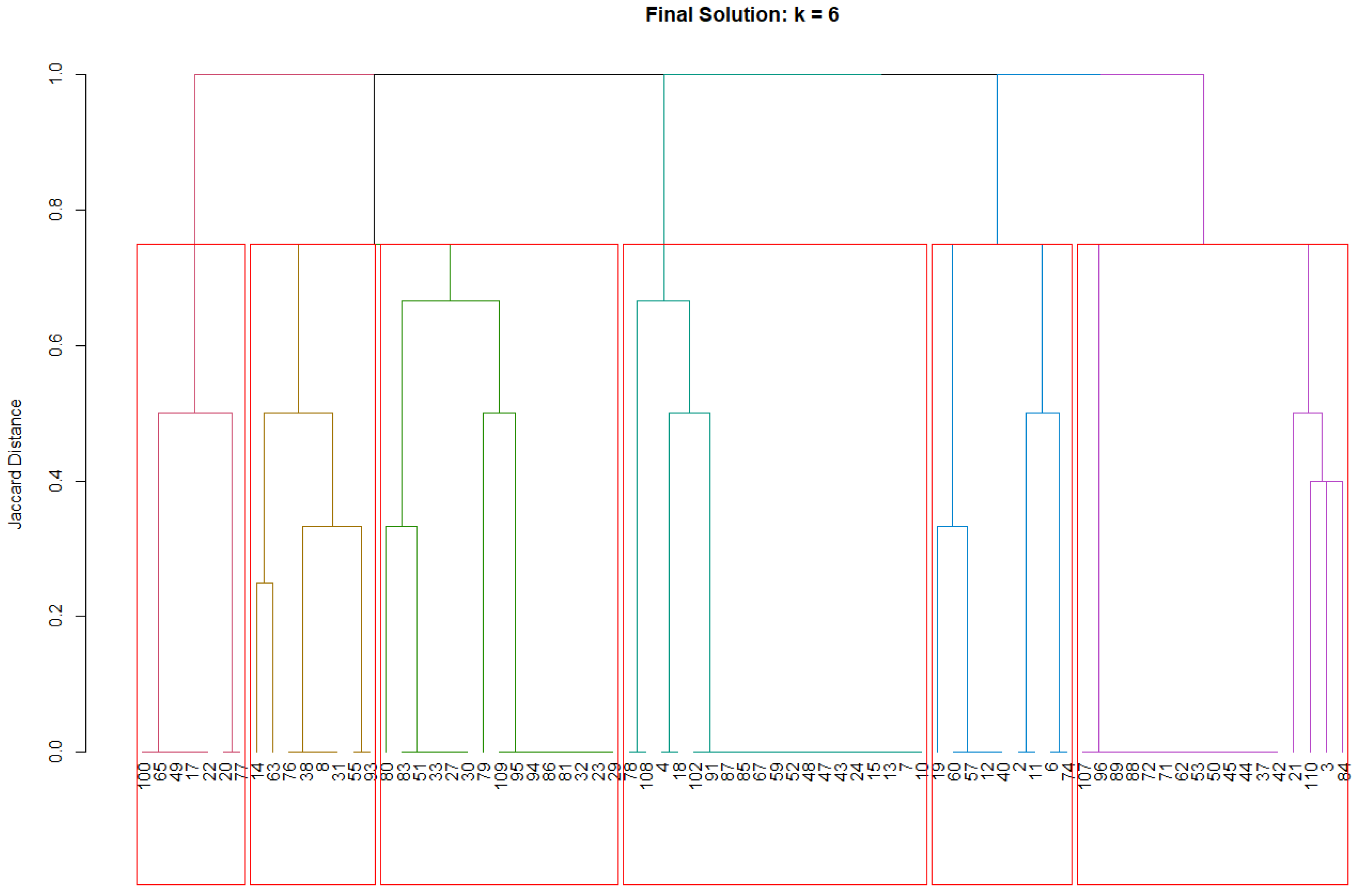
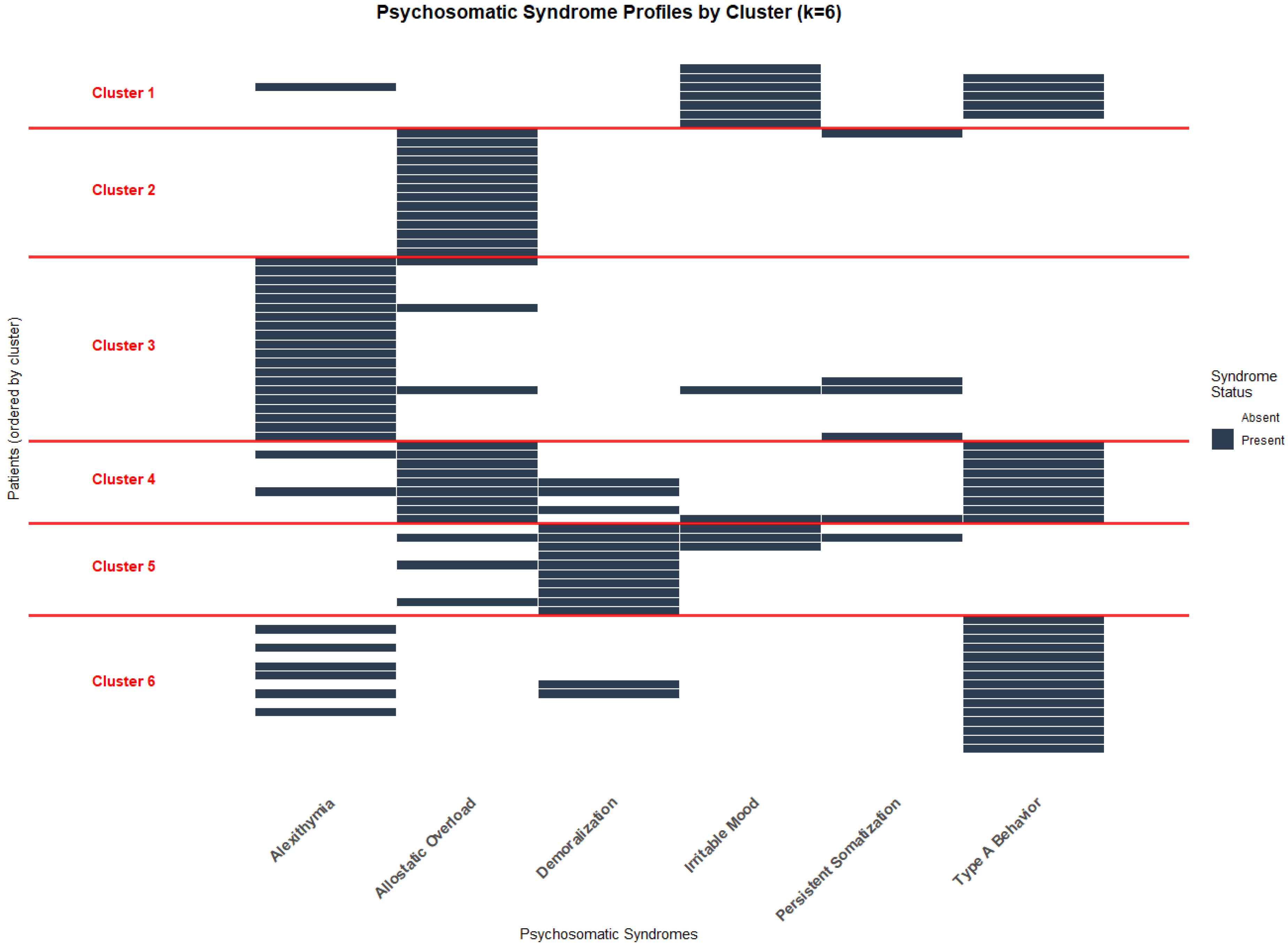
- Cluster 1 (n = 7, 9.3%) was characterized primarily by irritable mood (100%) and type A behavior (75%), and was designated “Irritability”;
- Cluster 2 (n = 14, 18.7%) featured exclusively allostatic overload (100%) and was designated “Pure allostatic overload”;
- Cluster 3 (n = 20, 26.7%) was dominated by alexithymia (100%) and was designated “Pure Alexithymia”;
- Cluster 4 (n = 9, 12%), characterized by universal presence of type A behavior (100%) and allostatic overload (100%), also exhibited demoralization in one-third of patients (33.3%). This profile was designated “Overwhelmed Type A Behavior”;
- Cluster 5 (n = 10, 13.3%) showed universal demoralization (100%) with moderate co-occurrence of allostatic overload (30%) and irritable mood (30%). Given this symptom constellation, it was designated “Subclinical Depressive Mood”;
- Cluster 6 (n = 20, 26.7%) was characterized by universal type A behavior (100%) and moderate co-occurrence of alexithymia (40%), and was designated “Alexithymic Type A Behavior”.
3.3. Dietary Habits
3.3.1. Individual Syndromes Model
3.3.2. Cluster-Based Model
3.4. Smoking Habits
3.4.1. Individual Syndromes Model
3.4.2. Cluster-Based Model
3.5. Physical Activity
3.5.1. Individual Syndromes Model for Physical Activity Frequency
3.5.2. Cluster-Based Model for Physical Activity Frequency
3.5.3. Individual Syndromes Model for Physical Activity Intensity
3.5.4. Cluster-Based Model for Physical Activity Intensity
3.6. Alcohol Consumption
3.6.1. Individual Syndromes Model
3.6.2. Cluster-Based Model
3.7. Exploratory Analyses
3.7.1. Psychosomatic Profiles of UC and CD Patients
3.7.2. Models Replication with Additional Covariates
3.7.3. Association Between Number of DCPR Syndromes and Dietary Habits
3.7.4. Association Between Number of DCPR Syndromes and Smoking Habits
3.7.5. Association Between Number of DCPR Syndromes and Physical Activity
3.7.6. Association Between Number of DCPR Syndromes and Alcohol Consumption
4. Discussion
4.1. Prevalence of Psychosomatic Syndromes
4.2. Psychosomatic Profiles
4.3. Psychosomatic Syndromes and Health Behaviors
4.4. Strenghts and Limitations
5. Conclusions
Supplementary Materials
Author Contributions
Funding
Institutional Review Board Statement
Informed Consent Statement
Data Availability Statement
Acknowledgments
Conflicts of Interest
Abbreviations
| IBD | Inflammatory bowel disease |
| DCPR-R | Diagnostic Criteria for Psychosomatic Research—Revised |
| CD | Crohn’s disease |
| UC | Ulcerative colitis |
| ZINB | Zero inflated negative binomial |
| ASW | Average silhouette width |
| CH | Calinski–Harabasz |
| PPO | Partial proportional odds |
| HAC | Heteroskedasticity and autocorrelation consistent |
| DSM | Diagnostic and Statistical Manual of Mental Disorders |
| ICD | International Classification of Diseases |
| FGID | Functional gastrointestinal disorders |
| FDR | False discovery rate |
| IBS | Irritable bowel syndrome |
| DBT | Dialectical behavior therapy |
References
- Parra, R.S.; Chebli, J.M.F.; Amarante, H.M.B.S.; Flores, C.; Parente, J.M.L.; Ramos, O.; Fernandes, M.; Rocha, J.J.R.; Feitosa, M.R.; Feres, O.; et al. Quality of Life, Work Productivity Impairment and Healthcare Resources in Inflammatory Bowel Diseases in Brazil. World J. Gastroenterol. 2019, 25, 5862–5882. [Google Scholar] [CrossRef]
- Rogler, G.; Singh, A.; Kavanaugh, A.; Rubin, D.T. Extraintestinal Manifestations of Inflammatory Bowel Disease: Current Concepts, Treatment, and Implications for Disease Management. Gastroenterology 2021, 161, 1118–1132. [Google Scholar] [CrossRef]
- Knowles, S.R.; Graff, L.A.; Wilding, H.; Hewitt, C.; Keefer, L.; Mikocka-Walus, A. Quality of Life in Inflammatory Bowel Disease: A Systematic Review and Meta-Analyses—Part I. Inflamm. Bowel Dis. 2018, 24, 742–751. [Google Scholar] [CrossRef]
- Mikocka-Walus, A.; Pittet, V.; Rossel, J.-B.; von Känel, R.; Swiss IBD Cohort Study Group. Symptoms of Depression and Anxiety Are Independently Associated with Clinical Recurrence of Inflammatory Bowel Disease. Clin. Gastroenterol. Hepatol. 2016, 14, 829–835.e1. [Google Scholar] [CrossRef]
- Guidi, J.; Piolanti, A.; Berrocal, C.; Gostoli, S.; Carrozzino, D. Incremental Validity Of The Diagnostic Criteria For Psychosomatic Research-Revised (DCPR-R) To Clinical Assessment In Primary Care. Psychiatry Res. 2020, 291, 113233. [Google Scholar] [CrossRef]
- Fava, G.A.; Cosci, F.; Sonino, N. Current Psychosomatic Practice. Psychother. Psychosom. 2017, 86, 13–30. [Google Scholar] [CrossRef]
- Sirri, L.; Fava, G.A.; Guidi, J.; Porcelli, P.; Rafanelli, C.; Bellomo, A.; Grandi, S.; Grassi, L.; Pasquini, P.; Picardi, A.; et al. Type A Behaviour: A Reappraisal of Its Characteristics in Cardiovascular Disease. Int. J. Clin. Pract. 2012, 66, 854–861. [Google Scholar] [CrossRef] [PubMed]
- Gostoli, S.; Subach, R.; Guolo, F.; Buzzichelli, S.; Abbate Daga, G.; de Figueiredo, J.M.; Rafanelli, C. Demoralization in Acute Coronary Syndrome: Treatment and Predictive Factors Associated with Its Persistence. Int. J. Clin. Health Psychol. 2024, 24, 100444. [Google Scholar] [CrossRef]
- Grassi, L.; Nanni, M.G. Beyond Psychiatric Classification in Oncology: Psychosocial Dimensions in Cancer and Implications for Care. Psycho-Oncologie 2013, 7, 235–242. [Google Scholar] [CrossRef]
- Grassi, L.; Rossi, E.; Sabato, S.; Cruciani, G.; Zambelli, M. Diagnostic Criteria for Psychosomatic Research and Psychosocial Variables in Breast Cancer Patients. Psychosomatics 2004, 45, 483–491. [Google Scholar] [CrossRef]
- Ghiggia, A.; Torta, R.; Tesio, V.; Di Tella, M.; Romeo, A.; Colonna, F.; Geminiani, G.C.; Fusaro, E.; Batticciotto, A.; Castelli, L. Psychosomatic Syndromes in Fibromyalgia. Clin. Exp. Rheumatol. 2017, 35 (Suppl. S105), 106–111. [Google Scholar]
- Gostoli, S.; Ferrara, F.; Quintavalle, L.; Tommasino, S.; Gigante, G.; Montecchiarini, M.; Urgese, A.; Guolo, F.; Subach, R.; D’Oronzo, A.; et al. Four-Year Follow-up of Psychiatric and Psychosomatic Profile in Patients with Inflammatory Bowel Disease (IBD). BMC Psychol. 2024, 12, 211. [Google Scholar] [CrossRef]
- Cosnes, J. Smoking, Physical Activity, Nutrition and Lifestyle: Environmental Factors and Their Impact on IBD. Dig. Dis. 2010, 28, 411–417. [Google Scholar] [CrossRef]
- Lamers, C.R.; de Roos, N.M.; Heerink, H.H.; van de Worp-Kalter, L.A.; Witteman, B.J.M. Lower Impact of Disease on Daily Life and Less Fatigue in Patients with Inflammatory Bowel Disease Following a Lifestyle Intervention. Inflamm. Bowel Dis. 2022, 28, 1791–1799. [Google Scholar] [CrossRef]
- Çelik, K.; Güveli, H.; Erzin, Y.Z.; Kenger, E.B.; Özlü, T. The Effect of Adherence to Mediterranean Diet on Disease Activity in Patients with Inflammatory Bowel Disease. Turk. J. Gastroenterol. 2023, 34, 714–719. [Google Scholar] [CrossRef]
- Clarke, D.M.; Kissane, D.W. Demoralization: Its Phenomenology and Importance. Aust. N. Z. J. Psychiatry 2002, 36, 733–742. [Google Scholar] [CrossRef]
- Tecuta, L.; Tomba, E.; Grandi, S.; Fava, G.A. Demoralization: A Systematic Review on Its Clinical Characterization. Psychol. Med. 2015, 45, 673–691. [Google Scholar] [CrossRef]
- Thorberg, F.A.; Young, R.M.; Sullivan, K.A.; Lyvers, M. Alexithymia and Alcohol Use Disorders: A Critical Review. Addict. Behav. 2009, 34, 237–245. [Google Scholar] [CrossRef]
- Cruise, K.E.; Becerra, R. Alexithymia and Problematic Alcohol Use: A Critical Update. Addict. Behav. 2018, 77, 232–246. [Google Scholar] [CrossRef]
- Maaser, C.; Sturm, A.; Vavricka, S.R.; Kucharzik, T.; Fiorino, G.; Annese, V.; Calabrese, E.; Baumgart, D.C.; Bettenworth, D.; Borralho Nunes, P.; et al. ECCO-ESGAR Guideline for Diagnostic Assessment in IBD Part 1: Initial Diagnosis, Monitoring of Known IBD, Detection of Complications. J. Crohn’s Colitis 2019, 13, 144–164. [Google Scholar] [CrossRef]
- Giannuzzi, P.; Temporelli, P.L.; Marchioli, R.; Maggioni, A.P.; Balestroni, G.; Ceci, V.; Chieffo, C.; Gattone, M.; Griffo, R.; Schweiger, C.; et al. Global Secondary Prevention Strategies to Limit Event Recurrence after Myocardial Infarction: Results of the GOSPEL Study, a Multicenter, Randomized Controlled Trial from the Italian Cardiac Rehabilitation Network. Arch. Intern. Med. 2008, 168, 2194–2204. [Google Scholar] [CrossRef]
- Siegel, C.A.; Whitman, C.B.; Spiegel, B.M.R.; Feagan, B.; Sands, B.; Loftus, E.V.; Panaccione, R.; D’Haens, G.; Bernstein, C.N.; Gearry, R.; et al. Development of an Index to Define Overall Disease Severity in IBD. Gut 2018, 67, 244–254. [Google Scholar] [CrossRef]
- Swaminathan, A.; Day, A.S.; Sparrow, M.P.; Peyrin-Biroulet, L.; Siegel, C.A.; Gearry, R.B. Review Article: Measuring Disease Severity in Inflammatory Bowel Disease—Beyond Treat to Target. Aliment. Pharmacol. Ther. 2024, 60, 1176–1199. [Google Scholar] [CrossRef]
- Guidi, J.; Lucente, M.; Piolanti, A.; Roncuzzi, R.; Rafanelli, C.; Sonino, N. Allostatic Overload in Patients with Essential Hypertension. Psychoneuroendocrinology 2020, 113, 104545. [Google Scholar] [CrossRef]
- Porcelli, P.; De Carne, M.; Todarello, O. Prediction of Treatment Outcome of Patients with Functional Gastrointestinal Disorders by the Diagnostic Criteria for Psychosomatic Research. Psychother. Psychosom. 2004, 73, 166–173. [Google Scholar] [CrossRef] [PubMed]
- CREA (Consiglio Per La Ricerca in Agricoltura E L’analisi Dell’economia Agraria). Dossier Scientifico Delle Linee Guida per Una Sana Alimentazione 2018; Centro di Ricerca Alimenti e Nutrizione: Roma, Italy, 2018. [Google Scholar]
- R Core Team. R: A Language and Environment for Statistical Computing, Version 4.4.3; R Foundation for Statistical Computing: Vienna, Austria, 2025. Available online: https://www.R-project.org/ (accessed on 26 October 2025).
- Posit Team. RStudio: Integrated Development Environment for R, Version 2024.12.1.563; Posit Software, PBC: Boston, MA, USA, 2025. Available online: http://www.posit.co/ (accessed on 26 October 2025).
- Maechler, M.; Rousseeuw, P.; Struyf, A.; Hubert, M.; Hornik, K. Cluster: Cluster Analysis Basics and Extensions, Version 2.1.8; R Package; 2024. Available online: https://CRAN.R-project.org/package=cluster (accessed on 26 October 2025).
- Galili, T. Dendextend: An R Package for Visualizing, Adjusting, and Comparing Trees of Hierarchical Clustering. Bioinformatics 2015, 31, 3718–3720. [Google Scholar] [CrossRef]
- Desgraupes, B. clusterCrit: Clustering Indices, Version 1.3.0; R Package; 2023. Available online: https://CRAN.R-project.org/package=clusterCrit (accessed on 26 October 2025).
- Rousseeuw, P.J. Silhouettes: A Graphical Aid to the Interpretation and Validation of Cluster Analysis. J. Comput. Appl. Math. 1987, 20, 53–65. [Google Scholar] [CrossRef]
- Caliński, T.; Harabasz, J. A Dendrite Method for Cluster Analysis. Commun. Stat. 1974, 3, 1–27. [Google Scholar] [CrossRef]
- Tibshirani, R.; Walther, G.; Hastie, T. Estimating the Number of Clusters in a Data Set via the Gap Statistic. J. R. Stat. Soc. Ser. B (Stat. Methodol.) 2001, 63, 411–423. [Google Scholar] [CrossRef]
- Fox, J.; Weisberg, S. An R Companion to Applied Regression, 3rd ed.; Sage: Thousand Oaks, CA, USA, 2019. [Google Scholar]
- Zeileis, A.; Hothorn, T. Diagnostic Checking in Regression Relationships. R News 2002, 2, 7–10. [Google Scholar]
- Zeileis, A.; Köll, S.; Graham, N. Various Versatile Variances: An Object-Oriented Implementation of Clustered Covariances in R. J. Stat. Softw. 2020, 95, 1–36. [Google Scholar] [CrossRef]
- Zeileis, A. Econometric Computing with HC and HAC Covariance Matrix Estimators. J. Stat. Softw. 2004, 11, 1–17. [Google Scholar] [CrossRef]
- Gross, J.; Ligges, U. Nortest: Tests for Normality, Version 1.0-4; R Package; 2015. Available online: https://CRAN.R-project.org/package=nortest (accessed on 26 October 2025).
- Behrendt, S. Lm.Beta: Add Standardized Regression Coefficients to Linear-Model-Objects, Version 1.7-2; R Package; 2023. Available online: https://CRAN.R-project.org/package=lm.beta (accessed on 26 October 2025).
- Jackman, S. Pscl: Classes and Methods for R Developed in the Political Science Computational Laboratory; University of Sydney: Sydney, Australia, 2024. [Google Scholar]
- Zeileis, A.; Kleiber, C.; Jackman, S. Regression Models for Count Data in R. J. Stat. Softw. 2008, 27, 1–25. [Google Scholar] [CrossRef]
- Venables, W.N.; Ripley, B.D. Modern Applied Statistics with S, 4th ed.; Springer: New York, NY, USA, 2002. [Google Scholar]
- Kleiber, C.; Zeileis, A. Applied Econometrics with R; Springer: New York, NY, USA, 2008. [Google Scholar]
- Schlegel, B.; Steenbergen, M. Brant: Test for Parallel Regression Assumption, Version 0.3-0; 2020. Available online: https://CRAN.R-project.org/package=brant (accessed on 26 October 2025).
- Yee, T.W. The VGAM Package for Categorical Data Analysis. J. Stat. Softw. 2010, 32, 1–34. [Google Scholar] [CrossRef]
- Newey, W.K.; West, K.D. A Simple, Positive Semi-Definite, Heteroskedasticity and Autocorrelation Consistent Covariance Matrix. Econometrica 1987, 55, 703–708. [Google Scholar] [CrossRef]
- Porcelli, P.; Guidi, J. The Clinical Utility of the Diagnostic Criteria for Psychosomatic Research: A Review of Studies. Psychother. Psychosom. 2015, 84, 265–272. [Google Scholar] [CrossRef]
- Fava, G.A.; Guidi, J.; Porcelli, P.; Rafanelli, C.; Bellomo, A.; Grandi, S.; Grassi, L.; Mangelli, L.; Pasquini, P.; Picardi, A.; et al. A Cluster Analysis-Derived Classification of Psychological Distress and Illness Behavior in the Medically Ill. Psychol. Med. 2012, 42, 401–407. [Google Scholar] [CrossRef] [PubMed]
- Carrozzino, D.; Porcelli, P. Alexithymia in Gastroenterology and Hepatology: A Systematic Review. Front. Psychol. 2018, 9, 470. [Google Scholar] [CrossRef]
- Martino, G.; Caputo, A.; Schwarz, P.; Bellone, F.; Fries, W.; Quattropani, M.C.; Vicario, C.M. Alexithymia and Inflammatory Bowel Disease: A Systematic Review. Front. Psychol. 2020, 11, 1763. [Google Scholar] [CrossRef]
- Lumley, M.A.; Neely, L.C.; Burger, A.J. The Assessment of Alexithymia in Medical Settings: Implications for Understanding and Treating Health Problems. J. Pers. Assess. 2007, 89, 230–246. [Google Scholar] [CrossRef]
- Woods, P.J.; Burns, J. Type A Behavior and Illness in General. J. Behav. Med. 1984, 7, 411–415. [Google Scholar] [CrossRef]
- Marcinkowska-Bachlińska, M.; Małecka-Panas, E. The Role of the Behaviour Type A in the Pathogenesis of Gastroesophageal Reflux Disease (GERD). Clin. Exp. Med. Lett. 2007, 48, 55–60. [Google Scholar]
- Eagleston, J.R.; Kirmil-Gray, K.; Thoresen, C.E.; Wiedenfeld, S.A.; Bracke, P.; Heft, L.; Arnow, B. Physical Health Correlates of Type A Behavior in Children and Adolescents. J. Behav. Med. 1986, 9, 341–362. [Google Scholar] [CrossRef]
- Suls, J.; Sanders, G.S. Type A Behavior as a General Risk Factor for Physical Disorder. J. Behav. Med. 1988, 11, 201–226. [Google Scholar] [CrossRef]
- Wrześniewski, K.; Wonicki, J.; Turlejski, J. Type a Behavior Pattern and Illness Other than Coronary Heart Disease. Soc. Sci. Med. 1988, 27, 623–626. [Google Scholar] [CrossRef]
- Gostoli, S.; Montecchiarini, M.; Urgese, A.; Ferrara, F.; Polifemo, A.M.; Ceroni, L.; Gasparri, A.; Rafanelli, C.; Cennamo, V. The Clinical Utility of a Comprehensive Psychosomatic Assessment in the Program for Colorectal Cancer Prevention: A Cross-Sectional Study. Sci. Rep. 2021, 11, 15575. [Google Scholar] [CrossRef]
- Porcelli, P.; Todarello, O. Psychological Factors Affecting Functional Gastrointestinal Disorders. Adv. Psychosom. Med. 2007, 28, 34–56. [Google Scholar] [CrossRef]
- Zhao, J.; Xue, E.; Zhou, S.; Zhang, M.; Jiang, F.; Wu, W.; Liu, Z.; Li, X. Allostatic Load Increases the Incidence and Risk of Adverse Prognosis in Inflammatory Bowel Disease. Aliment. Pharmacol. Ther. 2024, 60, 1062–1074. [Google Scholar] [CrossRef]
- Mangelli, L.; Fava, G.A.; Grandi, S.; Grassi, L.; Ottolini, F.; Porcelli, P.; Rafanelli, C.; Rigatelli, M.; Sonino, N. Assessing Demoralization and Depression in the Setting of Medical Disease. J. Clin. Psychiatry 2005, 66, 391–394. [Google Scholar] [CrossRef]
- Mangelli, L.; Semprini, F.; Sirri, L.; Fava, G.A.; Sonino, N. Use of the Diagnostic Criteria for Psychosomatic Research (DCPR) in a Community Sample. Psychosomatics 2006, 47, 143–146. [Google Scholar] [CrossRef]
- Mangelli, L.; Fava, G.A.; Grassi, L.; Ottolini, F.; Paolini, S.; Porcelli, P.; Rafanelli, C.; Rigatelli, M.; Sonino, N. Irritable Mood in Italian Patients with Medical Disease. J. Nerv. Ment. Dis. 2006, 194, 226–228. [Google Scholar] [CrossRef]
- Luo, Q.; Zhou, D.; He, J.; Liu, J.; Xu, B.; Fan, H.; Bai, Y. Relationships between Emotional States, Bipolar Disorder, and Gastrointestinal Disorders: A Two-Sample Mendelian Randomization Study. J. Affect. Disord. 2025, 369, 475–482. [Google Scholar] [CrossRef]
- Kovács, Z.; Seres, G.; Kerékgyártó, O.; Czobor, P. Psychopathological Symptom Dimensions in Patients with Gastrointestinal Disorders. J. Clin. Psychol. Med. Settings 2010, 17, 378–386. [Google Scholar] [CrossRef]
- Porcelli, P.; Todarello, O. Psychological Factors in Medical Disorders Assessed with the Diagnostic Criteria for Psychosomatic Research. Adv. Psychosom. Med. 2012, 32, 108–117. [Google Scholar] [CrossRef]
- Tiles-Sar, N.; Neuser, J.; de Sordi, D.; Baltes, A.; Preiss, J.C.; Moser, G.; Timmer, A. Psychological Interventions for Treatment of Inflammatory Bowel Disease. Cochrane Database Syst. Rev. 2025, 2025, CD006913. [Google Scholar] [CrossRef]
- Di Vincenzo, F.; D’Onofrio, A.M.; Del Gaudio, A.; Chiera, E.; Ferrajoli, G.F.; Pesaresi, F.; Simonetti, A.; Mazza, M.; Kotzalidis, G.D.; Pettorruso, M.; et al. Psychopharmacological Therapy Positively Modulates Disease Activity in Inflammatory Bowel Disease: A Systematic Review. Int. J. Mol. Sci. 2025, 26, 6514. [Google Scholar] [CrossRef]
- Engelmann-Kewitz, M.; Khwaja, I.; Takahashi, K.; Parkes, M.; Norton, C.; Hart, A.; Bulmer, D.; Aziz, Q. Factors Associated with Chronic Abdominal Pain in Patients with Inflammatory Bowel Disease in Remission: A Pilot Cross-Sectional Study. Neurogastroenterol. Motil. 2024, 36, e14881. [Google Scholar] [CrossRef] [PubMed]
- Berens, S.; Schaefert, R.; Baumeister, D.; Gauss, A.; Eich, W.; Tesarz, J. Does Symptom Activity Explain Psychological Differences in Patients with Irritable Bowel Syndrome and Inflammatory Bowel Disease? Results from a Multi-Center Cross-Sectional Study. J. Psychosom. Res. 2019, 126, 109836. [Google Scholar] [CrossRef]
- Rafanelli, C.; Roncuzzi, R.; Finos, L.; Tossani, E.; Tomba, E.; Mangelli, L.; Urbinati, S.; Pinelli, G.; Fava, G.A. Psychological Assessment in Cardiac Rehabilitation. Psychother. Psychosom. 2003, 72, 343–349. [Google Scholar] [CrossRef]
- Guidi, J.; Fava, G.A.; Picardi, A.; Porcelli, P.; Bellomo, A.; Grandi, S.; Grassi, L.; Pasquini, P.; Quartesan, R.; Rafanelli, C.; et al. Subtyping Depression in the Medically Ill by Cluster Analysis. J. Affect. Disord. 2011, 132, 383–388. [Google Scholar] [CrossRef]
- Fava, G.A.; Sonino, N. (Eds.) The Psychosomatic Assessment; Karger: Basel, Switzerland, 2012. [Google Scholar]
- Hamieh, N.; Meneton, P.; Zins, M.; Goldberg, M.; Wiernik, E.; Empana, J.-P.; Limosin, F.; Melchior, M.; Lemogne, C. Hostility, Depression and Incident Cardiac Events in the GAZEL Cohort. J. Affect. Disord. 2020, 266, 381–386. [Google Scholar] [CrossRef]
- Cai, D.; Fu, Y.; Song, Y.; Lin, H.; Ba, Y.; Lian, J. A Causal Relationship between Irritability and Cardiovascular Diseases: A Mendelian Randomization Study. Front. Cardiovasc. Med. 2023, 10, 1174329. [Google Scholar] [CrossRef]
- Šmigelskas, K.; Žemaitienė, N.; Julkunen, J.; Kauhanen, J. Type A Behavior Pattern Is Not a Predictor of Premature Mortality. Int. J. Behav. Med. 2015, 22, 161–169. [Google Scholar] [CrossRef]
- Du, J.; Zhang, D.; Yin, Y.; Zhang, X.; Li, J.; Liu, D.; Pan, F.; Chen, W. The Personality and Psychological Stress Predict Major Adverse Cardiovascular Events in Patients with Coronary Heart Disease after Percutaneous Coronary Intervention for Five Years. Medicine 2016, 95, e3364. [Google Scholar] [CrossRef]
- Porcelli, P.; Guidi, J.; Sirri, L.; Grandi, S.; Grassi, L.; Ottolini, F.; Pasquini, P.; Picardi, A.; Rafanelli, C.; Rigatelli, M.; et al. Alexithymia in the Medically Ill. Analysis of 1190 Patients in Gastroenterology, Cardiology, Oncology and Dermatology. Gen. Hosp. Psychiatry 2013, 35, 521–527. [Google Scholar] [CrossRef]
- Salles, B.M.; Maturana de Souza, W.; dos Santos, V.A.; Mograbi, D.C. Effects of DBT-Based Interventions on Alexithymia: A Systematic Review. Cogn. Behav. Ther. 2023, 52, 110–131. [Google Scholar] [CrossRef]
- Norman, H.; Marzano, L.; Coulson, M.; Oskis, A. Effects of Mindfulness-Based Interventions on Alexithymia: A Systematic Review. Evid. Based Ment. Health 2019, 22, 36–53. [Google Scholar] [CrossRef]
- Alarcon, G.; Eschleman, K.J.; Bowling, N.A. Relationships between Personality Variables and Burnout: A Meta-Analysis. Work Stress 2009, 23, 244–263. [Google Scholar] [CrossRef]
- Ariza Toledano, L.B.; Ruiz-Olivares, R. Relationship between Burnout and Type A Behavior Pattern in Spanish Social Workers. Soc. Work 2025, 70, 61–68. [Google Scholar] [CrossRef]
- Jamal, M. Short Communication: Personal and Organizational Outcomes Related to Job Stress and Type-A Behavior: A Study of Canadian and Chinese Employees. Stress Health 2005, 21, 129–137. [Google Scholar] [CrossRef]
- López, J.M.O.; Bolaño, C.C.; Mariño, M.J.S.; Pol, E.V. Exploring Stress, Burnout, and Job Dissatisfaction in Secondary School Teachers. Int. J. Psychol. Psychol. Ther. 2010, 10, 107–123. [Google Scholar]
- Guidi, J.; Fava, G.A. Innovative Strategies in Evaluation and Treatment of Burnout in Medical Workers. Psychother. Psychosom. 2024, 93, 361–366. [Google Scholar] [CrossRef]
- Nasr, S.; Dahmani, W.; Jaziri, H.; Hammami, A.; Slama, A.B.; Ameur, W.B.; Elleuch, N.; Ksiaa, M.; Jmaa, A. Exploring Work Productivity Loss in Patients with Inflammatory Bowel Disease. Future Sci. OA 2023, 9, FSO872. [Google Scholar] [CrossRef]
- Leso, V.; Testa, A.; Pacella, D.; Macrini, M.C.; Villani, G.D.; Gervetti, P.; Barbato, G.; Rispo, A.; Castiglione, F.; Iavicoli, I. The Impact of Inflammatory Bowel Diseases on Patients’ Quality of Life and Work Functionality An Observational Study. J. Occup. Environ. Med. 2024, 66, e567–e575. [Google Scholar] [CrossRef]
- Guilbaud, O.; Loas, G.; Perez-Diaz, F.; Corcos, M. Relationships between Alexithymia and Nicotine Dependence in French Speaking Subjects. In Handbook of Smoking and Health; Koskinen, C.J., Ed.; Nova Science Publishers, Inc.: Hauppauge, NY, USA, 2011; pp. 13–21. ISBN 978-1-60692-865-3. [Google Scholar]
- Sutherland, M.T.; Carroll, A.J.; Salmeron, B.J.; Ross, T.J.; Stein, E.A. Insula’s Functional Connectivity with Ventromedial Prefrontal Cortex Mediates the Impact of Trait Alexithymia on State Tobacco Craving. Psychopharmacology 2013, 228, 143–155. [Google Scholar] [CrossRef] [PubMed]
- Alagöz, Y.; Cihan, F.G.; Kutlu, R.; Alagöz, C.; Eren, İ.; Ecirli, Ş. Evaluation of Alexithymia, Anger and Anxiety Depression Levels in Smokers. J. Subst. Use 2025, 30, 265–270. [Google Scholar] [CrossRef]
- Ünübol, H.; Sayar, G.H. Psychological Factors Associated with Smoking and Quitting: Addiction Map of Turkey Study. Neuropsychiatr. Dis. Treat. 2019, 15, 1971–1982. [Google Scholar] [CrossRef] [PubMed]
- Kajanoja, J.; Scheinin, N.M.; Karukivi, M.; Karlsson, L.; Karlsson, H. Alcohol and Tobacco Use in Men: The Role of Alexithymia and Externally Oriented Thinking Style. Am. J. Drug Alcohol Abus. 2019, 45, 199–207. [Google Scholar] [CrossRef]
- Lamb, C.A.; Kennedy, N.A.; Raine, T.; Hendy, P.A.; Smith, P.J.; Limdi, J.K.; Hayee, B.; Lomer, M.C.E.; Parkes, G.C.; Selinger, C.; et al. British Society of Gastroenterology Consensus Guidelines on the Management of Inflammatory Bowel Disease in Adults. Gut 2019, 68, s1–s106. [Google Scholar] [CrossRef]
- Garey, L.; Olofsson, H.; Garza, T.; Shepherd, J.M.; Smit, T.; Zvolensky, M.J. The Role of Anxiety in Smoking Onset, Severity, and Cessation-Related Outcomes: A Review of Recent Literature. Curr. Psychiatry Rep. 2020, 22, 38. [Google Scholar] [CrossRef]
- Naczenski, L.M.; de Vries, J.D.; van Hooff, M.L.M.; Kompier, M.A.J. Systematic Review of the Association between Physical Activity and Burnout. J. Occup. Health 2017, 59, 477–494. [Google Scholar] [CrossRef]
- Cheifetz, A.S.; Gianotti, R.; Luber, R.; Gibson, P.R. Complementary and Alternative Medicines Used by Patients with Inflammatory Bowel Diseases. Gastroenterology 2017, 152, 415–429.e15. [Google Scholar] [CrossRef]
- Godlaski, A.J.; Giancola, P.R. Executive Functioning, Irritability, and Alcohol-Related Aggression. Psychol. Addict. Behav. 2009, 23, 391–403. [Google Scholar] [CrossRef]
- Giancola, P.R. Irritability, Acute Alcohol Consumption and Aggressive Behavior in Men and Women. Drug Alcohol Depend. 2002, 68, 263–274. [Google Scholar] [CrossRef] [PubMed]
- Folsom, A.R.; Hughes, J.R.; Buehler, J.F.; Mittelmark, M.B.; Jacobs, D.R.; Grimm, R.H. Do Type A Men Drink More Frequently than Type B Men? Findings in the Multiple Risk Factor Intervention Trial (MRFIT). J. Behav. Med. 1985, 8, 227–235. [Google Scholar] [CrossRef] [PubMed]
- Suzukamo, Y.; Kumano, H.; Yamauchi, Y. Relationships among type A behavior pattern, job stress and life style (2nd report). Jpn. J. Psychosom. Med. 1997, 37, 417–424. [Google Scholar]
- White, B.A.; Ramos, G.P.; Kane, S. The Impact of Alcohol in Inflammatory Bowel Diseases. Inflamm. Bowel Dis. 2022, 28, 466–473. [Google Scholar] [CrossRef]



| Sex | n | % |
|---|---|---|
| Female | 67 | 60.4 |
| Male | 44 | 39.6 |
| Education Level | n | % |
| Post-graduate diploma | 2 | 1.8 |
| Master’s degree | 19 | 17.1 |
| Bachelor’s degree | 7 | 6.3 |
| High school | 40 | 36.0 |
| Middle school | 38 | 34.2 |
| Primary school | 5 | 4.5 |
| Marital Status | n | % |
| Divorced | 13 | 11.7 |
| Married | 67 | 60.3 |
| Single | 29 | 26.1 |
| Widowed | 2 | 1.8 |
| Age Group | n | % |
| 20–29 | 12 | 10.8 |
| 30–39 | 25 | 22.5 |
| 40–49 | 20 | 18.0 |
| 50–59 | 28 | 25.2 |
| 60–69 | 19 | 17.1 |
| 70–79 | 7 | 6.3 |
| IBD Severity | n | % |
|---|---|---|
| Not severe | 96 | 86.5 |
| Severe | 15 | 13.5 |
| Years of Disease | n | % |
| 0–4 | 33 | 29.7 |
| 5–9 | 23 | 20.7 |
| 10–14 | 24 | 21.6 |
| 15–19 | 9 | 8.1 |
| 20+ | 22 | 19.8 |
| IBD-Related medications | n | % |
| Mesalazine | 93 | 83.8 |
| Corticosteroids | 7 | 6.3 |
| Azathioprine | 5 | 4.5 |
| Biologicals | 6 | 5.4 |
| Other medications | n | % |
| Antidepressants | 11 | 9.9 |
| Anxiolytics | 7 | 6.3 |
| Antiplatelets/Anticoagulants | 4 | 3.6 |
| Antidyslipidemics | 5 | 4.5 |
| Antidiabetics | 2 | 1.8 |
| Antihypertensives | 15 | 13.5 |
| IBD-Related Surgery | n | % |
| No | 108 | 97.3 |
| Yes | 3 | 2.7 |
| Smoking Status | n | % |
|---|---|---|
| Non-smoker | 81 | 73.0 |
| Smoker | 30 | 27.0 |
| Alcohol Consumption | n | % |
| Never/Occasionally | 79 | 71.2 |
| 1–2 times per week | 15 | 13.5 |
| Everyday | 15 | 13.5 |
| More than once a day | 2 | 1.8 |
| Frequency of Physical Activity | n | % |
| Never/Occasionally | 54 | 48.6 |
| 1–2 times per week | 32 | 28.8 |
| Everyday | 15 | 13.5 |
| More than once a day | 10 | 9.0 |
| Intensity of Physical Activity | n | % |
| Low | 44 | 39.6 |
| Moderate | 43 | 38.7 |
| High | 19 | 17.1 |
| Very High | 5 | 4.5 |
| Vegetables | n | % |
| Never/Occasionally | 21 | 18.9 |
| 2–3 times per week | 28 | 25.2 |
| Once a day | 34 | 30.6 |
| More than once a day | 28 | 25.2 |
| Fish | n | % |
| Never/Occasionally | 57 | 51.4 |
| 2–3 times per week | 43 | 38.7 |
| Once a day | 10 | 9.0 |
| More than once a day | 1 | 0.9 |
| White Meat | n | % |
| Never/Occasionally | 19 | 17.1 |
| 2–3 times per week | 64 | 57.7 |
| Once a day | 22 | 19.8 |
| More than once a day | 6 | 5.4 |
| Red Meat | n | % |
| Never/Occasionally | 59 | 53.2 |
| 2–3 times per week | 43 | 38.7 |
| Once a day | 7 | 6.3 |
| More than once a day | 2 | 1.8 |
| Fruit | n | % |
| Never/Occasionally | 23 | 20.7 |
| 2–3 times per week | 22 | 19.8 |
| Once a day | 31 | 27.9 |
| More than once a day | 35 | 31.5 |
| Dairies | n | % |
| Never/Occasionally | 43 | 38.7 |
| 2–3 times per week | 32 | 28.8 |
| Once a day | 27 | 24.3 |
| More than once a day | 9 | 8.1 |
| Processed meat | n | % |
| Never/Occasionally | 66 | 59.5 |
| 2–3 times per week | 30 | 27.0 |
| Once a day | 14 | 12.6 |
| More than once a day | 1 | 0.9 |
| DCPR Diagnosis | Total (n = 111) | UC (n = 71) | CD (n = 40) | |||
|---|---|---|---|---|---|---|
| n | % | n | % | n | % | |
| Absent | 34 | 30.6 | 17 | 23.9 | 17 | 42.5 |
| Present | 77 | 69.4 | 54 | 76.1 | 23 | 57.5 |
| DCPR Syndrome | n | % | n | % | n | % |
| Persistent Somatization | 7 | 6.3 | 4 | 5.6 | 3 | 7.5 |
| Irritable Mood | 12 | 10.8 | 8 | 11.3 | 4 | 10.0 |
| Type A Behavior | 29 | 26.1 | 22 | 31.0 | 7 | 17.5 |
| Demoralization | 15 | 13.5 | 10 | 14.1 | 5 | 12.5 |
| Alexithymia | 29 | 26.1 | 20 | 28.2 | 9 | 22.5 |
| Allostatic Overload | 29 | 26.1 | 17 | 23.9 | 12 | 30.0 |
| Thanatophobia | 1 | 0.9 | 0 | 0.0 | 1 | 2.5 |
| Conversion Symptoms | 0 | 0.0 | 0 | 0.0 | 0 | 0.0 |
| Health Anxiety | 4 | 3.6 | 3 | 4.2 | 1 | 2.5 |
| Illness Denial | 3 | 2.7 | 3 | 4.2 | 0 | 0.0 |
| Anniversary Reaction | 1 | 0.9 | 1 | 1.4 | 0 | 0.0 |
| Secondary Somatic Symptoms | 1 | 0.9 | 1 | 1.4 | 0 | 0.0 |
| Disease Phobia | 3 | 2.7 | 1 | 1.4 | 2 | 5.0 |
| Hypochondriasis | 1 | 1.4 | 1 | 1.4 | 0 | 0.0 |
| k | ASW | CH | Gap (SE) |
|---|---|---|---|
| 2 | 0.230 | 7.54 | 0.169 (0.024) |
| 3 | 0.265 | 12.61 | 0.273 (0.023) |
| 4 | 0.420 | 19.68 | 0.387 (0.024) |
| 5 | 0.512 | 26.26 | 0.441 (0.025) |
| 6 | 0.547 | 27.99 | 0.527 (0.026) |
| Cluster 1 (n = 7, 9.3%) | Cluster 2 (n = 14, 18.7%) | Cluster 3 (n = 20, 26.7%) | Cluster 4 (n = 9, 12%) | Cluster 5 (n = 10, 13.3%) | Cluster 6 (n = 15, 20%) | |
|---|---|---|---|---|---|---|
| Alexithymia | 1 (14.3%) | 0 (0%) | 20 (100%) | 2 (22.2%) | 0 (0%) | 6 (40%) |
| Allostatic Overload | 0 (0%) | 14 (100%) | 3 (15%) | 9 (100%) | 3 (30%) | 0 (0%) |
| Demoralization | 0 (0%) | 0 (0%) | 0 (0%) | 3 (33.3%) | 10 (100%) | 2 (13.3%) |
| Irritable mood | 7 (100%) | 0 (0%) | 1 (5%) | 1 (11.1%) | 3 (30%) | 0 (0%) |
| Type A Behavior | 5 (71.4%) | 0 (0%) | 0 (0%) | 9 (100%) | 0 (0%) | 15 (100%) |
| Persistent Somatization | 0 (0%) | 1 (7.1%) | 3 (15%) | 1 (11.1%) | 1 (10%) | 0 (0%) |
| ASW | 0.522 | 0.890 | 0.666 | 0.397 | 0.398 | 0.437 |
| k | ASW | CH | Gap (SE) |
|---|---|---|---|
| 2 | 0.207 | 11.70 | 0.158 (0.026) |
| 3 | 0.233 | 10.88 | 0.282 (0.027) |
| 4 | 0.401 | 18.71 | 0.434 (0.027) |
| 5 | 0.548 | 31.01 | 0.532 (0.028) |
|
Cluster 1
(n = 8, 10.7%) |
Cluster 2
(n = 20, 26.7%) |
Cluster 3
(n = 20, 26.7%) |
Cluster 4
(n = 10, 13.3%) |
Cluster 5
(n = 17, 22.7%) | |
|---|---|---|---|---|---|
| Alexithymia | 1 (12.5%) | 20 (100%) | 0 (0%) | 0 (0%) | 8 (47.1%) |
| Allostatic Overload | 1 (12.5%) | 3 (15%) | 20 (100%) | 3 (30%) | 2 (11.8%) |
| Demoralization | 0 (0%) | 0 (0%) | 2 (10%) | 10 (100%) | 3 (17.6%) |
| Irritable mood | 8 (100%) | 1 (5%) | 0 (0%) | 3 (30%) | 0 (0%) |
| Type A Behavior | 6 (75%) | 0 (0%) | 6 (30%) | 0 (0%) | 17 (100%) |
| ASW | 0.466 | 0.776 | 0.622 | 0.441 | 0.367 |
| Predictor | Estimate | SE | OR | 95% CI | p-Value | Adjusted p-Value |
|---|---|---|---|---|---|---|
| (Intercept) | 1.058 | 0.413 | 2.88 | [1.28, 6.47] | 0.010 * | NA |
| Irritability | −0.575 | 0.986 | 0.56 | [0.08, 3.89] | 0.560 | 0.974 |
| Pure Allostatic Overload | 0.143 | 0.777 | 1.15 | [0.25, 5.29] | 0.854 | 0.974 |
| Pure Alexithymia | −1.351 | 0.635 | 0.26 | [0.07, 0.90] | 0.033 * | 0.400 |
| Overwhelmed Type A Behavior | 0.172 | 0.905 | 1.19 | [0.20, 7.01] | 0.849 | 0.974 |
| Subclinical Depressive Mood | −0.102 | 0.930 | 0.90 | [0.15, 5.59] | 0.913 | 0.974 |
| Alexithymic Type A Behavior | 0.223 | 0.773 | 1.25 | [0.27, 5.69] | 0.773 | 0.974 |
| IBD Severity | 2.004 | 1.097 | 7.42 | [0.86, 63.67] | 0.068 | NA |
| Predictor | Estimate | SE | OR | 95% CI | p-Value | Adjusted p-Value |
|---|---|---|---|---|---|---|
| Irritability | 0.224 | 0.479 | 1.25 | [0.49, 3.20] | 0.640 | 0.818 |
| Pure Allostatic Overload | −0.272 | 0.356 | 0.76 | [0.38, 1.53] | 0.444 | 0.791 |
| Pure Alexithymia | −0.002 | 0.309 | 1.00 | [0.54, 1.83] | 0.995 | 0.996 |
| Overwhelmed Type A Behavior | −1.295 | 0.548 | 0.27 | [0.09, 0.80] | 0.018 * | 0.434 |
| Subclinical Depressive Mood | −0.214 | 0.420 | 0.81 | [0.35, 1.84] | 0.610 | 0.818 |
| Alexithymic Type A Behavior | −0.152 | 0.343 | 0.86 | [0.44, 1.68] | 0.658 | 0.818 |
| IBD Severity | −0.549 | 0.354 | 0.58 | [0.29, 1.16] | 0.121 | NA |
| Predictor | Estimate | SE | OR | 95% CI | p-Value | Adjusted p-Value |
|---|---|---|---|---|---|---|
| Persistent Somatization | 0.746 | 0.523 | 2.11 | [0.76, 5.89] | 0.154 | 0.370 |
| Irritable mood | −1.223 | 0.580 | 0.29 | [0.09, 0.92] | 0.035 * | 0.210 |
| Type A behavior | 0.624 | 0.288 | 1.87 | [1.06, 3.29] | 0.030 * | 0.210 |
| Demoralization | −0.439 | 0.405 | 0.64 | [0.29, 1.43] | 0.279 | 0.558 |
| Alexithymia | −0.533 | 0.302 | 0.59 | [0.32, 1.06] | 0.078 | 0.311 |
| Allostatic Overload | −0.171 | 0.343 | 0.84 | [0.48, 1.48] | 0.550 | 0.875 |
| IBD Severity | −0.170 | 0.406 | 0.84 | [0.38, 1.87] | 0.676 | NA |
| DCPR Diagnosis | Total (n = 75) | UC (n = 53) | CD (n = 22) | |||
|---|---|---|---|---|---|---|
| n | % | n | % | n | % | |
| Irritability | 7 | 9.3 | 5 | 9.4 | 2 | 9.1 |
| Pure Allostatic Overload | 14 | 18.7 | 8 | 15.1 | 6 | 27.3 |
| Pure Alexithymia | 20 | 26.7 | 13 | 24.5 | 7 | 31.8 |
| Overwhelmed Type A Behavior | 9 | 12.0 | 6 | 11.3 | 3 | 13.6 |
| Subclinical Depressive Mood | 10 | 13.3 | 8 | 15.1 | 2 | 9.1 |
| Alexithymic Type A Behavior | 15 | 24.5 | 13 | 23.9 | 2 | 9.1 |
Disclaimer/Publisher’s Note: The statements, opinions and data contained in all publications are solely those of the individual author(s) and contributor(s) and not of MDPI and/or the editor(s). MDPI and/or the editor(s) disclaim responsibility for any injury to people or property resulting from any ideas, methods, instructions or products referred to in the content. |
© 2025 by the authors. Licensee MDPI, Basel, Switzerland. This article is an open access article distributed under the terms and conditions of the Creative Commons Attribution (CC BY) license (https://creativecommons.org/licenses/by/4.0/).
Share and Cite
Gigante, G.; Gostoli, S.; Dettori, C.; Montecchiarini, M.; Urgese, A.; Polifemo, A.M.; Guolo, F.; Ferrara, F.; Cennamo, V.; Rafanelli, C. Psychosomatic Profiles and Their Association with Health Behaviors in Patients with Inflammatory Bowel Disease (IBD) and Low Disease Activity. J. Clin. Med. 2025, 14, 7944. https://doi.org/10.3390/jcm14227944
Gigante G, Gostoli S, Dettori C, Montecchiarini M, Urgese A, Polifemo AM, Guolo F, Ferrara F, Cennamo V, Rafanelli C. Psychosomatic Profiles and Their Association with Health Behaviors in Patients with Inflammatory Bowel Disease (IBD) and Low Disease Activity. Journal of Clinical Medicine. 2025; 14(22):7944. https://doi.org/10.3390/jcm14227944
Chicago/Turabian StyleGigante, Graziano, Sara Gostoli, Chiara Dettori, Maria Montecchiarini, Alessia Urgese, Anna M. Polifemo, Francesco Guolo, Francesco Ferrara, Vincenzo Cennamo, and Chiara Rafanelli. 2025. "Psychosomatic Profiles and Their Association with Health Behaviors in Patients with Inflammatory Bowel Disease (IBD) and Low Disease Activity" Journal of Clinical Medicine 14, no. 22: 7944. https://doi.org/10.3390/jcm14227944
APA StyleGigante, G., Gostoli, S., Dettori, C., Montecchiarini, M., Urgese, A., Polifemo, A. M., Guolo, F., Ferrara, F., Cennamo, V., & Rafanelli, C. (2025). Psychosomatic Profiles and Their Association with Health Behaviors in Patients with Inflammatory Bowel Disease (IBD) and Low Disease Activity. Journal of Clinical Medicine, 14(22), 7944. https://doi.org/10.3390/jcm14227944