Clinical Phenotyping in Acute Respiratory Distress Syndrome: Steps Towards Personalized Medicine

 , ,
, ,  ,
, 
Abstract
1. Introduction
1.1. One Syndrome, High Heterogeneity: The Need for ARDS Phenotyping and Conceptual Clarity
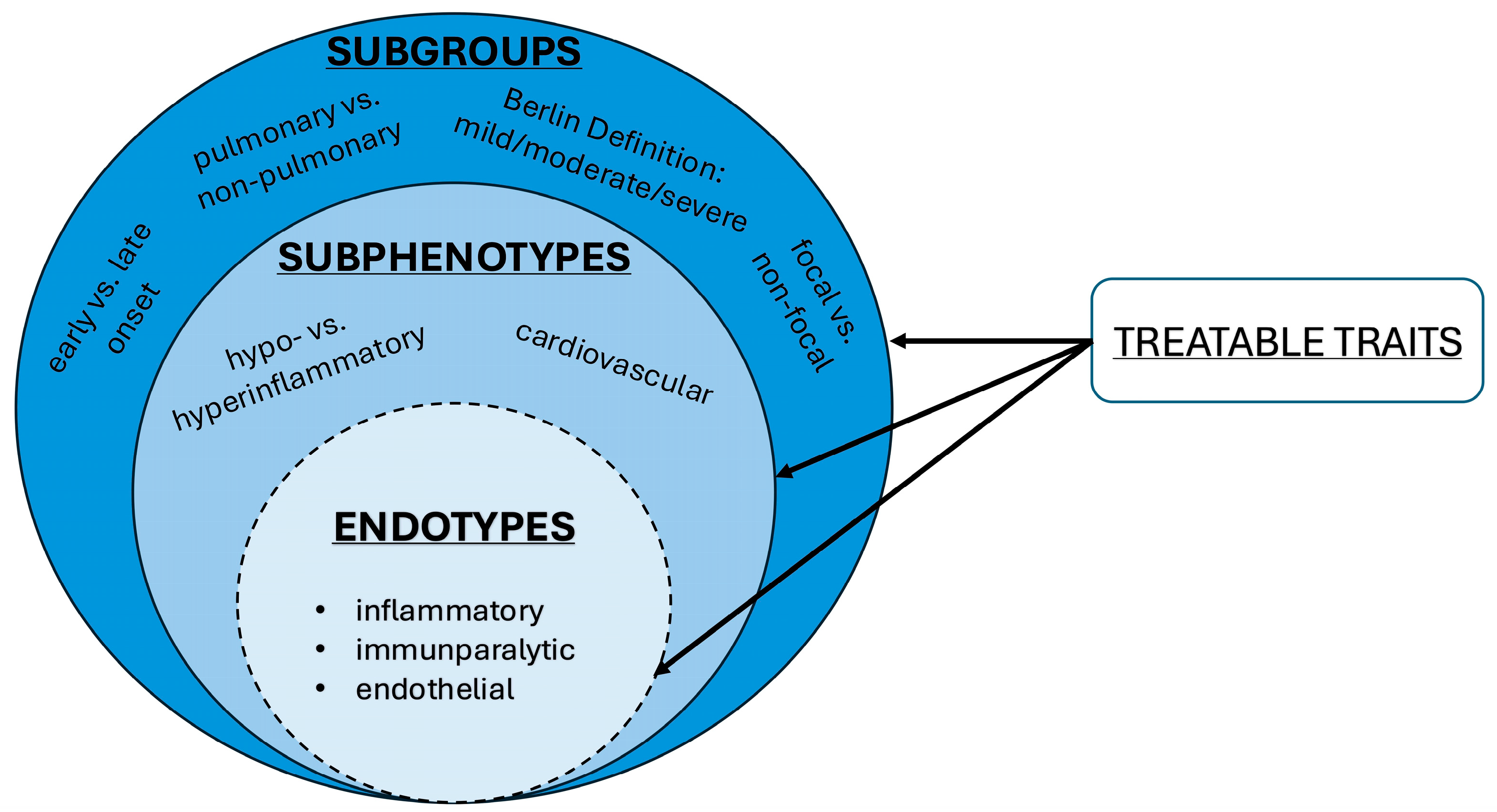
1.2. Definitions and Terminology in ARDS Phenotyping
2. Methods
2.1. Literature Search
2.2. Statistical Approaches to ARDS Phenotyping
3. Subgroups of ARDS
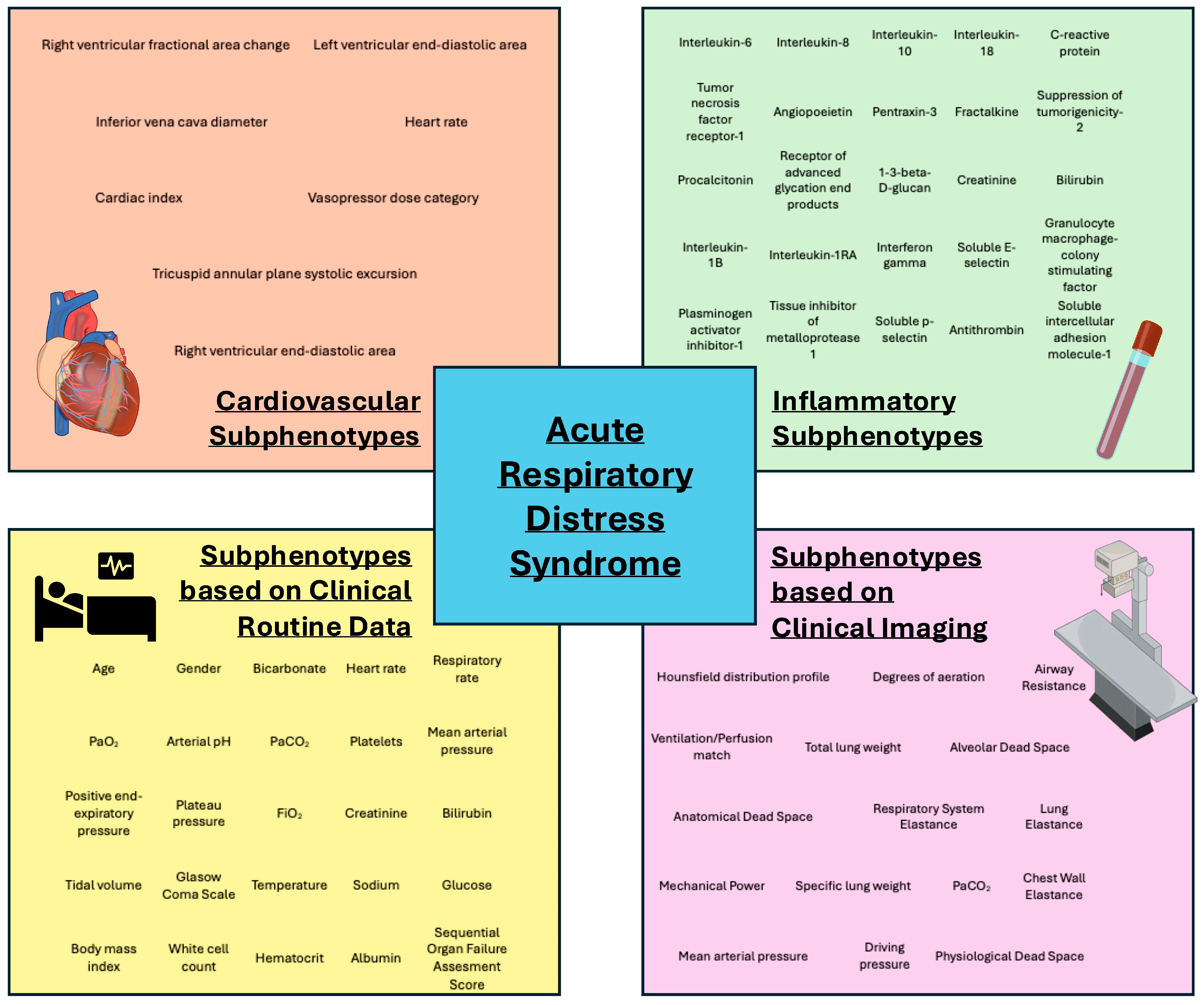
4. Subphenotypes of ARDS
4.1. Inflammatory Subphenotypes
4.2. Cardiovascular Subphenotypes
4.3. Subphenotypes Based on Clinical Routine Data
4.4. Subphenotyping Based on Clinical Imaging
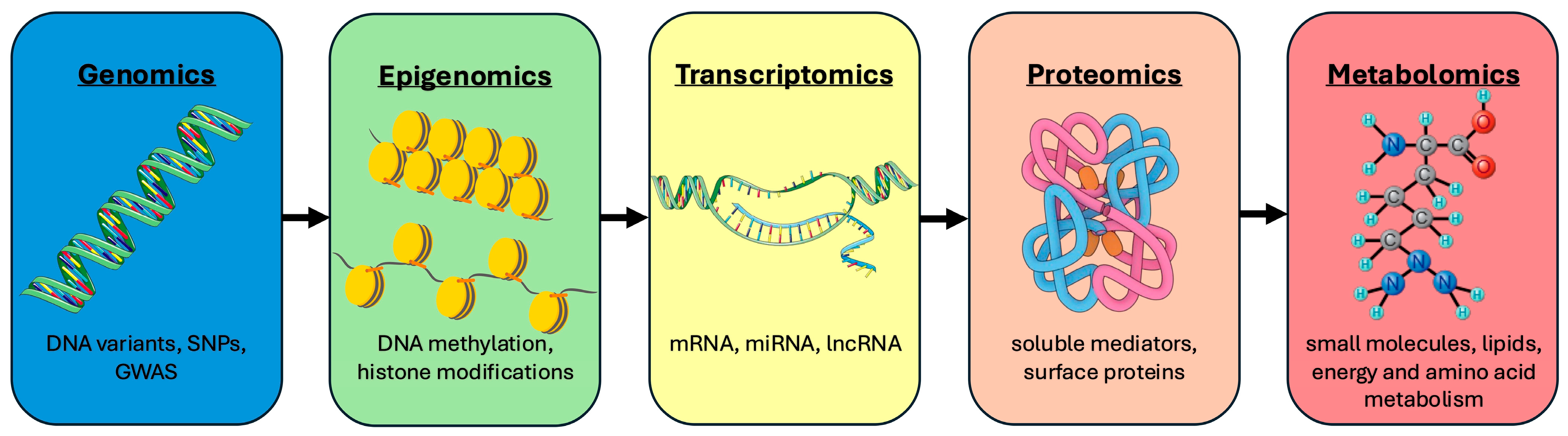
5. Multi-Omics Approach
6. Endotypes of ARDS
7. Therapeutic Approaches
8. Current Issues and Future Perspectives
9. Conclusions
Author Contributions
Funding
Institutional Review Board Statement
Informed Consent Statement
Acknowledgments
Conflicts of Interest
Abbreviations
| Ang-2 | Angiopoietin-2 |
| ARDS | Acute respiratory distress syndrome |
| CT | Computertomography |
| ECMO | Extracorporeal membrane oxygenation |
| EIT | Electrical impedance tomography |
| HLA-DR | Human leukocyte antigen DR isotype |
| IL | Interleukin |
| KL | Krebs von den Lungen |
| LCA | Latent class analysis |
| ML | Machine learning |
| PEEP | Positive end-expiratory pressure |
| RALE | Radiographic assessment of lung edema |
References
- Ranieri, V.M.; Rubenfeld, G.D.; Taylor Thompson, B.; Ferguson, N.D.; Caldwell, E.; Fan, E.; Camporota, L.; Slutsky, A.S. Acute Respiratory Distress Syndrome: The Berlin Definition. JAMA 2012, 307, 2526–2533. [Google Scholar]
- Bellani, G.; Laffey, J.G.; Pham, T.; Fan, E.; Brochard, L.; Esteban, A.; Gattinoni, L.; Van Haren, F.; Larsson, A.; McAuley, D.F.; et al. Epidemiology, Patterns of Care, and Mortality for Patients with Acute Respiratory Distress Syndrome in Intensive Care Units in 50 Countries. JAMA 2016, 315, 788. [Google Scholar] [CrossRef]
- Torres, L.K.; Hoffman, K.L.; Oromendia, C.; Diaz, I.; Harrington, J.S.; Schenck, E.J.; Price, D.R.; Gomez-Escobar, L.; Higuera, A.; Vera, M.P.; et al. Attributable mortality of acute respiratory distress syndrome: A systematic review, meta-analysis and survival analysis using targeted minimum loss-based estimation. Thorax 2021, 76, 1176–1185. [Google Scholar] [CrossRef] [PubMed]
- Palakshappa, J.A.; Krall, J.T.W.; Belfield, L.T.; Files, D.C. Long-Term Outcomes in Acute Respiratory Distress Syndrome. Crit. Care Clin. 2021, 37, 895–911. [Google Scholar] [CrossRef]
- Thompson, B.T.; Chambers, R.C.; Liu, K.D. Acute Respiratory Distress Syndrome. N. Engl. J. Med. 2017, 377, 562–572. [Google Scholar]
- Combes, A.; Hajage, D.; Capellier, G.; Demoule, A.; Lavoué, S.; Guervilly, C.; Da Silva, D.; Zafrani, L.; Tirot, P.; Veber, B.; et al. Extracorporeal Membrane Oxygenation for Severe Acute Respiratory Distress Syndrome. N. Engl. J. Med. 2018, 378, 1965–1975. [Google Scholar] [CrossRef]
- Tonna, J.E.; Abrams, D.; Brodie, D.; Greenwood, J.C.; Mateo-Sidron, J.A.R.; Usman, A.; Fan, E. Management of Adult Patients Supported with Venovenous Extracorporeal Membrane Oxygenation (VV ECMO): Guideline from the Extracorporeal Life Support Organization (ELSO). ASAIO J. 2021, 67, 601–610. [Google Scholar] [CrossRef]
- Bos, L.D.J.; Ware, L.B. Acute respiratory distress syndrome: Causes, pathophysiology, and phenotypes. Lancet 2022, 400, 1145–1156. [Google Scholar] [CrossRef]
- Wilson, J.G.; Calfee, C.S. ARDS Subphenotypes: Understanding a Heterogeneous Syndrome. Crit. Care 2020, 24, 102. [Google Scholar] [CrossRef] [PubMed]
- Sinha, P.; Calfee, C.S. Phenotypes in acute respiratory distress syndrome: Moving towards precision medicine. Curr. Opin. Crit. Care 2019, 25, 12–20. [Google Scholar] [CrossRef]
- Gordon, A.C.; Alipanah-Lechner, N.; Bos, L.D.; Dianti, J.; Diaz, J.V.; Finfer, S.; Fujii, T.; Giamarellos-Bourboulis, E.J.; Goligher, E.C.; Gong, M.N.; et al. From ICU Syndromes to ICU Subphenotypes: Consensus Report and Recommendations for Developing Precision Medicine in the ICU. Am. J. Respir. Crit. Care Med. 2024, 210, 155–166. [Google Scholar] [CrossRef]
- Grasselli, G.; Calfee, C.S.; Camporota, L.; Poole, D.; Amato, M.B.P.; Antonelli, M.; Arabi, Y.M.; Baroncelli, F.; Beitler, J.R.; Bellani, G.; et al. ESICM guidelines on acute respiratory distress syndrome: Definition, phenotyping and respiratory support strategies. Intensive Care Med. 2023, 49, 727–759. [Google Scholar] [CrossRef] [PubMed]
- Reddy, K.; Sinha, P.; O’Kane, C.M.; Gordon, A.C.; Calfee, C.S.; McAuley, D.F. Subphenotypes in critical care: Translation into clinical practice. Lancet Respir. Med. 2020, 8, 631–643. [Google Scholar] [CrossRef]
- Wildi, K.; Livingstone, S.; Palmieri, C.; LiBassi, G.; Suen, J.; Fraser, J. The discovery of biological subphenotypes in ARDS: A novel approach to targeted medicine? J. Intensive Care 2021, 9, 14. [Google Scholar] [CrossRef]
- Viswan, A.; Ghosh, P.; Gupta, D.; Azim, A.; Sinha, N. Distinct Metabolic Endotype Mirroring Acute Respiratory Distress Syndrome (ARDS) Subphenotype and its Heterogeneous Biology. Sci. Rep. 2019, 9, 2108. [Google Scholar] [CrossRef]
- Cole, V.; Boutet, M. ResearchRabbit (product review). J. Can. Health Libr. Assoc. 2023, 44, 43–47. [Google Scholar] [CrossRef]
- Sinha, P.; Spicer, A.; Delucchi, K.L.; McAuley, D.F.; Calfee, C.S.; Churpek, M.M. Comparison of machine learning clustering algorithms for detecting heterogeneity of treatment effect in acute respiratory distress syndrome: A secondary analysis of three randomised controlled trials. eBioMedicine 2021, 74, 103697. [Google Scholar] [CrossRef]
- Collins, L.M.; Lanza, S.T. Latent Class and Latent Transition Analysis: With Applications in the Social, Behavioral, and Health Sciences, 1st ed.; Wiley Series in Probability and Statistics; Wiley: Hoboken, NJ, USA, 2009; Available online: https://onlinelibrary.wiley.com/doi/book/10.1002/9780470567333 (accessed on 24 August 2025).
- Nagin, D.S.; Jones, B.L.; Passos, V.L.; Tremblay, R.E. Group-based multi-trajectory modeling. Stat. Methods Med. Res. 2018, 27, 2015–2023. [Google Scholar] [CrossRef] [PubMed]
- Niu, J.; Lv, X.; Gao, L.; Jia, H.; Zhao, J. Development and validation of a machine learning-based prediction model for in-ICU mortality in severe pneumonia: A dual-center retrospective study. Int. J. Med. Inf. 2025, 204, 106075. [Google Scholar] [CrossRef] [PubMed]
- McNicholas, B.; Madden, M.G.; Laffey, J.G. Machine Learning Classifier Models: The Future for Acute Respiratory Distress Syndrome Phenotyping? Am. J. Respir. Crit. Care Med. 2020, 202, 919–920. [Google Scholar] [CrossRef]
- Sinha, P.; Churpek, M.M.; Calfee, C.S. Machine Learning Classifier Models Can Identify Acute Respiratory Distress Syndrome Phenotypes Using Readily Available Clinical Data. Am. J. Respir. Crit. Care Med. 2020, 202, 996–1004. [Google Scholar] [CrossRef]
- Wick, K.D.; Ware, L.B.; Matthay, M.A. Acute respiratory distress syndrome. BMJ 2024, 387, e076612. [Google Scholar] [CrossRef]
- Meyer, N.J.; Gattinoni, L.; Calfee, C.S. Acute respiratory distress syndrome. Lancet 2021, 398, 622–637. [Google Scholar] [CrossRef] [PubMed]
- Chang, Y.; Yoo, H.J.; Kim, S.J.; Lee, K.; Lim, C.-M.; Hong, S.-B.; Koh, Y.; Huh, J.W. A targeted metabolomics approach for sepsis-induced ARDS and its subphenotypes. Crit. Care 2023, 27, 263. [Google Scholar] [CrossRef]
- Constantin, J.M.; Grasso, S.; Chanques, G.; Aufort, S.; Futier, E.; Sebbane, M.; Jung, B.; Gallix, B.; Bazin, J.E.; Rouby, J.J.; et al. Lung morphology predicts response to recruitment maneuver in patients with acute respiratory distress syndrome. Crit. Care Med. 2010, 38, 1108–1117. [Google Scholar] [CrossRef]
- Jabaudon, M.; Blondonnet, R.; Lutz, J.; Roszyk, L.; Bouvier, D.; Guérin, R.; Perbet, S.; Cayot, S.; Godet, T.; Blanchon, L.; et al. Net alveolar fluid clearance is associated with lung morphology phenotypes in acute respiratory distress syndrome. Anaesth. Crit. Care Pain Med. 2016, 35, 81–86. [Google Scholar] [CrossRef]
- Mauri, T.; Leali, M.; Spinelli, E.; Scaramuzzo, G.; Antonelli, M.; Grieco, D.L.; Spadaro, S.; Grasselli, G. Omics approach to chest electrical impedance tomography reveals physiological cluster of ARDS characterised by increased respiratory drive and effort. Ann. Intensive Care 2025, 15, 90. [Google Scholar] [CrossRef]
- Liao, K.M.; Chen, C.W.; Hsiue, T.R.; Lin, W.C. Timing of Acute Respiratory Distress Syndrome Onset is Related to Patient Outcome. J. Formos. Med. Assoc. 2009, 108, 694–703. [Google Scholar] [CrossRef]
- Zhang, R.; Wang, Z.; Tejera, P.; Frank, A.J.; Wei, Y.; Su, L.; Zhu, Z.; Guo, Y.; Chen, F.; Bajwa, E.K.; et al. Late-onset moderate to severe acute respiratory distress syndrome is associated with shorter survival and higher mortality: A two-stage association study. Intensive Care Med. 2017, 43, 399–407. [Google Scholar] [CrossRef] [PubMed]
- Vincent, J.L.; Sakr, Y.; Groeneveld, J.; Zandstra, D.F.; Hoste, E.; Malledant, Y.; Lei, K.; Sprung, C.L. ARDS of Early or Late Onset. Chest 2010, 137, 81–87. [Google Scholar] [CrossRef] [PubMed]
- Villar, J.; Blanco, J.; del Campo, R.; Andaluz-Ojeda, D.; Díaz-Domínguez, F.J.; Muriel, A.; Córcoles, V.; Suárez-Sipmann, F.; Tarancón, C.; González-Higueras, E.; et al. Assessment of PaO2/FiO2 for stratification of patients with moderate and severe acute respiratory distress syndrome. BMJ Open 2015, 5, e006812. [Google Scholar] [CrossRef]
- Hueda-Zavaleta, M.; Copaja-Corzo, C.; Miranda-Chávez, B.; Flores-Palacios, R.; Huanacuni-Ramos, J.; Mendoza-Laredo, J.; Minchón-Vizconde, D.; de la Torre, J.C.G.; Benites-Zapata, V.A. Determination of PaO2/FiO2 after 24 h of invasive mechanical ventilation and ΔPaO2/FiO2 at 24 h as predictors of survival in patients diagnosed with ARDS due to COVID-19. PeerJ 2022, 10, e14290. [Google Scholar] [CrossRef]
- Calfee, C.S.; Delucchi, K.; Parsons, P.E.; Thompson, B.T.; Ware, L.B.; Matthay, M.A. Subphenotypes in acute respiratory distress syndrome: Latent class analysis of data from two randomised controlled trials. Lancet Respir. Med. 2014, 2, 611–620. [Google Scholar] [CrossRef]
- The Acute Respiratory Distress Syndrome Network; Brower, R.G.; Matthay, M.A.; Morris, A.; Schoenfeld, D.; Thompson, B.T.; Wheeler, A. Ventilation with Lower Tidal Volumes as Compared with Traditional Tidal Volumes for Acute Lung Injury and the Acute Respiratory Distress Syndrome. N. Engl. J. Med. 2000, 342, 1301–1308. [Google Scholar] [CrossRef]
- Brower, R.G.; Lanken, P.N.; MacIntyre, N.; Matthay, M.A.; Morris, A.; Ancukiewicz, M.; Schoenfeld, D.; Thompson, B.T.; National Heart, Lung, and Blood Institute ARDS Clinical Trials Network. Higher versus Lower Positive End-Expiratory Pressures in Patients with the Acute Respiratory Distress Syndrome. N. Engl. J. Med. 2004, 351, 327–336. [Google Scholar]
- Redaelli, S.; von Wedel, D.; Fosset, M.; Suleiman, A.; Chen, G.; Alingrin, J.; Gong, M.N.; Gajic, O.; Goodspeed, V.; Talmor, D.; et al. Inflammatory subphenotypes in patients at risk of ARDS: Evidence from the LIPS-A trial. Intensive Care Med. 2023, 49, 1499–1507. [Google Scholar] [CrossRef]
- Bihari, S.; Bersten, A.; Paul, E.; McGuinness, S.; Dixon, D.; Sinha, P.; Calfee, C.S.; Nichol, A.; Hodgson, C.; Manuscript, C.E.T.; et al. Acute respiratory distress syndrome phenotypes with distinct clinical outcomes in PHARLAP trial cohort. Crit. Care Resusc. 2021, 23, 163–170. [Google Scholar] [CrossRef]
- Bime, C.; Casanova, N.; Oita, R.C.; Ndukum, J.; Lynn, H.; Camp, S.M.; Lussier, Y.; Abraham, I.; Carter, D.; Miller, E.J.; et al. Development of a biomarker mortality risk model in acute respiratory distress syndrome. Crit. Care 2019, 23, 410. [Google Scholar] [CrossRef] [PubMed]
- Drohan, C.M.; Nouraie, S.M.; Bain, W.; Shah, F.A.; Evankovich, J.; Zhang, Y.; Morris, A.; McVerry, B.J.; Kitsios, G.D. Biomarker-Based Classification of Patients with Acute Respiratory Failure Into Inflammatory Subphenotypes: A Single-Center Exploratory Study. Crit. Care Explor. 2021, 3, e0518. [Google Scholar] [CrossRef] [PubMed]
- Sinha, P.; Delucchi, K.L.; Chen, Y.; Zhuo, H.; Abbott, J.; Wang, C.; Wickersham, N.; McNeil, J.B.; Jauregui, A.; Ke, S.; et al. Latent class analysis-derived subphenotypes are generalisable to observational cohorts of acute respiratory distress syndrome: A prospective study. Thorax 2022, 77, 13–21. [Google Scholar] [CrossRef] [PubMed]
- Moore, A.R.; Pienkos, S.M.; Sinha, P.; Guan, J.; O’Kane, C.M.; Levitt, J.E.; Wilson, J.G.; Shankar-Hari, M.; Matthay, M.A.; Calfee, C.S.; et al. Elevated Plasma Interleukin-18 Identifies High-Risk Acute Respiratory Distress Syndrome Patients not Distinguished by Prior Latent Class Analyses Using Traditional Inflammatory Cytokines: A Retrospective Analysis of Two Randomized Clinical Trials. Crit. Care Med. 2023, 51, e269–e274. [Google Scholar] [CrossRef]
- Labar, A.S.; Ulrich, B.C.; Lovelace, T.C.; Bain, W.G.; Shah, F.A.; White, E.B.; Abe, E.A.; Giacona, F.; Alba, G.A.; Thompson, B.T.; et al. Plasma Levels of Soluble ST2 Reflect Extrapulmonary Organ Dysfunction and Predict Outcomes in Acute Respiratory Failure. Crit. Care Med. 2025, 53, e1567–e1580. [Google Scholar] [CrossRef] [PubMed]
- Blot, P.L.; Chousterman, B.G.; Santafè, M.; Cartailler, J.; Pacheco, A.; Magret, M.; Masclans, J.R.; Artigas, A.; Roca, O.; García-de-Acilu, M. Subphenotypes in patients with acute respiratory distress syndrome treated with high-flow oxygen. Crit. Care 2023, 27, 419. [Google Scholar] [CrossRef]
- Sathe, N.A.; Morrell, E.D.; Bhatraju, P.K.; Fessler, M.B.; Stapleton, R.D.; Wurfel, M.M.; Mikacenic, C. Alveolar Biomarker Profiles in Subphenotypes of the Acute Respiratory Distress Syndrome. Crit. Care Med. 2023, 51, e13–e18. [Google Scholar] [CrossRef]
- Bos, L.D.; Schouten, L.R.; Van Vught, L.A.; Wiewel, M.A.; Ong, D.S.Y.; Cremer, O.; Artigas, A.; Martin-Loeches, I.; Hoodgendijk, A.J.; Van Der Poll, T.; et al. Identification and validation of distinct biological phenotypes in patients with acute respiratory distress syndrome by cluster analysis. Thorax 2017, 72, 876–883. [Google Scholar] [CrossRef]
- Heijnen, N.F.L.; Hagens, L.A.; Smit, M.R.; Cremer, O.L.; Ong, D.S.Y.; Van Der Poll, T.; Van Vught, L.A.; Scicluna, B.P.; Schnabel, R.M.; Van Der Horst, I.C.C.; et al. Biological Subphenotypes of Acute Respiratory Distress Syndrome Show Prognostic Enrichment in Mechanically Ventilated Patients without Acute Respiratory Distress Syndrome. Am. J. Respir. Crit. Care Med. 2021, 203, 1503–1511. [Google Scholar] [CrossRef]
- Chotalia, M.; Ali, M.; Alderman, J.E.; Patel, J.M.; Parekh, D.; Bangash, M.N. Cardiovascular subphenotypes in patients with COVID-19 pneumonitis whose lungs are mechanically ventilated: A single-centre retrospective observational study. Anaesthesia 2022, 77, 763–771. [Google Scholar] [CrossRef]
- Chotalia, M.; Ali, M.; Alderman, J.E.; Bansal, S.; Patel, J.M.; Bangash, M.N.; Parekh, D. Cardiovascular Subphenotypes in Acute Respiratory Distress Syndrome. Crit. Care Med. 2023, 51, 460–470. [Google Scholar] [CrossRef]
- Sinha, P.; Lawler, P.R. Are There Distinct Cardiovascular Subclasses in Acute Respiratory Distress Syndrome? Maybe. Crit. Care Med. 2023, 51, 546–549. [Google Scholar] [CrossRef] [PubMed]
- Chotalia, M.; Patel, J.; Bangash, M.; Parekh, D. Cardiovascular Subphenotypes in ARDS: Diagnostic and Therapeutic Implications and Overlap with Other ARDS Subphenotypes. J. Clin. Med. 2023, 12, 3695. [Google Scholar] [CrossRef] [PubMed]
- National Heart, Lung, and Blood Institute Acute Respiratory Distress Syndrome (ARDS) Clinical Trials Network; Wheeler, A.P.; Bernard, G.R.; Thompson, B.T.; Schoenfeld, D.; Wiedemann, H.P.; deBoisblanc, B.; Connors, A.F.; Hite, R.D.; Harabin, A.L. Pulmonary-artery versus central venous catheter to guide treatment of acute lung injury. N. Engl. J. Med. 2006, 354, 2213–2224. [Google Scholar] [CrossRef]
- The National Heart, Lung, and Blood Institute Acute Respiratory Distress Syndrome (ARDS) Clinical Trials Network; Rice, T.W.; Wheeler, A.P.; Thompson, B.T.; Steingrub, J.; Hite, R.D.; Moss, M.; Morris, A.; Dong, N.; Rock, P. Initial Trophic vs. Full Enteral Feeding in Patients with Acute Lung Injury: The EDEN Randomized Trial. JAMA J. Am. Med. Assoc. 2012, 307, 795–803. [Google Scholar] [CrossRef]
- National Heart, Lung, and Blood Institute ARDS Clinical Trials Network; Truwit, J.D.; Bernard, G.R.; Steingrub, J.; Matthay, M.A.; Liu, K.D.; Albertson, T.E.; Brower, R.G.; Shanholtz, C.; Rock, P.; et al. Rosuvastatin for sepsis-associated acute respiratory distress syndrome. N. Engl. J. Med. 2014, 370, 2191–2200. [Google Scholar]
- Writing Group for the Alveolar Recruitment for Acute Respiratory Distress Syndrome Trial (ART) Investigators; Cavalcanti, A.B.; Suzumura, É.A.; Laranjeira, L.N.; Paisani, D.D.M.; Damiani, L.P.; Guimarães, H.P.; Romano, E.R.; Regenga, M.D.M.; Taniguchi, L.N.T.; et al. Effect of Lung Recruitment and Titrated Positive End-Expiratory Pressure (PEEP) vs. Low PEEP on Mortality in Patients with Acute Respiratory Distress Syndrome: A Randomized Clinical Trial. JAMA 2017, 318, 1335. [Google Scholar]
- Duggal, A.; Kast, R.; Van Ark, E.; Bulgarelli, L.; Siuba, M.T.; Osborn, J.; Rey, D.A.; Zampieri, F.G.; Cavalcanti, A.B.; Maia, I.; et al. Identification of acute respiratory distress syndrome subphenotypes de novo using routine clinical data: A retrospective analysis of ARDS clinical trials. BMJ Open 2022, 12, e053297. [Google Scholar] [CrossRef]
- Maddali, M.V.; Churpek, M.; Pham, T.; Rezoagli, E.; Zhuo, H.; Zhao, W.; He, J.; Delucchi, K.L.; Wang, C.; Wickersham, N.; et al. Validation and utility of ARDS subphenotypes identified by machine-learning models using clinical data: An observational, multicohort, retrospective analysis. Lancet Respir. Med. 2022, 10, 367–377. [Google Scholar] [CrossRef] [PubMed]
- Meza-Fuentes, G.; Delgado, I.; Barbé, M.; Sánchez-Barraza, I.; Retamal, M.A.; López, R. Machine learning-based identification of efficient and restrictive physiological subphenotypes in acute respiratory distress syndrome. Intensive Care Med. Exp. 2025, 13, 29. [Google Scholar] [CrossRef] [PubMed]
- Parhar, K.K.S.; Zjadewicz, K.; Soo, A.; Sutton, A.; Zjadewicz, M.; Doig, L.; Lam, C.; Ferland, A.; Niven, D.J.; Fiest, K.M.; et al. Epidemiology, Mechanical Power, and 3-Year Outcomes in Acute Respiratory Distress Syndrome Patients Using Standardized Screening. An Observational Cohort Study. Ann. Am. Thorac. Soc. 2019, 16, 1263–1272. [Google Scholar] [CrossRef]
- Liu, X.; Jiang, Y.; Jia, X.; Ma, X.; Han, C.; Guo, N.; Peng, Y.; Liu, H.; Ju, Y.; Luo, X.; et al. Identification of distinct clinical phenotypes of acute respiratory distress syndrome with differential responses to treatment. Crit. Care 2021, 25, 320. [Google Scholar] [CrossRef]
- Gattinoni, L.; Chiumello, D.; Caironi, P.; Busana, M.; Romitti, F.; Brazzi, L.; Camporota, L. COVID-19 pneumonia: Different respiratory treatments for different phenotypes? Intensive Care Med. 2020, 46, 1099–1102. [Google Scholar] [CrossRef]
- Panwar, R.; Madotto, F.; Laffey, J.G.; Van Haren, F.M.P. Compliance Phenotypes in Early Acute Respiratory Distress Syndrome before the COVID-19 Pandemic. Am. J. Respir. Crit. Care Med. 2020, 202, 1244–1252. [Google Scholar] [CrossRef] [PubMed]
- Dereli, N.; Babayiğit, M.; Koç, F.; Menteş, O.; Yildiz, G.; Kilinçarslan, A.; Kaplanoğlu, V.; Öncü, G.; Ünver, M. Type-H, and Type-L COVID-19: Are they different subtypes or the same? Eur. Rev. Med. Pharmacol. Sci. 2022, 26, 3367–3373. [Google Scholar]
- Vasquez, C.R.; Gupta, S.; Miano, T.A.; Roche, M.; Hsu, J.; Yang, W.; Holena, D.N.; Reilly, J.P.; Schrauben, S.J.; Leaf, D.E.; et al. Identification of Distinct Clinical Subphenotypes in Critically Ill Patients with COVID-19. Chest 2021, 160, 929–943. [Google Scholar] [CrossRef]
- Gutiérrez-Gutiérrez, B.; Del Toro, M.D.; Borobia, A.M.; Carcas, A.; Jarrín, I.; Yllescas, M.; Ryan, P.; Pachón, J.; Carratalà, J.; Berenguer, J.; et al. Identification and validation of clinical phenotypes with prognostic implications in patients admitted to hospital with COVID-19: A multicentre cohort study. Lancet Infect. Dis. 2021, 21, 783–792. [Google Scholar] [CrossRef]
- Ranjeva, S.; Pinciroli, R.; Hodell, E.; Mueller, A.; Hardin, C.C.; Thompson, B.T.; Berra, L. Identifying clinical and biochemical phenotypes in acute respiratory distress syndrome secondary to coronavirus disease-2019. eClinicalMedicine 2021, 34, 100829. [Google Scholar] [CrossRef]
- Da Cruz, M.R.; Azambuja, P.; Torres, K.S.C.; Lima-Setta, F.; Japiassú, A.M.; Medeiros, D.M. Identification and validation of respiratory subphenotypes in patients with COVID-19 acute respiratory distress syndrome undergoing prone position. Ann. Intensive Care 2024, 14, 178. [Google Scholar] [CrossRef] [PubMed]
- Lascarrou, J.B.; Gaultier, A.; Soumagne, T.; Serck, N.; Sauneuf, B.; Piagnerelli, M.; Ly, A.; Lejeune, F.; Lefebvre, L.; Hraiech, S.; et al. Identifying Clinical Phenotypes in Moderate to Severe Acute Respiratory Distress Syndrome Related to COVID-19: The COVADIS Study. Front. Med. 2021, 8, 632933. [Google Scholar] [CrossRef]
- Ceccato, A.; Forne, C.; Bos, L.D.; Camprubí-Rimblas, M.; Areny-Balagueró, A.; Campaña-Duel, E.; Quero, S.; Diaz, E.; Roca, O.; De Gonzalo-Calco, D.; et al. Clustering COVID-19 ARDS patients through the first days of ICU admission. An analysis of the CIBERESUCICOVID Cohort. Crit. Care 2024, 28, 91. [Google Scholar] [CrossRef]
- Fosset, M.; Von Wedel, D.; Redaelli, S.; Talmor, D.; Molinari, N.; Josse, J.; Baedorf-Kassis, E.N.; Schaefer, M.S.; Jung, B. Subphenotyping prone position responders with machine learning. Crit. Care 2025, 29, 116. [Google Scholar] [CrossRef] [PubMed]
- Nishikimi, M.; Ohshimo, S.; Bellani, G.; Fukumoto, W.; Anzai, T.; Liu, K.; Ishii, J.; Kyo, M.; Awai, K.; Takahashi, K.; et al. Identification of novel sub-phenotypes of severe ARDS requiring ECMO using latent class analysis. Crit. Care 2024, 28, 343. [Google Scholar] [CrossRef]
- Jabaudon, M.; Audard, J.; Pereira, B.; Jaber, S.; Lefrant, J.Y.; Blondonnet, R.; Godet, T.; Futier, E.; Lambert, C.; Bazin, J.-E.; et al. Early Changes over Time in the Radiographic Assessment of Lung Edema Score Are Associated with Survival in ARDS. Chest 2020, 158, 2394–2403. [Google Scholar] [CrossRef]
- Bjarnadottir, K.J.; Tovedal, M.; Perchiazzi, G.; Lipcsey, M.; Covaciu, L.; Von Seth, M.; Kawati, R.; Pellegrini, M. The focal index: A quantitative approach to morphological sub-phenotyping of COVID-19 patients with acute respiratory distress syndrome: A pilot study. Intensive Care Med. Exp. 2025, 13, 81. [Google Scholar] [CrossRef]
- Partouche, N.; Maumy, M.; Chamaraux-Tran, T.N.; Bertrand, F.; Schneider, F.; Meyer, N.; Solis, M.; Fafi-Kremer, S.; Noll, E.; Pottecher, J. Does the IL-6/KL-6 ratio distinguish different phenotypes in COVID-19 Acute Respiratory Distress Syndrome? An observational study stemmed from prospectively derived clinical, biological, and computed tomographic data. PLoS ONE 2025, 20, e0321533. [Google Scholar] [CrossRef]
- Wendel Garcia, P.D.; Caccioppola, A.; Coppola, S.; Pozzi, T.; Ciabattoni, A.; Cenci, S.; Chiumello, D. Latent class analysis to predict intensive care outcomes in Acute Respiratory Distress Syndrome: A proposal of two pulmonary phenotypes. Crit. Care 2021, 25, 154. [Google Scholar] [CrossRef]
- Filippini, D.F.L.; Di Gennaro, E.; Van Amstel, R.B.E.; Beenen, L.F.M.; Grasso, S.; Pisani, L.; Bos, L.D.J.; Smit, M.R. Latent class analysis of imaging and clinical respiratory parameters from patients with COVID-19-related ARDS identifies recruitment subphenotypes. Crit. Care 2022, 26, 363. [Google Scholar] [CrossRef]
- Babu, M.; Snyder, M. Multi-Omics Profiling for Health. Mol. Cell Proteomics 2023, 22, 100561. [Google Scholar] [CrossRef]
- Bressan, D.; Battistoni, G.; Hannon, G.J. The dawn of spatial omics. Science 2023, 381, eabq4964. [Google Scholar] [CrossRef]
- Xia, F.; Chen, H.; Liu, Y.; Huang, L.; Meng, S.; Xu, J.; Xie, J.; Wang, G.; Guo, F. Development of genomic phenotype and immunophenotype of acute respiratory distress syndrome using autophagy and metabolism-related genes. Front. Immunol. 2023, 14, 1209959. [Google Scholar] [CrossRef] [PubMed]
- Williams, J.E.; Mauya, Z.; Walkup, V.; Adderley, S.; Evans, C.; Wilson, K. Epigenetic Regulation of Neutrophils in ARDS. Cells 2025, 14, 1151. [Google Scholar] [CrossRef] [PubMed]
- Gysemans, C.; Beya, M.; Pedace, E.; Mathieu, C. Exploring Neutrophil Heterogeneity and Plasticity in Health and Disease. Biomedicines 2025, 13, 597. [Google Scholar] [CrossRef] [PubMed]
- Fu, Y.; Wen, Z.; Fan, J. Interaction of low-density neutrophils with other immune cells in the mechanism of inflammation. Mol. Med. 2025, 31, 133. [Google Scholar] [CrossRef]
- Panda, R.; Castanheira, F.V.S.; Schlechte, J.M.; Surewaard, B.G.J.; Shim, H.B.; Zucoloto, A.Z.; Slavikova, Z.; Yipp, B.G.; Kubes, P.; McDonald, P. A functionally distinct neutrophil landscape in severe COVID-19 reveals opportunities for adjunctive therapies. JCI Insight 2022, 7, e152291. [Google Scholar] [CrossRef] [PubMed]
- Morrell, E.D.; Bhatraju, P.K.; Mikacenic, C.R.; Radella, F.; Manicone, A.M.; Stapleton, R.D.; Wurfel, M.M.; Gharib, S.A. Alveolar Macrophage Transcriptional Programs Are Associated with Outcomes in Acute Respiratory Distress Syndrome. Am. J. Respir. Crit. Care Med. 2019, 200, 732–741. [Google Scholar] [CrossRef]
- López-Martínez, C.; Martín-Vicente, P.; Gómez De Oña, J.; López-Alonso, I.; Gil-Peña, H.; Cuesta-Llavona, E.; Fernández-Rodríguez, M.; Crespo, I.; Salgado Del Riego, E.; Rodríguez-García, R.; et al. Transcriptomic clustering of critically ill COVID-19 patients. Eur. Respir. J. 2023, 61, 2200592. [Google Scholar] [CrossRef]
- Wildi, K.; Bouquet, M.; Ainola, C.; Livingstone, S.; Colombo, S.M.; Heinsar, S.; Sato, N.; Sato, K.; Wilson, E.; Abbate, G.; et al. Differential Protein Expression among Two Different Ovine ARDS Phenotypes—A Preclinical Randomized Study. Metabolites 2022, 12, 655. [Google Scholar] [CrossRef] [PubMed]
- Gong, R.; Luo, H.; Long, G.; Xu, J.; Huang, C.; Zhou, X.; Shang, Y.; Zhang, D. Integrative proteomic profiling of lung tissues and blood in acute respiratory distress syndrome. Front. Immunol. 2023, 14, 1158951. [Google Scholar] [CrossRef]
- Chase, A.; Almuntashiri, S.; Sikora, A.; Zhang, D. Club Cell Secretory Protein–Derived Acute Respiratory Distress Syndrome Phenotypes Predict 90-Day Mortality: A Reanalysis of the Fluids and Catheter Treatment Trial. Crit. Care Explor. 2022, 4, e0711. [Google Scholar] [CrossRef] [PubMed]
- Alipanah-Lechner, N.; Neyton, L.; Mick, E.; Willmore, A.; Leligdowicz, A.; Contrepois, K.; Jauregui, A.; Zhuo, H.; Hendrickson, C.; Gomez, A.; et al. Plasma metabolic profiling implicates dysregulated lipid metabolism and glycolytic shift in hyperinflammatory ARDS. Am. J. Physiol.-Lung Cell. Mol. Physiol. 2023, 324, L297–L306. [Google Scholar] [CrossRef]
- Suber, T.L.; Wendell, S.G.; Mullett, S.J.; Zuchelkowski, B.; Bain, W.; Kitsios, G.D.; McVerry, B.J.; Ray, P.; Ray, A.; Mallampalli, R.K.; et al. Serum metabolomic signatures of fatty acid oxidation defects differentiate host-response subphenotypes of acute respiratory distress syndrome. Respir. Res. 2023, 24, 136. [Google Scholar] [CrossRef]
- Rogers, A.J.; Contrepois, K.; Wu, M.; Zheng, M.; Peltz, G.; Ware, L.B.; Matthay, M.A. Profiling of ARDS pulmonary edema fluid identifies a metabolically distinct subset. Am. J. Physiol.-Lung Cell. Mol. Physiol. 2017, 312, L703–9. [Google Scholar] [CrossRef]
- Wang, Y.; Wei, A.; Su, Z.; Shi, Y.; Li, X.; He, L. Characterization of lactylation-based phenotypes and molecular biomarkers in sepsis-associated acute respiratory distress syndrome. Sci. Rep. 2025, 15, 13831. [Google Scholar] [CrossRef]
- Kuruvilla, M.E.; Lee, F.E.H.; Lee, G.B. Understanding Asthma Phenotypes, Endotypes, and Mechanisms of Disease. Clin. Rev. Allergy Immunol. 2019, 56, 219–233. [Google Scholar] [CrossRef]
- Bhatt, S.P.; Agusti, A.; Bafadhel, M.; Christenson, S.A.; Bon, J.; Donaldson, G.C.; Sin, D.D.; Wedzicha, J.A.; Martinez, F.J. Phenotypes, Etiotypes, and Endotypes of Exacerbations of Chronic Obstructive Pulmonary Disease. Am. J. Respir. Crit. Care Med. 2023, 208, 1026–1041. [Google Scholar] [CrossRef] [PubMed]
- Hasegawa, T.; Nakagawa, A.; Suzuki, K.; Yamashita, K.; Yamashita, S.; Iwanaga, N.; Tamada, E.; Noda, K.; Tomii, K. Type 1 inflammatory endotype relates to low compliance, lung fibrosis, and severe complications in COVID-19. Cytokine 2021, 148, 155618. [Google Scholar] [CrossRef]
- Schønemann-Lund, M.; Itenov, T.S.; Larsson, J.E.; Lindegaard, B.; Johansson, P.I.; Bestle, M.H. Novel subgroups in acute respiratory failure based on the trajectories of three endotheliopathy biomarkers: A cohort study. Acta Anaesthesiol. Scand. 2023, 67, 896–908. [Google Scholar] [CrossRef] [PubMed]
- Li, F.; Yin, R.; Guo, Q. Circulating angiopoietin-2 and the risk of mortality in patients with acute respiratory distress syndrome: A systematic review and meta-analysis of 10 prospective cohort studies. Ther. Adv. Respir. Dis. 2020, 14, 1753466620905274. [Google Scholar] [CrossRef]
- Rosenberger, C.M.; Wick, K.D.; Zhuo, H.; Wu, N.; Chen, Y.; Kapadia, S.B.; Guimaraes, A.; Chang, D.; Choy, D.F.; Chen, H.; et al. Early plasma angiopoietin-2 is prognostic for ARDS and mortality among critically ill patients with sepsis. Crit. Care 2023, 27, 234. [Google Scholar] [CrossRef]
- Reilly, J.P.; Wang, F.; Jones, T.K.; Palakshappa, J.A.; Anderson, B.J.; Shashaty, M.G.S.; Dunn, T.G.; Johansson, E.D.; Riley, T.R.; Lim, B.; et al. Plasma angiopoietin-2 as a potential causal marker in sepsis-associated ARDS development: Evidence from Mendelian randomization and mediation analysis. Intensive Care Med. 2018, 44, 1849–1858. [Google Scholar] [CrossRef]
- Garcia, B.; Zarbock, A.; Bellomo, R.; Legrand, M. The alternative renin–angiotensin system in critically ill patients: Pathophysiology and therapeutic implications. Crit. Care 2023, 27, 453. [Google Scholar] [CrossRef] [PubMed]
- Bitker, L.; Burrell, L.M. Classic and Nonclassic Renin-Angiotensin Systems in the Critically Ill. Crit. Care Clin. 2019, 35, 213–227. [Google Scholar] [CrossRef]
- De Roquetaillade, C.; Dupuis, C.; Faivre, V.; Lukaszewicz, A.C.; Brumpt, C.; Payen, D. Monitoring of circulating monocyte HLA-DR expression in a large cohort of intensive care patients: Relation with secondary infections. Ann. Intensive Care 2022, 12, 39. [Google Scholar] [CrossRef]
- Leijte, G.P.; Rimmelé, T.; Kox, M.; Bruse, N.; Monard, C.; Gossez, M.; Monneret, G.; Pickkers, P.; Venet, F. Monocytic HLA-DR expression kinetics in septic shock patients with different pathogens, sites of infection and adverse outcomes. Crit. Care 2020, 24, 110. [Google Scholar] [CrossRef]
- Bendib, I.; Beldi-Ferchiou, A.; Schlemmer, F.; Maitre, B.; Surenaud, M.; Hüe, S.; Carteaux, G.; Razazi, K.; Lelièvre, J.-D.; Lévy, Y.; et al. Functional Ex Vivo Testing of Alveolar Monocytes in Patients with Pneumonia-Related ARDS. Cells 2021, 10, 3546. [Google Scholar] [CrossRef] [PubMed]
- Torbic, H.; Bulgarelli, L.; Deliberato, R.O.; Duggal, A. Potential Impact of Subphenotyping in Pharmacologic Management of Acute Respiratory Distress Syndrome. J. Pharm. Pract. 2024, 37, 955–966. [Google Scholar] [CrossRef] [PubMed]
- Calfee, C.S.; Delucchi, K.L.; Sinha, P.; Matthay, M.A.; Hackett, J.; Shankar-Hari, M.; McDowell, C.; Laffey, J.G.; O’Kane, C.M.; McAuley, D.F.; et al. Acute respiratory distress syndrome subphenotypes and differential response to simvastatin: Secondary analysis of a randomised controlled trial. Lancet Respir. Med. 2018, 6, 691–698. [Google Scholar] [CrossRef] [PubMed]
- Livingstone, S.A.; Wildi, K.S.; Dalton, H.J.; Usman, A.; Ki, K.K.; Passmore, M.R.; Li Bassi, G.; Suen, J.Y.; Fraser, J.F. Coagulation Dysfunction in Acute Respiratory Distress Syndrome and Its Potential Impact in Inflammatory Subphenotypes. Front. Med. 2021, 8, 723217. [Google Scholar] [CrossRef]
- Bhavani, S.V.; Verhoef, P.A.; Maier, C.L.; Robichaux, C.; Parker, W.F.; Holder, A.; Kamaleswaran, R.; Wang, M.D.; Churpek, M.M.; Coopersmith, C.M. Coronavirus Disease 2019 Temperature Trajectories Correlate with Hyperinflammatory and Hypercoagulable Subphenotypes. Crit. Care Med. 2022, 50, 212–223. [Google Scholar] [CrossRef]
- Famous, K.R.; Delucchi, K.; Ware, L.B.; Kangelaris, K.N.; Liu, K.D.; Thompson, B.T.; Calfee, C.S. Acute Respiratory Distress Syndrome Subphenotypes Respond Differently to Randomized Fluid Management Strategy. Am. J. Respir. Crit. Care Med. 2017, 195, 331–338. [Google Scholar] [CrossRef]
- Liao, Q.; Pu, Y.; Jin, X.; Zhuang, Z.; Xu, X.; Ren, X.; Liu, G.; Ding, Q. Physiological and clinical variables identify ARDS classes and therapeutic heterogeneity to glucocorticoids: A retrospective study. BMC Pulm. Med. 2023, 23, 92. [Google Scholar] [CrossRef]
- Goossen, R.L.; Filippini, D.F.L.; Van Vliet, R.; Buiteman-Kruizinga, L.A.; Hollmann, M.W.; Myatra, S.N.; Neto, A.S.; Spronk, P.E.; Van Der Woude, M.C.E.; Schultz, M.J.; et al. Longitudinal Respiratory Subphenotypes and Differences in Response to Positive End-Expiratory Pressure and Fio2 Ventilation Strategy in COVID-19 ARDS. CHEST Crit. Care 2025, 3, 100145. [Google Scholar] [CrossRef]
- Delucchi, K.; Famous, K.R.; Ware, L.B.; Parsons, P.E.; Thompson, B.T.; Calfee, C.S. Stability of ARDS subphenotypes over time in two randomised controlled trials. Thorax 2018, 73, 439–445. [Google Scholar] [CrossRef] [PubMed]
- Chen, H.; Yu, Q.; Xie, J.; Liu, S.; Pan, C.; Liu, L.; Huang, Y.; Guo, F.; Qiu, H.; Yang, Y. Longitudinal phenotypes in patients with acute respiratory distress syndrome: A multi-database study. Crit. Care 2022, 26, 340. [Google Scholar] [CrossRef]
- Bos, L.D.J.; Sjoding, M.; Sinha, P.; Bhavani, S.V.; Lyons, P.G.; Bewley, A.F.; Botta, M.; Tsonas, A.M.; Neto, A.S.; Schultz, M.J.; et al. Longitudinal respiratory subphenotypes in patients with COVID-19-related acute respiratory distress syndrome: Results from three observational cohorts. Lancet Respir. Med. 2021, 9, 1377–1386. [Google Scholar] [CrossRef]
- Belizário, J.; Garay-Malpartida, M.; Faintuch, J. Lung microbiome and origins of the respiratory diseases. Curr. Res. Immunol. 2023, 4, 100065. [Google Scholar] [CrossRef]
- Dickson, R.P. Lung microbiota and COVID-19 severity. Nat. Microbiol. 2021, 6, 1217–1218. [Google Scholar] [CrossRef] [PubMed]
- Heijnen, N.F.L.; Hagens, L.A.; Smit, M.R.; Schultz, M.J.; Poll, T.; Schnabel, R.M.; Horst, I.C.C.; Dickson, R.P.; Bergmans, D.C.J.J.; Bos, L.D.J.; et al. Biological subphenotypes of acute respiratory distress syndrome may not reflect differences in alveolar inflammation. Physiol. Rep. 2021, 9, e14693. [Google Scholar] [CrossRef] [PubMed]



| Unsupervised Learning (Clustering) | Latent Class Analysis (LCA) | Supervised Learning | |
|---|---|---|---|
| Aim | Discovery of new subtypes | Discovery of new subtypes | Assigning new patients to known subtypes |
| Method | Machine learning (ML) | Statistical modeling methods | Machine learning (ML) |
| Prior knowledge of subtypes required | No | No | Yes |
| Procedure | Grouping by similarity | Model-based grouping with probability assignment | Classifier is trained on existing subtypes |
| Examples | k-Means, hierarchical Clustering | Latent class analysis, latent profile analysis, latent trajectory analysis | Random Forrest, Support Vector Machine |
| Feature Selection | Optional, ML-based or manual | manual, theory-based | Optional, ML-based or manual |
| Advantages | Hypothesis-free, data-driven | Model-based, clinically interpretable | directly applicable in clinical practice |
| Disadvantages | Interpretation sometimes difficult | less flexible | Dependent on a good training basis, only for known subtypes |
Disclaimer/Publisher’s Note: The statements, opinions and data contained in all publications are solely those of the individual author(s) and contributor(s) and not of MDPI and/or the editor(s). MDPI and/or the editor(s) disclaim responsibility for any injury to people or property resulting from any ideas, methods, instructions or products referred to in the content. |
© 2025 by the authors. Licensee MDPI, Basel, Switzerland. This article is an open access article distributed under the terms and conditions of the Creative Commons Attribution (CC BY) license (https://creativecommons.org/licenses/by/4.0/).
Share and Cite
Petrick, P.L.; Mirus, M.; Heubner, L.; Harb, H.; Menk, M.; Spieth, P.M. Clinical Phenotyping in Acute Respiratory Distress Syndrome: Steps Towards Personalized Medicine. J. Clin. Med. 2025, 14, 7204. https://doi.org/10.3390/jcm14207204
Petrick PL, Mirus M, Heubner L, Harb H, Menk M, Spieth PM. Clinical Phenotyping in Acute Respiratory Distress Syndrome: Steps Towards Personalized Medicine. Journal of Clinical Medicine. 2025; 14(20):7204. https://doi.org/10.3390/jcm14207204
Chicago/Turabian StylePetrick, Paul Leon, Martin Mirus, Lars Heubner, Hani Harb, Mario Menk, and Peter Markus Spieth. 2025. "Clinical Phenotyping in Acute Respiratory Distress Syndrome: Steps Towards Personalized Medicine" Journal of Clinical Medicine 14, no. 20: 7204. https://doi.org/10.3390/jcm14207204
APA StylePetrick, P. L., Mirus, M., Heubner, L., Harb, H., Menk, M., & Spieth, P. M. (2025). Clinical Phenotyping in Acute Respiratory Distress Syndrome: Steps Towards Personalized Medicine. Journal of Clinical Medicine, 14(20), 7204. https://doi.org/10.3390/jcm14207204