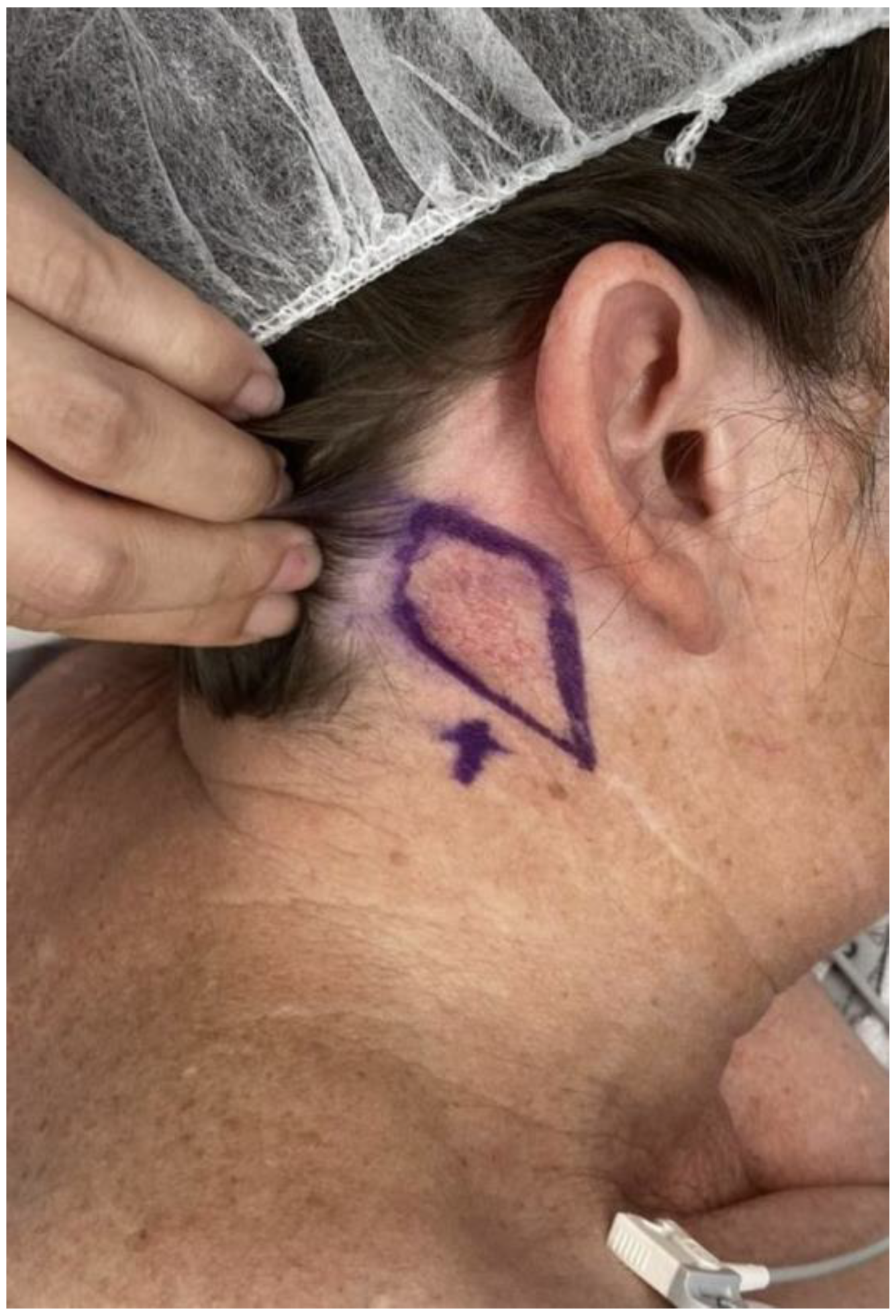
Basal Cell Carcinoma Arising in a Previous Full-Thickness Graft Donor Site: A Case Report and Comprehensive Literature Review

 ,
,  ,
,  , and
, and Abstract
Share and Cite
Shen, A.Y.; Seth, I.; Marcaccini, G.; Rozen, W.M.; Ross, R.J. Basal Cell Carcinoma Arising in a Previous Full-Thickness Graft Donor Site: A Case Report and Comprehensive Literature Review. J. Clin. Med. 2025, 14, 591. https://doi.org/10.3390/jcm14020591
Shen AY, Seth I, Marcaccini G, Rozen WM, Ross RJ. Basal Cell Carcinoma Arising in a Previous Full-Thickness Graft Donor Site: A Case Report and Comprehensive Literature Review. Journal of Clinical Medicine. 2025; 14(2):591. https://doi.org/10.3390/jcm14020591
Chicago/Turabian StyleShen, Amanda Y., Ishith Seth, Gianluca Marcaccini, Warren M. Rozen, and Richard J. Ross. 2025. "Basal Cell Carcinoma Arising in a Previous Full-Thickness Graft Donor Site: A Case Report and Comprehensive Literature Review" Journal of Clinical Medicine 14, no. 2: 591. https://doi.org/10.3390/jcm14020591
APA StyleShen, A. Y., Seth, I., Marcaccini, G., Rozen, W. M., & Ross, R. J. (2025). Basal Cell Carcinoma Arising in a Previous Full-Thickness Graft Donor Site: A Case Report and Comprehensive Literature Review. Journal of Clinical Medicine, 14(2), 591. https://doi.org/10.3390/jcm14020591