Review

Biologic Therapy in Severe Asthma: A Phenotype-Driven and Targeted Approach

1
Respiratory Department, Monaldi Hospital AO Dei Colli, Federico II University, 80131 Naples, Italy
2
Department of Health Sciences, University “Magna Græcia” of Catanzaro, 88100 Catanzaro, Italy
3
Department of Biomedicine, Neurosciences and Advanced Diagnostics, University of Palermo, 90133 Palermo, Italy
4
Department of Experimental and Clinical Medicine, University “Magna Græcia” of Catanzaro, 88100 Catanzaro, Italy
5
Department of Medical and Surgical Sciences, University “Magna Græcia” of Catanzaro, 88100 Catanzaro, Italy
6
Department of Medicine, Surgery and Dentistry, University of Salerno, 84084 Salerno, Italy
7
Department of Respiratory Diseases, Annunziata Hospital, 87100 Cosenza, Italy
*
Author to whom correspondence should be addressed.
J. Clin. Med. 2025, 14(13), 4749; https://doi.org/10.3390/jcm14134749
Submission received: 25 May 2025 / Revised: 29 June 2025 / Accepted: 30 June 2025 / Published: 4 July 2025
(This article belongs to the Special Issue New Clinical Advances in Chronic Asthma)

Abstract

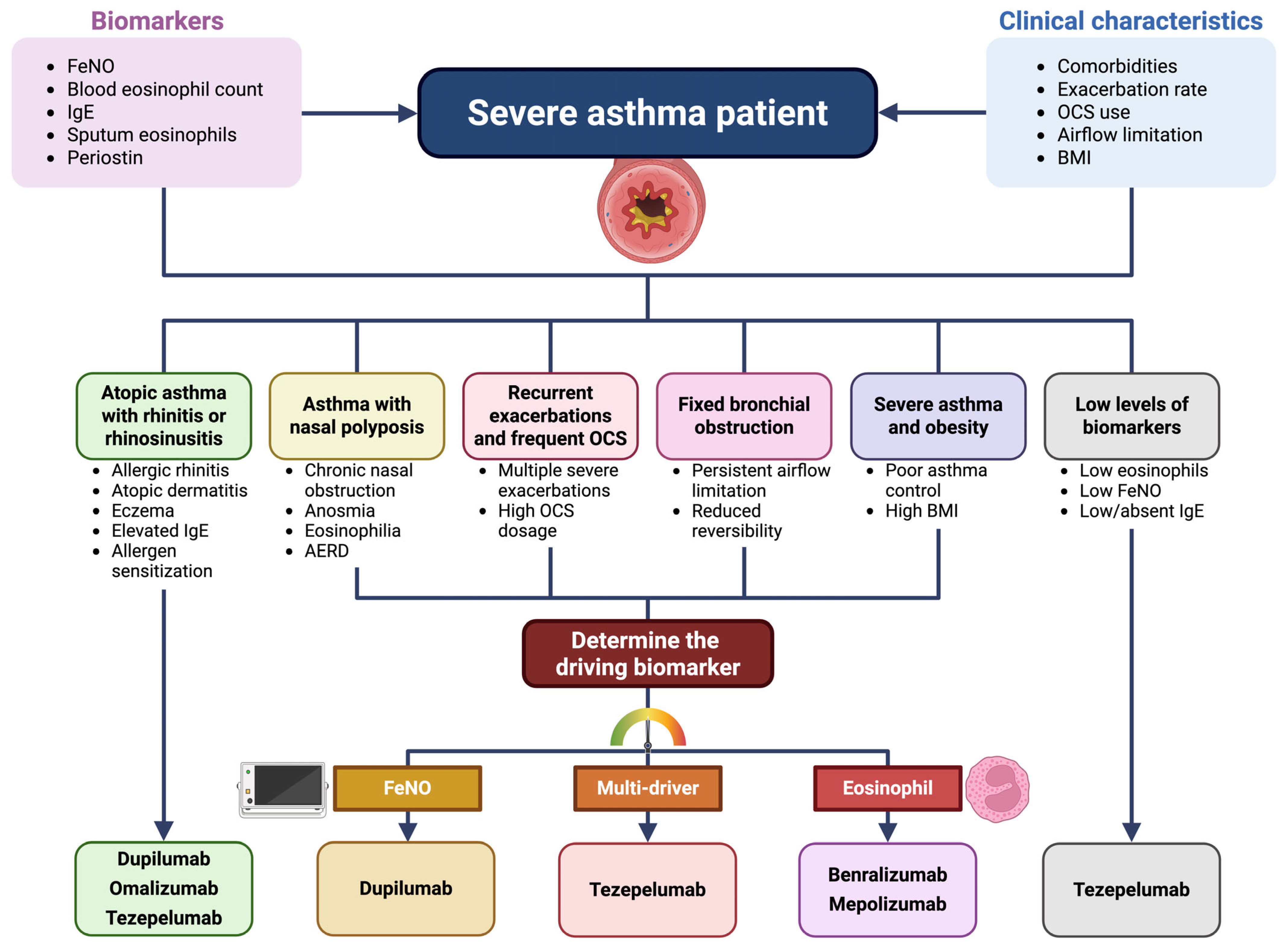
Asthma is a highly heterogeneous respiratory disease that, in its severe forms, is characterized by persistent symptoms, frequent exacerbations, and a significant impact on patients’ quality of life. Despite high-dose inhaled corticosteroids and long-acting bronchodilators, a subset of patients remains uncontrolled, necessitating advanced therapeutic strategies. The advent of biologic therapies has revolutionized the management of severe asthma, offering targeted interventions based on the underlying inflammatory endotypes, primarily T2-high and T2-low. However, selecting the most appropriate biologic remains challenging due to overlapping phenotypic features and the limited availability of validated biomarkers. This narrative review explores the clinical utility of key biomarkers, including blood eosinophils, fractional exhaled nitric oxide (FeNO), periostin, and total and specific IgE, in guiding biologic therapy. All the information provided is based on an extensive literature search conducted on PubMed. We also examine the clinical characteristics and comorbidities that influence therapeutic choices. Furthermore, we present a practical decision-making platform, including a clinical table matching phenotypes with biologic agents, such as omalizumab, mepolizumab, benralizumab, dupilumab, and tezepelumab. By integrating biomarker analysis with clinical assessment, based on current guidelines and our extensive real-life experience, we aim to offer a logical framework to help clinicians select the most suitable biologic treatment for patients with uncontrolled severe asthma. Future research should focus on identifying novel biomarkers, refining patient stratification, and evaluating long-term outcomes to further advance precision medicine in the management of severe asthma.
Keywords: severe asthma; biologic therapy; eosinophils; FeNO; IgE; personalized medicine severe asthma; biologic therapy; eosinophils; FeNO; IgE; personalized medicine