Article

New Classification System and Defect-Oriented Algorithm for Functional Soft-Palate Reconstruction with Buccinator Myomucosal Flaps


Department of Maxillofacial Surgery, University of Siena, 53100 Siena, Italy
*
Author to whom correspondence should be addressed.
These authors contributed equally to this work.
J. Clin. Med. 2024, 13(24), 7766; https://doi.org/10.3390/jcm13247766
Submission received: 15 October 2024 / Revised: 8 December 2024 / Accepted: 12 December 2024 / Published: 19 December 2024
(This article belongs to the Special Issue New Advances in Oral and Facial Surgery)

Abstract

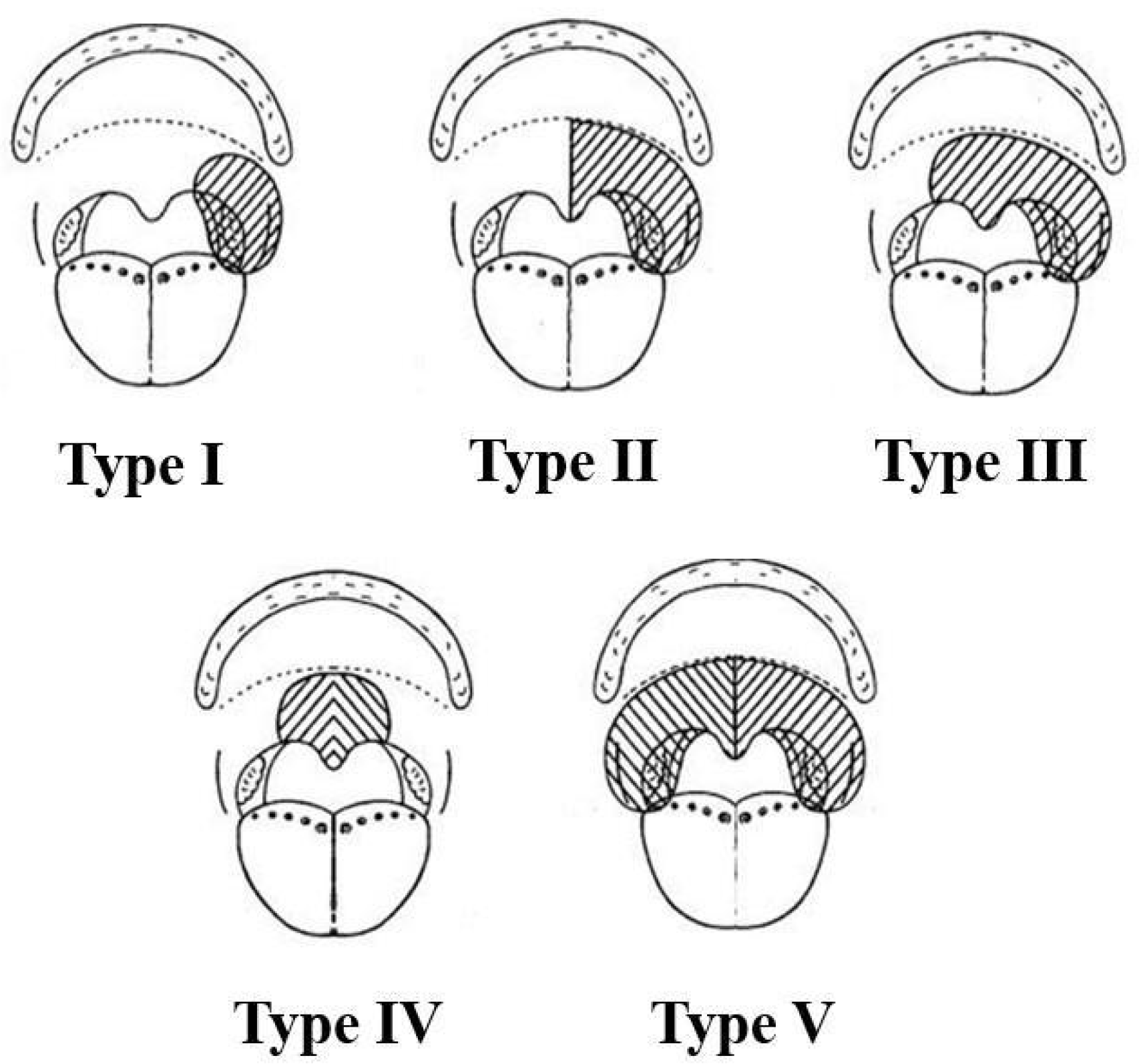
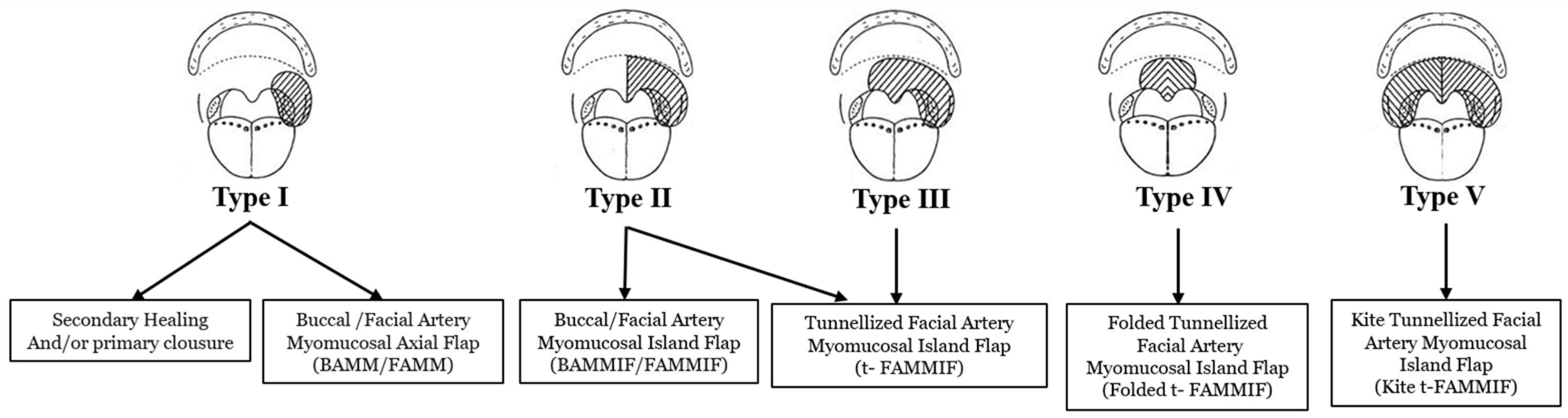
Background/Objectives: Currently, there is a lack of a comprehensive classification system for soft-palate defects that provides synthetic information to guide functional reconstructive treatment. Our awareness, shaped by extensive experience, of the superiority of myomucosal flaps to fasciocutaneous flaps in functional palate reconstruction has driven us to introduce a new defect-based classification system and propose a new algorithm for reconstructing soft-palate defects using buccinator myomucosal flaps. Methods: Soft-palate defects were classified into five classes. A reconstruction algorithm employing buccinator myomucosal flaps—including axial, island, and tunnelized flaps along with their variants as described in previous studies—was utilized. Clinical records, including tumor stage, location, defect size, and details of the myomucosal flap used, were documented. Postoperative speech intelligibility, swallowing, and quality of life (QoL) were evaluated. Donor-site morbidity and complications were also assessed. Spearman’s rank correlation was employed to assess relationships between clinical parameters and functional outcomes. Results: Twenty-two patients who had undergone soft-palate resection and subsequent reconstruction were reviewed. Favorable recovery of swallowing and speech was reported in all cases, with a median deglutition score of 6.04 ± 0.85 and no severe velopharyngeal insufficiency observed (speech score: 0.36 ± 0.58). Quality of life assessments indicated satisfactory recovery across physical, social, emotional, and functional parameters. Donor-site morbidity was low (average score: 8.3), with only minor complications observed. Tumor stage showed a significant correlation with speech score (r = 0.44, p = 0.04). Conclusions: The proposed classification introduces a comprehensive, simple, and user-friendly categorization of soft-palate defects, accompanied by a myomucosal reconstructive algorithm designed to guide surgeons through the reconstructive process, aiming to provide optimal functional reconstruction. The study’s small sample size and monocentric design may have limited the detection of meaningful correlations, highlighting the need for larger, multicentric studies with objective methods to validate findings.
Keywords: oropharyngeal reconstruction; soft-palate reconstruction; oropharyngeal defect; buccinator myomucosal flap; cheek myomucosal flap; facial artery flap; FAMM; velopharyngeal insufficiency oropharyngeal reconstruction; soft-palate reconstruction; oropharyngeal defect; buccinator myomucosal flap; cheek myomucosal flap; facial artery flap; FAMM; velopharyngeal insufficiency