Case Report

The Double-Edged Sword of Immunotherapy—Durvalumab-Induced Polyendocrinopathy—Case Report

by
Olga Błażowska
1,†,
Katarzyna Stróżna
1,†,
Hanna Dancewicz
1,
Przemysław Zygmunciak
1,
Wojciech Zgliczyński
2,† and
Beata Mrozikiewicz-Rakowska
2,*,†
1
Faculty of Medicine, Medical University of Warsaw, 02-091 Warsaw, Poland
2
Department of Endocrinology, Centre of Postgraduate Medical Education, Marymoncka St. 99/103, 01-813 Warsaw, Poland
*
Author to whom correspondence should be addressed.
These authors contributed equally to this work.
J. Clin. Med. 2024, 13(21), 6322; https://doi.org/10.3390/jcm13216322
Submission received: 18 September 2024 / Revised: 13 October 2024 / Accepted: 21 October 2024 / Published: 23 October 2024
(This article belongs to the Section Immunology & Rheumatology)

Abstract

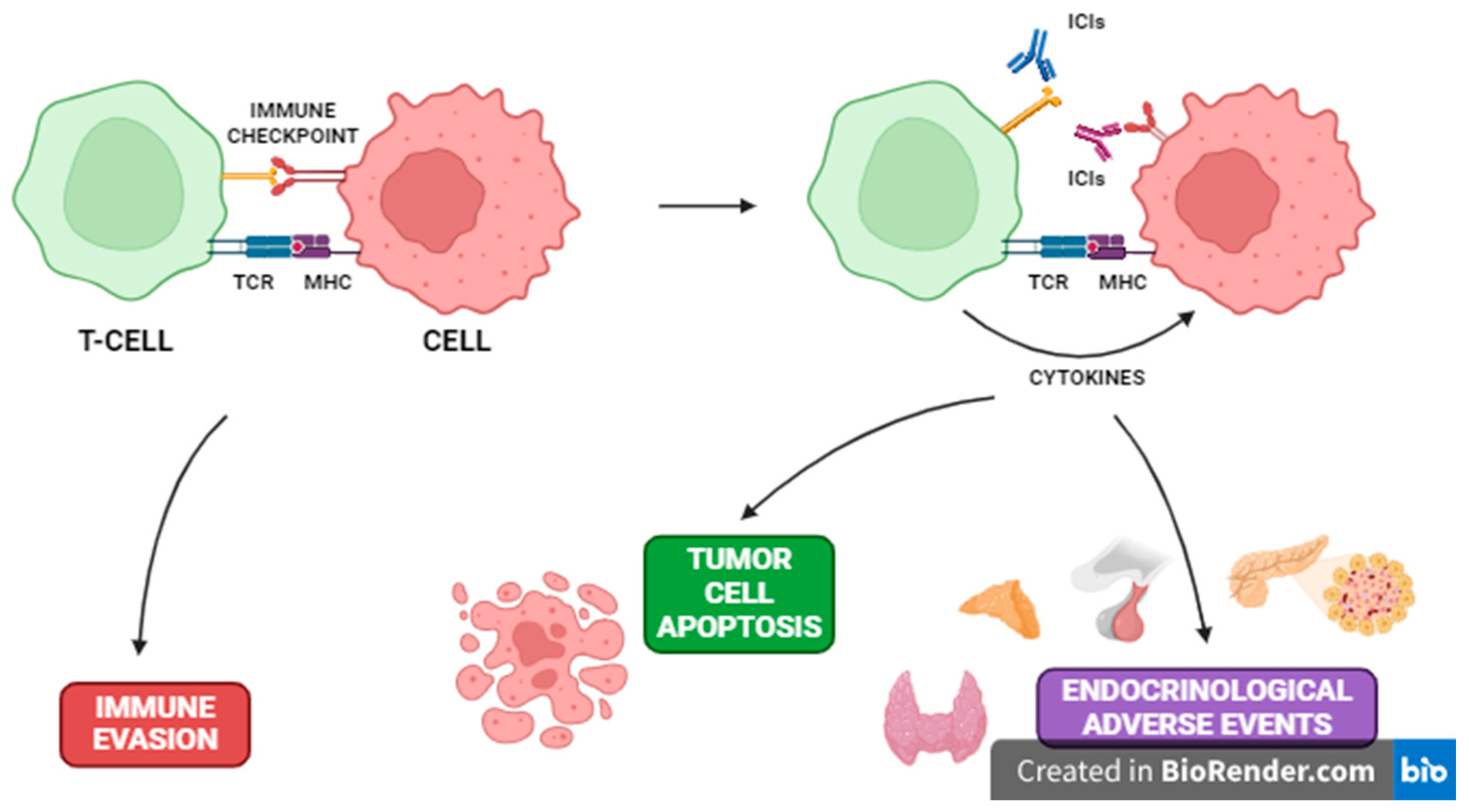
Introduction: Immunotherapy is one of the greatest advancements in oncological patient care. The broader the treatment application, the more common the adverse events associated with the therapy. Immune checkpoint inhibitors (ICI) are currently used in numerous malignancies. These drugs influence the immune cells’ interactions, which translates to interruption of immune evasion and increased anti-tumor activity. However, the disruption of immunological signaling pathways often leads to adverse events, such as endocrinological insufficiencies, among which thyroid is the most common. Moreover, the co-appearance of several insufficiencies has been previously described. Case report: A 73-year-old female treated with durvalumab due to non-small cell lung carcinoma was admitted to the emergency unit due to symptoms of ketoacidosis. She had a history of well-controlled type 2 diabetes mellitus and autoimmune thyroiditis. Laboratory results showed increased anti-GAD antibodies, while the low C-peptide level indicated type 1 diabetes mellitus. Moreover, over the course of longer observation, the patient presented with abrupt aggravation of her autoimmune thyroiditis. Conclusions: The new onset of endocrinological insufficiencies is a rare adverse event of immunotherapy. Clinicians must pay particular attention to any signs indicating these life-threatening conditions. In case of the appearance of any endocrinological adverse event, the close cooperation of oncologists and endocrinologists is required to enhance patients’ quality of life.
Keywords: durvalumab; ICI; polyendocrinopathy; T1DM; type 1 diabetes mellitus; thyroid insufficiency; endocrinopathy; endocrine adverse events durvalumab; ICI; polyendocrinopathy; T1DM; type 1 diabetes mellitus; thyroid insufficiency; endocrinopathy; endocrine adverse events