Article

A Critical Examination of Academic Hospital Practices—Paving the Way for Standardized Structured Reports in Neuroimaging

by
Ashwag Rafea Alruwaili
1,2,*,
Abdullah Abu Jamea
3,4,
Reema N. Alayed
5,
Alhatoun Y. Alebrah
4,
Reem Y. Alshowaiman
4,
Loulwah A. Almugbel
6,
Ataf G. Heikal
1,
Ahad S. Alkhanbashi
7 and
Anwar A. Maflahi
1,8
1
Radiological Sciences Department, King Saud University, Riyadh 11451, Saudi Arabia
2
Scientists Unit, Central Research Laboratory, King Saud University, Riyadh 11495, Saudi Arabia
3
College of Medicine, King Saud University, Riyadh 11451, Saudi Arabia
4
Department of Radiology and Medical Imaging, King Saud University Medical City, Riyadh 145111, Saudi Arabia
5
Magnetic Resonance Imaging Unit, King Faisal Specialist Hospital & Research Center (KFSHRC), Riyadh 12713, Saudi Arabia
6
Cath Lab, Radiological Imaging, Prince Sultan Cardiac Center, Riyadh 11625, Saudi Arabia
7
Radiology Department, Ad Diriyah Hospital, Riyadh 13717, Saudi Arabia
8
Health Gates—Center of Excellence for Primary Health Care, Riyadh 12214, Saudi Arabia
*
Author to whom correspondence should be addressed.
J. Clin. Med. 2024, 13(15), 4334; https://doi.org/10.3390/jcm13154334
Submission received: 24 June 2024 / Revised: 12 July 2024 / Accepted: 17 July 2024 / Published: 25 July 2024
(This article belongs to the Section Nuclear Medicine & Radiology)

Abstract

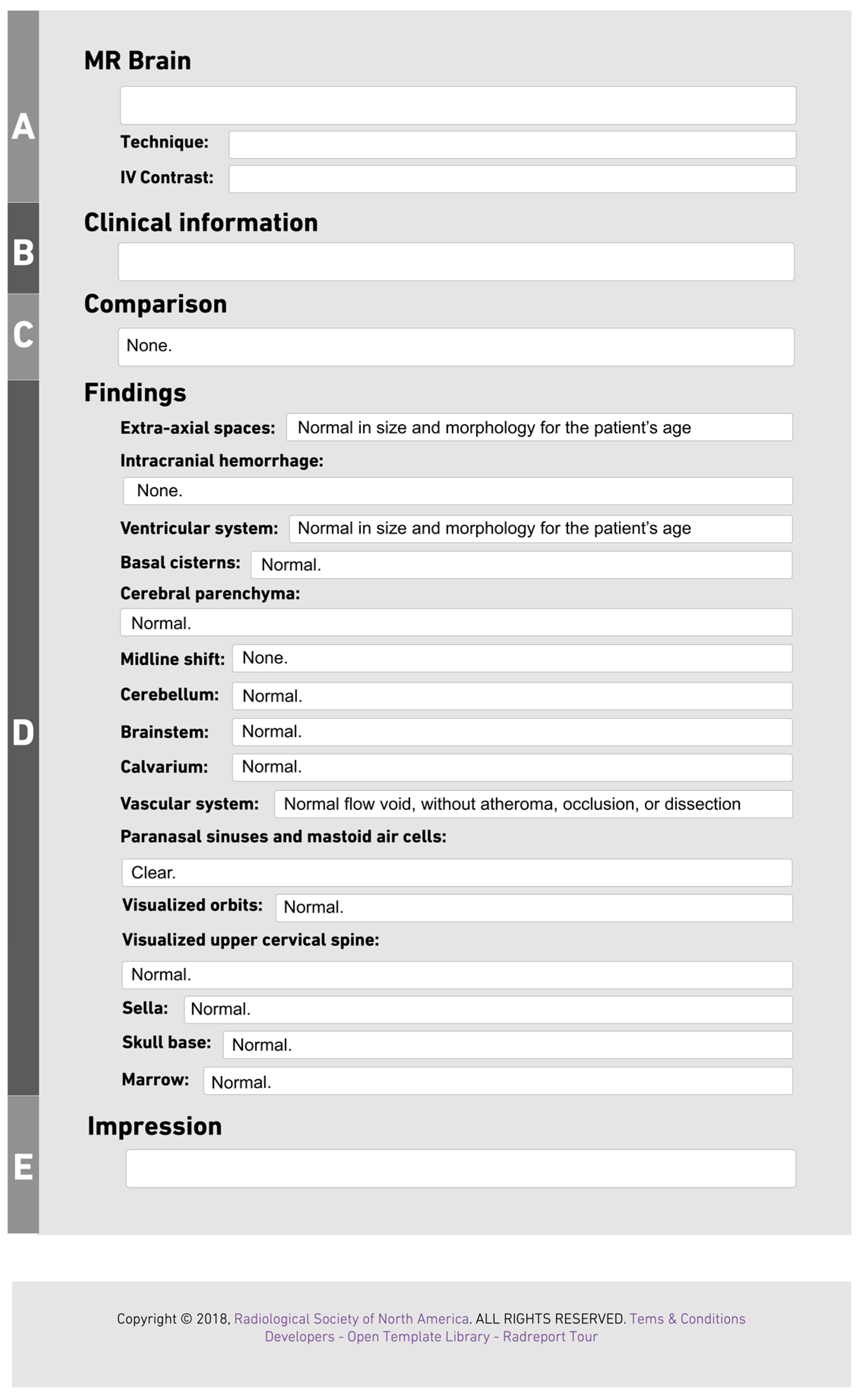
Background/Objectives: Imaging studies are often an integral part of patient evaluation and serve as the primary means of communication between radiologists and referring physicians. This study aimed to evaluate brain Magnetic Resonance Imaging (MRI) reports and to determine whether these reports follow a standardized or narrative format. Methods: A series of 466 anonymized MRI reports from an academic hospital were downloaded from the Picture Archiving and Communication System (PACS) in portable document format (pdf) for the period between August 2017 and March 2018. Two hundred brain MRI reports, written by four radiologists, were compared to a structured report template from the Radiology Society of North America (RSNA) and were included, whereas MR-modified techniques, such as MRI orbits and MR venography reports, were excluded (n = 266). All statistical analyses were conducted using Statistical Package for the Social Sciences (SPSS) statistical software (version 16.4.1, MedCalc Software). Results: None of the included studies used the RSNA template for structured reports (SRs). The highest number of brain-reported pathologies was for vascular disease (24%), while the lowest was for infections (3.5%) and motor dysfunction (5.5%). Radiologists specified the Technique (n = 170, 85%), Clinical Information (n = 187, 93.5%), and Impression (n = 197, 98.5%) in almost all reports. However, information in the Findings section was often missing. As hypothesized, radiologists with less experience showed a greater commitment to reporting additional elements than those with more experience. Conclusions: The SR template for medical imaging has been accessible online for over a decade. However, many hospitals and radiologists still use the free-text style for reporting. Our study was conducted in an academic hospital with a fellowship program, and we found that structured reporting had not yet been implemented. As the health system transitions towards teleservices and teleradiology, more efforts need to be put into advocating standardized reporting in medical imaging.
Keywords: structured reporting; neuroimaging; radiologists; text report; MRI; narrative report structured reporting; neuroimaging; radiologists; text report; MRI; narrative report