Article

Alexithymia Increases Pericranial and Cervical Muscle Tenderness in Women with Migraine

1
Neurology Unit, San Giacomo Hospital, 15067 Novi Ligure, Italy
2
Neurology Unit, Guglielmo da Saliceto Hospital, 29121 Piacenza, Italy
3
IUSTO—Istituto Universitario Salesiano Torino Rebaudengo, 10155 Torino, Italy
4
Neuroradiology Unit, Guglielmo da Saliceto Hospital, 29121 Piacenza, Italy
5
SVEMG—Scuola Veneta di Medicina Generale, 35129 Padova, Italy
*
Author to whom correspondence should be addressed.
J. Clin. Med. 2024, 13(10), 2772; https://doi.org/10.3390/jcm13102772
Submission received: 12 April 2024 / Revised: 7 May 2024 / Accepted: 7 May 2024 / Published: 8 May 2024
(This article belongs to the Special Issue Recent Progress in Multiple Sclerosis and Migraine)

Abstract

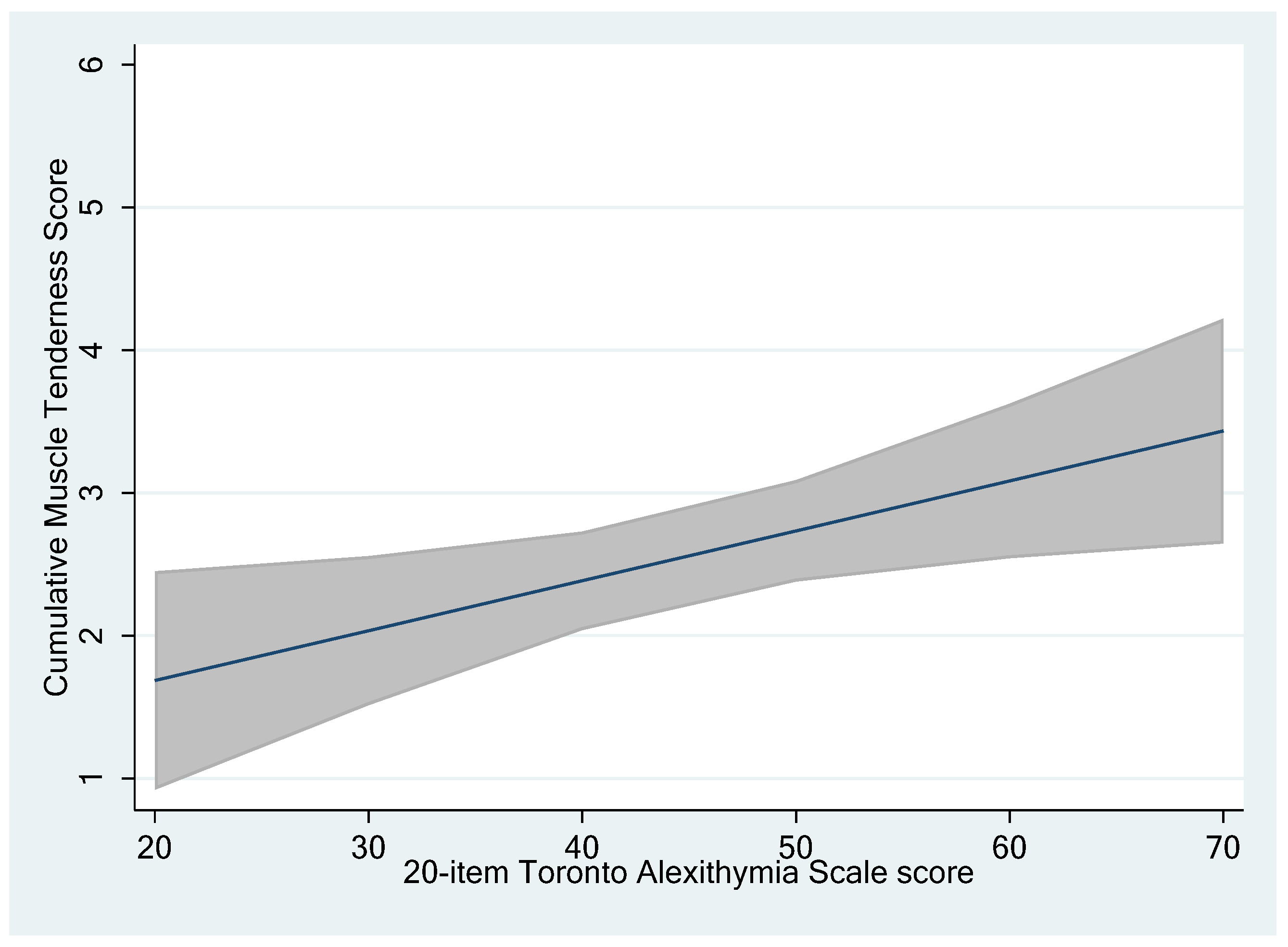
Background/Objectives: Alexithymia is characterized by a deficit in identifying and communicating feelings. Emerging evidence suggests that alexithymia is highly prevalent in migraine, in a complex interplay with psychiatric comorbidity. Pericranial/cervical muscle tenderness is a remarkable clinical feature in a large proportion of migraine patients. This pilot study aimed at investigating the relationship between alexithymia and pericranial/cervical muscle tenderness in female migraineurs. Methods: A total of 42 female patients fulfilling the diagnostic criteria for migraine were enrolled into this pilot, observational, cross-sectional study after informed consent was obtained. Each patient underwent a psychological assessment to identify any alexithymia by means of TAS-20, anxiety/mood comorbidity (by means of STAI-Y1 STAI-Y2, BDI-II), and migraine-related disability (by means of HIT-6), and a physical cranial/cervical musculoskeletal examination. Palpation of pericranial and cervical muscles was carried out in the standardized manner. A Cumulative Muscle Tenderness (CUM) score (0–6) was calculated for each patient. A multivariate analysis was performed to investigate any association amongst the TAS-20 score, the CUM score, and the following covariates: BDI-II, STAI-Y1, STAI-Y2, and HIT-6 scores, age, disease duration, monthly migraine days, and average head pain intensity in the previous three months. Results: Overall, 35.6% of the sample had alexithymia. The multivariate analysis detected a linear and independent relationship between the TAS-20 and CUM scores, with a statistically significant (p = 0.017) association. Conclusions: This pilot study suggests that alexithymia plays a role in increasing pericranial/cervical muscle tenderness in migraine, independently from psychiatric comorbidity. A novel therapeutical approach, targeting alexithymia, may well reduce muscular tenderness in female migraineurs.
Keywords: alexithymia; migraine; muscle tenderness; headache; depression; anxiety alexithymia; migraine; muscle tenderness; headache; depression; anxiety