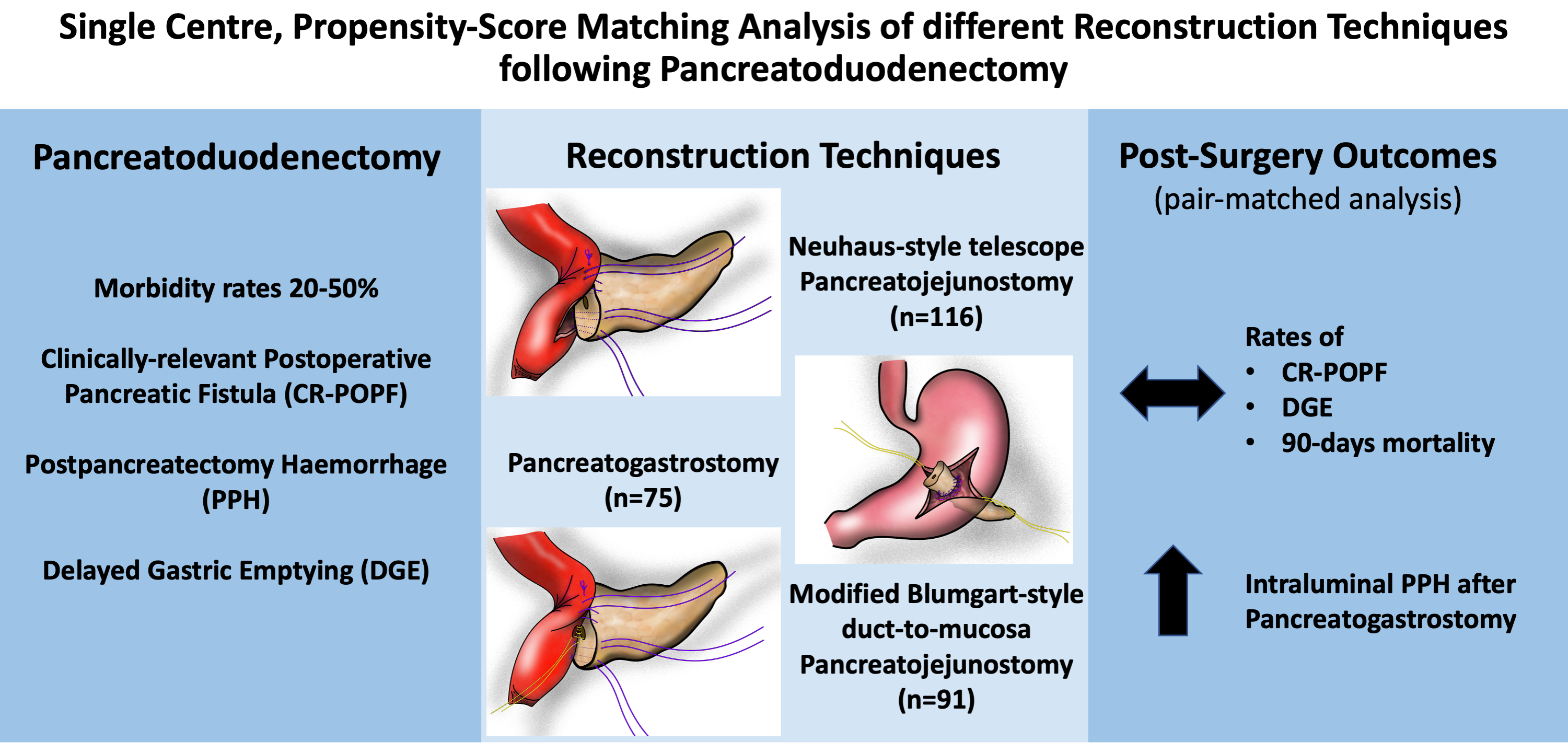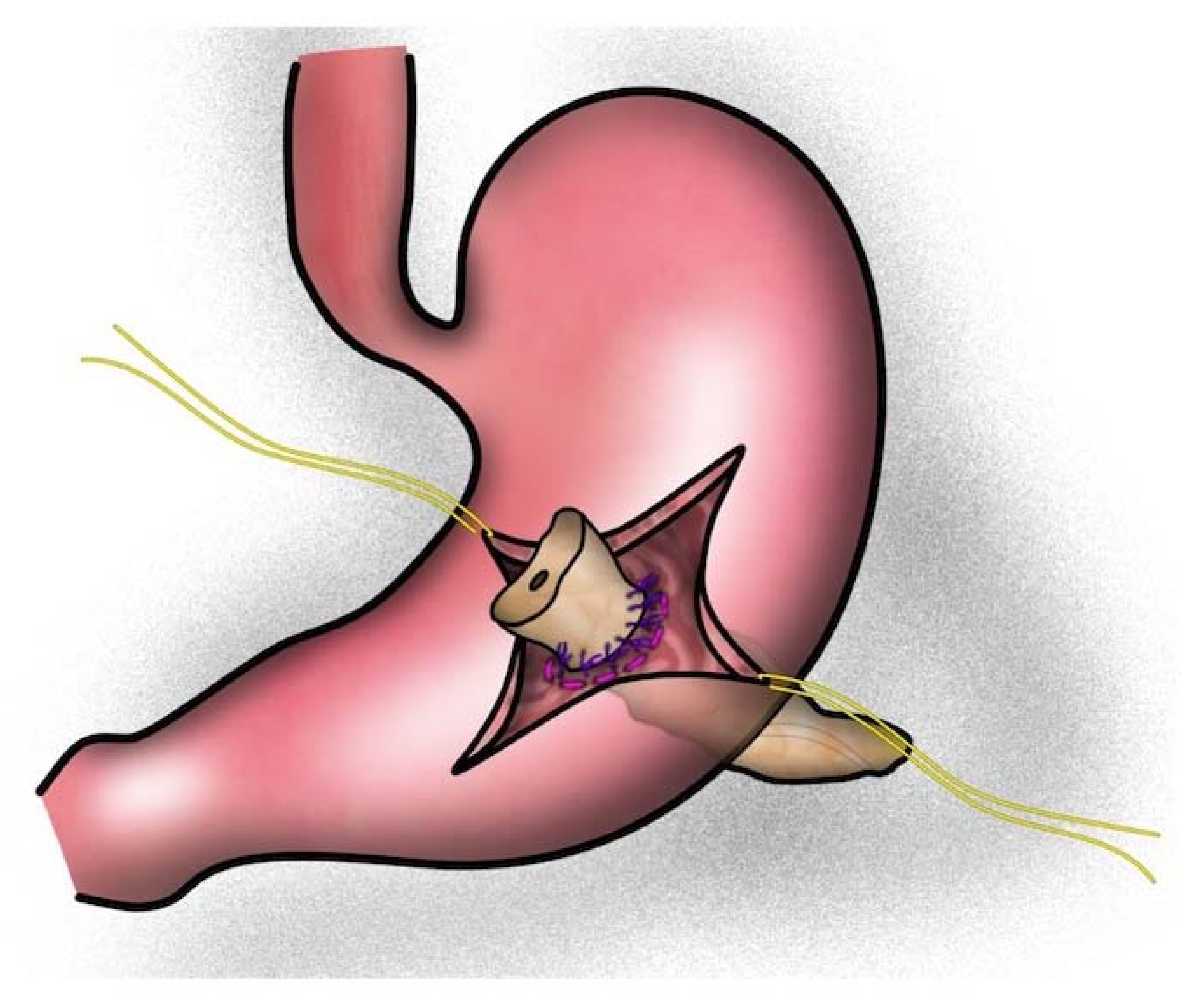


Single Center, Propensity Score Matching Analysis of Different Reconstruction Techniques following Pancreatoduodenectomy

 , ,
, ,  and
and 
Abstract
1. Introduction
2. Materials and Methods
2.1. Data Collection and Cohort Selection
2.2. Surgical Procedures
2.3. Statistical Analysis
3. Results
4. Discussion
5. Conclusions
Supplementary Materials
Author Contributions
Funding
Institutional Review Board Statement
Informed Consent Statement
Data Availability Statement
Acknowledgments
Conflicts of Interest
References
- Parikh, P.; Shiloach, M.; Cohen, M.E.; Bilimoria, K.Y.; Ko, C.Y.; Hall, B.L.; Pitt, H.A. Pancreatectomy risk calculator: An ACS-NSQIP resource. HPB 2010, 12, 488. [Google Scholar] [CrossRef] [PubMed]
- Cardini, B.; Primavesi, F.; Maglione, M.; Oberschmied, J.; Guschlbauer, L.; Gasteiger, S.; Kuscher, S.; Resch, T.; Oberhuber, R.; Margreiter, C.; et al. Outcomes following pancreatic resections—Results and challenges of an Austrian university hospital compared to nationwide data and international centres. Eur. Surg.—Acta Chir. Austriaca 2019, 51, 81–89. [Google Scholar] [CrossRef]
- Keck, T.; Wellner, U.F.; Bahra, M.; Klein, F.; Sick, O.; Niedergethmann, M.; Wilhelm, T.J.; Farkas, S.A.; Borner, T.; Bruns, C.; et al. Pancreatogastrostomy versus pancreatojejunostomy for reconstruction after PANCreatoduodenectomy (RECOPANC, DRKS 00000767): Perioperative and long-term results of a multicenter randomized controlled trial. Ann. Surg. 2016, 263, 440–449. [Google Scholar] [CrossRef] [PubMed]
- Bassi, C.; Dervenis, C.; Butturini, G.; Fingerhut, A.; Yeo, C.; Izbicki, J.; Neoptolemos, J.; Sarr, M.; Traverso, W.; Buchler, M. Postoperative pancreatic fistula: An international study group (ISGPF) definition. Surgery 2005, 138, 8–13. [Google Scholar] [CrossRef] [PubMed]
- Pulvirenti, A.; Ramera, M.; Bassi, C. Modifications in the International Study Group for Pancreatic Surgery (ISGPS) definition of postoperative pancreatic fistula. Transl. Gastroenterol. Hepatol. 2017, 2, 107. [Google Scholar] [CrossRef]
- Andrianello, S.; Marchegiani, G.; Malleo, G.; Masini, G.; Balduzzi, A.; Paiella, S.; Esposito, A.; Landoni, L.; Casetti, L.; Tuveri, M.; et al. Pancreaticojejunostomy with Externalized Stent vs. Pancreaticogastrostomy with Externalized Stent for Patients with High-Risk Pancreatic Anastomosis: A Single-Center, Phase 3, Randomized Clinical Trial. JAMA Surg. 2020, 155, 313–321. [Google Scholar] [CrossRef]
- Kojima, T.; Niguma, T.; Watanabe, N.; Sakata, T.; Mimura, T. Modified Blumgart anastomosis with the “complete packing method” reduces the incidence of pancreatic fistula and complications after resection of the head of the pancreas. Am. J. Surg. 2018, 216, 941–948. [Google Scholar] [CrossRef]
- Li, Z.; Wei, A.; Xia, N.; Zheng, L.; Yang, D.; Ye, J.; Xiong, J.; Hu, W. Blumgart anastomosis reduces the incidence of pancreatic fistula after pancreaticoduodenectomy: A systematic review and meta-analysis. Sci. Rep. 2020, 10, 17896. [Google Scholar] [CrossRef]
- Gómez, T.; Palomares, A.; Serradilla, M.; Tejedor, L. Reconstruction after Pancreatoduodenectomy: Pancreatojejunostomy vs. Pancreatogastrostomy. World J. Gastrointest. Oncol. 2014, 6, 369–376. [Google Scholar] [CrossRef]
- Lee, Y.-N.; Kim, W.-Y. Comparison of Blumgart versus conventional duct-to-mucosa anastomosis for pancreaticojejunostomy after pancreaticoduodenectomy. Ann. Hepato-Biliary-Pancreat. Surg. 2018, 22, 253. [Google Scholar] [CrossRef]
- Kawakatsu, S.; Inoue, Y.; Mise, Y.; Ishizawa, T.; Ito, H.; Takahashi, Y.; Saiura, A. Comparison of pancreatojejunostomy techniques in patients with a soft pancreas: Kakita anastomosis and Blumgart anastomosis. BMC Surg. 2018, 18, 88. [Google Scholar] [CrossRef] [PubMed]
- Kalev, G.; Marquardt, C.; Matzke, H.; Matovu, P.; Schiedeck, T. The modified Blumgart anastomosis after pancreaticoduodenectomy: A retrospective single center cohort study. Innov. Surg. Sci. 2020, 5, 105–109. [Google Scholar] [CrossRef] [PubMed]
- Senda, Y.; Shimizu, Y.; Natsume, S.; Ito, S.; Komori, K.; Abe, T.; Matsuo, K.; Sano, T. Randomized clinical trial of duct-to-mucosa versus invagination pancreaticojejunostomy after pancreatoduodenectomy. Br. J. Surg. 2018, 105, 48–57. [Google Scholar] [CrossRef] [PubMed]
- Lyu, Y.; Li, T.; Wang, B.; Cheng, Y.; Zhao, S. Selection of pancreaticojejunostomy technique after pancreaticoduodenectomy: Duct-to-mucosa anastomosis is not better than invagination anastomosis A meta-analysis. Medicine 2018, 97, e12621. [Google Scholar] [CrossRef]
- Jin, Y.; Feng, Y.-Y.; Qi, X.-G.; Hao, G.; Yu, Y.-Q.; Li, J.-T.; Peng, S.-Y. Pancreatogastrostomy vs. pancreatojejunostomy after pancreaticoduodenectomy: An updated meta-analysis of RCTs and our experience. World J. Gastrointest. Surg. 2019, 11, 322–332. [Google Scholar] [CrossRef]
- Casadei, R.; Ricci, C.; Ingaldi, C.; Alberici, L.; De Raffele, E.; Minni, F. Comparison of Blumgart Anastomosis with Duct-to-Mucosa Anastomosis and Invagination Pancreaticojejunostomy after Pancreaticoduodenectomy: A Single-Center Propensity Score Matching Analysis. J. Gastrointest. Surg. 2021, 25, 411–420. [Google Scholar] [CrossRef]
- Li, Y.-T.; Zhang, H.-Y.; Xing, C.; Ding, C.; Wu, W.-M.; Liao, Q.; Zhang, T.-P.; Zhao, Y.-P.; Dai, M.-H. Effect of Blumgart anastomosis in reducing the incidence rate of pancreatic fistula after pancreatoduodenectomy. World J. Gastroenterol. 2019, 25, 2514. [Google Scholar] [CrossRef]
- Gong, J.; He, S.; Cheng, Y.; Cheng, N.; Gong, J.; Zeng, Z. Fibrin sealants for the prevention of postoperative pancreatic fistula following pancreatic surgery. Cochrane Database Syst. Rev. 2018, 6, CD009621. [Google Scholar] [CrossRef]
- Andreasi, V.; Partelli, S.; Crippa, S.; Balzano, G.; Tamburrino, D.; Muffatti, F.; Belfiori, G.; Cirocchi, R.; Falconi, M. A systematic review and meta-analysis on the role of omental or falciform ligament wrapping during pancreaticoduodenectomy. HPB 2020, 22, 1227–1239. [Google Scholar] [CrossRef]
- Tangtawee, P.; Mingphruedhi, S.; Rungsakulkij, N.; Suragul, W.; Vassanasiri, W.; Muangkaew, P. Prospective randomized controlled trial of omental roll-up technique on pancreatojejunostomy anastomosis for reducing perioperative complication in patients undergoing pancreatoduodenectomy. J. Hepato-Biliary-Pancreat. Sci. 2021, 28, 450–456. [Google Scholar] [CrossRef]
- Halle-Smith, J.M.; Pande, R.; Hall, L.; Hodson, J.; Roberts, K.J.; Arshad, A.; Connor, S.; Conlon, K.C.P.; Dickson, E.J.; Giovinazzo, F.; et al. Perioperative interventions to reduce pancreatic fistula following pancreatoduodenectomy: Meta-analysis. Br. J. Surg. 2022, 109, 812–821. [Google Scholar] [CrossRef] [PubMed]
- Meng, G.; Xing, Q.; Yuan, Q.; Du, Z.; Wang, Y.; Meng, H. Internal compared with external drainage of pancreatic duct during pancreaticoduodenectomy: A retrospective study. Chin. J. Cancer Res. 2014, 26, 277–284. [Google Scholar] [CrossRef] [PubMed]
- Poon, R.T.P.; Fan, S.T.; Lo, C.M.; Ng, K.K.; Yuen, W.K.; Yeung, C.; Wong, J. External drainage of pancreatic duct with a stent to reduce leakage rate of pancreaticojejunostomy after pancreaticoduodenectomy: A prospective randomized trial. Ann. Surg. 2007, 246, 425–433. [Google Scholar] [CrossRef] [PubMed]
- Schorn, S.; Vogel, T.; Demir, I.E.; Demir, E.; Safak, O.; Friess, H.; Ceyhan, G.O. Do somatostatin-analogues have the same impact on postoperative morbidity and pancreatic fistula in patients after pancreaticoduodenectomy and distal pancreatectomy?—A systematic review with meta-analysis of randomized-controlled trials. Pancreatology 2020, 20, 1770–1778. [Google Scholar] [CrossRef]
- Pillarisetty, V.G.; Abbasi, A.; Park, J.O.; Sham, J.G. A phase II trial of lanreotide for the prevention of postoperative pancreatic fistula. HPB 2022, 24, 2029–2034. [Google Scholar] [CrossRef]
- Langrehr, J.M.; Bahra, M.; Jacob, D.; Glanemann, M.; Neuhaus, P. Prospective randomized comparison between a new mattress technique and Cattell (duct-to-mucosa) pancreaticojejunostomy for pancreatic resection. World J. Surg. 2005, 29, 1111–1119. [Google Scholar] [CrossRef]
- Aroori, S.; Puneet, P.; Bramhall, S.R.; Muiesan, P.; Mayer, A.D.; Mirza, D.F.; Buckels, J.C.; Isaac, J. Outcomes comparing a pancreaticogastrostomy (PG) and a pancreaticojejunostomy (PJ) after a pancreaticoduodenectomy (PD). HPB 2011, 13, 723. [Google Scholar] [CrossRef]
- Grobmyer, S.R.; Kooby, D.; Blumgart, L.H.; Hochwald, S.N. Novel Pancreaticojejunostomy with a Low Rate of Anastomotic Failure-Related Complications. J. Am. Coll. Surg. 2010, 210, 54–59. [Google Scholar] [CrossRef]
- Kuss, O.; Blettner, M.; Börgermann, J. Propensity Score: An Alternative Method of Analyzing Treatment EffectsPart 23 of a Series on Evaluation of Scientific Publications. Dtsch. Arztebl. Int. 2016, 113, 597–603. [Google Scholar]
- von Elm, E.; Altman, D.G.; Egger, M.; Pocock, S.J.; Gøtzsche, P.C.; Vandenbroucke, J.P. The Strengthening the Reporting of Observational Studies in Epidemiology (STROBE) Statement: Guidelines for reporting observational studies. Int. J. Surg. 2014, 12, 1495–1499. [Google Scholar] [CrossRef]
- Callery, M.P.; Pratt, W.B.; Kent, T.S.; Chaikof, E.L.; Vollmer, C.M. A prospectively validated clinical risk score accurately predicts pancreatic fistula after pancreatoduodenectomy. J. Am. Coll. Surg. 2013, 216, 1–14. [Google Scholar] [CrossRef] [PubMed]
- Bassi, C.; Marchegiani, G.; Dervenis, C.; Sarr, M.; Abu Hilal, M.; Adham, M.; Allen, P.; Andersson, R.; Asbun, H.J.; Besselink, M.G.; et al. The 2016 update of the International Study Group (ISGPS) definition and grading of postoperative pancreatic fistula: 11 Years After. Surgery 2017, 161, 584–591. [Google Scholar] [CrossRef] [PubMed]
- Dindo, D.; Demartines, N.; Clavien, P.-A. Classification of Surgical Complications. Ann. Surg. 2004, 240, 205–213. [Google Scholar] [CrossRef] [PubMed]
- Traverso, L.W.; Longmire, W.P. Preservation of the pylorus in pancreaticoduodenectomy. A follow-up evaluation. Ann. Surg. 1980, 192, 306–310. [Google Scholar] [CrossRef]
- Whipple, A.O.; Parsons, W.B.; Mullins, C.R. Treatment of carcinoma of the ampulla of Vater. Ann. Surg. 1935, 102, 763. [Google Scholar] [CrossRef]
- Tol, J.A.M.G.; Gouma, D.J.; Bassi, C.; Dervenis, C.; Montorsi, M.; Adham, M.; Andrén-Sandberg, A.; Asbun, H.J.; Bockhorn, M.; Büchler, M.W.; et al. Definition of a standard lymphadenectomy in surgery for pancreatic ductal adenocarcinoma: A consensus statement by the International Study Group on Pancreatic Surgery (ISGPS). Surgery 2014, 156, 591–600. [Google Scholar] [CrossRef]
- Kusnierz, K.; Mrowiec, S.; Lampe, P. A comparison of two invagination techniques for pancreatojejunostomy after pancreatoduodenectomy. Gastroenterol. Res. Pract. 2015, 2015, 894292. [Google Scholar] [CrossRef]
- Aranha, G.V. A technique for pancreaticogastrostomy. Am. J. Surg. 1998, 175, 328–329. [Google Scholar] [CrossRef]
- RR Core Team. R: A Language and Environment for Statistical Computing; R Foundation for Statistical Computing: Vienna, Austria, 2013. [Google Scholar]
- Mccaffrey, D.F.; Griffin, B.A.; Almirall, D.; Slaughter, M.E.; Ramchand, R.; Burgette, L.F. A tutorial on propensity score estimation for multiple treatments using generalized boosted models. Stat. Med. 2013, 32, 3388–3414. [Google Scholar] [CrossRef]
- Desai, R.J.; Franklin, J.M. Alternative approaches for confounding adjustment in observational studies using weighting based on the propensity score: A primer for practitioners. BMJ 2019, 367, l5657. [Google Scholar] [CrossRef]
- Chesnaye, N.C.; Stel, V.S.; Tripepi, G.; Dekker, F.W.; Fu, E.L.; Zoccali, C.; Jager, K.J. An introduction to inverse probability of treatment weighting in observational research. Clin. Kidney J. 2021, 15, 14–20. [Google Scholar] [CrossRef] [PubMed]
- Ridgeway, G.; McCaffrey, D.F.; Morral, A.R.; Cefalu, M.; Burgette, L.F.; Pane, J.D.; Griffin, B.A. Twang: Toolkit for Weighting and Analysis of Nonequivalent Groups; R package version 2.5; RAND Corporation: Santa Monica, CA, USA, 2021. [Google Scholar]
- Shrikhande, S.V.; Sivasanker, M.; Vollmer, C.M.; Friess, H.; Besselink, M.G.; Fingerhut, A.; Yeo, C.J.; Fernandez-delCastillo, C.; Dervenis, C.; Halloran, C.; et al. Pancreatic anastomosis after pancreatoduodenectomy: A position statement by the International Study Group of Pancreatic Surgery (ISGPS). Surgery 2017, 161, 1221–1234. [Google Scholar] [CrossRef] [PubMed]
- Figueras, J.; Sabater, L.; Planellas, P.; Muñoz-Forner, E.; Lopez-Ben, S.; Falgueras, L.; Sala-Palau, C.; Albiol, M.; Ortega-Serrano, J.; Castro-Gutierrez, E. Randomized clinical trial of pancreaticogastrostomy versus pancreaticojejunostomy on the rate and severity of pancreatic fistula after pancreaticoduodenectomy. Br. J. Surg. 2013, 100, 1597–1605. [Google Scholar] [CrossRef] [PubMed]
- Xiong, J.J.; Tan, C.L.; Szatmary, P.; Huang, W.; Ke, N.W.; Hu, W.M.; Nunes, Q.M.; Sutton, R.; Liu, X.B. Meta-analysis of pancreaticogastrostomy versus pancreaticojejunostomy after pancreaticoduodenectomy. Br. J. Surg. 2014, 101, 1196–1208. [Google Scholar] [CrossRef]
- Tabchouri, N.; Bouquot, M.; Hermand, H.; Benoit, O.; Loiseau, J.C.; Dokmak, S.; Aussilhou, B.; Gaujoux, S.; Turrini, O.; Delpero, J.R.; et al. A Novel Pancreatic Fistula Risk Score Including Preoperative Radiation Therapy in Pancreatic Cancer Patients. J. Gastrointest. Surg. 2021, 25, 991–1000. [Google Scholar] [CrossRef]
- Mungroop, T.H.; Klompmaker, S.; Wellner, U.F.; Steyerberg, E.W.; Coratti, A.; D’Hondt, M.; de Pastena, M.; Dokmak, S.; Khatov, I.; Saint-Marc, O.; et al. Updated Alternative Fistula Risk Score (ua-FRS) to Include Minimally Invasive Pancreatoduodenectomy: Pan-European Validation. Ann. Surg. 2021, 273, 334–340. [Google Scholar] [CrossRef]
- Pande, R.; Halle-Smith, J.M.; Phelan, L.; Thorne, T.; Panikkar, M.; Hodson, J.; Roberts, K.J.; Arshad, A.; Connor, S.; Conlon, K.C.; et al. External validation of postoperative pancreatic fistula prediction scores in pancreatoduodenectomy: A systematic review and meta-analysis. HPB 2022, 24, 287–298. [Google Scholar] [CrossRef]
- Trudeau, M.T.; Casciani, F.; Ecker, B.L.; Maggino, L.; Seykora, T.F.; Puri, P.; Mcmillan, M.T.; Miller, B.; Pratt, W.B.; Asbun, H.J.; et al. The Fistula Risk Score Catalog: Toward Precision Medicine for Pancreatic Fistula After Pancreatoduodenectomy. Ann. Surg. 2022, 275, E463–E472. [Google Scholar] [CrossRef]
- Tani, M.; Kawai, M.; Hirono, S.; Ina, S.; Miyazawa, M.; Shimizu, A.; Yamaue, H. A prospective randomized controlled trial of internal versus external drainage with pancreaticojejunostomy for pancreaticoduodenectomy. Am. J. Surg. 2010, 199, 759–764. [Google Scholar] [CrossRef]
- Malgras, B.; Duron, S.; Gaujoux, S.; Dokmak, S.; Aussilhou, B.; Rebours, V.; Palazzo, M.; Belghiti, J.; Sauvanet, A. Early biliary complications following pancreaticoduodenectomy: Prevalence and risk factors. HPB 2016, 18, 367–374. [Google Scholar] [CrossRef]
- El Nakeeb, A.; El Sorogy, M.; Hamed, H.; Said, R.; Elrefai, M.; Ezzat, H.; Askar, W.; Elsabbagh, A.M. Biliary leakage following pancreaticoduodenectomy: Prevalence, risk factors and management. Hepatobiliary Pancreat. Dis. Int. 2019, 18, 67–72. [Google Scholar] [CrossRef] [PubMed]
- Hanna, M.; Gadde, R.; Tamariz, L.; Allen, C.; Meizoso, J.; Sleeman, D.; Livingstone, A.; Yakoub, D. Delayed Gastric Emptying After Pancreaticoduodenectomy: Is Subtotal Stomach Preserving Better or Pylorus Preserving? J. Gastrointest. Surg. 2015, 19, 1542–1552. [Google Scholar] [CrossRef] [PubMed]
- Hayama, S.; Senmaru, N.; Hirano, S. Delayed gastric emptying after pancreatoduodenectomy: Comparison between invaginated pancreatogastrostomy and pancreatojejunostomy. BMC Surg. 2020, 20, 60. [Google Scholar] [CrossRef]
- Vandermeeren, C.; Loi, P.; Closset, J. Does Pancreaticogastrostomy Decrease the Occurrence of Delayed Gastric Emptying after Pancreatoduodenectomy? Pancreas 2017, 46, 1064–1068. [Google Scholar] [CrossRef] [PubMed]
- Komokata, T.; Nuruki, K.; Tada, N.; Imada, R.; Aryal, B.; Kaieda, M.; Sane, S. An invaginated pancreaticogastrostomy following subtotal stomach-preserving pancreaticoduodenectomy: A prospective observational study. Asian J. Surg. 2021, 44, 1510–1514. [Google Scholar] [CrossRef]
- Wente, M.N.; Veit, J.A.; Bassi, C.; Dervenis, C.; Fingerhut, A.; Gouma, D.J.; Izbicki, J.R.; Neoptolemos, J.P.; Padbury, R.T.; Sarr, M.G.; et al. Postpancreatectomy hemorrhage (PPH)-An International Study Group of Pancreatic Surgery (ISGPS) definition. Surgery 2007, 142, 20–25. [Google Scholar] [CrossRef]
- Kim, S.G.; Paik, K.Y.; Oh, J.S. The vulnerable point of modified blumgart pancreaticojejunostomy regarding pancreatic fistula learned from 50 consecutive pancreaticoduodenectomy. Ann. Transl. Med. 2019, 7, 630. [Google Scholar] [CrossRef]
- Mackay, T.M.; Wellner, U.F.; van Rijssen, L.B.; Stoop, T.F.; Busch, O.R.; Groot Koerkamp, B.; Bausch, D.; Petrova, E.; Besselink, M.G.; Keck, T.; et al. Variation in pancreatoduodenectomy as delivered in two national audits. Br. J. Surg. 2019, 106, 747–755. [Google Scholar] [CrossRef]
- Balzano, G.; Guarneri, G.; Pecorelli, N.; Paiella, S.; Rancoita, P.M.V.; Bassi, C.; Falconi, M. Modelling centralization of pancreatic surgery in a nationwide analysis. Br. J. Surg. 2020, 107, 1510–1519. [Google Scholar] [CrossRef]
- Krautz, C.; Nimptsch, U.; Weber, G.F.; Mansky, T.; Grützmann, R. Effect of Hospital Volume on In-hospital Morbidity and Mortality Following Pancreatic Surgery in Germany. Ann. Surg. 2018, 267, 411–417. [Google Scholar] [CrossRef]
- Ferencz, S.; Bíró, Z.; Vereczkei, A.; Kelemen, D. Innovations in pancreatic anastomosis technique during pancreatoduodenectomies. Langenbeck’s Arch. Surg. 2020, 405, 1039–1044. [Google Scholar] [CrossRef] [PubMed]
- Mitsuyoshi, A.; Hamada, S.; Ohe, H.; Fujita, H.; Okabe, H.; Inoguchi, K. Proposal for a Safe and Functional Pancreaticojejunostomy Technique from a Histopathological Perspective. World J. Surg. 2018, 42, 4090–4096. [Google Scholar] [CrossRef] [PubMed]
- Lonjon, G.; Porcher, R.; Ergina, P.; Fouet, M.; Boutron, I. Potential Pitfalls of Reporting and Bias in Observational Studies with Propensity Score Analysis Assessing a Surgical Procedure: A Methodological Systematic Review. Ann. Surg. 2017, 265, 901–909. [Google Scholar] [CrossRef] [PubMed]



| Factors | Type of Anastomosis | Unmatched | Matched | |||||
|---|---|---|---|---|---|---|---|---|
| All (n = 282) | tsPJN (n = 116) | PG (n = 75) | dtmPJB (n = 91) | z | p † | z | p † | |
| Age * | 66 (56–73) | 65 (54–71) | 66 (56–73) | 68 (60–76) | 0.42 | 0.003 | 0.16 | 0.254 |
| Sex Ratio (M:F) | 164:118 | 63:53 | 43:32 | 58:33 | 0.19 | 0.174 | 0.10 | 0.489 |
| BMI (kg/m2) * | 24.4 (22.2–27.3) | 24.4 (21.8–27.4) | 24.6 (22.9–27.6) | 24.4 (22.1–26.9) | 0.13 | 0.328 § | 0.04 | 0.772 |
| ASA (1–5) | 0.61 | 0.000 | 0.29 | 0.084 | ||||
| 1–2 | 180 (64.0) | 76 (65.5) | 59 (79.0) | 45 (49.0) | ||||
| 3–4 | 102 (36.0) | 40 (34.5) | 16 (21.0) | 46 (51.0) | ||||
| Tobacco Smoke | 93 (33.0) | 46 (39.7) | 22 (29.3) | 25 (27.5) | 0.26 | 0.069 | 0.18 | 0.255 |
| Alcohol Consumption | 0.37 | 0.003 | 0.24 | 0.134 | ||||
| Occasionally | 75 (26.6) | 29 (25.0) | 28 (37.3) | 18 (19.8) | ||||
| Abuse | 22 (7.8) | 18 (15.5) | 1 (1.3) | 3 (3.3) | ||||
| Pulmonary Disease | 46 (16.0) | 20 (17.2) | 12 (16.0) | 14 (15.4) | 0.05 | 0.721 | 0.14 | 0.887 |
| Diabetes | 49 (17.4) | 24 (21.0) | 6 (8.0) | 19 (21.0) | 0.34 | 0.020 | 0.25 | 0.124 |
| Cardiovascular Disease | 157 (55.7) | 70 (60.0) | 43 (57.0) | 44 (48.0) | 0.24 | 0.087 | 0.19 | 0.228 |
| Chronic Metabolic Disease (not Diabetes) | 105 (37.0) | 50 (43.1) | 24 (32.0) | 31 (34.1) | 0.23 | 0.127 | 0.09 | 0.532 |
| Previous Malignancies | 48 (17.0) | 18 (16.0) | 12 (16.0) | 18 (20.0) | 0.11 | 0.424 | 0.04 | 0.785 |
| Chronic Infections | 10 (4.0) | 6 (5.2) | 2 (2.7) | 2 (2.2) | 0.16 | 0.273 | 0.14 | 0.368 |
| Neoadjuvant Chemotherapy | 14 (5.0) | 3 (3.0) | 2 (3.0) | 9 (10.0) | 0.34 | 0.027 | 0.21 | 0.204 |
| Neoadjuvant Radiotherapy | 1 (0.4) | 0 (0.0) | 0 (0.0) | 1 (1.1) | n.a. | n.a. | n.a. | n.a. |
| Serum Bilirubin (mg/dl) * | 0.83 (0.42–3.52) | 0.77 (0.43–2.38) | 0.96 (0.49–6.36) | 0.74 (0.40–4.55) | 0.24 | 0.129 § | 0.72 | 0.466 |
| Biliary Drainage | ||||||||
| ERCP | 106 (37.6) | 56 (48.0) | 20 (27.0) | 30 (33.0) | 0.45 | 0.003 | 0.21 | 0.204 |
| PTCD | 10 (8.6) | 1 (1.3) | 3 (3.3) | 10 (8.6) | 0.34 | 0.037 | 0.22 | 0.138 |
| With stenting $ | 79 (28.0) | 37 (32.0) | 14 (19.0) | 28 (31.0) | 0.29 | 0.046 | 0.20 | 0.241 |
| Endoscopic Biopsy | 103 (36.5) | 58 (50.0) | 21 (28.0) | 24 (26.0) | 0.49 | 0.001 | 0.27 | 0.070 |
| PV/SMV Resection | 42 (14.9) | 14 (12.1) | 9 (12.0) | 19 (20.9) | 0.24 | 0.088 | 0.16 | 0.277 |
| PV Resection ‡ | n.a. | n.a. | n.a. | n.a. | ||||
| Wedge excision | 9 (3.2) | 1 (0.9) | 4 (5.3) | 4 (4.4) | ||||
| End to end reconstruction | 19 (6.7) | 7 (6.0) | 4 (5.3) | 8 (8.8) | ||||
| Prothesis | 2 (0.7) | 1 (0.9) | 0 (0.0) | 1 (1.0) | ||||
| SMV Resection ‡ | n.a. | n.a. | n.a. | n.a. | ||||
| Wedge excision | 6 (2.1) | 3 (2.6) | 1 (1.3) | 2 (2.2) | ||||
| End to end reconstruction | 5 (1.8) | 1 (0.9) | 0 (0.0) | 4 (4.4) | ||||
| Prothesis | 1 (0.4) | 1 (0.9) | 0 (0.0) | 0(0.0) | ||||
| Use of Sealants | 78 (27.7) | 52 (44.8) | 19 (25.3) | 7 (7.7) | 0.829 | 0.001 | 0.30 | 0.070 |
| Omental roll-up | 37 (13.1) | 13 (11.2) | 11 (14.7) | 13 (14.3) | 0.245 | 0.744 | 0.09 | 0.573 |
| Therapeutic anticoagulation | 52 (18.4) | 17 (14.7) | 13 (17.3) | 22 (24.2) | 0.102 | 0.999 | 0.09 | 0.575 |
| Somatostatin perioperative ‡ | 10 (3.5) | 1 (0.9) | 1 (1.3) | 8 (8.8) | 0.428 | 0.906 | n.a. | n.a. |
| Parenchyma Texture (n = 135) | 0.71 | 0.476 | 1.53 | 0.126 | ||||
| Soft | 67 (49.6) | 24 (53.3) | 10 (34.5) | 33 (54.1) | ||||
| Hard | 68 (50.4) | 21 (46.7) | 19 (65.5) | 28 (45.9) | ||||
| High-risk Pathology # | 125 (44·0) | 49 (42·2) | 38 (50·7) | 38 (41·8) | 0.18 | 0.255 | 0.13 | 0.438 |
| Duct Size | 0.08 | 0.557 | 0.07 | 0.661 | ||||
| >5 mm | 0 (0.0) | 0 (0.0) | 0 (0.0) | 0 (0.0) | ||||
| 4 mm | 168 (59.6) | 71 (61.2) | 45 (60.0) | 52 (57.1) | ||||
| 3 mm | 13 (4.6) | 4 (3.4) | 3 (4.0) | 6 (6.6) | ||||
| 2 mm | 97 (34.4) | 39 (33.6) | 25 (33.3) | 33 (36.3) | ||||
| <1 mm | 4 (1.4) | 2 (1.7) | 2 (2.7) | 0 (0.0) | ||||
| Intraoperative Blood Loss | 0.43 | 0.011 | 0.20 | 0.024 | ||||
| <400 mL | 218 (77.3) | 91 (78.4) | 54 (72.0) | 73 (80.2) | ||||
| 400–700 mL | 61 (21.6) | 24 (20.7) | 20 (26.7) | 17 (18.7) | ||||
| 700–1000 mL | 2 (0.7) | 1 (0.9) | 1 (1.3) | 0 (0.0) | ||||
| >1000 mL | 1 (0.4) | 0 (0.0) | 0 (0.0) | 1 (1.1) | ||||
| FRS (n = 278) ‡ | n.a. | n.a. | n.a. | n.a. | ||||
| 0–6 | 257 (92.4) | 108 (93.9) | 64 (85.3) | 85 (96.6) | ||||
| 7–10 | 21 (7.6) | 7 (6.1) | 11 (14.7) | 3 (3.4) | ||||
| All (n = 282) | tsPJN (n = 116) | PG (n = 75) | dtmPJB (n = 91) | Unw. † | Weights ‡ | |
|---|---|---|---|---|---|---|
| POPF | χ2(2) = 0.12, p = 0.941 | χ2(2) = 0.19, p = 0.910 | ||||
| 0 (zero) | 223 (79.0) | 91 (78.4) | 60 (80.0) | 72 (79.1) | ||
| A | 13 (5.0) | 6 (5.2) | 2 (2.7) | 5 (5.5) | ||
| B | 27 (10.0) | 13 (11.2) | 5 (6.6) | 9 (9.9) | ||
| C | 19 (7.0) | 6 (5.2) | 8 (10.7) | 5 (5.5) | ||
| POPF (grouped) | χ2(2) = 0.11, p = 0.993 | χ2(2) = 0.21, p = 0.901 | ||||
| 0 (zero)/A | 236 (83.7) | 97 (83.6) | 62 (82.7) | 77 (84.6) | ||
| B/C | 46 (16.3) | 19 (16.4) | 13 (17.3) | 14 (15.4) | ||
| Biliary Fistula | χ2(2) = 1.00, p = 0.607 | χ2(2) = 2.75, p = 0.253 | ||||
| 0 (zero) | 269 (95.4) | 112 (96.6) | 73 (97.3) | 84 (92.3) | ||
| Conservative Management | 1 (0.4) | 1 (0.9) | 0 (0.0) | 0 (0.0) | ||
| Drainage | 1 (0.4) | 0 (0.0) | 0 (0.0) | 1 (1.1) | ||
| Reoperation | 11 (3.9) | 3 (2.6) | 2 (2.7) | 6 (6.6) | ||
| DGE | χ2(2) = 0.77, p = 0.682 | χ2(2) = 1.64, p = 0.441 | ||||
| 0 (zero) | 235 (83.0) | 98 (84.5) | 59 (78.7) | 78 (85.7) | ||
| A | 23 (8.0) | 6 (5.2) | 8 (10.7) | 9 (9.9) | ||
| B | 14 (5.0) | 7 (6.0) | 5 (6.7) | 2 (2.2) | ||
| C | 10 (4.0) | 5 (4.3) | 3 (4.0) | 2 (2.2) | ||
| DGE (grouped) | χ2(2) = 0.20, p = 0.907 | χ2(2) = 1.31, p = 0.520 | ||||
| 0 (zero) | 235 (83.3) | 98 (84.5) | 59 (78.7) | 78 (85.7) | ||
| A + B + C | 47 (16.7) | 18 (15.5) | 16 (21.3) | 13 (14.3) | ||
| PPH | χ2(2) = 4.16, p = 0.125 | χ2(2) = 5.49, p = 0.064 | ||||
| 0 (zero) | 225 (80.0) | 93 (80.2) | 52 (69.3) | 80 (87.9) | ||
| A | 10 (4.0) | 4 (3.4) | 5 (6.7) | 1 (1.1) | ||
| B | 23 (8.0) | 11 (9.5) | 8 (10.7) | 4 (4.4) | ||
| C | 24 (9.0) | 8 (6.9) | 10 (13.3) | 6 (6.6) | ||
| PPH (grouped) | χ2(2) = 1.18, p = 0.556 | χ2(2) = 8.37, p = 0.015 | ||||
| 0 (zero) | 225 (79.8) | 93 (80.2) | 52 (69.3) | 80 (87.9) | ||
| A + B + C | 57 (20.2) | 23 (19.8) | 23 (30.7) | 11 (12.1) | ||
| Wound Complication | 39 (14.0) | 16 (13.8) | 14 (18.7) | 9 (9.9) | χ2(2) = 2.65, p = 0.266 | χ2(2) = 3.20, p = 0.202 |
| 90 days Relaparotomy | 49 (17.4) | 16 (13.8) | 15 (20.0) | 18 (19.8) | χ2(2) = 1.80, p = 0.406 | χ2(2) = 1.72, p = 0.424 |
| Dindo–Clavien | χ2(2) = 1.03, p = 0.596 | χ2(2) = 3.34, p = 0.188 | ||||
| 0 (zero) | 136 (48.0) | 47 (40.5) | 34 (45.3) | 55 (60.4) | ||
| Minor (1–2) | 83 (29.0) | 45 (38.8) | 23 (30.7) | 15 (16.5) | ||
| Major (≥3a) | 63 (22.0) | 24 (20.7) | 18 (24.0) | 21 (23.1) | ||
| Hospital Readmission | 57 (20.2) | 24 (20.7) | 13 (17.3) | 20 (22.0) | χ2(2) = 0.59, p = 0.745 | χ2(2) = 0.50, p = 0.780 |
| Intraoperative Mortality | 0 (0.0) | 0 (0.0) | 0 (0.0) | 0 (0.0) | χ2(2) = 0.00, p = 1.000 | χ2(2) = 1.32, p = 0.518 |
| 90 days Mortality | 12 (4.3) | 3 (2.6) | 3 (4.0) | 6 (6.6) | χ2(2) = 1.98, p = 0.371 | χ2(2) = 3.13, p = 0.209 |
| 90 days Mortality in case of POPF type C | 5 (1.8) | 1 (0.9) | 2 (2.7) | 2 (2.2) | χ2(2) = 0.77, p = 0.682 | χ2(2) = 3.13, p = 0.209 |
Disclaimer/Publisher’s Note: The statements, opinions and data contained in all publications are solely those of the individual author(s) and contributor(s) and not of MDPI and/or the editor(s). MDPI and/or the editor(s) disclaim responsibility for any injury to people or property resulting from any ideas, methods, instructions or products referred to in the content. |
© 2023 by the authors. Licensee MDPI, Basel, Switzerland. This article is an open access article distributed under the terms and conditions of the Creative Commons Attribution (CC BY) license (https://creativecommons.org/licenses/by/4.0/).
Share and Cite
Bellotti, R.; Cardini, B.; Strolz, C.J.; Stättner, S.; Oberhuber, R.; Braunwarth, E.; Resch, T.; Scheidl, S.; Margreiter, C.; Schneeberger, S.; et al. Single Center, Propensity Score Matching Analysis of Different Reconstruction Techniques following Pancreatoduodenectomy. J. Clin. Med. 2023, 12, 3318. https://doi.org/10.3390/jcm12093318
Bellotti R, Cardini B, Strolz CJ, Stättner S, Oberhuber R, Braunwarth E, Resch T, Scheidl S, Margreiter C, Schneeberger S, et al. Single Center, Propensity Score Matching Analysis of Different Reconstruction Techniques following Pancreatoduodenectomy. Journal of Clinical Medicine. 2023; 12(9):3318. https://doi.org/10.3390/jcm12093318
Chicago/Turabian StyleBellotti, Ruben, Benno Cardini, Carola J. Strolz, Stefan Stättner, Rupert Oberhuber, Eva Braunwarth, Thomas Resch, Stefan Scheidl, Christian Margreiter, Stefan Schneeberger, and et al. 2023. "Single Center, Propensity Score Matching Analysis of Different Reconstruction Techniques following Pancreatoduodenectomy" Journal of Clinical Medicine 12, no. 9: 3318. https://doi.org/10.3390/jcm12093318
APA StyleBellotti, R., Cardini, B., Strolz, C. J., Stättner, S., Oberhuber, R., Braunwarth, E., Resch, T., Scheidl, S., Margreiter, C., Schneeberger, S., Öfner, D., & Maglione, M. (2023). Single Center, Propensity Score Matching Analysis of Different Reconstruction Techniques following Pancreatoduodenectomy. Journal of Clinical Medicine, 12(9), 3318. https://doi.org/10.3390/jcm12093318