Article

The Combined Effect of Polygenic Risk Score and Prostate Health Index in Chinese Men Undergoing Prostate Biopsy

1
Department of Urology, Ruijin Hospital, Shanghai Jiao Tong University School of Medicine, Shanghai 200025, China
2
Division of Urology, Department of Surgery, The University of Hong Kong, Hong Kong, China
3
Department of Urology, Huashan Hospital, Fudan University, Shanghai 200040, China
4
State Key Laboratory of Oncogenes and Related Genes, Department of Urology, Renji Hospital, Shanghai Jiao Tong University School of Medicine, Shanghai 200127, China
*
Authors to whom correspondence should be addressed.
These authors contributed equally to this work.
J. Clin. Med. 2023, 12(4), 1343; https://doi.org/10.3390/jcm12041343
Submission received: 30 September 2022 / Revised: 2 January 2023 / Accepted: 2 February 2023 / Published: 8 February 2023
(This article belongs to the Special Issue New Advances in Clinical Genetics and Genetic Epidemiology)

Abstract

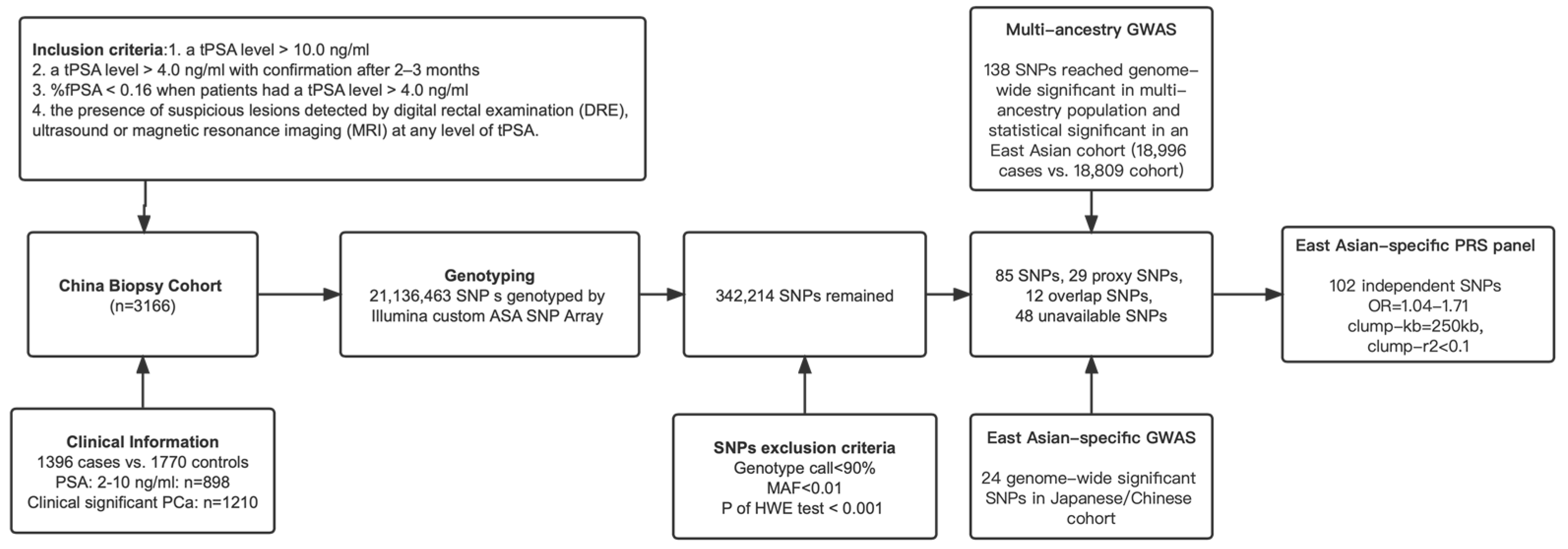
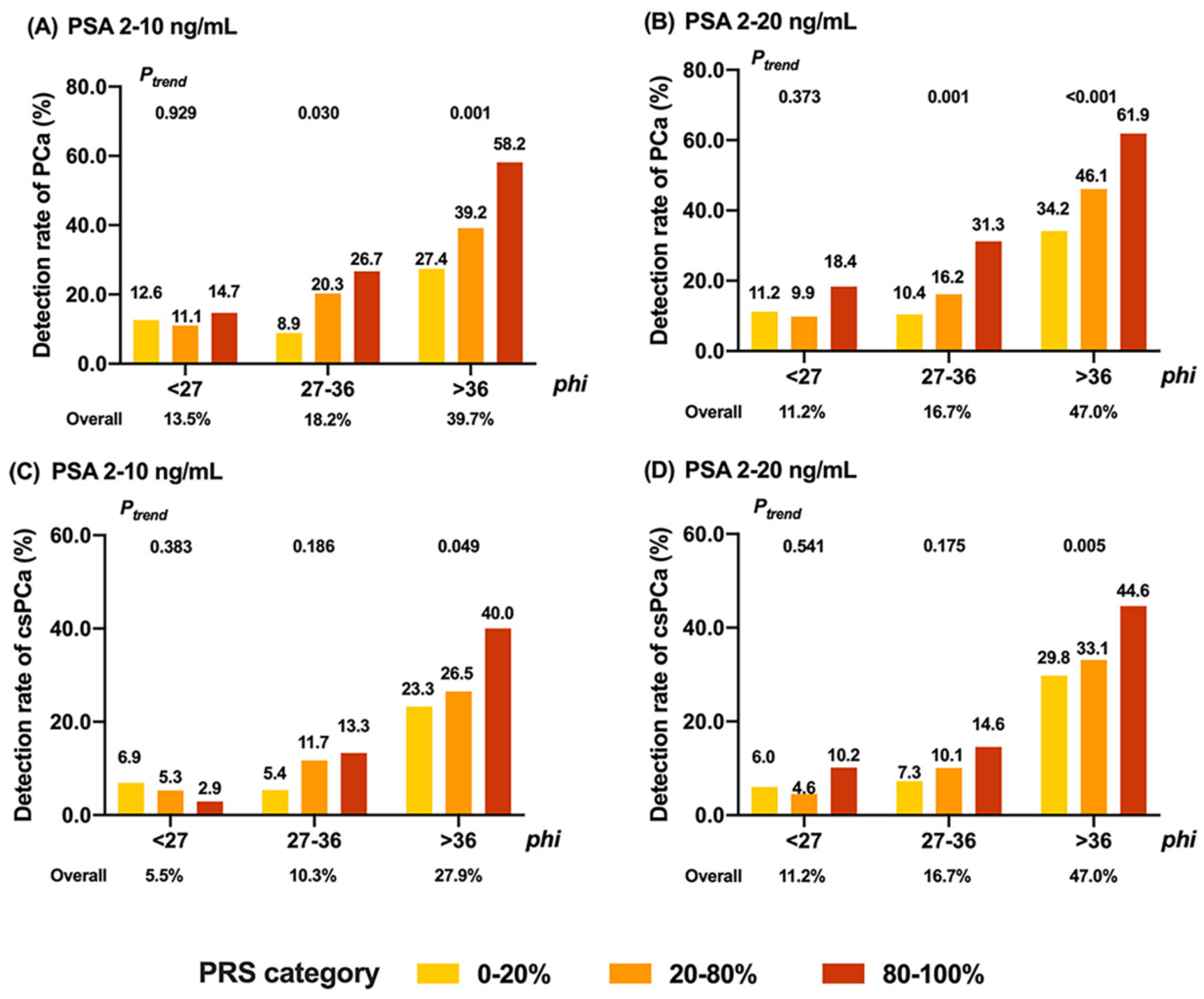
To date, the combined effect of polygenic risk score (PRS) and prostate health index (phi) on PCa diagnosis in men undergoing prostate biopsy has never been investigated. A total of 3166 patients who underwent initial prostate biopsy in three tertiary medical centers from August 2013 to March 2019 were included. PRS was calculated on the basis of the genotype of 102 reported East-Asian-specific risk variants. It was then evaluated in the univariable or multivariable logistic regression models that were internally validated using repeated 10-fold cross-validation. Discriminative performance was assessed by area under the receiver operating curve (AUC) and net reclassification improvement (NRI) index. Compared with men in the first quintile of age and family history adjusted PRS, those in the second, third, fourth, and fifth quintiles were 1.86 (odds ratio, 95% confidence interval (CI): 1.34–2.56), 2.07 (95%CI: 1.50–2.84), 3.26 (95%CI: 2.36–4.48), and 5.06 (95%CI: 3.68–6.97) times as likely to develop PCa (all p < 0.001). Adjustment for other clinical parameters yielded similar results. Among patients with prostate-specific antigen (PSA) at 2–10 ng/mL or 2–20 ng/mL, PRS still had an observable ability to differentiate PCa in the group of prostate health index (phi) at 27–36 (Ptrend < 0.05) or >36 (Ptrend ≤ 0.001). Notably, men with moderate phi (27–36) but highest PRS (top 20% percentile) would have a comparable risk of PCa (positive rate: 26.7% or 31.3%) than men with high phi (>36) but lowest PRS (bottom 20% percentile positive rate: 27.4% or 34.2%). The combined model of PRS, phi, and other clinical risk factors provided significantly better performance (AUC: 0.904, 95%CI: 0.887–0.921) than models without PRS. Adding PRS to clinical risk models could provide significant net benefit (NRI, from 8.6% to 27.6%), especially in those early onset patients (NRI, from 29.2% to 44.9%). PRS may provide additional predictive value over phi for PCa. The combination of PRS and phi that effectively captured both clinical and genetic PCa risk is clinically practical, even in patients with gray-zone PSA.
Keywords: polygenic risk score; prostate biopsy; prostate cancer; prostate health index; prostate-specific antigen polygenic risk score; prostate biopsy; prostate cancer; prostate health index; prostate-specific antigen