Article

Building Blocks for Deep Phenotyping in Infancy: A Use Case Comparing Spontaneous Neuromotor Functions in Prader-Willi Syndrome and Cerebral Palsy


1
Child and Adolescent Psychiatry and Psychotherapy, University Medical Center Göttingen, 37075 Göttingen, Germany
2
Leibniz Science Campus Primate Cognition, 37077 Göttingen, Germany
3
iDN—Interdisciplinary Developmental Neuroscience, Division of Phoniatrics, Medical University of Graz, 8036 Graz, Austria
4
Department of Rehabilitation, Children’s Hospital, Fudan University, Shanghai 201102, China
5
Center of Neurodevelopmental Disorders (KIND), Centre for Psychiatry Research, Department of Women’s and Children’s Health, Child and Adolescent Psychiatry, Region Stockholm, Karolinska Institutet & Stockholm Health Care Services, 17176 Stockholm, Sweden
*
Author to whom correspondence should be addressed.
These authors contributed equally to this work.
J. Clin. Med. 2023, 12(3), 784; https://doi.org/10.3390/jcm12030784
Submission received: 18 December 2022 / Revised: 12 January 2023 / Accepted: 13 January 2023 / Published: 18 January 2023
(This article belongs to the Special Issue Clinical Updates on Psychology in Children and Adolescents)

Abstract

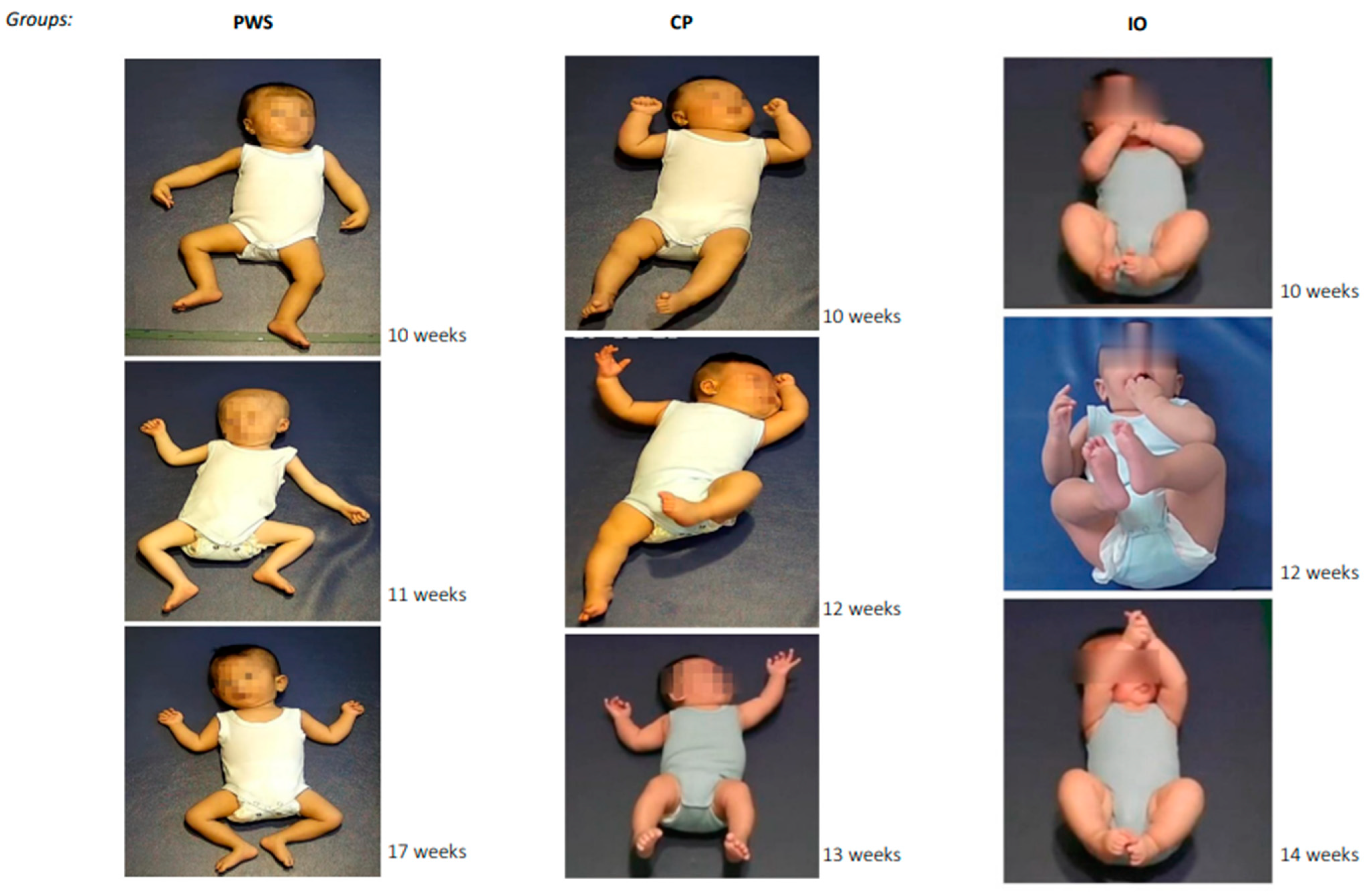
With the increasing worldwide application of the Prechtl general movements assessment (GMA) beyond its original field of the early prediction of cerebral palsy (CP), substantial knowledge has been gained on early neuromotor repertoires across a broad spectrum of diagnostic groups. Here, we aimed to profile the neuromotor functions of infants with Prader-Willi syndrome (PWS) and to compare them with two other matched groups. One group included infants with CP; the other included patients who were treated at the same clinic and turned out to have inconspicuous developmental outcomes (IOs). The detailed GMA, i.e., the motor optimality score-revised (MOS-R), was used to prospectively assess the infants’ (N = 54) movements. We underwent cross-condition comparisons to characterise both within-group similarities and variations and between-group distinctions and overlaps in infants’ neuromotor functions. Although infants in both the PWS and the CP groups scored similarly low on MOS-R, their motor patterns were different. Frog-leg and mantis-hand postures were frequently seen in the PWS group. However, a PWS-specific general movements pattern was not observed. We highlight that pursuing in-depth knowledge within and beyond the motor domain in different groups has the potential to better understand different conditions, improve accurate diagnosis and individualised therapy, and contribute to deep phenotyping for precision medicine.
Keywords: deep phenotyping; cross-condition comparison; infant; neuromotor function; motor development; Prechtl general movements assessment (GMA); motor optimality score-revised (MOS-R); Prader-Willi syndrome (PWS); cerebral palsy (CP) deep phenotyping; cross-condition comparison; infant; neuromotor function; motor development; Prechtl general movements assessment (GMA); motor optimality score-revised (MOS-R); Prader-Willi syndrome (PWS); cerebral palsy (CP)