



The Role of Primary Repair of the Recurrent Laryngeal Nerve during Thyroid/Parathyroid Surgery in Vocal Outcomes—A Systematic Review
 , , and
Abstract
1. Introduction
2. Materials and Methods
2.1. Search Strategy
2.2. Inclusion and Exclusion Criteria
2.3. Quality Assessment of the Studies Included
2.4. Statistical Analysis
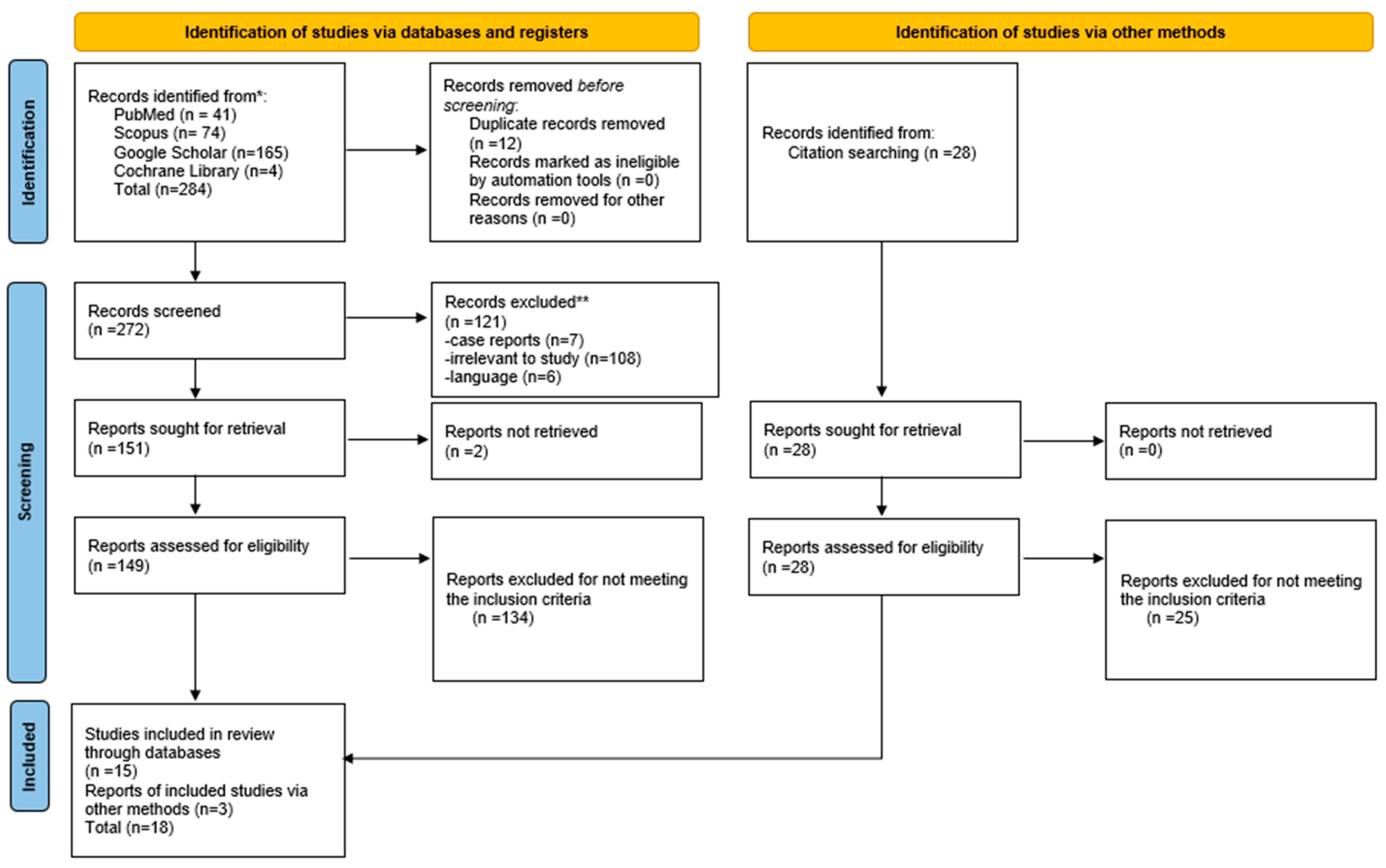
3. Results
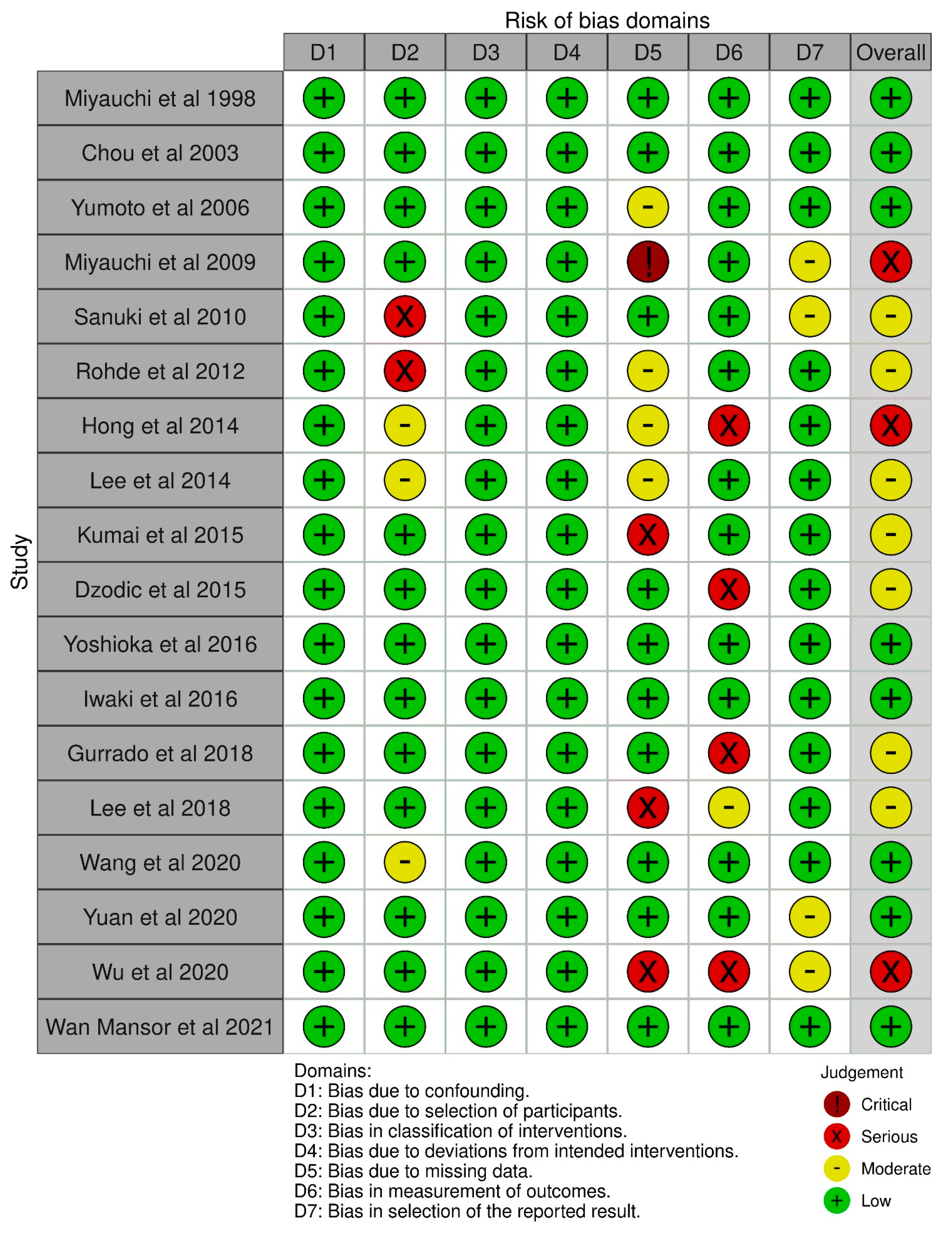
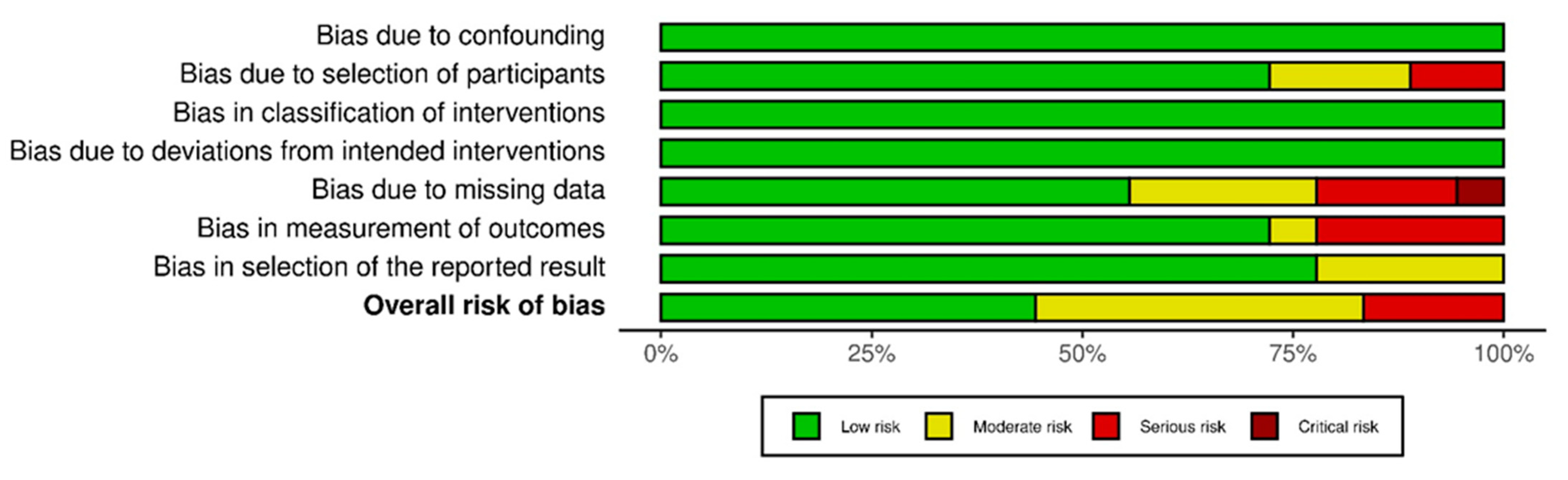
Risk of Bias
4. Discussion
5. Conclusions
Supplementary Materials
Author Contributions
Funding
Institutional Review Board Statement
Informed Consent Statement
Data Availability Statement
Conflicts of Interest
Abbreviations
| ARA | Ansa to recurrent nerve anastomosis |
| DA | Direct Anastomosis |
| FNG | Free Nerve Graft |
| GRB | Grade–Roughness–Breathiness (Hirano Scale) |
| GRBAS | Grade–Roughness–Breathiness–Authenticity–Strain Scale |
| HNR | Harmonics to Noise Ratio |
| IL | Injection Laryngoplasty |
| LEMG | Laryngeal Electromyography |
| m | months |
| MFR | Maximum Flow Rate |
| MPT | Maximum Phonation Time |
| nss | no statistical significance |
| P | Prospective |
| PC | Prospective Comparative |
| PEI | Phonation Efficacy Index |
| R | Retrospective |
| RC | Retrospective Comparative |
| RLN | Recurrent Laryngeal Nerve |
| ss | statistical significance |
| SVR | Selective Vagus to RLN Anastomosis |
| UVFP | Unilateral Vocal Fold Palsy |
| VC | Vocal Cord |
| VHI | Voice Handicap Index |
| VMUR | Voluntary Motor Unit Recruitment |
| VRA | Vagus to Recurrent Nerve Anastomosis |
| y | years |
References
- Hayward, N.J.; Grodski, S.; Yeung, M.; Johnson, W.R.; Serpell, J. Recurrent laryngeal nerve injury in thyroid surgery: A review. ANZ J. Surg. 2013, 83, 15–21. [Google Scholar] [CrossRef] [PubMed]
- Bihain, F.; Nomine-Criqui, C.; Demarquet, L.; Blanchard, C.; Gallet, P.; Nguyen, P.-L.; Mirallie, E.; Brunaud, L. What is the impact of continuous neuromonitoring on the incidence of injury to the recurrent laryngeal nerve during total thyroidectomy? Surgery 2020, 169, 63–69. [Google Scholar] [CrossRef] [PubMed]
- Lynch, J.; Parameswaran, R. Management of unilateral recurrent laryngeal nerve injury after thyroid surgery: A review. Head Neck 2017, 39, 1470–1478. [Google Scholar] [CrossRef] [PubMed]
- Pei, M.; Zhu, S.; Zhang, C.; Wang, G.; Hu, M. The value of intraoperative nerve monitoring against recurrent laryngeal nerve injury in thyroid reoperations. Medicine 2021, 100, e28233. [Google Scholar] [CrossRef]
- Cirocchi, R.; Arezzo, A.; D’Andrea, V.; Abraha, I.; Popivanov, G.I.; Avenia, N.; Gerardi, C.; Henry, B.M.; Randolph, J.; Barczyñski, M. Intraoperative neuromonitoring versus visual nerve identification for prevention of recurrent laryngeal nerve injury in adults undergoing thyroid surgery. Cochrane Database Syst. Rev. 2019, 1, CD012483. [Google Scholar] [CrossRef]
- Moreira, A.; Forrest, E.; Lee, J.C.; Paul, E.; Yeung, M.; Grodski, S.; Serpell, J.W. Investigation of recurrent laryngeal palsy rates for potential associations during thyroidectomy. ANZ J. Surg. 2020, 90, 1733–1737. [Google Scholar] [CrossRef]
- Rulli, F.; Ambrogi, V.; Dionigi, G.; Amirhassankhani, S.; Mineo, T.; Ottaviani, F.; Buemi, A.; Di Stefano, P.; Mourad, M. Meta-analysis of recurrent laryngeal nerve injury in thyroid surgery with or without intraoperative nerve monitoring. Acta Otorhinolaryngol. Ital. 2014, 34, 223–229. [Google Scholar]
- Liu, M.-Y.; Chang, C.-P.; Hung, C.-L.; Hung, C.-J.; Huang, S.-M. Traction Injury of Recurrent Laryngeal Nerve during Thyroidectomy. World J. Surg. 2020, 44, 402–407. [Google Scholar] [CrossRef]
- Calo, P.G.; Pisano, G.; Medas, F.; Tatti, A.; Pittau, M.R.; Demontis, R.; Favoriti, P.; Nicolosi, A. Intraoperative recurrent laryngeal nerve monitoring in thyroid surgery: Is it really useful? Clin. Ther. 2013, 164. [Google Scholar]
- Gunn, A.; Oyekunle, T.; Stang, M.; Kazaure, H.; Scheri, R. Recurrent Laryngeal Nerve Injury After Thyroid Surgery: An Analysis of 11,370 Patients. J. Surg. Res. 2020, 255, 42–49. [Google Scholar] [CrossRef]
- van Lith-Bijl, J.T.; Desuter, G.R.R. Laryngeal Reinnervation: The History and Where We Stand Now. Adv. Otorhinolaryngol. 2020, 85, 98–111. [Google Scholar]
- Vardaxi, C.; Tsetsos, N.; Koliastasi, A.; Poutoglidis, A.; Sapalidis, K.; Triaridis, S.; Printza, A. Swallowing disorders after thyroidectomy: A systematic review and meta-analysis. Eur. Arch. Oto-Rhino-Laryngol. 2022, 279, 4213–4227. [Google Scholar] [CrossRef]
- Isseroff, T.F.; Pitman, M.J. Optimal Management of Acute Recurrent Laryngeal Nerve Injury during Thyroidectomy. Curr. Otorhinolaryngol. Rep. 2013, 1, 163–170. [Google Scholar] [CrossRef]
- Pardal-Refoyo, J.L.; Ochoa-Sangrador, C. Bilateral Recurrent Laryngeal Nerve Injury in Total Thyroidectomy with or without Intraoperative Neuromonitoring. Systematic Review and Meta-analysis. Acta Otorrinolaringol. Esp. 2016, 67, 66–74. [Google Scholar] [CrossRef] [PubMed]
- Langerman, A.; Nocon, C.C. Primary Repair Versus No Repair for Transected Recurrent Laryngeal Nerve. In Difficult Decisions in Surgery: An Evidence-Based Approach; Springer: Cham, Switzerland, 2018; pp. 105–114. [Google Scholar] [CrossRef]
- Fancello, V.; Nouraei, S.A.R.; Heathcote, K.J. Role of reinnervation in the management of recurrent laryngeal nerve injury: Current state and advances. Curr. Opin. Otolaryngol. Head Neck Surg. 2017, 25, 480–485. [Google Scholar] [CrossRef] [PubMed]
- Mueller, A.H.; Pototschnig, C. Recurrent Laryngeal Nerve Stimulator. Otolaryngol. Clin. N. Am. 2020, 53, 145–156. [Google Scholar] [CrossRef] [PubMed]
- Miyauchi, A.; Inoue, H.; Tomoda, C.; Fukushima, M.; Kihara, M.; Higashiyama, T.; Takamura, Y.; Ito, Y. Improvement in phonation after recon-struction of the recurrent laryngeal nerve in patients with thyroid cancer invading the nerve. Surgery 2009, 146, 1056–1062. [Google Scholar] [CrossRef]
- Foerster, G.; Podema, R.; Guntinas-Lichius, O.; Crumley, R.L.; Mueller, A.H. Crumley’s Classification of Laryngeal Synkinesis: A Comparison of Laryngoscopy and Electromyography. Laryngoscope 2021, 131, E1605–E1610. [Google Scholar] [CrossRef]
- Patel, K.N.; Yip, L.; Lubitz, C.C.; Grubbs, E.G.; Miller, B.S.; Shen, W.; Angelos, P.; Chen, H.; Doherty, G.M.; Fahey, T.J.; et al. The American Association of Endocrine Surgeons Guide-lines for the Definitive Surgical Management of Thyroid Disease in Adults. Ann. Surg. 2020, 271, e21–e93. [Google Scholar] [CrossRef]
- Moher, D.; Liberati, A.; Tetzlaff, J.; Altman, D.G.; The PRISMA Group. Preferred Reporting Items for Systematic Reviews and Meta-Analyses: The PRISMA Statement. J. Clin. Epidemiol. 2009, 62, 1006–1012. [Google Scholar] [CrossRef]
- Page, M.J.; McKenzie, J.E.; Bossuyt, P.M.; Boutron, I.; Hoffmann, T.C.; Mulrow, C.D.; Shamseer, L.; Tetzlaff, J.M.; Akl, E.A.; Brennan, S.E.; et al. The PRISMA 2020 statement: An updated guideline for reporting systematic reviews. BMJ 2021, 372, n71. [Google Scholar] [CrossRef] [PubMed]
- Sterne, J.A.C.; Hernán, M.A.; Reeves, B.C.; Savović, J.; Berkman, N.D.; Viswanathan, M.; Henry, D.; Altman, D.G.; Ansari, M.T.; Boutron, I.; et al. ROBINS-I: A tool for assessing risk of bias in non-randomised studies of interventions. BMJ 2016, 355, i4919. [Google Scholar] [CrossRef]
- Wells, G.A.; Shea, B.; O’Connell, D.; Peterson, J.; Welch, V.; Losos, M.; Tugwell, P. The Newcastle-Ottawa Scale (NOS) for assessing the quality of nonrandomised studies in meta-analyses. In Proceedings of the 3rd Symposium on Systematic Reviews: Beyond the Basics, Oxford, UK, 3–5 July 2000. [Google Scholar]
- Miyauchi, A.; Matsusaka, K.; Kihara, M.; Matsuzuka, F.; Hirai, K.; Yokozawa, T.; Kobayashi, K.; Kobayashi, A.; Kuma, K. The role of ansa-to-recurrent-laryngeal nerve anastomosis in operations for thyroid cancer. Br. J. Surg. 1998, 164, 927–933. [Google Scholar] [CrossRef] [PubMed]
- Chou, F.-F.; Su, C.-Y.; Jeng, S.-F.; Hsu, K.-L.; Lu, K.-Y. Neurorrhaphy of the recurrent laryngeal nerve. J. Am. Coll. Surg. 2003, 197, 52–57. [Google Scholar] [CrossRef] [PubMed]
- Yumoto, E.; Sanuki, T.; Kumai, Y. Immediate Recurrent Laryngeal Nerve Reconstruction and Vocal Outcome. Laryngoscope 2006, 116, 1657–1661. [Google Scholar] [CrossRef] [PubMed]
- Sanuki, T.; Yumoto, E.; Minoda, R.; Kodama, N. The role of immediate recurrent laryngeal nerve reconstruction for thyroid cancer surgery. J. Oncol. 2010, 2010, 846235. [Google Scholar] [CrossRef]
- Rohde, S.L.; Wright, C.T.; Muckala, J.C.; Wiggleton, J.; Rousseau, B.; Netterville, J.L. Voice quality after recurrent laryngeal nerve resection and immediate reconstruction. Otolaryngol. Head Neck Surg. 2012, 147, 733–736. [Google Scholar] [CrossRef]
- Hong, J.W.; Roh, T.S.; Yoo, H.S.; Hong, H.J.; Choi, H.S.; Chang, H.S.; Park, C.S.; Kim, Y.S. Outcome with immediate direct anastomosis of recurrent laryngeal nerves injured during thyroidectomy. Laryngoscope 2014, 124, 1402–1408. [Google Scholar] [CrossRef]
- Lee, S.W.; Park, K.N.; Oh, S.K.; Jung, C.H.; Mok, J.O.; Kim, C.H. Long-term efficacy of primary intraoperative recurrent laryngeal nerve reinnervation in the management of thyroidectomy-related unilateral vocal fold paralysis. Acta Otolaryngol. 2014, 134, 1179–1184. [Google Scholar] [CrossRef]
- Kumai, Y.; Kodama, N.; Murakami, D.; Yumoto, E. Comparison of vocal outcome following two different procedures for im-mediate RLN reconstruction. Eur. Arch. Otorhinolaryngol. 2016, 273, 967–972. [Google Scholar] [CrossRef]
- Dzodic, R.; Markovic, I.; Santrac, N.; Buta, M.; Djurisic, I.; Lukic, S. Recurrent Laryngeal Nerve Liberations and Reconstructions: A Single Institution Experience. World J. Surg. 2016, 40, 644–651. [Google Scholar] [CrossRef] [PubMed]
- Yoshioka, K.; Miyauchi, A.; Fukushima, M.; Kobayashi, K.; Kihara, M.; Miya, A. Surgical Methods and Experiences of Surgeons Did not Significantly Affect the Recovery in Phonation Following Reconstruction of the Recurrent Laryngeal Nerve. World J. Surg. 2016, 40, 2948–2955. [Google Scholar] [CrossRef]
- Iwaki, S.; Maeda, T.; Saito, M.; Otsuki, N.; Takahashi, M.; Wakui, E.; Shinomiya, H.; Morimoto, K.; Inoue, H.; Masuoka, H.; et al. Role of immediate recurrent laryngeal nerve recon-struction in surgery for thyroid cancers with fixed vocal cords. Head Neck 2017, 39, 427–431. [Google Scholar] [CrossRef]
- Gurrado, A.; Pasculli, A.; Pezzolla, A.; Di Meo, G.; Fiorella, M.L.; Cortese, R.; Avenia, N.; Testini, M. A method to repair the recurrent laryngeal nerve during thyroidectomy. Can. J. Surg. 2018, 61, 278–282. [Google Scholar] [CrossRef] [PubMed]
- Lee, S.W.; Park, K.N. A long-term comparative prospective study between reinnervation and injection laryngoplasty. Laryn-goscope 2018, 128, 1893–1897. [Google Scholar] [CrossRef] [PubMed]
- Wang, W.; Liu, F.; Zhang, C.; Li, M.; Chen, S.; Gao, Y.; Chen, M.; Zheng, H. Immediate Ansa Cervicalis-to-Recurrent Laryngeal Nerve Anastomosis for the Management of Recurrent Laryngeal Nerve Infiltration by a Differentiated Thyroid Carcinoma. ORL J. Otorhinolaryngol. Relat. Spec. 2020, 82, 93–105. [Google Scholar] [CrossRef]
- Yuan, Q.; Hou, J.; Liao, Y.; Zheng, L.; Wang, K.; Wu, G. Selective vagus-recurrent laryngeal nerve anastomosis in thyroidectomy with cancer invasion or iatrogenic transection. Langenbecks Arch. Surg. 2020, 405, 461–468. [Google Scholar] [CrossRef] [PubMed]
- Wu, R.; Zhang, C.; Wang, H.; Li, M.; Lei, S.; Zeng, J.; He, J. Clinical observation of end-to-end neuroanastomosis in the treatment of complete injury of the unilateral recurrent laryngeal nerve. Gland. Surg. 2020, 9, 2017–2025. [Google Scholar] [CrossRef] [PubMed]
- Mansor, W.N.W.; Azman, M.; Remli, R.; Yunus, M.R.M.; Baki, M.M. Primary Nonselective Laryngeal Reinnervation in Iatrogenic Acute Recurrent Laryngeal Nerve Injury: Case Series and Literature Review. Ear Nose Throat J. 2021, 145561321993605. [Google Scholar] [CrossRef] [PubMed]
- Frazier, C.H. The treatment of paralysis of the recurrent laryngeal nerve by nerve anastomosis. Ann Surg. 1924, 79, 161–171. [Google Scholar] [CrossRef] [PubMed]
- Ezaki, H.; Ushio, H.; Harada, Y.; Takeichi, N. Recurrent laryngeal nerve anastomosis following thyroid surgery. World J. Surg. 1982, 6, 342–346. [Google Scholar] [CrossRef]
- Crumley, R.L.; Izdebski, K. Voice quality following laryngeal reinnervation by ansa hypoglossi transfer. Laryngoscope 1986, 96, 611–616. [Google Scholar] [CrossRef] [PubMed]
- Printza, A. Patient-Reported Outcome Measures in Diseases of the Head and Neck. J. Clin. Med. 2022, 11, 3358. [Google Scholar] [CrossRef] [PubMed]
- Masuoka, H.; Miyauchi, A. Intraoperative Management of the Recurrent Laryngeal Nerve Transected or Invaded by Thyroid Cancer. Front. Endocrinol. 2022, 13, 884866. [Google Scholar] [CrossRef] [PubMed]
- Simó, R.; Nixon, I.J.; Rovira, A.; Vander Poorten, V.; Sanabria, A.; Zafereo, M.; Hartl, D.M.; Kowalski, L.P.; Randolph, G.W.; Kamani, D.; et al. Immediate Intraoperative Repair of the Re-current Laryngeal Nerve in Thyroid Surgery. Laryngoscope 2021, 131, 1429–1435. [Google Scholar] [CrossRef] [PubMed]

| Search Terms | |
|---|---|
| PubMed | All fields: immediate OR primary AND repair OR reinnervation OR neurorrhaphy AND recurrent laryngeal nerve AND thyroid surgery |
| Scopus | All fields: ALL (repair OR reinnervation AND recurrent AND laryngeal AND nerve AND immediate OR primary AND neurorrhaphy) |
| Cochrane Library | Title abstract keywords: recurrent laryngeal nerve AND primary repair OR neurorrhaphy AND vocal function |
| Google Scholar | All fields: (repair OR reinnervation or neurorrhaphy “recurrent laryngeal nerve” AND immediate OR primary) |
| Patients | Adults who underwent intra-operative reinnervation of RLN during thyroid or/and parathyroid surgery. |
| Intervention | Primary neurorrhaphy of RLN |
| Comparison | Other methods of RLN injury repair, or general population (without any known vocal dysfunction), or no comparison. |
| Outcome | Vocal function outcome (evaluated by any method) |
| Authors, Year, Country | Study Period | Study Design | Sample | Method of Repair | Mean Age | Women | Methods of Assessment | Post-Op Follow-Up |
|---|---|---|---|---|---|---|---|---|
| Miyauchi et al., 1998, Japan [25] | 1983–1995 | RC | (a) 34, (b) 26, (c) 34 1 | ARA:19, FNG:8, DA:5, VRA:2 | (a) 52 | (a) 28, (b) 17, (c) 28 | Laryngoscopy, MPT | >1 y, mean: 4.2 y |
| Chou et al., 2003,Taiwan [26] | 1998–2001 | RC | (a) 8, (b) 4 2 | DA:8 | (a) 42.4 (b) 53 | (a) 6, (b) 3 | Videostroboscopy, Laryngoscopy, GRBAS, MPT | >6 m, mean: 10.5 m |
| Yumoto et al., 2006, Japan [27] | 1995–2002 | PC | (a) 9, (b) 9, (c) 4 3 | FNG:8, DA:1 | (a) 57.8 (b) 54.4 (c) 20.5 | (a) 7, (b) 6, (c) 2 | Videostroboscopy, MPT, MFR, HNR, jitter, shimmer | >9 m, mean: 17 m |
| Miyauchi et al., 2009, Japan [18] | 1984–2007 | RC | (a) 88, (b) 34, (c) 27 4 | ARA:65, FNG:14, DA:7, VRA:2 | (a) 56 | (a) 72, (b) 26, (c) 18 | Laryngoscopy, MPT, PEI | 1 y |
| Sanuki et al., 2010, Japan [28] | 2000–2008 | RC | (a) 6, (b) 6 5 | FNG:9, ARA:2, DA:1 | (a) 60.5 (b) 63.1 | (a) 5, (b) 3 | Videostroboscopy, MPT, MFR, GRBAS | >7 m, mean: 34.6 m |
| Rohde et al., 2012, USA [29] | 2002–2012 | P | 9 | DA:4, FNG:2, VRA:2 | 56.2 | 6 | Videostroboscopy | >9 m |
| Hong et al., 2014, South Korea [30] | 2004–2011 | RC | (a) 10, (b) 4 6 | (a) DA:10. All patients had IL 2–6 m post-op | (a) 48.1 (b) 54.3 | (a) 8, (b) 4 | Laryngoscopy, aspiration assessment, GRBAS, VHI, MPT | >1 y, (a) m mean (a/b): 19.6/19.3 m |
| Lee et al., 2014, South Korea [31] | 2008–2012 | P | 19 | DA:12, ARA: 7 | 48.4 | Videostroboscopy Laryngoscopy, MPT, HNR, jitter, shimmer, VHI-30 | 2 y (0.6 m, 12 m, 24 m) | |
| Kumai et al., 2015, Japan [32] | 2000–2011 | R | 17 | FNG:9, ARA:8 | 60.5 | 12 | Videostroboscopy, MPT, MFR, jitter, shimmer | 1 y |
| Dzodic et al., 2015, Serbia [33] | 2000–2015 | R | 16 | ARA:11, DA:5 | Laryngoscopy, vocal assessment qualitative scale (0–5) | 1 y | ||
| Yoshioka et al., 2016, Japan [34] | 1998–2014 | RC | (a) 449, (b) 1257, (c) 40 7 | ARA:345, DA:59, FNG:35, VRA:10 | (a) 59.2 | (a) 354 (b) 1045 (c) 29 | Laryngoscopy, MPT, MFR | 1 y |
| Iwaki et al., 2016, Japan [35] | 2009–2011 | PC | (a) 13, (b) 8, (c) 14 8 | (a+b) ARA:17, FNG:3, DA:1 | (a+b) 60.6 (c) 65.9 | (a) 10, (b) 7, (c) 3 | Laryngoscopy. MPT, PEI, jitter, shimmer, HNR | (a+b) 1 y (c) 3 m |
| Gurrado et al., 2018, Italy [36] | 2000–2015 | RC | (a) 5, (b) 7 9 | DA:5 | (a) 57.4 (b) 56.8 | (a) 3, (b) 5 | Videostroboscopy, GRBAS, aspiration assessment, subjective vocal assessment scale | >9 m |
| Lee et al., 2018 South Korea [37] | 2005–2016 | PC | (a) 19, (b) 43 10 | ARA:12, DA:7 | (a) 48.2 (b) 51.9 | Videostroboscopy, VHI, MPT, jitter, shimmer, HNR | >3 y Mean (a/b): 50.6/45.5 m | |
| Wang et al., 2020, China [38] | 1994–2017 | RC | (a) 37, (b) 16 11 | (a+b) ARA:53 | (a) 44.8 (b) 47.5 | (a) 28, (b) 12 | Videostroboscopy, LEMG, GRB, HNR, jitter, shimmer, MPT | 1y |
| Yuan et al., 2020, China [39] | 2004–2018 | R | 37 | SVR:17, ARA:8, FNG:4 | 48 | 16 | Laryngoscopy, GRBAS, MPT | 1–15 y, mean: 8.5 y |
| Wu et al., 2020, China [40] | 2009–2020 | R | 13 | DA:13 | 39 | 11 | GRBAS | 6 m |
| Wan Mansor et al., 2021, Malaysia [41] | R | 3 | ARA:2, DA:1 | 40 | 2 | Laryngoscopy, MPT, VHI-10, shimmer, jitter, HNR, LEMG | 12 m |
| Studies | Outcome |
|---|---|
| Miyauchi et al., 1998 [25] | Improvement in MPT at 2–5 m post-op. MPT stable at 12 m, comparable to general population, better than UVFP group (mean 26.2 ± 13 in men p < 0.02 and 17.2 ± 5.6 secs on women p < 0.0001 ss). Laryngoscopy: fixation of VC in middle position except for a few cases of minimal mobility, no atrophy, normal tone, minimal glottal gap during phonation. |
| Chou et al., 2003 [26] | Improvement of all parameters studied at 6 m post-op. Improvement in the GRBAS scale and aspiration assessment at 6 m compared to 3 m post-operatively. In 11 out of 12 who underwent neurorrhaphy reduction of glottal gap, immobility of the VC without atrophy of it (nss). |
| Yumoto et al., 2006 [27] | Minimization or elimination of the glottal gap during phonation. Improvement of all acoustic analysis parameters. |
| Miyauchi et al., 2009 [18] | 1 y post-op MPT and PEI were found greater than UVFP group (statistical significance: MPT 1 year post-op 20.9 ± 11.7 sec in men and 18.8 ± 6.6 in women p < 0.05 and PEI 7.22 ± 2.9 p < 0.0001) and comparable to healthy subjects. |
| Sanuki et al., 2010 [28] | Improvement of GRBAS post-operatively, reduction or elimination of glottal gap during phonation, restoration of mucosal wave post-op. Improvement of MPT and MFR. |
| Rohde et al., 2012 [29] | Improvement in GRBAS and VHI. Videostroboscopy: middle position of the VC (good tone, normal volume) with adequate glottal closure during phonation. |
| Hong et al., 2014 [30] | Improvement of all parameters at 12 m post-operatively. Improvement at 12 m when compared to results at 3 m post-operatively (statistical significance: 4.4 ± 0.84 sec vs. 11.7 ± 0.95 p = 0.002). |
| Lee et al., 2014, [31] | Improvement in VHI at 6 m and remaining at these levels at 12 m post-op, (statistical significance: VHI 6 m post-op 38.2 ± 24.1 vs. 84.89 ± 17, p < 0.05) improvement in glottal closure and mucosal wave. Improvement in shimmer, HNR, and MPT at 12 m post-op (statistical significance: HNR 6 m post-op 34.9 ± 1.2 vs. 16.8 ± 5.3, MPT at 6 m post-op 10.40 ± 2.59 vs. 6.69 ± 3.01, and shimmer 5.11 ± 4.09 vs. 8.05 ± 5.35 p < 0.05) remaining stable at 24 m. |
| Kumai et al., 2015 [32] | Improvement of videostroboscopic findings: wave width, glottal closure, and periodicity at 12 m post-op. Improvement in MPT, MFR, jitter, and shimmer 12 m post-op (statistical significance: MPT 22 vs. 8.9 p < 0.05, MFR 128 vs. 247 p < 0.05, jitter 1.1 vs. 3.5 p < 0.05, and shimmer 5 vs. 9.1 p < 0.05). |
| Dzodic et al., 2015 [33] | Preservation of VC’s tone post-op and achievement of near-normal phonation 12 m post-op. Improvement in vocal assessment scale and vocal fold immobility. |
| Yoshioka et al., 2016 [34] | Normal mobility of the VC was not achieved. Increase in MPT 12 m post-op (statistical significance: mean MPT 15 p < 0.0005). MFR improvement in 12 m post-op. |
| Iwaki et al., 2016 [35] | Fixation of the VC in median or paramedian position but no atrophy occurred (normal tone). Normal glottal closure was achieved. Post-op improvement in PEI, MPT, HNR, jitter%, and shimmer% after 12 m. |
| Gurrado et al., 2018 [36] | Improved GRBAS and subjective assessment for aspiration. Fixation of the VC in a middle position without atrophy with good tone. |
| Lee et al., 2018 [37] | Improvement in VHI and laryngoscopic reduction in glottal gap, improvement in mucosal wave at 12, 24, and 36 m post-op (statistical significance: VHI 36 m post-op 41.8 ± 25.2 vs. 24 m post-op 37.1 ± 21.5 vs. 12 m post-op 34.6 ± 19.9; glottis gap 2.2 ± 0.7 vs. 2.4 ± 0.5 vs. 2.6 ± 0.6; mucosal wave 2.1 ± 0.7 vs. 2.4 ± 0.5 vs. 2.5 ± 0.7; MPT 10.79 ± 1.64 vs. 10.53 ± 1.18 vs. 10.58 ± 2.29; jitter 0.95 ± 0.72 vs. 1.30 ± 0.52 vs. 1.52 ± 0.92; shimmer 2.87 ± 0.96 vs. 2.92 ± 0.96 vs. 2.86 ± 0.99; HNR 21.8 ± 3.7 vs. 22.2 ± 4.2 vs. 26.1 ± 3.7 all with p < 0.05). Improvement in MPT, jitter%, shimmer%, and HNR at 12, 24, and 36 m post-op (statistical significance). |
| Wang et al., 2020 [38] | Improvement of the GRB scale at 12 m post-op (nss). Videostroboscopy: elimination of glottal gap, symmetry, and regularity in the VC vibration but immobile, fixation in middle or paramedian position. Improvement in jitter, shimmer, HNR, and MPT at 1 y post-op. Improvement in VMUR recorded by LEMG at 12 m post-op (deterioration had occurred at the 1st month). |
| Yuan et al., 2020 [39] | Improvement in GRBAS and laryngoscopy. VC immobility with normal tone, no atrophy, and minimal glottal gap. Improvement in MPT from 1st to 3rd months of post-op. |
| Wu et al., 2020 [40] | Improvement on GRBAS scale in all patients. |
| Wan Mansor et al., 2021 [41] | Improvement in VHI-10 at 3 m post-op. Laryngoscopy: immobility of the VC with fixation in the middle position. Improvement and return to normal levels in jitter%, shimmer%, HNR, and MHF in all post-op measurements except for the 3rd m. |
| Selection | Comparability | Outcome | Total Score | ||||||
|---|---|---|---|---|---|---|---|---|---|
| I1 | I2 | I3 | I4 | I5 | I6 | I7 | I8 | ||
| Miyauchi et al., 1998 [25] | 1 | 0 | 1 | 1 | 1 | 1 | 1 | 1 | 7 |
| Chou et al., 2003 [26] | 1 | 0 | 1 | 1 | 1 | 1 | 0 | 0 | 5 |
| Yumoto et al., 2006 [27] | 1 | 0 | 1 | 1 | 1 | 1 | 1 | 1 | 7 |
| Miyauchi et al., 2009 [18] | 1 | 1 | 1 | 1 | 1 | 1 | 1 | 1 | 8 |
| Sanuki et al., 2010 [28] | 1 | 0 | 1 | 1 | 1 | 1 | 1 | 0 | 6 |
| Rohde et al., 2012 [29] | 1 | 0 | 1 | 1 | 1 | 1 | 1 | 1 | 7 |
| Hong et al., 2014 [30] | 1 | 1 | 1 | 1 | 1 | 1 | 1 | 1 | 8 |
| Lee et al., 2014 [31] | 1 | 0 | 1 | 1 | 1 | 1 | 1 | 1 | 7 |
| Kumai et al., 2015 [32] | 1 | 0 | 1 | 1 | 1 | 1 | 1 | 1 | 7 |
| Dzodic et al., 2015 [33] | 1 | 0 | 1 | 1 | 1 | 0 | 1 | 1 | 6 |
| Yoshioka et al., 2016 [34] | 1 | 1 | 1 | 1 | 1 | 1 | 1 | 1 | 8 |
| Iwaki et al., 2016 [35] | 1 | 1 | 1 | 1 | 1 | 1 | 0 | 1 | 7 |
| Gurrado et al., 2018 [36] | 1 | 1 | 1 | 1 | 1 | 0 | 1 | 0 | 6 |
| Lee et al., 2018 [37] | 1 | 1 | 1 | 1 | 1 | 1 | 1 | 1 | 8 |
| Wang et al., 2020 [38] | 1 | 1 | 1 | 1 | 1 | 1 | 1 | 1 | 8 |
| Yuan et al., 2020 [39] | 1 | 0 | 1 | 1 | 1 | 1 | 1 | 1 | 7 |
| Wu et al., 2020 [40] | 1 | 0 | 1 | 1 | 1 | 0 | 1 | 0 | 5 |
| Wan Mansor et al., 2021 [41] | 1 | 0 | 1 | 1 | 1 | 1 | 1 | 1 | 7 |
Disclaimer/Publisher’s Note: The statements, opinions and data contained in all publications are solely those of the individual author(s) and contributor(s) and not of MDPI and/or the editor(s). MDPI and/or the editor(s) disclaim responsibility for any injury to people or property resulting from any ideas, methods, instructions or products referred to in the content. |
© 2023 by the authors. Licensee MDPI, Basel, Switzerland. This article is an open access article distributed under the terms and conditions of the Creative Commons Attribution (CC BY) license (https://creativecommons.org/licenses/by/4.0/).
Share and Cite
Papadopoulou, E.; Sapalidis, K.; Triaridis, S.; Printza, A. The Role of Primary Repair of the Recurrent Laryngeal Nerve during Thyroid/Parathyroid Surgery in Vocal Outcomes—A Systematic Review. J. Clin. Med. 2023, 12, 1212. https://doi.org/10.3390/jcm12031212
Papadopoulou E, Sapalidis K, Triaridis S, Printza A. The Role of Primary Repair of the Recurrent Laryngeal Nerve during Thyroid/Parathyroid Surgery in Vocal Outcomes—A Systematic Review. Journal of Clinical Medicine. 2023; 12(3):1212. https://doi.org/10.3390/jcm12031212
Chicago/Turabian StylePapadopoulou, Elisavet, Konstantinos Sapalidis, Stefanos Triaridis, and Athanasia Printza. 2023. "The Role of Primary Repair of the Recurrent Laryngeal Nerve during Thyroid/Parathyroid Surgery in Vocal Outcomes—A Systematic Review" Journal of Clinical Medicine 12, no. 3: 1212. https://doi.org/10.3390/jcm12031212
APA StylePapadopoulou, E., Sapalidis, K., Triaridis, S., & Printza, A. (2023). The Role of Primary Repair of the Recurrent Laryngeal Nerve during Thyroid/Parathyroid Surgery in Vocal Outcomes—A Systematic Review. Journal of Clinical Medicine, 12(3), 1212. https://doi.org/10.3390/jcm12031212

