Article

Safety and Feasibility Study of the Medical Care Pit Walking Support System for Rehabilitation of Acute Stroke Patients


1
Department of Neurosurgery, Institute of Medicine, University of Tsukuba, Tsukuba 305-8575, Ibaraki, Japan
2
International Medical Center, University of Tsukuba Hospital, Tsukuba 305-8576, Ibaraki, Japan
3
Department of Rehabilitation Medicine, Institute of Medicine, University of Tsukuba, Tsukuba 305-8575, Ibaraki, Japan
4
Department of Occupational Therapy, Ibaraki Prefectural University of Health Sciences, Ami 300-0394, Ibaraki, Japan
5
Institute of Systems and Information Engineering, University of Tsukuba, Tsukuba 305-8573, Ibaraki, Japan
6
Ibaraki Prefectural University of Health Sciences, Ami 300-0394, Ibaraki, Japan
*
Author to whom correspondence should be addressed.
J. Clin. Med. 2023, 12(16), 5389; https://doi.org/10.3390/jcm12165389
Submission received: 14 July 2023 / Revised: 10 August 2023 / Accepted: 17 August 2023 / Published: 19 August 2023
(This article belongs to the Section Clinical Rehabilitation)

Abstract

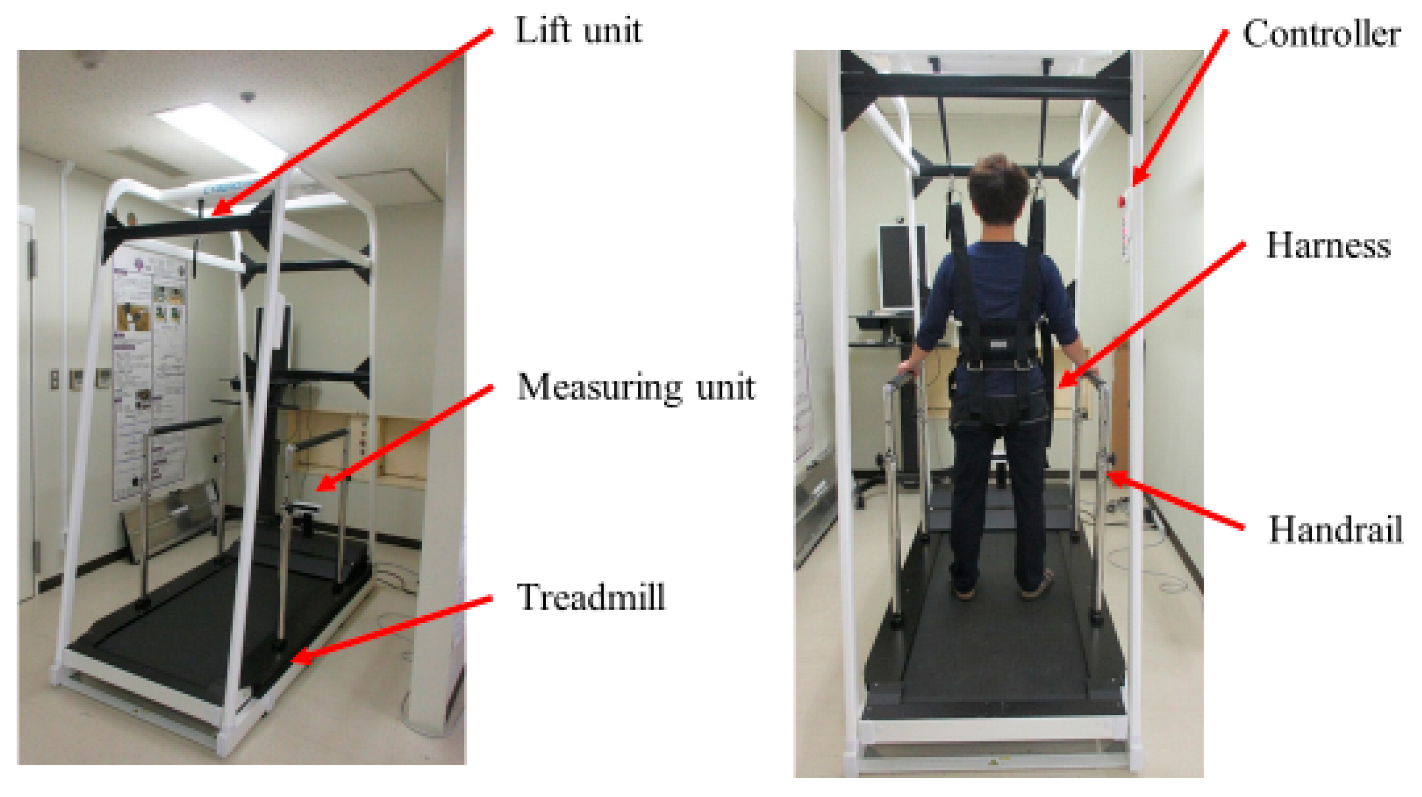
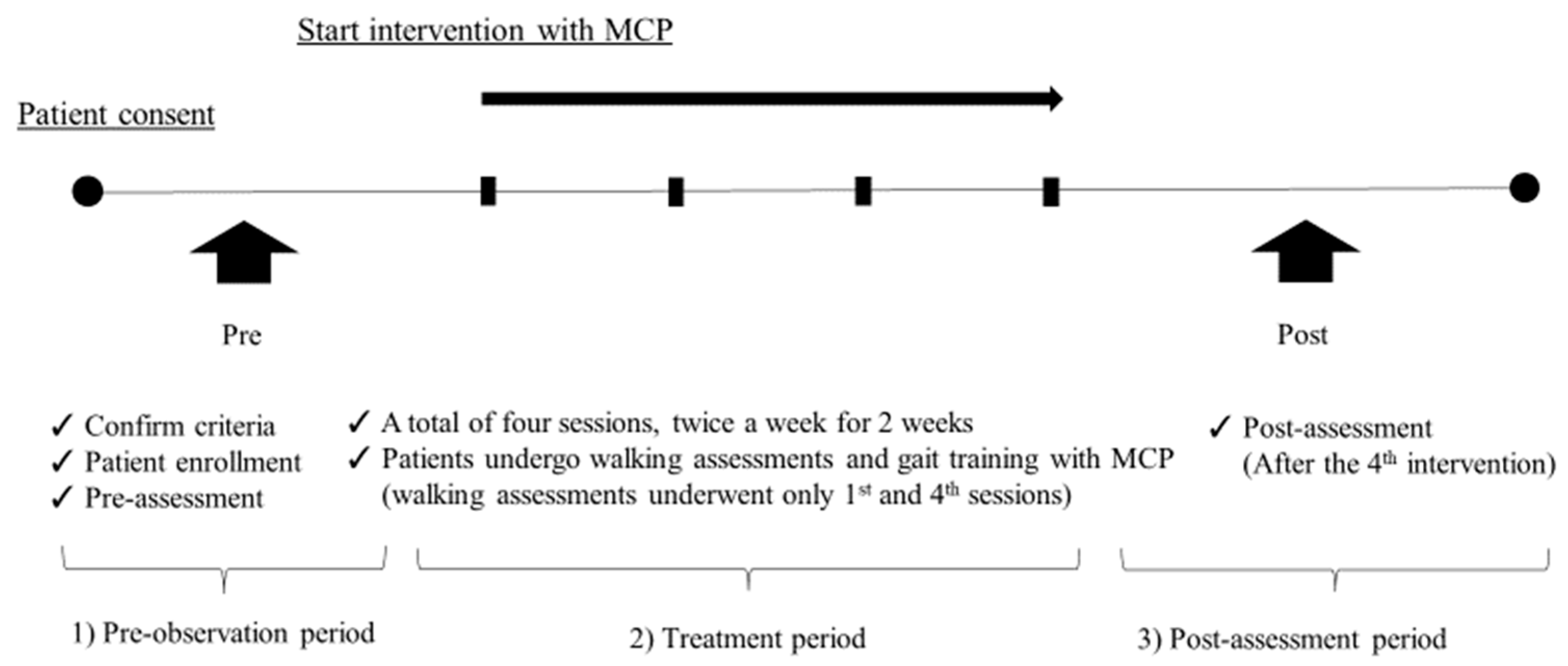
Stroke rehabilitation with mechanical assistance improves outcomes by facilitating repetition and relieving the care burden of therapy staff. Here, we tested the Medical Care Pit (MCP) walking assistance training device in the rehabilitation of eight acute stroke patients (median age 60.7 ± 16.3 years) who had recently suffered ischemic (three) or hemorrhagic (five) stroke (14.1 ± 6.5 days). Patients received standard rehabilitation approximately 5 days per week (weekdays only), plus MCP therapy twice a week, totaling four MCP sessions over 2 weeks. Fugl–Meyer Assessment-Lower Extremities (FMA-LE), Functional Ambulation Category (FAC), and other gait-associated parameters were measured. Over the 10.5 ± 1.6 days of therapy, MCP qualitatively assisted in gait analysis and real-time patient feedback while independent walking scores significantly improved (FAC 2.2 ± 0.8 to 3.1 ± 1.3, p = 0.020). FMA-LE scores also slightly improved but not to significance (p = 0.106). Objective burden on patients, as measured by modified Borg scale, was significantly improved (2.7 ± 1.6 to 2.0 ± 1.6, p = 0.014). In terms of questionnaires, anxiety scores for the physical therapist regarding gait training and falling with MCP significantly decreased (3.8 ± 2.3 to 1.0 ± 1.6; p = 0.027 and 3.1 ± 2.2 to 0.8 ± 1.3; p = 0.045) from the first to fourth sessions. Taken together, MCP, in addition to the usual rehabilitation program, was effective in gait rehabilitation for independent walking and relieved burdens on the patients. Such walking support systems may be an important part of acute stroke rehabilitation.
Keywords: Medical Care Pit; walking support system; walking; physical therapy; acute stroke; stroke rehabilitation; Functional Ambulation Category (FAC); independent walking; gait parameters; care burden of therapy staff Medical Care Pit; walking support system; walking; physical therapy; acute stroke; stroke rehabilitation; Functional Ambulation Category (FAC); independent walking; gait parameters; care burden of therapy staff