


Application of Pelvic Circumferential Compression Devices in Pelvic Ring Fractures—Are Guidelines Followed in Daily Practice?
 , ,
, ,  , ,
, ,
Abstract
1. Introduction
2. Materials and Methods
2.1. Study Design, Setting and Participants
2.2. Data Measurement and Variables
2.3. Statistical Methods
3. Results
4. Discussion
5. Conclusions
Author Contributions
Funding
Institutional Review Board Statement
Informed Consent Statement
Data Availability Statement
Conflicts of Interest
References
- Freitas, C.D.; Garotti, J.E.R.; Nieto, J.; Guimarães, R.P.; Ono, N.K.; Honda, E.; Polesello, G.C. There Have Been Changes in the Incidence and Epidemiology of Pelvic Ring Fractures in Recent Decades? Rev. Bras. Ortop. 2013, 48, 475–481. [Google Scholar] [CrossRef][Green Version]
- Toimela, J.; Brinck, T.; Handolin, L. Evolution of High-Energy Pelvic Trauma in Southern Finland: A 12-Year Experience from a Tertiary Trauma Centre. Eur. J. Trauma Emerg. Surg. 2019. [Google Scholar] [CrossRef]
- Wong, J.M.-L.; Bucknill, A. Fractures of the Pelvic Ring. Injury 2017, 48, 795–802. [Google Scholar] [CrossRef] [PubMed]
- Polytrauma Guideline Update Group. Level 3 Guideline on the Treatment of Patients with Severe/Multiple Injuries. Eur. J. Trauma Emerg. Surg. 2018, 44, 3–271. [CrossRef]
- Hemorrhage in Major Pelvic Fractures. Available online: https://europepmc.org/article/med/3046004 (accessed on 14 June 2020).
- Ben-Menachem, Y.; Coldwell, D.M.; Young, J.W.; Burgess, A.R. Hemorrhage Associated with Pelvic Fractures: Causes, Diagnosis, and Emergent Management. Am. J. Roentgenol. 1991, 157, 1005–1014. [Google Scholar] [CrossRef] [PubMed]
- ATLS 10th Edition Offers New Insights into Managing Trauma Patients. Available online: https://bulletin.facs.org/2018/06/atls-10th-edition-offers-new-insights-into-managing-trauma-patients/ (accessed on 11 April 2020).
- Coccolini, F.; Stahel, P.F.; Montori, G.; Biffl, W.; Horer, T.M.; Catena, F.; Kluger, Y.; Moore, E.E.; Peitzman, A.B.; Ivatury, R.; et al. Pelvic Trauma: WSES Classification and Guidelines. World J. Emerg. Surg. 2017, 12, 5. [Google Scholar] [CrossRef]
- Bottlang, M.; Krieg, J.C.; Mohr, M.; Simpson, T.S.; Madey, S.M. Emergent Management of Pelvic Ring Fractures with Use of Circumferential Compression. JBJS 2002, 84, S43. [Google Scholar] [CrossRef] [PubMed]
- DeAngelis, N.A.; Wixted, J.J.; Drew, J.; Eskander, M.S.; Eskander, J.P.; French, B.G. Use of the Trauma Pelvic Orthotic Device (T-POD) for Provisional Stabilisation of Anterior-Posterior Compression Type Pelvic Fractures: A Cadaveric Study. Injury 2008, 39, 903–906. [Google Scholar] [CrossRef]
- Krieg, J.C.; Mohr, M.; Ellis, T.J.; Simpson, T.S.; Madey, S.M.; Bottlang, M. Emergent Stabilization of Pelvic Ring Injuries by Controlled Circumferential Compression: A Clinical Trial. J. Trauma Acute Care Surg. 2005, 59, 659–664. [Google Scholar] [CrossRef]
- Croce, M.A.; Magnotti, L.J.; Savage, S.A.; Wood, G.W.; Fabian, T.C. Emergent Pelvic Fixation in Patients with Exsanguinating Pelvic Fractures. J. Am. Coll. Surg. 2007, 204, 935–939; discussion 940–942. [Google Scholar] [CrossRef]
- Gardner, M.J.; Parada, S.; Chip Routt, M.L. Internal Rotation and Taping of the Lower Extremities for Closed Pelvic Reduction. J. Orthop. Trauma 2009, 23, 361–364. [Google Scholar] [CrossRef] [PubMed]
- Gänsslen, A.; Lindahl, J.; Füchtmeier, B. Emergency Stabilization: Pelvic Binder. In Pelvic Ring Fractures; Gänsslen, A., Lindahl, J., Grechenig, S., Füchtmeier, B., Eds.; Springer International Publishing: Cham, Germany, 2021; pp. 135–140. ISBN 978-3-030-54730-1. [Google Scholar]
- Littlejohn, L.; Bennett, B.L.; Drew, B. Application of Current Hemorrhage Control Techniques for Backcountry Care: Part Two, Hemostatic Dressings and Other Adjuncts. Wilderness Environ. Med. 2015, 26, 246–254. [Google Scholar] [CrossRef]
- Severe Pelvic Injury with Pelvic Mass Hemorrhage: Determining Severity of Hemorrhage and Clinical Experience with Emergency Stabilization. Available online: https://europepmc.org/article/med/9005561 (accessed on 12 April 2020).
- Burkhardt, M.; Culemann, U.; Seekamp, A.; Pohlemann, T. Strategies for surgical treatment of multiple trauma including pelvic fracture. Review of the literature. Unfallchirurg 2005, 108, 812, 814–820. [Google Scholar] [CrossRef]
- Bonner, T.J.; Eardley, W.G.P.; Newell, N.; Masouros, S.; Matthews, J.J.; Gibb, I.; Clasper, J.C. Accurate Placement of a Pelvic Binder Improves Reduction of Unstable Fractures of the Pelvic Ring. J. Bone Jt. Surg. Br. 2011, 93, 1524–1528. [Google Scholar] [CrossRef]
- Bottlang, M.; Simpson, T.; Sigg, J.; Krieg, J.C.; Madey, S.M.; Long, W.B. Noninvasive Reduction of Open-Book Pelvic Fractures by Circumferential Compression. J. Orthop. Trauma 2002, 16, 367–373. [Google Scholar] [CrossRef] [PubMed]
- Suzuki, T.; Kurozumi, T.; Watanabe, Y.; Ito, K.; Tsunoyama, T.; Sakamoto, T. Potentially Serious Adverse Effects from Application of a Circumferential Compression Device for Pelvic Fracture: A Report of Three Cases. Trauma Case Rep. 2020, 26. [Google Scholar] [CrossRef]
- Schaller, T.M.; Sims, S.; Maxian, T. Skin Breakdown Following Circumferential Pelvic Antishock Sheeting: A Case Report. J. Orthop. Trauma 2005, 19, 661–665. [Google Scholar] [CrossRef] [PubMed]
- Krieg, J.C.; Mohr, M.; Mirza, A.J.; Bottlang, M. Pelvic Circumferential Compression in the Presence of Soft-Tissue Injuries: A Case Report. J. Trauma 2005, 59, 470–472. [Google Scholar] [CrossRef]
- Mason, L.W.; Boyce, D.E.; Pallister, I. Catastrophic Myonecrosis Following Circumferential Pelvic Binding after Massive Crush Injury: A Case Report. Inj. Extra 2009, 40, 84–86. [Google Scholar] [CrossRef][Green Version]
- Shank, J.R.; Morgan, S.J.; Smith, W.R.; Meyer, F.N. Bilateral Peroneal Nerve Palsy Following Emergent Stabilization of a Pelvic Ring Injury. J. Orthop. Trauma 2003, 17, 67–70. [Google Scholar] [CrossRef]
- Garner, A.A.; Hsu, J.; McShane, A.; Sroor, A. Hemodynamic Deterioration in Lateral Compression Pelvic Fracture After Prehospital Pelvic Circumferential Compression Device Application. Air Med. J. 2017, 36, 272–274. [Google Scholar] [CrossRef] [PubMed]
- Bakhshayesh, P.; Boutefnouchet, T.; Tötterman, A. Effectiveness of Non Invasive External Pelvic Compression: A Systematic Review of the Literature. Scand. J. Trauma, Resusc. Emerg. Med. 2016, 24, 73. [Google Scholar] [CrossRef] [PubMed]
- STROBE Statement: Home. Available online: https://www.strobe-statement.org/index.php?id=strobe-home (accessed on 14 June 2020).
- Olson, C.J.; Arthur, M.; Mullins, R.J.; Rowland, D.; Hedges, J.R.; Mann, N.C. Influence of Trauma System Implementation on Process of Care Delivered to Seriously Injured Patients in Rural Trauma Centers. Surgery 2001, 130, 273–279. [Google Scholar] [CrossRef]
- van Olden, G.D.J.; Dik Meeuwis, J.; Bolhuis, H.W.; Boxma, H.; Goris, R.J.A. Clinical Impact of Advanced Trauma Life Support. Am. J. Emerg. Med. 2004, 22, 522–525. [Google Scholar] [CrossRef]
- Siebert, H. White book of severely injured—Care of the DGU. Recommendations on structure, organization and provision of hospital equipment for care of severely injured in the Federal Republic of Germany. Unfallchirurg 2006, 109, 815–820. [Google Scholar] [CrossRef]
- Rommens, P.M.; Hofmann, A. Comprehensive Classification of Fragility Fractures of the Pelvic Ring: Recommendations for Surgical Treatment. Injury 2013, 44, 1733–1744. [Google Scholar] [CrossRef]
- Osler, T.; Baker, S.P.; Long, W. A Modification of the Injury Severity Score That Both Improves Accuracy and Simplifies Scoring. J. Trauma Acute Care Surg. 1997, 43, 922–926. [Google Scholar] [CrossRef]
- Lavoie, A.; Moore, L.; LeSage, N.; Liberman, M.; Sampalis, J.S. The New Injury Severity Score: A More Accurate Predictor of In-Hospital Mortality than the Injury Severity Score. J. Trauma Acute Care Surg. 2004, 56, 1312–1320. [Google Scholar] [CrossRef]
- Ringdal, K.G.; Coats, T.J.; Lefering, R.; Di Bartolomeo, S.; Steen, P.A.; Røise, O.; Handolin, L.; Lossius, H.M. Utstein TCD expert panel. The Utstein Template for Uniform Reporting of Data Following Major Trauma: A Joint Revision by SCANTEM, TARN, DGU-TR and RITG. Scand. J. Trauma Resusc. Emerg. Med. 2008, 16, 7. [Google Scholar] [CrossRef] [PubMed]
- Tile, M. Pelvic Ring Fractures: Should They Be Fixed? J. Bone Jt. Surg. Br. 1988, 70, 1–12. [Google Scholar] [CrossRef] [PubMed]
- Tile, M. Null Acute Pelvic Fractures: I. Causation and Classification. J. Am. Acad. Orthop. Surg. 1996, 4, 143–151. [Google Scholar] [CrossRef]
- Judet, R.; Judet, J.; Letournel, E. Fractures of the acetabulum: Classification and surgical approaches for open reduction. Preliminary report. J. Bone Jt. Surg. Am. 1964, 46, 1615–1646. [Google Scholar] [CrossRef]
- Sacral Fractures: An Important Problem. Retrospective Analysis of 236 Cases. Available online: https://europepmc.org/article/med/3338224 (accessed on 15 April 2020).
- Tan, E.C.T.H.; van Stigt, S.F.L.; van Vugt, A.B. Effect of a New Pelvic Stabilizer (T-POD®) on Reduction of Pelvic Volume and Haemodynamic Stability in Unstable Pelvic Fractures. Injury 2010, 41, 1239–1243. [Google Scholar] [CrossRef] [PubMed]
- Bryson, D.J.; Davidson, R.; Mackenzie, R. Pelvic Circumferential Compression Devices (PCCDs): A Best Evidence Equipment Review. Eur. J. Trauma Emerg. Surg. 2012, 38, 439–442. [Google Scholar] [CrossRef] [PubMed]
- Vaidya, R.; Roth, M.; Zarling, B.; Zhang, S.; Walsh, C.; Macsuga, J.; Swartz, J. Application of Circumferential Compression Device (Binder) in Pelvic Injuries: Room for Improvement. West. J. Emerg. Med. 2016, 17, 766–774. [Google Scholar] [CrossRef]
- Toth, L.; King, K.L.; McGrath, B.; Balogh, Z.J. Efficacy and Safety of Emergency Non-Invasive Pelvic Ring Stabilisation. Injury 2012, 43, 1330–1334. [Google Scholar] [CrossRef] [PubMed]
- Bakhshayesh, P.; Heljesten, S.; Weidenhielm, L.; Enocson, A. Experience and Availability of Pelvic Binders at Swedish Trauma Units; A Nationwide Survey. Bull. Emerg. Trauma 2018, 6, 221–225. [Google Scholar] [CrossRef][Green Version]
- Jain, S.; Bleibleh, S.; Marciniak, J.; Pace, A. A National Survey of United Kingdom Trauma Units on the Use of Pelvic Binders. Int. Orthop. 2013, 37, 1335–1339. [Google Scholar] [CrossRef] [PubMed]
- Zingg, T.; Piaget-Rossel, R.; Steppacher, J.; Carron, P.-N.; Dami, F.; Borens, O.; Albrecht, R.; Darioli, V.; Taffé, P.; Maudet, L.; et al. Prehospital Use of Pelvic Circumferential Compression Devices in a Physician-Based Emergency Medical Service: A 6-Year Retrospective Cohort Study. Sci. Rep. 2020, 10, 5106. [Google Scholar] [CrossRef]
- Prasarn, M.L.; Small, J.; Conrad, B.; Horodyski, N.; Horodyski, M.; Rechtine, G.R. Does Application Position of the T-POD Affect Stability of Pelvic Fractures? J. Orthop. Trauma 2013, 27, 262–266. [Google Scholar] [CrossRef]
- Wincheringer, D.; Langheinrich, A.; Schmidt-Horlohé, K.; Wohlrath, B.; Schröder, A.; Hoffmann, R.; Schweigkofler, U. Analyse der Positionierung von Beckengurten in der Notfallversorgung von Instabilen Beckenfrakturen; German Medical Science GMS Publishing House: Düsseldorf, Germany, 2015; pp. 29–1344. [Google Scholar]
- Williamson, F.; Coulthard, L.G.; Hacking, C.; Martin-Dines, P. Identifying Risk Factors for Suboptimal Pelvic Binder Placement in Major Trauma. Injury 2020. [Google Scholar] [CrossRef] [PubMed]
- Naseem, H.; Nesbitt, P.; Sprott, D.; Clayson, A. An Assessment of Pelvic Binder Placement at a UK Major Trauma Centre. Annals 2017, 100, 101–105. [Google Scholar] [CrossRef]
- Henning, S.; Norris, R.; Hill, C.E. Pelvic Binder Placement in a Regional Trauma Centre. J. Paramed. Pract. 2018, 10, 463–467. [Google Scholar] [CrossRef]
- Knops, S.P.; Schep, N.W.L.; Spoor, C.W.; van Riel, M.P.J.M.; Spanjersberg, W.R.; Kleinrensink, G.J.; van Lieshout, E.M.M.; Patka, P.; Schipper, I.B. Comparison of Three Different Pelvic Circumferential Compression Devices: A Biomechanical Cadaver Study. JBJS 2011, 93, 230–240. [Google Scholar] [CrossRef]
- How (Un)Useful Is the Pelvic Ring Stability Examination in Blunt Trauma Patients: Journal of Trauma and Acute Care Surgery. Available online: https://journals.lww.com/jtrauma/Fulltext/2009/03000/How__Un_Useful_is_the_Pelvic_Ring_Stability.34.aspx (accessed on 21 April 2020).
- Schweigkofler, U.; Wohlrath, B.; Trentsch, H.; Greipel, J.; Tamimi, N.; Hoffmann, R.; Wincheringer, D. Diagnostics and Early Treatment in Prehospital and Emergency-Room Phase in Suspicious Pelvic Ring Fractures. Eur. J. Trauma Emerg. Surg. 2018, 44, 747–752. [Google Scholar] [CrossRef] [PubMed]
- Significance of Physical Examination and Radiography of the Pelvis during Treatment in the Shock Emergency Room. Available online: https://europepmc.org/article/med/12955235 (accessed on 21 April 2020).
- Magner, A.; Smith, N.; Douglin, T. Application of Pelvic Binders by Student Paramedics: An Observational Cohort Study. J. Paramed. Pract. 2019, 11, 526–531. [Google Scholar] [CrossRef]
- Importance of the Correct Placement of the Pelvic Binder for Stabilisation of Haemodynamically Compromised Patients. Available online: https://europepmc.org/article/med/23296559 (accessed on 19 April 2020).
- Fu, C.-Y.; Wu, Y.-T.; Liao, C.-H.; Kang, S.-C.; Wang, S.-Y.; Hsu, Y.-P.; Lin, B.-C.; Yuan, K.-C.; Kuo, I.-M.; Ouyang, C.-H. Pelvic Circumferential Compression Devices Benefit Patients with Pelvic Fractures Who Need Transfers. Am. J. Emerg. Med. 2013, 31, 1432–1436. [Google Scholar] [CrossRef]
- Ganz, R.; Rj, K.; Rp, J.; Küffer, J. The Antishock Pelvic Clamp. Clin. Orthop. Relat. Res. 1991, 71–78. [Google Scholar] [CrossRef]
- Pohlemann, T.; Culemann, U.; Tosounidis, G.; Kristen, A. Application of the pelvic C-clamp. Unfallchirurg 2004, 107, 1185–1191. [Google Scholar] [CrossRef]
- Tiemann, A.H.; Böhme, J.; Josten, C. Use of the pelvic clamp in polytraumatised patients with unstable disruption of the posterior pelvic ring. Modified technique—risks—problems. Orthopade 2006, 35, 1225–1236. [Google Scholar] [CrossRef]
- Kellam, J.F. The Role of External Fixation in Pelvic Disruptions. Clin. Orthop. Relat. Res. 1989, 241, 66–82. [Google Scholar] [CrossRef]
- Broos, P.; Vanderschot, P.; Craninx, L.; Reynders, P.; Rommens, P. Internal hemorrhages associated with fractures of the pelvic girdle. Importance of early stabilization using an external fixator. Acta Orthop. Belg. 1993, 59, 130–138. [Google Scholar] [PubMed]
- Gänsslen, A.; Pohlemann, T.; Krettek, C. A simple supraacetabular external fixation for pelvic ring fractures. Oper. Orthop. Traumatol. 2005, 17, 296–312. [Google Scholar] [CrossRef] [PubMed]
- Kim, W.Y.; Hearn, T.C.; Seleem, O.; Mahalingam, E.; Stephen, D.; Tile, M. Effect of Pin Location on Stability of Pelvic External Fixation. Clin. Orthop. Relat. Res. 1999, 237–244. [Google Scholar] [CrossRef]
- Rommens, P.M.; Hofmann, A.; Hessmann, M.H. Management of Acute Hemorrhage in Pelvic Trauma: An Overview. Eur. J. Trauma 2010, 36, 91–99. [Google Scholar] [CrossRef] [PubMed]
- Schmal, H.; Larsen, M.S.; Stuby, F.; Strohm, P.C.; Reising, K.; Burri, K.G. Effectiveness and Complications of Primary C-Clamp Stabilization or External Fixation for Unstable Pelvic Fractures. Injury 2019, 50, 1959–1965. [Google Scholar] [CrossRef] [PubMed]
- Audretsch, C.K.; Mader, D.; Bahrs, C.; Trulson, A.; Höch, A.; Herath, S.C.; Küper, M.A. Comparison of Pelvic C-Clamp and Pelvic Binder for Emergency Stabilization and Bleeding Control in Type-C Pelvic Ring Fractures. Sci. Rep. 2021, 11. [Google Scholar] [CrossRef]
- Zeckey, C.; Cavalcanti Kußmaul, A.; Suero, E.M.; Kammerlander, C.; Greiner, A.; Woiczinski, M.; Braun, C.; Flatz, W.; Boecker, W.; Becker, C.A. The T-Pod Is as Stable as Supraacetabular Fixation Using 1 or 2 Schanz Screws in Partially Unstable Pelvic Fractures: A Biomechanical Study. Eur. J. Med. Res. 2020, 25. [Google Scholar] [CrossRef]
- Spanjersberg, W.R.; Knops, S.P.; Schep, N.W.L.; van Lieshout, E.M.M.; Patka, P.; Schipper, I.B. Effectiveness and Complications of Pelvic Circumferential Compression Devices in Patients with Unstable Pelvic Fractures: A Systematic Review of Literature. Injury 2009, 40, 1031–1035. [Google Scholar] [CrossRef]
- Jowett, A.J.L.; Bowyer, G.W. Pressure Characteristics of Pelvic Binders. Injury 2007, 38, 118–121. [Google Scholar] [CrossRef]
- Knops, S.P.; van Riel, M.P.J.M.; Goossens, R.H.M.; van Lieshout, E.M.M.; Patka, P.; Schipper, I.B. Measurements of the Exerted Pressure by Pelvic Circumferential Compression Devices. Open Orthop. J. 2010, 4, 101–106. [Google Scholar] [CrossRef] [PubMed]
- Knops, S.P.; Van Lieshout, E.M.M.; Spanjersberg, W.R.; Patka, P.; Schipper, I.B. Randomised Clinical Trial Comparing Pressure Characteristics of Pelvic Circumferential Compression Devices in Healthy Volunteers. Injury 2011, 42, 1020–1026. [Google Scholar] [CrossRef] [PubMed]
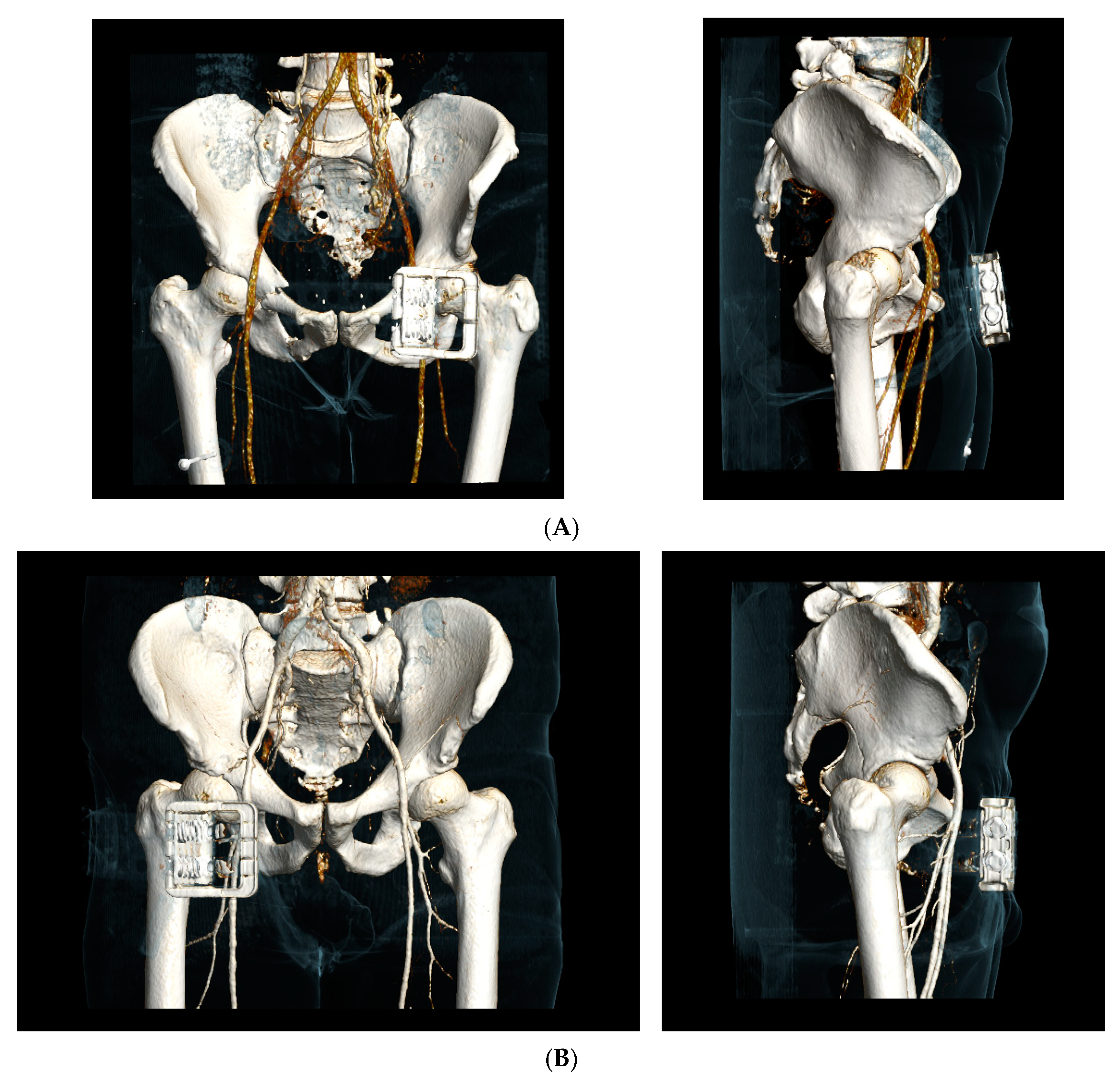
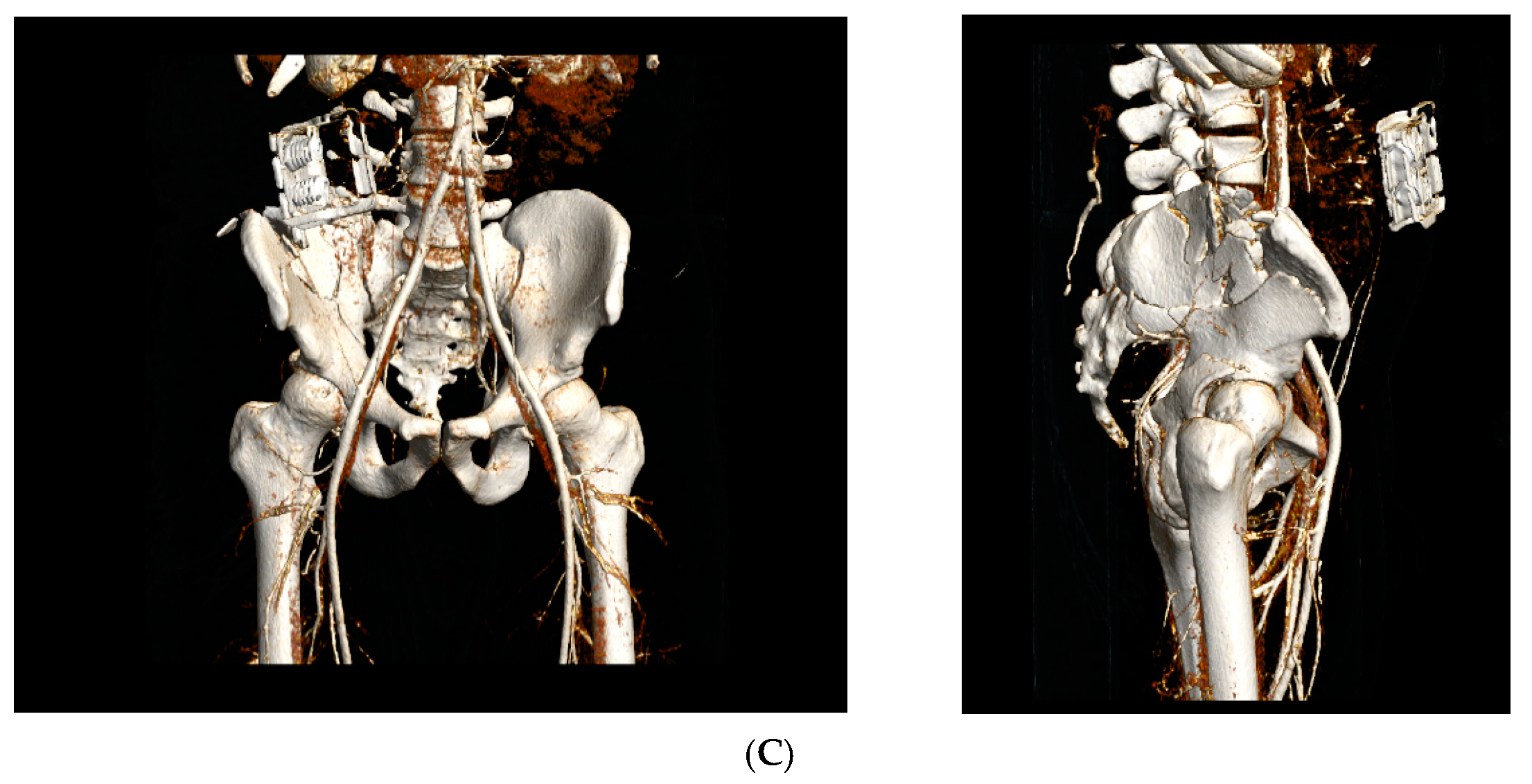
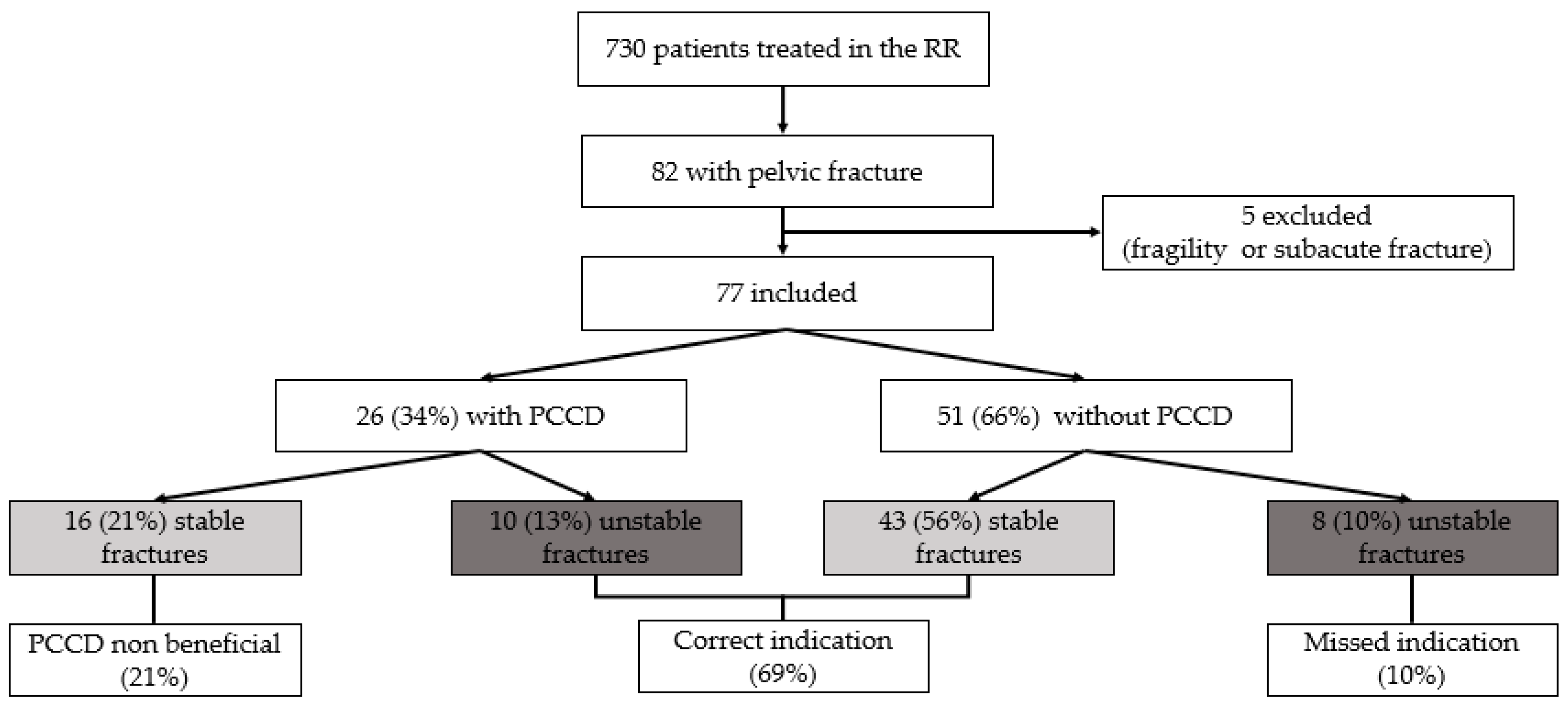

| Demographic Data | N | Mean |
|---|---|---|
| Sex | ||
| Male | 49 (64%) | |
| Female | 28 (36%) | |
| Age | 50 years (range 14–93, SD ± 21.2) | |
| Trauma mechanism | ||
| Blunt | 77 (100%) | |
| Type of accident | ||
| Car | 6 (8%) | |
| Motorcycle | 13 (17%) | |
| Cyclist | 6 (8%) | |
| Pedestrian | 8 (10%) | |
| Fall from height | 36 (47%) | |
| Other (like blow, explosion) | 8 (10%) | |
| NISS | 20 (range 4–66, SD ± 16) | |
| NISS≥/<16 | ||
| ≥16 | 54 (70%) | |
| <16 | 23 (30%) | |
| Intensive medical treatment | ||
| Yes | 40 (52%) | |
| No | 37 (48%) | |
| Survivors | 71 (92%) | |
| Death | 6 (8%) | |
| Length of hospital stay (days) | 11 (0–98 days, SD ± 14) |
| Fracture Type | Total n = 77 | PCCD Placed n = 26 | PCCD Not Placed n = 51 |
|---|---|---|---|
| Pelvic ring fractures according to Tile stable and unstable | 58 (75%) | ||
| A1 | 2 (3%) | 0 | 2 |
| A2 | 16 (21%) | 4 | 12 |
| A3 | 2 (3%) | 1 | 1 |
| B1 | 5 (6%) | 2 1 | 3 2 |
| B2 | 20 (26%) | 5 | 15 |
| B3 | 8 (10%) | 5 1 | 3 2 |
| C1 | 0 (0%) | 0 | 0 |
| C2 | 2 (3%) | 2 1 | 0 |
| C3 | 3 (4%) | 1 1 | 2 2 |
| acetabular fracture | 17 (22%) | 6 | 11 |
| isolated sacral fracture | 2 (3%) | 0 | 2 |
| additional femoral neck fracture | 3 (in 1 bilateral) | 1 | 2 |
| additional Pipkin fracture | 2 | 2 | 0 |
| Position of PCCD | Unstable Factures n = 10 | Stable Fractures n = 16 |
|---|---|---|
| correct | 1 (10%) | 3 (19%) |
| acceptable | 7 (70%) | 5 (31%) |
| incorrect | 2 (20%) | 8 (50%) |
| Position of T-POD (n = 7) | Position of SAM Pelvic Sling (n = 3) | ||
|---|---|---|---|
| correct | 1 (14%) | correct | 0 |
| acceptable | 5 (71%) | acceptable | 2 (67%) |
| incorrect | 1 (14%) | incorrect | 1 (33%) |
| Associated Injury | n = 77 | Fracture Type |
|---|---|---|
| Bladder injury | 3 (4%) | B1 |
| B2 + Denis I + acetabular anterior wall | ||
| acetabular anterior column, posterior hemitransverse | ||
| Neurogenic bladder disorder | 3 (4%) | B2 + sacrum fracture H- type |
| C3 + sacrum fracture H- type + acetabular anterior column 1 | ||
| acetabular anterior column | ||
| Neuroforaminal fracture involvement | 14 (18%) | A3 + transverse sacrum fracture |
| B2 + Denis II | ||
| B2 + Denis II | ||
| B2 + Denis II | ||
| B2 + Denis II | ||
| B2 + Denis II | ||
| B2 + Denis III | ||
| B2 + sacrum fracture H- type | ||
| B3 + transverse sacrum fracture | ||
| B3 + sacrum fracture U- type | ||
| C2 + Denis II | ||
| C3 + sacrum fracture H- type | ||
| Denis II + acetabular anterior colum with hemitransverse | ||
| Denis II + acetabular 2 colum fracture | ||
| Nerve lesion of the lower extremities | 4 (5%) | C3 + sacrum fracture H- type |
| sacrum fracture H- type | ||
| acetabular transverse fracture | ||
| acetabular 2 colum fracture | ||
| Neuroforaminal fracture involvement + posttraumatic peripheral neurologic injury of the lower extremities | 1 (1%) | C3 + sacrum fracture H- type + acetabular anterior column 1 |
| Traumatic vascular injury | 7 (9%) | A3 + transverse sacrum fracture |
| B1 | ||
| B1 | ||
| B2 + Denis II | ||
| B2 + Denis III | ||
| C2 + Denis II | ||
| acetabular transverse fracture | ||
| Pelvic hematoma | 19 (25%) | A2 |
| A2 | ||
| A2 + Denis I | ||
| A3 + transverse sacrum fracture | ||
| B1 + Denis I | ||
| B2 + Denis I | ||
| B2 + Denis I | ||
| B2 + Denis I | ||
| B2 + Denis II | ||
| B2 + sacrum fracture H- type | ||
| B2 + acetabular anterior wall | ||
| B3 | ||
| B3 + Denis I | ||
| B3 + Denis I | ||
| C2 + Denis I | ||
| C3 + sacrum fracture H- type + acetabular anterior colum | ||
| acetabular anterior colum with hemitransverse | ||
| acetabular 2 colum fracture | ||
| left acetabular transverse + posterior wall, right acetabular posterior wall |
| PCCD | No PCCD | ||
| Associated injury | 9 (69 %) | 4 (31%) | 13 |
| No associated injury | 17 (27 %) | 47 (73%) | 64 |
| 26 | 51 | 77 | |
| (a) | |||
| PCCD | No PCCD | ||
| Associated injury | 4 (80%) | 1 (20%) | 5 |
| No associated injury | 6 (46%) | 7 (54%) | 13 |
| 10 | 8 | 18 | |
| (b) | |||
| PCCD | No PCCD | ||
| Associated injury | 5 (62.5%) | 3 (37.5%) | 8 |
| No associated injury | 11 (22%) | 40 (78%) | 51 |
| 16 | 43 | 59 | |
| PCCD Correct or PCCD Acceptable | PCCD Incorrect or No PCCD | ||
|---|---|---|---|
| Associated injury | 6 (43%) | 8 (57%) | 14 |
| No associated injury | 10 (16%) | 53 (84%) | 63 |
| 16 | 61 | 77 |
Publisher’s Note: MDPI stays neutral with regard to jurisdictional claims in published maps and institutional affiliations. |
© 2021 by the authors. Licensee MDPI, Basel, Switzerland. This article is an open access article distributed under the terms and conditions of the Creative Commons Attribution (CC BY) license (http://creativecommons.org/licenses/by/4.0/).
Share and Cite
Kuner, V.; van Veelen, N.; Studer, S.; Van de Wall, B.; Fornaro, J.; Stickel, M.; Knobe, M.; Babst, R.; Beeres, F.J.P.; Link, B.-C. Application of Pelvic Circumferential Compression Devices in Pelvic Ring Fractures—Are Guidelines Followed in Daily Practice? J. Clin. Med. 2021, 10, 1297. https://doi.org/10.3390/jcm10061297
Kuner V, van Veelen N, Studer S, Van de Wall B, Fornaro J, Stickel M, Knobe M, Babst R, Beeres FJP, Link B-C. Application of Pelvic Circumferential Compression Devices in Pelvic Ring Fractures—Are Guidelines Followed in Daily Practice? Journal of Clinical Medicine. 2021; 10(6):1297. https://doi.org/10.3390/jcm10061297
Chicago/Turabian StyleKuner, Valerie, Nicole van Veelen, Stephanie Studer, Bryan Van de Wall, Jürgen Fornaro, Michael Stickel, Matthias Knobe, Reto Babst, Frank J.P. Beeres, and Björn-Christian Link. 2021. "Application of Pelvic Circumferential Compression Devices in Pelvic Ring Fractures—Are Guidelines Followed in Daily Practice?" Journal of Clinical Medicine 10, no. 6: 1297. https://doi.org/10.3390/jcm10061297
APA StyleKuner, V., van Veelen, N., Studer, S., Van de Wall, B., Fornaro, J., Stickel, M., Knobe, M., Babst, R., Beeres, F. J. P., & Link, B.-C. (2021). Application of Pelvic Circumferential Compression Devices in Pelvic Ring Fractures—Are Guidelines Followed in Daily Practice? Journal of Clinical Medicine, 10(6), 1297. https://doi.org/10.3390/jcm10061297

