Review

Osteoporosis Treatment with Anti-Sclerostin Antibodies—Mechanisms of Action and Clinical Application

by
Martina Rauner
1,*,†,
Hanna Taipaleenmäki
2,†,
Elena Tsourdi
1,‡ and
Elizabeth M. Winter
3,‡
1
Divisions of Endocrinology and Molecular Bone Biology, Department of Medicine III, Medical Center, Technische Universität Dresden, 01307 Dresden, Germany
2
Molecular Skeletal Biology Laboratory, Department of Trauma and Orthopedic Surgery, University Medical Center Hamburg-Eppendorf, 20246 Hamburg, Germany
3
Division of Endocrinology, Center for Bone Quality, Department of Medicine, Leiden University Medical Center, 2300 RC Leiden, The Netherlands
*
Author to whom correspondence should be addressed.
Co-first author.
Co-senior author.
J. Clin. Med. 2021, 10(4), 787; https://doi.org/10.3390/jcm10040787
Submission received: 7 January 2021 / Revised: 30 January 2021 / Accepted: 13 February 2021 / Published: 16 February 2021
(This article belongs to the Special Issue Osteoporosis Treatment: Recent Developments and Ongoing Challenges)

Abstract

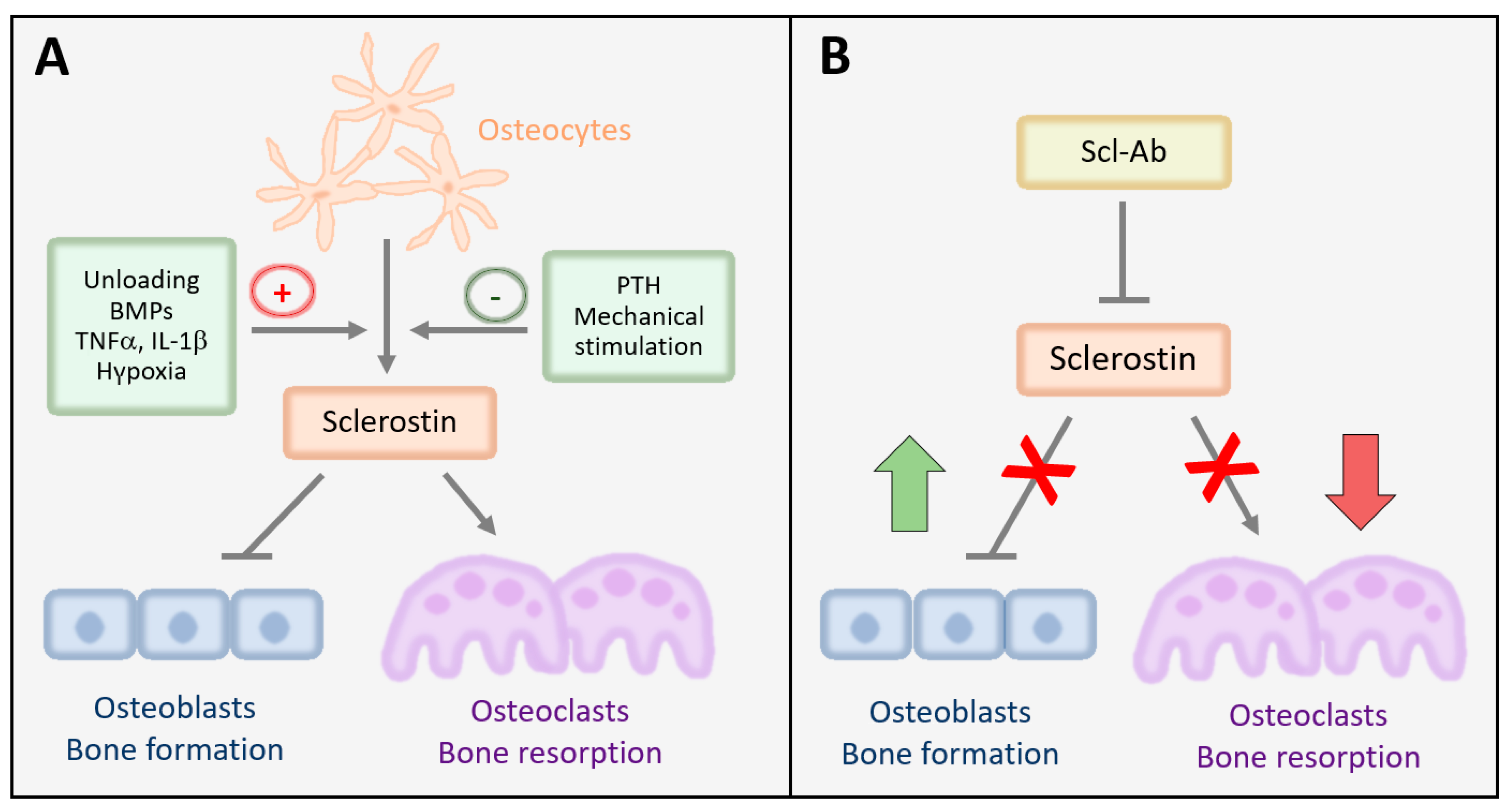
Osteoporosis is characterized by reduced bone mass and disruption of bone architecture, resulting in increased risk of fragility fractures and significant long-term disability. Although both anti-resorptive treatments and osteoanabolic drugs, such as parathyroid hormone analogues, are effective in fracture prevention, limitations exist due to lack of compliance or contraindications to these drugs. Thus, there is a need for novel potent therapies, especially for patients at high fracture risk. Romosozumab is a monoclonal antibody against sclerostin with a dual mode of action. It enhances bone formation and simultaneously suppresses bone resorption, resulting in a large anabolic window. In this opinion-based narrative review, we highlight the role of sclerostin as a critical regulator of bone mass and present human diseases of sclerostin deficiency as well as preclinical models of genetically modified sclerostin expression, which led to the development of anti-sclerostin antibodies. We review clinical studies of romosozumab in terms of bone mass accrual and anti-fracture activity in the setting of postmenopausal and male osteoporosis, present sequential treatment regimens, and discuss its safety profile and possible limitations in its use. Moreover, an outlook comprising future translational applications of anti-sclerostin antibodies in diseases other than osteoporosis is given, highlighting the clinical significance and future scopes of Wnt signaling in these settings.
Keywords: sclerostin; wnt signaling; osteoblast; osteoclast; osteoporosis; romosozumab sclerostin; wnt signaling; osteoblast; osteoclast; osteoporosis; romosozumab