


Auditable Clean-in-Place Decision Support from Routine SWRO SCADA: Selecting Differential-Pressure Recovery and Falsifying a Per-CIP-Reset Trigger

Abstract
1. Introduction
2. Materials and Methods
2.1. Study Site, Dataset and Anonymisation
2.2. Byte-Exact Processing Pipeline and Normalised Membrane Indicators
2.3. Label-Free CIP Ledger and Analysis-Unit Crosswalk
2.4. Estimand Registry
2.5. Layer 1: Label-Free Validation Battery
2.6. Layer 2: Exploratory Operator-Review Candidate and Retrospective Below-Benchmark Firing
2.7. Statistical Analysis
2.8. Layer 3: Identifiability-Gated Bayesian Composite Weighting
2.9. Economic Model
3. Results
3.1. Analysis Units and Estimand Registry
3.2. A Label-Free Battery Identifies DP_norm as Leading Recovery Candidate
3.3. Two Falsification Tests Invalidate Per-CIP-Reset NDP Trigger
3.4. Exploratory, Endogenous, In-Sample Operator-Review Candidate
3.5. Four-Weight Composite Is Non-Identifiable; Only Salt-Weight Marginal Contracts
3.6. Economic Layer: Observed Direction, Magnitude Basis-Sensitive
4. Discussion
4.1. Principal Contribution: Methodological and Cautionary Result
4.2. DP_Norm Is Decision Support, Not an Autonomous Trigger
4.3. Why Per-CIP-Reset NDP Trigger Fails
4.4. Identifiability: Reporting Closed Composite Gate
4.5. Economics: Observed Direction, Magnitude Basis-Sensitive, Cash Not Ageing
4.6. Comparison with Prior Work and Within-Plant Data-Window Flip
4.7. Practical Implications for Operators
4.8. Limitations, Threats to Validity, and Future Work
5. Conclusions
Supplementary Materials
Author Contributions
Funding
Institutional Review Board Statement
Informed Consent Statement
Data Availability Statement
Acknowledgments
Conflicts of Interest
References
- LG Chem (LG Water Solutions). Technical Service Bulletins (All-in-One); Public Ed., V2.4.1 TSB 113 “Membrane Cleaning” (p. 34: Clean When Normalized Permeate Flow −10%, Salt Passage +10%, or Feed–Concentrate ΔP +15% Since Start-Up or Last Cleaning; “One or More”); TSB 111 “Data Logging and Performance Normalization”; LG Chem: Seoul, Republic of Korea, 2025; pp. 28–32. Available online: https://www.lgwatersolutions.com/wp-content/uploads/2025/07/113.-Membrane-Cleaning.pdf (accessed on 28 June 2026).
- Siebdrath, N.; Farhat, N.; Ding, W.; Kruithof, J.; Vrouwenvelder, J.S. Impact of membrane biofouling in the sequential development of performance indicators: Feed channel pressure drop, permeability, and salt rejection. J. Membr. Sci. 2019, 585, 199–207. [Google Scholar] [CrossRef]
- DuPont Water Solutions. FilmTecTM Reverse Osmosis Membranes Technical Manual, Form No. 45-D01504-en, Rev. 19, Cleaning and Data-Normalization Sections; DuPont: Wilmington, DE, USA, 2026; Available online: https://www.dupont.com/content/dam/dupont/amer/us/en/water-solutions/public/documents/en/RO-NF-FilmTec-Manual-45-D01504-en.pdf (accessed on 28 June 2026).
- Hydranautics. Technical Service Bulletin TSB107.29: Foulants and Cleaning Procedures for Composite Polyamide RO/NF Membrane Elements; Hydranautics: Oceanside, CA, USA, 2026; Available online: https://membranes.com/wp-content/uploads/Documents/TSB/TSB107.pdf (accessed on 28 June 2026).
- Shim, J.; Lee, S.; Park, S.; Moon, J.; Lee, C.; Cho, K.H. Optimizing membrane cleaning strategy of industrial reverse osmosis process using long sequence time-series forecasting. Desalination 2025, 614, 119193. [Google Scholar] [CrossRef]
- Jiang, S.; Li, Y.; Ladewig, B.P. A review of reverse osmosis membrane fouling and control strategies. Sci. Total Environ. 2017, 595, 567–583. [Google Scholar] [CrossRef] [PubMed]
- Niu, C.; Li, X.; Dai, R.; Wang, Z. Artificial intelligence-incorporated membrane fouling prediction for membrane-based processes in the past 20 years: A critical review. Water Res. 2022, 216, 118299. [Google Scholar] [CrossRef] [PubMed]
- van Rooij, F.; Scarf, P.; Do, P. Planning the restoration of membranes in RO desalination using a digital twin. Desalination 2021, 519, 115214. [Google Scholar] [CrossRef]
- Kherraf, S.; Abahdou, F.-Z.; Benbouzid, M.; Izouaouen, Z.; Aarfane, A.; Baraket, A.; Nasrellah, H.; Bensemlali, M.; Ziti, S.; Labjar, N.; et al. Prediction of Reverse Osmosis Membrane Fouling Using Machine Learning: MLR, ANN, and SVM at a Seawater Desalination Plant. Eng 2026, 7, 106. [Google Scholar] [CrossRef]
- International Council for Harmonisation (ICH). ICH E9(R1): Addendum on Estimands and Sensitivity Analysis in Clinical Trials to the Guideline on Statistical Principles for Clinical Trials; ICH: Geneva, Switzerland, 2019; Available online: https://www.ich.org/page/efficacy-guidelines (accessed on 28 June 2026).
- ASTM D4516-19a; Standard Practice for Standardizing Reverse Osmosis Performance Data. ASTM International: West Conshohocken, PA, USA, 2019. Available online: https://www.astm.org/d4516-19a.html (accessed on 13 July 2026).
- Gonzalez-Gil, G.; Behzad, A.R.; Farinha, A.S.F.; Zhao, C.; Bucs, S.S.; Nada, T.; Das, R.; Altmann, T.; Buijs, P.J.; Vrouwenvelder, J.S. Clinical Autopsy of a Reverse Osmosis Membrane Module. Front. Chem. Eng. 2021, 3, 683379. [Google Scholar] [CrossRef]
- Benjamini, Y.; Hochberg, Y. Controlling the false discovery rate: A practical and powerful approach to multiple testing. J. R. Stat. Soc. Ser. B Methodol. 1995, 57, 289–300. [Google Scholar] [CrossRef]
- Wilson, E.B. Probable inference, the law of succession, and statistical inference. J. Am. Stat. Assoc. 1927, 22, 209–212. [Google Scholar] [CrossRef]
- Ibrahim, J.G.; Chen, M.-H. Power prior distributions for regression models. Stat. Sci. 2000, 15, 46–60. [Google Scholar] [CrossRef]
- Jafari, M.; Vanoppen, M.; van Agtmaal, J.M.C.; Cornelissen, E.R.; Vrouwenvelder, J.S.; Verliefde, A.; van Loosdrecht, M.C.M.; Picioreanu, C. Cost of fouling in full-scale reverse osmosis and nanofiltration installations in the Netherlands. Desalination 2021, 500, 114865. [Google Scholar] [CrossRef]
- Feo-García, J.; Pulido-Alonso, A.; Florido-Betancor, A.; Florido-Suárez, N.R. Cost Studies of Reverse Osmosis Desalination Plants in the Range of 23,000–33,000 m3/day. Water 2024, 16, 910. [Google Scholar] [CrossRef]
- Abada, B.; Safarik, J.; Ishida, K.P.; Chellam, S. Phenomenological Interpretations of Membrane Properties Following Repeated Chemical Cleaning of an End-of-Life Potable Reuse Reverse Osmosis Element Dominated by Inorganic Fouling. ACS ES&T Eng. 2025, 5, 167–178. [Google Scholar] [CrossRef]
- Meng, F.C.; Chang, P.Y.; Su, Y.H. Optimization of clean-in-place protocols for seawater reverse osmosis: A case study of the Jibei desalination plant. Water Pract. Technol. 2026, 21, 2595–2607. [Google Scholar] [CrossRef]
- Su, Y.H.; Meng, F.C.; Chang, P.Y. Data-informed operational optimization of a small island SWRO plant: Field-validated energy reduction and pretreatment simplification over 22 months. Results Eng. 2026, 31, 111589. [Google Scholar] [CrossRef]
- Garcia-Alvarez, D.; Fuente, M.J. A UPCA-based monitoring and fault detection approach for reverse osmosis desalination plants. Desalin. Water Treat. 2014, 52, 1272–1286. [Google Scholar] [CrossRef]
- Quatrini, E.; Costantino, F.; Mba, D.; Li, X.; Gan, T.-H. Monitoring a Reverse Osmosis Process with Kernel Principal Component Analysis: A Preliminary Approach. Appl. Sci. 2021, 11, 6370. [Google Scholar] [CrossRef]




| Analysis/Object | Unit of Analysis | Count | Role |
|---|---|---|---|
| CIP ledger legs | train-leg (acid/alkaline stage) | 23 | descriptive only; pseudo-replicated (one physical cleaning contributes several overlapping legs, so legs are not independent samples)—never carries power/significance |
| Within-train campaigns | campaign (same-train-legs ≤ 7 d collapsed) | 18 (A: 3, B: 8, C: 7) | campaign definition |
| Complete-window campaigns | campaign with full pre + post windows | 14 | matched event-study recovery (primary inferential unit) |
| Effective-independent events | plant-wide event (+≤3 d cross-train collapse) | ≈11 | conservative effective n for power/FDR |
| Label-free event-pair ledger | event-pair | 17 | head-to-head construction grid; raw-sensor descriptive count |
| Estimand grid | cell (dataset × window × construction × placebo) | 16 | non-circularity/construction-robustness of selection |
| FDR-effective n | — | ≈11–14 | all multiplicity, power, and FDR statements |
| Estimand | Operational Question | Outcome/Window/Comparison/Unit | Selected or Identifiable Channel | Status in This Work |
|---|---|---|---|---|
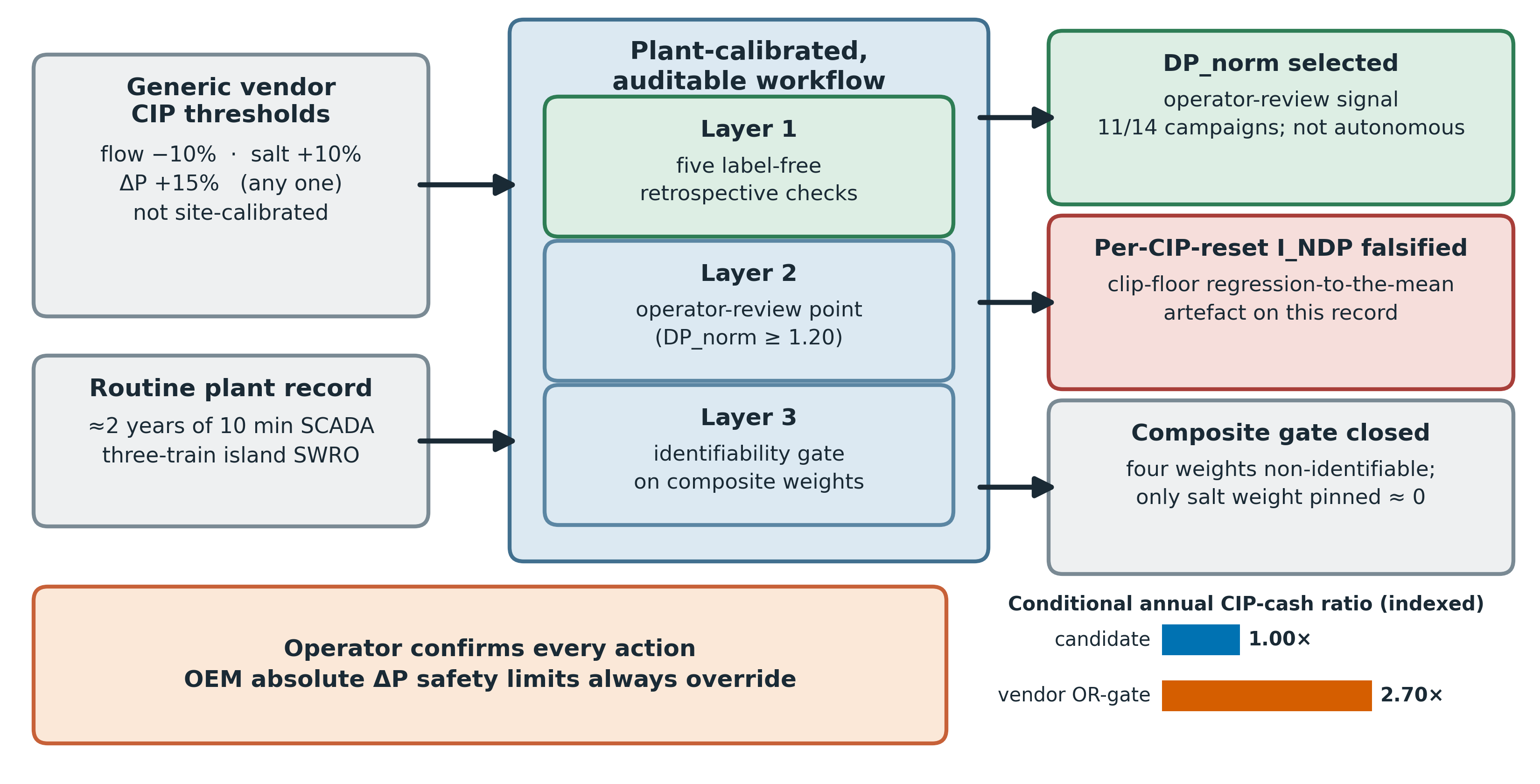
| E1 | CIP cleaning-recovery/operator decision support (does a cleaning recover the channel; when to review) | Post-CIP recovery vs. matched placebo; ±14 d; effective-independent campaign | DP_norm (feed channel hydraulic) | This work: leading operator-review candidate; not autonomous, not FDR-confirmed (11/14 = 79%, exact two-sided sign-test p ≈ 0.057, mid-p BH q ≈ 0.141; ≈11 effective-independent events). Per-CIP-reset NDP (I_NDP) failed the retrospective validity checks; its pattern is consistent with reset/clip effects |
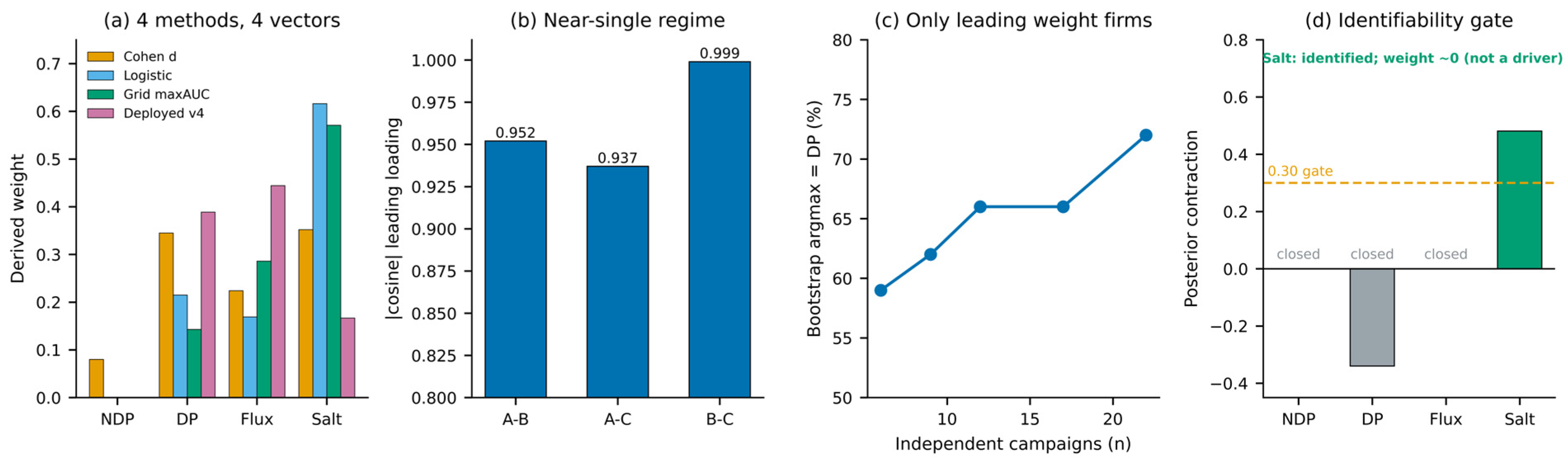
| E2 | Bayesian identifiability of a composite weight (which weight can the data learn) | Posterior contraction (>0.30 gate) under DP-dominant power prior; per-CIP baseline; day-rows | Salt passage weight is the only marginal that contracts, pinned ≈0 (posterior mean 0.043 [0.001, 0.230]; contraction +0.481). Joint four-weight vector non-identifiable | This work: native identifiability-gating result; “identified” = pinned near-zero, not a cleaning driver |
| Retrospective Check (Unit) | DP_norm (Leading Candidate) | I_NDP (Per-CIP-Reset NDP Loss) | Salt Passage/Specific Flux |
|---|---|---|---|
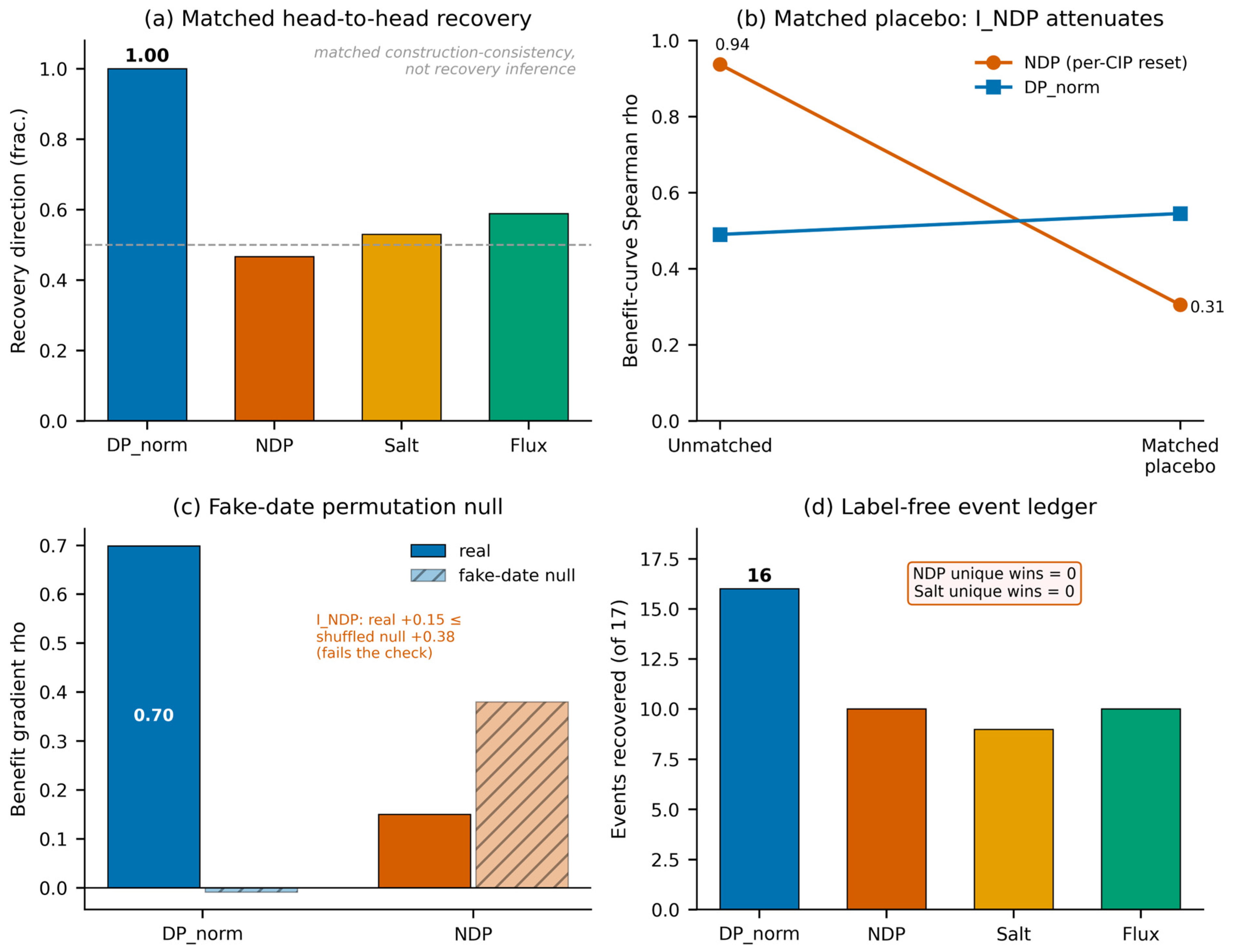
| 1. Matched head-to-head across 16-cell construction grid (recovery direction) | moves toward baseline in 16/16 cells (recover_dir = 1.00; descriptive construction consistency) † | recovery direction only in native per-CIP-reset short-window cells; fails the retrospective validity checks (Tests 2–3) | inconsistent across cells |
| 2. Symmetric matched (level + slope) comparison—benefit-gradient ρ (pre → post matching) | +0.46 → +0.55 (descriptive matched-view correlation) | +0.94 → +0.31 (descriptive; attenuated after matching) | not selected |
| 3. Fake-date comparison—observed gradient vs. shuffled summary | observed +0.699 versus shuffled median ≈ −0.009 (descriptive) | +0.150 versus +0.380 (not distinguished from the fake-date null; descriptive) | not selected |
| 4. Raw-sensor physical cross-check | raw feed ΔP falls, median −0.020 to −0.033 bar; 21/23 legs (91%), 16/17 pairs (94%); descriptive pseudo-replicated counts, no p/q-value | no repeatable movement | no repeatable movement |
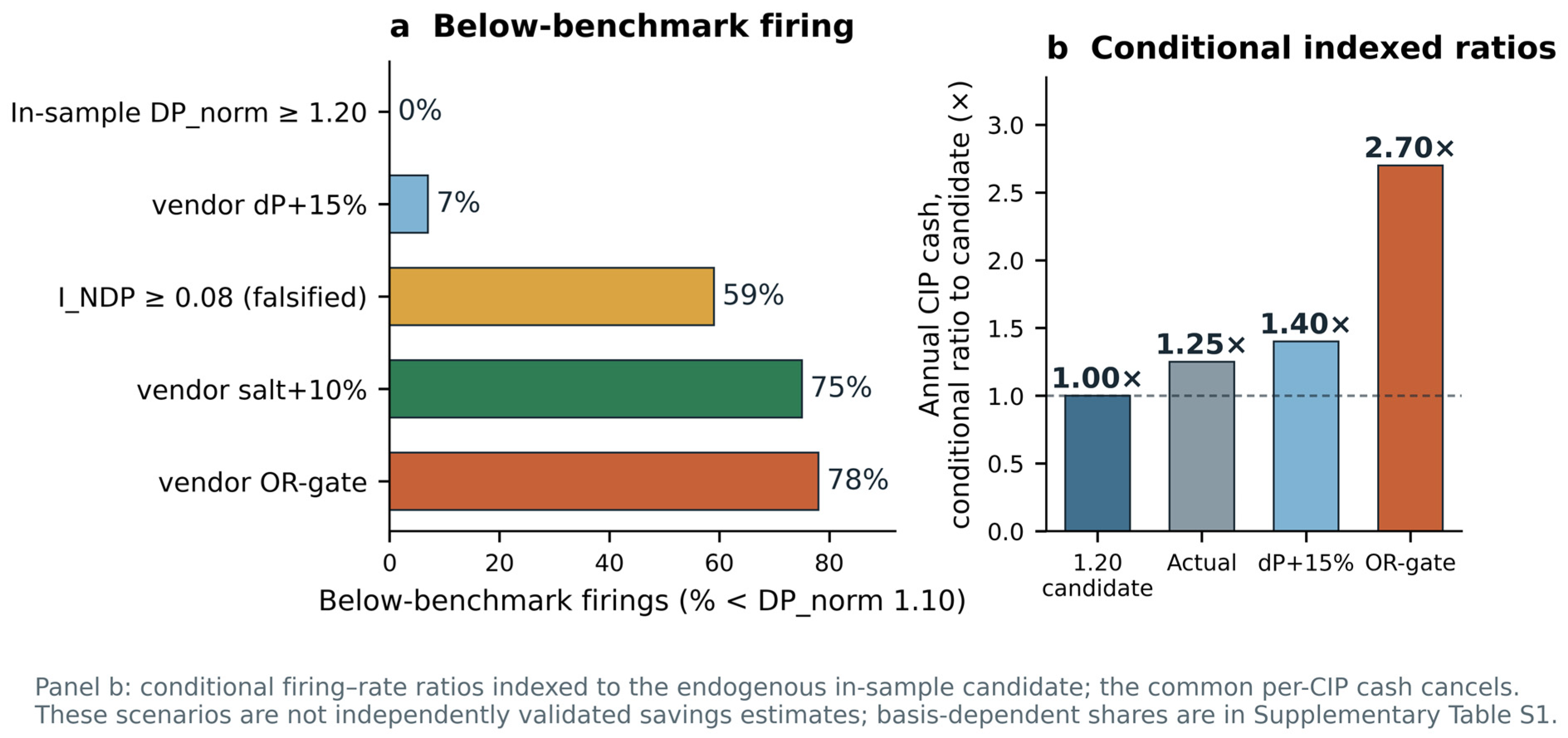
| 5. Retrospective below-benchmark firing (DP_norm < 1.10) | in-sample DP_norm ≥ 1.20 candidate: ≈0% (by construction) | 58.6% (48–55% even floor-free) | salt-only 75%; flow-only 74% |
| Nominal complete-campaign recovery (n = 14; ≈11 effective-independent) | 11/14 (79%); exact two-sided sign-test p ≈ 0.057; mid-p BH q ≈ 0.141 (marginal, not FDR-significant) | 50% | flux 50%; salt 57% |
| Channel | Layer 1: Recovery Direction (16-Cell Grid) | Campaign-Level Recovery (n = 14) | mid-p BH q | Retrospective Validity-Check Result | Layer 2: Below-Benchmark Firing (DP_norm < 1.10) | Layer 3: Identifiability |
|---|---|---|---|---|---|---|
| DP_norm (fixed baseline) | moves toward baseline in 16/16 descriptive construction-grid cells | 11/14 (79%; Wilson [52%, 92%]) | 0.141 (marginal, not FDR-significant) | matching correlation remained similar; observed fake-date gradient exceeded shuffled median (descriptive) | ≈0% at the in-sample DP_norm ≥ 1.20 candidate (by construction) | joint weight not identified (“suggested”; gate closed) |
| NDP (per-CIP-reset I_NDP) | recovery direction only in native per-CIP-reset cells | 50% | ≈0.95 | failed on this record—attenuated after matching; not distinguished from fake-date null | 58.6% (48–55% even floor-free) | rides the prior (gate closed) |
| Specific flux (25 °C) | inconsistent across cells | 50% | ≈0.95 | not selected | vendor flow-only leg: 74% | rides the prior (gate closed) |
| Salt passage (25 °C) | inconsistent across cells | 57% | ≈0.95 | not selected | vendor salt-only leg: 75% | only contracting marginal, pinned ≈0 (0.043 [0.001, 0.230]) |
| Firing Rule | Annualised CIP Rate, Plant-Total (yr−1) | Firings Below Hydraulic Benchmark (DP_norm < 1.10) | Median DP_norm at Firing | Conditional CIP Cash Ratio to In-Sample Candidate (×) |
|---|---|---|---|---|
| In-sample DP_norm ≥ 1.20 candidate (operator-review) | 8.6 | ≈0% (by construction) | ≥1.20 | 1.00× |
| Operator actual (historical log) | 10.8 | ≈8% | — | 1.25× |
| Vendor dP +15% leg (hydraulic) | 12.1 | 7% | 1.156 | 1.40× |
| Vendor full OR-gate (flow −10% OR salt +10% OR dP +15%) | 23.3 | 78% | 0.958 | 2.70× |
| Method Element | Layer | Sharpens with Single-Plant N? | Evidence/Bottleneck |
|---|---|---|---|
| Indicator screening (which channel is the leading recovery candidate) | 1 | Directionally consistent on this record; confirmation remains limited | DP_norm moves toward baseline in 16/16 descriptive construction-grid cells; raw feed ΔP falls in 21/23 descriptive legs |
| Candidate threshold + retrospective descriptors | 2 | Yes—per campaign | endogenous in-sample DP_norm ≥ 1.20 candidate; ≈0% below benchmark; ≈48 d median lead; 30% duty |
| Leading-weight confidence (DP share) | 3 | Yes—leading coordinate only | bootstrap argmax DP rises 59% (n = 6) → 72% (n = 22); leave-one-train-out still flips NDP↔DP |
| FDR confirmation of recovery | 1→2 | Yes—directional now, confirmation later | mid-p BH q = 0.141 (n ≈ 11–14); ≈25+ effective-independent campaigns projected for FDR < 0.05 |
| Full four-weight composite vector | 3 | No—needs multi-plant/multi-regime | cross-train cosine 0.952/0.937/0.999; excitation rank ≈ 1 |
Disclaimer/Publisher’s Note: The statements, opinions and data contained in all publications are solely those of the individual author(s) and contributor(s) and not of MDPI and/or the editor(s). MDPI and/or the editor(s) disclaim responsibility for any injury to people or property resulting from any ideas, methods, instructions or products referred to in the content. |
© 2026 by the authors. Licensee MDPI, Basel, Switzerland. This article is an open access article distributed under the terms and conditions of the Creative Commons Attribution (CC BY) license.
Share and Cite
Su, Y.H.; Meng, F.C.; Chang, P.Y. Auditable Clean-in-Place Decision Support from Routine SWRO SCADA: Selecting Differential-Pressure Recovery and Falsifying a Per-CIP-Reset Trigger. Membranes 2026, 16, 257. https://doi.org/10.3390/membranes16080257
Su YH, Meng FC, Chang PY. Auditable Clean-in-Place Decision Support from Routine SWRO SCADA: Selecting Differential-Pressure Recovery and Falsifying a Per-CIP-Reset Trigger. Membranes. 2026; 16(8):257. https://doi.org/10.3390/membranes16080257
Chicago/Turabian StyleSu, Yi Hsiang, Fan Cheng Meng, and Pieh Yu Chang. 2026. "Auditable Clean-in-Place Decision Support from Routine SWRO SCADA: Selecting Differential-Pressure Recovery and Falsifying a Per-CIP-Reset Trigger" Membranes 16, no. 8: 257. https://doi.org/10.3390/membranes16080257
APA StyleSu, Y. H., Meng, F. C., & Chang, P. Y. (2026). Auditable Clean-in-Place Decision Support from Routine SWRO SCADA: Selecting Differential-Pressure Recovery and Falsifying a Per-CIP-Reset Trigger. Membranes, 16(8), 257. https://doi.org/10.3390/membranes16080257