
Hybrid Response Surface–Particle Swarm Optimisation of Donnan Dialysis Processes for Aluminium Recovery from Water Treatment Sludge




Abstract
1. Introduction
2. Methodology
2.1. Design of Experiment
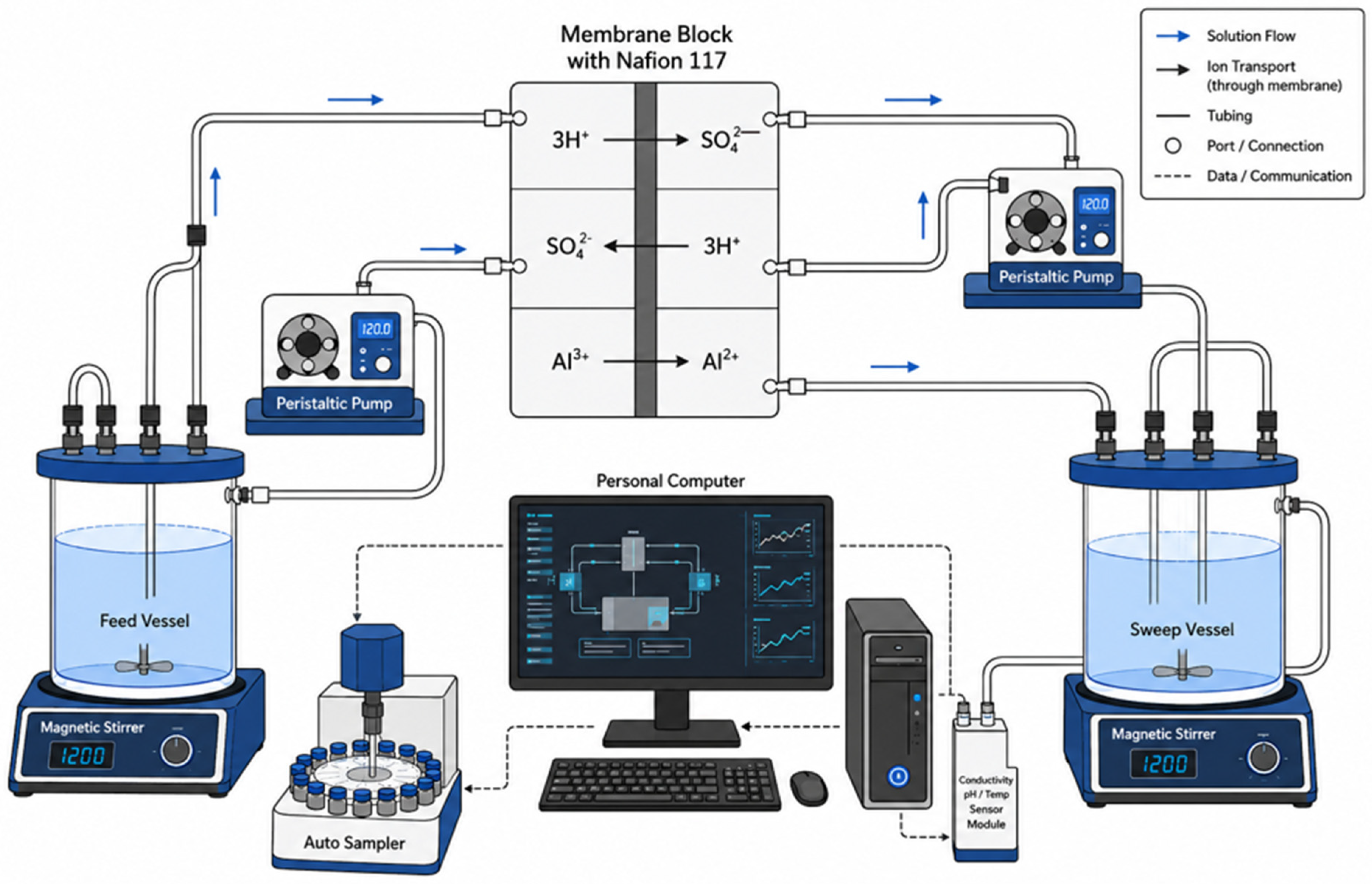
2.2. Donnan Dialysis Al Recovery Setup
2.3. Modelling of DD Al Recovery Process
2.4. Optimisation of DD Coagulant Recovery Process
3. Results and Discussions
3.1. Design of Experiment and Statistical Analysis
- Y% = Percentage Al recovery
- A = pH of feed solution
- B = Flow rate of feed solution,
- C = Feed concentration, ppm
- D = Runtime, h
- E = Sweep concentration, M
3.2. ANOVA of Reduced Cubic DD Al Recovery Model
- Y% = Percentage Al recovery
- A = pH of feed solution
- B = Flow rate of feed solution,
- C = Feed concentration, ppm
- D = Runtime, h
- E = Sweep concentration, M
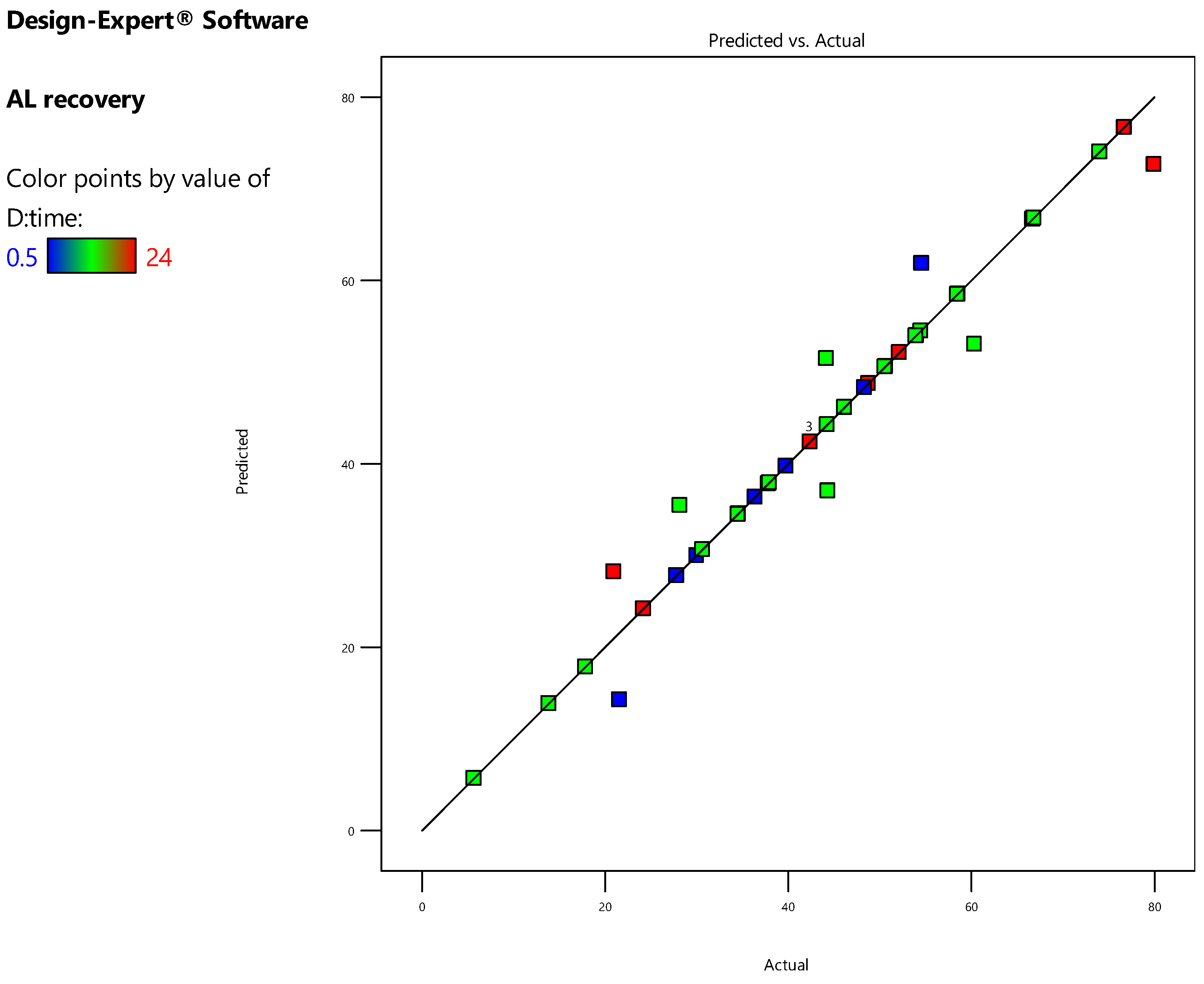
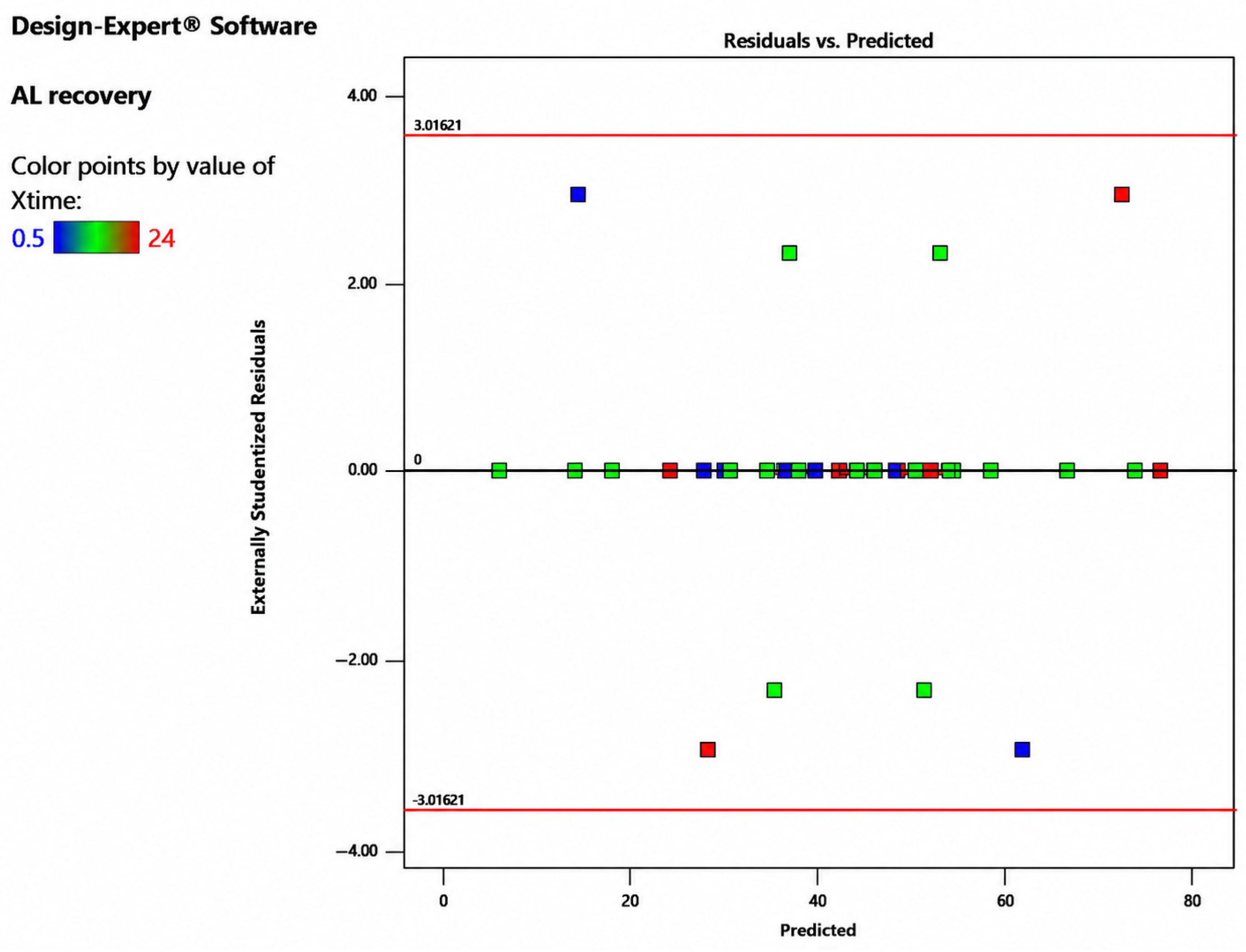
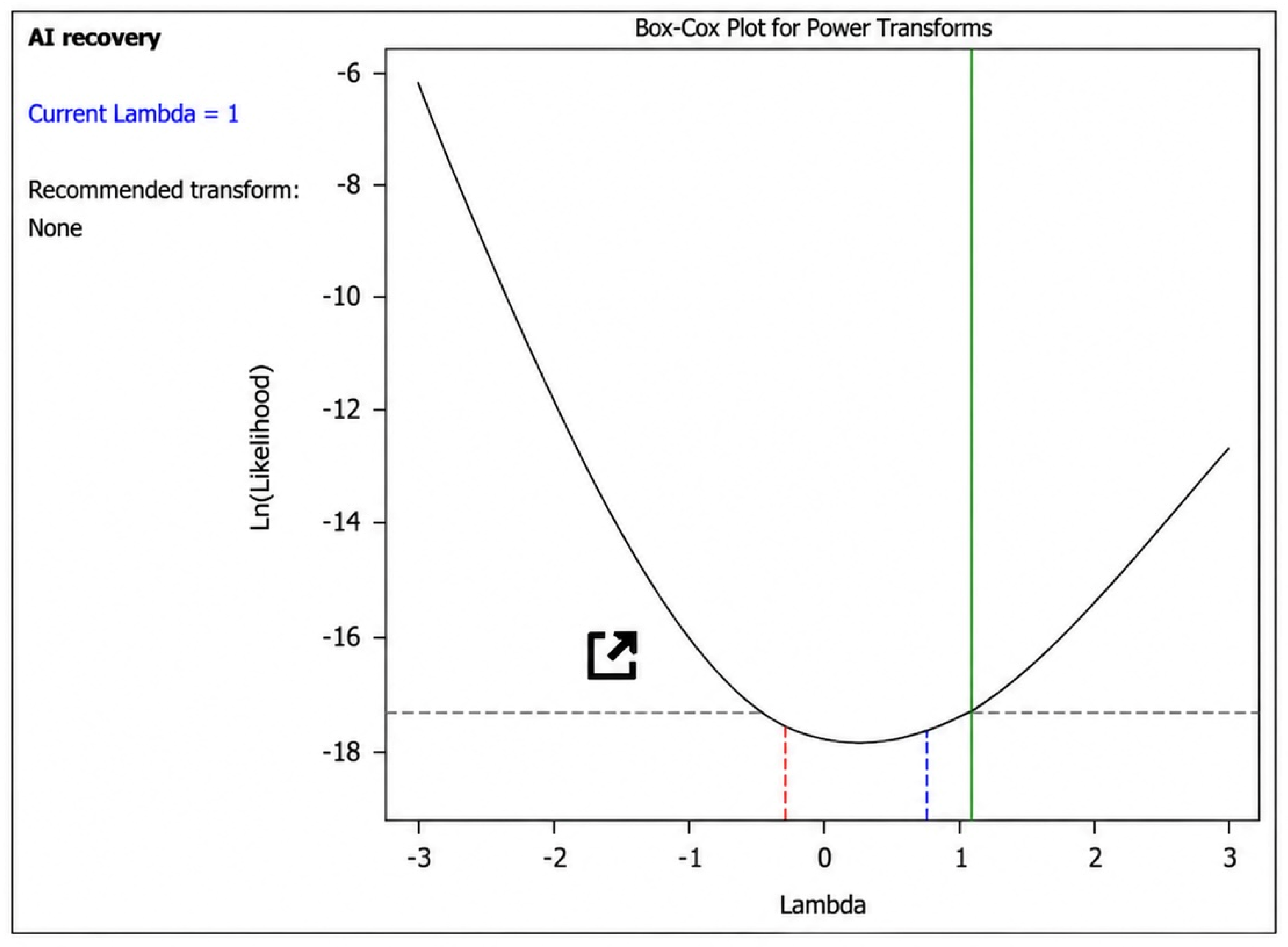
3.3. Model Evaluation Plots of the Reduced Cubic DD Al Recovery Model
3.4. Effects of Process Variables on Al Recovery
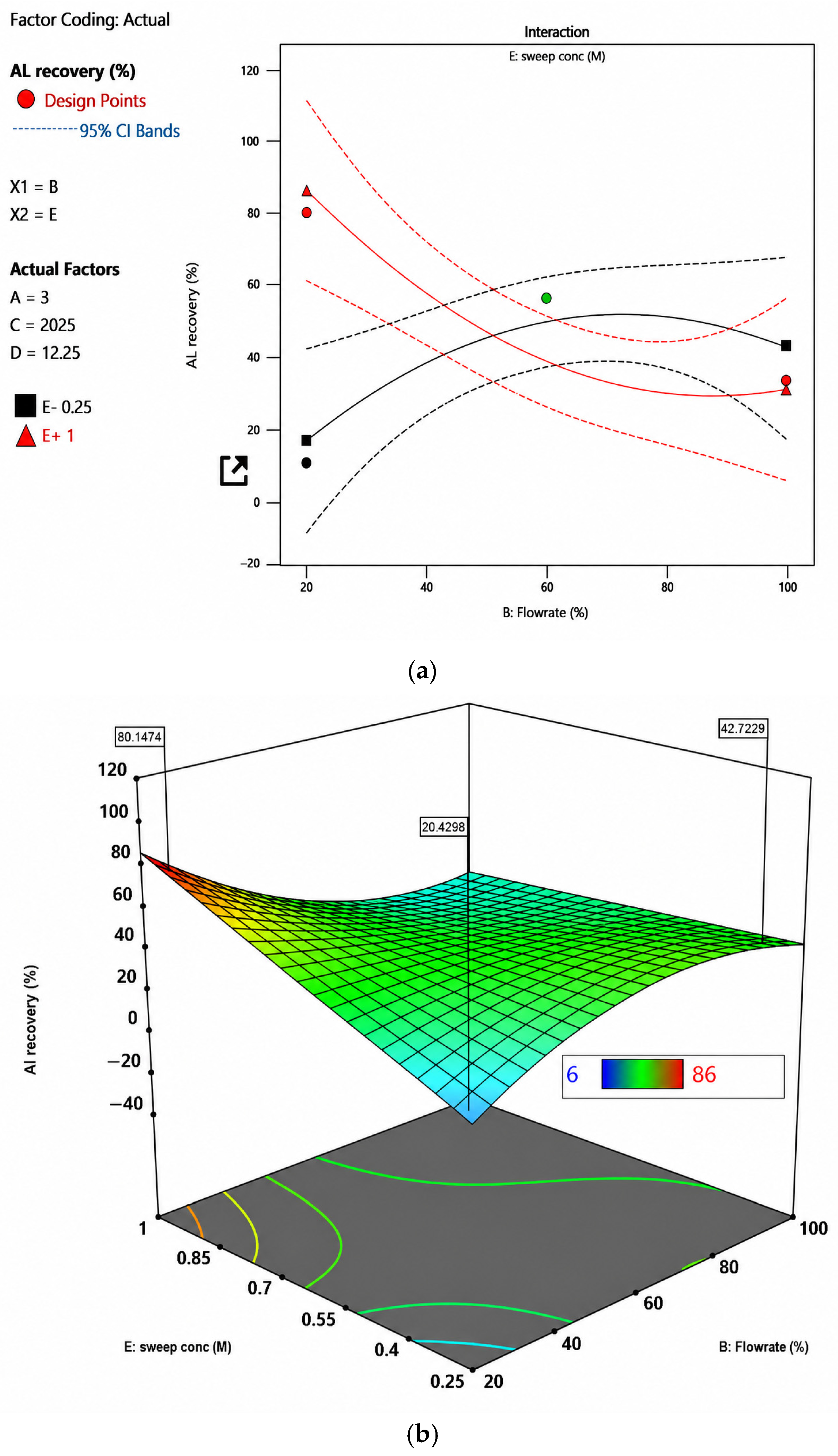
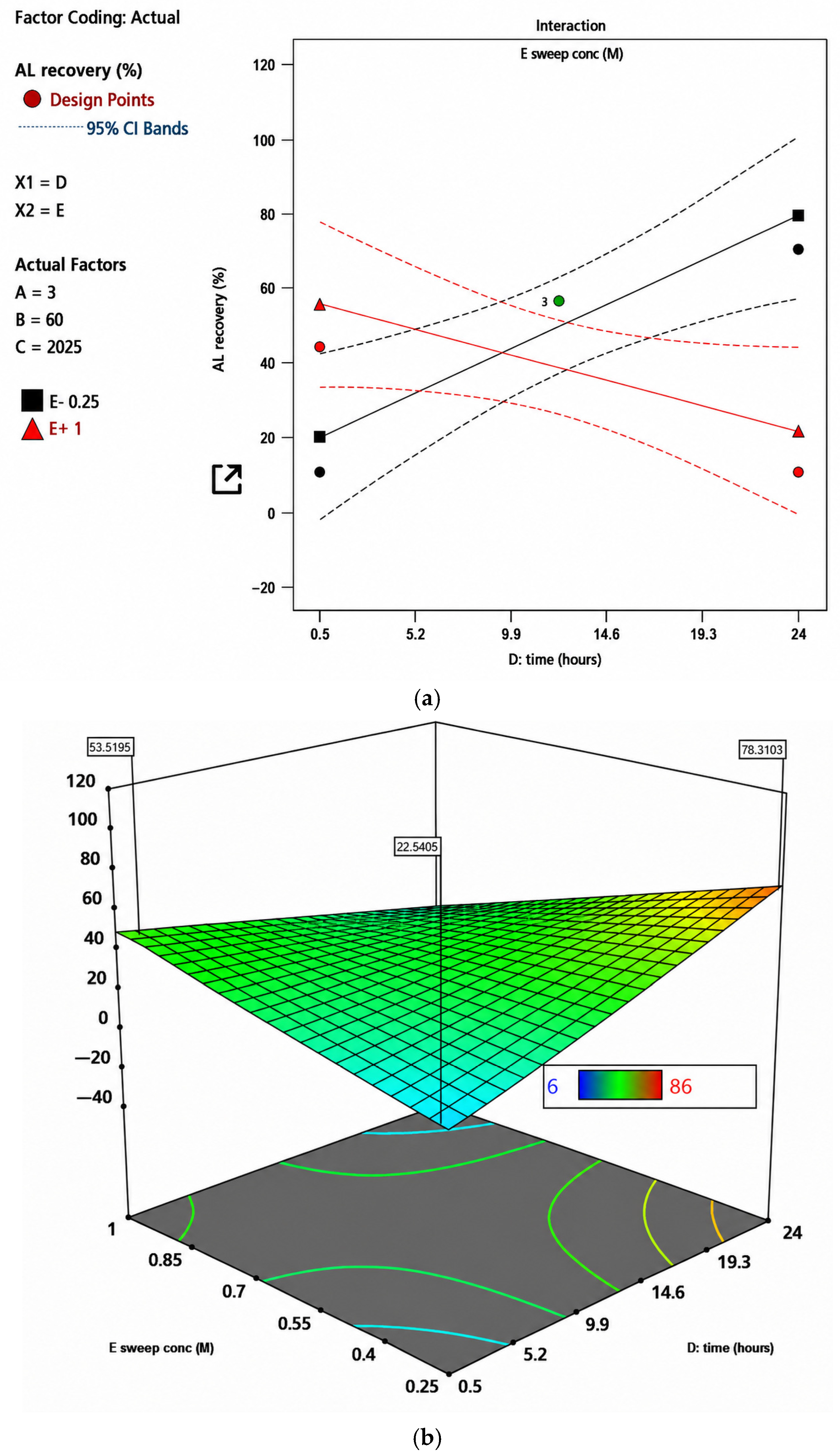
3.5. Factor Interaction Plots for the Reduced Cubic DD Al Recovery Model
3.6. Optimisation of DD Al Recovery
4. Conclusions
Supplementary Materials
Author Contributions
Funding
Data Availability Statement
Conflicts of Interest
References
- Jiang, J.Q. The role of coagulation in water treatment. Curr. Opin. Chem. Eng. 2015, 8, 82–89. [Google Scholar] [CrossRef] [Scilit]
- Davis, T.A. Donnan Dialysis. In Membrane Separations; Academic Press: Annandale, NJ, USA, 2000; pp. 1701–1707. [Google Scholar]
- Prakash, P.; Hoskins, D.; SenGupta, A.K. Application of homogeneous and heterogeneous cation-exchange membranes in coagulant recovery from water treatment plant residuals using Donnan membrane process. J. Membr. Sci. 2004, 237, 131–144. [Google Scholar] [CrossRef]
- Mophethe, M. The Recovery of Aluminium Utilising the Donnan Membrane Process. Ph.D. Dissertation, Stellenbosch University, Stellenbosch, South Africa, 2018. [Google Scholar]
- Ooi, T.Y.; Yong, E.L.; Din, M.F.M.; Rezania, S.; Aminudin, E.; Chelliapan, S.; Rahman, A.A.; Park, J. Optimisation of aluminium recovery from water treatment sludge using Response Surface Methodology. J. Environ. Manag. 2018, 228, 13–19. [Google Scholar] [CrossRef] [Scilit] [PubMed]
- Keeley, J.; Jarvis, P.; Judd, S.J. An economic assessment of coagulant recovery from water treatment residuals. Desalination 2012, 287, 132–137. [Google Scholar] [CrossRef] [Scilit]
- Asante-Sackey, D.; Rathilal, S.; Tetteh, E.K.; Pillay, L. Optimisation of Donnan dialysis for alum recovery using Box Behnken design. CBU Int. Conf. Proc. 2018, 6, 1007–1012. [Google Scholar] [CrossRef] [Scilit]
- Prakash, P.; SenGupta, A.K. Selective coagulant recovery from water treatment plant residuals using Donnan membrane process. Environ. Sci. Technol. 2003, 37, 4468–4474. [Google Scholar] [CrossRef] [Scilit] [PubMed]
- Pillay, V.L.; Mophethe, M.; Asante-Sackey, D. The Development and Evaluation of a Donnan Dialysis Process for the Recovery and Reuse of Aluminium from Potable Water Treatment Residual Streams; Report to the Water Research Commission; Water Research Commission: Pretoria, South Africa, 2018. [Google Scholar]
- Ho, C.C.; Jan, D.S.; Tsai, F.N. Membrane diffusion-controlled kinetics of ionic transport. J. Membr. Sci. 1993, 81, 287–294. [Google Scholar] [CrossRef] [Scilit]
- Turki, T.; Hamdi, R.; Tlili, M.; Ben Amor, M. Donnan dialysis removal of nitrate from water: Effects of process parameters. Am. J. Anal. Chem. 2015, 6, 569–576. [Google Scholar] [CrossRef]
- Boubakri, A. Exploring the potential of Donnan dialysis for sustainable water treatment: A bibliometric analysis on global research trends and future directions. Desalin. Water Treat. 2024, 320, 100700. [Google Scholar] [CrossRef] [Scilit]
- Nair, A.T.; Ahammed, M.M. Coagulant recovery from water treatment plant sludge and reuse in post-treatment of UASB reactor effluent treating municipal wastewater. Environ. Sci. Pollut. Res. 2014, 21, 10407–10418. [Google Scholar] [CrossRef] [Scilit] [PubMed]
- Bezerra, M.A.; Santelli, R.E.; Oliveira, E.P.; Villar, L.S.; Escaleira, L.A. Response surface methodology (RSM) as a tool for optimization in analytical chemistry. Talanta 2008, 76, 965–977. [Google Scholar] [CrossRef] [Scilit] [PubMed]
- Elgharbi, S.; Ounifi, I.; Boubakri, A.; Abdedayem, A. A review of the application of response surface methodology in nanofiltration: Insights into process modelling, parametric analysis, and optimisation. Sep. Sci. Technol. 2025, 60, 1589–1603. [Google Scholar] [CrossRef] [Scilit]
- Susaimanickam, A.; Manickam, P.; Joseph, A.A. A comprehensive review on RSM-coupled optimisation techniques and its applications. Arch. Comput. Methods Eng. 2023, 30, 4831–4853. [Google Scholar] [CrossRef] [Scilit]
- Kudryavtsev, P. Aluminum Hydroxide Based Anion Exchange Materials. Sci. Israzl Technol. Advant. 2020, 22, 44. [Google Scholar]
- Asante-Sackey, D.; Rathilal, S.; Pillay, L.V.; Kweinor Tetteh, E. Ion Exchange Dialysis for Aluminium Transport through a Face-Centred Central Composite Design Approach. Processes 2020, 8, 160. [Google Scholar] [CrossRef] [Scilit]
- Barabadi, H.; Honary, S.; Ebrahimi, P.; Alizadeh, A.; Naghibi, F.; Saravanan, M. Optimization of myco-synthesized silver nanoparticles by response surface methodology employing Box-Behnken design. Inorg. Nano-Met. Chem. 2019, 49, 33–43. [Google Scholar] [CrossRef] [Scilit]
- Owolabi, R.U.; Usman, M.A.; Kehinde, A.J. Modelling and optimization of process variables for the solution polymerization of styrene using response surface methodology. J. King Saud Univ.-Eng. Sci. 2018, 30, 22–30. [Google Scholar] [CrossRef] [Scilit]
- Stenina, I.; Golubenko, D.; Nikonenko, V.; Yaroslavtsev, A. Selectivity of Transport Processes in Ion-Exchange Membranes: Relationship with the Structure and Methods for Its Improvement. Int. J. Mol. Sci. 2020, 21, 5517. [Google Scholar] [CrossRef] [Scilit] [PubMed]
- Asante-Sackey, D.; Rathilal, S.; Pillay, V.L.; Tetteh, E.K. Effect of ion exchange dialysis process variables on aluminium permeation using response surface methodology. Environ. Eng. Res. 2020, 25, 714–721. [Google Scholar]
- Strathmann, H. Ion-Exchange Membrane Separation Processes; Elsevier: Amsterdam, The Netherlands, 2004. [Google Scholar]
- Tanaka, Y. Ion Exchange Membranes: Fundamentals and Applications; Elsevier: Amsterdam, The Netherlands, 2015. [Google Scholar]
- Mohammed, M.A.A. Production of Geopolymer Materials from Solid Wastes of Drinking Water Treatment Plants and Alum Industry. Ph.D. Dissertation, Faculty of Science, Port Said University, Port Fuad, Egypt, 2021. [Google Scholar]
- Asante-Sackey, D.; Rathilal, S.; Kweinor Tetteh, E.; Ezugbe, E.O.; Pillay, L.V. Donnan membrane process or the selective recovery and removal of target metal ions—A mini review. Membranes 2021, 11, 358. [Google Scholar] [CrossRef] [Scilit] [PubMed]
- Koley, S.; Singh, G.D.; Khwairakpam, M.; Kalamdhad, A.S. Sustainable water treatment: Leveraging drinking water treatment sludge for enhanced water quality. Environ. Technol. 2025, 46, 5525–5542. [Google Scholar] [CrossRef] [Scilit] [PubMed]
- Goldberg, S.; Davis, J.A.; Hem, J.D. The surface chemistry of aluminum oxides and hydroxides. In The Environmental Chemistry of Aluminum; CRC Press: Boca Raton, FL, USA, 2020; pp. 271–331. [Google Scholar]
- Kleijnen, J.P. Response surface methodology. In Handbook of Simulation Optimization; Springer: New York, NY, USA, 2014; pp. 81–104. [Google Scholar]
- Myers, R.H.; Montgomery, D.C.; Anderson-Cook, C.M. Response Surface Methodology: Process and Product Optimization Using Designed Experiments; John Wiley & Sons: New York, NY, USA, 2009. [Google Scholar]
- Chi, G.; Hu, S.; Yang, Y.; Chen, T. Response surface methodology with prediction uncertainty: A multi-objective optimisation approach. Chem. Eng. Res. Des. 2012, 90, 1235–1244. [Google Scholar] [CrossRef] [Scilit]
- Derringer, G.; Suich, R. Simultaneous optimisation of several response variables. J. Qual. Technol. 1980, 12, 214–219. [Google Scholar] [CrossRef] [Scilit]
- Kennedy, J.; Eberhart, R. Particle swarm optimisation. In Proceedings of ICNN’95-International Conference on Neural Networks; IEEE: Piscataway, NJ, USA, 1995; Volume 4, pp. 1942–1948. [Google Scholar]
- Poli, R.; Kennedy, J.; Blackwell, T. Particle swarm optimisation: An overview. Swarm Intell. 2007, 1, 33–57. [Google Scholar] [CrossRef] [Scilit]
- Peydayesh, M.; Bagheri, M.; Mohammadi, T.; Bakhtiari, O. Fabrication optimization of polyethersulfone (PES)/polyvinylpyrrolidone (PVP) nanofiltration membranes using Box–Behnken response surface method. RSC Adv. 2017, 7, 24995–25008. [Google Scholar] [CrossRef] [Scilit]




| Process | Input Variables | Coded Levels (X) | |||
|---|---|---|---|---|---|
| DD Aluminium Ions Recovery Process | −1 | 0 | +1 | ||
| X1 | pH of Feed Solution | 1 | 3 | 5 | |
| X2 | Feed Flow Rate (%) | 20 | 60 | 100 | |
| X3 | Feed Concentration (mg/L) | 50 | 2025 | 4000 | |
| X4 | Runtime (h) | 0.5 | 12.25 | 24 | |
| X5 | Sweep Concentration (M) | 0.25 | 0.625 | 1.0 | |
| Parameter | Description | ||||
| Design | Box–Behnken Design (BBD) | ||||
| Number of Factors | 5 | ||||
| Levels | 3 | ||||
| Total Experimental Runs | 43 | ||||
| Factorial Runs | 40 | ||||
| Centre Points Replication | 3 | ||||
| Randomisation | Randomised using BBD | ||||
| Source | Sum of Squares | df | Mean Square | F-Value | p-Value | |
|---|---|---|---|---|---|---|
| Model | 11,955.00 | 15 | 797.00 | 2.20 | 0.0359 | significant |
| A-pH | 1024.00 | 1 | 1024.00 | 3.14 | 0.0863 | |
| B-Flowrate | 45.56 | 1 | 45.56 | 0.1399 | 0.7110 | |
| C-Feed conc. | 1040.06 | 1 | 1040.06 | 3.19 | 0.0840 | |
| D-time | 612.56 | 1 | 612.56 | 1.88 | 0.1804 | |
| E-sweep conc. | 315.06 | 1 | 315.06 | 0.9675 | 0.3332 | |
| AB | 90.25 | 1 | 90.25 | 0.2772 | 0.6024 | |
| AC | 2025.00 | 1 | 2025.00 | 6.22 | 0.0184 | |
| AD | 1332.25 | 1 | 1332.25 | 4.09 | 0.0656 | |
| AE | 81.00 | 1 | 81.00 | 0.2487 | 0.6216 | |
| BC | 121.00 | 1 | 121.00 | 0.3716 | 0.5467 | |
| BD | 64.00 | 1 | 64.00 | 0.1965 | 0.6607 | |
| BE | 1600.00 | 1 | 1600.00 | 4.91 | 0.0344 | |
| CD | 676.00 | 1 | 676.00 | 2.08 | 0.1600 | |
| CE | 812.25 | 1 | 812.25 | 2.49 | 0.1247 | |
| DE | 2116.00 | 1 | 2116.00 | 6.50 | 0.0162 | |
| Residual | 9768.91 | 27 | 361.81 | |||
| Lack of Fit | 9768.08 | 22 | 444.00 | 2344.34 | <0.0001 | significant |
| Pure Error | 0.8333 | 5 | 0.1667 | |||
| Cor Total | 21,723.91 | 42 |
| Std. Dev. | 19.02 | R2 | 0.5503 |
| Mean | 45.04 | Adjusted R2 | 0.2983 |
| C.V.% | 42.23 | Predicted R2 | −0.1705 |
| Adeq. Precision | 6.1192 |
| Source | Sum of Squares | df | Mean Square | F-Value | p-Value | |
|---|---|---|---|---|---|---|
| Model | 11,135.40 | 12 | 927.95 | 65.43 | <0.0001 | significant |
| A: pH | 1024.00 | 1 | 1024.00 | 72.21 | <0.0001 | |
| B: Flow rate | 45.56 | 1 | 45.56 | 3.21 | 0.0832 | |
| C: Feed conc. | 1040.06 | 1 | 1040.06 | 73.34 | <0.0001 | |
| D: Time | 612.32 | 1 | 612.32 | 43.18 | <0.0001 | |
| E: Sweep conc. | 5.02 | 1 | 5.02 | 0.3543 | 0.5562 | |
| AC | 2025.00 | 1 | 2025.00 | 142.79 | <0.0001 | |
| AD | 1332.25 | 1 | 1332.25 | 93.94 | <0.0001 | |
| BE | 1600.00 | 1 | 1600.00 | 112.82 | <0.0001 | |
| CE | 812.25 | 1 | 812.25 | 57.28 | <0.0001 | |
| DE | 2116.00 | 1 | 2116.00 | 149.21 | <0.0001 | |
| B2E | 141.81 | 1 | 141.81 | 10.00 | 0.0036 | |
| C2E | 141.81 | 1 | 141.81 | 10.00 | 0.0036 | |
| Residual | 425.44 | 30 | 14.18 | |||
| Lack of Fit | 425.44 | 28 | 15.19 | |||
| Pure Error | 0.0000 | 2 | 0.0000 | |||
| Cor. Total | 11,560.85 | 42 |
| Std. Dev. | 3.77 | R2 | 0.9632 |
| Mean | 44.26 | Adjusted R2 | 0.9485 |
| C.V.% | 8.51 | Predicted R2 | 0.9072 |
| Adeq. Precision | 34.2888 |
| Name | Goal | Lower Limit | Upper Limit | Lower Weight | Upper Weight | Importance |
|---|---|---|---|---|---|---|
| A: pH | is in range | 1 | 5 | 1 | 1 | 3 |
| B: Flow rate | is in range | 20 | 100 | 1 | 1 | 3 |
| C: Feed conc. | is in range | 50 | 4000 | 1 | 1 | 3 |
| D: Time | is in range | 0.5 | 24 | 1 | 1 | 3 |
| E: Sweep conc. | is in range | 0.25 | 1 | 1 | 1 | 3 |
| AL recovery | maximize | 86 | 90 | 1 | 1 | 3 |
| pH | Feed Flow Rate (%) | Feed Concentration (ppm) | Time (Hours) | Sweep Concentration (M) | Al Recovery (%) | |||||||
|---|---|---|---|---|---|---|---|---|---|---|---|---|
| BBD-RSM | PSO | BBD-RSM | PSO | BBD-RSM | PSO | BBD-RSM | PSO | BBD-RSM | PSO | BBD-RSM | PSO | |
| Optimisation | 4.97 | 4.47 | 23 | 98.6 | 2823.5 | 1313.30 | 8.7 | 21.5 | 0.97 | 0.25 | 96.98 | 99.1 |
| Experimental | 4.97 | 4.47 | 23 | 98.6 | 2823.5 | 1313.30 | 8.7 | 21.5 | 0.97 | 0.25 | 32 | 90.4 |
| Error (%) | 67 | 9.2% | ||||||||||
Disclaimer/Publisher’s Note: The statements, opinions and data contained in all publications are solely those of the individual author(s) and contributor(s) and not of MDPI and/or the editor(s). MDPI and/or the editor(s) disclaim responsibility for any injury to people or property resulting from any ideas, methods, instructions or products referred to in the content. |
© 2026 by the authors. Licensee MDPI, Basel, Switzerland. This article is an open access article distributed under the terms and conditions of the Creative Commons Attribution (CC BY) license.
Share and Cite
Darmey, J.; Rathilal, S.; Tetteh, E.K.; Ahiekpor, J.C. Hybrid Response Surface–Particle Swarm Optimisation of Donnan Dialysis Processes for Aluminium Recovery from Water Treatment Sludge. Membranes 2026, 16, 256. https://doi.org/10.3390/membranes16080256
Darmey J, Rathilal S, Tetteh EK, Ahiekpor JC. Hybrid Response Surface–Particle Swarm Optimisation of Donnan Dialysis Processes for Aluminium Recovery from Water Treatment Sludge. Membranes. 2026; 16(8):256. https://doi.org/10.3390/membranes16080256
Chicago/Turabian StyleDarmey, James, Sudesh Rathilal, Emmanuel Kweinor Tetteh, and Julius Cudjoe Ahiekpor. 2026. "Hybrid Response Surface–Particle Swarm Optimisation of Donnan Dialysis Processes for Aluminium Recovery from Water Treatment Sludge" Membranes 16, no. 8: 256. https://doi.org/10.3390/membranes16080256
APA StyleDarmey, J., Rathilal, S., Tetteh, E. K., & Ahiekpor, J. C. (2026). Hybrid Response Surface–Particle Swarm Optimisation of Donnan Dialysis Processes for Aluminium Recovery from Water Treatment Sludge. Membranes, 16(8), 256. https://doi.org/10.3390/membranes16080256