
GCMembrane-LLM: An Evidence-Grounded Domain-Specific Large Language Model for Structure–Performance Reasoning in Graphene and Carbon Nanotube Separation Membranes

Abstract
1. Introduction
2. Materials and Methods
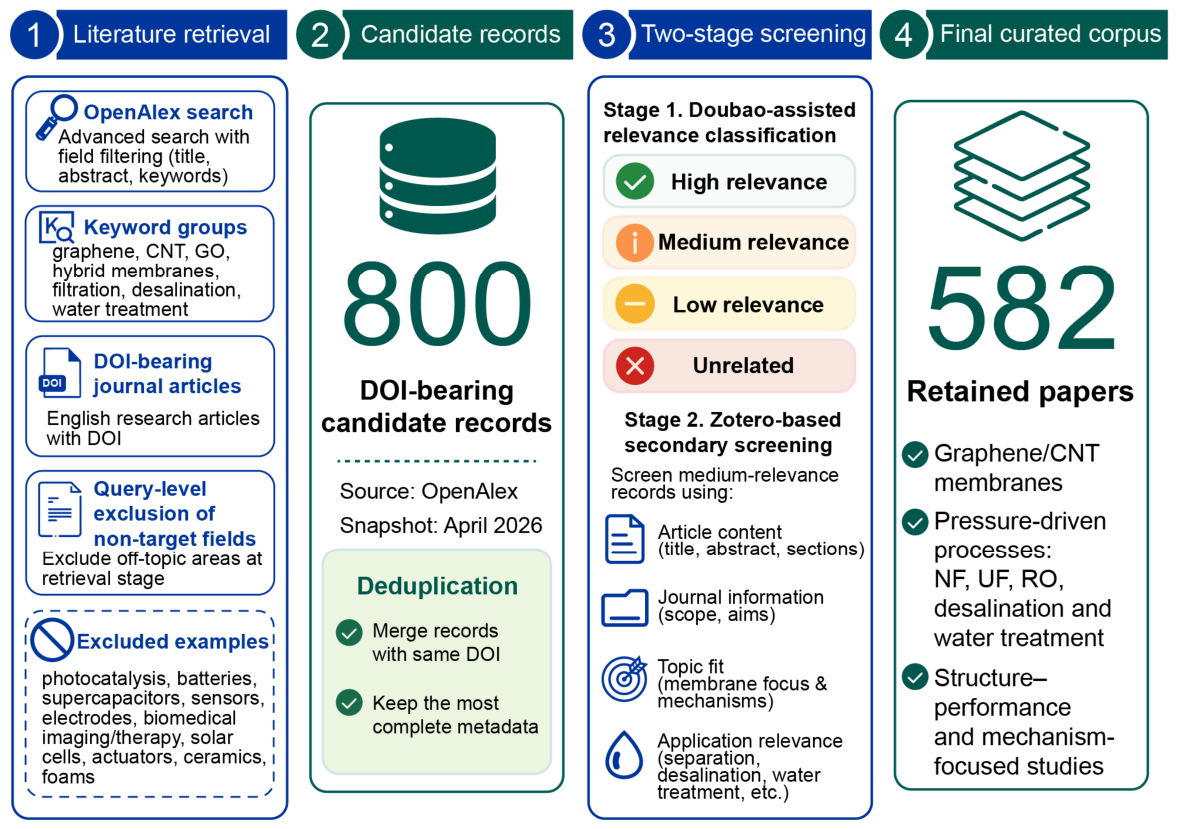
2.1. Literature Corpus Construction
2.2. Full-Text Processing and Metadata Traceability
2.3. Membrane-Specific Question–Answer Generation and Data Cleaning
2.4. Supervised Fine-Tuning of GCMembrane-LLM
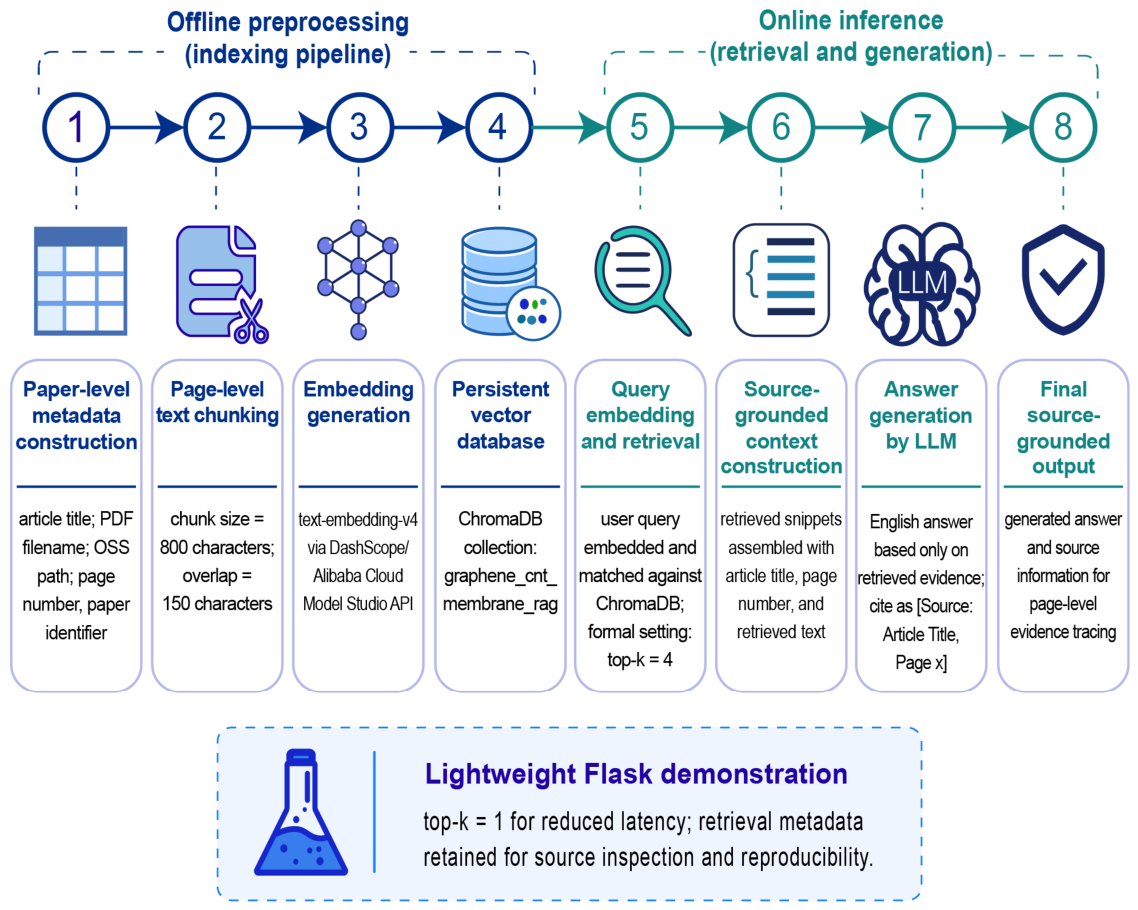
2.5. Retrieval-Augmented Generation
2.6. Benchmark Design, Model Comparison, and Statistical Analysis
3. Results
3.1. Corpus and QA Dataset Outcomes
3.2. Retrieval-Augmented Source Grounding
3.3. Application-Oriented Membrane Structure–Performance Reasoning Case Studies
3.4. Comparative Performance on GCMembraneBench
4. Discussion
4.1. From Literature Retrieval to Membrane Design Reasoning
4.2. Source Grounding, Reproducibility, and Scientific Usability
4.3. Limitations, Evaluation Boundaries, and Future Directions
5. Conclusions
Supplementary Materials
Author Contributions
Funding
Institutional Review Board Statement
Informed Consent Statement
Data Availability Statement
Conflicts of Interest
Abbreviations
| AI | Artificial Intelligence |
| API | Application Programming Interface |
| CI | Confidence Interval |
| CNT | Carbon Nanotube |
| CSV | Comma-Separated Values |
| DOI | Digital Object Identifier |
| DSW | Data Science Workshop |
| FP16 | 16-Bit Floating-Point Precision |
| GO | Graphene Oxide |
| JSON | JavaScript Object Notation |
| JSONL | JavaScript Object Notation Lines |
| LLM | Large Language Model |
| LoRA | Low-Rank Adaptation |
| OSS | Object Storage Service |
| Portable Document Format | |
| QA | Question–Answer |
| RAG | Retrieval-Augmented Generation |
| SFT | Supervised Fine-Tuning |
| TF-IDF | Term Frequency–Inverse Document Frequency |
References
- Shannon, M.A.; Bohn, P.W.; Elimelech, M.; Georgiadis, J.G.; Marinas, B.J.; Mayes, A.M. Science and technology for water purification in the coming decades. Nature 2008, 452, 301–310. [Google Scholar] [CrossRef] [PubMed]
- Elimelech, M.; Phillip, W.A. The future of seawater desalination: Energy, technology, and the environment. Science 2011, 333, 712–717. [Google Scholar] [CrossRef] [PubMed]
- Werber, J.R.; Osuji, C.O.; Elimelech, M. Materials for next-generation desalination and water purification membranes. Nat. Rev. Mater. 2016, 1, 16018. [Google Scholar] [CrossRef]
- Nunes, S.P.; Culfaz-Emecen, P.Z.; Ramon, G.Z.; Visser, T.; Koops, G.H.; Jin, W.; Ulbricht, M. Thinking the future of membranes: Perspectives for advanced and new membrane materials and manufacturing processes. J. Membr. Sci. 2020, 598, 117761. [Google Scholar] [CrossRef]
- Rana, D.; Matsuura, T. Surface modifications for antifouling membranes. Chem. Rev. 2010, 110, 2448–2471. [Google Scholar] [CrossRef] [PubMed]
- Warsinger, D.M.; Chakraborty, S.; Tow, E.W.; Plumlee, M.H.; Bellona, C.; Loutatidou, S.; Karimi, L.; Mikelonis, A.M.; Achilli, A.; Ghassemi, A.; et al. A review of polymeric membranes and processes for potable water reuse. Prog. Polym. Sci. 2018, 81, 209–237. [Google Scholar] [CrossRef] [PubMed]
- Tong, T.; Wallace, A.F.; Zhao, S.; Wang, Z. Mineral scaling in membrane desalination: Mechanisms, mitigation strategies, and feasibility of scaling-resistant membranes. J. Membr. Sci. 2019, 579, 52–69. [Google Scholar] [CrossRef]
- Nair, R.R.; Wu, H.A.; Jayaram, P.N.; Grigorieva, I.V.; Geim, A.K. Unimpeded permeation of water through helium-leak-tight graphene-based membranes. Science 2012, 335, 442–444. [Google Scholar] [CrossRef] [PubMed]
- Joshi, R.K.; Carbone, P.; Wang, F.C.; Kravets, V.G.; Su, Y.; Grigorieva, I.V.; Wu, H.A.; Geim, A.K.; Nair, R.R. Precise and ultrafast molecular sieving through graphene oxide membranes. Science 2014, 343, 752–754. [Google Scholar] [CrossRef] [PubMed]
- Mi, B. Materials science. Graphene oxide membranes for ionic and molecular sieving. Science 2014, 343, 740–742. [Google Scholar] [CrossRef] [PubMed]
- Hu, M.; Mi, B. Enabling Graphene Oxide Nanosheets as Water Separation Membranes. Environ. Sci. Technol. 2013, 47, 3715–3723. [Google Scholar] [CrossRef] [PubMed]
- Koenig, S.P.; Wang, L.; Pellegrino, J.; Bunch, J.S. Selective Molecular Sieving through Porous Graphene. Nat. Nanotechnol. 2012, 7, 728–732. [Google Scholar] [CrossRef] [PubMed]
- Ge, R.; Huo, T.; Gao, Z.; Li, J.; Zhan, X. GO-Based Membranes for Desalination. Membranes 2023, 13, 220. [Google Scholar] [CrossRef] [PubMed]
- Huang, H.; Song, Z.; Wei, N.; Shi, L.; Mao, Y.; Ying, Y.; Sun, L.; Xu, Z.; Peng, X. Ultrafast Viscous Water Flow through Nanostrand-Channelled Graphene Oxide Membranes. Nat. Commun. 2013, 4, 2979. [Google Scholar] [CrossRef] [PubMed]
- Sun, P.; Zhu, M.; Wang, K.; Zhong, M.; Wei, J.; Wu, D.; Xu, Z.; Zhu, H. Selective Ion Penetration of Graphene Oxide Membranes. ACS Nano 2013, 7, 428–437. [Google Scholar] [CrossRef] [PubMed]
- O’Hern, S.C.; Jang, D.; Bose, S.; Idrobo, J.-C.; Song, Y.; Laoui, T.; Kong, J.; Karnik, R. Nanofiltration across Defect-Sealed Nanoporous Monolayer Graphene. Nano Lett. 2015, 15, 3254–3260. [Google Scholar] [CrossRef] [PubMed]
- Abraham, J.; Vasu, K.S.; Williams, C.D.; Gopinadhan, K.; Su, Y.; Cherian, C.T.; Dix, J.; Prestat, E.; Haigh, S.J.; Grigorieva, I.V.; et al. Tunable sieving of ions using graphene oxide membranes. Nat. Nanotechnol. 2017, 12, 546–550. [Google Scholar] [CrossRef] [PubMed]
- Chen, L.; Shi, G.; Shen, J.; Peng, B.; Zhang, B.; Wang, Y.; Bian, F.; Wang, J.; Li, D.; Qian, Z.; et al. Ion sieving in graphene oxide membranes via cationic control of interlayer spacing. Nature 2017, 550, 380–383. [Google Scholar] [CrossRef] [PubMed]
- Zheng, S.; Tu, Q.; Urban, J.J.; Li, S.; Mi, B. Swelling of Graphene Oxide Membranes in Aqueous Solution: Characterization of Interlayer Spacing and Insight into Water Transport Mechanisms. ACS Nano 2017, 11, 6440–6450. [Google Scholar] [CrossRef] [PubMed]
- Thebo, K.H.; Qian, X.; Zhang, Q.; Chen, L.; Cheng, H.-M.; Ren, W. Highly stable graphene-oxide-based membranes with superior permeability. Nat. Commun. 2018, 9, 1486. [Google Scholar] [CrossRef] [PubMed]
- Liu, G.; Jin, W.; Xu, N. Graphene-based membranes. Chem. Soc. Rev. 2015, 44, 5016–5030. [Google Scholar] [CrossRef] [PubMed]
- Yang, T.; Lin, H.; Loh, K.P.; Jia, B. Fundamental Transport Mechanisms and Advancements of Graphene Oxide Membranes for Molecular Separation. Chem. Mater. 2019, 31, 1829–1846. [Google Scholar] [CrossRef]
- Surwade, S.P.; Smirnov, S.N.; Vlassiouk, I.V.; Unocic, R.R.; Veith, G.M.; Dai, S.; Mahurin, S.M. Water desalination using nanoporous single-layer graphene. Nat. Nanotechnol. 2015, 10, 459–464. [Google Scholar] [CrossRef] [PubMed]
- Cohen-Tanugi, D.; Grossman, J.C. Water Desalination across Nanoporous Graphene. Nano Lett. 2012, 12, 3602–3608. [Google Scholar] [CrossRef] [PubMed]
- Hummer, G.; Rasaiah, J.C.; Noworyta, J.P. Water conduction through the hydrophobic channel of a carbon nanotube. Nature 2001, 414, 188–190. [Google Scholar] [CrossRef] [PubMed]
- Kalra, A.; Garde, S.; Hummer, G. Osmotic water transport through carbon nanotube membranes. Proc. Natl. Acad. Sci. USA 2003, 100, 10175–10180. [Google Scholar] [CrossRef] [PubMed]
- Majumder, M.; Chopra, N.; Andrews, R.; Hinds, B.J. Nanoscale hydrodynamics: Enhanced flow in carbon nanotubes. Nature 2005, 438, 44. [Google Scholar] [CrossRef]
- Holt, J.K.; Park, H.G.; Wang, Y.; Stadermann, M.; Artyukhin, A.B.; Grigoropoulos, C.P.; Noy, A.; Bakajin, O. Fast mass transport through sub-2-nanometer carbon nanotubes. Science 2006, 312, 1034–1037. [Google Scholar] [CrossRef] [PubMed]
- Fornasiero, F.; Park, H.G.; Holt, J.K.; Stadermann, M.; Grigoropoulos, C.P.; Noy, A.; Bakajin, O. Ion exclusion by sub-2-nm carbon nanotube pores. Proc. Natl. Acad. Sci. USA 2008, 105, 17250–17255. [Google Scholar] [CrossRef] [PubMed]
- Corry, B. Designing carbon nanotube membranes for efficient water desalination. J. Phys. Chem. B 2008, 112, 1427–1434. [Google Scholar] [CrossRef] [PubMed]
- Lee, B.; Baek, Y.; Lee, M.; Jeong, D.H.; Lee, H.H.; Yoon, J.; Kim, Y.H. A carbon nanotube wall membrane for water treatment. Nat. Commun. 2015, 6, 7109. [Google Scholar] [CrossRef] [PubMed]
- Lee, J.H.; Kim, H.S.; Yun, E.T.; Ham, S.Y.; Park, J.H.; Ahn, C.H.; Lee, S.H.; Park, H.D. Vertically Aligned Carbon Nanotube Membranes: Water Purification and Beyond. Membranes 2020, 10, 273. [Google Scholar] [CrossRef] [PubMed]
- Tunuguntla, R.H.; Henley, R.Y.; Yao, Y.-C.; Pham, T.A.; Wanunu, M.; Noy, A. Enhanced Water Permeability and Tunable Ion Selectivity in Subnanometer Carbon Nanotube Porins. Science 2017, 357, 792–796. [Google Scholar] [CrossRef] [PubMed]
- Han, Y.; Jiang, Y.; Gao, C. High-flux graphene oxide nanofiltration membrane intercalated by carbon nanotubes. ACS Appl. Mater. Interfaces 2015, 7, 8147–8155. [Google Scholar] [CrossRef] [PubMed]
- Zeng, W.-J.; Li, C.; Feng, Y.; Zeng, S.-H.; Fu, B.-X.; Zhang, X.-L. Carboxylated multi-walled carbon nanotubes (MWCNTs-COOH)-intercalated graphene oxide membranes for highly efficient treatment of organic wastewater. J. Water Process Eng. 2021, 40, 101901. [Google Scholar] [CrossRef]
- Musielak, M.; Gagor, A.; Zawisza, B.; Talik, E.; Sitko, R. Graphene Oxide/Carbon Nanotube Membranes for Highly Efficient Removal of Metal Ions from Water. ACS Appl. Mater. Interfaces 2019, 11, 28582–28590. [Google Scholar] [CrossRef] [PubMed]
- Zhang, M.; Guan, K.; Ji, Y.; Liu, G.; Jin, W.; Xu, N. Controllable Ion Transport by Surface-Charged Graphene Oxide Membrane. Nat. Commun. 2019, 10, 1253. [Google Scholar] [CrossRef] [PubMed]
- Gao, S.J.; Qin, H.; Liu, P.; Jin, J. SWCNT-Intercalated GO Ultrathin Films for Ultrafast Separation of Molecules. J. Mater. Chem. A 2015, 3, 6649–6654. [Google Scholar] [CrossRef]
- Boretti, A.; Al-Zubaidy, S.; Vaclavikova, M.; Al-Abri, M.; Castelletto, S.; Mikhalovsky, S. Outlook for graphene-based desalination membranes. npj Clean Water 2018, 1, 5. [Google Scholar] [CrossRef]
- Ignacz, G.; Bader, L.; Beke, A.K.; Ghunaim, Y.; Shastry, T.; Vovusha, H.; Carbone, M.R.; Ghanem, B.; Szekely, G. Machine learning for the advancement of membrane science and technology: A critical review. J. Membr. Sci. 2025, 713, 123256. [Google Scholar] [CrossRef]
- Butler, K.T.; Davies, D.W.; Cartwright, H.; Isayev, O.; Walsh, A. Machine Learning for Molecular and Materials Science. Nature 2018, 559, 547–555. [Google Scholar] [CrossRef] [PubMed]
- Nazari, S.; Abdelrasoul, A. Advancements and Applications of Artificial Intelligence and Machine Learning in Material Science and Membrane Technology: A Comprehensive Review. Membranes 2025, 15, 353. [Google Scholar] [CrossRef] [PubMed]
- Tshitoyan, V.; Dagdelen, J.; Weston, L.; Dunn, A.; Rong, Z.; Kononova, O.; Persson, K.A.; Ceder, G.; Jain, A. Unsupervised Word Embeddings Capture Latent Knowledge from Materials Science Literature. Nature 2019, 571, 95–98. [Google Scholar] [CrossRef] [PubMed]
- Liang, Y.Y.; Li, M. Unsteady-State Dynamics and AI in Membrane Desalination: Challenges and Emerging Opportunities. Desalination 2025, 618, 119507. [Google Scholar] [CrossRef]
- Gupta, T.; Zaki, M.; Krishnan, N.M.A.; Mausam. MatSciBERT: A materials domain language model for text mining and information extraction. npj Comput. Mater. 2022, 8, 102. [Google Scholar] [CrossRef]
- Yang, D.; Lu, C.; Feng, Y.; Mao, W.; Wang, K.; Sun, L.; Wang, Y.; Hu, B.; Tan, J.; Liu, Z.; et al. GrapheneChat: A Large Language Model for Enhancing Graphene Research. ACS Nano 2026, 20, 9970–9982. [Google Scholar] [CrossRef] [PubMed]
- Grattafiori, A.; Dubey, A.; Jauhri, A.; Pandey, A.; Kadian, A.; Al-Dahle, A.; Letman, A.; Mathur, A.; Schelten, A.; Vaughan, A.; et al. The Llama 3 Herd of Models. arXiv 2024, arXiv:2407.21783. [Google Scholar]
- Hu, E.J.; Shen, Y.; Wallis, P.; Allen-Zhu, Z.; Li, Y.; Wang, S.; Wang, L.; Chen, W. LoRA: Low-Rank Adaptation of Large Language Models. In Proceedings of the International Conference on Learning Representations, Virtual, 25–29 April 2022. [Google Scholar]
- Zheng, Y.; Zhang, R.; Zhang, J.; Ye, Y.; Luo, Z. LlamaFactory: Unified Efficient Fine-Tuning of 100+ Language Models. In Proceedings of the 62nd Annual Meeting of the Association for Computational Linguistics (Volume 3: System Demonstrations), Bangkok, Thailand, 11 16 August 2024; Association for Computational Linguistics: Stroudsburg, PA, USA, 2024; pp. 400–410. [Google Scholar] [CrossRef]
- Lewis, P.; Perez, E.; Piktus, A.; Petroni, F.; Karpukhin, V.; Goyal, N.; Küttler, H.; Lewis, M.; Yih, W.-T.; Rocktäschel, T.; et al. Retrieval-Augmented Generation for Knowledge-Intensive NLP Tasks. Adv. Neural Inf. Process. Syst. 2020, 33, 9459–9474. [Google Scholar]
- Taipalus, T. Vector Database Management Systems: Fundamental Concepts, Use-Cases, and Current Challenges. Cogn. Syst. Res. 2024, 85, 101216. [Google Scholar] [CrossRef]
- Zheng, L.; Chiang, W.-L.; Sheng, Y.; Zhuang, S.; Wu, Z.; Zhuang, Y.; Lin, Z.; Li, Z.; Li, D.; Xing, E.P.; et al. Judging LLM-as-a-Judge with MT-Bench and Chatbot Arena. Adv. Neural Inf. Process. Syst. 2023, 36, 46595–46623. [Google Scholar] [CrossRef]





| Parameter | Setting |
|---|---|
| Base model | Llama-3.1-8B-Instruct |
| Fine-tuning framework | LLaMA-Factory |
| Training stage | Supervised fine-tuning |
| Fine-tuning method | LoRA |
| SFT dataset size | 12,208 records |
| Dataset format | instruction, input, output |
| LoRA rank | r = 8 |
| LoRA scaling factor | α = 16 |
| LoRA dropout | 0.0 |
| LoRA target modules | q_proj, k_proj, v_proj, o_proj, gate_proj, up_proj, down_proj |
| Maximum sequence length | 2048 tokens |
| Number of training epochs | 3 |
| Per-device training batch size | 2 |
| Gradient accumulation steps | 4 |
| Effective batch size | 8 |
| Learning rate | 5 × 10⁻⁵ |
| Learning-rate scheduler | Cosine scheduler |
| Warm-up ratio | 0.1 |
| Precision | FP16 |
| Optimizer | Paged AdamW 8-bit |
| Flash attention | Auto |
| Gradient checkpointing | Enabled |
| Symbol | Evaluation Dimension | Weight |
|---|---|---|
| D | Domain relevance | 0.278 |
| A | Practical usefulness | 0.222 |
| S | Structure–performance reasoning | 0.222 |
| T | Technical accuracy | 0.167 |
| L | Practical limitation awareness | 0.111 |
| Item | Result |
|---|---|
| Final literature corpus | 582 papers |
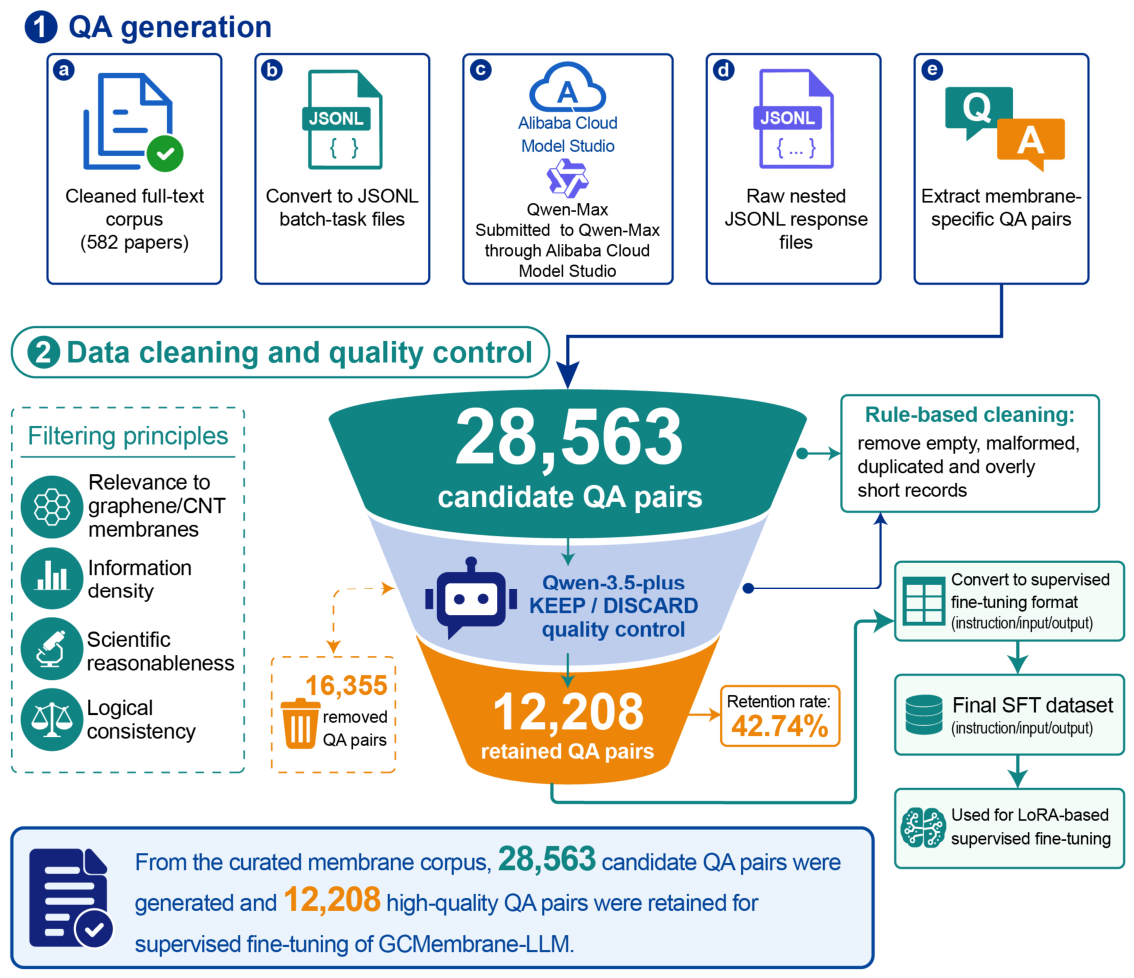
| Candidate QA pairs generated | 28,563 |
| Final cleaned QA pairs retained | 12,208 |
| QA retention rate | 42.7% |
| Case | System and Reasoning Target | Main Finding |
|---|---|---|
| Case 1 | GO/CNT composites; CNT incorporation, transport, selectivity, and stability | CNTs can enlarge GO transport pathways and improve permeance, but CNT loading, dispersion, interfacial compatibility, and defects must be checked. |
| Case 2 | GO laminates; swelling, interlayer spacing, and salt rejection | GO swelling can enlarge interlayer spacing and weaken ion sieving; spacing control and defect suppression are critical for salt rejection. |
| Case 3 | CNT membranes; high flux, pore diameter, and ion exclusion | CNT channels can accelerate water transport, but ion exclusion still depends on pore size, entrance chemistry, hydration barriers, defects, and operating conditions. |
| Model | Score | 95% Confidence Interval (CI) | Δ Score | Δ 95% CI | Fractional Wins |
|---|---|---|---|---|---|
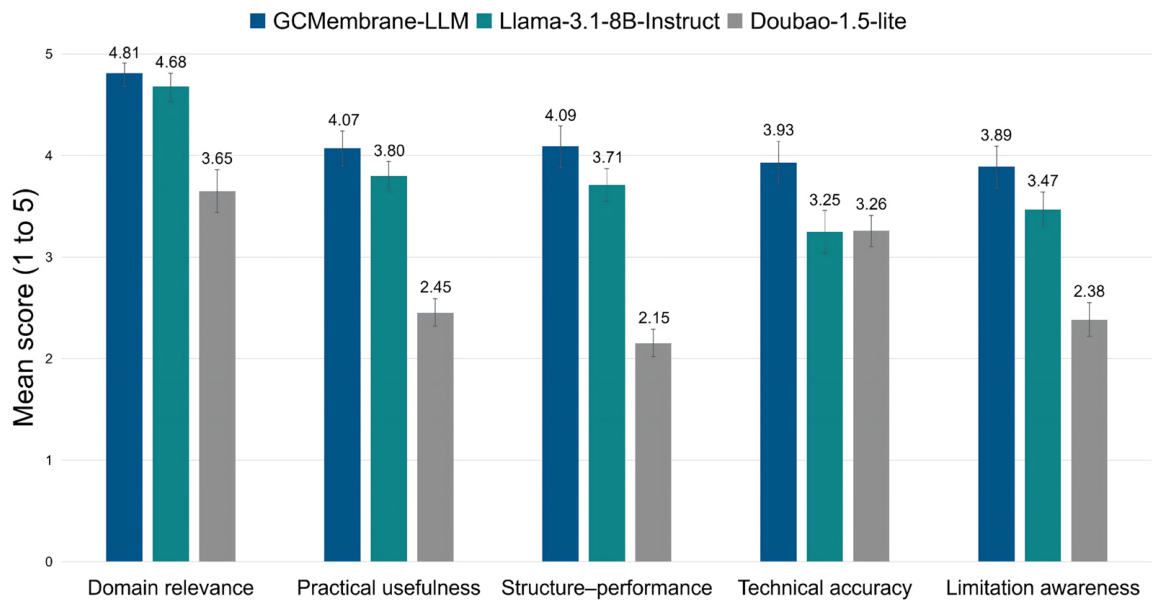
| GCMembrane-LLM | 4.237 | 4.087 to 4.378 | NA | NA | 62.5 |
| Llama-3.1-8B-Instruct | 3.896 | 3.778 to 4.012 | 0.341 | 0.143 to 0.533 | 33.5 |
| Doubao-1.5-lite | 2.845 | 2.723 to 2.968 | 1.392 | 1.177 to 1.596 | 4.0 |
Disclaimer/Publisher’s Note: The statements, opinions and data contained in all publications are solely those of the individual author(s) and contributor(s) and not of MDPI and/or the editor(s). MDPI and/or the editor(s) disclaim responsibility for any injury to people or property resulting from any ideas, methods, instructions or products referred to in the content. |
© 2026 by the authors. Licensee MDPI, Basel, Switzerland. This article is an open access article distributed under the terms and conditions of the Creative Commons Attribution (CC BY) license.
Share and Cite
Liu, Y.; Liu, S.; He, Y.; Yan, Z.; Zhao, Y.; Zhang, X.; Li, Z.; Wei, N. GCMembrane-LLM: An Evidence-Grounded Domain-Specific Large Language Model for Structure–Performance Reasoning in Graphene and Carbon Nanotube Separation Membranes. Membranes 2026, 16, 214. https://doi.org/10.3390/membranes16060214
Liu Y, Liu S, He Y, Yan Z, Zhao Y, Zhang X, Li Z, Wei N. GCMembrane-LLM: An Evidence-Grounded Domain-Specific Large Language Model for Structure–Performance Reasoning in Graphene and Carbon Nanotube Separation Membranes. Membranes. 2026; 16(6):214. https://doi.org/10.3390/membranes16060214
Chicago/Turabian StyleLiu, Youyang, Shuhan Liu, Yao He, Ziyi Yan, Yilu Zhao, Xinyu Zhang, Zhen Li, and Ning Wei. 2026. "GCMembrane-LLM: An Evidence-Grounded Domain-Specific Large Language Model for Structure–Performance Reasoning in Graphene and Carbon Nanotube Separation Membranes" Membranes 16, no. 6: 214. https://doi.org/10.3390/membranes16060214
APA StyleLiu, Y., Liu, S., He, Y., Yan, Z., Zhao, Y., Zhang, X., Li, Z., & Wei, N. (2026). GCMembrane-LLM: An Evidence-Grounded Domain-Specific Large Language Model for Structure–Performance Reasoning in Graphene and Carbon Nanotube Separation Membranes. Membranes, 16(6), 214. https://doi.org/10.3390/membranes16060214