
Wastewater Membrane Bioreactors: A Comprehensive Review of Explainable Artificial Intelligence and Digital Twin Applications

Abstract
1. Introduction
2. Methodology
Literature Search and Study Selection
3. Machine Learning for Membrane Fouling Prediction
3.1. Fouling Mechanisms and Modelling Context
3.2. Shallow and Kernel-Based ML Models
3.3. Ensemble Methods and Deep Learning
3.4. Dataset Limitations, Overfitting Risk, and Cross-Site Generalization
4. Explainable Artificial Intelligence in MBR Applications
4.1. The Explainability Imperative in Regulated Water Systems
4.2. SHAP: Dominant XAI Framework in MBR Studies
4.3. LIME, Partial Dependence Plots, and Gradient-Based Methods
5. ML-Driven Energy Optimization in MBR Systems
5.1. Energy Consumption Structure and Optimization Targets
5.2. Confirmed Energy Reduction Evidence and Research Gap
6. Digital Twin Frameworks for MBR Systems
6.1. Architecture, Components, and Maturity Tiers
6.2. XAI Integration in Digital Twin Decision Architecture
7. Research Gaps and Future Directions
8. Conclusions
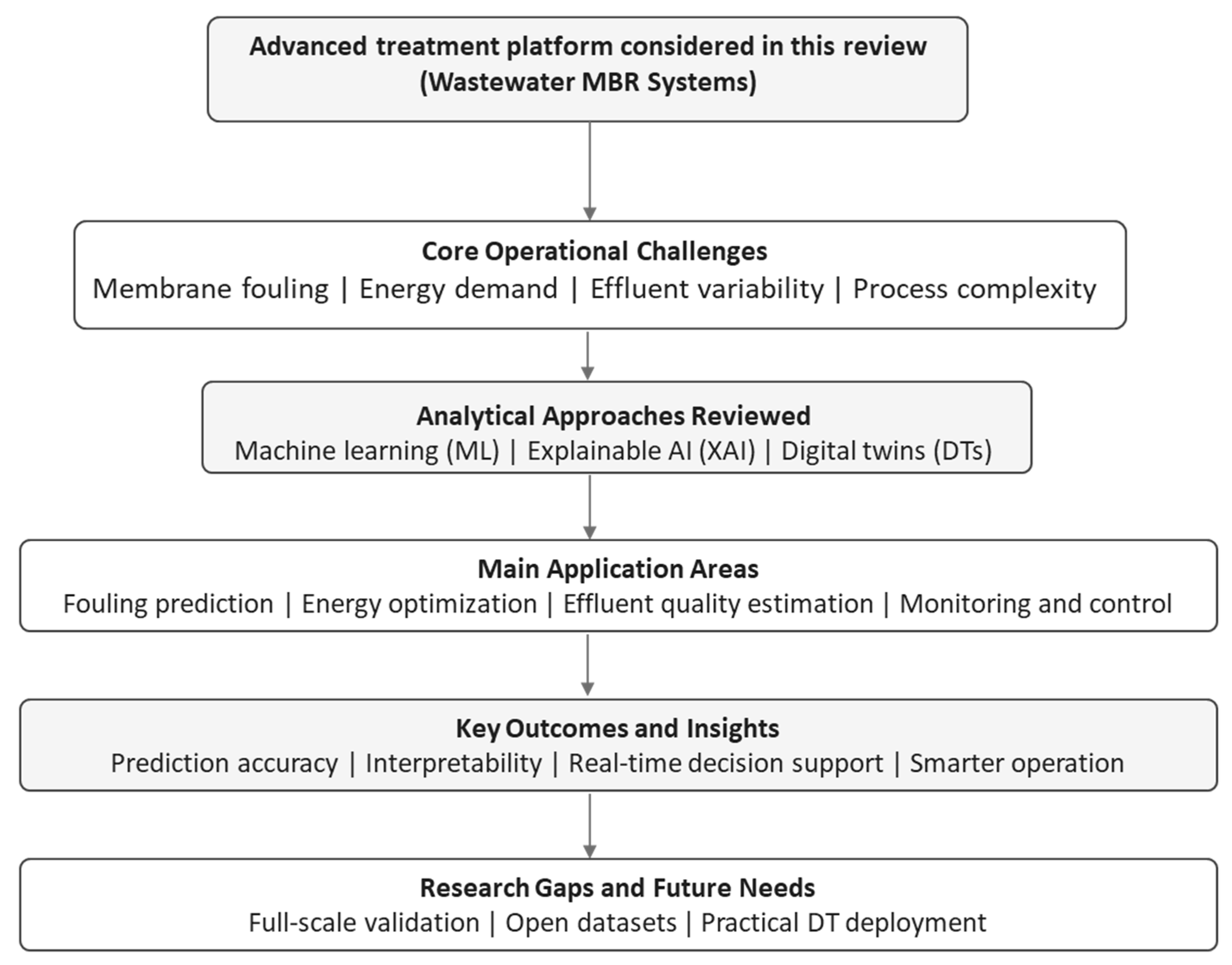
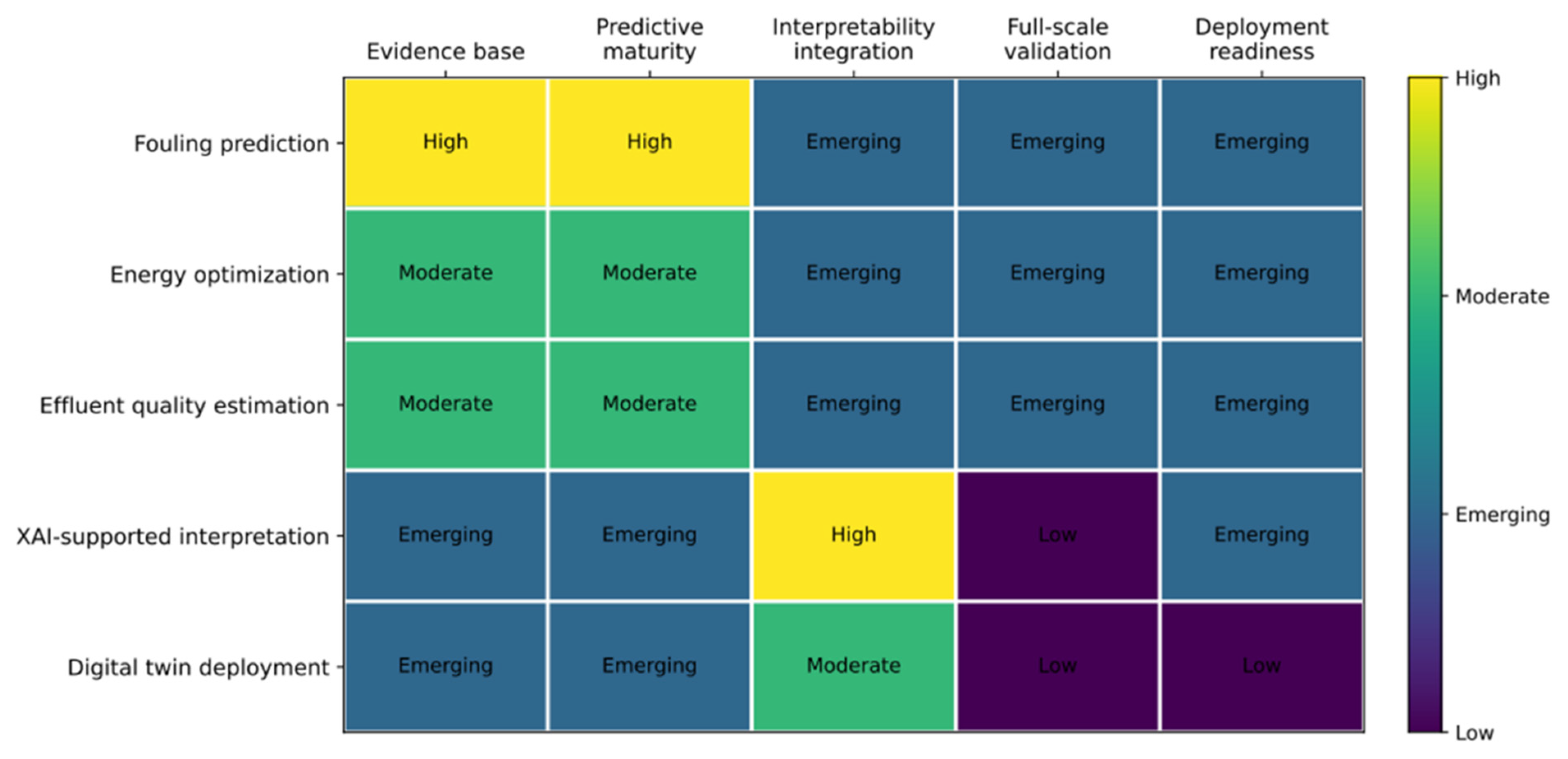
- ML models for MBR fouling and TMP prediction have matured substantially over the review period. Ensemble methods (particularly RF) and kernel-based approaches (LSSVM) achieve R2 = 0.85–0.99 across laboratory, pilot, and full-scale systems, consistently outperforming standard ANN architectures. Full-scale RF validation on 80,000+ operational samples (R2 = 0.927–0.996, RMSE = 0.264–0.904 kPa) represents a strong historical validation result. It is important to clarify, however, that historical validation on archived SCADA data is not equivalent to operational deployment validation. Closed-loop performance under live conditions, including sensor drift, noise, and data latency, has not yet been demonstrated. Site-specific validation and governance safeguards remain prerequisites before deployment in operational MBR monitoring systems.
- SHAP-based analyses in MBR studies frequently identify MLSS, SRT, HRT, and aeration intensity as dominant predictors. These findings simultaneously validate mechanistic understanding and provide operator-actionable evidence of the variables most critical for fouling control [17,25,42]. SHAP’s dominance across XAI-inclusive publications reflects both its theoretical grounding in cooperative game theory and its practical usability for engineering interpretation.
- Model-based and feedback-control approaches have confirmed up to 20% reductions in aeration energy demand at full-scale MBR installations [59], establishing a validated benchmark for model-informed control. Dedicated ML-specific energy optimization demonstrations remain limited and represent the most immediately impactful research gap for operational energy efficiency.
- Digital twin frameworks integrating mechanistic ASM sub-models with ML corrections provide the architecture for Tier II predictive and Tier III prescriptive MBR management. The embedding of XAI decision-transparency modules within the DT architecture is a functional requirement, not merely a desirable feature for achieving the operator trust necessary for autonomous prescriptive control. No full-scale MBR Tier III deployment with integrated XAI has yet been documented, which represents the field’s primary frontier.
- Nine critical research gaps require systematic investigation: standardized multi-facility benchmark datasets; calibrated uncertainty quantification in operational ML predictions; full-scale DT deployment evidence; dynamic integration of influent characterization technology; empirical evaluation of XAI within regulatory acceptance frameworks; transparent reporting of ML model development and retraining costs; workforce capacity building for DT and XAI operations at water utilities; systematic benchmarking of ML-based control against PID and fuzzy logic baselines; and reporting of computational energy footprints for deep learning models deployed in environmental systems.
Supplementary Materials
Funding
Data Availability Statement
Conflicts of Interest
References
- Judd, S. The MBR Book: Principles and Applications of Membrane Bioreactors for Water and Wastewater Treatment; Elsevier: Amsterdam, The Netherlands, 2010. [Google Scholar]
- Kraume, M.; Drews, A. Membrane bioreactors in waste water treatment–status and trends. Chem. Eng. Technol. 2010, 33, 1251–1259. [Google Scholar]
- Xiao, K.; Liang, S.; Wang, X.; Chen, C.; Huang, X. Current state and challenges of full-scale membrane bioreactor applications: A critical review. Bioresour. Technol. 2019, 271, 473–481. [Google Scholar] [CrossRef]
- Le-Clech, P.; Chen, V.; Fane, T.A. Fouling in membrane bioreactors used in wastewater treatment. J. Membr. Sci. 2006, 284, 17–53. [Google Scholar] [CrossRef]
- Judd, S. The status of membrane bioreactor technology. Trends Biotechnol. 2008, 26, 109–116. [Google Scholar] [CrossRef]
- Yang, W.; Cicek, N.; Ilg, J. State-of-the-art of membrane bioreactors: Worldwide research and commercial applications in North America. J. Membr. Sci. 2006, 270, 201–211. [Google Scholar]
- Rahman, T.U.; Roy, H.; Islam, M.R.; Tahmid, M.; Fariha, A.; Mazumder, A.; Tasnim, N.; Pervez, M.N.; Cai, Y.; Naddeo, V. The advancement in membrane bioreactor (MBR) technology toward sustainable industrial wastewater management. Membranes 2023, 13, 181. [Google Scholar] [CrossRef]
- Meng, F.; Chae, S.-R.; Drews, A.; Kraume, M.; Shin, H.-S.; Yang, F. Recent advances in membrane bioreactors (MBRs): Membrane fouling and membrane material. Water Res. 2009, 43, 1489–1512. [Google Scholar] [CrossRef]
- Drews, A. Membrane fouling in membrane bioreactors—Characterisation, contradictions, cause and cures. J. Membr. Sci. 2010, 363, 1–28. [Google Scholar] [CrossRef]
- Wang, Z.; Ma, J.; Tang, C.Y.; Kimura, K.; Wang, Q.; Han, X. Membrane cleaning in membrane bioreactors: A review. J. Membr. Sci. 2014, 468, 276–307. [Google Scholar] [CrossRef]
- Meng, F.; Zhang, S.; Oh, Y.; Zhou, Z.; Shin, H.-S.; Chae, S.-R. Fouling in membrane bioreactors: An updated review. Water Res. 2017, 114, 151–180. [Google Scholar] [CrossRef]
- Liao, B.-Q.; Kraemer, J.T.; Bagley, D.M. Anaerobic membrane bioreactors: Applications and research directions. Crit. Rev. Environ. Sci. Technol. 2006, 36, 489–530. [Google Scholar] [CrossRef]
- Jha, S.; Mishra, B.K. An overview of deploying different treatment processes with membrane bioreactor for enhanced treatment of wastewaters: Synergistic performances and reduced fouling of membrane. Environ. Sci. Pollut. Res. 2024, 31, 63603–63634. [Google Scholar] [CrossRef]
- Verrecht, B.; Maere, T.; Nopens, I.; Brepols, C.; Judd, S. The cost of a large-scale hollow fibre MBR. Water Res. 2010, 44, 5274–5283. [Google Scholar] [CrossRef]
- Krzeminski, P.; Leverette, L.; Malamis, S.; Katsou, E. Membrane bioreactors–a review on recent developments in energy reduction, fouling control, novel configurations, LCA and market prospects. J. Membr. Sci. 2017, 527, 207–227. [Google Scholar] [CrossRef]
- Kamali, M.; Appels, L.; Yu, X.; Aminabhavi, T.M.; Dewil, R. Artificial intelligence as a sustainable tool in wastewater treatment using membrane bioreactors. Chem. Eng. J. 2021, 417, 128070. [Google Scholar] [CrossRef]
- Newhart, K.B.; Holloway, R.W.; Hering, A.S.; Cath, T.Y. Data-driven performance analyses of wastewater treatment plants: A review. Water Res. 2019, 157, 498–513. [Google Scholar] [CrossRef]
- Cortes, C.; Vapnik, V. Support-vector networks. Mach. Learn. 1995, 20, 273–297. [Google Scholar] [CrossRef]
- Chen, T.; He, T.; Benesty, M.; Khotilovich, V.; Tang, Y.; Cho, H.; Chen, K.; Mitchell, R.; Cano, I.; Zhou, T. Xgboost: Extreme Gradient Boosting, R Package Version 0.4-2; R Foundation: Vienna, Austria, 2015.
- Hochreiter, S.; Schmidhuber, J. Long short-term memory. Neural Comput. 1997, 9, 1735–1780. [Google Scholar] [CrossRef]
- Breiman, L. Random forests. Mach. Learn. 2001, 45, 5–32. [Google Scholar] [CrossRef]
- Viet, N.D.; Jang, A. Development of artificial intelligence-based models for the prediction of filtration performance and membrane fouling in an osmotic membrane bioreactor. J. Environ. Chem. Eng. 2021, 9, 105337. [Google Scholar] [CrossRef]
- Mirbagheri, S.A.; Bagheri, M.; Bagheri, Z.; Kamarkhani, A.M. Evaluation and prediction of membrane fouling in a submerged membrane bioreactor with simultaneous upward and downward aeration using artificial neural network-genetic algorithm. Process Saf. Environ. Prot. 2015, 96, 111–124. [Google Scholar] [CrossRef]
- Schmitt, F.; Do, K.-U. Prediction of membrane fouling using artificial neural networks for wastewater treated by membrane bioreactor technologies: Bottlenecks and possibilities. Environ. Sci. Pollut. Res. 2017, 24, 22885–22913. [Google Scholar] [CrossRef]
- Schmitt, F.; Banu, R.; Yeom, I.-T.; Do, K.-U. Development of artificial neural networks to predict membrane fouling in an anoxic-aerobic membrane bioreactor treating domestic wastewater. Biochem. Eng. J. 2018, 133, 47–58. [Google Scholar] [CrossRef]
- Kovacs, D.J.; Li, Z.; Baetz, B.W.; Hong, Y.; Donnaz, S.; Zhao, X.; Zhou, P.; Ding, H.; Dong, Q. Membrane fouling prediction and uncertainty analysis using machine learning: A wastewater treatment plant case study. J. Membr. Sci. 2022, 660, 120817. [Google Scholar] [CrossRef]
- Ribeiro, M.T.; Singh, S.; Guestrin, C. Anchors: High-precision model-agnostic explanations. In Proceedings of the AAAI Conference on Artificial Intelligence, New Orleans, LA, USA, 2–7 February 2018; Volume 32. [Google Scholar]
- Barredo, A.A.; Del Ser, J.; Gil-Lopez, S.; Díaz-Rodríguez, N.; Bennetot, A.; Chatila, R.; Tabik, S.; Garcia, S.; Molina, D.; Herrera, F. Explainable Explainable Artificial Intelligence (XAI): Concepts, taxonomies, opportunities and challenges toward responsible AI. Inf. Fusion 2020, 58, 82–115. [Google Scholar] [CrossRef]
- Adadi, A.; Berrada, M. Peeking inside the black-box: A survey on explainable artificial intelligence (XAI). IEEE Access 2018, 6, 52138–52160. [Google Scholar] [CrossRef]
- Grieves, M. Digital twin: Manufacturing excellence through virtual factory replication. White Pap. 2014, 1, 1–7. [Google Scholar]
- Fuller, A.; Fan, Z.; Day, C.; Barlow, C. Digital twin: Enabling technologies, challenges and open research. IEEE Access 2020, 8, 108952–108971. [Google Scholar] [CrossRef]
- Tao, F.; Zhang, H.; Liu, A.; Nee, A.Y. Digital twin in industry: State-of-the-art. IEEE Trans. Ind. Inform. 2018, 15, 2405–2415. [Google Scholar] [CrossRef]
- Barricelli, B.R.; Casiraghi, E.; Fogli, D. A survey on digital twin: Definitions, characteristics, applications, and design implications. IEEE Access 2019, 7, 167653–167671. [Google Scholar] [CrossRef]
- Henze, M.; Gujer, W.; Mino, T.; Van Loosedrecht, M. Activated Sludge Models ASM1, ASM2, ASM2d and ASM3; IWA Publishing: London, UK, 2006. [Google Scholar]
- Gujer, W.; Henze, M.; Mino, T.; Van Loosdrecht, M. Activated sludge model No. 3. Water Sci. Technol. 1999, 39, 183–193. [Google Scholar] [CrossRef]
- Maere, T.; Verrecht, B.; Moerenhout, S.; Judd, S.; Nopens, I. BSM-MBR: A benchmark simulation model to compare control and operational strategies for membrane bioreactors. Water Res. 2011, 45, 2181–2190. [Google Scholar] [CrossRef]
- Wang, A.-J.; Li, H.; He, Z.; Tao, Y.; Wang, H.; Yang, M.; Savic, D.; Daigger, G.T.; Ren, N. Digital twins for wastewater treatment: A technical review. Engineering 2024, 36, 21–35. [Google Scholar] [CrossRef]
- Shi, Y.; Wang, Z.; Du, X.; Gong, B.; Jegatheesan, V.; Haq, I.U. Recent advances in the prediction of fouling in membrane bioreactors. Membranes 2021, 11, 381. [Google Scholar] [CrossRef]
- Ni, B.-J.; Rittmann, B.E.; Yu, H.-Q. Soluble microbial products and their implications in mixed culture biotechnology. Trends Biotechnol. 2011, 29, 454–463. [Google Scholar] [CrossRef]
- Fenu, A.; Guglielmi, G.; Jimenez, J.; Spèrandio, M.; Saroj, D.; Lesjean, B.; Brepols, C.; Thoeye, C.; Nopens, I. Activated sludge model (ASM) based modelling of membrane bioreactor (MBR) processes: A critical review with special regard to MBR specificities. Water Res. 2010, 44, 4272–4294. [Google Scholar] [CrossRef]
- Achilli, A.; Cath, T.Y.; Marchand, E.A.; Childress, A.E. The forward osmosis membrane bioreactor: A low fouling alternative to MBR processes. Desalination 2009, 239, 10–21. [Google Scholar] [CrossRef]
- Hamedi, H.; Ehteshami, M.; Mirbagheri, S.A.; Zendehboudi, S. New deterministic tools to systematically investigate fouling occurrence in membrane bioreactors. Chem. Eng. Res. Des. 2019, 144, 334–353. [Google Scholar] [CrossRef]
- Giwa, A.; Daer, S.; Ahmed, I.; Marpu, P.; Hasan, S. Experimental investigation and artificial neural networks ANNs modeling of electrically-enhanced membrane bioreactor for wastewater treatment. J. Water Process Eng. 2016, 11, 88–97. [Google Scholar]
- Nguyen, T.N.; Do, K.U.; Tran, T.P.N.; Van Nguyen, T.; Chu, Q.X. Predictive Modeling of Membrane Fouling in Domestic Wastewater Membrane Bioreactor Using Machine Learning. Water Environ. Res. 2025, 97, e70205. [Google Scholar] [CrossRef]
- de Queiroz, M.M.; Moreira, V.R.; Amaral, M.C.S.; Oliveira, S.M.A.C. Machine learning algorithms for predicting membrane bioreactors performance: A review. J. Environ. Manag. 2025, 380, 124978. [Google Scholar] [CrossRef]
- Vaswani, A.; Shazeer, N.; Parmar, N.; Uszkoreit, J.; Jones, L.; Gomez, A.N.; Kaiser, Ł.; Polosukhin, I. Attention is all you need. Adv. Neural Inf. Process. Syst. 2017, 30, 6000–6010. [Google Scholar]
- Frontistis, Z.; Lykogiannis, G.; Sarmpanis, A. Machine learning implementation in membrane bioreactor systems: Progress, challenges, and future perspectives: A review. Environments 2023, 10, 127. [Google Scholar] [CrossRef]
- Molnar, C. Interpretable Machine Learning: A Guide for Making Black Box Models Explainable, 2nd ed.; Leanpub: Victoria, BC, Canada, 2022. [Google Scholar]
- Liang, J.; Lee, S.; Ren, X.; Guo, Y.; Park, J.; Park, S.-G.; Kim, J.-Y.; Hwang, M.-H. Predictive Framework for Membrane Fouling in Full-Scale Membrane Bioreactors (MBRs): Integrating AI-Driven Feature Engineering and Explainable AI (XAI). Processes 2025, 13, 2352. [Google Scholar] [CrossRef]
- Zhu, Y.; Wang, Y.; Zhu, E.; Ma, Z.; Wang, H.; Chen, C.; Guan, J.; Waite, T.D. Predicting membrane fouling of submerged membrane bioreactor wastewater treatment plants using machine learning. Environ. Sci. Technol. 2025, 59, 10010–10021. [Google Scholar] [CrossRef]
- Rudin, C. Stop explaining black box machine learning models for high stakes decisions and use interpretable models instead. Nat. Mach. Intell. 2019, 1, 206–215. [Google Scholar] [CrossRef]
- Lundberg, S.M.; Lee, S.-I. A unified approach to interpreting model predictions. Adv. Neural Inf. Process. Syst. 2017, 30, 4768–4777. [Google Scholar]
- Lundberg, S.M.; Erion, G.; Chen, H.; DeGrave, A.; Prutkin, J.M.; Nair, B.; Katz, R.; Himmelfarb, J.; Bansal, N.; Lee, S.-I. From local explanations to global understanding with explainable AI for trees. Nat. Mach. Intell. 2020, 2, 56–67. [Google Scholar] [CrossRef]
- LeCun, Y.; Bengio, Y.; Hinton, G. Deep learning. Nature 2015, 521, 436–444. [Google Scholar] [CrossRef]
- Ribeiro, M.T.; Singh, S.; Guestrin, C. “Why should i trust you?” Explaining the predictions of any classifier. In Proceedings of the 22nd ACM SIGKDD International Conference on Knowledge Discovery and Data Mining, San Francisco, CA, USA, 13–17 August 2016; pp. 1135–1144. [Google Scholar] [CrossRef]
- Verrecht, B.; Judd, S.; Guglielmi, G.; Brepols, C.; Mulder, J. An aeration energy model for an immersed membrane bioreactor. Water Res. 2008, 42, 4761–4770. [Google Scholar] [CrossRef]
- Germain, E.; Nelles, F.; Drews, A.; Pearce, P.; Kraume, M.; Reid, E.; Judd, S.J.; Stephenson, T. Biomass effects on oxygen transfer in membrane bioreactors. Water Res. 2007, 41, 1038–1044. [Google Scholar] [CrossRef] [PubMed]
- Diaz, O.; Gonzalez, E.; Vera, L. Influence of air scouring and residual fouling on cake build-up and compression in membrane bioreactors. Ind. Eng. Chem. Res. 2024, 63, 13740–13751. [Google Scholar] [CrossRef]
- Sun, J.; Liang, P.; Yan, X.; Zuo, K.; Xiao, K.; Xia, J.; Qiu, Y.; Wu, Q.; Wu, S.; Huang, X. Reducing aeration energy consumption in a large-scale membrane bioreactor: Process simulation and engineering application. Water Res. 2016, 93, 205–213. [Google Scholar] [CrossRef]
- Ghorbani Bam, P.; Rezaei, N.; Roubanis, A.; Austin, D.; Austin, E.; Tarroja, B.; Takacs, I.; Villez, K.; Rosso, D. Digital Twin Applications in the Water Sector: A Review. Water 2025, 17, 2957. [Google Scholar] [CrossRef]
- Rodríguez-Alonso, C.; Pena-Regueiro, I.; García, Ó. Digital twin platform for water treatment plants using microservices architecture. Sensors 2024, 24, 1568. [Google Scholar] [CrossRef] [PubMed]
- Xu, M.; Liu, D. AI-Enabled Membrane Bioreactors: A Review of Control Architectures and Operating-Parameter Optimization for Nitrogen and Phosphorus Removal. Water 2025, 17, 2899. [Google Scholar] [CrossRef]
- Wei, Q.; Xu, Z.; Yin, H. Enhanced nitrogen prediction and mechanistic process analysis in high-salinity wastewater treatment using interpretable machine learning approach. Bioresour. Technol. 2025, 426, 132393. [Google Scholar] [CrossRef]
- Leichtmann, B.; Humer, C.; Hinterreiter, A.; Streit, M.; Mara, M. Effects of explainable artificial intelligence on trust and human behavior in a high-risk decision task. Comput. Hum. Behav. 2023, 139, 107539. [Google Scholar]
- Goncalves, A.; Correia, A. Engineering Explainable AI Systems for GDPR-Aligned Decision Transparency: A Modular Framework for Continuous Compliance. J. Cybersecur. Priv. 2025, 6, 7. [Google Scholar] [CrossRef]
- Sheik, A.G.; Kumar, A.; Srungavarapu, C.S.; Azari, M.; Ambati, S.R.; Bux, F.; Patan, A.K. Insights into the application of explainable artificial intelligence for biological wastewater treatment plants: Updates and perspectives. Eng. Appl. Artif. Intell. 2025, 144, 110132. [Google Scholar] [CrossRef]
- Teixeira, B.; Pinto, T.; Vale, Z. Detecting Concept Drift with SHapley Additive ExPlanations for Intelligent Model Retraining in Energy Generation Forecasting. In World Conference on Explainable Artificial Intelligence; Springer: Berlin/Heidelberg, Germany, 2025; pp. 156–168. [Google Scholar]



| ML Algorithm | Target Variable | Scale | Best R2 | Approx. Dataset Size | External Validation | RMSE/MSE | Reference |
|---|---|---|---|---|---|---|---|
| ANN (MLP + RBF) | TMP/permeability | Pilot | Satisfactory | N/R; 60-day campaign | None (train–test split) | N/R | [23] |
| ANN (backprop) | TMP, AO-MBR | Pilot | 0.850 | N/R; pilot-scale | None (train–test split) | N/R | [25] |
| LSSVM (best) | Fouling resistance | Lab | 0.990 | N/R; lab-scale | None (train–test split) | MSE = 0.0002 | [42] |
| ANN-MLP | Fouling resistance | Lab | Lower than LSSVM | N/R; lab-scale | None (train–test split) | >LSSVM | [42] |
| AI models (OMBR) | Water flux + fouling | Lab | 0.92–0.98 | N/R; lab OMBR | None (train–test split) | Reported | [22] |
| RF (best) | TMP, full-scale WWTP | Full-scale | 0.927–0.996 | >80,000 samples | None (single plant) | 0.264–0.904 kPa | [26] |
| LSTM | TMP, full-scale WWTP | Full-scale | Lower than RF (no exact value reported) | >80,000 samples | None (single plant) | Higher than RF | [26] |
| ANN | TMP, full-scale WWTP | Full-scale | Lower than RF (no exact value reported) | >80,000 samples | None (single plant) | Higher than RF | [26] |
| Algorithm | Category | Key Strength | Key Limitation | Best R2 | Bias Risk 1 | Reference |
|---|---|---|---|---|---|---|
| ANN-MLP + RBF | Shallow ANN | Fast convergence; handles non-linear input-output relationships | No quantitative R2 reported; generalizability unvalidated | Not reported | HIGH | [23] |
| ANN (backprop) | Shallow ANN | Established architecture; practical for pilot-scale use | R2 = 0.850 only; moderate accuracy; no uncertainty quantification | 0.850 | HIGH | [24] |
| LSSVM | Kernel-based | Highest R2 in lab setting (0.99); robust on small data; built-in sensitivity analysis | Does not scale to large datasets; no temporal modeling capability | 0.990 | HIGH 2 | [42] |
| AI models (OMBR) | Various | Captures osmotic driving force dynamics; R2 = 0.92–0.98 | Small lab dataset; single facility only; no external validation | 0.92–0.98 | HIGH | [22] |
| Random Forest | Ensemble | Best accuracy at full scale; robust to outliers; built-in feature importance; handles mixed data types | Memory-intensive; global feature importance only; single-plant validation | 0.927–0.996 | MODERATE 3 | [26] |
| LSTM | Deep learning (RNN) | Captures long-range temporal fouling dependencies; suited to time-series TMP | Requires large datasets; high compute demand; less accurate than RF in same study | Lower than RF | MODERATE 3 | [26] |
| CatBoost + XAI | Gradient boosting | Strong full-scale performance; XAI identifies dominant fouling drivers (F/M, MLSS) | Moderate R2 (0.8374) on noisy industrial data; single food-processing plant | 0.8374 | MODERATE 3 | [49] |
| MBR-Net (custom DL) | Deep learning | Real-time IoT-integrated prediction; R2 > 0.87 on two independent test sets; one-day-ahead forecasting | Limited by data availability; single facility type validated | >0.87 | LOW 4 | [50] |
| XAI Method | Explanation Scope | Model Compatibility | Comp. Cost | Applications in MBR/Water Treatment | References |
|---|---|---|---|---|---|
| SHAP | Local + Global | Model-agnostic | Medium–High | Fouling prediction, energy optimization, effluent quality | [17,53] |
| LIME | Local | Model-agnostic | Low–Medium | Anomaly detection, water quality classification | [27,55] |
| PDP/ICE | Global | Model-agnostic | Low | Feature threshold identification, operating curve analysis | [48] |
| Integrated Gradients | Local (temporal) | Neural networks | Low | LSTM fouling forecasting, temporal attribution | [28,54] |
| ANCHORS | Local (rule-based) | Model-agnostic | High | Conceptual: operational rule extraction | [27] |
| Scale | Method | Key Finding | Confirmed Energy Metric | Reference |
|---|---|---|---|---|
| Full-scale | Mechanistic energy model | Model validated within 20% of all plant parameters | Aeration: 0.4–0.8 kWh/m3 | [56] |
| BSM-MBR simulation | ASM scenario optimization | Energy reduced by SRT/recirculation tuning | Pilot baseline: 0.73 kWh/m3 | [14] |
| Multiple full-scale | Empirical survey | Benchmarking across diverse MBR plants | Typical range: 0.8–1.1 kWh/m3 | [15] |
| Full-scale | ASM + PI feedback control | Dynamic aeration control reduced blower demand 20% | Total: 0.45 kWh/m3 (−20% aeration) | [59] |
| Tier | Capabilities | Data Requirements | Implementation Complexity | Status in MBR Literature | References |
|---|---|---|---|---|---|
| I—Descriptive | Real-time monitoring, dashboards, alarm management | SCADA, online sensors | Low | Commercially deployed | [5,15] |
| II—Predictive | TMP forecast, effluent quality prediction, fault detection, 12–72 h ahead | SCADA + lab analytics + trained ML | Medium | Validated in simulation and full-scale data | [24,26,36] |
| III—Prescriptive | Closed-loop autonomous optimization, what-if scenario testing, XAI decision justification | Full DT + actuators + XAI + safety validation | High | No full-scale MBR deployment documented | [33,37] |
Disclaimer/Publisher’s Note: The statements, opinions and data contained in all publications are solely those of the individual author(s) and contributor(s) and not of MDPI and/or the editor(s). MDPI and/or the editor(s) disclaim responsibility for any injury to people or property resulting from any ideas, methods, instructions or products referred to in the content. |
© 2026 by the author. Licensee MDPI, Basel, Switzerland. This article is an open access article distributed under the terms and conditions of the Creative Commons Attribution (CC BY) license.
Share and Cite
Al-Rashed, W.S. Wastewater Membrane Bioreactors: A Comprehensive Review of Explainable Artificial Intelligence and Digital Twin Applications. Membranes 2026, 16, 181. https://doi.org/10.3390/membranes16050181
Al-Rashed WS. Wastewater Membrane Bioreactors: A Comprehensive Review of Explainable Artificial Intelligence and Digital Twin Applications. Membranes. 2026; 16(5):181. https://doi.org/10.3390/membranes16050181
Chicago/Turabian StyleAl-Rashed, Wael S. 2026. "Wastewater Membrane Bioreactors: A Comprehensive Review of Explainable Artificial Intelligence and Digital Twin Applications" Membranes 16, no. 5: 181. https://doi.org/10.3390/membranes16050181
APA StyleAl-Rashed, W. S. (2026). Wastewater Membrane Bioreactors: A Comprehensive Review of Explainable Artificial Intelligence and Digital Twin Applications. Membranes, 16(5), 181. https://doi.org/10.3390/membranes16050181