1. Introduction
Red blood cells (RBCs) are an archetypal system for linking molecular-scale membrane organization to cell-scale mechanics and function [
1]. Their ability to repeatedly deform while traversing microcapillaries depends on a composite envelope: a lipid bilayer coupled to an underlying spectrin–actin cytoskeleton through transmembrane complexes [
2]. Perturbations to either the bilayer (e.g., lipid composition, cholesterol content) or the membrane skeleton (e.g., connectivity, anchoring) can shift RBC shape, deformability, and susceptibility to hemolysis, with direct physiological relevance [
3,
4]. Beyond bulk rheology, RBCs are particularly attractive because key mechanical and functional readouts (shape, membrane fluctuations, and effective mechanical parameters) are accessible at the single-cell level using optical microscopy and quantitative analysis pipelines.
At rest, healthy RBCs exhibit a stable biconcave morphology and a characteristic spectrum of nanometer-scale membrane fluctuations, aka “flickering” [
5]. Flickering arises from the interplay between thermal forces, bilayer bending resistance, membrane tension, and cytoskeletal shear elasticity, and it can be further modulated by non-equilibrium, metabolism-dependent activity [
6,
7,
8]. Because flickering integrates multiple structural and energetic contributors, it provides a compact, systems-level mechanical phenotype that is sensitive to perturbations affecting bilayer–cytoskeleton coupling, membrane viscosity, or active processes [
9]. In this sense, simultaneously characterizing RBC shape (morphometry) and flickering (dynamics) offers a coherent framework to track how a chemical perturbation propagates across scales, from molecular interactions at the membrane to observable cellular phenotypes.
Multiple approaches have been developed to quantify RBC flickering and infer effective mechanical parameters. Eigenmode-based decompositions and spatially resolved fluctuation analyses can extract mode amplitudes and assess the contribution of ATP-dependent processes [
6,
10], while correlation-based strategies quantify spatiotemporal correlations, often using quantitative phase imaging, to connect fluctuation statistics with effective mechanical descriptors through model-based inference under controlled perturbations [
8,
11,
12,
13]. Although differing in implementation, these methods converge on a shared premise: fluctuation spectra and their spatial structure encode the effective mechanics of the RBC envelope. For comparative studies across compounds, this motivates adopting a homogeneous image-processing and analysis pipeline to minimize methodological variance and to enable robust, side-by-side mechanical phenotyping.
Flavonoids are a chemically diverse family of plant-derived polyphenols widely studied for antioxidant and other bioactivities, and they also represent prototypical small molecules whose structure strongly governs membrane affinity, depth of insertion, and perturbation of lipid order. Mechanistic studies emphasize that flavonoid–membrane interactions depend on hydroxylation pattern, molecular planarity and conjugation, and the presence of sugar moieties, which increase polarity and typically reduce bilayer partitioning [
14,
15,
16]. In model membranes, quercetin has been shown to interact with lipid bilayers and modify membrane properties, and comparative work suggests substantial variation in membrane affinity and effects across flavonoids [
17,
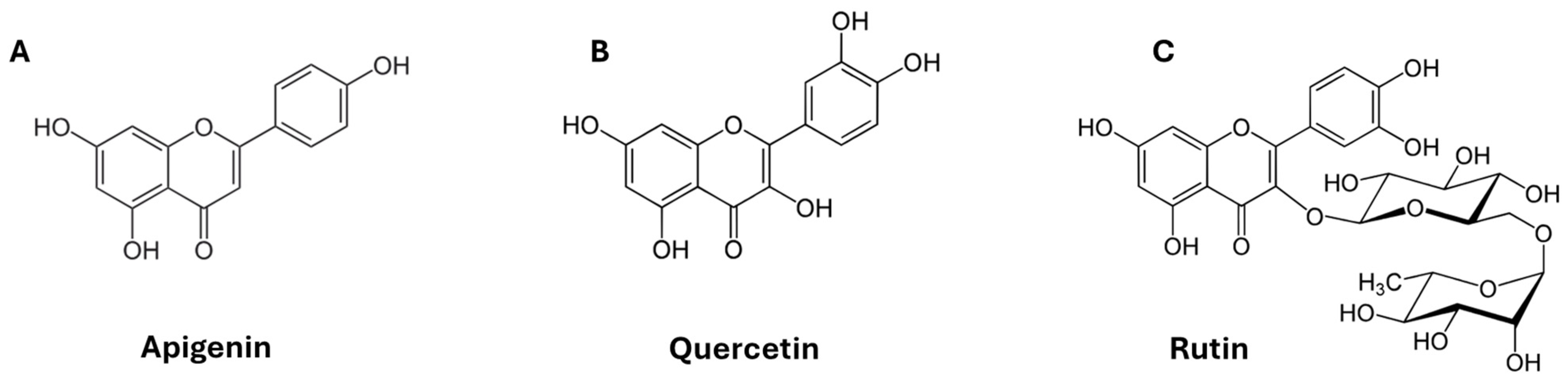
18]. These considerations motivate focusing here on three representative compounds: quercetin (a flavonol aglycone), rutin (a glycosylated quercetin derivative), and apigenin (a flavone aglycone) (see chemical structures in
Figure 1).
In erythrocytes, much of the flavonoid literature has historically emphasized protection against oxidative stress and membrane-damage endpoints (hemolysis, lipid peroxidation, protein oxidation), often under exogenous oxidant challenge. Quercetin has long been reported to protect erythrocyte membranes against oxidative damage, with mechanistic interpretations including iron chelation and attenuation of lipid peroxidation [
19], and other studies have reported measurable changes in membrane organization and, in some cases, shape alterations [
20]. A recurring theme is that membrane composition, especially cholesterol, modulates flavonoid effects: cholesterol regulates bilayer order and lateral organization, influences small-molecule partitioning [
21], and affects the mechanical coupling between bilayer and cytoskeleton [
22]. In oxidatively stressed erythrocytes, cholesterol has been reported to modify the protective effects of quercetin and rutin on integrity and viability, underscoring the importance of membrane context and reinforcing that rutin (as a polar glycoside) cannot be assumed to behave as a simple equivalent of quercetin at the membrane interface [
23,
24]. More broadly, RBC mechanics and flickering are strongly responsive to cholesterol-dependent organization [
9] and to amphiphilic membrane active agents such as beta escin, which remodel bilayer mechanics [
25,
26] and bilayer cytoskeleton coupling through mechanisms distinct from polyphenolic insertion. Although beta escin is chemically distinct from flavonoids, being a triterpenoid saponin rather than a polyphenol, it shares an amphiphilic architecture characterized by a membrane-active aglycone core and glycosidic substituents that modulate polarity and membrane partitioning. The characteristic mechanical impact of escin on RBC flickering highlights how chemically distinct phytochemical classes can generate distinct and interpretable membrane phenotypes [
27]. Apigenin adds a further mechanistic dimension because its scaffold and hydroxylation pattern differ from quercetin; beyond model-membrane studies [
20], apigenin has been linked to erythrocyte-specific responses such as eryptosis-like hallmarks [
28] and has been reported to reduce hemolysis and oxidative markers in oxidative-stress models [
29]. Apigenin therefore appears to act in a regime-dependent manner rather than being uniformly protective or deleterious, with outcomes strongly shaped by dose, incubation time, and the oxidative context [
28,
30].
Collectively, these reports motivate treating quercetin, rutin, and apigenin as mechanistically distinguishable perturbations with potentially distinct consequences for whole-cell mechanics and dynamics (see
Table 1).
Despite this substantial biochemical and membrane-focused literature, a practical gap remains from the perspective of membrane biophysics and single-cell phenotyping: comparatively few studies provide a systematic, side-by-side quantification of both RBC morphometry and membrane flickering across multiple flavonoids using a consistent experimental and analytical workflow. This dual approach matters because morphology and fluctuations are not redundant: a compound may remodel bilayer–skeleton coupling and shift fluctuation spectra without producing an obvious mean-shape transition or, conversely, induce shape alterations with modest changes in fluctuation statistics. Accordingly, the objective of this work is to evaluate whether quercetin, rutin, and apigenin generate reproducible, distinguishable signatures in RBC morphometry and membrane flickering under matched conditions using a homogeneous computational microscopy pipeline. The working hypothesis is intentionally conservative: given their structural differences and known determinants of membrane interaction [
14,
15], these flavonoids will not produce equivalent perturbations at the RBC membrane, and this non-equivalence will be observable as compound-specific shifts in single-cell shape descriptors and/or fluctuation-derived metrics. A secondary hypothesis is that combining morphometry with flickering yields higher discrimination power than either readout alone because it jointly samples static geometry and dynamical mechanical behavior of the same composite membrane system.
Importantly, the present study is framed as a proof-of-concept at the phenotype level. Our primary aim is to establish feasibility and validate the end-to-end computational microscopy pipeline under controlled, sub-hemolytic conditions, rather than making population-level claims. This framing also defines the work as a methodological framework to support subsequent expansion to multi-donor cohorts, dose–response designs, and cholesterol-modulation experiments.
2. Materials and Methods
2.1. Reagents and Solutions
Apigenin, quercetin, and rutin (≥95% purity) were used as membrane-active effectors. Apigenin (CAS 520-36-5) and quercetin (CAS 117-39-5) were obtained from Merck Life Science S.L.U (Madrid, Spain). Rutin (CAS 153-18-4) was purchased from Phyto-Lab GmbH & Co. KG (Vestenbergsgreuth, Germany). Stock solutions were prepared in DMSO (100%) and diluted in incubation buffer to the desired working concentrations. DMSO content was kept constant across all groups, including the vehicle control (final DMSO 0.1% v/v).
A PBS-based incubation medium enriched with glucose and albumin (PBS+) was prepared using 1× PBS (pH 7.4) supplemented with D-glucose (1.8 mg/mL) and bovine serum albumin (BSA; 1.0 mg/mL). Solutions were filtered (0.22 µm) and stored at 4 °C until use.
2.2. Blood Collection and Erythrocyte Preparation
Fresh blood was obtained by capillary finger-prick from a healthy adult donor. Whole blood was diluted 1:10 in PBS+. The suspension was centrifuged (5000× g, 10 min, 4 °C), the supernatant discarded, and the erythrocyte pellet resuspended in PBS+. The washing step was repeated, and the final washed erythrocyte suspension was adjusted to a final volume of 500 µL. Samples were maintained at 37 °C and used within 3 h of preparation.
2.3. Flavonoid Stock Solutions and Working Concentrations
Flavonoids were dissolved in 100% DMSO to obtain concentrated stock solutions and subsequently diluted in PBS+ to yield the desired working concentrations while maintaining a constant final DMSO content of 0.1% (v/v) across all experimental conditions. For long-term cytotoxicity assays and for imaging experiments (morphometry and flickering), the following concentrations were selected: apigenin 10 µM, quercetin 50 µM, and rutin 50 µM. All flavonoid solutions were prepared fresh on the day of each experiment and handled under light-protected conditions to minimize degradation of photosensitive compounds.
2.4. Experimental Design and Definition of Replicates
Experimental groups included a baseline vehicle control (PBS+ + 0.1% DMSO) and three flavonoid-treated groups: apigenin, quercetin, rutin (in PBS+ + 0.1% DMSO). Vehicle controls were evaluated at two time points (C0h and C1h) and the corresponding flavonoid-treated conditions after 1 h of incubation. The baseline control (C0h) corresponds to vehicle-treated erythrocytes analyzed immediately after extraction and purification and therefore reflects a transient post-isolation state, as the extraction and washing procedures impose acute mechanical and osmotic stress on the cells. The incubated control (C1h) corresponds to vehicle-treated erythrocytes after 1 h of incubation at 37 °C, allowing partial recovery from extraction-induced stress. All morphometric and flickering measurements in flavonoid-treated samples were performed after 1 h of incubation at 37 °C and are therefore directly comparable to the C1h vehicle control. For the integrity assessment, hemolysis was quantified in control samples at 30, 60, 90, 120, and 180 min, whereas flavonoid-treated samples were evaluated at 30, 90, and 180 min. To ensure statistical significance, the experiments were carried out in triplicate.
2.5. Hemolysis Assay (Integrity Control)
To quantify hemolysis, samples were centrifuged after the selected incubation period (5000×
g, 10 min, 4 °C), and the supernatant was collected for hemoglobin determination. Hemoglobin absorbance was measured by scanning spectrophotometry (Thermo Scientific™ GENESYS™ 30, Madison, WI, USA) using the Harboe approach, i.e., the primary readout at 415 nm with baseline corrections at 380 nm and 450 nm [
33]. For blank correction, two condition-matched blanks were prepared and measured in parallel: (i) PBS + 0.1% DMSO (vehicle control) and (ii) PBS + 0.1% DMSO + flavonoid (treatment vehicle), to account for the optical contribution of solvents and compounds. Blank optical densities were subtracted from the measured absorbance at each wavelength prior to applying the Harboe equation to obtain hemoglobin concentration (
Appendix B.1) [
15,
34,
35,
36].
Hemolysis is reported as a percentage relative to complete hypotonic lysis in deionized water (100% hemolysis). All conditions (vehicle control and flavonoid-treated samples) were assayed in triplicate. The limit of detection (LOD) was estimated separately for each condition from replicate blank measurements: three independent blank replicates (vehicle control and each flavonoid vehicle) were prepared, and each replicate was measured five times to quantify the absorbance uncertainty used for LOD determination.
2.6. High-Throughput Morphmechanical Phenotyping
Aliquots (40 µL) were diluted 2:15 in PBS+ and loaded into 8-well chamber slides. Bright-field images were acquired on a Leica THUNDER inverted microscope (Leica Microsystems GmbH/CMS GmbH, Wetzlar, Germany) using a Leica K5 camera (LAS X) and an HC PL APO 63×/1.4 oil objective (0.103 μm/px). Images were recorded at 2048 × 2048 px. Ten fields per sample at 60 min were used for quantitative analysis, at a constant temperature of 37 °C, with a typical amount of 30–40 cells per field (300–400 cells per sample).
Image processing for morphometric analysis was performed in Wolfram Mathematica version 14.3 (Wolfram Research, Inc., Champaign, IL, USA) using custom-written scripts (see Code Availability Statement). Bright-field images were first subjected to noise reduction by Gaussian filtering (radius 2 px), globally normalized and subsequently binarized using a global threshold determined by Otsu’s clustering-based variance maximization method. Connected components were then labeled to identify candidate erythrocytes. Components were accepted for further analysis only if they corresponded to isolated cells fully contained within the field of view and in focus; aggregates, border-touching objects, and out-of-focus cells were excluded. In addition, quantitative acceptance criteria were applied to restrict the analysis to suspended normocytic erythrocytes displaying minimal morphological alterations. Specifically, components were required to exhibit a circularity greater than 0.9, to exclude elliptocytes and echinocytes, and an equivalent radius between 7 and 8 µm, to avoid stomatocytes, reticulocytes, or abnormally sized cells. Under these criteria, approximately 10% of the initially detected components were typically discarded.
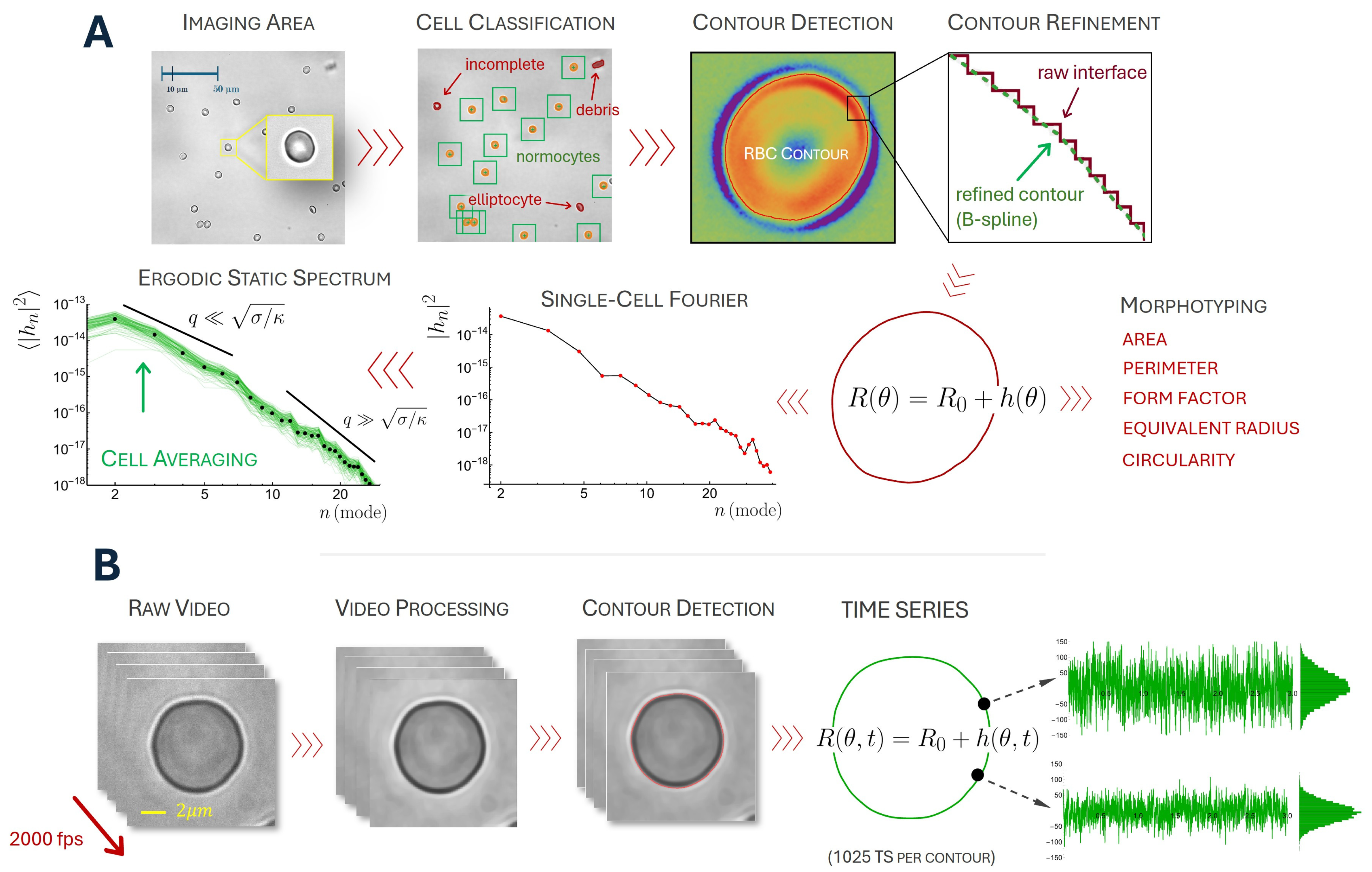
Accepted cell contours were extracted using Otsu-based segmentation and further refined to mitigate pixelation effects (
Figure 2A). The raw contours were transformed into polar coordinates interpolated using a B-spline polynomial of degree twelve and resampled on a fixed angular grid of 720 points spanning 0 to 2π. This procedure ensured smooth, uniformly sampled contours suitable for robust and reproducible computation of morphometric descriptors. Cell contours were described as parametric curves,
, shaped as a mean radius
(or equivalent disk radius) with an angular-dependent perturbation
. For each accepted cell, we computed the following morphological parameters: area (
), perimeter (
), circularity (
), form factor (
), and elongation (
), where
and
are the major and minor semi-axes of the inertia-equivalent ellipse fitted to the cell contour.
2.7. Ergodic Approximation
In addition to morphological estimations, we have performed Helfrich-like physical analysis of membrane fluctuations by evaluating
for each cell at a given time-shot in an ergodic fashion, following refs. [
37,
38]. The erythrocyte population was assumed to be biologically homogeneous and to behave as an ergodic system, in such a way that temporal averaging of membrane fluctuations for a given cell is equivalent to ensemble averaging over the population, which exhibits morphological variability at any given time. This approach allows for a higher-throughput comparative characterization of the mechanical properties of the sample. The validity of this ergodic approximation for estimating effective membrane tension has been previously assessed by direct comparison with conventional time-resolved flickering analyses under matched conditions [
9,
13]; in the present proof-of-concept study, we use it strictly as a comparative estimator under a fixed acquisition/analysis pipeline. Effective tensions inferred from ensemble-averaged static spectra have been shown to quantitatively agree, within experimental uncertainty, with tensions obtained from temporal fluctuation spectroscopy on individual cells under matched conditions [
9,
13]. This cross-validation supports the use of ensemble-based static spectra as a reliable estimator of effective lateral tension for comparative studies across conditions. The ergodic method is implemented as follows:
First, the mean fluctuation amplitude for each cell was computed as the standard deviation of the contour fluctuations, defined as , where represents averaging over the angular coordinate. This parameter quantifies the overall magnitude of membrane fluctuations along the cell contour, measured as angular roughness at one instant.
Second, each extracted fluctuation function was subsequently transformed into Fourier space using a fast Fourier transform (FFT). The resulting fluctuation spectra, associated with lateral cortical tension (, display an inverse dependence on the equatorial wave vector . Because the detected contours correspond to relatively large projected cell sizes, the analysis was confined to low-order (long-wavelength) deformation modes, typically around . In this regime, membrane tension dominates the fluctuation spectrum () as higher-order contributions are effectively buffered by the membrane–cortex area reservoirs. Under these conditions, an operational estimate of the effective lateral tension can be obtained from the relation
Within this context, the ergodic flickering approach enables the analysis of shape fluctuations across hundreds of cells, yielding a robust ensemble-averaged estimate of lateral cortical tension by modeling the viscoelastic cortex as a thick membrane described by an effective Helfrich Hamiltonian. The mechanical contribution of the cortical cytoskeleton to membrane tension is incorporated as a spatially distributed force within the Helfrich continuum framework. In the ensemble-based (“ergodic”) approach, long-wavelength fluctuation statistics are estimated by treating the population of discocytic cells, acquired under matched conditions at a given time point, as an ensemble proxy for membrane states. This procedure assumes that, for the specific acquisition protocol used here (normocytic cells, in-focus equatorial contours, constant temperature and buffer, sub-hemolytic regime), ensemble variability across cells provides a practical proxy for temporal variability in single-cell flickering at the level of low-order modes. Importantly, this approximation is used here as a comparative estimator to quantify condition-dependent shifts under identical acquisition and processing, rather than as a route to absolute material parameters or to single-cell temporal inference.
2.8. High-Resolution & High-Speed Flickering Analysis
The second approach to investigate RBC dynamics involves the use of high spatial and temporal resolution videomicroscopy applied to a small cohort of cells for each experimental group.
RBC aliquots (40 µL) diluted 2:15 were loaded onto microscope slides using a silicone spacer chamber. Videos were acquired on a Nikon Eclipse TE2000 (Nikon Instruments Inc., Melville, NY, USA) inverted microscope using an Apo VC 100× oil objective with an additional 1.5× magnification, a Photron FASTCAM-SA3 camera (Photron Limited, Chiyoda-ku, Tokyo, Japan), and an additional 2.25× optical magnification, at a constant temperature of 37 °C. Videos were recorded at 2000 fps, 256 × 256 px (50 nm/px), for 3 s (6000 frames) and exported as uncompressed TIFF stacks. For each video, cell contours were extracted following the same procedure described in the previous section, including a denoising step, Otsu-based segmentation and posterior B-spline (polynomial degree 18) refinement and resampling (1024 angles per contour and time step). Contours are represented in polar form as
, relative to the instantaneous cell centroid [
12]. To remove global translations and slow drift, the centroid was tracked frame-by-frame and the contour re-centered. Finally, the fluctuation field was defined as
, where
denotes time averaging over the full recording.
Mechanical parameters. For each of the 1024 time series of the cell contour, we computed the following descriptors:
- (A)
Signal volatility, used as a measure of signal non-stationarity. It was defined as the variability of the fluctuation amplitude within a time series and estimated as the moving standard deviation of the signal amplitude, computed over 0.5 s windows with 0.25 s overlap [
39].
- (B)
Effective local rigidity, estimated under the assumption of thermal equilibrium as where denotes the time-averaged mean-square fluctuation amplitude (STD), which is equivalent to computing the mean squared displacements, MSD, value at
- (C)
Einstein diffusivity, extracted from the initial slope of the mean squared displacements . Its inverse is related to the effective local viscosity of the cell membrane.
- (D)
Effective viscous friction, obtained under an overdamped Langevin description of the local contour coordinate
, the Einstein relation links the short-time diffusivity to an effective friction coefficient
as
here,
is obtained from the initial linear regime of the MSD. Thus,
is proportional to the effective viscous dissipation, while
provides an absolute friction proxy (in units of
) for the extracted contour coordinate.
- (E)
Characteristic relaxation frequency, estimated as
providing a single-cell proxy for the dominant relaxation timescale
.
2.9. Statistical Analysis
Group comparisons were performed using nonparametric tests (Kruskal–Wallis for multi-group comparisons; Mann–Whitney U for planned pairwise tests). A two-sided significance threshold of was applied. Data are summarized as median and interquartile range (IQR). Mean SEM is not used for inferential comparisons in this single-donor pilot study. To minimize pseudo-replication, per-cell/per-video measurements were aggregated per donor prior to inferential testing whenever biological replication (multiple donors) was available. In the present study, statistics are therefore within-donor; p-values reflect cell-level sampling under a single biological replicate and should not be interpreted as population-level inference. Effects with are reported as trends only and are discussed cautiously without inferential claims. Because this is a single-donor pilot study, reported p-values reflect within-donor separability under matched acquisition/analysis and should not be interpreted as population-level inference.
All experiments were performed using erythrocytes from a single healthy donor and should therefore be considered a pilot study. The results support within-donor comparisons and methodological validation but do not allow population-level inference; generalization will require confirmation in multi-donor studies.
3. Results
3.1. Control of Erythrocyte Integrity: Hemolysis Assays
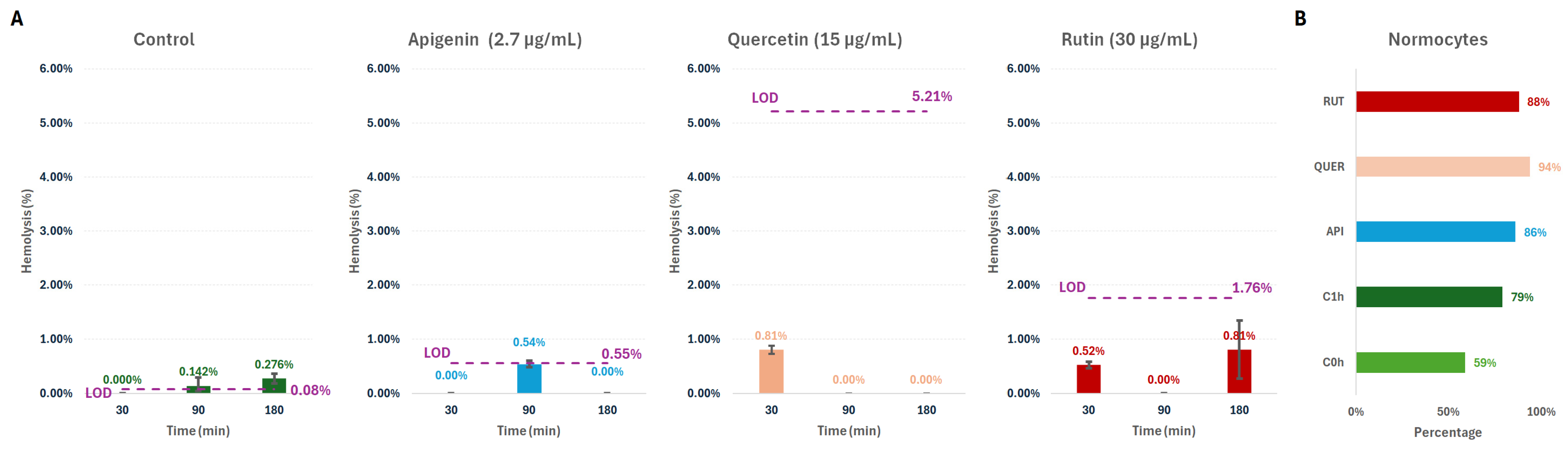
To verify that the experimental conditions were compatible with subsequent biomechanical analyses, erythrocyte integrity was first assessed by hemolysis measurements under all incubation conditions. Hemolysis was quantified over a 3 h window, corresponding to the time frame used for morphometry and flickering experiments (
Figure 3A). For each condition, we estimated a condition-specific limit of detection (LOD) by propagating the uncertainty associated with the absorbance measurements at the wavelengths used for hemoglobin quantification. Importantly, the LOD differed across effectors because the flavonoids exhibit residual spectral cross-talk, particularly due to emission tails approaching the lower-wavelength limit (~380 nm), which affects blank correction and increases the uncertainty budget (
Appendix B.2).
In the vehicle control, hemolysis showed only a slight time-dependent increase, remaining negligible throughout the assay (<0.3%), consistent with basal incubation effects. For apigenin-, quercetin-, and rutin-treated samples, the estimated hemolysis values were similarly low (<0.5%) and, in all cases, fell below the corresponding LOD, indicating that the apparent fluctuations cannot be reliably interpreted as true changes in hemoglobin release. Taken together, these results confirm that the morphometric and flickering measurements performed at 0 h and 1 h were conducted within a sub-hemolytic regime, with no analytically detectable hemolytic effect or membrane disintegration under the selected imaging conditions.
Hemolysis measurements were complemented by an image-based morphotype analysis at 0 h and 1 h for controls and at 1 h for the flavonoid-treated samples (
Figure 3B). The fraction of normocytes (biconcave discocytes) was computed for each condition; the remaining population consisted predominantly of echinocytic forms, with a residual representation of stomatocytes. The lowest normocyte fraction was observed at C0h (59%), consistent with mechanical and osmotic stress and ATP depletion during isolation [
7], followed by a clear increment after 1 h incubation in PBS (79%). Under flavonoid exposure, the normocyte fraction increased further, reaching ~85–95% depending on the compound.
3.2. Morphometric Analysis of Erythrocytes
Bright-field images of erythrocytes were analyzed using a high-throughput morphometric pipeline to quantify changes in cell geometry and membrane-related mechanical proxies induced by incubation and flavonoid exposure. An initial morphometric screening indicated a predominantly discocytic population across all samples, with the remaining fraction consisting mainly of echinocytic and stomatocytic morphotypes (
Figure 3B). These non-discocytic cells were excluded from further analysis because their 3D geometry frequently places portions of the membrane out of the focal plane, blurring the peripheral halo and compromising contour detection, thereby degrading the accuracy of downstream morphometric and mechanically inferred parameters. Beyond these practical limitations, non-discocytic morphologies are also expected to exhibit intrinsically different fluctuation physics: changes in shape are accompanied by substantial shifts in effective mechanical state (e.g., excess-area availability, tension and stiffness) and in the fluctuation spectrum, as shown for discocyte–echinocyte–spherocyte transitions [
7,
11]. In particular, stomatocytic configurations are typically dominated by altered curvature/tension constraints, while echinocytic phenotypes involve spicule-related heterogeneities and membrane–cytoskeleton remodeling that can strongly bias mode decomposition and relaxation dynamics. Downstream analyses were therefore restricted to discocytic (normocytic) cells to ensure robust contour-based quantification and meaningful cross-condition comparisons of flickering-derived phenotypes.
Six morphomechanical parameters were considered: mean equivalent radius, elongation, circularity, elongation, fluctuation amplitude, shape factor, and effective tension. In all analyses, both the baseline vehicle control measured immediately after extraction (C0h) and the incubated vehicle control measured after 1 h at 37 °C (C1h) were included to contextualize the post-isolation state.
Representative images showed predominantly normocytic morphologies across all conditions, with no evidence of shape transitions or widespread echinocytic or spherocytic forms (
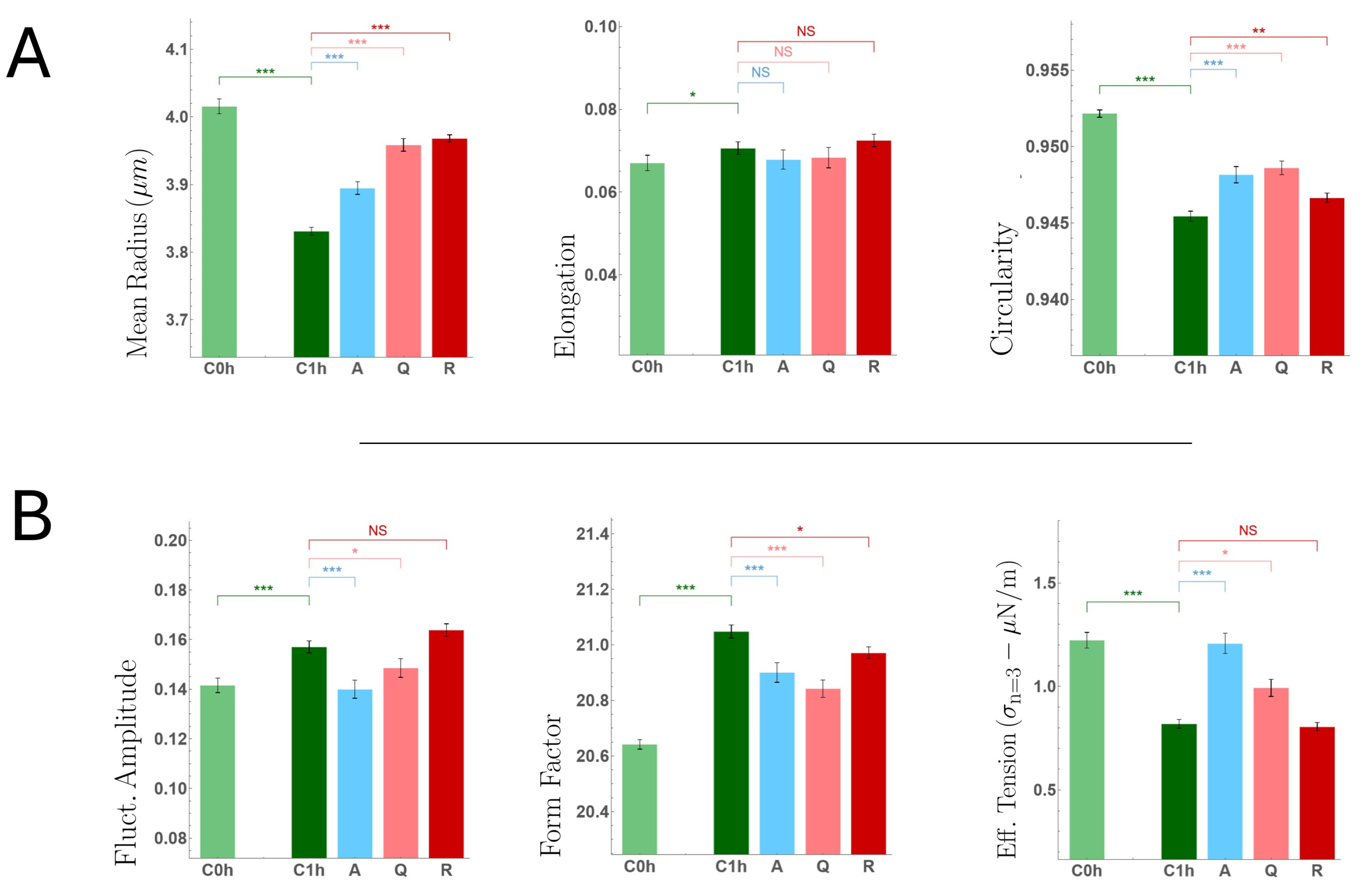
Figure 4). Neither circularity nor elongation shows noticeable modifications under incubation with vehicle (PBS+ + DMSO). However, quantitative analysis revealed a clear and statistically significant effect of the incubation step when comparing C0h and C1h controls (see
Table 2). After 1 h of incubation, all analyzed parameters exhibited systematic shifts consistent with metabolic reactivation following the osmotic and mechanical stress associated with erythrocyte purification. Specifically, morphometric descriptors indicated a marked reduction in cell size and circularity, while the global cell shape, as quantified by elongation, remained essentially unchanged. In parallel, mechanical-related parameters showed an increase in membrane fluctuation amplitude and shape factor, accompanied by a significant decrease in effective tension [
6,
9,
40]. Taken together, these trends point to a progressive incubation-dependent relaxation from post-isolation perturbation, associated with increased membrane dynamical activity and mechanical compliance from post-isolation perturbation after sample preparation.
Comparison of flavonoid-treated samples with the C1h incubated control revealed compound-dependent morphomechanical signatures. No significant changes were observed in elongation for any treatment, indicating that global cell geometry was preserved. In contrast, all three flavonoids induced a measurable increase in cell size, accompanied by a slight but consistent increase in circularity. This effect was more pronounced for apigenin and quercetin (both aglycones), whereas rutin-treated cells showed minimal changes relative to the vehicle.
Analysis of membrane fluctuation amplitude further highlighted distinct behaviors among the compounds. Rutin-treated erythrocytes exhibited fluctuation amplitudes comparable to the vehicle control, indicating no appreciable modification of membrane dynamics. In contrast, treatment with quercetin and apigenin resulted in a significant reduction in the mean fluctuation amplitude. This trend was mirrored by corresponding changes in the shape factor, which decreased in aglycone-treated samples but remained unchanged in the presence of rutin.
Finally, estimation of the effective mechanical tension revealed a clear divergence between aglycones and the glycosylated flavonoid. Apigenin- and quercetin-treated cells displayed a significant increase in effective tension relative to vehicle control, whereas no detectable change was observed for rutin-treated erythrocytes. Consistent with prior validations, the effective tensions extracted from ensemble-averaged static spectra fall within the range reported for time-resolved flickering analyses of healthy erythrocytes [
9,
39], supporting their interpretation as comparative mechanical descriptors rather than methodological artifacts. These results indicate that, despite the absence of major geometric alterations, aglycones induce a mechanically stiffer membrane phenotype, while rutin preserves morphomechanical properties close to the control state.
3.3. Flickering Analysis: Dynamic and Mechanical Signatures
High spatiotemporal resolution microscopy was used to perform a detailed analysis of local membrane fluctuations in erythrocytes under the different experimental conditions. For each group, fluctuations were analyzed in ten individual cells. In the case of apigenin-treated samples, five recordings were excluded due to insufficient image quality or contour-tracking reliability, resulting in five cells included in the final analysis. All reported results are therefore based on high-quality single-cell time series suitable for quantitative flickering analysis.
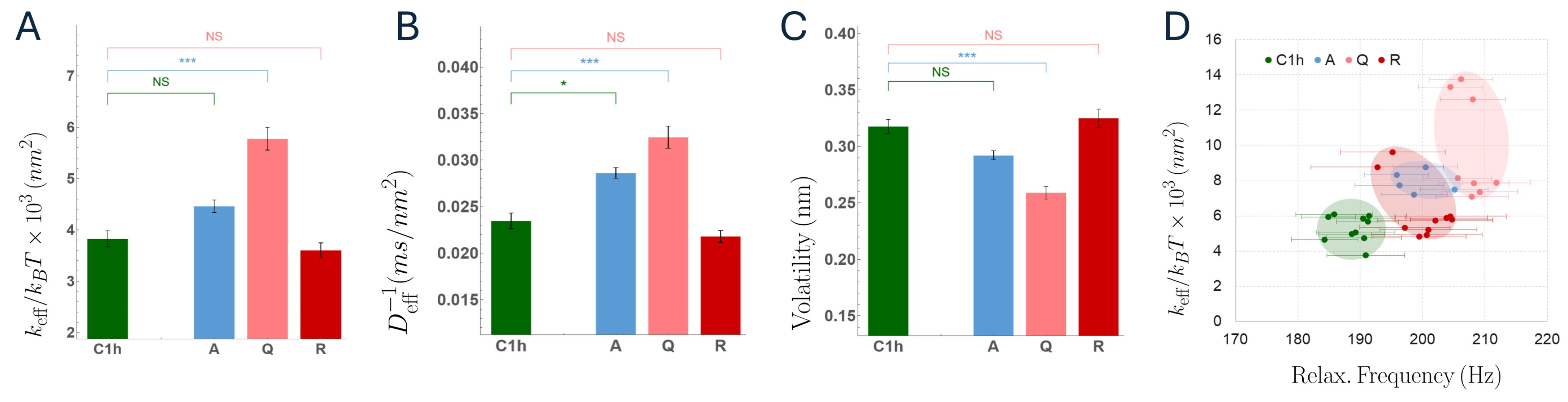
Rheological descriptors derived from fluctuation dynamics revealed consistent and compound-dependent trends. Effective rigidity and the inverse of Einstein diffusivity (used here as a proxy for viscous dissipation) displayed closely aligned behaviors across conditions. Both apigenin- and quercetin-treated erythrocytes exhibited a clear increase in effective rigidity accompanied by an increase in viscous friction, indicative of enhanced membrane viscoelasticity. In contrast, rutin-treated cells did not show statistically significant deviations from vehicle control in either rheological parameter, remaining within the control variability range.
To disentangle the respective roles of elastic stiffening and viscous dissipation, we analyzed the coupling between effective rigidity and the characteristic relaxation frequency at the single-cell level. For each cell, we estimated the relaxation frequency as , where the effective friction was obtained from the short-time Einstein diffusivity via . We then plotted against to visualize how changes in stiffness and dissipation jointly reshape fluctuation timescales across conditions. This representation showed that apigenin- and quercetin-treated cells shift toward higher as increases, indicating faster relaxation despite concomitantly increased friction. Because the characteristic relaxation frequency scales as , an increase in reflects a dominant stiffening effect that outweighs the concomitant increase in viscous dissipation, rather than a reduction in friction. Consequently, the different experimental groups populate distinct regions of the plane, following an approximately linear trend that separates aglycone-treated cells from controls and rutin-treated cells.
This combined representation defines a characteristic mechanical space in which flavonoid-treated erythrocytes are displaced relative to controls, consistent with a shift toward a mechanically more constrained dynamical regime, characterized by increased effective rigidity and shorter relaxation timescales. In contrast, rutin-treated cells clustered near the vehicle control, reinforcing the absence of a significant mechanical remodeling under this condition. All inferred quantities are reported as effective descriptors within the adopted fluctuation-inference model and should not be interpreted as absolute bilayer or cytoskeletal material constants. We use them comparatively to quantify condition-dependent shifts under matched acquisition and analysis.
Finally, signal volatility was analyzed as a measure of flickering non-stationarity. Quercetin-treated erythrocytes displayed a marked reduction in signal volatility compared with vehicle controls, indicating a stabilization of fluctuation amplitudes over time. This effect was not statistically significant for apigenin- or rutin-treated samples, which exhibited volatility levels comparable to the control group. Together, these observations suggest that quercetin uniquely reduces temporal heterogeneity in membrane dynamics, whereas apigenin primarily affects average mechanical properties without substantially altering signal non-stationarity.
3.4. Integrative Phenotypic Analysis
To explore the relationship between static geometry and dynamic membrane behavior, morphometric and flickering-derived parameters were analysed jointly. Scatter plots revealed partial correlations between selected dynamic descriptors (e.g., characteristic relaxation frequency or effective rigidity) (
Figure 5C) and morphometric measures such as equivalent radius or circularity. These correlations were moderate and condition-dependent, indicating that morphological and dynamic readouts capture overlapping but non-redundant aspects of the erythrocyte membrane state. Importantly, the combined analysis highlighted that flavonoid-induced phenotypic signatures cannot be fully described by morphology or flickering alone; instead, their integration provides a more sensitive and discriminative characterization.
The static (ensemble-based) and dynamic (time-resolved) analyses probe complementary projections of the same underlying membrane–cortex mechanics. It is important to note that effective (ensemble) tension and effective rigidity are distinct mechanical readouts and do not imply one another a priori. While the ergodic static spectra emphasize long-wavelength, population-averaged constraints dominated by effective tension, the time-resolved analysis captures local viscoelastic response and dissipation at shorter timescales. Under the assumption of a shared effective mechanical state, consistent compound-dependent trends across these two readouts (such as concurrent increases in effective tension, rigidity, and viscous friction) support a unified interpretation in terms of membrane remodeling rather than independent or contradictory effects.
Taken together, the results demonstrate that, under sub-hemolytic conditions, structurally distinct flavonoids induce reproducible and differentiable phenotypic signatures in erythrocyte morphology and membrane dynamics. Within the limitations of a single-donor pilot study, these findings support the feasibility and sensitivity of the combined morphometry–flickering approach as a biophysical phenotyping framework.





 ,
,