
Review

Polysulfone Membranes: Here, There and Everywhere
by
Pere Verdugo
1,*,
Iwona Gulaczyk
2,
Magdalena Olkiewicz
1,
Josep M. Montornes
1,
Marta Woźniak-Budych
3,
Filip F. Pniewski
4,
Iga Hołyńska-Iwan
5 and
Bartosz Tylkowski
1,6,*
1
Eurecat, Centre Tecnològic de Catalunya, Chemical Technologies Unit, Marcel·lí Domingo 2, 43007 Tarragona, Spain
2
Faculty of Chemistry, Adam Mickiewicz University in Poznań, ul. Uniwersytetu Poznańskiego 8, 61-614 Poznań, Poland
3
NanoBioMedical Centre, Adam Mickiewicz University in Poznan, Wszechnicy Piastowskiej 3, 61-614 Poznań, Poland
4
Faculty of Oceanography and Geography, University of Gdańsk, Al. Piłsudskiego 46, 81-378 Gdynia, Poland
5
Department of Pathobiochemistry and Clinical Chemistry, Faculty of Pharmacy, Ludwik Rydygier Collegium Medicum in Bydgoszcz, Nicolaus Copernicus University in Toruń, 85-094 Bydgoszcz, Poland
6
Department of Clinical Neuropsychology, Faculty of Health Science, Ludwik Rydygier Collegium Medicum in Bydgoszcz, Nicolaus Copernicus University in Toruń, ul. Sklodowskiej Curie 9, 85-094 Bydgoszcz, Poland
*
Authors to whom correspondence should be addressed.
Membranes 2026, 16(1), 35; https://doi.org/10.3390/membranes16010035
Submission received: 30 October 2025 / Revised: 27 November 2025 / Accepted: 11 December 2025 / Published: 5 January 2026

Abstract

Polysulfone (PSU) membranes are widely recognized for their thermal stability, mechanical strength, and chemical resistance, making them suitable for diverse separation applications. This review highlights recent advances in PSU membrane development, focusing on fabrication techniques, structural modifications, and emerging applications. Phase inversion remains the predominant method for membrane synthesis, allowing precise control over morphology and performance. Functional enhancements through blending, chemical grafting, and incorporation of nanomaterials—such as metal–organic frameworks (MOFs), carbon nanotubes, and zwitterionic polymers—have significantly improved gas separation, and water purification., In gas separation, PSU-based mixed matrix membranes demonstrate enhanced CO2/CH4 selectivity, particularly when integrated with MOFs like ZIF-7 and ZIF-8. In water treatment, PSU membranes effectively remove algal toxins and heavy metals, with surface modifications improving hydrophilicity and antifouling properties. Despite these advancements, challenges remain in optimizing cross-linking strategies and understanding structure–property relationships. This review provides a comprehensive overview of PSU membrane technologies and outlines future directions for their development in sustainable and high-performance separation systems.

1. Introduction

Polysulfones are polymers composed of aryl and sulfonyl groups. They are typically synthesized via the polycondensation of bisphenol A and dichlorodiphenyl sulfone. The diphenyl sulfonyl moiety contributes high bond dissociation energy, resulting in excellent tensile strength and resistance to oxidizing agents. These properties can be further enhanced by reinforcing the polymer with glass or carbon fibers. Polysulfones were first synthesized in 1959, presented during a conference in 1965, and their commercialization under the trade name Udel started in 1966 by Union Carbide. They were the first thermoplastics specifically engineered for prolonged use at temperatures exceeding 150 °C [1]. Polysulfones exhibit relatively high glass transition temperatures (Tg), typically ranging from 190 °C to 240 °C, ensuring structural integrity from −100 °C to 150 °C. These polymers are amorphous, semi-transparent, and possess low creep, excellent electrical insulating properties, and self-extinguishing behavior. Their high chemical resistance is largely attributed to the diphenyl sulfonyl moiety, which enhances oxidative stability through electron delocalization via resonance [2]. Mechanically, polysulfones exhibit high tensile strength, 70–75 MPa; Young’s modulus, 2.5–2.6 GPa, and excellent impact resistance [3]. However, prolonged outdoor exposure makes polysulfones susceptible to chemical degradation due to their aromatic ether backbone. This vulnerability can be mitigated by incorporating carbon fillers, applying surface coatings, or metalizing the material. Despite these measures, polysulfones remain generally unsuitable for long-term outdoor use. Ultraviolet (UV) radiation and moisture can lead to the breakdown of polymer chains, causing irreversible deterioration of the material’s structural and functional properties over time. Additionally, polysulfones are not resistant to low-polarity organic solvents such as ketones, chlorinated hydrocarbons, and aromatic hydrocarbons.
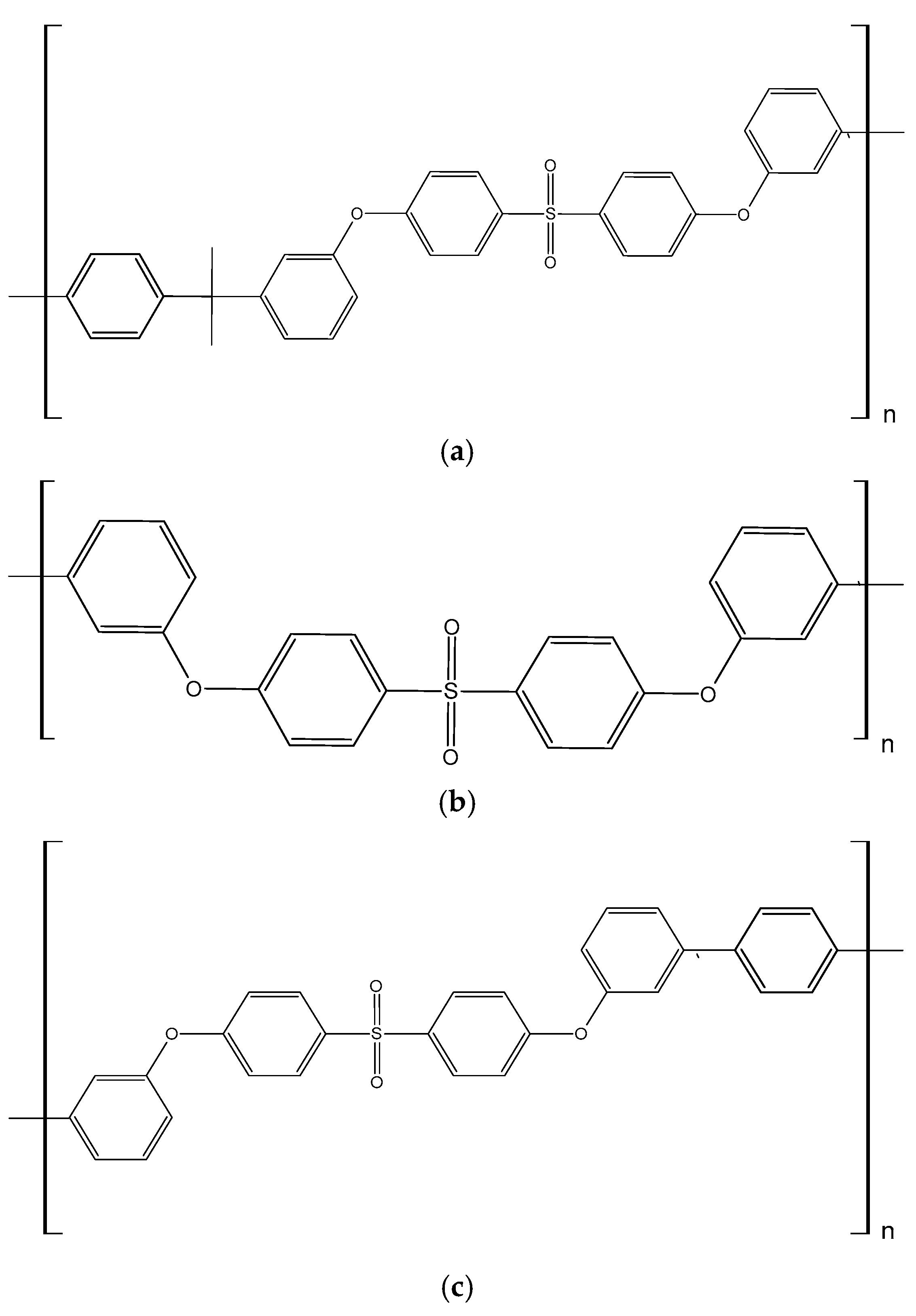
Currently, three primary variants of polysulfones are in use: polysulfone (PSU), polyethersulfone (PES), and polyphenylene sulfone (PPSU). These variants differ in their chemical structures, particularly in the functional groups located between adjacent benzene rings (see Figure 1).
While polysulfone-based thermoplastics exhibit broadly similar performance characteristics, their structural variations confer distinct properties that render each variant more suitable for specific applications. Among these, polysulfone (PSU) is recognized as the most economically viable, which has led to its prominence in both research and industrial modification efforts. In 2024, the global market valuation for PSU was approximately USD 1.55 billion. Forecast models project continued growth, with the market expected to expand from USD 1.62 billion in 2025 to USD 2.36 billion by 2034, corresponding to a compound annual growth rate (CAGR) of approximately 4.30% over the forecast period (2025–2034) [4].

2. Preparation and Modification of Polysulfone Membranes

Polysulfone (PSU), polyethersulfone (PES), and polyvinylidene fluoride (PVDF) are among the most widely utilized conventional polymeric materials for the fabrication of membranes and membrane elements [5]. The morphology of polymeric membranes, defined by the structure and spatial arrangement of pores as well as other microstructural features, is a critical determinant of their performance across various applications.
The phase inversion precipitation, also referred to as non-solvent induced phase separation (NIPS), is among the most commonly used techniques for the fabrication of polysulfone membranes at both laboratory and industrial scales. In this process, a polymer solution undergoes liquid–liquid or liquid–gas demixing, resulting in the formation of a solid membrane. This method was pioneered in the late 1950s by Sidney Loeb (University of California) and Srinivasa Sourirajan (University of Florida) for the development of reverse osmosis membranes [6,7]. Since its development, phase inversion has been regarded as one of the most versatile and straightforward techniques for the fabrication of polymeric membranes [8,9].
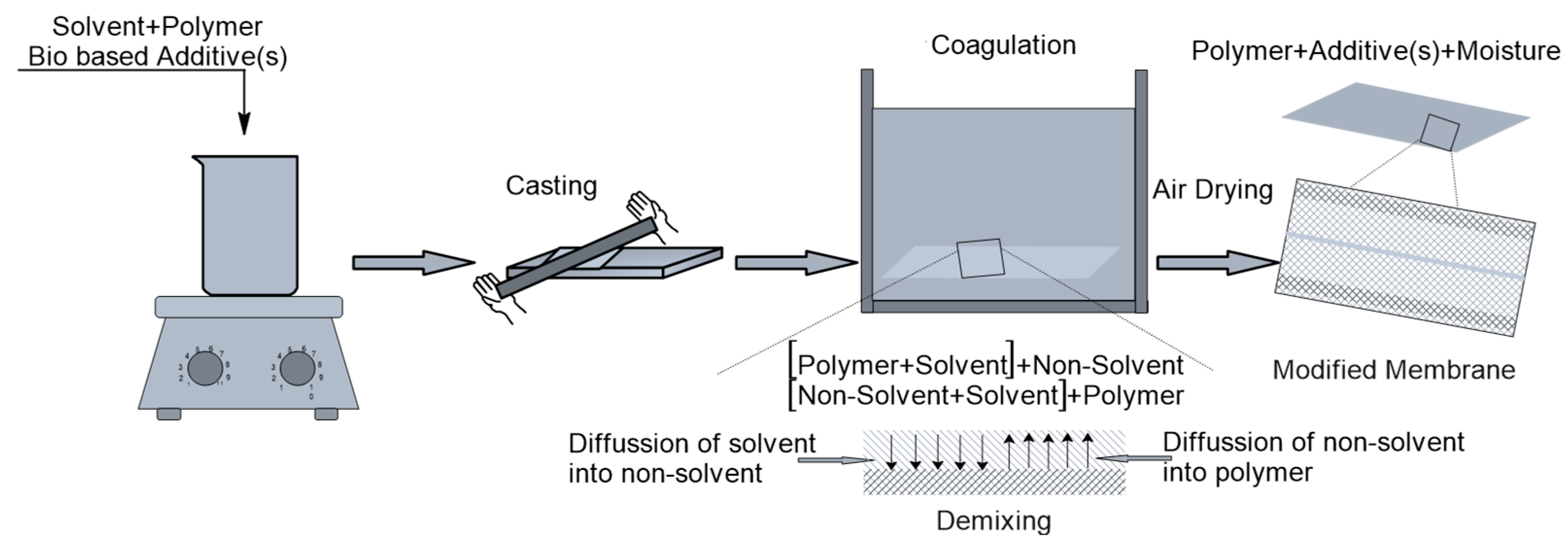
As illustrated in Figure 2, the process begins with the dissolution of a polymer in an appropriate solvent to form a homogeneous dope solution. This solution is subsequently cast and immersed in a non-solvent bath, initiating a diffusion-driven exchange: the non-solvent permeates into the polymer film while the solvent diffuses outward. This exchange induces phase separation, resulting in the formation of a porous membrane structure. The polymer-rich phase solidifies to form the continuous matrix of the membrane, whereas the non-solvent-rich phase gives rise to the pore network. Following phase separation, the membrane is typically subjected to washing and air-drying to remove residual solvent and to stabilize the final structure [10].
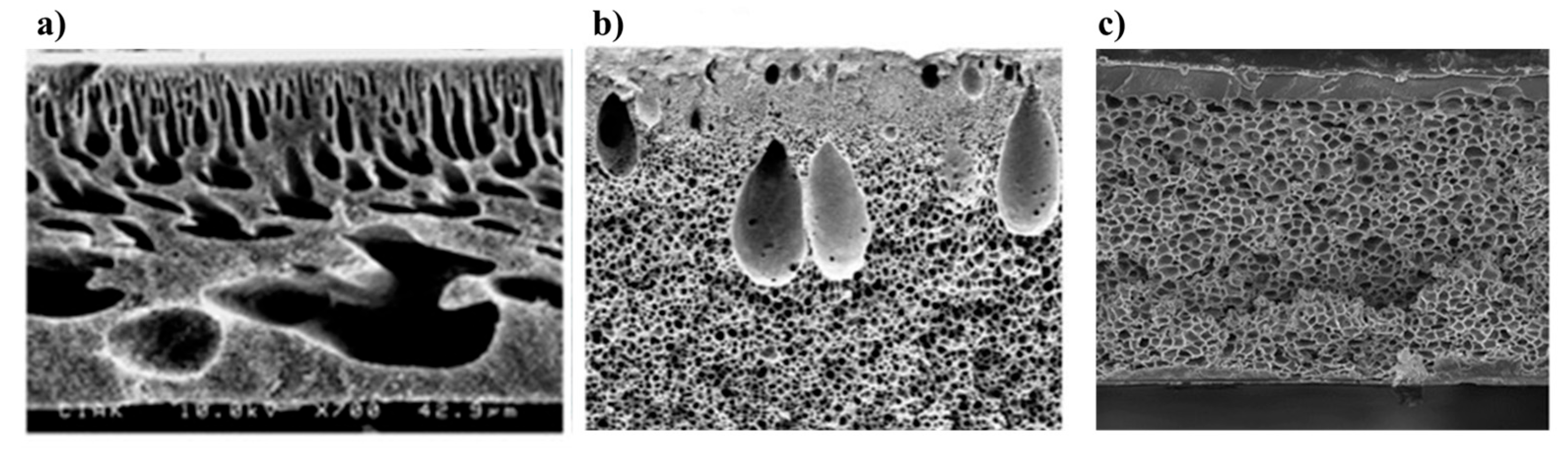
A critical factor in the development and application of PSU membranes is the precise control of their polymeric morphology, which plays a pivotal role in determining membrane performance. Morphological characteristics can vary significantly depending on parameters such as polymer concentration, the choice of solvent/non-solvent system, and processing conditions. Key structural features—including pore size, surface porosity, and the presence of macrovoids—govern membrane morphology and directly influence performance metrics such as permeability and fouling resistance. Enhancements in these features typically lead to improved membrane efficiency and reduced fouling propensity. Numerous techniques and strategies for tailoring the morphology of PSU membranes have been extensively studied, with the effects of morphological modifications on mechanical integrity, chemical stability, operational performance, and fouling behavior thoroughly investigated. These findings are detailed in the following articles [11,12,13,14,15,16,17]. As a matter of example, Figure 3 provides SEM micrographs of polysulfone membranes with different morphologies. Figure 3a demonstrates PSU membrane with a finger-like structure [18], while Figure 3b,c show PSU membranes with sponge-like [19] and sponge-like with macrovoids [20] structures, respectively.
In addition to structural optimization, PSU membranes can be functionally enhanced through blending or chemical modification. Blending involves the incorporation of other polymers or inorganic materials into the PSU matrix to tailor its physicochemical properties and improve performance in specific applications such as water purification, gas separation, and food processing. Chemical functionalization, on the other hand, facilitates the introduction of reactive groups onto the polymer backbone, thereby enhancing membrane selectivity, hydrophilicity, antifouling characteristics, and thus expanding the potential range of membrane applications [21].
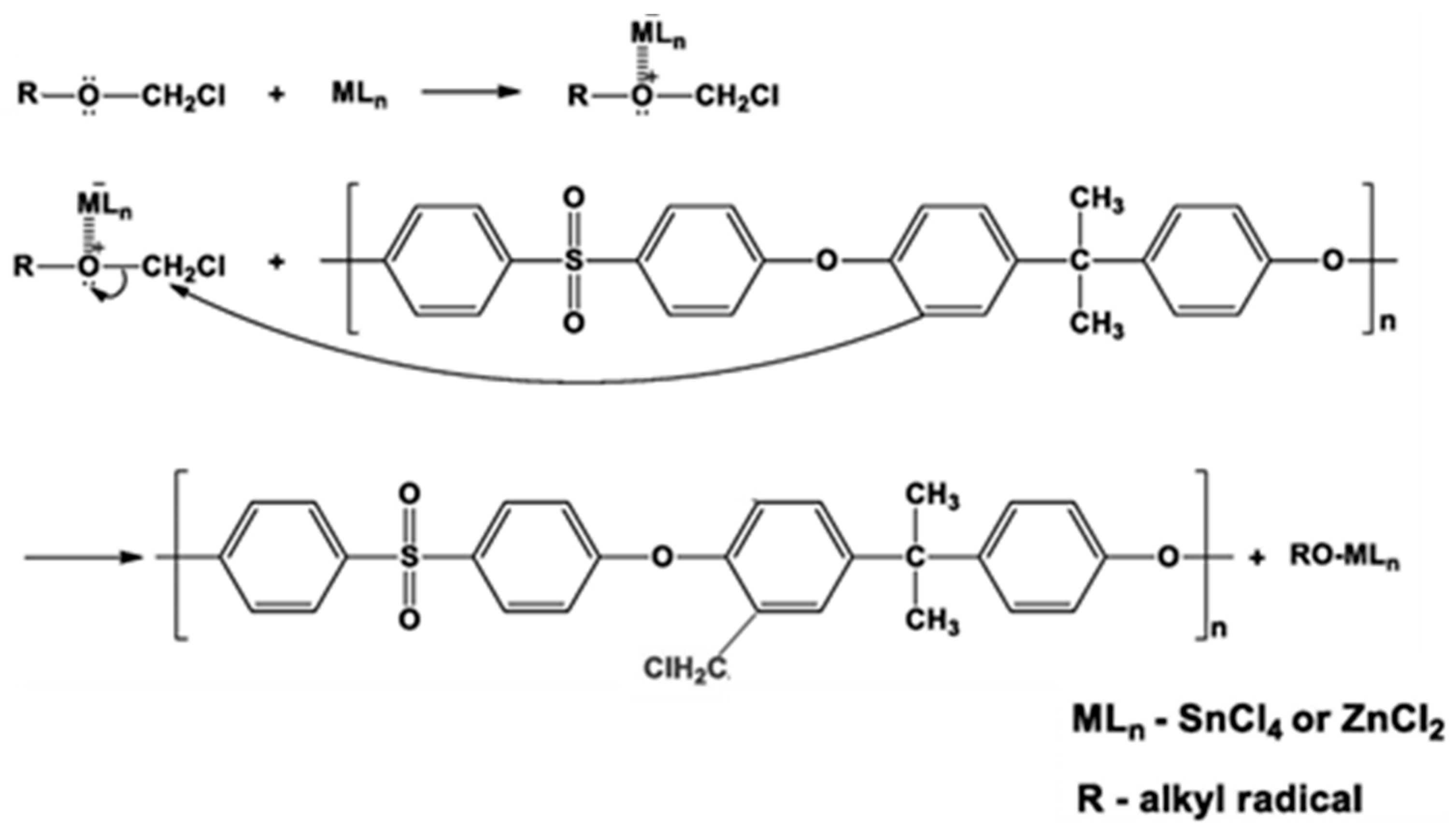
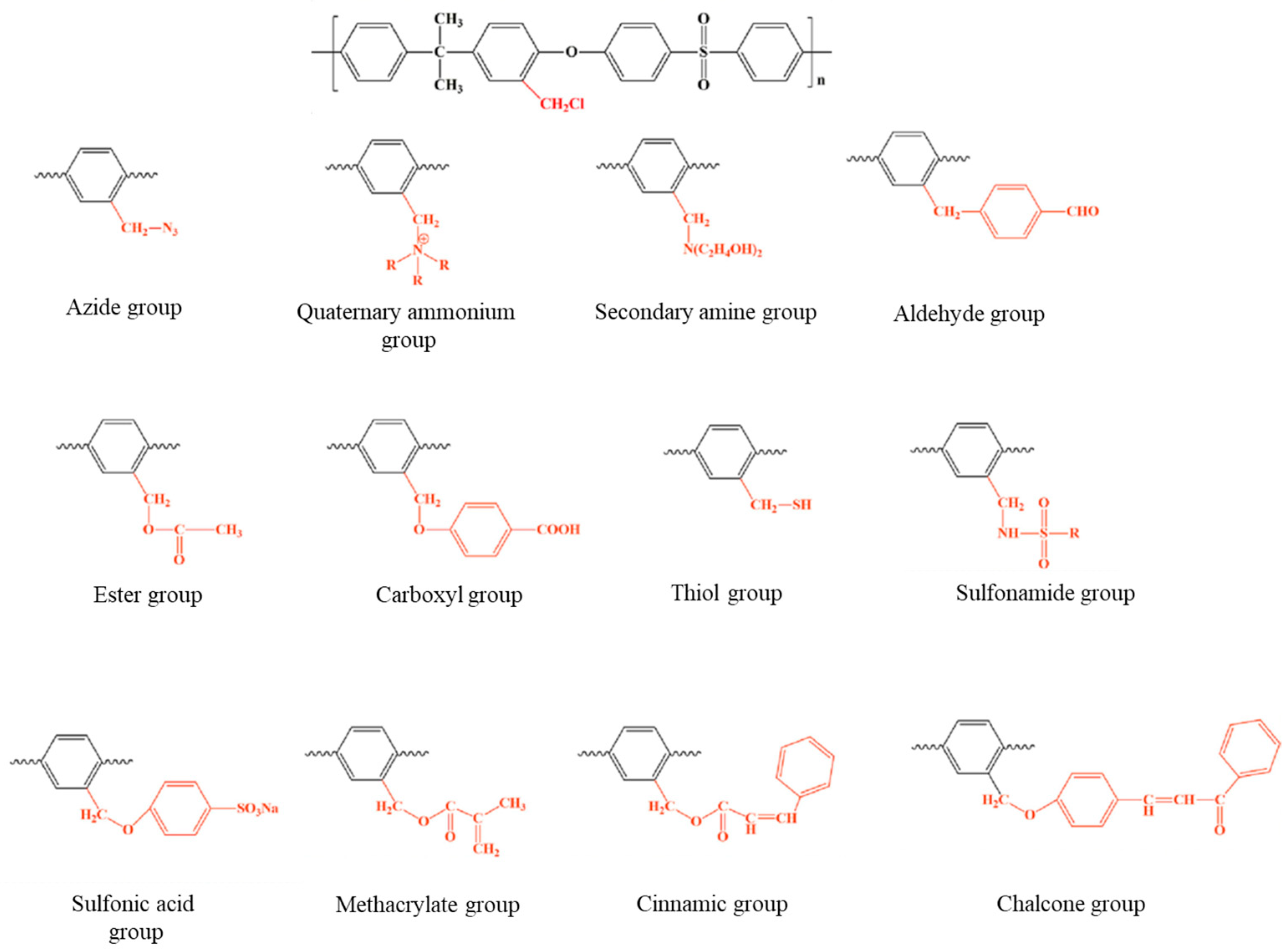
In the case of polysulfone, functionalization can be achieved via two primary approaches: copolymerization with functionalized comonomers or post-polymerization modification. The copolymerization route often results in low-molecular-weight polymers due to the reduced reactivity of certain comonomers during condensation polymerization [22]. Moreover, some functional groups may be incompatible with the harsh polymerization conditions typically required for nucleophilic aromatic substitution, which generally involves elevated temperatures (>150 °C) and prolonged reaction times (>12 h). Alternatively, post-functionalization (a strategy broadly used for PSU) allows for the introduction of various functional groups after polymer synthesis. Common post-functionalization methods include sulfonation, bromination, amidoalkylation, lithiation, and chloromethylation, each offering distinct advantages in tuning the polymer’s chemical, thermal, and separation properties. It is important to highlight that chloromethylation reactions have been extensively applied as effective strategies for generating reactive intermediates, which can be further functionalized through a variety of synthetic pathways tailored to specific applications. This utility stems from the high reactivity and versatility of the chloromethyl group (─CH2Cl), which readily undergoes nucleophilic substitution with diverse functional groups. The reaction proceeds via an electrophilic aromatic substitution mechanism and typically involves chlorinated hydrocarbons (e.g., chloroform, dichloroethane, trichloroethane) as solvents, along with chloromethyl alkyl ethers such as monochloromethyl methyl ether, bis(chloromethyl) methyl ether, 1,4-bis(chloromethoxy)butane, and 1-chloromethoxy-4-chlorobutane as chloromethylating agents. A halogen-containing Lewis acid catalyst, such as SnCl4 or ZnCl2, is required to facilitate the reaction (Figure 4) [23,24,25]. The effectiveness of a series of Lewis-type catalysts on the substitution degree has been studied in literature, and reported [12] that it decreases in the order: SnCl4 > ZnCl2 > AlCl3 > TiCl4 > SnCl2 > FeCl3.
In the case of PSU, the chloromethyl cation preferentially reacts with the electron-rich aromatic rings of the bisphenol A unit, resulting in the grafting of chloromethyl groups. The reaction exhibits high regioselectivity due to the electron-donating effects of the oxygen atoms, which activate specific positions on the aromatic rings. In contrast, the aromatic rings within the arylsulfone unit are deactivated by the strongly electron-withdrawing sulfone group. Consequently, the chloromethylation of polysulfone yields a derivative containing a maximum of two chloromethyl groups per repeating unit, reflecting the influence of the sulfone group’s deactivating effect. To minimize undesirable side reactions and obtain soluble chloromethylated polysulfones (CMPSU) with a high degree of substitution, investigators have emphasized the importance of maintaining specific reaction conditions. These include: (I) a low concentration of polysulfone in solution (typically 2% w/v); (II) extended reaction times ranging from 28 to 140 h; (III) a high molar ratio between the polysulfone repeating unit and the chloromethylating agent (commonly 1:10:10); and (IV) a limited amount of catalyst, typically between 0.10 and 0.18 mmol of SnCl4 [12,26]. The primary advantage of polysulfone functionalization using chloromethylated precursors lies in the facile substitution of chloromethyl groups with a wide range of nucleophilic agents, as illustrated in Figure 5. Consequently, polysulfones incorporating chloromethyl functionalities within their backbone play a pivotal role in broadening their application spectrum by enabling structural diversification and the development of novel properties.

3. Application of Polysulfone and Polysulfone Modified Membranes

3.1. CO2 Capture and Gas Separation

Addressing global warming driven by anthropogenic CO2 emissions remains a critical challenge in contemporary environmental research. Conventional liquid solvent-based absorbents for CO2 capture, while effective, are hindered by high operational costs and complex handling requirements, limiting their scalability for industrial applications. In contrast, solid sorbents derived from earth-abundant materials present a promising alternative, offering reduced energy demands for CO2 desorption and improved process efficiency.
Nogalska et al., inspired by nature, designed and developed artificial stomata for carbon dioxide absorption based on a polysulfone membrane contactor [27]. By using the phase inversion precipitation method and varying membrane preparation parameters (like different solvents, coagulation bath composition, and casting knife thickness), the authors successfully fabricated membrane contactors with thicknesses ranging from 76 to 176 µm and different morphologies, from spongy-like to open microvoid structures. The authors reported that the highest CO2 absorption flux (67.5 mmol/m2·s) was achieved using a fringelike macrovoid membrane, which could absorb more CO2 than natural stomata (40 µmol/m2·s). The aforementioned results presented the first membrane contactor established for ambient CO2 capture, and indicated that CO2 flux increased with the absorbent flow rate over the range of liquid velocities investigated. The flux grew with the increase in membrane macrovoid size, due to the decrease in membrane mass transfer resistance.
As reported by Chukov et al. [3] and Nisar et al. [28], the mechanism of CO2 capture in PSU-based membranes was primarily governed by their distinctive structural characteristics—most notably, the presence of polar sulfone (SO2) groups and a rigid aromatic polymer backbone. These features facilitated selective dipole–quadrupole interactions with CO2 molecules, while also imparting long-term thermal and mechanical stability to the membrane. CO2 absorption into the membrane material followed Henry’s law, with solubility generally increasing under higher pressures and lower temperatures. Once absorbed, CO2 diffuses through the membrane as a result of concentration gradients. The polymer’s free volume—defined as the intermolecular space between polymer chains—played a critical role in gas diffusion, with larger free volumes enabling more rapid transport. Membrane thickness also influenced diffusion rates; thinner membranes can enhance permeance [29].
Recently, Abdulabbas and co-workers [30] addressed a research gap by analyzing the influence of various PSU membrane designs and operational parameters on gas separation performance. Utilizing computational fluid dynamics (CFD), the authors demonstrated several key findings: (i) increasing the gas flow rate from 20 to 75 mL/min resulted in a 27% enhancement in the mole fraction of CO2 in the permeate stream; (ii) elevating the operating temperature from 313 K to 393 K led to an 8% reduction in CO2 mole fraction; and (iii) increasing the feed pressure from 3 to 9 bar yielded a 12.5% increase in CO2 mole fraction. These results underscore the importance of optimizing both membrane configuration and operating conditions to enhance the separation efficiency of CO2/CH4 mixtures. Table 1 provides experimental data on permeability and selectivity values for CO2/CH4 separation using PSU and PSU composite membranes reported in the literature.
Almuhtaseb et al. [36] systematically investigated the suitability of two solvents: chloroform (CF) and tetrahydrofuran (THF) for casting PSU membranes intended for the separation of individual components from a binary CO2/CH4 gas mixture. The influence of feed gas pressure on membrane performance was examined across a range of 1–10 bar, with particular emphasis on permeability and selectivity. The authors reported that the maximum CO2 and CH4 permeabilities for membranes fabricated using THF were 62.32 and 2.06 Barrer at 1 and 2 bar, respectively. In comparison, membranes cast with CF exhibited maximum permeabilities of 57.59 and 2.12 Barrer at 1 and 2 bar, respectively. Selectivity values at 1 bar were 48 for THF and 36 for CF. Moreover, the results demonstrated a consistent decline in both permeability and selectivity with increasing pressure for membranes prepared with either solvent. Notably, PSU membranes synthesized using THF outperformed those fabricated with CF, particularly when benchmarked against the Robeson upper bound. These findings underscore the critical role of solvent selection during membrane fabrication for gas separation.
To further enhance CO2 separation can be modulated by incorporation of different fillers/additives, such as ionic liquids, zeolites, metal nanoparticles, silica-based materials, carbon molecular sieves, and metal–organic frameworks (MOFs).
The 2025 Nobel Prize in Chemistry was awarded to Susumu Kitagawa, Richard Robson, and Omar M. Yaghi for their work on developing metal–organic frameworks. MOFs are crystalline porous materials composed of metal ions or clusters coordinated to organic linkers, forming highly tunable structures with large surface areas and high adsorption capacities [37], making them useful for applications like gas storage, carbon capture, and catalysis. The organic linkers within MOFs promote favorable interactions between the polymer matrix and the filler, improving compatibility and dispersion [35]. The high permeability and selectivity observed in MOF-containing PSU membranes primarily stem from the significantly greater adsorption affinity of MOFs for CO2 compared to CH4. In certain MOFs, molecular sieving also contributes to enhanced selectivity, as their pore sizes can be precisely tailored to fall between the kinetic diameters of the target gas molecules. This enables preferential diffusion of smaller CO2 molecules while restricting the passage of larger CH4 molecules, thereby improving separation performance [38]. Among MOFs, Zeolitic Imidazolate Frameworks (ZIFs)—including ZIF-7, ZIF-8, ZIF-11, ZIF-90, ZIF-71, ZIF-108, and ZIF-3025—have demonstrated promising performance in CO2/CH4 separation due to their tailored pore structures and chemical stability. Zeolitic Imidazolate Framework-7 (ZIF-7) is a porous crystalline material composed of zinc ions coordinated with benzimidazole ligands, forming a sodalite (SOD) topology. Its intrinsic pore size is approximately 3.0 Å. The benzimidazole ligand exhibits a strong affinity for CO2, which induces a gate-opening phenomenon: the angle between the vertical plane separating the interior of the ZIF-7 structure and the ligand increases from the conventional 48° to approximately 61–62°, thereby expanding the pore size up to 5.2 Å [39]. Cacho-Bailo et al. [40] prepared a PSU hollow-fiber membrane with ZIF-7, and they reported that CO2/CH4 gas mixture separation should be carried out at 4 bar and at lower temperatures. By performing high-temperature tests of H2/CO2 separation using ZIF-7 membranes, the authors observed that CO2 is preferentially adsorbed within the porous structure of ZIF-7 at lower temperatures. As temperature increases, adsorption effects diminish, and diffusion becomes the dominant transport mechanism. Under these conditions, the H2/CO2 separation factor increased to 5.7 at 150 °C, with H2 permeance reaching a value seven times higher than that observed at 35 °C. According to the authors, this separation factor, which slightly exceeds the theoretical Knudsen selectivity, indicates that CO2 transport through the ZIF-7 structure is not significantly restricted under elevated temperature and pressure conditions.
Negi and Suresh [35] reported that ZIF-8 exhibits excellent permeability and selectivity for CO2/CH4 separation. The enhanced CO2 permeability in ZIF-8 is attributed to its higher adsorption affinity for CO2 compared to CH4. Additionally, its pore size of approximately 3.4 Å lies between the kinetic diameters of CO2 (3.3 Å) and CH4 (3.8 Å), enabling effective molecular sieving and selective transport of CO2. The authors investigated dense polysulfone membranes with ZIF-8 loadings ranging from 0.5 to 5 wt % for the separation of CO2 from both synthetic CO2/CH4 mixtures. They reported that the membrane containing 1 wt % ZIF-8 exhibited the greatest improvement, with CO2 permeability and CO2/CH4 selectivity increasing approximately 58% and 41%, respectively, compared to the pristine PSU membrane, as it is shown in Table 1. Furthermore, the authors demonstrated that at higher filler loadings, ZIF-8 particles tended to agglomerate, which may reduce their effectiveness and hinder membrane performance. In tests with mixed gases, CO2 permeability increased by approximately 8% to 34%, depending on the gas composition. Notably, the enhancement was more pronounced in mixtures with lower CO2 concentrations. Nordin et al. [41] reported that for asymmetric PSU membranes, an optimal ZIF-8 loading is 0.5 wt %. Their results demonstrated that at this loading, CO2 permeance increased by 37% (from 21.27 GPU to 28.22 GPU), and CO2/CH4 selectivity improved from 19.43 to 23.19 compared to the neat PSU membrane. These findings highlight the effectiveness of low ZIF-8 concentrations in enhancing membrane performance without inducing particle agglomeration or compromising structural integrity. Sorribas et al. [42] incorporated silica–ZIF-8 composite spheres into a polysulfone matrix and observed a 300% increase in CO2 permeability compared to pristine PSU membranes, highlighting the potential of hybrid membrane systems for enhanced gas separation. Similarly, Sasikumar et al. [43] incorporated amine-functionalized ZIF-8 into PSU hollow-fiber membranes, achieving a remarkable 61.46% increase (from 13.78 to 22.25) in CO2/CH4 selectivity compared to pristine PSU membranes.
Jonnalagedda and Kuncharam investigated the influence of indium-based 2D and 3D MOFs—MIL-68(In)–NH2 and In(aip)2—embedded within PSU matrices for gas separation applications [44]. Their findings revealed maximum CO2/CH4 selectivities of 19.8 and 24.4 for mixed matrix membranes containing 15 wt % MIL-68(In)–NH2 and 10 wt % In(aip)2, respectively. Additionally, Khan et al. synthesized and incorporated polyethyleneimine (PEI)-functionalized bimetallic MOFs, specifically PEI@HKUST-1(Cu, Mg), into PSU membranes. Their results indicated that a 5 wt % loading of this MOF filler significantly improved CO2/CH4 selectivity [45].
Ionic liquids (ILs) are organic molten salts with melting points below 100 °C. Room-temperature ionic liquids (RTILs) are a subset of ILs that remain liquid at temperatures below ambient conditions (Tmelting < 373 K). These compounds exhibit a range of remarkable properties that set them apart from conventional liquids, including negligible vapor pressure, high thermal stability, non-flammability, a liquid range extending up to at least 300 °C, and excellent solubility for a wide variety of inorganic and organic compounds. Furthermore, their physicochemical properties can be precisely tuned for specific chemical applications through the appropriate selection of the anion, cation, and substituents on the cationic component [46]. Alkhouzaam et al. [47] investigated CO2/CH4 separation using dense polysulfone-supported ionic liquid membranes. The authors blended four ionic liquids (ILs)—1-alkyl-3-methylimidazolium bistriflamide ([C4mim][NTf2]), diisopropyl 1-alkyl-3-methylimidazolium bistriflamide ([DIP-C4mim][NTf2]), tributylmethylphosphonium formate ([P4441][formate]), and tributylmethylammonium formate ([N4441][formate])—with polysulfone to produce functional dense polymer-supported IL membranes (DPSILMs). According to the reported results, the DPSILMs exhibited clear chemical and physical changes in the PSU structure and demonstrated good IL distribution within the polymer matrix. The highest CO2/CH4 selectivities reported were 70, 63, 47, and 32 for PSU-2.5 wt% [C4mim][NTf2], PSU-2.5 wt% [DIP-C4mim][NTf2], PSU-0.5 wt% [N4441][formate], and PSU-5 wt% [P4441][formate], respectively. Moreover, the authors reported, that all ILs improved CO2/CH4 selectivity compared to pure PSU, as it is showed in Table 1. The effect of IL concentration on separation was also examined: selectivity was inversely proportional to IL concentration, with the highest values observed at lower IL loadings. Stability tests showed minimal loss of [N4441][formate] and [P4441][formate] compared to literature reports, while no loss of [C4mim][NTf2] and [DIP-C4mim][NTf2] was detected. Thus, the synthesized DPSILMs are stable under high pressure for extended periods.
Nisar et al. [48] developed and evaluated nanoarchitectured composites based on PSU and carbon-based fillers with magnetically responsive properties for efficient CO2 capture. The fillers—carbon nanotubes (CNTs) and activated carbon (AC) embedded with iron nanoparticles—were incorporated into the PSU matrix at concentrations ranging from 5 to 20 wt %. Transmission electron microscopy (TEM) confirmed a uniform dispersion of the fillers within the polymer matrix, with particle sizes between 47 and 54 nm. Thermal analysis revealed an increase of approximately 4 °C in both the onset (Tonset) and maximum (Tmax) degradation temperatures upon the addition of 5 wt % nanoparticles, compared to the pristine PSU. Differential scanning calorimetry (DSC) showed that the glass transition temperature (Tg) remained unchanged across all formulations. Increasing the filler content led to a gradual reduction in water contact angle values, indicating enhanced hydrophilicity of the nanocomposites. The CO2 capture capacity of the PSU-based nanocomposites ranged from 40 to 61 mg CO2/g at 45 °C, significantly surpassing that of the unmodified PSU. This performance represents a notable advancement over previously reported systems, establishing a new benchmark for polymer-based CO2 sorbents.
Ahn et al. [49] developed a polysulfone-based mixed-matrix membrane containing dispersed nonporous fumed silica nanoparticles. During these studies permeabilities of H2, He, O2, N2, CH4, and CO2 were measured as a function of silica volume fraction, and diffusion and solubility coefficients were determined via the time-lag method. Experimental results revealed that the influence of silica on gas permeability deviates from predictions based on the Maxwell model: O2 permeability increased approximately fourfold, and CH4 permeability more than fivefold compared to pristine PSU. However, the permeability–selectivity trade-off for CO2/CH4 remained aligned with the upper-bound trend as silica content increased, giving the following selectivity values 6.5, 6.7, 7.0, 5.7 and 6.0 for membranes containing 0 wt% Si, 0.05 wt% Si, 0.10 wt% Si, 0.15 wt% Si and 0.25 wt% Si, respectively, at 4.4 atm and 35 °C. The observed enhancement in gas permeability is attributed to increased free volume arising from inefficient polymer chain packing and additional voids at polymer–silica interfaces. Larger gas molecules exhibited greater permeability enhancement, primarily due to increased diffusion coefficients, which concurrently reduced pure-gas selectivity. Consequently, incorporation of fumed silica did not surpass the upper-bound performance limit, yet significantly disrupted polymer packing, generating free volume in low-free-volume glassy polymers to a greater extent than in high-free-volume analogues.
Chemical modification of the polymer backbone or side chains of PSU, particularly through halogenation and fluorination, has also been shown to significantly enhance gas separation performance. These modifications improve key membrane properties such as gas permeability, selectivity, and resistance to plasticization. Halogenation involves the introduction of halogen atoms (e.g., fluorine or chlorine) into the PSU backbone or pendant groups, thereby altering the membrane’s physicochemical interactions with specific gas molecules and improving separation selectivity. As an example, Chinese patent CN107376603B claims application of PSU membranes or chloromethylated polysulfone membranes for CO removal in hydrogen production tail gas.
Although the membrane-based gas separation industry has been established for nearly 45 years, there remains a strong impetus to develop advanced polymer membranes with enhanced resistance to plasticization and physical aging. Cross-linked polymer structures have emerged as a promising strategy to address these challenges, offering improved mechanical and chemical stability. However, current cross-linking approaches face several unresolved limitations, including substantial reductions in gas permeability due to densification of the membrane matrix, restricted tunability of the cross-linked architecture, and an incomplete understanding of structure–property relationships, which hinders predictive design of high-performance membranes [50]. In the case of cross-linked PSU membrane development for gas separation, chloromethylated polysulfone could be used as a starting polymer.

3.2. Water Purification

Water pollution has emerged as a critical global issue, driven not only by the worldwide expansion of industrial activity but also by the increasing demand for clean and safe drinking water. The presence of hazardous contaminants, ranging from heavy metals and organic pollutants to biologically derived compounds and emerging contaminants, further exacerbates this challenge. The scarcity of potable water amplifies the impact of contamination, making water pollution one of the most pressing environmental and public health concerns.
In response, researchers are actively pursuing innovative and sustainable solutions for effective water treatment. PSU membranes have been widely employed in water remediation and wastewater treatment due to their favorable properties, including excellent chemical and thermal stability, high mechanical strength, and ease of structural modification [51]. Recently, in Asia, PSU membranes have been applied to face a challenge related to the mitigation of algal toxin release from algae-contaminated water sources, which poses a serious threat to drinking water safety and public health. Although algal cells and algal toxins differ significantly in size and solubility, they often coexist in micro-polluted water bodies, complicating conventional treatment approaches. To address this issue, Zhang et al. [52] investigated the use of PSU membranes for the simultaneous removal of algae and algal toxins from drinking water sources. Their study demonstrated that under an operating pressure of 0.05–0.08 MPa, PSU hollow-fiber membranes with a molecular weight cut-off (MWCO) of 200 kDa effectively removed algal cells, even at influent concentrations ranging from 1 to 30 cells/mL. Despite the widespread use of PSU in water treatment, its intrinsic hydrophobicity can negatively impact membrane performance, particularly in terms of fouling and permeability. Surface modification techniques allow for the tuning of physicochemical properties such as hydrophilicity and porosity, thereby enhancing membrane permeability and antifouling efficiency [53].
PSU and PSU-modified membranes have also been applied in membrane distillation (MD), which is a thermally driven separation process that utilizes differences in vapor pressure across a hydrophobic porous membrane to selectively transport water vapor, while effectively retaining non-volatile solutes [54]. MD has gained prominence in water desalination applications due to several key advantages: (a) lower operating temperatures compared to conventional thermal distillation; (b) reduced hydrostatic pressure requirements; (c) high solute rejection rates, theoretically up to 100% for non-volatile compounds; (d) less stringent mechanical demands on membrane materials; and (e) lower susceptibility to membrane fouling relative to pressure-driven processes such as reverse osmosis [55,56]. To date, a wide range of modifiers has been employed to enhance the performance of PSU membranes. These include inorganic nanomaterials such as halloysite nanotubes, titanium dioxide, alumina, silicon dioxide, manganese oxide, zirconia, carbon nanotubes, graphene oxide, zinc oxide, and MOFs. In addition to these cellulose nanocrystals or macromolecular modifiers—such as dendrimers, quaternary ammonium compounds, polyzwitterions, and chitosan—have emerged as promising candidates for membrane surface functionalization in water treatment applications. These materials have been the subject of numerous scientific and review articles due to their potential to improve membrane hydrophilicity, antifouling properties, and overall separation performance [51,57,58,59,60,61]. As an example, Zodrow et al. [62] incorporated nanosilver particles into the PSU membrane matrix to enhance hydrophilicity and mitigate biofouling and viral penetration. Using the phase inversion technique, Kang et al. [63] fabricated PSU membranes blended with sulfonated graphene oxide (SGO), achieving significantly improved hydrophilicity. Their findings revealed that the incorporation of 1.5 wt% SGO increased water flux by more than 125% compared to pristine PSU membranes. Similarly, Balakashrisna Prabhu et al. [64] employed a wet coagulation method to introduce a chitosan derivative, 1H-pyrazole-4-carbaldehyde, into the PSU matrix. The presence of hydrophilic functional groups (e.g., hydroxyl, amine, imine) markedly enhanced membrane wettability, reducing the contact angle from 70 ± 1° for unmodified PSU to 62 ± 1° for blended membranes, and increasing water flux from 24 L·m−2·h−1 to 351 L·m−2·h−1 at 0.8 MPa. Ravishankar et al. [21] incorporated graphene oxide (GO) nanoparticles into PSU to produce PSf/GO membranes, which exhibited superior hydrophilicity compared to neat PSU, with a water contact angle of 34.2° and permeability of 52.1 L·m−2·h−1·bar−1.
Chemical grafting using chloromethylated polysulfone as a precursor enables surface modification of PSU membranes through the attachment of grafting agents bearing functional end groups and long compatibilizing tails. Dong et al. [65] grafted poly[poly(ethylene glycol) methyl ether methacrylate], PPEGMA, and poly(glycidyl methacrylate), PGMA, onto chloromethylated polysulfone to enhance its antifouling properties. Literature also reports that chloromethylated polysulfone modified with grafted zwitterionic polymers exhibits superior antifouling performance compared to unmodified PSU [66].
In particular, Maggay et al. [67] demonstrated that biofouling of PSU membranes modified with a zwitterionic copolymer—comprising styrene and 4-vinylpyridine units via a dual-bath grafting procedure—was reduced by 87% relative to pristine PSU membranes. This significant reduction in biofouling highlights the potential of zwitterionic-modified PSU membranes not only for water purification applications but also for use in biomedical devices such as hemodialysis membranes.

4. Conclusions

Polysulfone (PSU) membranes remain integral to advanced separation technologies due to their outstanding thermal stability, mechanical robustness, and chemical resistance. Progress in fabrication methods, particularly phase inversion, has enabled precise control over membrane morphology, while chemical functionalization and nanocomposite strategies have substantially broadened their performance envelope. The incorporation of inorganic fillers, metal–organic frameworks (MOFs), and zwitterionic polymers has driven notable enhancements in gas separation and water purification.
PSU-based mixed-matrix membranes demonstrate superior selectivity and permeability for CO2/CH4 separations, whereas surface-modified variants exhibit improved antifouling characteristics and hydrophilicity in aqueous environments.
Despite these advances, critical challenges persist, including plasticization resistance, physical aging, and limited tunability of cross-linked architectures. To address these issues, future research should focus on:
  • Developing scalable and spatially controlled cross-linking strategies to mitigate physical aging without compromising permeability.
  • Employing multi-scale modeling and molecular simulations to elucidate structure–property relationships and predict long-term performance.
  • Designing hybrid membranes with hierarchical architectures to enhance selectivity and mechanical integrity under operational stresses.
  • Exploring novel application domains such as selective ion separation, bio-hybrid systems, and membranes for energy storage and conversion.
  • Advancing green and solvent-free fabrication techniques to improve sustainability and reduce environmental impact.
Such targeted efforts will accelerate the transition of PSU membranes toward next-generation, high-performance, and environmentally responsible separation systems.

Author Contributions

Conceptualization, B.T., F.F.P., I.G., M.O. and I.H.-I.; writing—original draft preparation, all contributors; writing—review and editing, all contributors; visualization, I.G., B.T., M.W.-B., M.O. and I.H.-I.; project administration, P.V. and J.M.M.; funding acquisition, P.V. All authors have read and agreed to the published version of the manuscript.

Funding

This work was financially supported by the Catalan Government through the funding grant ACCIÓ-Eurecat (Project CIRCLE 2025).

Data Availability Statement

No new data were created or analyzed in this study.

Conflicts of Interest

The authors declare no conflicts of interest.

References

  1. Alaei Shahmirzadi, M.A.; Kargari, A.; Matsuura, T. State-of-the-Art Poly Aryl Sulfone (PAS)-Based Membranes for Gas Separation: A Review on Molecular Design and Structural Engineering. J. Ind. Eng. Chem. 2024, 131, 1–28. [Google Scholar] [CrossRef]
  2. Karimi, S.; Mehdipour-Ataei, S.; Babanzadeh, S. Improved Performance of Novel Bulky Polysulfone versus Conventional Polysulfone as Substrate in Thin-Film Composite Membrane. Mater. Today Chem. 2025, 46, 102761. [Google Scholar] [CrossRef]
  3. Chukov, D.I.; Tcherdyntsev, V.V.; Stepashkin, A.A.; Zadorozhnyy, M.Y. Structure, Thermal, and Mechanical Behavior of the Polysulfone Solution Impregnated Unidirectional Carbon Fiber Yarns. Polymers 2023, 15, 4601. [Google Scholar] [CrossRef]
  4. Deepthi, P.V.; Viji, K.; Vijesh, A.M.; Anjana, P.T.; Kumar, V.; Malladi, S. A Review on Advancements in Polysulfone-Based Membranes for Gas Separation Applications. Asian J. Chem. 2024, 36, 2717–2730. [Google Scholar] [CrossRef]
  5. Ghamari, S.; Tourani, S. Development of Polysulfone-Based Nanocomposite Membranes Reinforced with Magnetic Graphene Oxide for Efficient Mercury and Oil Removal from Wastewater. Mater. Sci. Eng. B 2025, 317, 118190. [Google Scholar] [CrossRef]
  6. Hacıfazlıoğlu, M.C.; Ahmadipouya, S.; Ipekci, D.; Li, Y.; Kumar, M.; Warner, J.; Zhang, Y.; McCutcheon, J.R. Customized Membranes: Needs and Opportunities for Moving beyond Conventional Interfacial Polymerization for Desalination Membranes. Curr. Opin. Chem. Eng. 2025, 49, 101151. [Google Scholar] [CrossRef]
  7. Yadav, K.; Gudjonsdottir, M.; Axelsson, G.; Ómarsdóttir, M.; Sircar, A.; Shah, M.; Yadav, A. Geothermal-Solar Integrated Multistage Flash Distillation Cogeneration System: A Cleaner and Sustainable Solution. Desalination 2023, 566, 116897. [Google Scholar] [CrossRef]
  8. Xu, Y.; Chen, J.; Ding, J.; Sun, J.; Song, W.; Tang, Z.; Xiao, C.; Chen, X. Synthetic Polymers for Drug, Gene, and Vaccine Delivery. Polym. Sci. Technol. 2025, 1, 171–220. [Google Scholar] [CrossRef]
  9. Bărdacă Urducea, C.; Nechifor, A.C.; Dimulescu, I.A.; Oprea, O.; Nechifor, G.; Totu, E.E.; Isildak, I.; Albu, P.C.; Bungău, S.G. Control of Nanostructured Polysulfone Membrane Preparation by Phase Inversion Method. Nanomaterials 2020, 10, 2349. [Google Scholar] [CrossRef]
  10. Idriss, I.M.; Hashmi, Z.; Abu Bakar, M.S.; Shamsuddin, N.; Khan, A.L.; Gapsari, F.; Widodo, T.D.; Bilad, M.R. Application of Bio-Based Additives in Membrane Modification for Water Purification: A Review. Next Mater. 2025, 8, 100836. [Google Scholar] [CrossRef]
  11. Kwong, M.; Abdelrasoul, A.; Doan, H. Controlling Polysulfone (PSF) Fiber Diameter and Membrane Morphology for an Enhanced Ultrafiltration Performance Using Heat Treatment. Results Mater. 2019, 2, 100021. [Google Scholar] [CrossRef]
  12. Dumbrava, O.; Filimon, A.; Marin, L. Tailoring Properties and Applications of Polysulfone Membranes by Chemical Modification: Structure-Properties-Applications Relationship. Eur. Polym. J. 2023, 196, 112316. [Google Scholar] [CrossRef]
  13. Tutuş, M.; Hartenauer, K.; Tutuş, M. Morphology Behavior of Polysulfone Membranes Made from Sustainable Solvents. Gases 2024, 4, 133–152. [Google Scholar] [CrossRef]
  14. Ge, Q.; Ding, L.; Wu, T.; Xu, G.; Yang, F.; Xiang, M. Effect of Surfactant on Morphology and Pore Size of Polysulfone Membrane. J. Polym. Res. 2017, 25, 21. [Google Scholar] [CrossRef]
  15. Baldo, L.G.M.; Lenzi, M.K.; Eiras, D. Water Vapor Permeation and Morphology of Polysulfone Membranes Prepared by Phase Inversion. Polímeros 2020, 30, e2020027. [Google Scholar] [CrossRef]
  16. Madaeni, S.S.; Rahimpour, A. Effect of Type of Solvent and Non-Solvents on Morphology and Performance of Polysulfone and Polyethersulfone Ultrafiltration Membranes for Milk Concentration. Polym. Adv. Technol. 2005, 16, 717–724. [Google Scholar] [CrossRef]
  17. Abdelrasoul, A.; Doan, H.; Lohi, A.; Cheng, C.-H. Morphology Control of Polysulfone Membranes in Filtration Processes: A Critical Review. ChemBioEng Rev. 2015, 2, 22–43. [Google Scholar] [CrossRef]
  18. Pandele, A.M.; Serbanescu, O.S.; Voicu, S.I. Polysulfone Composite Membranes with Carbonaceous Structure. Synthesis and Applications. Coatings 2020, 10, 609. [Google Scholar] [CrossRef]
  19. Kluge, S.; Kose, T.; Tutuş, M. Tuning the Morphology and Gas Separation Properties of Polysulfone Membranes. Membranes 2022, 12, 654. [Google Scholar] [CrossRef] [PubMed]
  20. Chen, Z.; Eisen, M.S. Molecular Engineering of Carboxylated Polysulfone Membranes for Enhancing Salt Rejection. Polymers 2025, 17, 1840. [Google Scholar] [CrossRef]
  21. Ravishankar, H.; Christy, J.; Jegatheesan, V. Graphene Oxide (GO)-Blended Polysulfone (PSf) Ultrafiltration Membranes for Lead Ion Rejection. Membranes 2018, 8, 77. [Google Scholar] [CrossRef]
  22. Li, S.; Dai, S. Highly Efficient Incorporation of Polar Comonomers in Copolymerizations with Ethylene Using Iminopyridyl Palladium System. J. Catal. 2021, 393, 51–59. [Google Scholar] [CrossRef]
  23. Rehman, M.H.U.; Simari, C.; Mancuso, R.; Sebastián, D.; Lázaro, M.J.; Gabriele, B.; Nicotera, I. Tailoring Cationic Functional Groups for Enhanced Stability and Performance in Polysulfone-Based Anion Exchange Membranes. Electrochim. Acta 2025, 528, 146295. [Google Scholar] [CrossRef]
  24. Zhang, C.; Song, S.; Liu, Q.; Li, J.; Cao, Q.; Zhang, S.; Jian, X.; Weng, Z. Fabrication of Cross-Linked Polysulfone Aerogels for Thermal Insulation. Mater. Lett. 2023, 351, 135000. [Google Scholar] [CrossRef]
  25. An, E.J.; Sim, G.H.; Yu, S.; Kim, H.G.; An, S.J.; Lee, C.; Kim, M.; Kim, J.H.; Lee, J.H.; Chi, W.S. Cross-Linked Polysulfone Membranes with Controllable Cross-Linkers for Anion-Exchange Membrane Water Electrolysis. Eur. Polym. J. 2024, 221, 113543. [Google Scholar] [CrossRef]
  26. Dizman, C.; Tasdelen, M.A.; Yagci, Y. Recent Advances in the Preparation of Functionalized Polysulfones. Polym. Int. 2013, 62, 991–1007. [Google Scholar] [CrossRef]
  27. Nogalska, A.; Ammendola, M.; Tylkowski, B.; Ambrogi, V.; Garcia-Valls, R. Ambient CO2 Adsorption via Membrane Contactors—Value of Assimilation from Air as Nature Stomata. J. Membr. Sci. 2018, 546, 41–49. [Google Scholar] [CrossRef]
  28. Nisar, M.; Bernard, F.L.; Duarte, E.; Chaban, V.V.; Einloft, S. New Polysulfone Microcapsules Containing Metal Oxides and ([BMIM][NTf2]) Ionic Liquid for CO2 Capture. J. Environ. Chem. Eng. 2021, 9, 104781. [Google Scholar] [CrossRef]
  29. Jasrotia, S.; Puttaiahgowda, Y.M.; Praveen, B.M. Polysulfone-Based Membranes for Industrial CO2 Capture: Advanced Fabrication Strategies, Performance Enhancement, and Commercial Viability—A Review. Process Saf. Environ. Prot. 2025, 203, 107964. [Google Scholar] [CrossRef]
  30. Abdulabbas, A.A.; Mohammed, T.J.; Al-Hattab, T.A. Parameters Estimation of Fabricated Polysulfone Membrane for CO2/CH4 Separation. Results Eng. 2024, 21, 101929. [Google Scholar] [CrossRef]
  31. Zhuo, Q.; Luo, M.; Guo, Q.; Yu, G.; Deng, S.; Xu, Z.; Yang, B.; Liang, X. Electrochemical Oxidation of Environmentally Persistent Perfluorooctane Sulfonate by a Novel Lead Dioxide Anode. Electrochim. Acta 2016, 213, 358–367. [Google Scholar] [CrossRef]
  32. Wang, L.; Yao, B.; Cha, M.; Alqahtani, N.B.; Patterson, T.W.; Kneafsey, T.J.; Miskimins, J.L.; Yin, X.; Wu, Y.-S. Waterless Fracturing Technologies for Unconventional Reservoirs-Opportunities for Liquid Nitrogen. J. Nat. Gas Sci. Eng. 2016, 35, 160–174. [Google Scholar] [CrossRef]
  33. Liu, G.; Wei, M.; Xu, Z.; Li, D.; Liu, M.; Huang, J.; Zhang, Z.; Wang, Y. How Monomer Concentrations Influence Structures and Separation Performances of Polyamide Nanofiltration Membranes? J. Membr. Sci. 2025, 733, 124334. [Google Scholar] [CrossRef]
  34. Qavi, S.; Lindsay, A.P.; Firestone, M.A.; Foudazi, R. Ultrafiltration Membranes from Polymerization of Self-Assembled Pluronic Block Copolymer Mesophases. J. Membr. Sci. 2019, 580, 125–133. [Google Scholar] [CrossRef]
  35. Negi, S.; Suresh, A.K. Intricacies of CO2 Removal from Mixed Gases and Biogas Using Polysulfone/ZIF-8 Mixed Matrix Membranes—Part 1: Experimental. RSC Adv. 2024, 14, 30529–30542. [Google Scholar] [CrossRef]
  36. Almuhtaseb, R.M.; Awadallah-F, A.; Al-Muhtaseb, S.A.; Khraisheh, M. Influence of Casting Solvents on CO2/CH4 Separation Using Polysulfone Membranes. Membranes 2021, 11, 286. [Google Scholar] [CrossRef]
  37. Jiao, L.; Seow, J.Y.R.; Skinner, W.S.; Wang, Z.U.; Jiang, H.-L. Metal–Organic Frameworks: Structures and Functional Applications. Mater. Today 2019, 27, 43–68. [Google Scholar] [CrossRef]
  38. Mei, X.; Yang, S.; Lu, P.; Zhang, Y.; Zhang, J. Improving the Selectivity of ZIF-8/Polysulfone-Mixed Matrix Membranes by Polydopamine Modification for H2/CO2 Separation. Front. Chem. 2020, 8, 528. [Google Scholar] [CrossRef] [PubMed]
  39. Yoon, S.-S.; Lee, H.-K.; Hong, S.-R. CO2/N2 Gas Separation Using Pebax/ZIF-7—PSf Composite Membranes. Membranes 2021, 11, 708. [Google Scholar] [CrossRef]
  40. Cacho-Bailo, F.; Catalán-Aguirre, S.; Etxeberría-Benavides, M.; Karvan, O.; Sebastian, V.; Téllez, C.; Coronas, J. Metal-Organic Framework Membranes on the Inner-Side of a Polymeric Hollow Fiber by Microfluidic Synthesis. J. Membr. Sci. 2015, 476, 277–285. [Google Scholar] [CrossRef]
  41. Nordin, N.A.H.M.; Ismail, A.F.; Mustafa, A.; Murali, R.S.; Matsuura, T. Utilizing Low ZIF-8 Loading for an Asymmetric PSf/ZIF-8 Mixed Matrix Membrane for CO2/CH4 Separation. RSC Adv. 2015, 5, 30206–30215. [Google Scholar] [CrossRef]
  42. Sorribas, S.; Zornoza, B.; Téllez, C.; Coronas, J. Mixed Matrix Membranes Comprising Silica-(ZIF-8) Core–Shell Spheres with Ordered Meso–Microporosity for Natural- and Bio-Gas Upgrading. J. Membr. Sci. 2014, 452, 184–192. [Google Scholar] [CrossRef]
  43. Sasikumar, B.; Bisht, S.; Arthanareeswaran, G.; Ismail, A.F.; Othman, M.H.D. Performance of Polysulfone Hollow Fiber Membranes Encompassing ZIF-8, SiO2/ZIF-8, and Amine-Modified SiO2/ZIF-8 Nanofillers for CO2/CH4 and CO2/N2 Gas Separation. Sep. Purif. Technol. 2021, 264, 118471. [Google Scholar] [CrossRef]
  44. Jonnalagedda, A.; Kuncharam, B.V.R. Novel Mixed Matrix Membranes with Indium-Based 2D and 3D MOFs as Fillers and Polysulfone for CO2/CH4 Mixed Gas Separation. RSC Adv. 2025, 15, 2996–3007. [Google Scholar] [CrossRef]
  45. Khan, A.U.; Samuel, O.; Othman, M.H.D.; Younas, M.; Kamaludin, R.; Khan, Z.I.; Al-Ogaili, M.F.A.; Yoshida, N.; Kurniawan, T.A.; Puteh, M.H.; et al. Modifying Polysulfone Dual-Layer Hollow Fiber Membrane with Amine-Functionalized Bimetallic MOF (PEI@HKUST-1(Cu, Mg)) for Improved Mechanical Stability and CO2/CH4 Separation Performance. J. Environ. Chem. Eng. 2025, 13, 114913. [Google Scholar] [CrossRef]
  46. Elhenawy, S.; Khraisheh, M.; AlMomani, F.; Hassan, M. Key Applications and Potential Limitations of Ionic Liquid Membranes in the Gas Separation Process of CO2, CH4, N2, H2 or Mixtures of These Gases from Various Gas Streams. Molecules 2020, 25, 4274. [Google Scholar] [CrossRef] [PubMed]
  47. Alkhouzaam, A.; Khraisheh, M.; Atilhan, M.; Al-Muhtaseb, S.A.; Qi, L.; Rooney, D. High-Pressure CO2/N2 and CO2/CH4 Separation Using Dense Polysulfone-Supported Ionic Liquid Membranes. J. Nat. Gas Sci. Eng. 2016, 36, 472–485. [Google Scholar] [CrossRef]
  48. Nisar, M.; Dos Santos, L.M.; Geshev, J.; Qadir, M.I.; Khan, S.; Fechine, G.J.M.; Machado, G.; Einloft, S. Nanoarchitectured Composite of Polysulfone and Carbon-Based Fillers Bearing Magnetically Stimulable Function for Efficient CO2 Capture. J. Sci. Adv. Mater. Devices 2024, 9, 100701. [Google Scholar] [CrossRef]
  49. Ahn, J.; Chung, W.-J.; Pinnau, I.; Guiver, M.D. Polysulfone/Silica Nanoparticle Mixed-Matrix Membranes for Gas Separation. J. Membr. Sci. 2008, 314, 123–133. [Google Scholar] [CrossRef]
  50. Rader, C.; Fritz, P.W.; Ashirov, T.; Coskun, A.; Weder, C. One-Component Nanocomposites Made from Diblock Copolymer Grafted Cellulose Nanocrystals. Biomacromolecules 2024, 25, 1637–1648. [Google Scholar] [CrossRef] [PubMed]
  51. Mamah, S.C.; Goh, P.S.; Ismail, A.F.; Suzaimi, N.D.; Yogarathinam, L.T.; Raji, Y.O.; El-badawy, T.H. Recent Development in Modification of Polysulfone Membrane for Water Treatment Application. J. Water Process Eng. 2021, 40, 101835. [Google Scholar] [CrossRef]
  52. Zhang, F.; Xiong, J.; Zhang, C.; Wu, X.; Tian, Y. Removal of Algae and Algal Toxins from a Drinking Water Source Using a Two-Stage Polymeric Ultrafiltration Membrane Process. Polymers 2023, 15, 4495. [Google Scholar] [CrossRef]
  53. Casetta, J.; Pochat-Bohatier, C.; Cornu, D.; Bechelany, M.; Miele, P. Enhancing Water Treatment Performance of Porous Polysulfone Hollow Fiber Membranes through Atomic Layer Deposition. Molecules 2023, 28, 6133. [Google Scholar] [CrossRef]
  54. Lim, Y.J.; Goh, K.; Kurihara, M.; Wang, R. Seawater Desalination by Reverse Osmosis: Current Development and Future Challenges in Membrane Fabrication—A Review. J. Membr. Sci. 2021, 629, 119292. [Google Scholar] [CrossRef]
  55. Fahmey, M.S.; El-Aassar, A.-H.M.; M.Abo-Elfadel, M.; Orabi, A.S.; Das, R. Comparative Performance Evaluations of Nanomaterials Mixed Polysulfone: A Scale-Up Approach through Vacuum Enhanced Direct Contact Membrane Distillation for Water Desalination. Desalination 2019, 451, 111–116. [Google Scholar] [CrossRef]
  56. Choi, J.-K.; Paudel, A.; Sapkota, S.; Alsehli, M.; Alshamrani, A.; Park, J.; Hong, Y.; Romeiko, X. Comparative Assessment of Conventional and Emerging Desalination Technologies: A Holistic Review for Sustainable Water Solutions. Desalination 2025, 614, 119140. [Google Scholar] [CrossRef]
  57. Tupe, J.V.; Khot, S.M.; Padmanabhan, D.; Rajaguru, B. Polysulfone Membranes with Natural Additives for Water Purification: Fabrication and Performance Testing. Polymer 2025, 338, 129070. [Google Scholar] [CrossRef]
  58. Hussien, M.A.; Alotaibi, M.T.; Alharbi, A.; Fahmi, M.S.; Shahat, A.; Ali, M.E.A. Sustainable Light Energy Conversion Using Partially Zn-Substituted Mn Ferrite Doped Polysulfone Membranes for Enhanced Water Desalination. J. Water Process Eng. 2025, 71, 107264. [Google Scholar] [CrossRef]
  59. Zubair, M.; Farooq, S.; Hussain, A.; Riaz, S.; Ullah, A. A Review of Current Developments in Graphene Oxide–Polysulfone Derived Membranes for Water Remediation. Environ. Sci. Adv. 2024, 3, 983–1003. [Google Scholar] [CrossRef]
  60. Shivam, T.; Jha, R.K. Emerging 2D Materials for Hydrogen Detection: Mechanism, Challenges, & Opportunities. Coord. Chem. Rev. 2026, 549, 217237. [Google Scholar] [CrossRef]
  61. Xu, X.; Xie, J.; Li, Y.; Wu, S.; Yang, X.; Eltzov, E.; Jia, K. Carboxylated Polyarylene Ether Nitrile Modified Polysulfone Membrane with Enhanced Anti-Fouling for Oily Water Separation and Hexavalent Chromium Removal. Sep. Purif. Technol. 2025, 364, 132486. [Google Scholar] [CrossRef]
  62. Zodrow, K.; Brunet, L.; Mahendra, S.; Li, D.; Zhang, A.; Li, Q.; Alvarez, P.J.J. Polysulfone Ultrafiltration Membranes Impregnated with Silver Nanoparticles Show Improved Biofouling Resistance and Virus Removal. Water Res. 2009, 43, 715–723. [Google Scholar] [CrossRef] [PubMed]
  63. Kang, Y.; Obaid, M.; Jang, J.; Ham, M.-H.; Kim, I.S. Novel Sulfonated Graphene Oxide Incorporated Polysulfone Nanocomposite Membranes for Enhanced-Performance in Ultrafiltration Process. Chemosphere 2018, 207, 581–589. [Google Scholar] [CrossRef] [PubMed]
  64. Balakrishna Prabhu, K.; Saidutta, M.B.; Isloor, A.M.; Hebbar, R. Improvement in Performance of Polysulfone Membranes through the Incorporation of Chitosan-(3-Phenyl-1h-Pyrazole-4-Carbaldehyde). Cogent Eng. 2017, 4, 1403005. [Google Scholar] [CrossRef]
  65. Dong, H.-B.; Xu, Y.-Y.; Yi, Z.; Shi, J.-L. Modification of Polysulfone Membranes via Surface-Initiated Atom Transfer Radical Polymerization. Appl. Surf. Sci. 2009, 255, 8860–8866. [Google Scholar] [CrossRef]
  66. Radu, E.R.; Voicu, S.I. Functionalized Hemodialysis Polysulfone Membranes with Improved Hemocompatibility. Polymers 2022, 14, 1130. [Google Scholar] [CrossRef] [PubMed]
  67. Maggay, I.V.B.; Aini, H.N.; Lagman, M.M.G.; Tang, S.-H.; Aquino, R.R.; Chang, Y.; Venault, A. A Biofouling Resistant Zwitterionic Polysulfone Membrane Prepared by a Dual-Bath Procedure. Membranes 2022, 12, 69. [Google Scholar] [CrossRef]
Figure 1. Chemical structures of (a) polisulfone (PSU), (b) poliethersulfone (PES) and (c) polyphenylene sulfone (PPSU).
Membranes 16 00035 g001
Figure 2. Membrane preparation by the phase inversion precipitation method.
Membranes 16 00035 g002
Figure 3. Morphologies of PSU membrane with: (a) finger-like structure [18], (b) sponge-like [19] and (c) sponge-like with macrovoids [20] structures.
Membranes 16 00035 g003
Figure 4. Chloromethylation mechanism of polysulfone with chloromethyl alkyl ethers.
Membranes 16 00035 g004
Figure 5. Polysulfones functionalization using chloromethylated precursors.
Membranes 16 00035 g005
Table 1. Permeability and selectivity values for CO2/CH4 separation using PSU and PSU modified membranes reported in the literature.
MembraneMw (Da)SolventAdditiveCO2/CH4
Selectivity
CO2
Permeability (Barrer)
CH4
Permeability
(Barrer)
∆P
(bar)
T
(°C)
Ref.
PSU~22,000tetrahydrofuran-5030.00.65120[29]
PSU~22,000chloroform-3524.80.72120[29]
PSU~22,000chloroform-256.90.281022[31]
PSU-0.5 wt% [C4mim][NTf2]~22,000chloroformionic liquid
1-alkyl-3-methylimidazolium bistriflamide ([C4mim][NTf2])
5710.90.191022[32]
PSU-2.5 wt% [C4mim][NTf2]~22,000chloroformionic liquid
1-alkyl-3-methylimidazolium bistriflamide ([C4mim][NTf2])
7011.50.161022[31]
PSU-0.5 wt% [DIP-C4mim][NTf2]~22,000chloroformdiisopropyl 1-alkyl-3-methylimidazolium bistriflamide ([DIP-C4mim][NTf2])6112.20.191022[31]
PSU-2.5 wt% [DIP-C4mim][NTf2]~22,000chloroformdiisopropyl 1-alkyl-3-methylimidazolium bistriflamide ([DIP-C4mim][NTf2])6313.80.221022[31]
PSU-5 wt% [P4441][formate]~22,000chloroformtributylmethylphosphonium formate ([P4441][formate])3211.50.401022[31]
PSU-12.5 wt% [P4441][formate]~22,000chloroformtributylmethylphosphonium formate ([P4441][formate])3117.30.481022[31]
PSU-0.5 wt% [N4441][formate]~22,000chloroformtributylmethylammonium formate ([N4441][formate])4712.50.261022[31]
PSU-2.5 wt% [N4441][formate]~22,000chloroformtributylmethylammonium formate ([N4441][formate])4610.20.221022[31]
PSU- wt32% ZIF-835,000chloroform32 wt% of MSS-Z8 synthesied by authors3224.4-135[33]
PSU35,000chloroform-~316.1 135[34]
PSU77,000–83,000chloroform-~22----[35]
PSU77,000–83,000chloroform1 wt% of synthesied ZIF-8~31----[35]
Disclaimer/Publisher’s Note: The statements, opinions and data contained in all publications are solely those of the individual author(s) and contributor(s) and not of MDPI and/or the editor(s). MDPI and/or the editor(s) disclaim responsibility for any injury to people or property resulting from any ideas, methods, instructions or products referred to in the content.