Next Article in Journal
Polysulfone Membranes: Here, There and Everywhere
Previous Article in Journal
Impact of Lipid Composition on Membrane Partitioning and Permeability of Gas Molecules
Previous Article in Special Issue
A Bipolar Membrane Containing Core–Shell Structured Fe3O4-Chitosan Nanoparticles for Direct Seawater Electrolysis
error_outline You can access the new MDPI.com website here. Explore and share your feedback with us.
 
 
Article

Investigation of Biogas Dry Reforming over Ru/CeO2 Catalysts and Pd/YSZ Membrane Reactor

Chemical and Biomolecular Engineering Department, Clarkson University, Potsdam, NY 13699, USA
*
Author to whom correspondence should be addressed.
Membranes 2026, 16(1), 34; https://doi.org/10.3390/membranes16010034
Submission received: 12 November 2025 / Revised: 27 December 2025 / Accepted: 30 December 2025 / Published: 5 January 2026
(This article belongs to the Special Issue Advanced Membrane Design for Hydrogen Technologies)

Abstract

The biogas dry reforming reaction offers a promising route for syngas production while simultaneously mitigating greenhouse gas emissions. Membrane reactors have proven to be an excellent option for hydrogen production and separation in a single unit, where conversion and yield can be enhanced over conventional processes. In this study, a Pd/YSZ membrane integrated with a Ru/CeO2 catalyst was evaluated for biogas reaction under varying operating conditions. The selective removal of hydrogen through the palladium membrane improved reactant conversion and suppressed side reactions such as methanation and the reverse water–gas shift. Experiments were performed at temperatures ranging from 500 to 600 °C, pressures of 1–6 bar, and a gas hourly space velocity (GHSV) of 800 h−1. Maximum conversions of CH4 (43%) and CO2 (46.7%) were achieved at 600 °C and 2 bar, while the maximum hydrogen recovery of 78% was reached at 6 bar. The membrane reactor outperformed a conventional reactor, offering up to 10% higher CH4 conversion and improved hydrogen production and yield. Also, a comparative analysis between Ru/CeO2 and Ni/Al2O3 catalysts revealed that while the Ni-based catalyst provided higher CH4 conversion, it also promoted methane decomposition reaction and coke formation. In contrast, the Ru/CeO2 catalyst exhibited excellent resistance to coke formation, attributable to ceria’s redox properties and oxygen storage capacity. The combined system of Ru/CeO2 catalyst and Pd/YSZ membrane offers an effective and sustainable approach for hydrogen-rich syngas production from biogas, with improved performance and long-term stability.

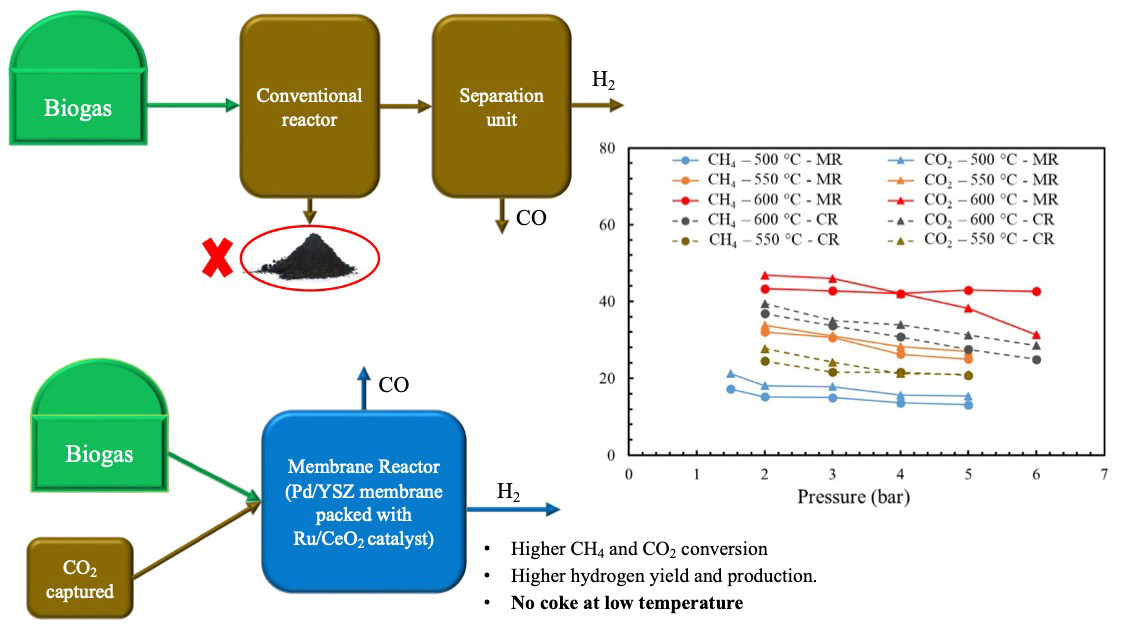
Graphical Abstract

1. Introduction

The continuous rise in global energy demand, alongside the escalating challenges of climate change, highlights the necessity for sustainable and low-carbon energy carriers [1,2,3,4]. Hydrogen (H2) has gained considerable attention as a clean energy vector capable of enabling decarbonization across different sectors, including transportation, power generation, and chemical manufacturing [5,6,7]. At present, hydrogen production is predominantly reliant on steam methane reforming (SMR), a process that is both energy-intensive and a major source of CO2 emissions. Consequently, the development of renewable-based hydrogen production pathways is critical for achieving climate mitigation targets and reducing dependency on fossil resources. Biogas, composed primarily of methane (CH4) and carbon dioxide (CO2) generated via the anaerobic digestion of organic substrates such as agricultural residues, municipal solid waste, and sewage sludge, represents a promising renewable feedstock [8,9,10]. Substantial quantities of biogas are already produced at wastewater treatment plants, landfills, and agricultural facilities. However, it is applied in low-efficiency processes such as direct combustion for heat. Reforming biogas to hydrogen offers a higher-value utilization pathway that aligns with circular economy principles by valorizing waste streams, lowering greenhouse gas emissions, and contributing to the production of carbon-neutral fuels. Among the available routes, biogas dry reforming (BDR [MDR and BDR are used interchangeably in this paper when referring to the process and reaction]) represents a promising thermochemical process that simultaneously converts the two most potent greenhouse gases, CO2 and CH4, into synthesis gas (a mixture of H2 and CO) via the so-called methane dry reforming (MDR1) reaction [11,12,13,14]. The MDR reaction is highly endothermic, proceeding at elevated temperatures (700–1000 °C) and pressures (15–30 bar), as shown in Equation (1) [15]:
CH4 + CO2↔2CO + 2H2    ΔH°298 = 247 kJ/mol
Despite its environmental and industrial advantages, BDR faces several critical challenges. The reaction is thermodynamically limited, leading to partial feed conversion. Additionally, the presence of both CO2 and CH4 under harsh reaction conditions promotes multiple side reactions (Equations (2)–(8)), including the reverse water–gas shift, methanation, the Boudouard reaction, and methane decomposition, which reduce syngas yield and accelerate carbon formation [13,16,17,18]. Among these, carbon deposition is the most critical issue, as it leads to catalyst deactivation and frequent regeneration cycles. This deactivation inhibits the scalability of BDR despite its promising potential for sustainable syngas production for industrial application [19,20,21]. Overcoming these challenges requires ongoing efforts toward enhanced catalyst design and process intensification strategies to improve both catalyst stability and reactor performance.
Side reactions:
CH4 + H2O↔CO + 3H2    ΔH°298 = 206 kJ/mol (methane steam reforming)
CO2 + H2↔CO + H2O    ΔH°298 = 41.4 kJ/mol (reverse water–gas shift reaction)
CO2 + 4H2↔CH4 + 2H2O    ΔH°298 = −165 kJ/mol (methanation reaction)
Carbon formation reactions:
2CO↔CO2 + C    ΔH°298 = −173 kJ/mol (Boudouard reaction)
CH4↔2H2 + C    ΔH°298 = 75 kJ/mol (methane decomposition)
CO + H2↔H2O + C    ΔH°298 = −131 kJ/mol (carbon formation via hydrogenation reaction)
CO2 + 2H2↔2H2O + C    ΔH°298 = −90 kJ/mol (carbon formation via hydrogenation reaction)
So far, both non-noble and noble catalysts have been studied for BDR [22]. Noble metal-based catalysts are particularly attractive due to their exceptional catalytic activity, thermal stability, and superior resistance to carbon deposition. These properties make them highly effective for maintaining long-term catalyst performance under the harsh conditions of dry reforming. However, their high cost and limited availability create significant economic constraints for large-scale applications. In contrast, non-noble metal catalysts, especially Ni-based systems, offer a cost-effective alternative and have demonstrated promising activity and syngas selectivity. Nevertheless, they are generally more susceptible to carbon formation and sintering, which leads to deactivation over time; thus, a more efficient catalyst should be developed. Additionally, the catalyst support plays a critical role that extends beyond providing a structural anchor for the active metal [23,24,25,26]. Among various supports, ceria (CeO2) has shown exceptional promise due to its ability to promote uniform metal dispersion and mitigate sintering of active metal particles. Furthermore, its redox properties enable the removal of surface carbon species via lattice oxygen participation. Indeed, CeO2 can readily release lattice oxygen through the reduction of Ce4+ to Ce3+, thereby enhancing the oxidation of intermediate carbon species and improving coke resistance and maintaining catalyst activity during dry reforming reactions [27,28,29,30,31].
While most research has focused on optimizing catalysts within conventional reactors (CRs) to enhance BDR performance and mitigate carbon deposition, integrating the reaction into a hydrogen-selective membrane reactor (MR) represents a promising process intensification strategy. This configuration simultaneously enhances conversion efficiency, hydrogen yield, and product selectivity, while suppressing undesired side reactions such as the reverse water–gas shift (Equation (3)) and methanation (Equation (4)), both of which lower overall system efficiency [14,32,33,34]. By continuously and selectively removing hydrogen from the reaction zone, the MR shifts the reaction equilibrium toward greater syngas formation, achieving higher reactant conversions under milder conditions. Moreover, this in-situ separation suppresses coke formation (Equations (5) and (6)), thereby sustaining catalyst activity and improving the long-term stability and performance of the intensified system [15]. Additionally, the MRs mainly operate at milder conditions than the CRs, which provide some benefits such as reduction in thermal severity, enabling lower material stress, improved membrane stability, and potential integration with decentralized biogas sources. However, the complete conversion could not be achieved at milder operating conditions, and hydrogen recovery in MR mainly depends on pressure [14,32,33,34].
Palladium-based alloy membranes are particularly well-suited for this thermochemical application due to their complete selectivity for hydrogen, thermal stability, and chemical resistance. As a result, Pd-based MRs have been studied for reactions [35,36,37,38]. Sumrunronnasak et al. [39] demonstrated that using a ternary Pd–Ag–Cu MR significantly enhanced both CH4 and CO2 conversion rates by 30% and 20%, respectively, at 550 °C, when compared to CRs. This was accompanied by an improvement in the H2/CO ratio, which increased from 0.6 to 1. Gallucci et al. [32] investigated MDR in a Pd–Ag MR at relatively low temperatures (400–450 °C), reporting 5% CO2 conversion and 15% CH4 conversion at 450 °C, with minimal impact on conversion when pressure was increased from 1.2 to 2 bar. Galuzka et al. [40] achieved 48% CH4 conversion and 63% CO2 conversion at 550 °C in a Pd/Al2O3 MR, outperforming CR (41% CH4 conversion, 57% CO2 conversion). They also reported an improvement in the H2/CO ratio from 0.84 in CR to 0.94 in MR, demonstrating the superior performance of MRs in promoting more efficient reactant consumption and minimizing side reactions. Additional studies by Bosko et al. [41] and Caravella et al. [42] have confirmed that Pd and Pd–Ag MRs offer higher CH4 conversion and hydrogen recovery compared to CRs, particularly with the use of Rh/La2O3 catalysts. Interestingly, Pd–Ag MRs also showed superior hydrogen permeation rates, leading to higher hydrogen recovery and better overall system performance.
The aim of this study is to evaluate the performance of a hydrogen-selective Pd-based MR for BDR reaction under milder operating conditions (500–600 °C, 1–6 bar) using a Ru/CeO2 catalyst and an equimolar CH4/CO2 feed compared with CR. In contrast to conventional biogas compositions (≈60/40 CH4/CO2), the feed was enriched with CO2 captured via Direct Air Capture to establish a closed-loop process that integrates carbon capture with renewable hydrogen generation. A model biogas/CO2-enriched without impurities was used to evaluate the intrinsic performance of the catalytic activity and membrane reactor, such as CH4 and CO2 conversion, hydrogen yield, and recovery. The investigation focuses on assessing how elevated pressure and in-situ hydrogen removal affect CH4 and CO2 conversions, H2 yield and selectivity, suppression of side reactions, and mitigation of carbon deposition. The findings provide new insights into the potential of Pd-based MRs as a viable and sustainable technology for low-carbon hydrogen production from biogas and recycled CO2 sources.

2. Materials and Methods

The Pd/YSZ composite membrane was manufactured by a thin layer of Pd deposition via electroless plating (ELP) on asymmetric yttria-stabilized zirconia (YSZ) support (4% Y2O3, 96% ZrO2), provided by Praxair Surface Technologies (Indianapolis, IN, USA). The Pd/YSZ membrane was characterized to have an active length of 17.6 cm, an OD of ~1 cm, and a thickness of 13 µm. The total active surface area was measured to be approximately 5.4 × 10⁻³ m2.
The Pd/YSZ membrane was packed with a commercial Ru-based catalyst to form MR, which was used for the experimental tests. The MR was heated using an ultra-high temperature heating tape, model STH051-080 (OMEGA Engineering, Norwalk, CT, USA). A thermocouple was inserted into the system via a K-type Omega. Aalborg and Brooks mass flow controllers were used to regulate the feed flow rate. The pressure on the retentate side was controlled with a Swagelok pressure regulator (Swagelok Company, Solon, OH, USA) and measured with a Swagelok EN 837-1 pressure gauge (Swagelok Company, Solon, OH, USA).
The MR was heated with a ramp of 2 °C/min by feeding both sides of the MR with N2 gas. After reaching the targeted temperature, pure hydrogen was fed to the system to activate both membrane and catalyst for 24 h. After this step, N2 was fed again to check that the membrane was still leak-free. Hydrogen permeation flux was measured using a bubble flow meter during the permeation and reaction tests.
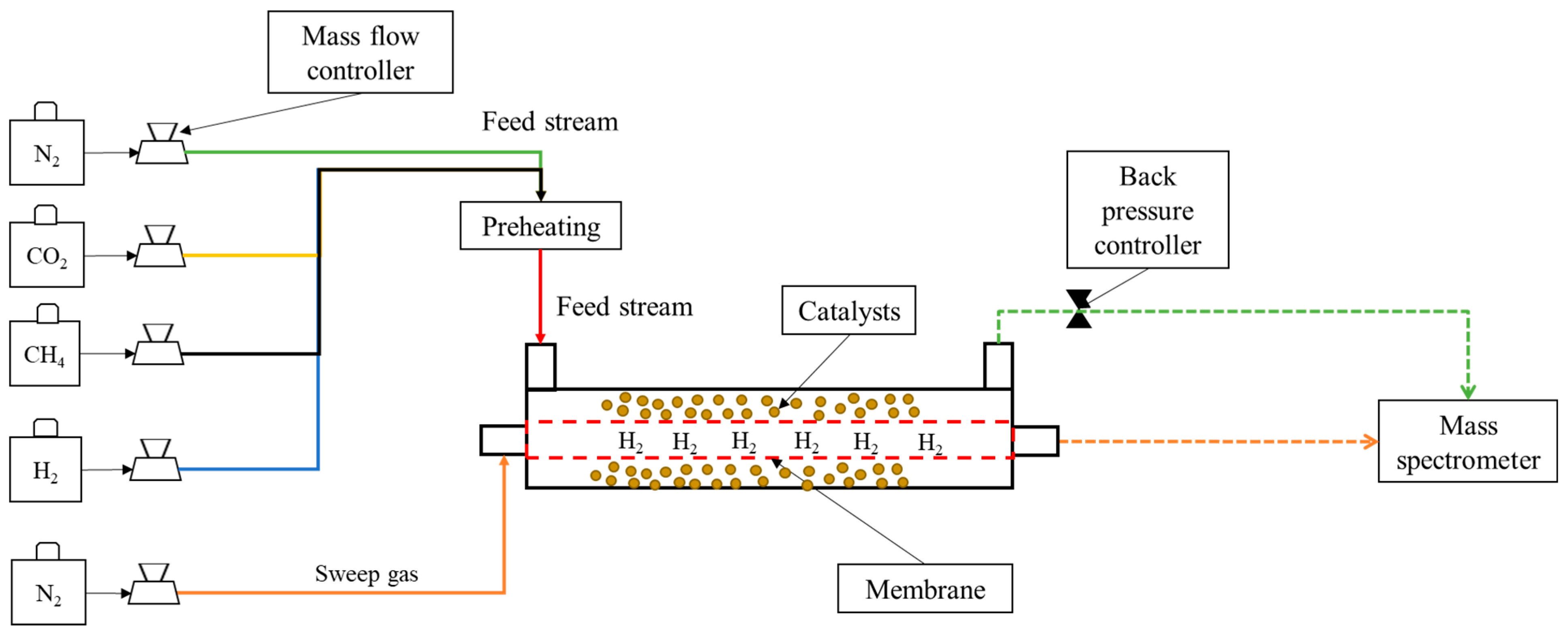
A schematic showing the Pd/YSZ MR used to carry out the R experiments is shown in Figure 1.
The membrane was characterized by permeation tests using pure H2 at the temperatures of 500, 550, and 600 °C and a pressure range of 1–2.2 bar, and N2 leak tests performed up to 6 bar before any reaction tests. Each gas permeating flux through the membrane was calculated using a bubble-flow meter with an average of 10 experimental points and a standard deviation of less than 1%.
The equations used to describe the permeation characteristics of the membrane are reported below:
J H 2 =   P H 2   p H 2 , retentate n p H 2 , permeate n
where JH2 is the hydrogen permeation flux through the membrane, PH2 is hydrogen permeance, p H 2 , retentate n and p H 2 , permeate n are hydrogen partial pressures in the retentate and permeate side, respectively, and n is the dependent factor, which shows the correlation between the H2 permeation and the driving force; this varies from 0.5 to 1 [43]. Hydrogen permeance depends on temperature and follows the Arrhenius-like equation.
P H 2 = P H 2 0   exp   ( Ea   RT )
P H 2 0   is the pre-exponential factor, Ea is the apparent activation energy, T is the absolute temperature, and R is the universal gas constant.
Also, hydrogen permeance is defined in Equation (11):
P H 2 = Pe H 2   δ
where Pe H 2 is hydrogen permeability, and δ is the membrane thickness.
After the H2 permeation tests, the BDR reaction tests were implemented to evaluate the performance of the MR. For the reaction tests, 5.4 g of commercial Ru-based catalyst was packed outside of the membrane, as shown in Figure 1. The equimolar ratio of CH4 and CO2 was used for the reaction. An Extrel Max-300LG mass spectrometer (MS) was used to evaluate the composition of the permeate and retentate streams for all experimental tests. The MS was tuned and calibrated to ensure accurate molar composition prior to the testing. Each point for the reaction test represents an average of 200 points.
The MR performance has been evaluated by the following equations.
CH 4   conversion   ( % ) = CH 4   in     CH 4   out CH 4   in × 100
CO 2   conversion   ( % ) = CO 2   in     CO 2   out CO 2   in × 100
H 2   recovery   ( % ) = H 2   permeate   H 2   permeate   + H 2   retentate   × 100
Total H2 production = H2 permeate + H2 retentate
H 2   yield   ( % ) = Total   H 2   production 2   CH 4   in
where CH4-in, CH4-out, CO2-in, CO2-out, H2-permeate, and H2-retentate are the inlet and outlet CH4, CO2, and H2 flow rates in the retentate and permeate sides, respectively. The amount of coke was also calculated through a carbon balance (Equation (17)).
Carbon accumulation(g) = Carbon in(g) – Carbon out(g)
Carbon in(g) referred to total grams of carbon entering the MR, and Carbon out(g) referred to the total carbon species (CO2, CH4, and CO) in the retentate and permeate sides. The carbon balance closure for all experiments was within 95–98%.
Table 1 summarizes the operating conditions used to conduct the BDR reaction in the Pd/YSZ MR.
* GHSV   ( h 1 ) = Volumetric   flow   rate   of   feed   gas   Mass   of   catalyst   bed  
where the volumetric flow rate of the feed gas is CH4 and CO2 total flow rates. Gas-phase carbon flow rates were converted to mass using molar flow rates and molecular weights.
Also, the same tests were performed in the CRs at the same operating conditions to compare the results with the MR performances.

3. Results and Discussion

3.1. H2 Permeation

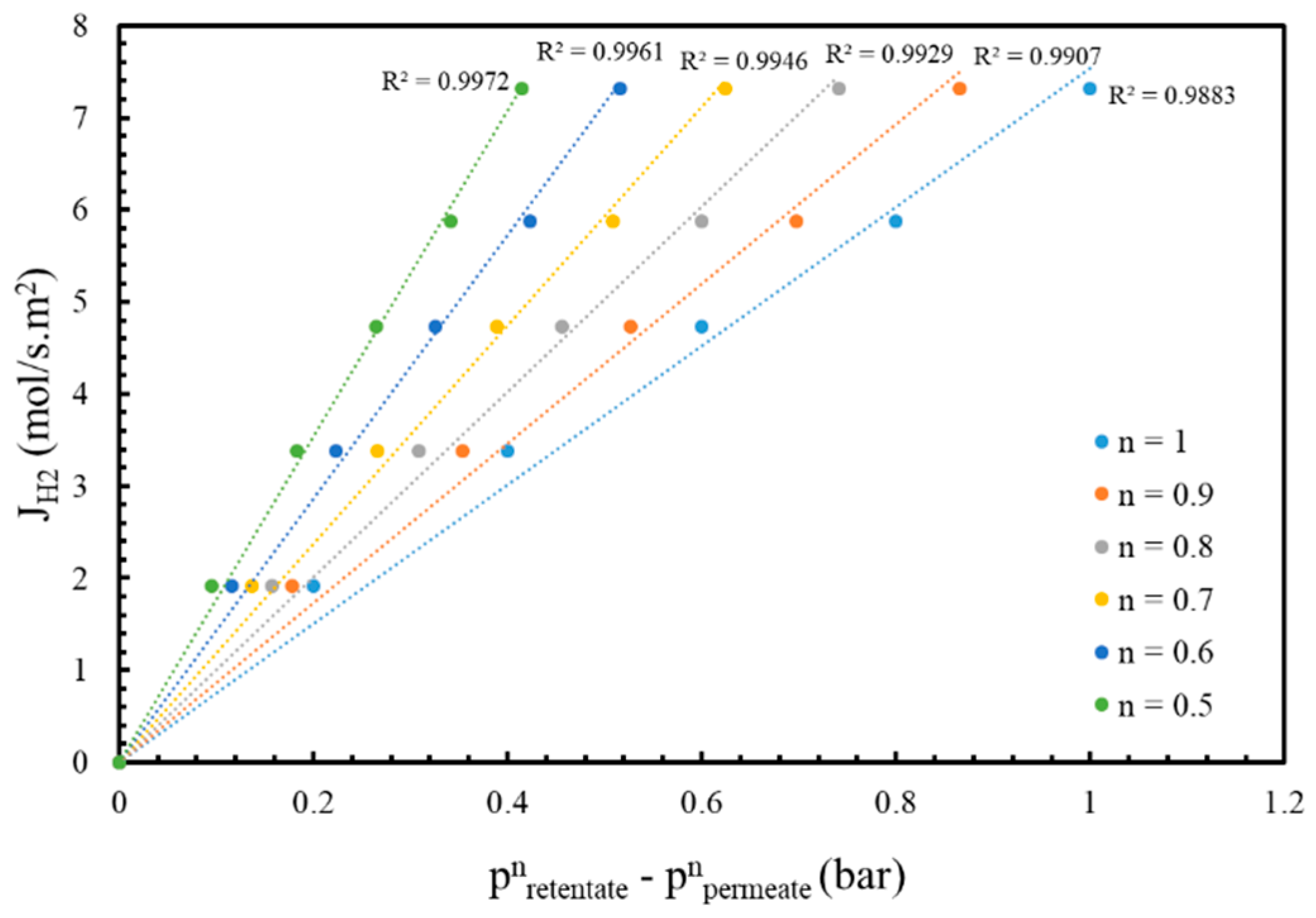
This section evaluates the permeation properties of the Pd/YSZ membrane, including the H2 permeation flux, H2 permeance, and the ‘n’ value. According to Equation (9), the ‘n’ value was determined by plotting the hydrogen permeation flux against the driving forces for different ‘n’ values ranging from 0.5 to 1. A linear regression analysis was then used to determine the highest R2-value, which corresponds to the optimal ‘n’ value. Therefore, tests were performed at 500 °C, and the results were plotted in Figure 2, which indicated that the ‘n’ value was equal to 0.5. Permeation tests were also performed at higher temperatures of 550 °C and 600 °C, and the n value was confirmed to be 0.5. Moreover, the hydrogen permeation flux increased with temperature, consistent with the Arrhenius-type behavior described by Equation (10). As shown in Table 2, the hydrogen permeance of this membrane was compared to the values reported in the literature, and the results from this study are in good agreement with previously reported data. The apparent activation energy and pre-exponential factor were determined to be 23.4 kJ/mol and 5.7·10−5 mol·m−2·s−1·Pa−1, respectively, which are consistent with the literature, shown in Table 3.

3.2. MR Performance

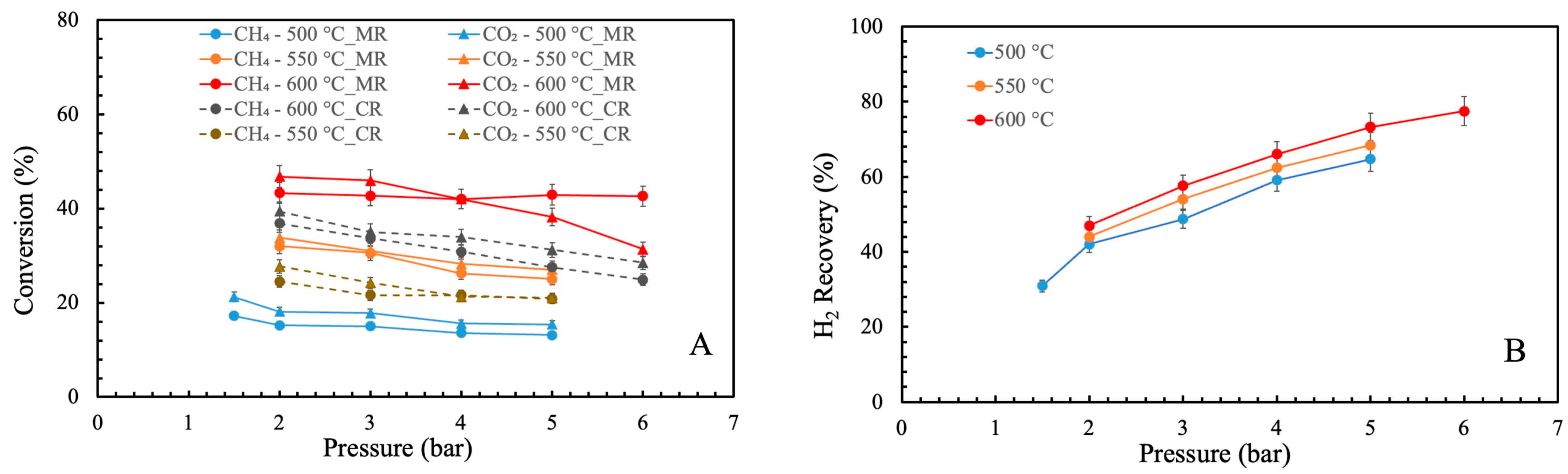
The BDR tests were conducted with a Ru/CeO2 catalyst to evaluate the performance of the Pd/YSZ MR. The same tests were repeated by using a CR. Figure 3A,B show the CH4 and CO2 conversions, and hydrogen recovery at different temperatures and pressures. As seen in Figure 3A, the Pd/YSZ MR has shown better performance in terms of CH4 and CO2 conversion in comparison with CR, due to the removal of hydrogen from the reaction zone, which shifts the reaction towards the consumption of more reactants. The MR indicated higher CH4 conversion by 8% at 550 °C and 7% at 600 °C, and CO2 conversion by 6% at 550 °C and 7% at 600 °C than CR at 2 bar. Also, the CH4 and CO2 conversions improved with the increase in temperature. Elevated temperature positively influences the system through different mechanisms: (1) the BDR reaction is endothermic, (2) catalyst activity increases at higher temperatures, and (3) elevated temperature facilitates hydrogen permeation, shifting the reaction towards the consumption of more reactants [32,33]. At 2 bar, the CH4 and CO2 conversions increased from 15.2% and 18.1% at 500 °C to 43% and 46.7% at 600 °C. At low temperature and at each pressure, CO2 conversion was higher than CH4 conversion due to the catalyst’s selectivity towards CO2. A similar trend has been reported in the previous studies [32,33,39]. However, at 600 °C and elevated pressure of 5 and 6 bar, CH4 showed higher conversion than CO2 due to the methane decomposition. Under these conditions, increased coke formation was observed. The amount of deposited carbon increased from approximately 0.5 g at 550 °C to 1.2 g at 600 °C, confirming the enhanced coking tendency at higher temperatures. The pressure increase has a dual impact on the BDR reaction in the MR, contributing both positive and negative effects on system performance. The positive effect is due to the presence of the membrane: the higher the pressure, the higher the hydrogen removal from the reaction zone, which shifts the reaction towards the consumption of more reactants. In contrast, the negative effect is due to the intrinsic thermodynamics of the BDR reaction, as the overall reaction takes place with an increase in mole number, which makes the process less favorable at elevated pressures, thereby limiting the conversion. In Figure 3A it is visible that the increase in pressure caused a slight reduction in both CH4 and CO2 conversion, indicating that the negative effect of thermodynamics was more dominant than the positive effect of the membrane. For example, the CH4 and CO2 conversion decreased from 32% and 34% at 2 bar to 25% and 27% at 5 bar, at 550 °C. Notably, the CH4 conversion did not decline above 5 bar at 600 °C and remained constant due to the increased occurrence of methane decomposition reactions, which was also favored by the presence of the membrane.
Another important parameter used to evaluate the performance of the MR is the hydrogen recovery. Figure 3B shows the hydrogen recovery in the MR at different temperatures and pressures. As seen, the increase in temperature and pressure positively affect the hydrogen recovery through the MR due to Equations (9) and (10). In addition, by increasing the temperature, the conversion of the reactants was improved at each pressure, due to both membrane and thermodynamic effects. At 600 °C, the hydrogen recovery was enhanced from 47% at 2 bar to 78% at 6 bar. This trend is consistent with what is reported in the literature [41,42].
Table 4 summarizes reported performances of Pd- and Pd–Ag-based MRs for BDR using various catalysts and operating conditions. Overall, CH4 conversions in the literature range from 10% to 50%, with H2 recoveries up to 62%, depending on membrane thickness, temperature, and pressure. In this work, a 13 μm Pd membrane coupled with a Ru/CeO2 catalyst achieved CH4 and CO2 conversions of 43% and 32%, respectively, and H2 recovery of 78% at 600 °C and 6 bar.
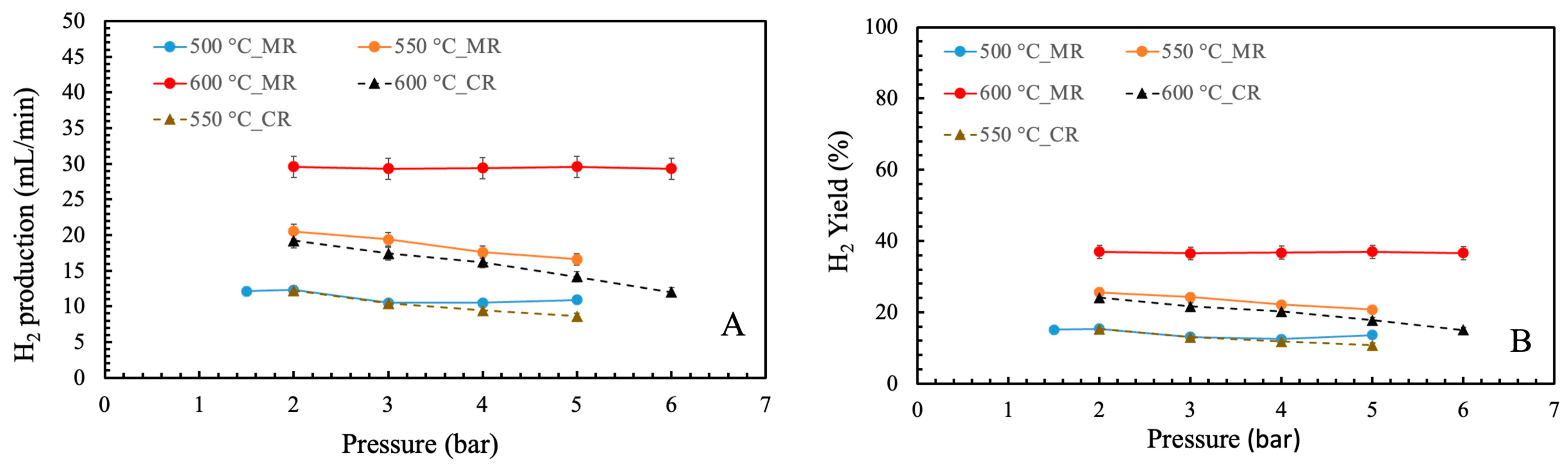
Figure 4A,B indicate the hydrogen production and yield against temperature and pressure. As can be seen, their trends are similar to CH4 conversion. The hydrogen production and yield were enhanced by an increase of temperature. For instance, at 2 bar the hydrogen production and yield were enhanced from 12.3 mL/min and 15.4% at 500 °C to 29.6 mL/min and 37% at 600 °C. However, they decreased with the increase of pressure due to a lower reactant conversion. In contrast, they both remained constant with the increase of pressure at 600 °C. The MR indicated higher hydrogen production and yield than CR when tests were performed at the same operating conditions. For example, hydrogen production and yield were 20.5 mL/min and 25.6% in MR, while they were 12.2 mL/min and 15.3%, respectively.
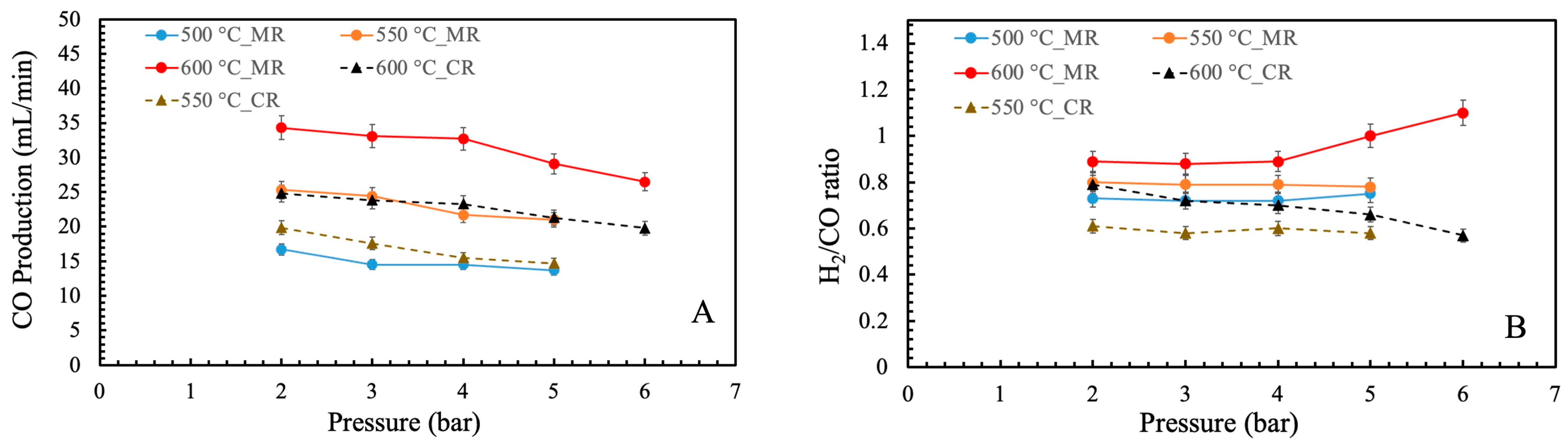
Figure 5A,B indicate CO production and the H2/CO ratio. The CO production was enhanced by the increase in temperature due to an improvement in the reactant conversion, while it declined with increasing pressure because of the reduction in conversion. Furthermore, CO production was lower in CR than in MR at similar operating conditions. This occurred due to lower CO2 conversion in the CR compared to the MR. Another key parameter in evaluating BDR performance is the H2/CO ratio, as it determines the suitability of the produced syngas for downstream applications. For instance, methanol synthesis requires an H2/CO ratio of approximately 2:1, whereas formaldehyde production typically operates near a 1:1 ratio. In this study, the H2/CO ratio increased with temperature, rising from 0.7 at 500 °C to 0.9 at 600 °C and 2 bar. At 600 °C and 6 bar, the ratio further approached unity, indicating that these operating conditions are favorable for generating syngas compositions suitable for formaldehyde synthesis. Moreover, MR exhibited a higher H2/CO ratio than the CR, reflecting the enhanced methane conversion and effective hydrogen removal achieved in the MR configuration. Finally, stable performance was achieved over multiple experiments conducted across a 30-day period.

3.3. Comparison of Ru/CeO2 and Ni/Al2O3 Catalyst

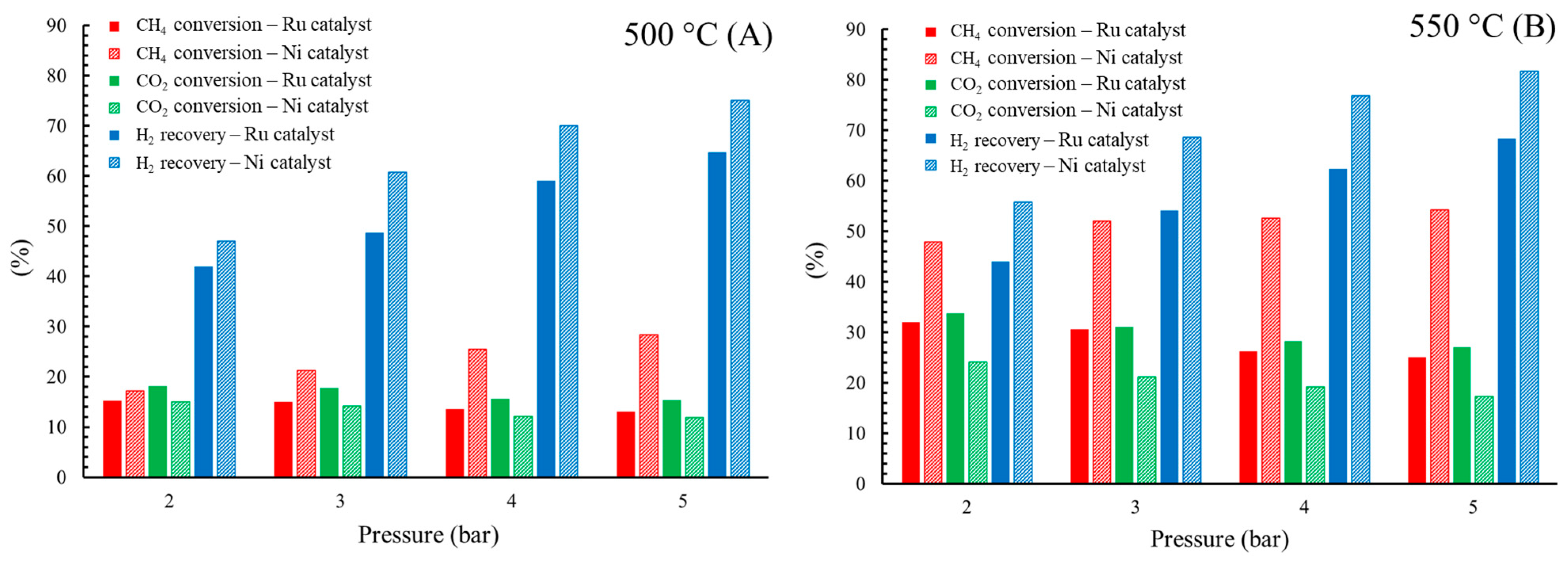
In this work, the Ru/CeO2 catalyst results were compared with those of a Ni/Al2O3 catalyst previously reported by the authors [15] in a Pd/YSZ MR under the same operating conditions. Figure 6 compares the catalytic performance of the Ru/CeO2 and Ni/Al2O3 systems in the Pd/YSZ MR. Overall, the Ni/Al2O3 catalyst exhibited higher CH4 conversion and hydrogen recovery, whereas the Ru/CeO2 catalyst achieved greater CO2 conversion at similar operating conditions. At 550 °C, the CH4 conversion obtained with the Ni/Al2O3 was approximately 20% higher than that with Ru/CeO2, reflecting the superior ability of Ni to activate C–H bonds and promote methane reforming pathways, thereby enhancing hydrogen generation and permeation through the membrane. In contrast, the Ru/CeO2 catalyst displayed lower CH4 conversion but significantly reduced carbon formation. This behavior can be attributed to the intrinsic properties of Ru combined with the oxygen storage and transfer capacity of CeO2, which collectively mitigate coke-forming reactions such as methane decomposition. The basicity of the CeO2 support further contributes to carbon suppression by favoring gasification of surface carbon species and maintaining active metallic sites. As a result, the Ru/CeO2 system demonstrated enhanced resistance to coking and improved long-term stability. The influence of pressure also differed between the two catalytic systems. For the Ni/Al2O3, CH4 conversion increased with pressure, indicating that methane decomposition was the dominant reaction pathway and that hydrogen removal through the membrane shifted the equilibrium toward further CH4 consumption. In contrast, the Ru/CeO2 catalyst exhibited a decrease in CH4 conversion with increasing pressure, consistent with the thermodynamic inhibition of the BDR reaction at elevated pressures. Nevertheless, the Ru/CeO2 catalyst maintained stable performance and minimized carbon deposition, confirming its suitability for sustained operation in membrane-assisted biogas reforming processes.
In terms of hydrogen recovery, the MR with the Ni catalyst indicated higher hydrogen recovery than the Ru catalyst due to greater methane conversion. On average, the hydrogen recovery was higher by 5% and 10% for 500 and 550, respectively. Additionally, the difference increases with higher pressure.
Furthermore, the results of Ru/CeO2 and Ni/Al2O3 catalysts are compared in Table 5 and Table 6 in terms of hydrogen production, hydrogen yield, CO production, and H2/CO ratio at similar operating conditions. The Ni/Al2O3 catalyst showed higher hydrogen production and yield due to greater methane conversion, with the difference between the two systems increasing at higher temperatures and pressures as methane decomposition became more dominant. In contrast, the Ru/CeO2 catalyst produced more CO, consistent with its tendency to promote the dry reforming pathway while suppressing coke-forming reactions. Finally, the amount of coke formation was significantly reduced by using Ru/CeO2 rather than Ni/Al2O3. For example, around 3 g of coke was produced by Ni/Al2O3 catalyst at 550 °C, but the coke formation was 0.5 g for Ru/CeO2 at similar conditions under 3 h for each reaction test.
From a catalysis point of view for dry reforming reaction, the elementary reaction steps differ significantly between Ni and Ru catalysts, leading to different catalytic performance. On Ni surfaces, methane activation proceeds through sequential C–H bond cleavage, with the first C–H dissociation identified as the rate-limiting step and associated with relatively high energy barriers. While Ni effectively dissociates CH4, it binds carbonaceous intermediates strongly, favoring their complete dissociation to surface carbon (C*). In parallel, CO2 activation on Ni is less efficient, occurring primarily at defect sites with higher energy barriers, which limits the supply of O* species required for carbon oxidation (C* + O* = CO*). This difference between rapid methane decomposition and sluggish CO2 dissociation results in significant carbon accumulation and catalyst deactivation. In contrast, Ru catalysts exhibit lower barriers for CH4 activation, facilitating faster C–H bond and easier hydrogen evolution, while also enabling more favorable CO2 activation through stronger Ru–O interactions that promote CO2* intermediates and enhance O* formation. The greater availability of reactive oxygen on Ru surfaces enhances carbon oxidation, thereby suppressing coke formation and maintaining long-term stability [55,56,57,58].
Moreover, Al2O3 and CeO2 supports have different performances in dry reforming reaction due to their different physicochemical properties. Al2O3 is largely inert toward CO2 activation and exhibits poor oxygen mobility. As a result, Ni/Al2O3 catalysts often suffer from rapid carbon accumulation and strong metal–support interactions, which can lead to reduced active site availability. In contrast, CeO2 provides unique redox properties through the reversible Ce4+/Ce3+ cycle, enabling oxygen vacancy formation and high oxygen storage capacity. These features facilitate CO2 activation and in-situ carbon oxidation (C* + O* = CO*), thereby enhancing coke resistance and catalyst stability [59,60,61,62,63].

4. Conclusions

In this study, the performance of a Pd/YSZ MR integrated with a Ru/CeO2 catalyst was evaluated under various operating conditions. The Pd/YSZ MR exhibited significantly higher methane conversion, up to 10% greater, compared to a CR under similar conditions. The results demonstrated that CH4 and CO2 conversions increased with temperature but decreased with pressure. The highest conversions of CH4 and CO2 were achieved, 43% and 46.7% at 2 bar, 600 °C, and a GHSV of 800 h−1. A maximum hydrogen recovery of 78% was observed at 6 bar, 600 °C, and 800 h−1. Hydrogen production and yield followed trends consistent with reactant conversions.
A comparative study between Ru/CeO2 and Ni/Al2O3 catalysts revealed that the Ni-based catalyst provided higher methane conversion but also led to coke formation. In contrast, the Ru/CeO2 catalyst effectively suppressed coke formation under identical conditions, indicating that the combination of Ru and CeO2 inhibits pathways responsible for carbon deposition.

Author Contributions

Conceptualization, S.L.; methodology, O.J.; investigation, O.J.; data analysis, O.J. and S.L.; material characterizations, O.J.; supervision; S.L.; funding acquisition, S.L. All authors have read and agreed to the published version of the manuscript.

Funding

This research was supported by the Alfred P. Sloan Foundation (Award: G-2023-19634).

Data Availability Statement

The original contributions presented in the study are included in the article. Further inquiries can be directed to the corresponding author.

Acknowledgments

The authors thank the Sloan Foundation and the Research Corporation for Science Advancement under the Scialog: Negative Emissions Science Initiative for their support.

Conflicts of Interest

The authors declare no conflicts of interest.

Abbreviations

BDRbiogas dry reforming
CRconventional reactor
ELPelectroless plating
GHGsgreenhouse gases
GHSVgas hourly space velocity
MRmembrane reactor
MDRmethane dry reforming
Runiversal gas constant
SMRsteam methane reforming
Symbols
Eaapparent activation energy
JH2hydrogen permeating flux
ndependence factor
PeH2hydrogen permeability
p H 2 , permeate n partial pressures in the permeate side
p H 2 , retentate n partial pressure in the retentate side
PH2hydrogen permeance
Pe0pre-exponential factor
δmembrane thickness
αideal selectivity

References

  1. Adejumo, M.; Jazani, O.; Shildebayev, T.; Liguori, S. Chapter Four—Efficient ammonia decomposition in membrane reactor for hydrogen separation, purification, storage, and utilization. In Progresses in Ammonia: Science, Technology and Membranes; Basile, A., Rahimpour, M.R., Eds.; Elsevier: Amsterdam, The Netherlands, 2024; pp. 67–94. [Google Scholar] [CrossRef]
  2. Gulzar, A.; Gulzar, A.; Ansari, M.B.; He, F.; Gai, S.; Yang, P. Carbon dioxide utilization: A paradigm shift with CO2 economy. Chem. Eng. J. Adv. 2020, 3, 100013. [Google Scholar] [CrossRef]
  3. Alper, E.; Orhan, O.Y. CO2 utilization: Developments in conversion processes. Petroleum 2017, 3, 109–126. [Google Scholar] [CrossRef]
  4. Valluri, S.; Claremboux, V.; Kawatra, S. Opportunities and challenges in CO2 utilization. J. Environ. Sci. 2022, 113, 322–344. [Google Scholar] [CrossRef]
  5. Tashie-Lewis, B.C.; Nnabuife, S.G. Hydrogen Production, Distribution, Storage and Power Conversion in a Hydrogen Economy—A Technology Review. Chem. Eng. J. Adv. 2021, 8, 100172. [Google Scholar] [CrossRef]
  6. Pal, D.B.; Singh, A.; Bhatnagar, A. A review on biomass based hydrogen production technologies. Int. J. Hydrogen Energy 2022, 47, 1461–1480. [Google Scholar] [CrossRef]
  7. Midilli, A.; Kucuk, H.; Topal, M.E.; Akbulut, U.; Dincer, I. A comprehensive review on hydrogen production from coal gasification: Challenges and Opportunities. Int. J. Hydrogen Energy 2021, 46, 25385–25412. [Google Scholar] [CrossRef]
  8. Jazani, O.; Adejumo, M.; Elharati, M.A.; Liguori, S. Low-Carbon Hydrogen Production via Ethanol Reforming Reactions in Membrane Reactors: Recent Advances and Future Directions. Energy Fuels 2024, 38, 19992–20014. [Google Scholar] [CrossRef]
  9. Saravanan, A.; Senthil kumar, P.; Vo, D.V.N.; Jeevanantham, S.; Bhuvaneswari, V.; Narayanan, V.A.; Yaashikaa, P.R.; Swetha, S.; Reshma, B. A comprehensive review on different approaches for CO2 utilization and conversion pathways. Chem. Eng. Sci. 2021, 236, 116515. [Google Scholar] [CrossRef]
  10. James, O.O.; Mesubi, A.M.; Ako, T.C.; Maity, S. Increasing carbon utilization in Fischer-Tropsch synthesis using H2-deficient or CO2-rich syngas feeds. Fuel Process. Technol. 2010, 91, 136–144. [Google Scholar] [CrossRef]
  11. Gao, Y.; Jiang, J.; Meng, Y.; Yan, F.; Aihemaiti, A. A review of recent developments in hydrogen production via biogas dry reforming. Energy Convers. Manag. 2018, 171, 133–155. [Google Scholar] [CrossRef]
  12. Usman, M.; Daud, W.M.A.W.; Abbas, H.F. Dry reforming of methane: Influence of process parameters—A review. Renew. Sustain. Energy Rev. 2015, 45, 710–744. [Google Scholar] [CrossRef]
  13. Parente, M.; Soria, M.A.; Madeira, L.M. Hydrogen and/or syngas production through combined dry and steam reforming of biogas in a membrane reactor: A thermodynamic study. Renew. Energy 2020, 157, 1254–1264. [Google Scholar] [CrossRef]
  14. Yoosefdoost, A.; Jazani, O.; Liguori, S.; Das, A.; Santos, R.M. Toward Carbon-Negative Methanol Production from Biogas: Intensified Membrane Reactor. ChemCatChem 2024, 17, e202400698. [Google Scholar] [CrossRef]
  15. Jazani, O.; Adejumo, M.; Liguori, S. Hydrogen production via biogas reforming reaction in tubular Pd/YSZ membrane reactor. Chem. Eng. J. 2025, 523, 168535. [Google Scholar] [CrossRef]
  16. Nishimura, A.; Takada, T.; Ohata, S.; Kolhe, M.L. Biogas Dry Reforming for Hydrogen through Membrane Reactor Utilizing Negative Pressure. Fuels 2021, 2, 194–209. [Google Scholar] [CrossRef]
  17. Leimert, J.M.; Karl, J.; Dillig, M. Dry reforming of methane using a nickel membrane reactor. Processes 2017, 5, 82. [Google Scholar] [CrossRef]
  18. Carapellucci, R.; Giordano, L. Steam, dry and autothermal methane reforming for hydrogen production: A thermodynamic equilibrium analysis. J. Power Sources 2020, 469, 228391. [Google Scholar] [CrossRef]
  19. Muraza, O.; Galadima, A. A review on coke management during dry reforming of methane. Int. J. Energy Res. 2015, 39, 1196–1216. [Google Scholar] [CrossRef]
  20. Pashchenko, D. Experimental study of methane reforming with products of complete methane combustion in a reformer filled with a nickel-based catalyst. Energy Convers. Manag. 2019, 183, 159–166. [Google Scholar] [CrossRef]
  21. Bach, V.R.; de Camargo, A.C.; de Souza, T.L.; Cardozo-Filho, L.; Alves, H.J. Dry reforming of methane over Ni/MgO–Al2O3 catalysts: Thermodynamic equilibrium analysis and experimental application. Int. J. Hydrogen Energy 2020, 45, 5252–5263. [Google Scholar] [CrossRef]
  22. Hou, Z.; Chen, P.; Fang, H.; Zheng, X.; Yashima, T. Production of synthesis gas via methane reforming with CO2 on noble metals and small amount of noble-(Rh-) promoted Ni catalysts. Int. J. Hydrogen Energy 2006, 31, 555–561. [Google Scholar] [CrossRef]
  23. Ferreira-Aparicio, P.; Rodrı, I.; Anderson, J.A.; Guerrero-Ruiz, A. Mechanistic aspects of the dry reforming of methane over ruthenium catalysts. Appl. Catal. A Gen. 2000, 202, 183–196. [Google Scholar] [CrossRef]
  24. Feng, J.; Ding, Y.; Guo, Y.; Li, X.; Li, W. Calcination temperature effect on the adsorption and hydrogenated dissociation of CO2 over the NiO/MgO catalyst. Fuel 2013, 109, 110–115. [Google Scholar] [CrossRef]
  25. Hua, W.; Jin, L.; He, X.; Liu, J.; Hu, H. Preparation of Ni/MgO catalyst for CO2 reforming of methane by dielectric-barrier discharge plasma. Catal. Commun. 2010, 11, 968–972. [Google Scholar] [CrossRef]
  26. Kwon, Y.; Eichler, J.E.; Floto, M.E.; Mullins, C.B. The complementary relationship between Ru/Al2O3 and Ni/Al2O3 catalyst for dry reforming of methane. Chem. Eng. Res. Des. 2023, 195, 624–636. [Google Scholar] [CrossRef]
  27. Djinović, P.; Črnivec, I.G.O.; Batista, J.; Levec, J.; Pintar, A. Catalytic syngas production from greenhouse gasses: Performance comparison of Ru-Al2O3 and Rh-CeO2 catalysts. Chem. Eng. Process. Process Intensif. 2011, 50, 1054–1062. [Google Scholar] [CrossRef]
  28. Odedairo, T.; Chen, J.; Zhu, Z. Metal–support interface of a novel Ni–CeO2 catalyst for dry reforming of methane. Catal. Commun. 2013, 31, 25–31. [Google Scholar] [CrossRef]
  29. Chen, W.; Zhao, G.; Xue, Q.; Chen, L.; Lu, Y. High carbon-resistance Ni/CeAlO3-Al2O3 catalyst for CH4/CO2 reforming. Appl. Catal. B 2013, 136–137, 260–268. [Google Scholar] [CrossRef]
  30. Manan, W.N.; Isahak, W.N.R.W.; Yaakob, Z. CeO2-Based Heterogeneous Catalysts in Dry Reforming Methane and Steam Reforming Methane: A Short Review. Catalysts 2022, 12, 452. [Google Scholar] [CrossRef]
  31. Sorbino, G.; Di Benedetto, A.; Italiano, C.; Thomas, M.; Vita, A.; Ruoppolo, G.; Landi, G. Novel Ni–Ru/CeO2 catalysts for low-temperature steam reforming of methane. Int. J. Hydrogen Energy 2025, 137, 961–975. [Google Scholar] [CrossRef]
  32. Gallucci, F.; Tosti, S.; Basile, A. Pd-Ag tubular membrane reactors for methane dry reforming: A reactive method for CO2 consumption and H2 production. J. Memb. Sci. 2008, 317, 96–105. [Google Scholar] [CrossRef]
  33. García-García, F.R.; Soria, M.A.; Mateos-Pedrero, C.; Guerrero-Ruiz, A.; Rodríguez-Ramos, I.; Li, K. Dry reforming of methane using Pd-based membrane reactors fabricated from different substrates. J. Memb. Sci. 2013, 435, 218–225. [Google Scholar] [CrossRef]
  34. Mamivand, S.; Binazadeh, M.; Sohrabi, R. Applicability of membrane reactor technology in industrial hydrogen producing reactions: Current effort and future directions. J. Ind. Eng. Chem. 2021, 104, 212–230. [Google Scholar] [CrossRef]
  35. Jazani, O.; Adejumo, M.; Liguori, S. Chapter 3—Alcohol reforming processes in membrane reactors. In Current Trends and Future Developments on (Bio-) Membranes; Basile, A., Ghasemzadeh, K., Eds.; Elsevier: Amsterdam, The Netherlands, 2025; pp. 51–79. [Google Scholar] [CrossRef]
  36. Jazani, O.; Elharati, M.A.; Liguori, S. Effects of Porous Supports and Binary Gases on Hydrogen Permeation in Pd-Ag-Y Alloy Membrane. J. Memb. Sci. 2024, 713, 123327. [Google Scholar] [CrossRef]
  37. Jazani, O.; Bennett, J.; Liguori, S. Carbon-low, renewable hydrogen production from methanol steam reforming in membrane reactors—A review. Chem. Eng. Process. Process Intensif. 2023, 189, 109382. [Google Scholar] [CrossRef]
  38. Minardi, E.R.; Chakraborty, S.; Curcio, S. Membrane reactors for dry reforming of methane. In Membrane Reactors for Energy Applications and Basic Chemical Production; Elsevier Inc.: Amsterdam, The Netherlands, 2015; pp. 99–104. [Google Scholar] [CrossRef]
  39. Sumrunronnasak, S.; Tantayanon, S.; Kiatgamolchai, S.; Sukonket, T. Improved hydrogen production from dry reforming reaction using a catalytic packed-bed membrane reactor with Ni-based catalyst and dense PdAgCu alloy membrane. Int. J. Hydrogen Energy 2016, 41, 2621–2630. [Google Scholar] [CrossRef]
  40. Galuszka, J.; Pandey, R.N.; Ahmed, S. Methane conversion to syngas in a palladium membrane reactor. Catal. Today 1998, 46, 83–89. [Google Scholar] [CrossRef]
  41. Bosko, M.L.; Múnera, J.F.; Lombardo, E.A.; Cornaglia, L.M. Dry reforming of methane in membrane reactors using Pd and Pd-Ag composite membranes on a NaA zeolite modified porous stainless steel support. J. Memb. Sci. 2010, 364, 17–26. [Google Scholar] [CrossRef]
  42. Caravella, A.; Brunetti, A.; Grandinetti, M.; Barbieri, G. Dry reforming of methane in a Pd-Ag membrane reactor: Thermodynamic and experimental analysis. ChemEngineering 2018, 2, 48. [Google Scholar] [CrossRef]
  43. Jazani, O.; Bennett, J.; Liguori, S. Effect of temperature, air exposure and gas mixture on Pd82–Ag15–Y3 membrane for hydrogen separation. Int. J. Hydrogen Energy 2023, 51, 624–636. [Google Scholar] [CrossRef]
  44. Yolcular, S. Hydrogen recovery from methylcyclohexane as a chemical hydrogen carrier using a palladium membrane reactor. Energy Sources Part A Recovery Util. Environ. Eff. 2016, 38, 2148–2152. [Google Scholar] [CrossRef]
  45. Tong, J.; Su, L.; Kashima, Y.; Shirai, R.; Suda, H.; Matsumura, Y. Simultaneously Depositing Pd–Ag Thin Membrane on Asymmetric Porous Stainless Steel Tube and Application To Produce Hydrogen from Steam Reforming of Methane. Ind. Eng. Chem. Res. 2006, 45, 648–655. [Google Scholar] [CrossRef]
  46. Su, C.; Jin, T.; Kuraoka, K.; Matsumura, Y.; Yazawa, T. Thin Palladium Film Supported on SiO2-Modified Porous Stainless Steel for a High-Hydrogen-Flux Membrane. Ind. Eng. Chem. Res. 2005, 44, 3053–3058. [Google Scholar] [CrossRef]
  47. Bosko, M.L.; Ojeda, F.; Lombardo, E.A.; Cornaglia, L.M. NaA zeolite as an effective diffusion barrier in composite Pd/PSS membranes. J. Memb. Sci. 2009, 331, 57–65. [Google Scholar] [CrossRef]
  48. Mardilovich, P.P.; She, Y.; Ma, Y.H.; Rei, M.-H. Defect-free palladium membranes on porous stainless-steel support. AIChE J. 1998, 44, 310–322. [Google Scholar] [CrossRef]
  49. Liguori, S.; Iulianelli, A.; Dalena, F.; Pinacci, P.; Drago, F.; Broglia, M.; Huang, Y.; Basile, A. Performance and Long-Term Stability of Pd/PSS and Pd/Al2O3 Membranes for Hydrogen Separation. Membranes 2014, 4, 143–162. [Google Scholar] [CrossRef]
  50. Wu, L.-Q.; Xu, N.; Shi, J. Preparation of a Palladium Composite Membrane by an Improved Electroless Plating Technique. Ind. Eng. Chem. Res. 2000, 39, 342–348. [Google Scholar] [CrossRef]
  51. Keuler, J.N.; Lorenzen, L.; Miachon, S. Preparing and testing Pd films of thickness 1–2 micrometer with high selectivity and high hydrogen permeance. Sep. Sci. Technol. 2002, 37, 379–401. [Google Scholar] [CrossRef]
  52. Simakov, D.S.A.; Román-Leshkov, Y. Highly efficient methane reforming over a low-loading Ru/Γ-Al2O3 catalyst in a Pd-Ag membrane reactor. AIChE J. 2018, 64, 3101–3108. [Google Scholar] [CrossRef]
  53. Silva, F.A.; Hori, C.E.; Da Silva, A.M.; Mattos, L.V.; Múnera, J.; Cornaglia, L.; Noronha, F.B.; Lombardo, E. Hydrogen production through CO2 reforming of CH4 over Pt/CeZrO2/Al2O3 catalysts using a Pd–Ag membrane reactor. Catal. Today 2012, 193, 64–73. [Google Scholar] [CrossRef]
  54. Coronel, L.; Múnera, J.F.; Lombardo, E.A.; Cornaglia, L.M. Pd based membrane reactor for ultra pure hydrogen production through the dry reforming of methane. Experimental and modeling studies. Appl. Catal. A Gen. 2011, 400, 185–194. [Google Scholar] [CrossRef]
  55. Ke, C.; Lin, Z. Elementary reaction pathway study and a deduced macrokinetic model for the unified understanding of Ni-catalyzed steam methane reforming. React. Chem. Eng. 2020, 5, 873–885. [Google Scholar] [CrossRef]
  56. Yu, J.; Le, T.; Jing, D.; Stavitski, E.; Hunter, N.; Lalit, K.; Leshchev, D.; Resasco, D.E.; Sargent, E.H.; Wang, B.; et al. Balancing elementary steps enables coke-free dry reforming of methane. Nat. Commun. 2023, 14, 7514. [Google Scholar] [CrossRef]
  57. Qu, P.-F.; Wang, G.-C. A Comprehensive Mechanistic Study for Dry Reforming of Methane over CeO2-Supported TM4 clusters (TM = Ru, Pt, Co, Ni). ACS Appl. Mater. Interfaces 2024, 16, 66052–66065. [Google Scholar] [CrossRef] [PubMed]
  58. Moreno, A.Á.; Ramirez-Reina, T.; Ivanova, S.; Roger, A.-C.; Centeno, M.Á.; Odriozola, J.A. Bimetallic Ni–Ru and Ni–Re Catalysts for Dry Reforming of Methane: Understanding the Synergies of the Selected Promoters. Front. Chem. 2021, 9, 694976. [Google Scholar] [CrossRef]
  59. Yang, E.; Nam, E.; Lee, J.; Lee, H.; Park, E.D.; Lim, H.; An, K. Al2O3-Coated Ni/CeO2 nanoparticles as coke-resistant catalyst for dry reforming of methane. Catal. Sci. Technol. 2020, 10, 8283–8294. [Google Scholar] [CrossRef]
  60. Jin, B.; Shang, Z.; Li, S.; Jiang, Y.-B.; Gu, X.; Liang, X. Reforming of methane with carbon dioxide over cerium oxide promoted nickel nanoparticles deposited on 4-channel hollow fibers by atomic layer deposition. Catal. Sci. Technol. 2020, 10, 3212–3222. [Google Scholar] [CrossRef]
  61. Lorber, K.; Zavašnik, J.; Arčon, I.; Huš, M.; Teržan, J.; Likozar, B.; Djinović, P. CO2 Activation over Nanoshaped CeO2 Decorated with Nickel for Low-Temperature Methane Dry Reforming. ACS Appl. Mater. Interfaces 2022, 14, 31862–31878. [Google Scholar] [CrossRef]
  62. Hepburn, C.; Adlen, E.; Beddington, J.; Carter, E.A.; Fuss, S.; Dowell, N.M.; Minx, J.C.; Smith, P.; Williams, C.K. The technological and economic prospects for CO2 utilization and removal. Nature 2019, 575, 87–97. [Google Scholar] [CrossRef] [PubMed]
  63. Lucas, J.; Naveen, N.S.P.; Janik, M.J.; Alexopoulos, K.; Noh, G.; Aireddy, D.; Ding, K.; Dorman, J.A.; Dooley, K.M. Improved Selectivity and Stability in Methane Dry Reforming by Atomic Layer Deposition on Ni-CeO2–ZrO2/Al2O3 Catalysts. ACS Catal. 2024, 14, 9115–9133. [Google Scholar] [CrossRef]
Figure 1. Experimental setup for the BDR reaction performed in Pd/YSZ MR.
Membranes 16 00034 g001
Figure 2. Hydrogen permeation flux vs different pressures and ‘n’ value at 500 °C.
Membranes 16 00034 g002
Figure 3. (A) CH4 and CO2 conversion and (B) H2 recovery vs. pressure and temperature.
Membranes 16 00034 g003
Figure 4. (A) H2 production, (B) H2 yield vs. pressure and temperature.
Membranes 16 00034 g004
Figure 5. (A) CO production and (B) H2/CO ratio vs. pressure and temperature.
Membranes 16 00034 g005
Figure 6. Comparison of Ru/CeO2 and Ni/Al2O3 catalyst in Pd/YSZ MR at (A) 500 °C and (B) 550 °C.
Membranes 16 00034 g006
Table 1. Operating conditions for BDR reaction tests.
Operating Conditions
CH4/CO2 molar ratio = 1/1
Pressure (bar) = 1–6
Temperature (°C) = 500–600
GHSV* (h−1) = 800
Catalyst mass (g) = 5.4
Total feed flow rate (mL/min) = 80
Sweep gas flow rate (mL/min) = 30
Sweep gas = N2
Table 2. H2 permeance results comparison with the literature.
Membrane Thickness   ( μ m ) Preparation MethodT (°C)H2 Permeance
(mol.m−2.s−1.Pa−1)
Ref
Pd/TiO213ELP3751.6 × 10−6[44]
Pd/PSS6ELP5502 × 10−6[45]
Pd/SiO2/PSS6ELP5002.7 × 10−6[46]
Pd/PSS19ELP4501.1 × 10−6[47]
Pd/YSZ13ELP5001.4 × 10−6This work
Pd/YSZ13ELP5501.7 × 10−6This work
Pd/YSZ13ELP6001.8 × 10−6This work
Table 3. Ea comparison with the literature.
Membrane Thickness   ( μ m ) Ea (kJ/mol)Ref
Pd/Al2O34.518.3[46]
Pd/PSS2016.4[48]
Pd/PSS1014.7[49]
Pd/TiO20.421.2[50]
Pd/Al2O3618.5[51]
Pd/YSZ1323.4This work
Table 4. Results of this work compared with the literature.
Membrane Thickness   ( μ m )CatalystT (°C)P (Bar)CH4
Conversion (%)
CO2
Conversion (%)
H2 Recovery (%)Ref
Pd22Ru/ZrO2/La2O3400110--[33]
Pd22Ru/ZrO2/La2O3450126--[33]
Pd–Ag100Ru/Al2O3500222-17[42]
Pd20Rh/La2O3450117-47[41]
Pd20Rh/La2O3500125-60[41]
Pd–Ag23Rh/La2O3450115-62[41]
Pd–Ag5Ru/Al2O365085020-[52]
Pd–Ag50Pt/CeZrO2/Al2O3550144--[53]
Pd–Ag50Rh/La2O3550140--[54]
Pd13Ru/CeO25002151842This work
Pd13Ru/CeO26006433278This work
The - symbol is used to indicate that CH4 and CO2 conversion values are not reported in the referenced work.
Table 5. Comparison of Ru/CeO2 and Ni/Al2O3 catalyst in Pd/YSZ MR at 500 °C.
PressureH2 Production
(mL/min)
CO Production (mL/min)H2 Yield (%)H2/CO Ratio
NiRuNiRuNiRuNiRu
214.412.31216.71915.41.20.73
315.110.510.114.519.913.11.50.72
416.610.58.914.421.812.51.90.72
51710.98.613.722.313.220.75
Table 6. Comparison of Ru/CeO2 and Ni/Al2O3 catalyst in Pd/YSZ MR at 550 °C.
PressureH2 Production
(mL/min)
CO Production (mL/min)H2 Yield (%)H2/CO Ratio
NiRuNiRuNiRuNiRu
230.120.51225.339.625.62.50.8
33319.41124.443.324.230.79
433.917.69.921.744.622.13.40.78
535.116.692146.220.73.90.78
Disclaimer/Publisher’s Note: The statements, opinions and data contained in all publications are solely those of the individual author(s) and contributor(s) and not of MDPI and/or the editor(s). MDPI and/or the editor(s) disclaim responsibility for any injury to people or property resulting from any ideas, methods, instructions or products referred to in the content.