
Next Article in Journal
Silicalite Nanosheet Laminated Membranes: Effects of Layered Structure on the Performance in Pervaporation Desalination
Previous Article in Journal
Lattice Boltzmann Simulation of Mass Transfer Characteristics in Catalyst Layer of High-Temperature Proton Exchange Membrane Fuel Cells
Previous Article in Special Issue
Recycled Polystyrene as a Sustainable Material for Hollow Fiber Membranes in Dye Filtration
error_outline You can access the new MDPI.com website here. Explore and share your feedback with us.
 
 
Article

Development of Chitosan Polymer Membranes with Potential Use in Filtration Processes

by
Ana Luisa Aguilar-Ruiz
1,
Tomás Jesús Madera-Santana
2,
Reyna G. Sánchez-Duarte
1,*,
Yedidia Villegas-Peralta
1,*,
Ana Alejandra Aguilar-Ruiz
1 and
Víctor Manuel Orozco-Carmona
3
1
Departamento de Ciencias del Agua y Medio Ambiente, Instituto Tecnológico de Sonora, 5 de Febrero 818 Sur, Ciudad Obregón 85000, Sonora, Mexico
2
Coordinación de Tecnología de Alimentos de Origen Vegetal, Centro de Investigación en Alimentación y Desarrollo, A.C. Carr. Gustavo E. Astiazarán No. 46, Hermosillo 83304, Sonora, Mexico
3
Centro de Investigación en Materiales Avanzados S.C., Ave. Miguel de Cervantes 120, Complejo Industrial Chihuahua, Chihuahua 31136, Chihuahua, Mexico
*
Authors to whom correspondence should be addressed.
Membranes 2026, 16(1), 31; https://doi.org/10.3390/membranes16010031
Submission received: 1 December 2025 / Revised: 16 December 2025 / Accepted: 18 December 2025 / Published: 4 January 2026

Abstract

Polymeric membranes based on chitosan (Cs) were extracted from shrimp shells and evaluated. These membranes were modified using polyethylene glycol (PEG), polyvinylpyrrolidone (PVP), and glycerol (Gly) and crosslinked with glutaraldehyde (GA) to examine their suitability for water filtration processes. The Cs exhibited high purity, a total nitrogen content of 6.49%, and an average molecular weight of 456 kDa, all of which are suitable for membrane formation. Four membranes (Cs-GA, B2: Cs-PEG, B5: Cs-PEG-PVP, and B7: Cs-Gly) were characterized by means of FTIR, SEM, AFM, thickness, contact angle, tensile testing, TGA, DSC, and filtration with distilled water at 4.83 bar. B2 and B5 showed thicknesses of 207 and 190 μm and contact angles of 56.7° and 58.9°, lower than that of Cs-GA (89.4°). In filtration, B2 achieved a flux of 2222.70 LMH, a permeance of 460.19 LMH·bar−1, and a hydraulic resistance of 8.79 × 10¹¹ m−1, while Cs-GA, B5, and B7 exhibited fluxes of 24.10, 40.43, and 24.77 LMH, respectively, permeances of 9.75, 8.37, and 5.13 LMH·bar−1, and hydraulic resistances of 4.15 × 10¹³, 4.83 × 10¹³, and 7.89 × 10¹³ m−1, in the same order. Overall, membranes B2 and B5 are recognized as the most promising for water filtration under pressured operating conditions.

1. Introduction

Water is an essential resource for human survival and development, as it is used for direct consumption, hygiene, and sanitation. Approximately 70% of the Earth’s surface is covered by water. This total volume is 97.5% saltwater found in seas and oceans, while only 2.5% is available freshwater; approximately 79% is frozen in glaciers, and about 30% exist as groundwater. Only 1% of the total freshwater, which is equivalent to 0.025% of all of the water on the planet, is available in rivers, lakes, and other surface water bodies that can be accessed for human consumption [1]. It is worth noting that most of this freshwater is used for agriculture and livestock farming, followed by industrial and energy generation sectors [2,3]. However, the repeated use of water bodies as final receptacles for various waste streams has led to a significant decline in water quality, compromising its availability and sustainable use [4].
Water quality degradation is mainly due to the persistent discharge of chemical and biological pollutants into different aquatic systems, as well as the increasingly limited availability of the resource, attributed to population growth, accelerated urbanization, industrial expansion, and the progressive decrease in rainfall regimes observed in various regions of the world as a climate change consequence [5,6]. Water scarcity is one of the most significant problems globally; up to 40% of the world’s population faces severe scarcity [3]. This phenomenon has motivated numerous research projects aimed at finding alternatives that efficiently and sustainably improve water quality from various sources, enabling its reuse or allocation to different uses [7]. Alternatives to mitigate water scarcity include two main categories: thermal and membrane-based processes. These separation technologies stand out not only for their efficiency but also for their promotion of an environmental sustainability perspective [8,9]. In recent decades, desalination processes have gained significant importance, enabling the use of 97% of previously underutilized seawater to meet human, agricultural, and industrial demands. Currently, reverse osmosis (RO) is one of the most widely used technologies for water desalination and producing potable water from rivers, lakes, wells, and other sources [10].
The reverse osmosis (RO) process consists of a system that forces a fluid under pressure through a semi-permeable membrane. These systems are notable for their high efficiency, compact design, and operational flexibility. However, RO has limitations related to its high energy requirements and susceptibility to membrane fouling/biofouling, factors that significantly reduce treated water recovery efficiency and increase operating expenses from 25 to 50% [11]. The most commonly used materials for membrane fabrication in separation processes, such as desalination, are resistant, semipermeable polymers, including polyamide and, to a lesser extent, cellulose acetate [12]. However, a growing interest has emerged in using biopolymers as base materials for membrane production. Chitosan (Cs) has gained significant attention due to its biocompatibility, antimicrobial properties, and extensive chemical functionality, which enable modifying its polymer chain. Nevertheless, Cs films exhibit mechanical limitations and a marked hydrophilic tendency, which compromise the balance between flow, selectivity, and long-term stability [13].
Chitosan (Cs) is a natural polysaccharide containing primary amino and hydroxyl groups along its chain, which confer high chemical reactivity. Furthermore, it is insoluble in most organic solvents, expanding its potential applications. These characteristics have made chitosan a versatile base for developing new materials—for example, cross-linked membranes—in biotechnology, biomedicine, agriculture, and filtration processes [14,15].
To overcome Cs limitations, various polymer grafts can be incorporated, and crosslinking agents can be used to modify the polymer chain density, porosity, surface wettability, and mechanical properties of the material. Hydrophilic polymers such as polyethylene glycol (PEG), polyvinylpyrrolidone (PVP), and glycerol (Gly) act as pore formers or plasticizers by improving chain compatibility and mobility, thereby promoting controlled porosity and affinity. On the other hand, adjusting the proportions of crosslinkers, such as glutaraldehyde (GA), strengthens the Cs polymer network and increases its chemical stability [16,17,18].
In the present work, Cs-based membranes were prepared by incorporating PEG, PVP, and Gly with GA used as a crosslinking agent. FTIR was used to characterize chitosan; molecular weight was determined by means of capillary viscometry, and total nitrogen, moisture, and ash content were measured. The impact of processing on membrane morphology was examined using SEM and AFM analyses. Thickness, wettability (contact angle), and mechanical and thermal behavior were also evaluated using TGA and DSC analyses. Finally, membrane performance was assessed in filtration tests using permeate flux (J), permeance (Lp), and hydraulic resistance (R).

2. Materials and Methods

The chemicals used in the present investigation were as follows: poly(ethylene glycol) with a molecular weight of 20 kDa, obtained from Merck (Darmstadt, Germany); polyvinylpyrrolidone with an approximate molecular weight of 29 kDa; glutaraldehyde solution (25%, Mw = 100.12 g·mol−1); sodium hydroxide (NaOH, reagent grade, 97%); and glycerol (reagent grade, ≥99.5%) all sourced from Sigma-Aldrich (St. Louis, MO, USA). Additionally, glacial acetic acid (CH3COOH, reagent grade 99.5%) was purchased from Fermont (Monterrey, México). Distilled water was used in all preparations. The abbreviations used throughout the manuscript are chitosan (Cs), poly (ethylene glycol) (PEG), glutaraldehyde solution (GA), polyvinylpyrrolidone (PVP) and glycerol (Gly).

2.1. Chitosan Production

Chitosan (Cs) was obtained from shrimp waste by alkaline hydrolysis, following the methodology of Sánchez-Duarte et al. [19]. Before the alkaline hydrolysis, shrimp waste was manually separated to remove the legs and tails, leaving only the shells. Subsequently, the shells were boiled in water at 90 °C for 5 min, drained, and dried in an oven at 60 °C. Once dry, they were stored until processing. The process of converting chitin to chitosan was performed in the following stages: (a) Demineralization: dry shells were treated with 1 M HCl for 4 h with constant stirring, then washed with water until a neutral pH was reached; (b) Deproteinization: after the demineralization process, the shell was treated with 4.5% (w/v) NaOH at 65 °C for 4 h with constant stirring, then washed with water until a neutral pH was reached; (c) Alkaline deacetylation: finally, the shell was treated with 45% (w/v) NaOH at 110 °C for 2 h with constant stirring to convert chitin into chitosan. The resulting chitosan (Cs) was washed with sufficient water until neutral stage and left to dry at room temperature for subsequent storage.

2.2. Chitosan Characterization

2.2.1. Moisture and Ash Content

Following the AOAC [20] method, moisture content was determined by oven drying. A 0.2 g sample of Cs was placed in Petri dishes and dried at 40 ± 1 °C for 24 h. Moisture content was calculated from mass loss; Petri dishes were preheated to constant weight by heating at 110 ± 1 °C for 12 h; then, they were cooled for 20 min and weighed. Ash content was measured gravimetrically: after carbonizing 0.5 g of chitosan in a porcelain crucible; the residues were transferred to a muffle furnace at 600 °C for 12 h. Finally, ash percentage was calculated on a dry basis. All measurements were performed in triplicate.

2.2.2. Molecular Weight and Deacetylation Degree (DD)

Chitosan molecular weight was determined by capillary viscometry using the method described by Solís et al. [21], with minor modifications. In an oil bath at 30 ± 1 °C, the flow times of the solvent (t0)—0.3 M acetic acid/0.2 M sodium acetate—and of five chitosan solutions (ti) of known concentration (C) were measured in a Ubbelohde viscometer. The relative, specific, and reduced viscosities were calculated as ηrel = ti/t0, ηsp = ηrel − 1, and ηred = ηsp/C, respectively. The intrinsic viscosity [η] was obtained from the intersection of the linear graph ηred versus C. Finally, the average molecular weight (Mv) of chitosan was calculated using the Mark-Houwink equation (Equation (1)):
η = K M v α     M v = η K 1 α
For chitosan in HAc/NaAc at 30 °C, K = 0.074 mL·g−1 and α = 0.76 mL·g−1 were used.
The degree of deacetylation (DD) was determined from the FTIR spectrum, which shows the percentage of absorbance (%) as a function of the wavelength (cm−1). Based on the intensities of the characteristic bands (1320 and 1420), Equation (2) was applied to calculate the DD, following the method proposed by Brugnerotto et al. [22].
DD = A 1320 A 1420 0.03822 0.0313 + 100

2.2.3. Total Nitrogen (Kjeldahl)

The total nitrogen content of chitosan was determined using the Kjeldahl method [20] with slight modifications. A sample of 0.2 g of chitosan, 0.2 g of selenium catalyst, and 8 mL of H2SO4 were placed in a Kjeldahl flask, and digestion was carried out at 350 ± 1 °C for 6 h. After cooling for 20 min, the digestion was diluted with 10 mL of distilled water, alkalized with 12 mL of 45% NaOH, and subjected to steam distillation at 40 ± 1 °C. The distillate was titrated with 1 N H2SO4 to determine total nitrogen (%NT) using Equation (3). All determinations were performed in triplicate.
% N T = ( V H 2 S O 4 ) ( N H 2 S O 4 ) ( 0.0111 ) m s a m p l e × 100
where VH2SO4 = volume of H2SO4 used in the titration (mL); NH2SO4 = acid normality (here, 1 N); msample = sample mass (g); 0.0111 = conversion factor used for nitrogen in this titration system.

2.2.4. FTIR Spectroscopy

The spectra (400–4000 cm−1, 64 scans, resolution 4 cm−1) were obtained using a Thermo Scientific Nicolet iS5 spectrophotometer (iD1 transmission), equipped with a fast recovery deuterated triglycine sulfate detector (DTGS, standard) manufactured by Thermo Fisher Scientific (Madison, WI, USA). KBr pellets were prepared by mixing 100 mg of chitosan with 1 g of KBr, grinding the mixture, and pressing it.

2.3. Membrane Preparation

The synthesis of chitosan–glutaraldehyde (Cs-GA), chitosan–polyethylene glycol (B2), chitosan–polyvinylpyrrolidone (B5), and chitosan–glycerol (B7) membranes was carried out following the method proposed by Zeng & Fang [23], with minor modifications. For the Cs-GA membrane, a 1.5% (m/v) Cs solution was prepared by dissolving 1.5 g of Cs in 100 mL of 2% acetic acid and then adding 3.85 mL of 0.0107% (v/v) GA solution. The resulting solution was poured into plastic Petri dishes and placed in an oven (Yamato DX402C, manufactured by Yamato Scientific Co., Ltd., Tokyo, Japan) at 50 ± 1 °C for 16 h to obtain the Cs-GA membranes. Finally, the membranes were neutralized in 2% (w/v) NaOH at a 1:3 ratio (membrane mass: solution volume) for 30 min, then washed with distilled water to remove residual alkaline residues.
For the preparation of membranes B2, B5, and B7, the corresponding polymer (PEG, PVP, Gly) was added to a 1.5% (m/v) Cs solution in a ratio (2:1) (w/w) to achieve a concentration of 2.5% (w/v). Subsequently, 0.0107% GA was added to the chitosan/polymer mixture at a mol: mol ratio. This procedure was carried out under mechanical stirring for 1 h. The final solution was poured into plastic Petri dishes and dried in an oven (Yamato DX402C) at 50 ± 1 °C for 16 h to obtain the membranes. Finally, the membranes were neutralized in 2% (w/v) NaOH at a 1:3 ratio (membrane mass: solution volume) for 30 min, then thoroughly rinsed with distilled water to remove residual alkaline residues. The compositions used are shown in Table 1.

Microporous Formation

Microporous formation in all membranes (Cs-GA, B2, B5, and B7) was performed according to the methods established by Salerno et al. [24] and Zeng et al. [25], with some modifications. The neutralized membrane was kept completely submerged in water in an oil bath at 80–90 °C for 10 h to dissolve the polymer and thus generate the microporous structure. After treatment, the membrane was dried on filter paper to remove excess surface water, then stored in glass Petri dishes for further analysis.

2.4. Methods for Characterization

2.4.1. Membrane Thickness

The membrane thickness was measured using a Mitutoyo micrometer (model 7300s, Kawasaki, Japan). For each membrane, measurements were taken at multiple randomly selected points and the average values were then calculated.

2.4.2. Mechanical Stress–Strain Test

The mechanical properties were evaluated according to ASTM D882, following the method proposed by Hernández-Gómez et al. [26] with minor adaptations. Rectangular membrane strips (60 mm × 10 mm) were tested in an Instron 4442 universal testing machine (Instron Corp., USA) at room temperature with a stretching speed of 1 mm·min−1. The thickness was measured at the center of each strip with a digital micrometer (accuracy ± 0.001 mm) to calculate the initial cross-sectional area. Adhesive tape was applied to the ends of the sample to prevent tearing during clamping; the initial separation of the jaws was 30 mm. The data were acquired and processed using Instron Series IX software (Compatible with version 8.25, Instron Corporation, Norwood, MA, USA). The stress–strain curve provided the maximum stress (σmax), strain at break (εmax), and Young’s modulus (E). Four measurements were made per membrane type, and the results are reported as mean ± standard deviation.

2.4.3. Contact Angle

The contact angle was measured using a Dataphysics OCA 15EC goniometer equipped with the accompanying SCA 20 software (Dataphysics Instruments GmbH, Filderstadt, Germany), employing the sessile drop method. Rectangular membrane samples (3 cm × 5 cm) were mounted on the sample platform, and five drops of distilled water (6 µL each) were sequentially deposited at different points on the surface. The images were captured immediately after dosing and analyzed with SCA20 software to obtain the static contact angle; the reported value is the average of five measurements.

2.4.4. Scanning Electron Microscopy (SEM) of Membranes

To study the surface of chitosan-based membranes, samples were metallized with gold in a Quarum Q150R ES vacuum evaporator (Quorum Technologies Ltd., Loughton, UK) for 1 h. Subsequently, a scanning electron microscope (JEOL JSM-7600F, JEOL Ltd., Tokyo, Japan) was used at an acceleration voltage of 5 kV to visualize the membranes obtained.

2.4.5. Atomic Force Microscopy (AFM) Analysis

The 1 cm × 1 cm membrane samples were mounted on a stainless-steel magnetic disc with double-sided adhesive tape and analyzed on a TT-AFM (AFM Workshop, Hilton Head Island, CA, USA). The optical system was focused, and a small tip (radius < 15 nm; monocrystalline silicon; cantilever length 215–235 μm) was brought close to the surface for scanning. For each membrane, images were acquired at multiple distinct locations on the surface using 30 μm × 30 μm scan areas; both height and phase contrast signals were recorded from 2D images using Gwyddion (version 2013; Brno, South Moravia, Czech Republic).

2.4.6. Thermogravimetric Analysis (TGA) and Differential Scanning Calorimetry (DSC)

The thermal stability and degradation of the membranes were measured using a Discovery Series thermogravimetric analyzer (TA Instruments, New Castle, DE, USA). Samples weighing between 6 and 10 mg were heated from 25 to 800 °C at 10 °C·min−1 under an N2 atmosphere (25 mL·min−1). The glass transition temperature (Tg) was determined using a Discovery Series Differential Scanning Calorimeter (TA Instruments, USA). Samples of between 6 and 10 mg were taken and heated from −50 to 250 °C at 10 °C·min−1 under an N2 atmosphere (50 mL·min−1).

2.4.7. Filtration Tests

The membranes were evaluated in a flat module with an effective area of 1.59 × 10⁻³ m2 fed with distilled water from a 20 L externally pressurized tank (maximum operating pressure: 70 psi ≈ 4.83 bar). The permeate was collected on an analytical balance connected to a PC with a data logger, continuously recording the accumulated mass mt (g) as a function of time t (s) at room temperature (≈25 °C) [27]. The flux (permeate flow, J) was calculated from the slope dm/dt (g·s−1) of the mass-time curve, converting it to volumetric flow rate with the permeate density ρ (g·L−1) and dividing by the effective membrane area; in units L·m−2·h−1 (LMH) [28]. Equation (4) was used:
J = 1 A m   1 ρ d m d t   3600   L M H
where the factor 3600 converts seconds to hours; dm/dt = mass increase rate according to time; ρ = permeate density; Am = effective membrane area; J = flux.
Additionally, water permeance, Lp (LMH·bar−1), was reported and calculated from the flux and the applied pressure ΔP (bar) using Equation (5) [29].
L p = J Δ P   L M H   b a r 1
where J = flux; ΔP = applied pressure; Lp = water permeation.
Finally, the total hydraulic resistance R is obtained from Darcy’s relationship between flow, applied pressure, and water viscosity (R = ΔP·µ−1·J−1). However, since water permeability is defined as Lp = J·ΔP−1, we have Equation (6).
R = 1 μ · L p   m 1
where R = total hydraulic resistance; Lp = water permeation; µ = water viscosity (Pa·s).

3. Results and Discussion

3.1. Characterization of Chitosan: FTIR, Molecular Weight, Total Nitrogen, Moisture, and Ash

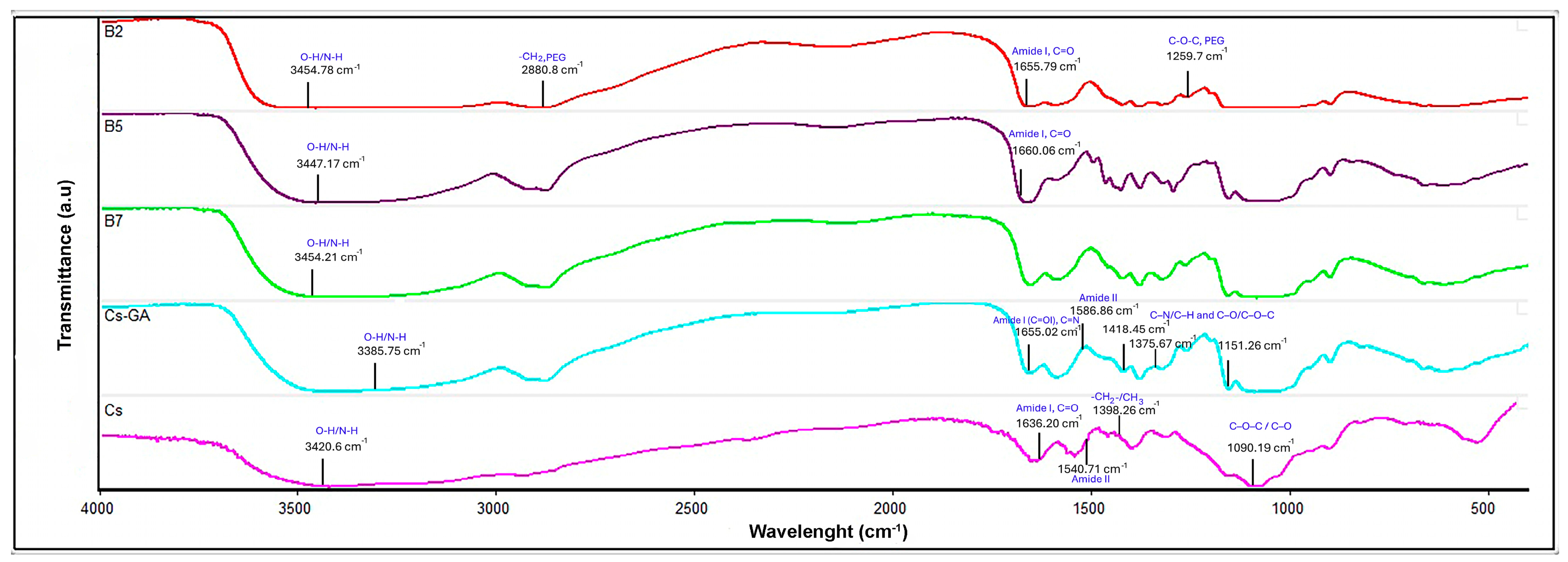
The FTIR of Cs extracted from the shrimp shell (Figure 1) shows bands that are typical of polysaccharides. One of these bands, at 3420.6 cm−1, is attributed to the stretching vibration of O-H and N-H functional groups [30]. Additionally, bands at 1636.20 and 1540.71 cm−1 are found, corresponding to the C=O stretching of amide I and the N-H bending with C-N stretching of amide II, respectively [31,32]. The band at 1398.26 cm−1 is attributed to C–H bending vibrations of the –CH2 and –CH3 groups, while the band at 1090.19 cm−1, associated with C–O–C and C–O stretching vibrations of the polysaccharide backbone, confirms the identity of chitosan [33]. The proximate analysis values for chitosan are shown in Table 2. An ash content of 0.17 ± 0.0345% and a moisture content of 5.02 ± 0.2458% are observed, indicating an effective demineralization process and a high degree of purity in the obtained chitosan, as reported by Hosney et al. [34]. Furthermore, the total nitrogen percentage of 6.49 ± 0.4197% indicates an amine-rich chitosan, reflecting a high abundance of -NH2 groups [35]. The yield (%) of chitosan from crustaceans is up to a 50%. In this study, the yield was 28% dry mass. Some authors reported this yield using other raw materials and different chemical extraction conditions with values around 23–30% [34,36].
On the other hand, the degree of deacetylation (DD) obtained for chitosan was 93.72%, which is considered high, indicating high purity and quality of the chitosan. According to Nemtsev et al. [37], the degree of deacetylation of chitosan can affect crosslinking formation and solubility, which is considered an important parameter to define the purity of chitosan.
Capillary viscometry determined that chitosan has a molecular weight (Mv) of 456.30 ± 0.99 kDa, which, according to different authors, is classified as a medium molecular weight (100–1000 kDa) [38,39]. This medium molecular weight suggests that chitosan may offer practical processing options due to its viscosity, as well as the crosslinking that may be required to modify its mechanical properties in membrane fabrication [40].

3.2. Membrane Characterization

3.2.1. FTIR

Figure 1 shows the FTIR spectra of Cs and the Cs-GA, B2, B5, and B7 membranes. Comparing the FTIR spectra of Cs and Cs-GA reveals that the fundamental chemical structure of chitosan is conserved, but modifications are observed in several key bands associated with glutaraldehyde crosslinking. In Cs-GA, the broad O–H/N–H stretching band is centered at 3385.75 cm−1, remaining within the typical range reported for Cs. The most significant change is observed in the 1700–1500 cm−1 region: the amide I band shifts to 1655.02 cm−1, which is interpreted as the overlap of the amide’s C=O bond with the new C=N band (Schiff base) formed by the Cs–GA crosslinking. This result is consistent with that reported by Galan et al. [41] in chitosan beads crosslinked with glutaraldehyde. Similarly, in Cs, the 1540.71 cm−1 band shows a shift in the range associated with N–H bending, reaching 1586.85 cm−1 in Cs-GA [42]. Finally, the bands at 1418.45, 1375.67, and 1151 cm−1 of Cs-GA remain within the typical region corresponding to C–N/C–H and C–O/C–O–C vibrations of polysaccharides [43], although with slight changes in position and intensity, indicating that the chitosan network is maintained. However, glutaraldehyde crosslinking alters its chemical environment.
In membranes (B2, B5, and B7), the O–H/N–H band shifts towards higher frequencies (3443–3454 cm−1) and exhibits less width and intensity compared to Cs, suggesting partial consumption of –NH2 and –OH groups due to the formation of imine and acetal bonds during crosslinking with glutaraldehyde [44,45]. Although the glutaraldehyde concentration was very low (0.0107%), the observed shifts confirm the effectiveness of crosslinking, even in the absence of a defined C=N band, which is usually overlapped or undetectable at low concentrations [46,47].
In membrane B2, additional signals appear at 2880 cm−1 (C–H stretching of –CH2–) and 1259 cm−1, attributable to the methylene and ether groups of the incorporated PEG [48]. In membrane B5, a single, intense peak is observed at 1660 cm−1, replacing the separate amide I and II bands of Cs, a typical behavior when PVP is incorporated due to the overlap of the carbonyl group of the pyrrolidone ring (1660–1680 cm−1) with amide I of chitosan [49,50,51].
In membrane B7, the O–H/N–H band moves slightly to 3454.21 cm−1, but the Cs-GA spectral pattern stays the same. This behavior confirms that, when Gly is incorporated as a plasticizer, no new covalent bonds are formed; instead, hydrogen bonding interactions predominate between the hydroxyl groups of glycerol and the –OH/–NH2 groups of Cs [52,53]. In summary, the FTIR spectra confirm the effective crosslinking of chitosan with glutaraldehyde in Cs-GA, B2, B5, and B7, as well as the successful incorporation of PEG and PVP in B2 and B5, and the minimal chemical modification of Cs in the presence of Gly (B7).

3.2.2. Morphology and Topography (SEM and AFM)

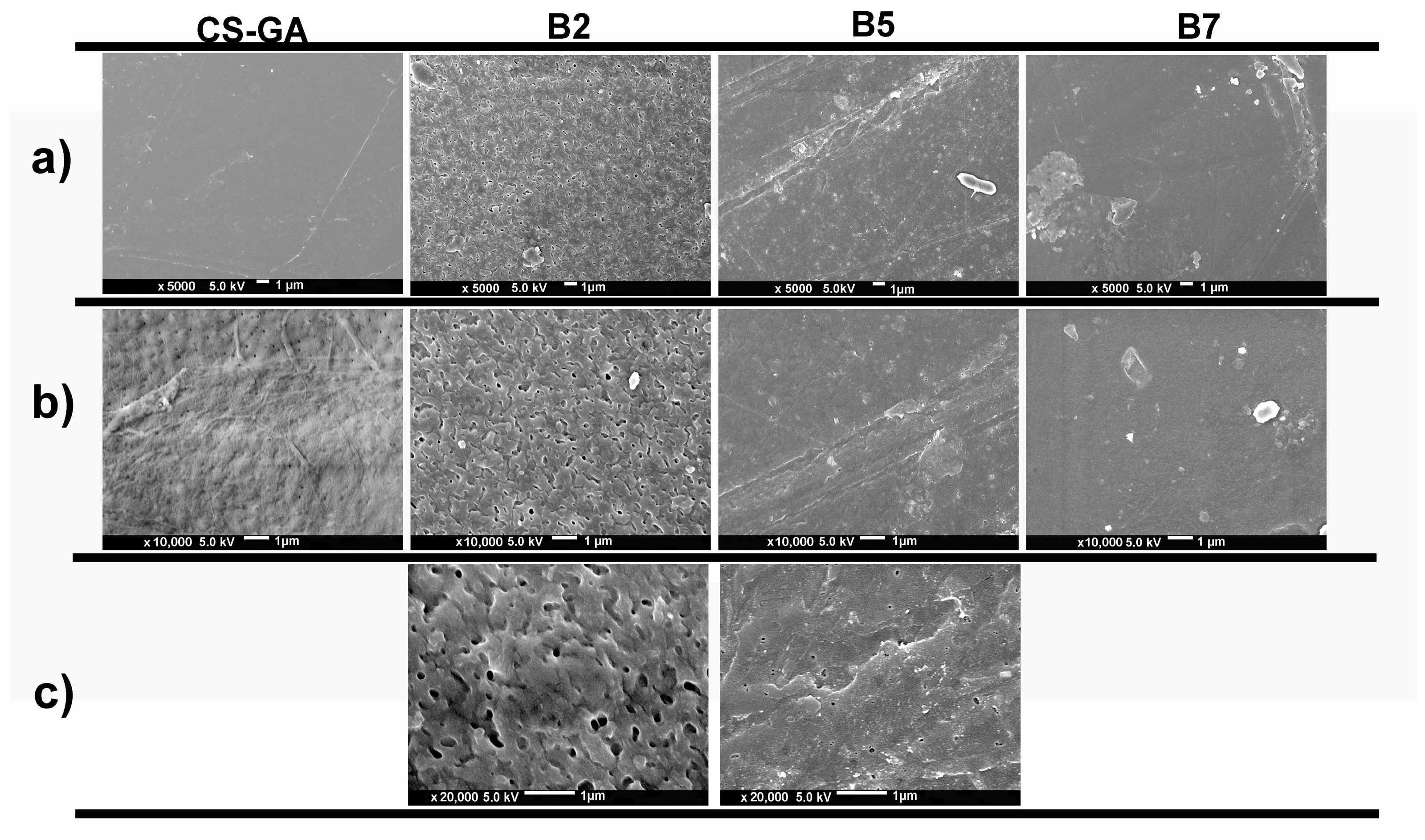
Figure 2a displays SEM micrographs of the various membranes at a magnification of 5000×. Cs-GA exhibits a compact and continuous surface with little to no visible porosity, a result very similar to that reported by Cui et al. [54]. In contrast, membrane B2 shows a rougher, more heterogeneous texture, with surface depressions and deep cavities characteristic of porous materials, consistent with the findings of Zeng & Fang [23]. Membrane B5 exhibits an intermediate morphology, with interconnected pores and grooves forming an open network that may facilitate fluid displacement, as reported by Shirazi et al. [55]. Finally, membrane B7 shows a smoother surface, compared to membranes B2 and B5, with apparent polymeric aggregates on the surface, making it difficult to distinguish between the Cs-GA membrane, this could be attributed to the plasticizing effect of glycerol, which tends to smooth surfaces, a behavior consistent with that described by Liu et al. [56] and Pinto et al. [57].
Figure 2b presents SEM micrographs of the same membranes at 10,000× magnification. The Cs-GA membrane exhibits fine undulations and microreliefs, without evident pore openings; in the upper zone, scattered depressions are visible, possibly associated with the collapse of microbubbles during the membrane formation process, as noted by Galiano et al. [58]. The B2 membrane has pores that show convergence and connectivity with neighboring cavities, forming continuous channels across its entire surface. In contrast, the B5 membrane exhibits only a limited number of sparsely distributed pores, which may be easily mistaken for irregular polymeric clusters. The B7 membrane exhibits fine micro-wrinkles; however, polymeric aggregates predominate on the observed surface.
The high-resolution SEM micrographs (Figure 2c) show that membranes B2 and B5 are the most promising. Membrane B2 exhibits a high density of submicrometer cavities with sharp edges and signs of fusion and connectivity between gaps, forming an open and continuous structure that may be favorable for fluid transport. Although membrane B5 has a more compact surface compared to B2, it exhibits well-distributed, isolated pores and fine grooves, resulting in moderate roughness without extensive discontinuities. Discrete inclusions and gently differentiated domains are also observed, suggesting a stable microstructure. In general, B2 has more interconnected pores, while B5 has a uniform matrix with controlled porosity. Both microstructures are considered beneficial for filtration processes, as reported for Cs-PEG membranes (B2) [59,60,61].
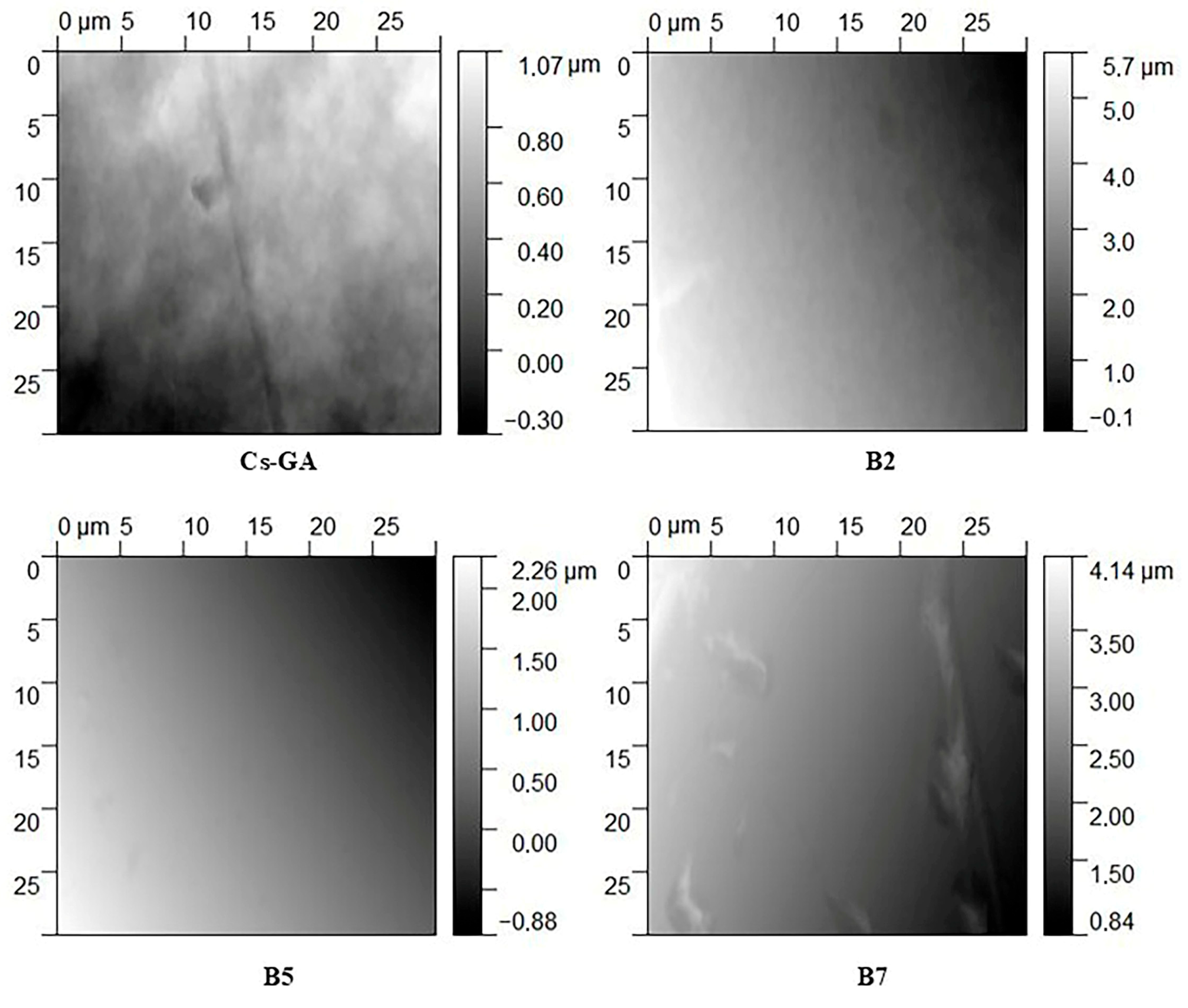
The AFM topography (Figure 3) confirms the trends observed by SEM: membranes containing PEG exhibit more corrugated, heterogeneous surfaces, consistent with the findings of He et al. [59]. Cs-GA exhibits the lowest roughness amplitude and a compact, continuous topography. Membrane B2 displays the greatest corrugation, with persistent micrometric valleys even after leveling, confirming its surface heterogeneity. Membrane B5 exhibits intermediate roughness, attributed to the PEG-PVP combination, where PEG induces a more pronounced relief than Cs-GA, but less than B2. Finally, membrane B7 exhibits broad undulations and elongated ridges, consistent with the plasticizing effect of Gly reported by Galo et al. [62].

3.2.3. Thickness and Hydrophilic Character of the Membranes (Contact Angle)

Table 3 shows the thickness and contact angle results for each membrane. The thicknesses range from approximately 300 to approximately 123 μm, with the modified membranes being thinner than pure chitosan. Wanichapichart & Yu [63] indicate that chitosan membranes used for filtration typically have a thickness of 40–80 μm. The pure chitosan membranes developed in this study are thicker than 300 μm. This considerably greater value is attributed to the higher molecular weight of the chitosan used (Mv ≈ 456.30 kDa). Several authors have reported that a higher molecular weight increases the viscosity of the film-forming solution, thereby favoring the formation of thicker, mechanically stronger films [40,64,65]. Al-Hobaib et al. [66] report that commercial reverse osmosis membranes have a total thickness of approximately 130 to 250 μm, corresponding to three structural layers (bottom, middle, and top). These values are comparable to those obtained for membranes B2 and B5. However, in our study, the membranes lack additional layers or any additional support, so the reported thickness corresponds to a single functional layer. In membrane B7, glycerol acts as a plasticizer, increasing the mobility of the chitosan chains, as described by Nwaka et al. [67]. Similarly, Rivero et al. [68] indicate that glycerol in the chitosan polymer matrix increases molecular mobility and promotes the rearrangement of the polymer network, which could explain its reduced thickness. This decrease is because greater mobility promotes more intense compaction during drying, resulting in a lower thickness than in B2 and B5.
Analysis of the hydrophilic-hydrophobic character revealed that all membranes exhibited contact angles below 90°, indicating hydrophilic surfaces, as reported by Kertész et al. [69]. However, differences were observed among the membrane values (Table 3). The Cs-GA membrane had the largest contact angle (89.39 ± 3.65172°), a value very close to that of hydrophobic surfaces (θ ≥ 90°), according to Chen et al. [70]. Membranes B2 and B5 presented the lowest angles, which agrees with the AFM and SEM results, where more corrugated surfaces with connected domains were observed, favoring the spreading of the water droplet across the surface. Taken together, their lower thickness and greater hydrophilicity in B2 and B5 suggest that these membranes are more favorable for more efficient water transport, a topic discussed in more detail in the filtration tests section.

3.2.4. Mechanical Properties (Maximum Stress, Strain at Break, Young’s Modulus)

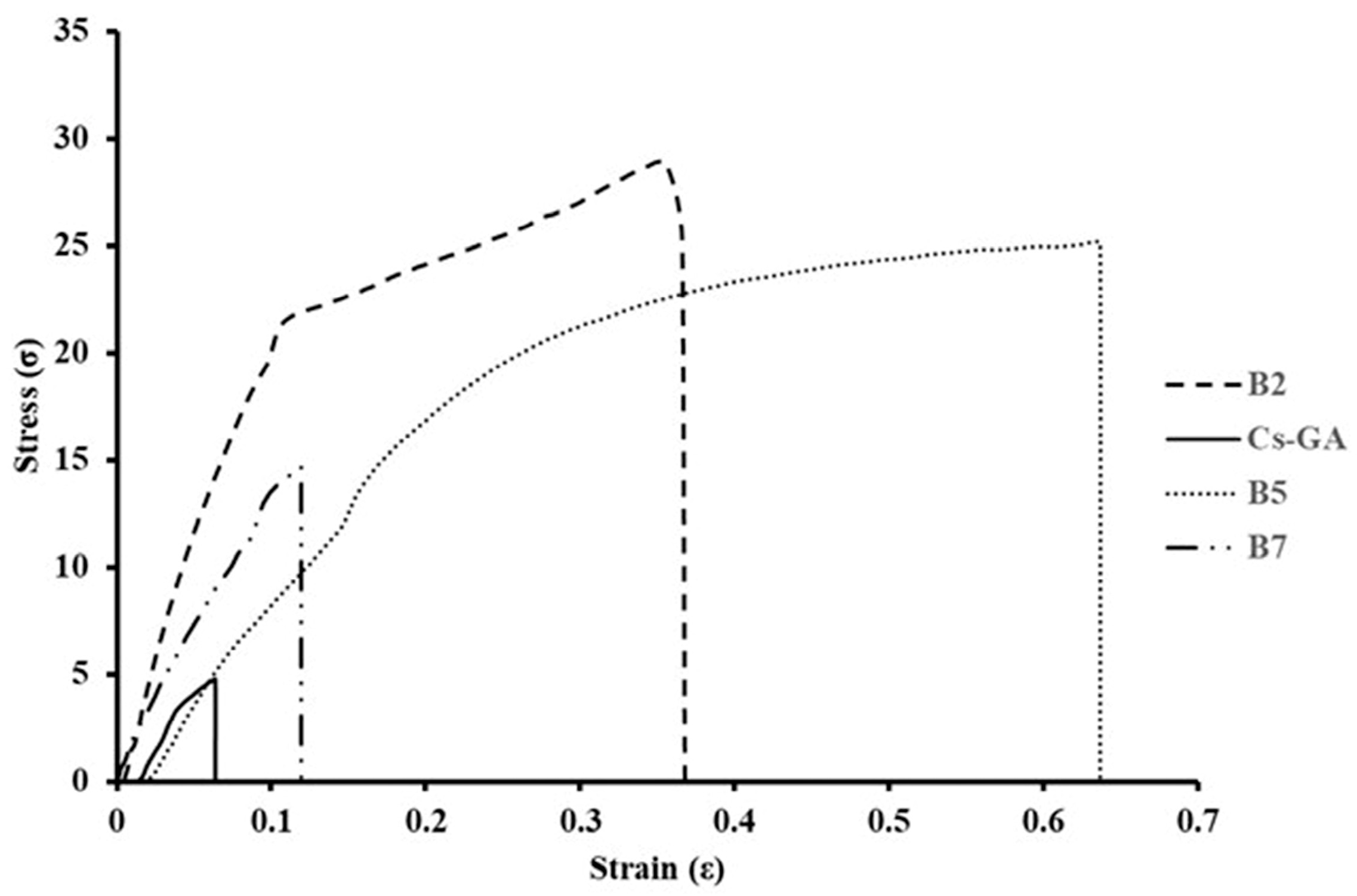
Table 4 shows the mechanical property values. The Cs-GA membrane exhibited the most brittle behavior, with a σmax of 2.612 ± 1.479 MPa and a strain at break of 9.10 ± 0.0459%, reflected in a short stress–strain curve with a low slope (Figure 4). This data indicates a rigid matrix that, despite being cross-linked with GA, is fragile and has low mechanical strength, in accordance with the findings of Silva et al. [71], and may be susceptible to failure under relatively low stresses during handling or operation.
The incorporation of PEG into the B2 membrane resulted in the greatest increase in strength and stiffness. The maximum stress (σmax) increases to 24.59 ± 2.69 MPa and Young’s modulus reaches 0.179 ± 0.070 GPa, while the strain at break is 16.99 ± 9.79%. In Figure 4, the B2 curve shows a steep initial slope and a moderate deformation interval before failure. This behavior is consistent with that reported by He et al. [59] for Cs-PEG systems and with the more open microstructure observed by SEM and AFM.
The B5 membrane exhibited the highest deformation capacity, with a strain at break of 27.10 ± 8.38%, a σmax of 15.48 ± 3.70 MPa, and a Young’s modulus of 0.058 ± 0.006 GPa. In Figure 4, the B5 curve exhibits a very long deformation zone (plastic zone), indicating high toughness. This performance relates to the previously observed hybrid morphology. B5 has a more compact surface than B2, yet it has connected pores and grooves that form a well-opened network. These results are consistent with those reported by He et al. [59] and Sarhan [72] for Cs-PEG blends. They are also consistent with the work of Raza et al. [73], which indicates that Cs-PVP blends exhibit improved mechanical properties, excellent compatibility, and stability, attributed to the interactions between the two chains.
Finally, membrane B7 shows that σmax is 9.36 ± 5.14 MPa, strain at break is 11.29 ± 3.62%, and Young’s modulus is 0.086 ± 0.031 GPa. Its stress–strain curve (Figure 4) shows an intermediate initial slope and a relatively limited deformation zone. These mechanical results are consistent with the smoother topography and lower surface porosity of membrane B7 (Figure 2 and Figure 3), attributable to the plasticizing effect of Gly, which smoothes the surface and promotes a more compact rearrangement of the polymer network. Membrane B7 is better than Cs-GA, but it does not have the balance of strength and ductility as B2 and B5. Leceta et al. [74] reported gly-plasticized chitosan films with maximum stress of 55–62 MPa and elongations near 0.5, characteristics of relatively rigid and brittle materials. The B7 membrane has lower strength but a significantly higher deformation capacity prior to failure. From a membrane engineering perspective, parameters such as tensile strength and strain at break are decisive for mechanical stability under pressure gradients [75]. In this sense, the greater deformation observed in B7 before breaking suggests mechanical behavior compatible with its potential use in water filtration applications.

3.2.5. Thermal Behavior (TGA and DSC)

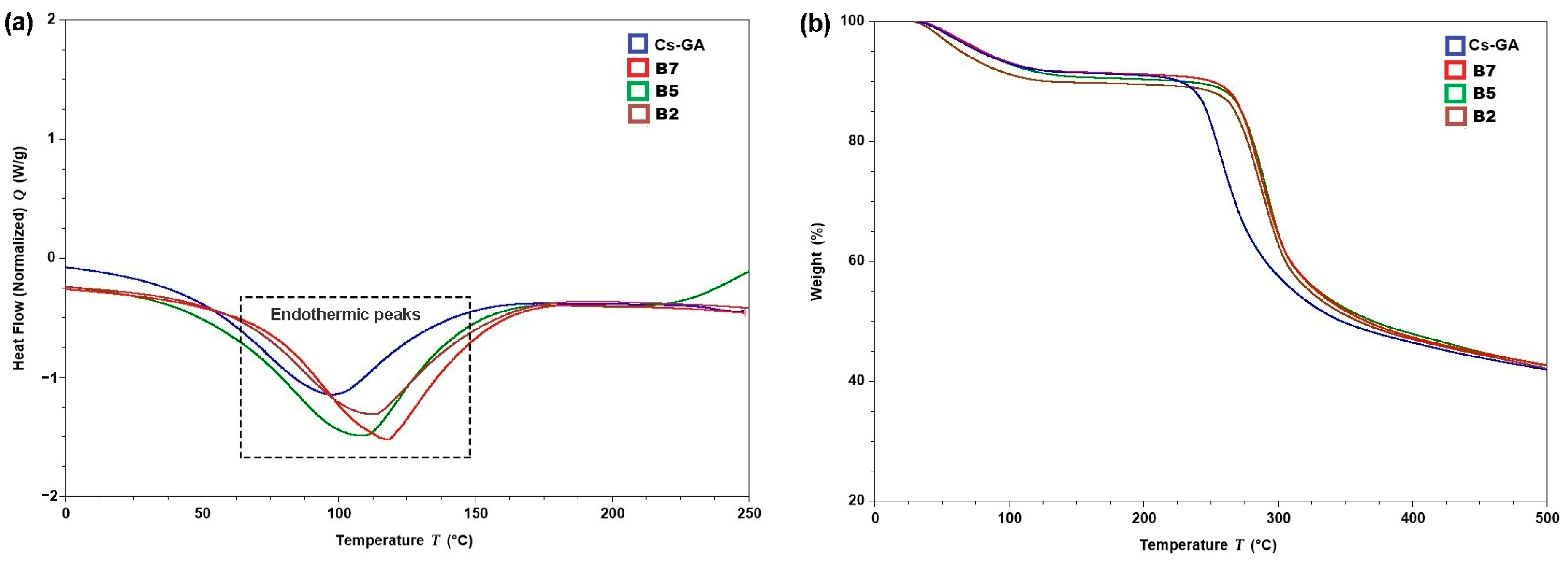
Figure 5a shows an endothermic peak in all thermograms; in the case of Cs-GA, the decrease in heat flow rate (W/g) begins at 10 °C, followed by B7, B5, and B2, which begin to lose heat at 25 °C. This is attributed to the heat resistance provided by each crosslink or graft to the Cs-GA polymer network, which prolongs the loss of water and other volatile compounds per unit mass [76]. The maximum endotherm temperature for B5 was 106 °C, for B2 it was 112.5 °C, and for B7 it was 118 °C; for Cs-GA, it was below the values observed in the membrane (<100 °C). In the case of the B5 membrane, there is an interaction between the hydroxyl groups of Cs and the carbonyl group of PVP. Sizílio et al. [77] suggest that the pyrrolidone rings in PVP contain a carbonyl group that accepts protons, while chitosan has hydroxyl and amino groups as side groups; therefore, hydrogen bonding can occur between these two chemical groups.
In the case of TGA (Figure 5b), an initial phase of weight loss was observed in the Cs-GA membrane at temperatures below 225 °C, while for membranes B2, B5, and B7, this loss was detected at temperatures below 275 °C; at these temperatures, only the loss of water molecules is indicated [78,79]. Likewise, a second stage of weight loss is observed above the aforementioned temperatures (225 °C for Cs-GA and 275 °C for membranes with B2, B5, and B7 grafts). In this stage, degradation is more intense due to thermal degradation of chitosan, leading to the loss of functional groups (amino groups, hydroxyl groups, etc.); however, membranes with a cross-linking agent and/or grafting exhibit higher degradation temperatures [80]. The percentage of normalized weight loss recorded in the second stage indicates that Cs loses mass more quickly and with a lower percentage. Cs-GA lost 58.48% of its mass, while the rest of the membranes behaved very similarly, recording losses of 62.99% for B7, 67.73% for B5, and 70.748% for B2. The third and final stage of decomposition starts at 262 °C, 288.91 °C, 290.59 °C, and 294.32 °C for Cs-GA, B7, B5, and B2, respectively. This is in line with the mechanical test results for membranes that use PEG.

3.3. Membrane Performance in Filtration Tests

Table 5 presents the flux (J), water permeance (Lp), and total hydraulic resistance (R) values of the membranes evaluated under filtration by distilled water at 4.83 bar. Membrane B2 showed superior performance compared to the other membranes, with much higher flux and water permeance values and a much lower hydraulic resistance. The Cs-GA, B5, and B7 membranes exhibit flux values of 24.10, 40.43, and 24.77 LMH, respectively, and permeance values that do not exceed 10 LMH·bar−1, while the B2 membrane reaches 2222.70 LMH and a permeance of 460.19 LMH·bar−1. Consistently, the hydraulic resistance of Cs-GA, B5, and B7 is in the range of 4.15 × 10¹³ to 7.89 × 10¹³ m−1, compared to the value of 8.79 × 10¹¹ m−1 for B2. Although the J and Lp values of B2 are much higher than those of Cs-GA, B5, and B7, its permeance is still lower than that of some commercial ultrafiltration membranes used for seawater pretreatment. Cordier et al. [81] reported an initial permeability of approximately 880 LMH·bar−1 and a membrane resistance of 4.1 × 10¹¹ m−1 for a polysulfone hollow fiber membrane used in seawater ultrafiltration, operating with nearly constant fluxes of 60–80 LMH. The results of this study show that water passes through the B2 membrane much more easily than through the other membranes evaluated; this implies that lower flux and permeance values correspond to higher hydraulic resistance.
On the other hand, the Cs-GA, B5, and B7 membranes exhibit much lower filtration performance. The B5 membrane, which has a mixture of PEG and PVP in the Cs chain, reports the highest flux within this group (40.43 LMH), but its permeability (8.37 LMH·bar−1) and hydraulic resistance (4.83 × 10¹³ m−1) are very similar to those of Cs-GA. In other words, although B5 allows slightly more water to pass through than the Cs-GA membrane, the overall resistance to flow remains high. This result is consistent with the idea that the combination of PEG and PVP generates a corrugated surface but with a more homogeneous, relatively compact matrix that partly limits the paths available for water to pass through. In the case of the B7 membrane, the flux (24.77 LMH) is similar to that of Cs-GA, but the permeance is the lowest compared to the other results (5.13 LMH·bar−1), and the hydraulic resistance is the highest at 7.89 × 10¹³ m−1. This observation suggests that, although B7 is a thin membrane, the presence of Gly and the rearrangement of the polymer network during drying result in a less porous structure, making it more difficult for water to pass through.
The relatively low flux values and high hydraulic resistances observed for Cs-GA, B5, and B7 (flux in the range of 24–40 LMH and R of the order of 1013 m−1) are numerically comparable to values reported for ultrafiltration membranes subjected to high salinity and fouling conditions; Scelfo et al. [82] describe permeance values of 7.4–17 LMH·bar−1 in their study. This suggests that these chitosan-based membranes exhibit very high hydraulic resistance, even during distilled water filtration.

4. Conclusions

The results of the present study show that the chitosan obtained allowed for the production of stable membranes, whose modification with PEG, PVP, and Gly and cross-linking with GA produced a dense and compact structure (Cs-GA) with more open, corrugated surfaces (B2 and B5) or thinner but compact surfaces (B7). Additionally, B2 and B5 exhibited a higher degree of hydrophilicity. These structural changes were reflected in the mechanical properties, with membranes B2 and B5 exhibiting higher maximum stress (σmax) and greater strain at break (εmax) than Cs-GA, indicating better tensile performance. In water filtration tests, the B2 membrane had the highest flow and permeability and the lowest hydraulic resistance, consistent with its lower thickness, higher porosity, and hydrophilic nature. At the same time, B5 showed intermediate performance, with moderate flow but a more compact and mechanically stable structure. However, Cs-GA and B7 exhibited higher hydraulic resistances and more limited water transport. In conclusion, these results indicate that membranes B2 and B5 are the most promising for their use in water filtration processes, since they combine hydrophilicity, adequate mechanical and thermal properties, and superior filtration performance to Cs-GA. Therefore, their evaluation is recommended in future work with real water flows and under prolonged operating conditions.

Author Contributions

A.L.A.-R., conceptualization, experimental methodology, experimental work related to the synthesis of the modified membranes, writing original draft, preparation of manuscript; T.J.M.-S., review and supervision of membrane characterization tests, review and edition of the manuscript; R.G.S.-D., conceptualization, supervision of experimental work related to the synthesis of membranes, writing and edition of the manuscript, and funding acquisition; Y.V.-P., manuscript writing and editing, analysis, and discussion of results; A.A.A.-R., supervision, revision and editing; V.M.O.-C., supervision, revision, and editing. All authors have read and agreed to the published version of the manuscript.

Funding

The authors would like to acknowledge to Instituto Tecnológico de Sonora through PROFAP-2025-035, PROFAPI-2025-051 and projects SECIHTI, Ciencia de Frontera CF.2023-G-1395, and CF-2025-G-1036.

Institutional Review Board Statement

No applicable.

Informed Consent Statement

Not applicable.

Data Availability Statement

The original contributions presented in this study are included in the article. Further inquiries can be directed to the corresponding author.

Acknowledgments

The first author is grateful to CONACYT (CVU: 785122). The authors would like to thank Víctor Rejón-Moo, William Santiago-Gómez, and Daniel Treviño-Aguilar at CINVESTAV-IPN Unidad Mérida for their technical assistance and Diana Fischer for translation and editing.

Conflicts of Interest

The authors declare no conflicts of interest.

Abbreviations

The following abbreviations are used in this manuscript:
CsChitosan
PEGPolyethylene glycol
PVPPolyvinylpyrrolidone
GlyGlycerol
GAGlutaraldehyde
FTIRFourier-transform infrared spectroscopy
SEMScanning electron microscopy
AFMAtomic force microscopy
TGAThermogravimetric analysis
DSCDifferential scanning calorimetry
LMHLiters per square meter per hour (LMH)
LMH·bar−1Liters per square meter per hour per bar (LMH·bar−1)
JPermeate flux (J)
LpWater permeance (Lp)
RTotal hydraulic resistance (R)
kDaKilodaltons
MwMolecular weight (Mw)
ηIntrinsic viscosity (η)
MvViscosity-average molecular weight (Mv)
ηrelRelative viscosity (ηrel)
ηspSpecific viscosity (ηsp)
ηredReduced viscosity (ηred)
%NTTotal nitrogen percentage (%NT)
TgGlass transition temperature (Tg)
ΔPApplied pressure (ΔP)
Cs-GAChitosan–glutaraldehyde
B2Chitosan–polyethylene glycol
B5Chitosan–polyvinylpyrrolidone–polyethylene glycol
B7Chitosan–glycerol

References

  1. Omelusuki, A.; Mastcke, V. El agua como recurso y como derecho. In Escribir el Hacer: La Enseñanza en la Escuela Primaria; Hoz, G., Carli, M.C., Eds.; Editorial de la Universidad Nacional de La Plata (EDULP): La Plata, Argentina, 2022; Chapter 6; pp. 83–100. Available online: http://sedici.unlp.edu.ar/handle/10915/140374 (accessed on 9 November 2025).
  2. Ingrao, C.; Strippoli, R.; Lagioia, G.; Huisingh, D. Water scarcity in agriculture: An overview of causes, impacts and approaches for reducing the risks. Heliyon 2023, 9, e18507. [Google Scholar] [CrossRef]
  3. Jones, E.R.; Bierkens, M.F.P.; van Vliet, M.T.H. Current and future global water scarcity intensifies when accounting for surface water quality. Nat. Clim. Change 2024, 14, 629–635. [Google Scholar] [CrossRef]
  4. Yago, Q.T. El sistema de saneamiento convencional y la escasez global de agua: Uso irracional de los recursos versus sistemas secos y circulares. Rev. Iberoam. Cienc. Tecnol. Soc.-CTS 2023, 18, 173–194. [Google Scholar] [CrossRef]
  5. He, C.; Liu, Z.; Wu, J.; Pan, X.; Fang, Z.; Li, J.; Bryan, B.A. Future global urban water scarcity and potential solutions. Nat. Commun. 2021, 12, 4667. [Google Scholar] [CrossRef] [PubMed]
  6. Singh, N.; Poonia, T.; Siwal, S.S.; Srivastav, A.L.; Sharma, H.K.; Mittal, S.K. Challenges of water contamination in urban areas. In Current Directions in Water Scarcity Research; Srivastav, A.L., Madhav, S., Bhardwaj, A.K., Valsami-Jones, E., Eds.; Elsevier: Amsterdam, The Netherlands, 2022; Volume 6, pp. 173–202. [Google Scholar] [CrossRef]
  7. Shemer, H.; Wald, S.; Semiat, R. Challenges and solutions for global water scarcity. Membranes 2023, 13, 612. [Google Scholar] [CrossRef]
  8. van Vliet, M.T.H.; Jones, E.R.; Flörke, M.; Franssen, W.H.P.; Hanasaki, N.; Wada, Y.; Yearsley, J.R. Global water scarcity including surface water quality and expansions of clean water technologies. Environ. Res. Lett. 2021, 16, 024020. [Google Scholar] [CrossRef]
  9. Yatawatta, Y.J.M.; Sridarran, P. Need of establishing desalination plants to mitigate water scarcity in dry zones of Sri Lanka. In World Construction Symposium; Ceylon Institute of Builders: Colombo, Sri Lanka, 2023; Volume 1, pp. 833–846. [Google Scholar] [CrossRef]
  10. Baysak, F.K.; Özcan, C. Desalination of seawater with pervaporation technology by using poly(vinyl alcohol)/chitosan-g-poly(N,N-dimethylacrylamide) membranes. Desalination Water Treat. 2022, 259, 45–53. [Google Scholar] [CrossRef]
  11. Dhakal, N.; Salinas-Rodriguez, S.G.; Hamdani, J.; Abushaban, A.; Sawalha, H.; Schippers, J.C.; Kennedy, M.D. Is desalination a solution to freshwater scarcity in developing countries? Membranes 2022, 12, 381. [Google Scholar] [CrossRef]
  12. Kuzminova, A.; Dmitrenko, M.; Dubovenko, R.; Puzikova, M.; Mikulan, A.; Korovina, A.; Koroleva, A.; Selyutin, A.; Semenov, K.; Su, R.; et al. Development and study of novel ultrafiltration membranes based on cellulose acetate. Polymers 2024, 16, 1236. [Google Scholar] [CrossRef]
  13. Shakeri, A.; Salehi, H.; Rastgar, M. Chitosan-based thin active layer membrane for forward osmosis desalination. Carbohydr. Polym. 2017, 174, 658–668. [Google Scholar] [CrossRef]
  14. Alshahrani, A.A.; Alsuhybani, M.; Algamdi, M.S.; Alquppani, D.; Mashhour, I.; Alshammari, M.S.; Alsohaimi, I.H.; Alraddadi, T.S. Evaluating the performance of chitosan and chitosan-palm membrane for water treatment: Preparation, characterization and purification study. J. Taibah Univ. Sci. 2021, 15, 77–86. [Google Scholar] [CrossRef]
  15. Yadav, M.; Kaushik, B.; Rao, G.K.; Srivastava, C.M.; Vaya, D. Advances and challenges in the use of chitosan and its derivatives in biomedical fields: A review. Carbohydr. Polym. Technol. Appl. 2023, 5, 100323. [Google Scholar] [CrossRef]
  16. Spoială, A.; Ilie, C.I.; Ficai, D.; Ficai, A.; Andronescu, E. Chitosan-based nanocomposite polymeric membranes for water purification—A review. Materials 2021, 14, 2091. [Google Scholar] [CrossRef] [PubMed]
  17. Widiastuti, N.; Silitonga, R.S.; Dharma, H.N.C.; Jaafar, J.; Widyanto, A.R.; Purwanto, M. Decreasing free fatty acid of crude palm oil with polyvinylidene fluoride hollow fiber membranes using a combination of chitosan and glutaraldehyde. RSC Adv. 2022, 12, 22662–22670. [Google Scholar] [CrossRef]
  18. Sun, S.; Xu, L.; Li, H.; Du, W.; Zhang, H.; Zuo, D. Effect of chitosan gelation time on the structure and antifouling performance of PVDF membrane. Preprints 2023. [Google Scholar] [CrossRef]
  19. Sánchez-Duarte, R.G.; Sánchez-Machado, D.I.; López-Cervantes, J.; Correa-Murrieta, M.A. Adsorption of allura red dye by cross-linked chitosan from shrimp waste. Water Sci. Technol. 2012, 65, 618–623. [Google Scholar] [CrossRef]
  20. AOAC International. Official Methods of Analysis of AOAC International, 22nd ed.; AOAC International: Rockville, MD, USA, 2023; Available online: https://www.aoac.org/official-methods-of-analysis/ (accessed on 16 November 2025).
  21. Solis, Y.; Peniche, C.; García, R.; Davidenko, N. Un procedimiento biomimético novedoso para obtener composites de quitosana–hidroxiapatita. In VII Congreso de la Sociedad Cubana de Bioingeniería; Sociedad Cubana de Bioingeniería: La Habana, Cuba, 2007. [Google Scholar]
  22. Brugnerotto, J.; Lizardi, J.; Goycoolea, F.M.; Argüelles-Monal, W.; Desbrières, J.; Rinaudo, M. An infrared investigation in relation with chitin and chitosan characterization. Polymer 2001, 42, 3569–3580. [Google Scholar] [CrossRef]
  23. Zeng, M.; Fang, Z. Preparation of sub-micrometer porous membrane from chitosan/polyethylene glycol semi-IPN. J. Membr. Sci. 2004, 245, 95–102. [Google Scholar] [CrossRef]
  24. Salerno, S.; De Santo, M.P.; Drioli, E.; De Bartolo, L. Nano- and micro-porous chitosan membranes for human epidermal stratification and differentiation. Membranes 2021, 11, 394. [Google Scholar] [CrossRef]
  25. Zeng, M.; Fang, Z.; Xu, C. Effect of compatibility on the structure of the microporous membrane prepared by selective dissolution of chitosan/synthetic polymer blend membrane. J. Membr. Sci. 2004, 230, 175–181. [Google Scholar] [CrossRef]
  26. Hernández-Gómez, E.; Madera-Santana, T.J.; Quintana-Owen, P.; Ortiz Vázquez, E.; Ramón Sierra, J.M.; Vargas y Vargas, M.L. Propiedades fisicoquímicas y bioactivas de películas comestibles basadas en alginato y miel melipona. Biotecnia 2024, 26, 16–25. [Google Scholar] [CrossRef]
  27. Ambrož, A.; Yao, Z.; Rojas, C.; Angelova, P.; Gölzhäuser, A.; Petrinić, I. Water flow decrease of track-etched polyethylene terephthalate membranes. J. Membr. Sci. 2025, 733, 124294. [Google Scholar] [CrossRef]
  28. Hao, F.; Li, X.; Wang, J.; Li, R.; Zou, L.; Wang, K.; Chen, F.; Shi, F.; Yang, H.; Wang, W.; et al. Separation of bioproducts through the integration of cyanobacterial metabolism and membrane filtration: Facilitating cyanobacteria’s industrial application. Membranes 2022, 12, 963. [Google Scholar] [CrossRef] [PubMed]
  29. Wu, B.; Wang, S.; Wang, J.; Song, X.; Zhou, Y.; Gao, C. Facile fabrication of high-performance thin film nanocomposite desalination membranes imbedded with alkyl group-capped silica nanoparticles. Polymers 2020, 12, 1415. [Google Scholar] [CrossRef] [PubMed]
  30. Sierakowska-Byczek, A.; Gałuszka, A.; Janus, Ł.; Radwan-Pragłowska, J. Bioactive three-dimensional chitosan-based scaffolds modified with poly(dopamine)/CBD@Pt/Au/PVP nanoparticles as potential NGCs applicable in nervous tissue regeneration—Preparation and characterization. Molecules 2024, 29, 5376. [Google Scholar] [CrossRef]
  31. Kumirska, J.; Czerwicka, M.; Kaczyński, Z.; Bychowska, A.; Brzozowski, K.; Thöming, J.; Stepnowski, P. Application of spectroscopic methods for structural analysis of chitin and chitosan. Mar. Drugs 2010, 8, 1567–1636. [Google Scholar] [CrossRef]
  32. Tovar, C.D.G.; Castro, J.I.; Valencia, C.H.; Porras, D.P.N.; Hernandez, J.H.M.; Zapata, M.E.V.; Chaur, M.N. Nanocomposite films of chitosan-grafted carbon nano-onions for biomedical applications. Molecules 2020, 25, 1203. [Google Scholar] [CrossRef]
  33. Zarif, M.E.; Yehia-Alexe, S.A.; Bita, B.; Negut, I.; Locovei, C.; Groza, A. Calcium phosphates–chitosan composite layers obtained by combining radio-frequency magnetron sputtering and matrix-assisted pulsed laser evaporation techniques. Polymers 2022, 14, 5241. [Google Scholar] [CrossRef]
  34. Hosney, A.; Ullah, S.; Barčauskaitė, K. A review of the chemical extraction of chitosan from shrimp wastes and prediction of factors affecting chitosan yield by using an artificial neural network. Mar. Drugs 2022, 20, 675. [Google Scholar] [CrossRef]
  35. Ssekatawa, K.; Byarugaba, D.K.; Wampande, E.M.; Moja, T.N.; Nxumalo, E.; Maaza, M.; Sackey, J.; Ejobi, F.; Kirabira, J.B. Isolation and characterization of chitosan from Ugandan edible mushrooms, Nile perch scales and banana weevils for biomedical applications. Sci. Rep. 2021, 11, 4116. [Google Scholar] [CrossRef]
  36. Martínez-Robinson, K.; Martínez-Inzunza, A.; Rochín-Wong, S.; Rodríguez-Córdova, R.J.; Vásquez-García, S.R.; Fernández-Quiroz, D. Physicochemical study of chitin and chitosan obtained from California brown shrimp (Farfantepenaeus californiensis) exoskeleton. Biotecnia 2022, 24, 28–35. [Google Scholar] [CrossRef]
  37. Nemtsev, S.V.; Gamzazade, A.I.; Rogozhin, S.V.; Bykova, V.M.; Bykov, V.P. Deacetylation of chitin under homogeneous conditions. Appl. Biochem. Microbiol. 2002, 38, 521–526. [Google Scholar] [CrossRef]
  38. Gonçalves, C.; Ferreira, N.; Lourenço, L. Production of low molecular weight chitosan and chitooligosaccharides (COS): A review. Polymers 2021, 13, 2466. [Google Scholar] [CrossRef] [PubMed]
  39. Santoso, J.; Adiputra, K.C.; Soerdirga, L.C.; Tarman, K. Effect of acetic acid hydrolysis on the characteristics of water soluble chitosan. IOP Conf. Ser. Earth Environ. Sci. 2020, 414, 012021. [Google Scholar] [CrossRef]
  40. Aranaz, I.; Alcántara, A.R.; Civera, M.C.; Arias, C.; Elorza, B.; Caballero, A.H.; Acosta, N.; Velasco, H.; Mecerreyes, D.; Antonio, R.; et al. Chitosan: An overview of its properties and applications. Polymers 2021, 13, 3256. [Google Scholar] [CrossRef]
  41. Galan, J.; Trilleras, J.; Zapata, P.A.; Arana, V.A.; Grande-Tovar, C.D. Optimization of chitosan glutaraldehyde-crosslinked beads for Reactive Blue 4 anionic dye removal using a surface response methodology. Life 2021, 11, 85. [Google Scholar] [CrossRef]
  42. Martins, M.; Veroneze-Júnior, V.; Carvalho, M.; Carvalho, D.T.; Barbosa, S.; Doriguetto, A.C.; Magalhães, P.C.; Ribeiro, C.; Santos, M.H.; De Souza, T.C. Physicochemical characterization of chitosan and its effects on early growth, cell cycle and root anatomy of transgenic and non-transgenic maize hybrids. Aust. J. Crop Sci. 2018, 12, 183–207. [Google Scholar] [CrossRef]
  43. Koyuncu, D.D.E.; Okur, M.; Temuçin, B.; Şen, S.M.; Şahbaz, E.; Eroğlu, Ş.; Akın, Z.S.; Topaloğlu, G. Evaluation of the nitrogen release properties of chitosan–bentonite beads. J. Turkish Chem. Soc. Sect. B Chem. Eng. 2024, 7, 183–192. [Google Scholar] [CrossRef]
  44. Romal, J.R.A.; Ong, S.K. Single-step fabrication of a dual-sensitive chitosan hydrogel by C-Mannich reaction: Synthesis, physicochemical properties, and screening of its Cu2+ uptake. Processes 2023, 11, 354. [Google Scholar] [CrossRef]
  45. Bradu, I.-A.; Vlase, T.; Bunoiu, M.; Grădinaru, M.; Pahomi, A.; Bajas, D.; Budiul, M.M.; Vlase, G. Synthesis and characterization of polymer-based membranes for methotrexate drug delivery. Polymers 2023, 15, 4325. [Google Scholar] [CrossRef]
  46. Buranachai, T.; Praphairaksit, N.; Muangsin, N. Chitosan/polyethylene glycol beads crosslinked with tripolyphosphate and glutaraldehyde for gastrointestinal drug delivery. Aaps Pharmscitech 2010, 11, 1128–1137. [Google Scholar] [CrossRef] [PubMed]
  47. Mansur, H.S.; Oréfice, R.L.; Mansur, A.A.P. Characterization of poly(vinyl alcohol)/poly(ethylene glycol) hydrogels and PVA-derived hybrids by small-angle X-ray scattering and FTIR spectroscopy. Polymer 2004, 45, 7193–7202. [Google Scholar] [CrossRef]
  48. Abednejad, A.S.; Amoabediny, G.; Ghaee, A. Surface Modification of Polypropylene Blood Oxygenator Membrane by Poly Ethylene Glycol Grafting. Adv. Mater. Res. 2013, 816–817, 459–463. [Google Scholar] [CrossRef]
  49. Feyissa, Z.; Edossa, G.D.; Bedasa, T.B.; Inki, L.G. Fabrication of pH-responsive chitosan/polyvinylpyrrolidone hydrogels for controlled release of metronidazole and antibacterial properties. Int. J. Polym. Sci. 2023, 2023, 1205092. [Google Scholar] [CrossRef]
  50. Iancu, I.M.; Schröder, V.; Apetroaei, M.-R.; Crețu, R.M.; Mireșan, H.; Honcea, A.; Iancu, V.; Bucur, L.A.; Mitea, G.; Atodiresei-Pavalache, G. Biocompatibility of membranes based on a mixture of chitosan and Lythri herba aqueous extract. Appl. Sci. 2023, 13, 8023. [Google Scholar] [CrossRef]
  51. Livanovich, K.S.; Sharamet, A.A.; Shimko, A.N.; Shutava, T.G. Layer-by-layer films of polysaccharides modified with poly(N-vinylpyrrolidone) and poly(vinyl alcohol). Heliyon 2021, 7, e08224. [Google Scholar] [CrossRef]
  52. Doan, L.; Tran, K. Relationship between the polymer blend using chitosan, polyethylene glycol, polyvinyl alcohol, polyvinylpyrrolidone, and antimicrobial activities against Staphylococcus aureus. Pharmaceutics 2023, 15, 2453. [Google Scholar] [CrossRef]
  53. Mahatmanti, F.W.; Kusumastuti, E.; Wijayati, N. Electrospinning of nanofibers chitosan/PVA–sodium silicate. J. Phys. Conf. Ser. 2021, 1918, 032012. [Google Scholar] [CrossRef]
  54. Cui, L.; Gao, S.; Song, X.; Huang, L.; Dong, H.; Liu, J.; Chen, F.; Yu, S. Preparation and characterization of chitosan membranes. RSC Adv. 2018, 8, 28433–28439. [Google Scholar] [CrossRef]
  55. Shirazi, R.H.M.T.; Mohammadi, T.; Asadi, A.A.; Ahmadzadeh Tofighy, M. Electrospun nanofiber affinity membranes for water treatment applications: A review. J. Water Process Eng. 2022, 47, 102795. [Google Scholar] [CrossRef]
  56. Liu, H.; Adhikari, R.; Guo, Q.; Adhikari, B. Preparation and characterization of glycerol plasticized (high-amylose) starch–chitosan films. J. Food Eng. 2013, 116, 588–597. [Google Scholar] [CrossRef]
  57. Pinto, E.P.; Tavares, W.D.S.; Matos, R.S.; Ferreira, A.M.; Menezes, R.P.; Da Costa, M.E.H.M.; De Souza, T.M.; Ferreira, I.M.; De Sousa, F.F.O.; Zamora, R.R.M. Influence of low and high glycerol concentrations on wettability and flexibility of chitosan biofilms. Quim. Nova 2018, 41, 1109–1116. [Google Scholar] [CrossRef]
  58. Galiano, F.; Msahel, A.; Russo, F.; Rovella, N.; Policicchio, A.; Hamouda, S.B.; Hafiane, A.; Castro-Muñoz, R.; Figoli, A. Enhancing the separation performance of chitosan membranes through the blending with deep eutectic solvents for the pervaporation of polar/non-polar organic mixtures. Membranes 2024, 14, 237. [Google Scholar] [CrossRef] [PubMed]
  59. He, L.H.; Xue, R.; Yang, D.B.; Liu, Y.; Song, R. Effects of blending chitosan with PEG on surface morphology, crystallization and thermal properties. Chin. J. Polym. Sci. 2009, 27, 501–510. [Google Scholar] [CrossRef]
  60. Rekik, S.B.; Gassara, S.; Deratani, A. Green fabrication of sustainable porous chitosan/kaolin composite membranes using polyethylene glycol as a porogen: Membrane morphology and properties. Membranes 2023, 13, 378. [Google Scholar] [CrossRef]
  61. Zeng, M.; Fang, Z.; Xu, C. Novel method of preparing microporous membrane by selective dissolution of chitosan/polyethylene glycol blend membrane. J. Appl. Polym. Sci. 2004, 91, 2840–2847. [Google Scholar] [CrossRef]
  62. Galo, C.; Anaya, P.; Del Rio, R.; Schrebler, R.; Von Plessing, C.; Schneider, M. Scanning electron microscopy and atomic force microscopy of chitosan composite films. J. Chil. Chem. Soc. 2010, 55, 352–354. [Google Scholar] [CrossRef]
  63. Wanichapichart, P.; Yu, L. Chitosan membrane filtering characteristics modification by N-ion beams. Surf. Coat. Technol. 2007, 201, 8165–8169. [Google Scholar] [CrossRef]
  64. Mutasher, S.H.; Al-Lami, H.S. The effect of different molecular weight chitosan on the physical and mechanical properties of plasticized films. Eur. J. Chem. 2022, 13, 460–467. [Google Scholar] [CrossRef]
  65. Zhong, Y.; Zhuang, C.; Gu, W.; Zhao, Y. Effect of molecular weight on the properties of chitosan films prepared using electrostatic spraying technique. Carbohydr. Polym. 2019, 212, 197–205. [Google Scholar] [CrossRef]
  66. Al-Hobaib, A.S.; Al-Sheetan, K.M.; Shaik, M.R.; Al-Andis, N.M.; Al-Suhybani, M.S. Characterization and evaluation of reverse osmosis membranes modified with Ag2O nanoparticles to improve performance. Nanoscale Res. Lett. 2015, 10, 379. [Google Scholar] [CrossRef]
  67. Nwaka, E.; Akomah, U.C.; Maduoma, T.U.; Ezeokolie, E.D.; Menankiti, D.T.; Osarenren, E.; Donatus, U.D.; Orji, C.H.; Ekwem, C.H.; Oduaro, I.J. Optimizing the production of biodegradable chitosan–glycerol bioplastics from potato starch. Eur. J. Sustain. Dev. Res. 2025, 9, 16354. [Google Scholar] [CrossRef] [PubMed]
  68. Rivero, S.; Damonte, L.; García, M.A.; Pinotti, A. An insight into the role of glycerol in chitosan films. Food Biophys. 2016, 11, 117–127. [Google Scholar] [CrossRef]
  69. Kertész, S.; de Freitas, T.B.; Hodúr, C. Characterization of polymer membranes by contact angle goniometer. Analecta Tech. Szeged. 2014, 8, 18–22. [Google Scholar] [CrossRef]
  70. Chen, X.; Wang, X.P.; Xu, X. Effective contact angle for rough boundary. Phys. D 2013, 242, 54–64. [Google Scholar] [CrossRef]
  71. Silva, R.M.; Silva, G.A.; Coutinho, O.P.; Mano, J.F.; Reis, R.L. Preparation and characterisation in simulated body conditions of glutaraldehyde crosslinked chitosan membranes. J. Mater. Sci. Mater. Med. 2004, 15, 1105–1112. [Google Scholar] [CrossRef]
  72. Sarhan, A. Characterization of chitosan and polyethylene glycol blend film. Egypt. J. Chem. 2019, 62, 405–412. [Google Scholar] [CrossRef]
  73. Raza, M.A.; Shahzad, K.; Purohit, S.; Park, S.H.; Han, S.S. The fabrication strategies for chitosan/poly(vinyl pyrrolidone) based hydrogels and their biomedical applications: A focused review. Polym.-Plast. Technol. Mater. 2023, 62, 2255–2271. [Google Scholar] [CrossRef]
  74. Leceta, I.; Guerrero, P.; De la Caba, K. Functional properties of chitosan-based films. Carbohydr. Polym. 2013, 93, 339–346. [Google Scholar] [CrossRef]
  75. Kotsilkova, R.; Borovanska, I.; Todorov, P.; Ivanov, E.; Menseidov, D.; Chakraborty, S.; Bhattacharjee, C. Combined mechanical fields tensile and surface mechanical properties of polyethersulphone (PES) and polyvinylidene fluoride (PVDF) membranes. J. Theor. Appl. Mech. 2018, 48, 85–99. [Google Scholar] [CrossRef]
  76. Scaccini, L.; Sensini, A.; Puppi, D.; Gagliardi, M.; Moroni, L.; Cecchini, M.; Wieringa, P.; Tonazzini, I. Chitosan–glycerol blended nanofibers for peripheral nerve regeneration applications. Nanoscale Adv. 2025, 7, 6132–6144. [Google Scholar] [CrossRef] [PubMed]
  77. Sizílio, R.H.; Galvão, J.G.; Trindade, G.G.G.; Pina, L.T.S.; Andrade, L.N.; Gonsalves, J.K.M.C.; Lira, A.A.M.; Chaud, M.V.; Alves, T.F.R.; Arguelho, M.L.P.M.; et al. Chitosan/PVP-based mucoadhesive membranes as a promising delivery system of betamethasone-17-valerate for aphthous stomatitis. Carbohydr. Polym. 2018, 190, 339–345. [Google Scholar] [CrossRef] [PubMed]
  78. Afrouz, M.; Ahmadi-Nouraldinvand, F.; Ajirlu, Y.Y.; Arabnejad, F.; Eskanlou, H.; Yaghoubi, H. Preparation and characterization of PLA-PEG/chitosan-FA/DNA for gene transfer to MCF-7 cells. Med. Drug Discov. 2022, 15, 100138. [Google Scholar] [CrossRef]
  79. Ma, X.; Qiao, C.; Zhang, J.; Xu, J. Effect of sorbitol content on microstructure and thermal properties of chitosan films. Int. J. Biol. Macromol. 2018, 119, 1294–1297. [Google Scholar] [CrossRef]
  80. Debandi, M.V.; Bernal, C.R.; Francois, N. Development of biodegradable films based on chitosan/glycerol blends suitable for biomedical applications. J. Tissue Sci. Eng. 2016, 7, 1000187. [Google Scholar] [CrossRef]
  81. Cordier, C.; Eljaddi, T.; Ibouroihim, N.; Stavrakakis, C.; Sauvade, P.; Coelho, F.; Moulin, P. Optimization of air backwash frequency during the ultrafiltration of seawater. Membranes 2020, 10, 78. [Google Scholar] [CrossRef]
  82. Scelfo, G.; Serrano-Tari, P.; Raffaelli, R.; Vicari, F.; Oller, I.; Cipollina, A.; Tamburini, A.; Micale, G. The operational performance of an ultrafiltration pilot unit for the treatment of ultra-concentrated brines. Membranes 2024, 14, 276. [Google Scholar] [CrossRef]
Figure 1. FTIR of chitosan-based membranes. Cs: chitosan, Cs-GA: chitosan–glutaraldehyde, B2: chitosan–polyethylene glycol, B5: chitosan–polyvinylpyrrolidone–polyethylene glycol, and B7: chitosan–glycerol.
Membranes 16 00031 g001
Figure 2. SEM micrograph of chitosan-based membranes at (a) 5000×, (b) 10,000×, and (c) 20,000×. Cs-GA: chitosan–glutaraldehyde, B2: chitosan–polyethylene glycol, B5: chitosan–polyvinylpyrrolidone–polyethylene glycol, and B7: chitosan–glycerol.
Membranes 16 00031 g002
Figure 3. AFM topographies (30 µm × 30 µm) of the chitosan-based membranes. Cs-GA: chitosan–glutaraldehyde, B2: chitosan–polyethylene glycol, B5: chitosan–polyvinylpyrrolidone–polyethylene glycol, and B7: chitosan–glycerol.
Membranes 16 00031 g003
Figure 4. Stress–strain curves for the different membranes. Cs-GA: chitosan–glutaraldehyde, B2: chitosan–polyethylene glycol, B5: chitosan–polyvinylpyrrolidone–polyethylene glycol, and B7: chitosan–glycerol.
Membranes 16 00031 g004
Figure 5. Thermograms of the different membranes: (a) DSC and (b) TGA. Cs-GA: chitosan–glutaraldehyde, B2: chitosan–polyethylene glycol, B5: chitosan–polyvinylpyrrolidone–polyethylene glycol, and B7: chitosan–glycerol.
Membranes 16 00031 g005
Table 1. Formulations used for the preparation of membranes.
MembraneCs (g)PEG (g)PVP (g)Gly (g)Solution GA (mL)
Cs-GA1.503.850
B21.500.753.850
B51.500.350.353.850
B71.500.753.850
Cs = chitosan; PEG = poly (ethylene glycol); PVP = polyvinylpyrrolidone; Gly = glycerol; GA = glutaraldehyde.
Table 2. Proximate analysis of chitosan.
ParametersResults (%)
Moisture5.02 ± 0.2458
Total Nitrogen6.49 ± 0.4197
Ash Content0.17 ± 0.0345
The reported values are the average of n = 3 ± standard deviation.
Table 3. Thickness and contact angle of the membranes studied.
MembraneThickness (μm)Contact Angle (°)
Cs-GA300 ± 10.12 189.39 ± 3.6517 2
B2207 ± 40.40 156.68 ± 1.4249 2
B5190 ± 26.85 158.94 ± 4.7231 2
B7123 ± 15.37 165.20 ± 5.1517 2
Cs-GA: chitosan–glutaraldehyde, B2: chitosan–polyethylene glycol, B5: chitosan–polyvinylpyrrolidone–polyethylene glycol, and B7: chitosan–glycerol. 1 The reported values are the mean of n = 3 ± standard deviation. 2 The reported values are the mean of n = 5 ± standard deviation.
Table 4. Mechanical properties of the membranes (σmax, εmax, and Young’s modulus).
MembraneMaximum Stress (σmax) (MPa)Strain at Break
max) (%)
Young’s Modulus
(GPa)
Cs-GA2.612 ± 1.4799.10 ± 0.04590.037 ± 0.028
B224.589 ± 2.69016.99 ± 9.790.179 ± 0.070
B515.478 ± 3.70527.10 ± 8.380.058 ± 0.006
B79.361 ± 5.14411.29 ± 3.6240.086 ± 0.031
Cs-GA: chitosan–glutaraldehyde, B2: chitosan–polyethylene glycol, B5: chitosan–polyvinylpyrrolidone, and B7: chitosan–glycerol. The reported values correspond to the average ± standard deviation of n = 3.
Table 5. Membrane performance in water filtration tests.
MembraneFlux (J)
(LMH)
Permeance (Lp)
(LMH/bar)
Hydraulic Resistance
(R)
(m−1)
Cs-GA24.09889.75134.1481 × 1013
B22222.70460.1878.7900 × 1011
B540.43458.37154.8317 × 1013
B724.77015.12847.8873 × 1013
Cs-GA: chitosan–glutaraldehyde, B2: chitosan–polyethylene glycol, B5: chitosan–polyvinylpyrrolidone–polyethylene glycol, and B7: chitosan–glycerol.
Disclaimer/Publisher’s Note: The statements, opinions and data contained in all publications are solely those of the individual author(s) and contributor(s) and not of MDPI and/or the editor(s). MDPI and/or the editor(s) disclaim responsibility for any injury to people or property resulting from any ideas, methods, instructions or products referred to in the content.