
Article

Influence of Casting Solvents on CO2/CH4 Separation Using Polysulfone Membranes
by
Roba M. Almuhtaseb
,
Ahmed Awadallah-F
,
Shaheen A. Al-Muhtaseb
and
Majeda Khraisheh
*
Department of Chemical Engineering, Qatar University, Doha P.O. Box 2713, Qatar
*
Author to whom correspondence should be addressed.
On leave from the Radiation Research of Polymer Department, National Centre for Radiation Research and Technology, Atomic Energy Authority, P.O. Box 29, Nasr City, Cairo, Egypt.
Membranes 2021, 11(4), 286; https://doi.org/10.3390/membranes11040286

Submission received: 10 February 2021 / Revised: 24 March 2021 / Accepted: 24 March 2021 / Published: 13 April 2021
(This article belongs to the Section Polymeric Membranes)

Abstract

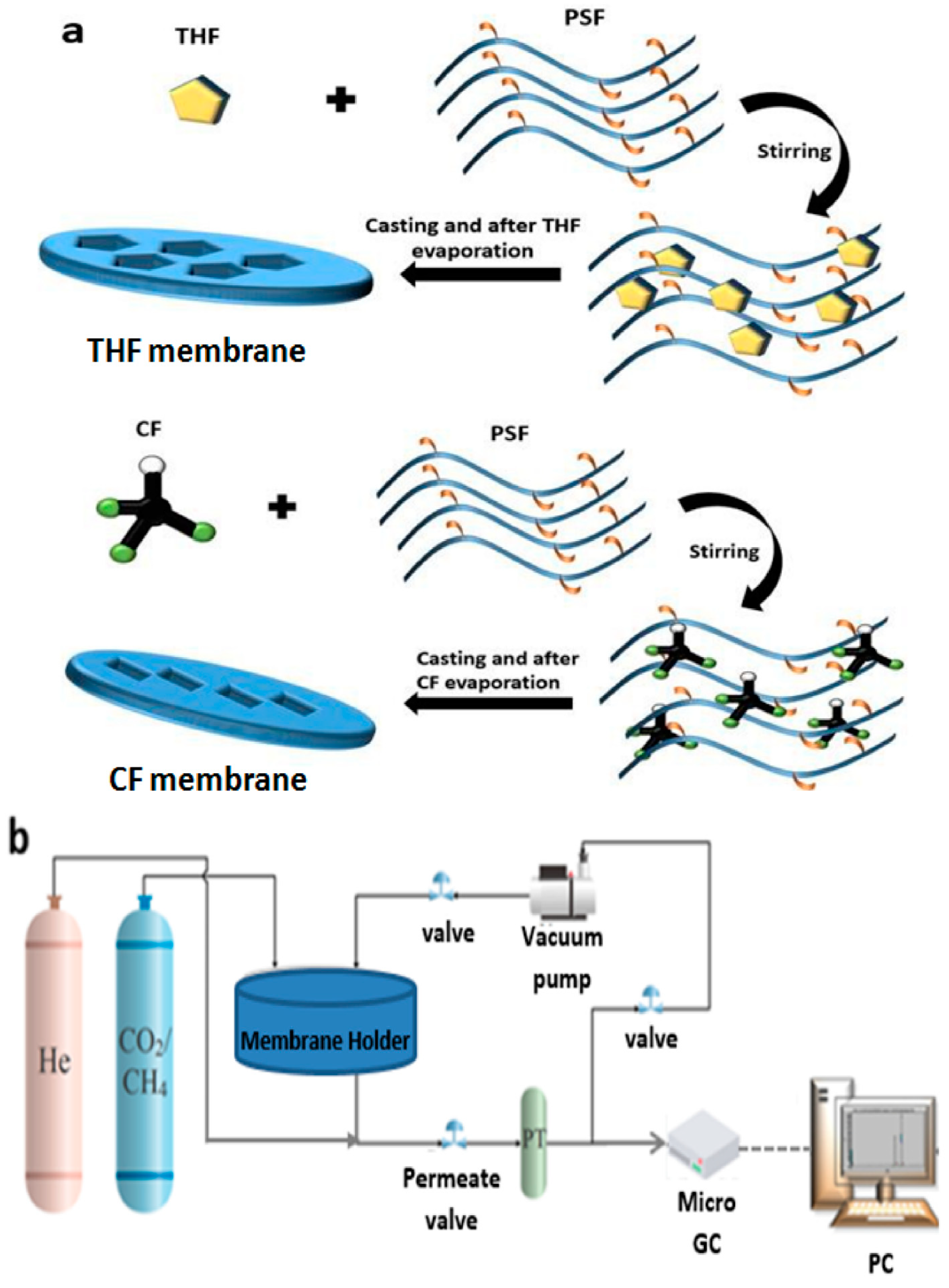
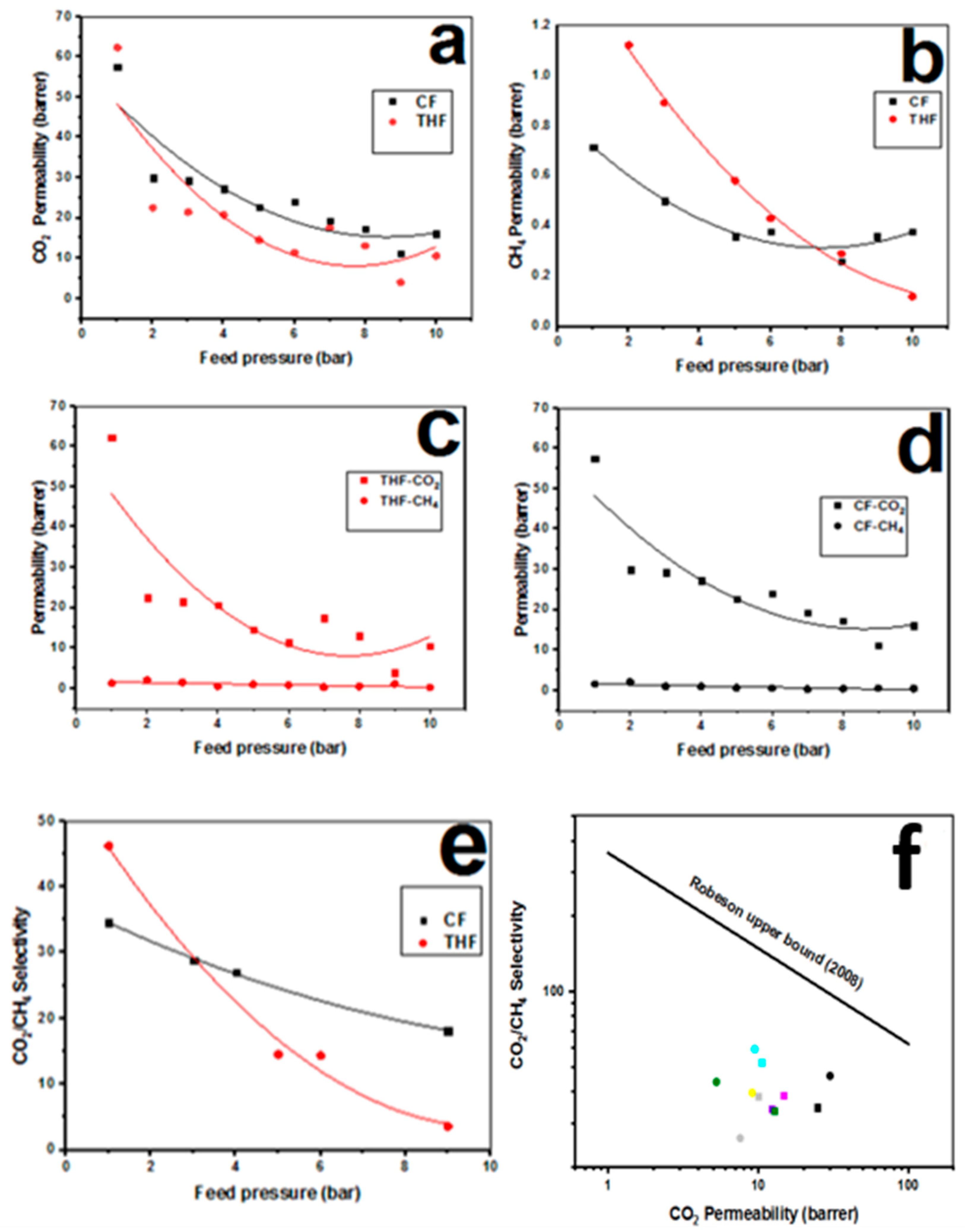
Polysulfone membranes exhibit resistance to high temperature with low manufacturing cost and high efficiency in the separation process. The composition of gases is an important step that estimates the efficiency of separation in membranes. As membrane types are currently becoming in demand for CO2/CH4 segregation, polysulfone will be an advantageous alternative to have in further studies. Therefore, research is undertaken in this study to evaluate two solvents: chloroform (CF) and tetrahydrofuran (THF). These solvents are tested for casting polymeric membranes from polysulfone (PSF) to separate every single component from a binary gas mixture of CO2/CH4. In addition, the effect of gas pressure was conducted from 1 to 10 bar on the behavior of the permeability and selectivity. The results refer to the fact that the maximum permeability of CO2 and CH4 for THF is 62.32 and 2.06 barrer at 1 and 2 bars, respectively. Further, the maximum permeability of CF is 57.59 and 2.12 barrer at 1 and 2 bars, respectively. The outcome selectivity values are 48 and 36 for THF and CF at 1 bar, accordingly. Furthermore, the study declares that with the increase in pressure, the permeability and selectivity values drop for CF and THF. The performance for polysulfone (PSF) membrane that is manufactured with THF is superior to that of CF relative to the Robeson upper bound. Therefore, through the results, it can be deduced that the solvent during in-situ synthesis has a significant influence on the gas separation of a binary mixture of CO2/CH4.
Keywords: polysulfone (PSF); tetrahydrofuran (THF); chloroform (CF); membrane; gas separation polysulfone (PSF); tetrahydrofuran (THF); chloroform (CF); membrane; gas separation