
Article

Early Findings after Implementation of Veno-Arteriovenous ECMO: A Multicenter European Experience

by
Aaron Blandino Ortiz
1,
Mirko Belliato
2,†,
Lars Mikael Broman
3,†,
Olivier Lheureux
1,
Maximilian Valentin Malfertheiner
4,†,
Angela Xini
1,
Federico Pappalardo
5,† and
Fabio Silvio Taccone
1,*
1
Department of Intensive Care, Erasme Hospital, Université Libre de Bruxelles, Route de Lennik, 808, B-1070 Brussels, Belgium
2
UOS Advanced Respiratory Intensive Care Unit, UOC Anestesia e Rianimazione 1, Fondazione IRCCS Policlinico San Matteo, 27100 Pavia, Italy
3
ECMO Centre Karolinska, Department of Physiology and Pharmacology, Karolinska Institutet, Karolinska University Hospital, 17177 Stockholm, Sweden
4
Department of Internal Medicine II, Cardiology and Pneumology, Intensive Care, University Medical Center Regensburg, 93053 Regensburg, Germany
5
Department of Cardiothoracic Anesthesia and Intensive Care, Advanced Heart Failure and Mechanical Circulatory Support Program, San Raffaele Hospital, Vita-Salute University, 20121 Milan, Italy
*
Author to whom correspondence should be addressed.
European ECMO Advisory Board (EEAB).
Membranes 2021, 11(2), 81; https://doi.org/10.3390/membranes11020081

Submission received: 23 December 2020 / Revised: 15 January 2021 / Accepted: 20 January 2021 / Published: 22 January 2021
(This article belongs to the Special Issue Advances in Extracorporeal Membrane Oxygenation)

Abstract

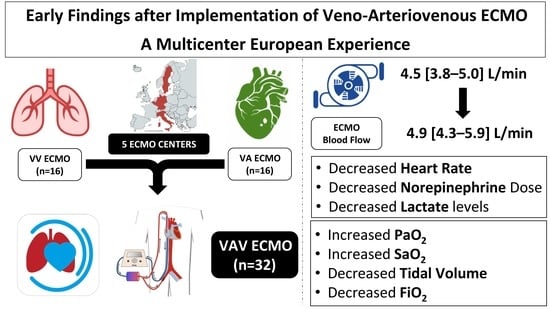
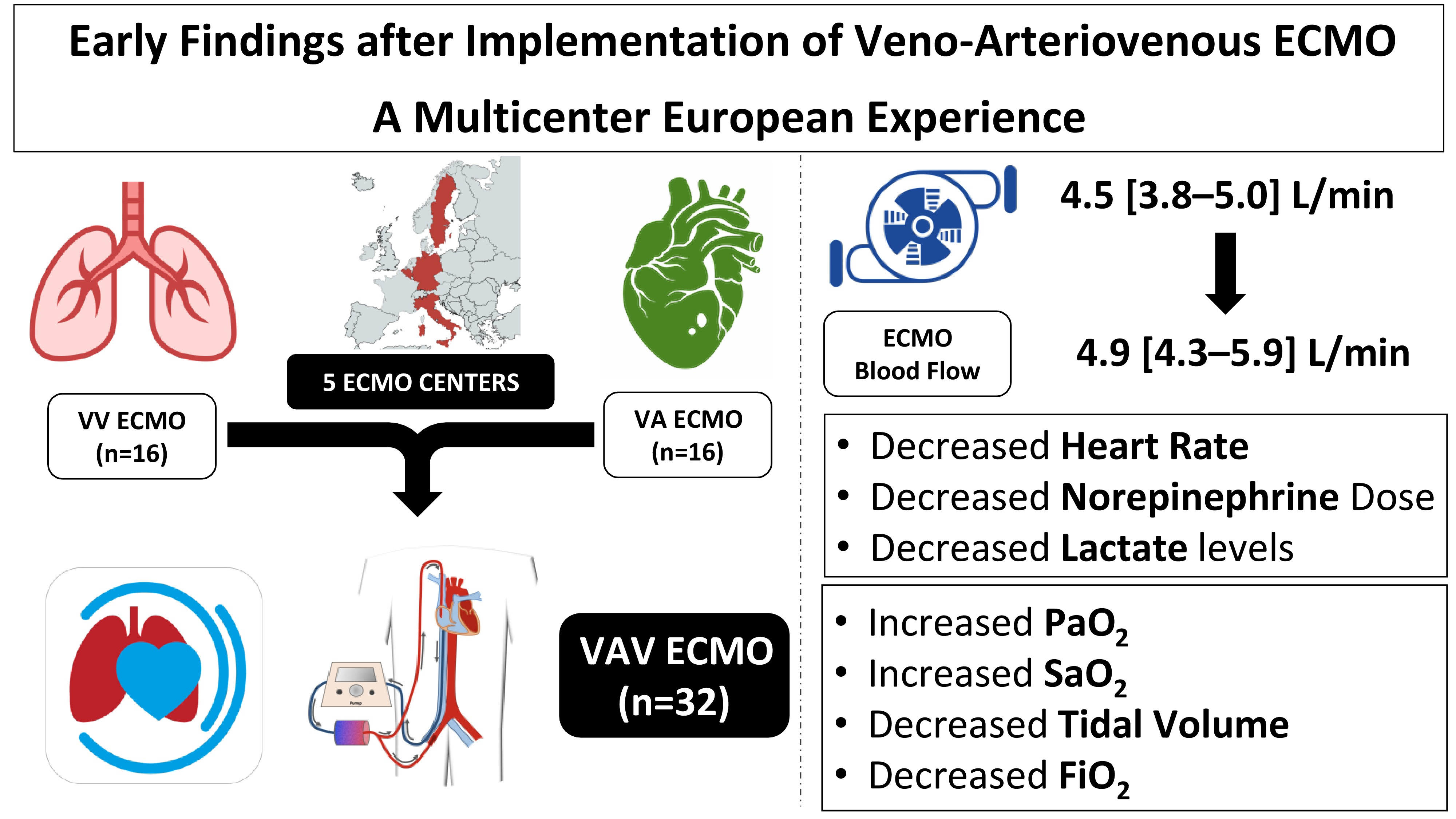
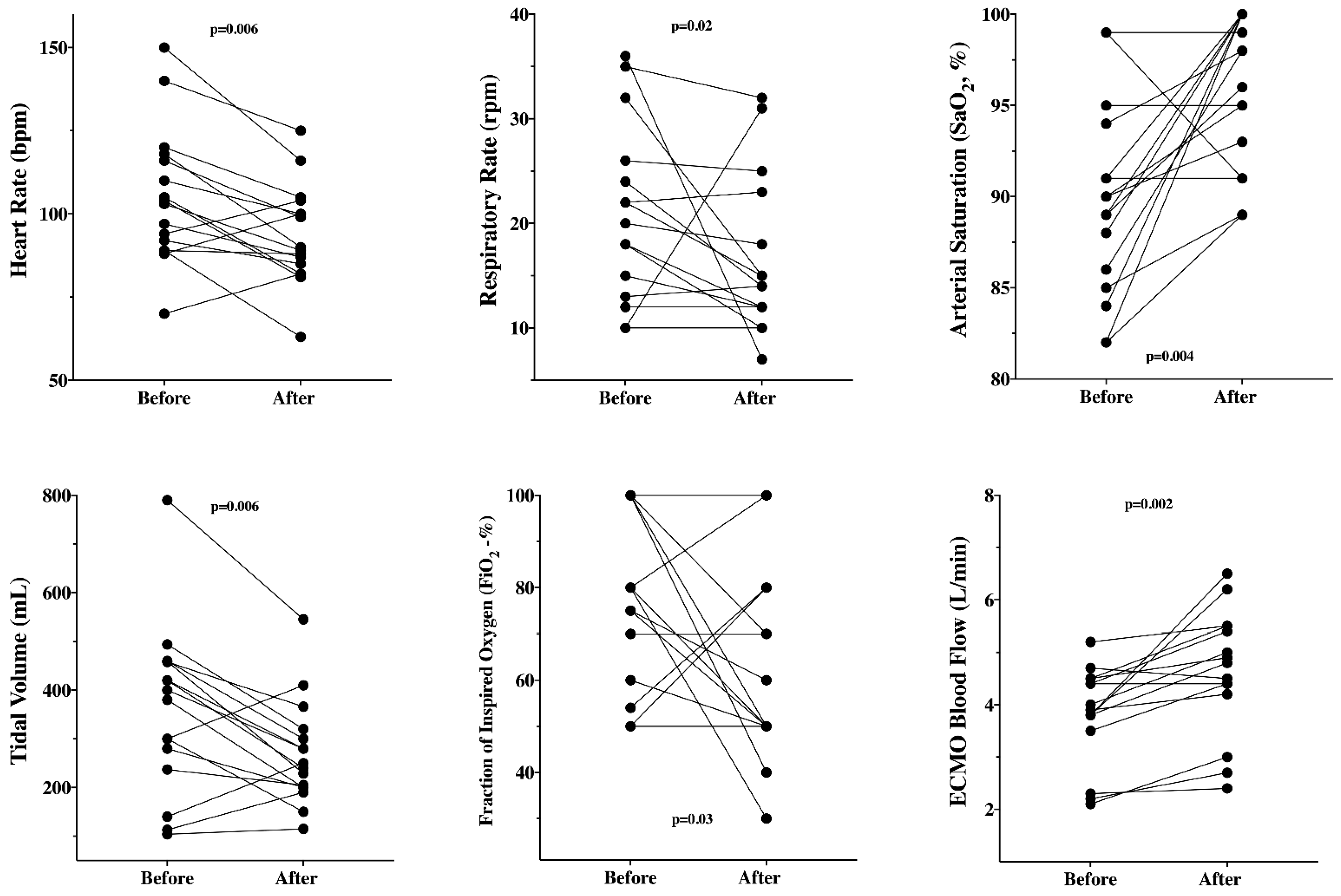
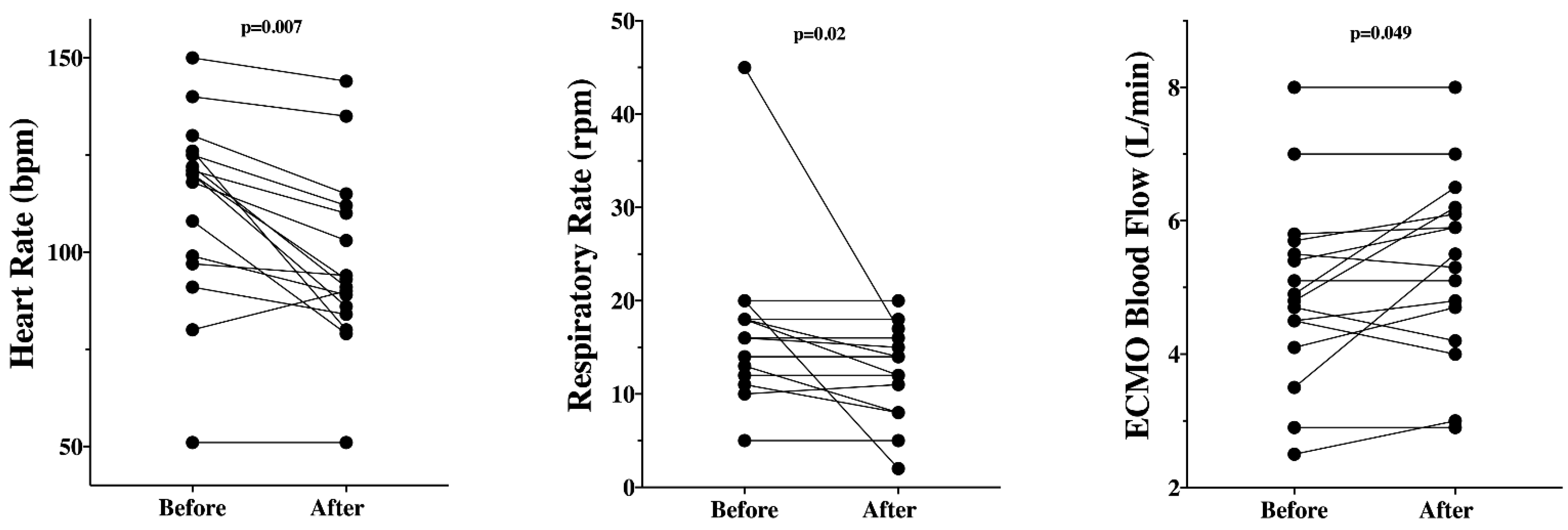
Extracorporeal membrane oxygenation (ECMO) is increasingly used to treat cardiopulmonary failure in critically ill patients. Peripheral cannulation may be complicated by a persistent low cardiac output in case of veno-venous cannulation (VV-ECMO) or by differential hypoxia (e.g., lower PaO2 in the upper than in the lower body) in case of veno-arterial cannulation (VA-ECMO) and severe impairment of pulmonary function associated with cardiac recovery. The treatment of such complications remains challenging. We report the early effects of the use of veno-arterial-venous (V-AV) ECMO in this setting. Methods: Retrospective analysis including patients from five different European ECMO centers (January 2013 to December 2016) who required V-AV ECMO. We collected demographic data as well as comorbidities and ECMO characteristics, hemodynamics, and arterial blood gas values before and immediately after (i.e., within 2 h) V-AV implementation. Results: A total of 32 patients (age 53 (interquartiles, IQRs: 31–59) years) were identified: 16 were initially supported with VA-ECMO and 16 with VV-ECMO. The median time to V-AV conversion was 2 (1–5) days. After V-AV implantation, heart rate and norepinephrine dose significantly decreased, while PaO2 and SaO2 significantly increased compared to baseline values. Lactate levels significantly decreased from 3.9 (2.3–7.1) to 2.8 (1.4–4.4) mmol/L (p = 0.048). A significant increase in the overall ECMO blood flow (from 4.5 (3.8–5.0) to 4.9 (4.3–5.9) L/min; p < 0.01) was observed, with 3.0 (2.5–3.2) L/min for the arterial and 2.8 (2.1–3.6) L/min for the venous return flows. Conclusions: In ECMO patients with differential hypoxia or persistently low cardiac output syndrome, V-AV conversion was associated with improvement in some hemodynamic and respiratory parameters. A significant increase in the overall ECMO blood flow was also observed, with similar flow distributed into the arterial and venous return cannulas.
Keywords: ECMO; veno-artero-venous; differential hypoxia; low cardiac output ECMO; veno-artero-venous; differential hypoxia; low cardiac output
Graphical Abstract