Article

Etiology of Clinical Community-Acquired Pneumonia in Swedish Children Aged 1–59 Months with High Pneumococcal Vaccine Coverage—The TREND Study

1
Pediatric Emergency Department, Sachs’ Children and Youth Hospital, S-118 83 Stockholm, Sweden
2
Department of Global Public Health, Karolinska Institutet, S-171 77 Stockholm, Sweden
3
Department of Medical Epidemiology and Biostatistics, Karolinska Institutet, S-171 77 Stockholm, Sweden
4
Pediatric Emergency Department, Astrid Lindgren Children’s Hospital, Karolinska University Hospital, S-171 64 Solna, Sweden
5
Department of Women’s and Children’s Health, Karolinska Institutet, S-171 77 Stockholm, Sweden
6
Department of Infectious Diseases, University of Gothenburg, S-405 30 Gothenburg, Sweden
7
Department of Protein Science, Division of Nanobiotechnology, KTH Royal Institute of Technology, SciLifeLab, S-171 65 Solna, Sweden
8
Department of Paediatrics and Adolescent Medicine, Turku University Hospital, University of Turku, Fi-20521 Turku, Finland
9
Institute of Biomedicine, University of Turku and Clinical Microbiology, Turku University Hospital, Fi-20521 Turku, Finland
10
Division of Infectious Diseases, Department of Medicine, S-17176 Stockholm, Sweden
11
Karolinska Institutet & Department of Infectious Diseases, Karolinska University Hospital, S-17164 Solna, Sweden
12
Department of Women’s and Children’s Health, International Maternal and Child Health (IMCH), Uppsala University, S-75237 Uppsala, Sweden
*
Author to whom correspondence should be addressed.
Vaccines 2021, 9(4), 384; https://doi.org/10.3390/vaccines9040384

Submission received: 28 February 2021 / Revised: 5 April 2021 / Accepted: 12 April 2021 / Published: 14 April 2021

Abstract

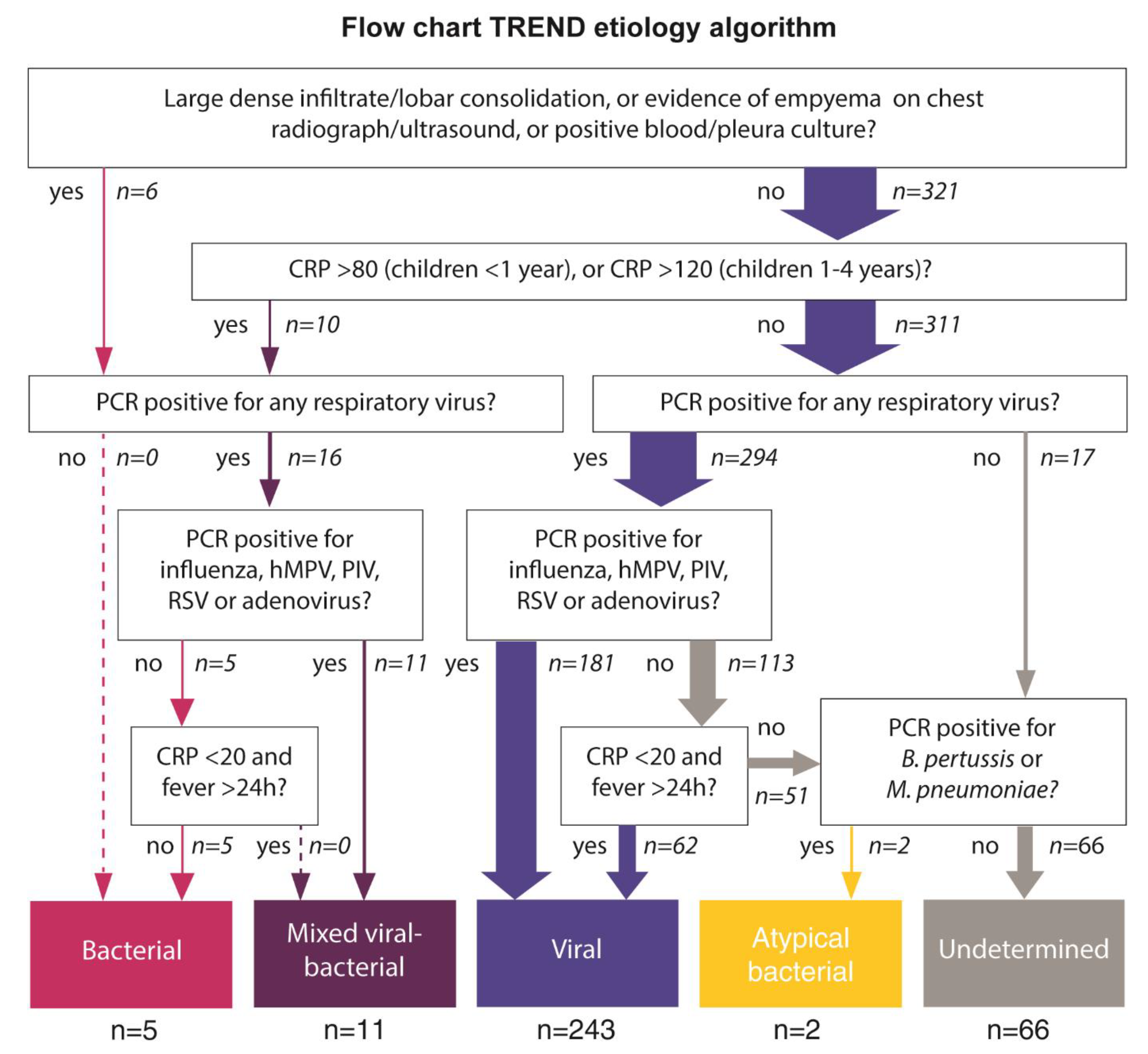
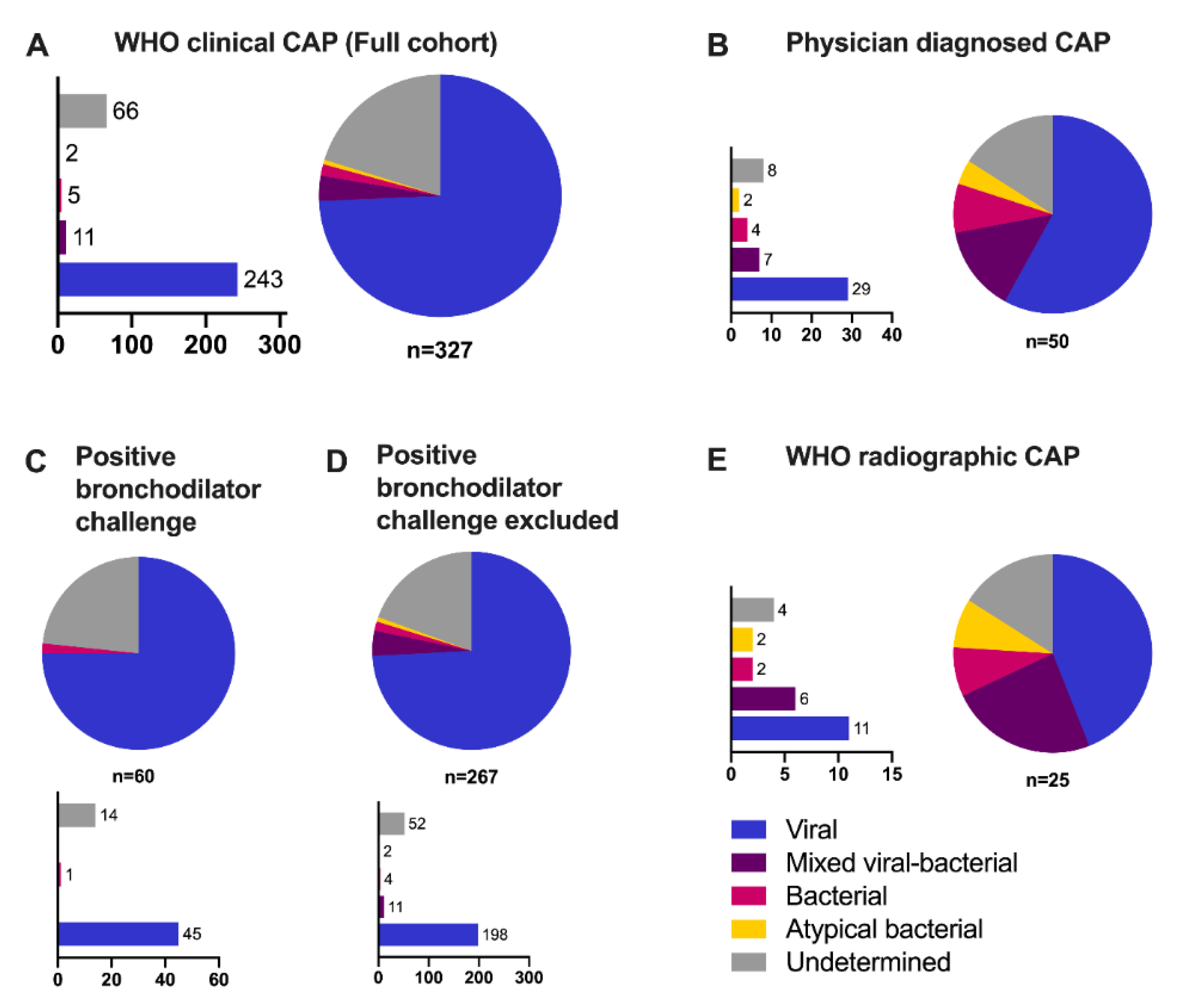
(1) Immunization with pneumococcal conjugate vaccines has decreased the burden of community-acquired pneumonia (CAP) in children and likely led to a shift in CAP etiology. (2) The Trial of Respiratory infections in children for ENhanced Diagnostics (TREND) enrolled children 1-59 months with clinical CAP according to the World Health Organization (WHO) criteria at Sachs’ Children and Youth Hospital, Stockholm, Sweden. Children with rhonchi and indrawing underwent “bronchodilator challenge”. C-reactive protein and nasopharyngeal PCR detecting 20 respiratory pathogens, were collected from all children. Etiology was defined according to an a priori defined algorithm based on microbiological, biochemical, and radiological findings. (3) Of 327 enrolled children, 107 (32%) required hospitalization; 91 (28%) received antibiotic treatment; 77 (24%) had a chest X-ray performed; and 60 (18%) responded to bronchodilator challenge. 243 (74%) episodes were classified as viral, 11 (3%) as mixed viral-bacterial, five (2%) as bacterial, two (0.6%) as atypical bacterial and 66 (20%) as undetermined etiology. After exclusion of children responding to bronchodilator challenge, the proportion of bacterial and mixed viral-bacterial etiology was 1% and 4%, respectively. (4) The novel TREND etiology algorithm classified the majority of clinical CAP episodes as of viral etiology, whereas bacterial etiology was uncommon. Defining CAP in children <5 years is challenging, and the WHO definition of clinical CAP is not suitable for use in children immunized with pneumococcal conjugate vaccines.
Keywords: pneumococcal conjugate vaccines; bacterial pneumonia; viral pneumonia; respiratory infection; etiology; children; World Health Organization pneumococcal conjugate vaccines; bacterial pneumonia; viral pneumonia; respiratory infection; etiology; children; World Health Organization