
Engineered mRNA Nanoparticle Platforms for Respiratory Mucosal Delivery

Abstract
1. Introduction
2. Modified mRNA Lipid Nanoparticles (LNPs)
3. Polymer-Based mRNA Nanoparticles
4. Hybrid RNA Nanoparticle Platforms
4.1. Replicon RNA/Lipid-Inorganic Hybrid Nanoparticles
4.2. Lipid–Polymer Hybrid Nanoparticles
4.3. Lipid-Extracellular Vesicle (EV) Hybrid Nanoparticles
5. Optimization of RNA Nanoparticle Platform
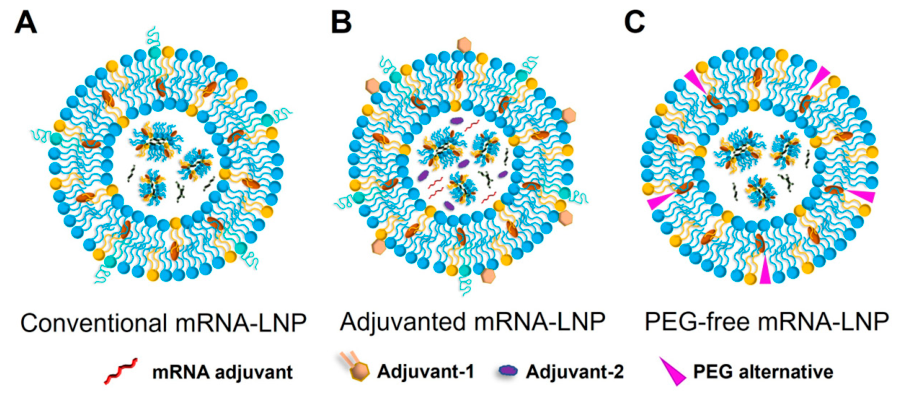
5.1. Adjuvants
5.2. PEG Alternatives
5.3. Delivery Strategies
6. Conclusions
7. Challenges and Future Perspectives
Author Contributions
Funding
Data Availability Statement
Conflicts of Interest
References
- Centers for Disease Control and Prevention (CDC). Respiratory Virus Activity—United States, 1 July 2024–30 June 2025. Morb. Mortal. Wkly. Rep. (MMWR) 2026, 75, 77–84. [Google Scholar] [PubMed]
- Centers for Disease Control and Prevention (CDC). 2024–2025 Influenza Season Summary: Severity, Disease Burden, and Burden Prevented. 2026. Available online: https://www.cdc.gov/flu-burden/php/data-vis-vac/2024-2025-prevented.html (accessed on 2 July 2026).
- Baden, L.R.; El Sahly, H.M.; Essink, B.; Kotloff, K.; Frey, S.; Novak, R.; Diemert, D.; Spector, S.A.; Rouphael, N.; Creech, C.B.; et al. Efficacy and Safety of the mRNA-1273 SARS-CoV-2 Vaccine. N. Engl. J. Med. 2021, 384, 403–416. [Google Scholar] [CrossRef] [PubMed]
- Polack, F.P.; Thomas, S.J.; Kitchin, N.; Absalon, J.; Gurtman, A.; Lockhart, S.; Perez, J.L.; Perez Marc, G.; Moreira, E.D.; Zerbini, C.; et al. Safety and Efficacy of the BNT162b2 mRNA Covid-19 Vaccine. N. Engl. J. Med. 2020, 383, 2603–2615. [Google Scholar] [CrossRef] [PubMed]
- Pardi, N.; Hogan, M.J.; Porter, F.W.; Weissman, D. mRNA vaccines—A new era in vaccinology. Nat. Rev. Drug Discov. 2018, 17, 261–279. [Google Scholar] [CrossRef] [PubMed]
- Pardi, N.; Krammer, F. mRNA vaccines for infectious diseases—Advances, challenges and opportunities. Nat. Rev. Drug Discov. 2024, 23, 838–861. [Google Scholar] [CrossRef] [PubMed]
- Leong, K.Y.; Tham, S.K.; Poh, C.L. Correction: Revolutionizing immunization: A comprehensive review of mRNA vaccine technology and applications. Virol. J. 2025, 22, 272. [Google Scholar] [CrossRef] [PubMed]
- Metkar, M.; Pepin, C.S.; Moore, M.J. Tailor made: The art of therapeutic mRNA design. Nat. Rev. Drug Discov. 2024, 23, 67–83. [Google Scholar] [CrossRef] [PubMed]
- Lavelle, E.C.; Ward, R.W. Publisher Correction: Mucosal vaccines—Fortifying the frontiers. Nat. Rev. Immunol. 2022, 22, 266. [Google Scholar] [CrossRef] [PubMed]
- Russell, M.W.; Moldoveanu, Z.; Ogra, P.L.; Mestecky, J. Mucosal Immunity in COVID-19: A Neglected but Critical Aspect of SARS-CoV-2 Infection. Front. Immunol. 2020, 11, 611337. [Google Scholar] [CrossRef] [PubMed]
- Zhou, X.; Wu, Y.; Zhu, Z.; Lu, C.; Zhang, C.; Zeng, L.; Xie, F.; Zhang, L.; Zhou, F. Mucosal immune response in biology, disease prevention and treatment. Signal Transduct. Target. Ther. 2025, 10, 7. [Google Scholar] [CrossRef] [PubMed]
- Zhang, M.; Li, N.; He, Y.; Shi, T.; Jie, Z. Pulmonary resident memory T cells in respiratory virus infection and their inspiration on therapeutic strategies. Front. Immunol. 2022, 13, 943331. [Google Scholar] [CrossRef] [PubMed]
- Kunzli, M.; O’Flanagan, S.D.; LaRue, M.; Talukder, P.; Dileepan, T.; Stolley, J.M.; Soerens, A.G.; Quarnstrom, C.F.; Wijeyesinghe, S.; Ye, Y.; et al. Route of self-amplifying mRNA vaccination modulates the establishment of pulmonary resident memory CD8 and CD4 T cells. Sci. Immunol. 2022, 7, eadd3075. [Google Scholar] [CrossRef] [PubMed]
- Tang, J.; Zeng, C.; Cox, T.M.; Li, C.; Son, Y.M.; Cheon, I.S.; Wu, Y.; Behl, S.; Taylor, J.J.; Chakaraborty, R.; et al. Respiratory mucosal immunity against SARS-CoV-2 after mRNA vaccination. Sci. Immunol. 2022, 7, eadd4853. [Google Scholar] [CrossRef] [PubMed]
- Lokugamage, M.P.; Vanover, D.; Beyersdorf, J.; Hatit, M.Z.C.; Rotolo, L.; Echeverri, E.S.; Peck, H.E.; Ni, H.; Yoon, J.K.; Kim, Y.; et al. Optimization of lipid nanoparticles for the delivery of nebulized therapeutic mRNA to the lungs. Nat. Biomed. Eng. 2021, 5, 1059–1068. [Google Scholar] [CrossRef] [PubMed]
- Neary, M.T.; Mulder, L.M.; Kowalski, P.S.; MacLoughlin, R.; Crean, A.M.; Ryan, K.B. Nebulised delivery of RNA formulations to the lungs: From aerosol to cytosol. J. Control. Release 2024, 366, 812–833. [Google Scholar] [CrossRef] [PubMed]
- Bansil, R.; Turner, B.S. The biology of mucus: Composition, synthesis and organization. Adv. Drug Deliv. Rev. 2018, 124, 3–15. [Google Scholar] [CrossRef] [PubMed]
- Jiang, A.Y.; Witten, J.; Raji, I.O.; Eweje, F.; MacIsaac, C.; Meng, S.; Oladimeji, F.A.; Hu, Y.; Manan, R.S.; Langer, R.; et al. Combinatorial development of nebulized mRNA delivery formulations for the lungs. Nat. Nanotechnol. 2024, 19, 364–375. [Google Scholar] [CrossRef] [PubMed]
- Huckaby, J.T.; Lai, S.K. PEGylation for enhancing nanoparticle diffusion in mucus. Adv. Drug Deliv. Rev. 2018, 124, 125–139. [Google Scholar] [CrossRef] [PubMed]
- Vu, M.N.; Pilapitiya, D.; Kelly, A.; Koutsakos, M.; Kent, S.J.; Juno, J.A.; Tan, H.X.; Wheatley, A.K. Deconvolution of cargo delivery and immunogenicity following intranasal delivery of mRNA lipid nanoparticle vaccines. Mol. Ther. Nucleic Acids 2025, 36, 102547. [Google Scholar] [CrossRef] [PubMed]
- LoPresti, S.T.; Arral, M.L.; Chaudhary, N.; Whitehead, K.A. The replacement of helper lipids with charged alternatives in lipid nanoparticles facilitates targeted mRNA delivery to the spleen and lungs. J. Control. Release 2022, 345, 819–831. [Google Scholar] [CrossRef] [PubMed]
- Radmand, A.; Lokugamage, M.P.; Kim, H.; Dobrowolski, C.; Zenhausern, R.; Loughrey, D.; Huayamares, S.G.; Hatit, M.Z.C.; Ni, H.; Del Cid, A.; et al. The Transcriptional Response to Lung-Targeting Lipid Nanoparticles in Vivo. Nano Lett. 2023, 23, 993–1002. [Google Scholar] [CrossRef] [PubMed]
- Maniyamgama, N.; Bae, K.H.; Chang, Z.W.; Lee, J.; Ang, M.J.Y.; Tan, Y.J.; Ng, L.F.P.; Renia, L.; White, K.P.; Yang, Y.Y. Muco-Penetrating Lipid Nanoparticles Having a Liquid Core for Enhanced Intranasal mRNA Delivery. Adv. Sci. 2025, 12, 2407383. [Google Scholar] [CrossRef] [PubMed]
- Leiros, G.J.; Kusinsky, A.G.; Balana, M.E.; Hagelin, K. Triolein reduces MMP-1 upregulation in dermal fibroblasts generated by ROS production in UVB-irradiated keratinocytes. J. Dermatol. Sci. 2017, 85, 124–130. [Google Scholar] [CrossRef] [PubMed]
- Rossi, A.; Bragonzi, A.; Medede, M.; De Fino, I.; Lippi, G.; Prosdocimi, M.; Tamanini, A.; Cabrini, G.; Dechecchi, M.C. beta-sitosterol ameliorates inflammation and Pseudomonas aeruginosa lung infection in a mouse model. J. Cyst. Fibros. 2023, 22, 156–160. [Google Scholar] [CrossRef] [PubMed]
- Xu, Q.; Ensign, L.M.; Boylan, N.J.; Schon, A.; Gong, X.; Yang, J.C.; Lamb, N.W.; Cai, S.; Yu, T.; Freire, E.; et al. Impact of Surface Polyethylene Glycol (PEG) Density on Biodegradable Nanoparticle Transport in Mucus ex Vivo and Distribution in Vivo. ACS Nano 2015, 9, 9217–9227. [Google Scholar] [CrossRef] [PubMed]
- Schneider, C.S.; Xu, Q.; Boylan, N.J.; Chisholm, J.; Tang, B.C.; Schuster, B.S.; Henning, A.; Ensign, L.M.; Lee, E.; Adstamongkonkul, P.; et al. Nanoparticles that do not adhere to mucus provide uniform and long-lasting drug delivery to airways following inhalation. Sci. Adv. 2017, 3, e1601556. [Google Scholar] [CrossRef] [PubMed]
- Khutoryanskiy, V.V. Beyond PEGylation: Alternative surface-modification of nanoparticles with mucus-inert biomaterials. Adv. Drug Deliv. Rev. 2018, 124, 140–149. [Google Scholar] [CrossRef] [PubMed]
- Kim, J.; Jozic, A.; Lin, Y.X.; Eygeris, Y.; Bloom, E.; Tan, X.C.; Acosta, C.; MacDonald, K.D.; Welsher, K.D.; Sahay, G. Engineering Lipid Nanoparticles for Enhanced Intracellular Delivery of mRNA through Inhalation. Acs Nano 2022, 16, 14792–14806. [Google Scholar] [CrossRef] [PubMed]
- Radmand, A.; Kim, H.; Beyersdorf, J.; Dobrowolski, C.N.; Zenhausern, R.; Paunovska, K.; Huayamares, S.G.; Hua, X.; Han, K.; Loughrey, D.; et al. Cationic cholesterol-dependent LNP delivery to lung stem cells, the liver, and heart. Proc. Natl. Acad. Sci. USA 2024, 121, e2307801120. [Google Scholar] [CrossRef] [PubMed]
- Baldeon Vaca, G.; Meyer, M.; Cadete, A.; Hsiao, C.J.; Golding, A.; Jeon, A.; Jacquinet, E.; Azcue, E.; Guan, C.M.; Sanchez-Felix, X.; et al. Intranasal mRNA-LNP vaccination protects hamsters from SARS-CoV-2 infection. Sci. Adv. 2023, 9, eadh1655. [Google Scholar] [CrossRef] [PubMed]
- Moreno Herrero, J.; Stahl, T.B.; Erbar, S.; Maxeiner, K.; Schlegel, A.; Bacic, T.; Schumacher, J.; Cavalcanti, L.P.; Schroer, M.A.; Svergun, D.I.; et al. Compact polyethylenimine-complexed mRNA vaccines. Nat. Nanotechnol. 2025, 20, 1323–1331. [Google Scholar] [CrossRef] [PubMed]
- Kaczmarek, J.C.; Patel, A.K.; Kauffman, K.J.; Fenton, O.S.; Webber, M.J.; Heartlein, M.W.; DeRosa, F.; Anderson, D.G. Polymer-Lipid Nanoparticles for Systemic Delivery of mRNA to the Lungs. Angew. Chem. Int. Ed. Engl. 2016, 55, 13808–13812. [Google Scholar] [CrossRef] [PubMed]
- Patel, A.K.; Kaczmarek, J.C.; Bose, S.; Kauffman, K.J.; Mir, F.; Heartlein, M.W.; DeRosa, F.; Langer, R.; Anderson, D.G. Inhaled Nanoformulated mRNA Polyplexes for Protein Production in Lung Epithelium. Adv. Mater. 2019, 31, e1805116. [Google Scholar] [CrossRef] [PubMed]
- Blanchard, E.L.; Vanover, D.; Bawage, S.S.; Tiwari, P.M.; Rotolo, L.; Beyersdorf, J.; Peck, H.E.; Bruno, N.C.; Hincapie, R.; Michel, F.; et al. Treatment of influenza and SARS-CoV-2 infections via mRNA-encoded Cas13a in rodents. Nat. Biotechnol. 2021, 39, 717–726. [Google Scholar] [CrossRef] [PubMed]
- Kaczmarek, J.C.; Kauffman, K.J.; Fenton, O.S.; Sadtler, K.; Patel, A.K.; Heartlein, M.W.; DeRosa, F.; Anderson, D.G. Optimization of a Degradable Polymer-Lipid Nanoparticle for Potent Systemic Delivery of mRNA to the Lung Endothelium and Immune Cells. Nano Lett. 2018, 18, 6449–6454. [Google Scholar] [CrossRef] [PubMed]
- Chen, Q.; Chang, Y.; He, X.; Ding, Y.; Wang, R.; Luo, R.; Yuan, J.; Chen, J.; Zhong, G.; Yang, H.; et al. Targeted Delivery of mRNA with Polymer-Lipid Nanoparticles for In Vivo Base Editing. ACS Nano 2025, 19, 7835–7850. [Google Scholar] [CrossRef] [PubMed]
- Rotolo, L.; Vanover, D.; Bruno, N.C.; Peck, H.E.; Zurla, C.; Murray, J.; Noel, R.K.; O’Farrell, L.; Arainga, M.; Orr-Burks, N.; et al. Species-agnostic polymeric formulations for inhalable messenger RNA delivery to the lung. Nat. Mater. 2023, 22, 369–379. [Google Scholar] [CrossRef] [PubMed]
- Rui, Y.; Wilson, D.R.; Tzeng, S.Y.; Yamagata, H.M.; Sudhakar, D.; Conge, M.; Berlinicke, C.A.; Zack, D.J.; Tuesca, A.; Green, J.J. High-throughput and high-content bioassay enables tuning of polyester nanoparticles for cellular uptake, endosomal escape, and systemic in vivo delivery of mRNA. Sci. Adv. 2022, 8, eabk2855. [Google Scholar] [CrossRef] [PubMed]
- Ben-Akiva, E.; Karlsson, J.; Hemmati, S.; Yu, H.; Tzeng, S.Y.; Pardoll, D.M.; Green, J.J. Biodegradable lipophilic polymeric mRNA nanoparticles for ligand-free targeting of splenic dendritic cells for cancer vaccination. Proc. Natl. Acad. Sci. USA 2023, 120, e2301606120. [Google Scholar] [CrossRef] [PubMed]
- Suberi, A.; Grun, M.K.; Mao, T.; Israelow, B.; Reschke, M.; Grundler, J.; Akhtar, L.; Lee, T.; Shin, K.; Piotrowski-Daspit, A.S.; et al. Polymer nanoparticles deliver mRNA to the lung for mucosal vaccination. Sci. Transl. Med. 2023, 15, eabq0603. [Google Scholar] [CrossRef] [PubMed]
- Binns, T.C.; Eaton, D.A.; Akiki, D.V.; Deschenes, E.; Piotrowski-Daspit, A.S.; Bracaglia, L.G.; Hendrickson, J.E.; Saltzman, W.M. Cellular determinants influence the red blood cell adsorption efficiency of poly(amine-co-ester) nanoparticles. Sci. Adv. 2025, 11, eadt8637. [Google Scholar] [CrossRef]
- Liu, G.; Xiang, W.Q.; Guan, M.M.; Xu, C.T.; Liu, J.; Zhao, C.; Deng, Y. Biodegradable Hyperbranched Poly(Amine-Co-Ester)-Based Polymeric Nanoparticles for mRNA Delivery. Adv. Funct. Mater. 2025, 35, 2425986. [Google Scholar] [CrossRef]
- Erasmus, J.H.; Khandhar, A.P.; O’Connor, M.A.; Walls, A.C.; Hemann, E.A.; Murapa, P.; Archer, J.; Leventhal, S.; Fuller, J.T.; Lewis, T.B.; et al. An Alphavirus-derived replicon RNA vaccine induces SARS-CoV-2 neutralizing antibody and T cell responses in mice and nonhuman primates. Sci. Transl. Med. 2020, 12, eabc9396. [Google Scholar] [CrossRef] [PubMed]
- Kimura, T.; Reed, S.J.; Warner, N.L.; Fredericks, M.N.; Lewis, T.B.; Lafferty, A.; Hodge, E.; Simpson, A.; Hinkley, T.; Khandhar, A.P.; et al. Antigen-dependent interplay of formulation, systemic innate responses, and antibody responses to multi-component replicon RNA vaccination. Mol. Ther. Nucleic Acids 2025, 36, 102595. [Google Scholar] [CrossRef] [PubMed]
- Gulati, G.K.; Simpson, A.C.; MacMillen, Z.; Krieger, K.; Sharma, S.; Erasmus, J.H.; Reed, S.G.; Davie, J.W.; Avril, M.; Khandhar, A.P. Preclinical development of lyophilized self-replicating RNA vaccines for COVID-19 and malaria with improved long-term thermostability. J. Control. Release 2025, 377, 81–92. [Google Scholar] [CrossRef] [PubMed]
- Wang, Y.; Qin, B.; Xia, G.; Choi, S.H. FDA’s Poly (Lactic-Co-Glycolic Acid) Research Program and Regulatory Outcomes. AAPS J. 2021, 23, 92. [Google Scholar] [CrossRef] [PubMed]
- Panyam, J.; Zhou, W.Z.; Prabha, S.; Sahoo, S.K.; Labhasetwar, V. Rapid endo-lysosomal escape of poly(DL-lactide-co-glycolide) nanoparticles: Implications for drug and gene delivery. FASEB J. 2002, 16, 1217–1226. [Google Scholar] [CrossRef] [PubMed]
- Jiang, M.; Sieber-Schafer, F.; Carneiro, S.P.; Matzek, D.; Nguyen, A.; Porras-Gonzalez, D.L.; Verma, A.K.; Kolog-Gulko, M.; Jurgens, D.C.; Burgstaller, G.; et al. A hybrid polymeric system for pulmonary mRNA delivery: Advancing mucosal vaccine development. Cell Biomater. 2026, 2, 100311. [Google Scholar] [CrossRef] [PubMed]
- Santander-Ortega, M.J.; Jodar-Reyes, A.B.; Csaba, N.; Bastos-Gonzalez, D.; Ortega-Vinuesa, J.L. Colloidal stability of pluronic F68-coated PLGA nanoparticles: A variety of stabilisation mechanisms. J. Colloid Interface Sci. 2006, 302, 522–529. [Google Scholar] [CrossRef] [PubMed]
- Sharifnia, Z.; Bandehpour, M.; Hamishehkar, H.; Mosaffa, N.; Kazemi, B.; Zarghami, N. Transcribed mRNA Delivery Using PLGA/PEI Nanoparticles into Human Monocyte-derived Dendritic Cells. Iran. J. Pharm. Res. 2019, 18, 1659–1675. [Google Scholar] [CrossRef] [PubMed]
- Zhou, J.; Patel, T.R.; Fu, M.; Bertram, J.P.; Saltzman, W.M. Octa-functional PLGA nanoparticles for targeted and efficient siRNA delivery to tumors. Biomaterials 2012, 33, 583–591. [Google Scholar] [CrossRef] [PubMed]
- Zhao, W.; Zhang, C.; Li, B.; Zhang, X.; Luo, X.; Zeng, C.; Li, W.; Gao, M.; Dong, Y. Lipid Polymer Hybrid Nanomaterials for mRNA Delivery. Cell. Mol. Bioeng. 2018, 11, 397–406. [Google Scholar] [CrossRef] [PubMed]
- Baghel, S.; Lokras, A.; Dias, B.A.; Landry, M.; Cerda, S.L.; Wadhwa, A.; Herrera-Barrera, M.; Thakur, A.; Rades, T.; Franzyk, H.; et al. Design of messenger RNA vaccines based on lipid-polymer hybrid nanoparticles. J. Control. Release 2025, 388, 114385. [Google Scholar] [CrossRef] [PubMed]
- Mazrad, Z.A.I.; Lee, C.L.; Zhang, T.X.; Warne, N.M.; Huynh, N.T.; Nur-A-Tomal, M.S.; Cameron, N.R.; van’t Hag, L.; Pouton, C.W.; Kempe, K. Lipid-Polyhydroxyalkanoate Hybrid Nanoparticles as Sustainable Platform for mRNA delivery. Eur. J. Pharm. Biopharm. 2025, 213, 114755. [Google Scholar] [CrossRef] [PubMed]
- Chahal, J.S.; Khan, O.F.; Cooper, C.L.; McPartlan, J.S.; Tsosie, J.K.; Tilley, L.D.; Sidik, S.M.; Lourido, S.; Langer, R.; Bavari, S.; et al. Dendrimer-RNA nanoparticles generate protective immunity against lethal Ebola, H1N1 influenza, and Toxoplasma gondii challenges with a single dose. Proc. Natl. Acad. Sci. USA 2016, 113, E4133–E4142. [Google Scholar] [CrossRef] [PubMed]
- Meshanni, J.A.; Stevenson, E.R.; Zhang, D.; Sun, R.; Ona, N.A.; Reagan, E.K.; Abramova, E.; Guo, C.J.; Wilkinson, M.; Baboo, I.; et al. Targeted delivery of TGF-beta mRNA to murine lung parenchyma using one-component ionizable amphiphilic Janus Dendrimers. Nat. Commun. 2025, 16, 1806. [Google Scholar] [CrossRef] [PubMed]
- Park, Y.; Moses, A.S.; Demessie, A.A.; Singh, P.; Lee, H.; Korzun, T.; Taratula, O.R.; Alani, A.W.G.; Taratula, O. Poly(aspartic acid)-Based Polymeric Nanoparticle for Local and Systemic mRNA Delivery. Mol. Pharm. 2022, 19, 4696–4704. [Google Scholar] [CrossRef] [PubMed]
- Han, Y.; Jones, T.W.; Dutta, S.; Zhu, Y.; Wang, X.; Narayanan, S.P.; Fagan, S.C.; Zhang, D. Overview and Update on Methods for Cargo Loading into Extracellular Vesicles. Processes 2021, 9, 356. [Google Scholar] [CrossRef] [PubMed]
- Muskan, M.; Abeysinghe, P.; Cecchin, R.; Branscome, H.; Morris, K.V.; Kashanchi, F. Therapeutic potential of RNA-enriched extracellular vesicles: The next generation in RNA delivery via biogenic nanoparticles. Mol. Ther. 2024, 32, 2939–2949. [Google Scholar] [CrossRef] [PubMed]
- Dong, S.; Liu, X.; Bi, Y.; Wang, Y.; Antony, A.; Lee, D.; Huntoon, K.; Jeong, S.; Ma, Y.; Li, X.; et al. Adaptive design of mRNA-loaded extracellular vesicles for targeted immunotherapy of cancer. Nat. Commun. 2023, 14, 6610. [Google Scholar] [CrossRef] [PubMed]
- Chung, J.; Kim, K.H.; An, S.H.; Bae, D.; Kim, H.K.; Choi, Y.; Kim, J.H.; Kwon, K.; Kim, S.H. A single extracellular vesicle-based platform supporting both RBD protein and mRNA vaccination against SARS-CoV-2. J. Control. Release 2026, 390, 114515. [Google Scholar] [CrossRef] [PubMed]
- Wang, X.; Munson, M.J.; Friis, K.; Marzeda, A.; Silva, A.M.; Kohl, F.; Hultin, L.; Schiffelers, R.M.; Dekker, N. Hybrid Extracellular Vesicles for Efficient Loading and Functional Delivery of mRNA. J. Extracell. Vesicles 2025, 14, e70201. [Google Scholar] [CrossRef] [PubMed]
- Louro, A.F.; Gomes, I.; Lu, C.E.; Alfonzo-Méndez, M.A.; Dekker, N.; Khan, M.; Lázaro-Ibáñez, E. Engineering Hybrid Extracellular Vesicles for Functional mRNA Delivery. Adv. Funct. Mater. 2026, 36, e09636. [Google Scholar] [CrossRef]
- Pareja Tello, R.; Lamparelli, E.P.; Ciardulli, M.C.; Hirvonen, J.; Barreto, G.; Mafulli, N.; Della Porta, G.; Santos, H.A. Hybrid lipid nanoparticles derived from human mesenchymal stem cell extracellular vesicles by microfluidic sonication for collagen I mRNA delivery to human tendon progenitor stem cells. Biomater. Sci. 2025, 13, 2066–2081. [Google Scholar] [CrossRef] [PubMed]
- Ding, N.; Daci, A.; Krasniqi, V.; Butler, R.; Goddard, A.; Guo, Q.; Zhang, Y.; Zhong, J.; Chan, K.L.A.; Thanou, M.; et al. Engineered extracellular vesicles demonstrate altered endocytosis and biodistribution and have superior oral siRNA delivery efficiency compared to lipid nanoparticles. Int. J. Pharm. X 2025, 10, 100428. [Google Scholar] [CrossRef] [PubMed]
- Zhu, W.; Dong, C.; Wei, L.; Kim, J.K.; Wang, B.Z. Inverted HA-EV immunization elicits stalk-specific influenza immunity and cross-protection in mice. Mol. Ther. 2025, 33, 485–498. [Google Scholar] [CrossRef] [PubMed]
- Zhu, W.; Wei, L.; Dong, C.; Kim, J.K.; Bruhn, M.; Ma, Y.; Ferrante, A.; Arsana, A.; Omotara, P.; Kang, S.M.; et al. Mosaic Inverted Hemagglutinin Extracellular Vesicle Vaccines Elicit Protective Systemic and Mucosal Immunity against Heterosubtypic Influenza Infection. ACS Nano 2026, 20, 10858–10871. [Google Scholar] [CrossRef] [PubMed]
- Dong, C.; Wei, L.; Zhu, W.; Kim, J.K.; Wang, Y.; Omotara, P.; Arsana, A.; Wang, B.Z. Mature Dendritic Cell-Derived Extracellular Vesicles are Potent Mucosal Adjuvants for Influenza Hemagglutinin Vaccines. ACS Nano 2025, 19, 25526–25542. [Google Scholar] [CrossRef] [PubMed]
- Xie, C.; Yao, R.; Xia, X. The advances of adjuvants in mRNA vaccines. npj Vaccines 2023, 8, 162. [Google Scholar] [CrossRef] [PubMed]
- Svensson, M.; Limeres, M.J.; Zeyn, Y.; Gambaro, R.C.; Islan, G.A.; Berti, I.R.; Fraude-El Ghazi, S.; Pretsch, L.; Hilbert, K.; Schneider, P.; et al. mRNA-LNP vaccine strategies: Effects of adjuvants on non-parenchymal liver cells and tolerance. Mol. Ther. Methods Clin. Dev. 2025, 33, 101427. [Google Scholar] [CrossRef] [PubMed]
- Wang, J.; Li, P.; Yu, Y.; Fu, Y.; Jiang, H.; Lu, M.; Sun, Z.; Jiang, S.; Lu, L.; Wu, M.X. Pulmonary surfactant-biomimetic nanoparticles potentiate heterosubtypic influenza immunity. Science 2020, 367, eaau0810. [Google Scholar] [CrossRef] [PubMed]
- Xiao, L.; Yu, W.; Shen, L.; Yan, W.; Qi, J.; Hu, T. Mucosal SARS-CoV-2 Nanoparticle Vaccine Based on Mucosal Adjuvants and Its Immune Effectiveness by Intranasal Administration. ACS Appl. Mater. Interfaces 2023, 15, 35895–35905. [Google Scholar] [CrossRef] [PubMed]
- Leekha, A.; Saeedi, A.; Kumar, M.; Sefat, K.; Martinez-Paniagua, M.; Meng, H.; Fathi, M.; Kulkarni, R.; Reichel, K.; Biswas, S.; et al. An intranasal nanoparticle STING agonist protects against respiratory viruses in animal models. Nat. Commun. 2024, 15, 6053. [Google Scholar] [CrossRef] [PubMed]
- Wei, L.; Zhu, W.; Dong, C.; Kim, J.K.; Ma, Y.; Denning, T.L.; Kang, S.M.; Wang, B.Z. Lipid nanoparticles encapsulating both adjuvant and antigen mRNA improve influenza immune cross-protection in mice. Biomaterials 2025, 317, 123039. [Google Scholar] [CrossRef] [PubMed]
- Aunins, E.A.; Phan, A.T.; Alameh, M.G.; Dwivedi, G.; Cruz-Morales, E.; Christian, D.A.; Tam, Y.; Bunkofske, M.E.; Penafiel, A.Z.; O’Dea, K.M.; et al. An Il12 mRNA-LNP adjuvant enhances mRNA vaccine-induced CD8 T cell responses. Sci. Immunol. 2025, 10, eads1328. [Google Scholar] [CrossRef] [PubMed]
- Li, B.; Jiang, A.Y.; Raji, I.; Atyeo, C.; Raimondo, T.M.; Gordon, A.G.R.; Rhym, L.H.; Samad, T.; MacIsaac, C.; Witten, J.; et al. Author Correction: Enhancing the immunogenicity of lipid-nanoparticle mRNA vaccines by adjuvanting the ionizable lipid and the mRNA. Nat. Biomed. Eng. 2025, 9, 280. [Google Scholar] [CrossRef] [PubMed]
- PEG alternatives for RNA therapeutics. Nat. Mater. 2025, 24, 1665. [CrossRef] [PubMed]
- Gao, W.; Zhang, L. Making way for PEG alternatives. Nat. Mater. 2025, 24, 1682–1683. [Google Scholar] [CrossRef] [PubMed]
- Xiao, Y.; Lian, X.; Sun, Y.; Sung, Y.C.; Vaidya, A.; Chen, Z.; Gupta, A.; Chatterjee, S.; Zheng, L.; Guerrero, E.; et al. High-density brush-shaped polymer lipids reduce anti-PEG antibody binding for repeated administration of mRNA therapeutics. Nat. Mater. 2025, 24, 1840–1851. [Google Scholar] [CrossRef] [PubMed]
- Luozhong, S.J.; Liu, P.C.; Li, R.X.; Yuan, Z.F.; Debley, E.; Chen, Y.; Hu, Y.P.; Cao, Z.Y.; Cui, M.; Mcilhenny, K.; et al. Poly(carboxybetaine) lipids enhance mRNA therapeutics efficacy and reduce their immunogenicity. Nat. Mater. 2025, 24, 1852–1861. [Google Scholar] [CrossRef] [PubMed]
- Berger, M.; Degey, M.; Curnel, A.; Evrard, B.; Piel, G. The benefits of emerging alternatives to PEG for lipid nanoparticle RNA delivery systems. Nanomedicine 2025, 20, 1987–1989. [Google Scholar] [CrossRef] [PubMed]
- Berger, M.; Toussaint, F.; Ben Djemaa, S.; Maquoi, E.; Pendeville, H.; Evrard, B.; Jerome, C.; Leblond Chain, J.; Lechanteur, A.; Mottet, D.; et al. Poly(N-methyl-N-vinylacetamide): A Strong Alternative to PEG for Lipid-Based Nanocarriers Delivering siRNA. Adv. Healthc. Mater. 2024, 13, e2302712. [Google Scholar] [CrossRef] [PubMed]
- Hassanel, D.; Pilkington, E.H.; Ju, Y.; Kent, S.J.; Pouton, C.W.; Truong, N.P. Replacing poly(ethylene glycol) with RAFT lipopolymers in mRNA lipid nanoparticle systems for effective gene delivery. Int. J. Pharm. 2024, 665, 124695. [Google Scholar] [CrossRef] [PubMed]
- Dong, C.; Zhu, W.; Wei, L.; Kim, J.K.; Ma, Y.; Kang, S.M.; Wang, B.Z. Enhancing cross-protection against influenza by heterologous sequential immunization with mRNA LNP and protein nanoparticle vaccines. Nat. Commun. 2024, 15, 5800. [Google Scholar] [CrossRef] [PubMed]
- Lapuente, D.; Fuchs, J.; Willar, J.; Vieira Antao, A.; Eberlein, V.; Uhlig, N.; Issmail, L.; Schmidt, A.; Oltmanns, F.; Peter, A.S.; et al. Protective mucosal immunity against SARS-CoV-2 after heterologous systemic prime-mucosal boost immunization. Nat. Commun. 2021, 12, 6871. [Google Scholar] [CrossRef] [PubMed]
- Gagne, M.; Flynn, B.J.; Andrew, S.F.; Marquez, J.; Flebbe, D.R.; Mychalowych, A.; Lamb, E.; Davis-Gardner, M.E.; Burnett, M.R.; Serebryannyy, L.A.; et al. Mucosal adenovirus vaccine boosting elicits IgA and durably prevents XBB.1.16 infection in nonhuman primates. Nat. Immunol. 2024, 25, 1913–1927. [Google Scholar] [CrossRef] [PubMed]
- Chen, G.; Nguyen, T.; McKay, L.G.A.; Nakka, S.S.; Hu, P.; McBride, J.; Liang, A.C.; Olson, R.; Moon, J.J.; Luster, A.D.; et al. Conserved CD8 T cell vaccines without B cell epitopes drive robust protection against SARS-CoV-2 that is enhanced by intranasal boost. Sci. Adv. 2025, 11, eadx0037. [Google Scholar] [CrossRef] [PubMed]



| Modified Lipid Nanoparticles (LNPs) | |||||
| Ref. | Platform | Key Design | Cargo | Route/Application type | Features |
| [20] | Ionizable mRNA-LNP | Ionizable lipids (ALC-0315, SM-102, MC3) ± cationic lipid (DOTAP/DOTMA) | mRNA | IN/Vaccine | Lung epithelial and immune cell transfection; limited mucosal immunogenicity; recalls draining lymphoid tissue responses |
| [21] | Charged-helper lipid LNP | Standard helper lipids replaced with neutral, anionic, or cationic lipids | mRNA | IV | Non-hepatocellular delivery; redirected lung and spleen tropism |
| [22] | Lung-targeting LNP | Supplemental cationic lipid added to ionizable LNP formulation | mRNA | IV | Significantly increased lung-selective mRNA delivery |
| [23] | Ionizable lipid-like NP (iLLN) | Ionizable + cationic lipid hybrid; liquid-core; triolein + beta-sitosterol; PEGylated muco-inert surface | mRNA | IN/Vaccine | pKa matched to nasal pH; ~60-fold higher nasal gene expression; enhanced mucus penetration and tolerability |
| [29] | Inhalable PEGylated LNP | Combination of β-sitosterol and high PEG contents, aerosol-stable ionizable LNP | mRNA | Inhalation | Rapid mucus penetration; improved lung epithelium transfection; PEG >5% reduces transfection efficiency |
| [30] | Cationic cholesterol LNP | Cationic cholesterol + cationic helper lipids | mRNA | IV | mRNA delivery to lung epithelial, stem-like, and cardiac cells; distinct biodistribution vs. conventional LNPs |
| [31] | SARS-CoV-2 mRNA-LNP | Spike mRNA in ionizable LNP | mRNA | IN/Vaccine | Successful immunogenicity and protective efficacy in hamster challenge model |
| Polymer-Based mRNA Nanoparticles | |||||
| Ref. | Platform | Key Design | Cargo | Route/Application type | Features |
| [32] | PEI/saRNA polyplex | Large excess of the cationic PEI and single saRNA molecules in solution | saRNA | IM | Small spherical NP with high packing density and low polymer mass fraction; PEI/HA-saRNA induced immune responses in mice |
| [33] | PBAE-PEG-lipid NP | Degradable PBAE terpolymers + PEG-lipid conjugate | mRNA | IV | Increased serum stability and in vitro potency; functional delivery of mRNA to lung |
| [34] | Hyperbranched PBAE (hPBAE) polyplex | hDD90-118 and hC32-118 hPBAE mRNA polyplex | mRNA | Inhalation | Consistent protein expression in lung epithelium with minimal toxicity |
| [35] | hPBAE/Cas13a mRNA NP | hDD90-118 co-delivering Cas13a mRNA + guide RNA; nebulized | mRNA | Inhalation/Therapeutic | Reduces SARS-CoV-2 replication in mice and hamsters via inhaled CRISPR-Cas13a |
| [36] | Optimized Polymer–lipid NP | PBAE + PEG-lipid hybrid; tailored polymer synthesis | mRNA | IV | Targeted delivery to lung endothelium and pulmonary immune cells |
| [38] | PBATE P76 polymer NP | Poly(β-amino-thio-ester) (PBATE) P76; nebulized; species-agnostic | mRNA | Nebulization/Therapeutic | Active in mice, hamsters, ferrets, cows, and NHPs; Fourfold dose sparing vs. prior PBAEs; favorable safety profile |
| [39] | PBAE NP library screen | PBAE NPs with varying hydrophobic monomer content; high-throughput image-based screen | mRNA | IV | High lung expression across most formulations; safe and efficacious mRNA expression in multiple tissues |
| [40] | PBAE mRNA NP | Bioreducible PBAE co-delivering CpG ODN or Poly (I:C) + antigen mRNA | mRNA + adjuvant | IV/Vaccine | Robust antigen-specific CD8+ T-cell responses; Splenic DC targeting |
| [41] | PACE mRNA NP | Optimized PACE with amine end-groups and PEG content | mRNA | IN/Intratracheal instillation/Vaccine | Protective mucosal immunity in rodents; safe profile; internalized by lung epithelial cells and APCs |
| [42] | PACE NP + RBC hitchhiking | PACE60 NPs adsorbed onto RBCs prior to administration | mRNA | IV | Enhanced lung delivery via RBC hitchhiking strategy |
| [43] | Hyperbranched PACE NP | Hyperbranched PACE (HBPA-E) | mRNA | Pulmonary/intranasal | Higher pulmonary and intranasal delivery efficiency than linear PACE; lyophilizable |
| [49] | PLGA/PBAE hybrid NP | FDA-approved PLGA + PBAE hybrid; vibrating-mesh nebulization compatible | mRNA | Nebulization/Vaccine | Mucus penetration; ex vivo human lung transfection; superior post-nebulization activity vs. SM-102 LNP |
| [51] | PLGA/PEI NP | PLGA core + PEI/PLL cationic coating | mRNA | In vitro | Efficient dendritic cell transfection |
| [58] | P(Asp(DET)) NP | Diethylenetriamine-substituted poly(aspartic acid); PEG-tuned surface | mRNA | IM | Pulmonary protein expression; tissue targeting modulated by PEG surface coverage |
| Lipid–Polymer Hybrid Nanoparticles | |||||
| Ref. | Platform | Key Design | Cargo | Route/Application type | Features |
| [53] | PLGA-TT3 lipid–polymer NP | PLGA core + TT3 ionizable lipid + DOPE + Cholesterol + DMG-PEG2000 | mRNA | In vitro | Enhanced mRNA delivery vs. Intravenous TT3-only LNP |
| [54] | PLGA-C12-200 lipid–polymer NP | PLGA core + C12-200 ionizable lipid + DOPE + DMPE-PEG2000 | mRNA | IM/Vaccine | Spike-specific antibody and CD8+ T-cell responses; inhibited SARS-CoV-2 in hamsters |
| [55] | mcl-PHA lipid–polymer NP | Medium-chain-length PHA (mcl-PHA) + DMG-PEG or PEtOx-MA | mRNA | IV | Preserved efficacy after lyophilization; multi-organ expression after IV injection; lyophilizable |
| [56] | Dendrimer-RNA NP | Ionizable dendrimer + lipid-anchored PEG formulated with repRNA | repRNA | IM/Vaccine | Elicit both CD8+ T-cell and antibody responses; protective immunity against lethal Ebola, influenza, and Zika challenges |
| [57] | Dendrimer-TGF-β mRNA | Lung-specific IAJD34; TGF-β delivery | mRNA (TGF-β) | IV/ Therapeutic | Protein expression in the lower regions of the lung; reduce inflammation in ITB model |
| Replicon RNA/Lipid-Inorganic Hybrid Nanoparticles | |||||
| Ref. | Platform | Key Design | Cargo | Route/Application type | Features |
| [44] | LION/repRNA-SARS-CoV-2 | Cationic squalene emulsion (Span60/DOTAP/Tween80) embedding SPIO; repRNA assembled on surface via electrostatic interaction | repRNA (spike S) | IM/Vaccine | Robust antibody and T-cell responses in mice and NHPs |
| [45] | LION/repRNA-multi-antigen | LION with repRNA encoding multi-component antigens | repRNA (multi-antigen) | IM/Vaccine | Robust antibody responses with reduced systemic inflammation vs. LNPs in pigtail macaques |
| [46] | Lyophilized LION/repRNA | LION/repRNA lyophilized with 10% sucrose cytoprotectant | repRNA | IM/Vaccine | Stable at 2–8 degrees; preserved antigen expression and antibody responses vs. liquid formulation |
| Lipid-Extracellular Vesicle (EV) Hybrid Nanoparticles | |||||
| Ref. | Platform | Key Design | Cargo | Route/Application type | Features |
| [61] | mRNA-loaded EV | Microfluidic electroporation loading IFN-γ mRNA into CD64-overexpressing EVs | mRNA (IFN-γ) | IV/ Therapeutic | Targeted mRNA delivery for cancer immunotherapy |
| [62] | Monocyte-EV mRNA vaccine | Acoustic shock wave loading of RBD mRNA into LPS-activated THP-1 EVs | mRNA | IM/Vaccine | ~75% encapsulation; lyophilizable; potent humoral and balanced Th1/Th2 responses; stable lyophilized form |
| [63] | Hybrid EV (HEV) | EV-LNP fusion in MES buffer (pH 5.5), PH controlled | mRNA | IV | Enhanced mRNA encapsulation; endosomal escape; extrahepatic delivery; predominant functional distribution in spleen |
| [64] | CELLNPs | Microfluidic mixing of hiPSC-EVs with lipid mix | mRNA | In vitro | Low hybridization efficiency; increased uptake; comparable endosomal escape and protein expression compared to LNP |
| [65] | MSC-EV-LNP hybrid | MSC-derived EVs integrated into hybrid LNPs via microfluidic sonication | mRNA | In vitro | COL1A1 mRNA delivery to tendon stem/progenitor cells; therapeutic EV-LNP |
| [66] | Milk-EV-LNP hybrid | Milk-derived EVs fused with siRNA loaded LNP by microfluidic micromixer | siRNA | Oral gavage | Lower cytotoxicity; improved intestinal epithelial transport vs. LNPs; preferential colonic accumulation |
| Platform | Preparation Method (General) | Size * | Key Physicochemical/Functional Properties | Biocompatibility & Translational Status |
|---|---|---|---|---|
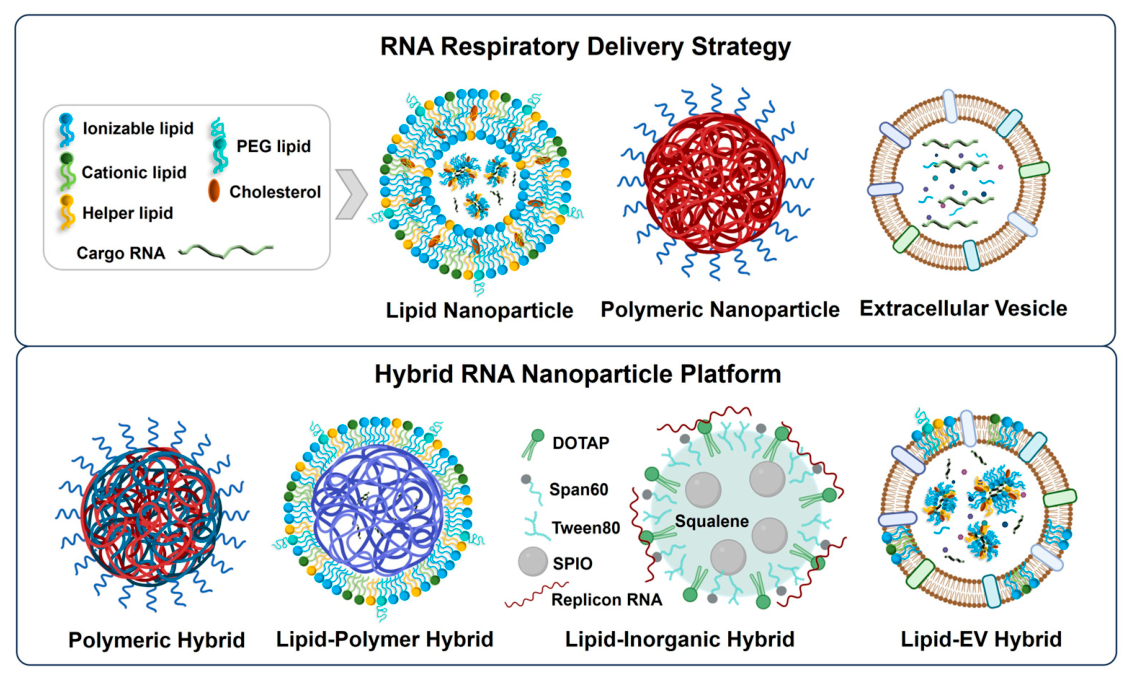
| Lipid Nanoparticles | Microfluidic mixing of ionizable lipids, helper lipids, cholesterol, and PEG-lipids; tunable lipid composition | ~60–150 nm | High mRNA encapsulation; tunable ionization; mucus-penetrating or lung-targeting via lipid modification [20,21,22,23,24,25,26,27,28,29,30,31] | Clinically validated systemic safety; respiratory delivery still limited; limited mucosal immunogenicity |
| Polymer-Based Nanoparticles | Self-assembly or nanoprecipitation of cationic/biodegradable polymers (PBAE, PEI, PACE, PLGA); variable synthesis | ~50–200 nm (highly variable) | High structural tunability; strong nucleic acid binding; adjustable degradation kinetics and surface charge [32,33,34,35,36,37,38,39,40,41,42,43] | Generally favorable preclinical safety (variable by polymer); cytotoxicity concerns for polycationic polymers; limited clinical translation |
| Lipid–Polymer Hybrid Nanoparticles | Hybrid assembly combining polymer cores (PLGA/PBAE/PHA) with lipid/PEG surface components | ~80–200 nm | Combined stability and transfection efficiency; improved mucus penetration; aerosol-stable formulations [49,50,51,52,53,54,55,56,57,58] | Improved biocompatibility vs. polymers alone; still preclinical for mucosal delivery applications |
| Lipid-Inorganic Nanoparticles (LION) | Self-assembly of lipid emulsions (squalene, Span60, DOTAP, Tween80) with inorganic cores (e.g., SPIO) | ~70–200 nm | Enhanced stability; strong immunogenicity; lyophilizable formulations; preserved efficacy after storage [44,45,46] | Promising vaccine platforms with favorable immune activation; limited mucosal clinical data; thermostable formulations |
| Lipid–EV Hybrid Nanoparticles | Isolation from cells (ultracentrifugation, microfluidics) or fusion with LNPs via microfluidic mixing/electroporation/sonication | ~50–150 nm | Natural membrane composition; microfluidic loading/fusion capability; high cellular uptake rates [61,62,63,64,65] | Improved biocompatibility; low immunogenicity; major limitations in manufacturing scalability and batch standardization |
Disclaimer/Publisher’s Note: The statements, opinions and data contained in all publications are solely those of the individual author(s) and contributor(s) and not of MDPI and/or the editor(s). MDPI and/or the editor(s) disclaim responsibility for any injury to people or property resulting from any ideas, methods, instructions or products referred to in the content. |
© 2026 by the authors. Licensee MDPI, Basel, Switzerland. This article is an open access article distributed under the terms and conditions of the Creative Commons Attribution (CC BY) license.
Share and Cite
Jin, R.; Wang, B.-Z.; Zhu, W. Engineered mRNA Nanoparticle Platforms for Respiratory Mucosal Delivery. Vaccines 2026, 14, 596. https://doi.org/10.3390/vaccines14070596
Jin R, Wang B-Z, Zhu W. Engineered mRNA Nanoparticle Platforms for Respiratory Mucosal Delivery. Vaccines. 2026; 14(7):596. https://doi.org/10.3390/vaccines14070596
Chicago/Turabian StyleJin, Rui, Bao-Zhong Wang, and Wandi Zhu. 2026. "Engineered mRNA Nanoparticle Platforms for Respiratory Mucosal Delivery" Vaccines 14, no. 7: 596. https://doi.org/10.3390/vaccines14070596
APA StyleJin, R., Wang, B.-Z., & Zhu, W. (2026). Engineered mRNA Nanoparticle Platforms for Respiratory Mucosal Delivery. Vaccines, 14(7), 596. https://doi.org/10.3390/vaccines14070596