Complete Genomes of Human Papillomavirus Type 16 Viruses Isolated from Cases of Cervical Neoplasia and Squamous Cell Carcinomas Followed in Latvia in 2012–2024

 ,
,  , , , , , , ,
Abstract
1. Introduction
2. Materials and Methods
2.1. Study Group
2.2. Isolation of DNA, hrHPV Genotyping and Quality Check
2.3. Whole Genome Sequencing (WGS)
2.4. Sanger Sequencing
2.5. Reconstruction of the Consensus Sequence of Latvian HPV16 Isolates
2.6. Phylogenetic Analysis of the Latvian HPV16 Isolates
2.7. Analysis of the Variations Identified in the Latvian HPV16 Isolates
2.8. Analysis of the Direction of Selection
2.9. Analysis of Co-Variation
2.10. Statistics
3. Results
3.1. Reconstruction of 16 Whole Genome Sequences of the Latvian HPV16 Isolates
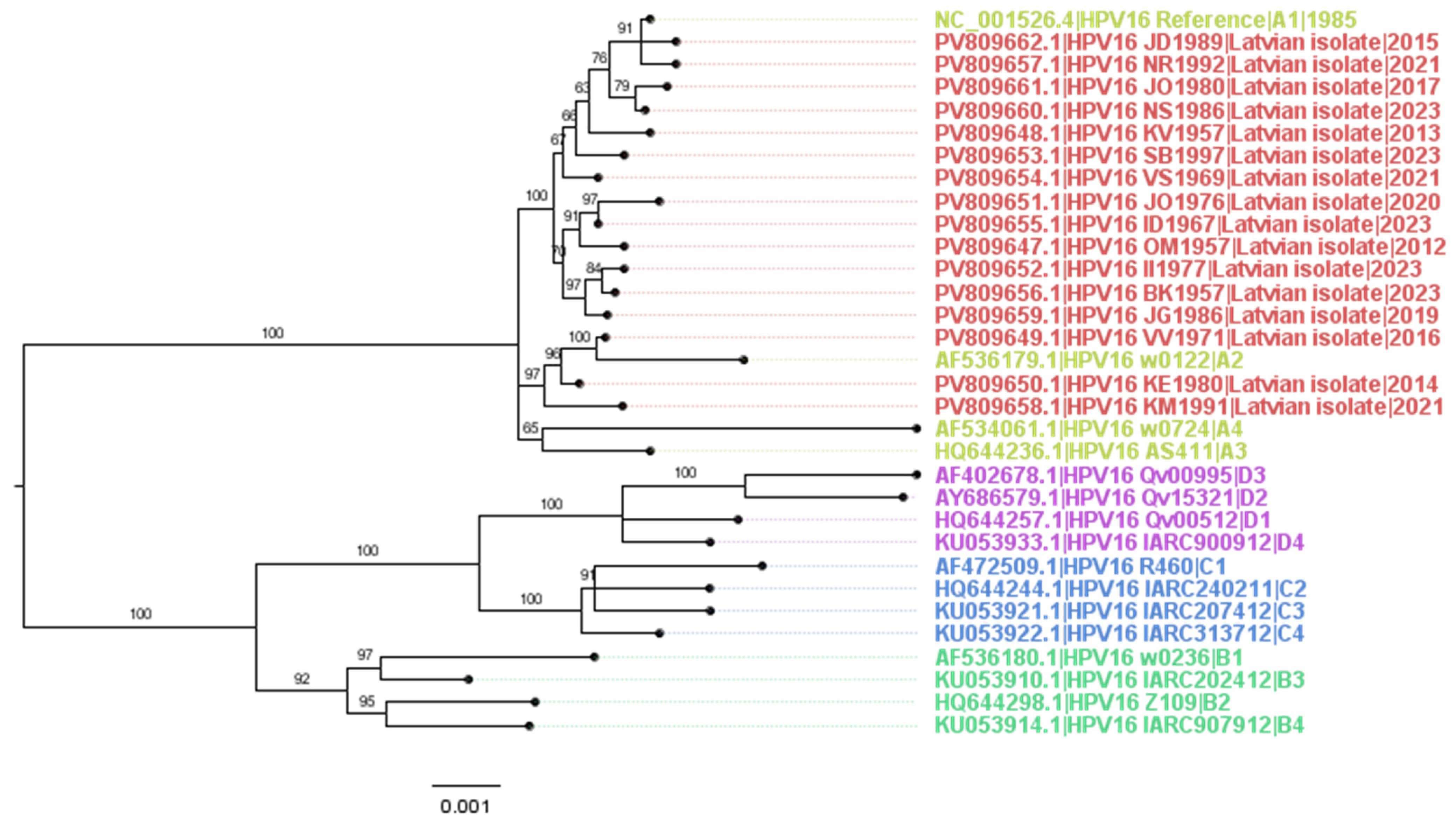
3.2. Analysis of HPV16 Isolates
3.3. Genomes of the Latvian HPV16 Isolates Demonstrate an Absence of Co-Variance Between Single Positions
3.4. Analysis of SNPs Leading to Amino Acid Substitutions Along Open Reading Frames of the Early HPV16 Proteins
3.5. Analysis of SNPs Leading to Amino Acid Substitutions in ORFs of the Late HPV16 Proteins
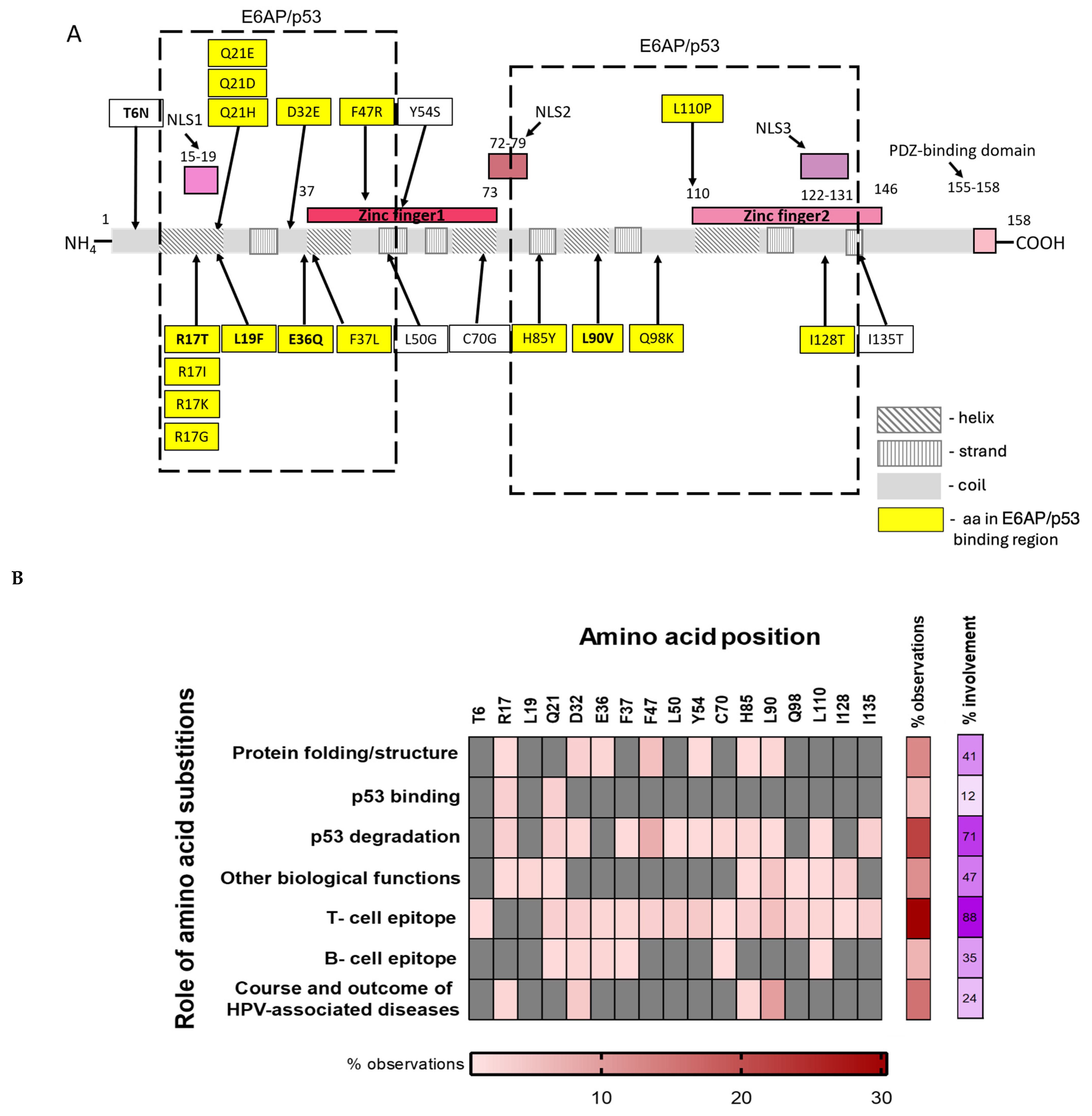
3.6. In-Depth Analysis of the Variability in HPV16 E6 Oncoprotein
3.6.1. Amino Acid Substitution L90V in E6 Is Associated with the Severity of Cervical Disease
3.6.2. Analysis of Polymorphisms in HPV16 E6
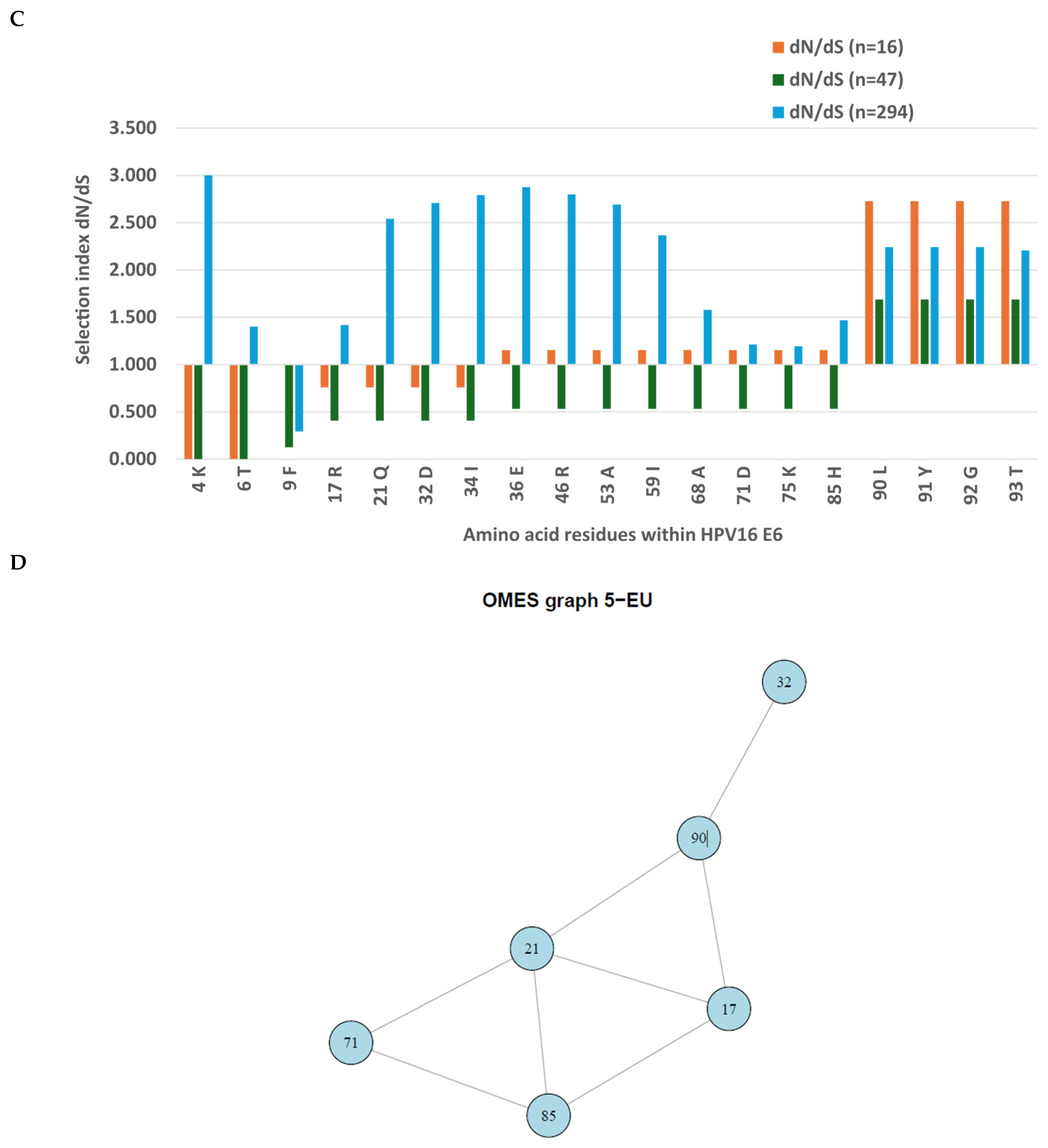
3.6.3. Analysis of the Variability in HPV16 E6—Direction of Selection
3.6.4. Co-Variance of Amino Acid Residues in Polymorphic Positions of E6
4. Discussion
5. Conclusions
6. Limitations
Supplementary Materials
Author Contributions
Funding
Institutional Review Board Statement
Informed Consent Statement
Data Availability Statement
Acknowledgments
Conflicts of Interest
Abbreviations
| HPV | Human papillomavirus |
| hrHPV | High-risk human papillomaviruses |
| HPV16 | Human papillomavirus type 16 |
| CC | Cervical cancer |
| SCC | Squamous cell carcinoma |
| CIN | Cervical intraepithelial lesion |
| WGS | Whole-genome sequencing |
| ORF | Open reading frame |
| SNP | Single-nucleotide polymorphism |
| AAS | Amino acid substitution |
References
- Cervical Cancer. Available online: https://www.who.int/news-room/fact-sheets/detail/cervical-cancer (accessed on 19 February 2025).
- Martel, C.; Plummer, M.; Vignat, J.; Franceschi, S. Worldwide Burden of Cancer Attributable to HPV by Site, Country and HPV Type. Int. J. Cancer 2017, 141, 664–670. [Google Scholar] [CrossRef] [PubMed]
- International Human Papillomavirus Reference Center. Available online: https://www.hpvcenter.se/ (accessed on 30 March 2026).
- Kombe Kombe, A.J.; Li, B.; Zahid, A.; Mengist, H.M.; Bounda, G.-A.; Zhou, Y.; Jin, T. Epidemiology and Burden of Human Papillomavirus and Related Diseases, Molecular Pathogenesis, and Vaccine Evaluation. Front. Public Health 2021, 8, 552028. [Google Scholar] [CrossRef]
- Okunade, K.S. Human Papillomavirus and Cervical Cancer. J. Obstet. Gynaecol. 2020, 40, 602–608. [Google Scholar] [CrossRef]
- Global Strategy to Accelerate the Elimination of Cervical Cancer as a Public Health Problem. Available online: https://www.who.int/publications/i/item/9789240014107 (accessed on 30 March 2026).
- zur Hausen, H. Papillomaviruses in the Causation of Human Cancers—A Brief Historical Account. Virology 2009, 384, 260–265. [Google Scholar] [CrossRef] [PubMed]
- Sanjose, S.; Quint, W.G.; Alemany, L.; Geraets, D.T.; Klaustermeier, J.E.; Lloveras, B.; Tous, S.; Felix, A.; Bravo, L.E.; Shin, H.-R.; et al. Human Papillomavirus Genotype Attribution in Invasive Cervical Cancer: A Retrospective Cross-Sectional Worldwide Study. Lancet Oncol. 2010, 11, 1048–1056. [Google Scholar] [CrossRef]
- Drolet, M.; Bénard, É.; Pérez, N.; Brisson, M.; HPV Vaccination Impact Study Group. Population-Level Impact and Herd Effects Following the Introduction of Human Papillomavirus Vaccination Programmes: Updated Systematic Review and Meta-Analysis. Lancet 2019, 394, 497–509. [Google Scholar] [CrossRef] [PubMed]
- Nonboe, M.H.; Napolitano, G.M.; Schroll, J.B.; Andersen, B.; Bennetsen, M.H.; Christiansen, S.; Frandsen, A.P.; Rygaard, C.; Salmani, R.; Høgdall, E.V.S.; et al. Human Papillomavirus Prevalence in First, Second and Third Cervical Cell Samples from Women HPV-Vaccinated as Girls, Denmark, 2017 to 2024: Data from the Trial23 Cohort Study. Euro Surveill. 2025, 30, 2400820. [Google Scholar] [CrossRef]
- Kamzayeva, N.; Bapayeva, G.; Terzic, M.; Primbetov, B.; Imankulova, B.; Kim, Y.; Sultanova, A.; Kongrtay, K.; Kadroldinova, N.; Ukybassova, T. Enhancing Cervical Cancer Screening: New Diagnostic Methodologies, Triage, and Risk Stratification in Prevention and Treatment. Life 2025, 15, 367. [Google Scholar] [CrossRef]
- Bruni, L.; Albero, G.; Serrano, B.; Mena, M.; Collado, J.J.; Gómez, D.; Muñoz, J.; Bosch, F.X.; de Sanjosé, S. ICO/IARC Information Centre on HPV and Cancer (HPV Information Centre). Human Papillomavirus and Related Diseases in the World. Summary Report. 10 March 2023. Available online: https://hpvcentre.net/statistics/reports/XWX.pdf (accessed on 1 January 2025).
- Naslazi, E.; Hontelez, J.A.C.; Naber, S.K.; van Ballegooijen, M.; de Kok, I.M.C.M. The Differential Risk of Cervical Cancer in HPV Vaccinated and Unvaccinated Women: A Mathematical Modelling Study. Cancer Epidemiol. Biomark. Prev. 2021, 30, 912–919. [Google Scholar] [CrossRef]
- Baussano, I.; Lazzarato, F.; Ronco, G.; Franceschi, S. Impacts of Human Papillomavirus Vaccination for Different Populations: A Modeling Study. Int. J. Cancer 2018, 143, 1086–1092. [Google Scholar] [CrossRef]
- Castle, P.E.; Maza, M. Prophylactic HPV Vaccination: Past, Present, and Future. Epidemiol. Infect. 2016, 144, 449–468. [Google Scholar] [CrossRef]
- Dorji, T.; Nopsopon, T.; Tamang, S.T.; Pongpirul, K. Human Papillomavirus Vaccination Uptake in Low-and Middle-Income Count Ries: A Meta-Analysis. eClinicalMedicine 2021, 34, 100836. [Google Scholar] [CrossRef]
- Burd, E.M. Human Papillomavirus and Cervical Cancer. Clin. Microbiol. Rev. 2003, 16, 1–17. [Google Scholar] [CrossRef]
- West, N.; Boz, V.; Zanotta, N.; Cason, C.; Campisciano, G.; Casuccio, A.; Gianfrilli, D.; Fasciana, T.M.A.; Capra, G.; Salfa, M.C.; et al. Human Papillomavirus: An Old New History. Pathogens 2025, 14, 1043. [Google Scholar] [CrossRef]
- Holl, K.; Nowakowski, A.M.; Powell, N.; McCluggage, W.G.; Pirog, E.C.; Collas De Souza, S.; Tjalma, W.A.; Rosenlund, M.; Fiander, A.; Castro Sánchez, M.; et al. Human Papillomavirus Prevalence and Type-Distribution in Cervical Glandular Neoplasias: Results from a European Multinational Epidemiological Study. Int. J. Cancer 2015, 137, 2858–2868. [Google Scholar] [CrossRef]
- Yang, X.; Qi, S.; Dai, L.; Ye, Q.; Li, X. Trends in HPV-Positive Cervical Cancer Prevalence: A Retrospective Study from 2013 to 2020. Virol. J. 2025, 22, 199. [Google Scholar] [CrossRef] [PubMed]
- Velázquez-Márquez, N.; Velázquez-Márquez, S.; Velez-Haro, J.M. Progression Pathways of Human Papillomavirus-Associated Cancer. In Pathogens Associated with the Development of Cancer in Humans: OMICs, Immunological, and Pathophysiological Studies; Velázquez-Márquez, N., Paredes-Juárez, G.A., Vallejo-Ruiz, V., Eds.; Springer Nature: Cham, Switzerland, 2024; pp. 21–43. [Google Scholar]
- Yu, Y.-Q.; Jiang, M.-Y.; Dang, L.; Feng, R.-M.; Bangura, M.S.; Chen, W.; Qiao, Y.-L. Changes in High-Risk HPV Infection Prevalence and Associated Factors in Selected Rural Areas of China: A Multicenter Population-Based Study. Front. Med. 2022, 9, 911367. [Google Scholar] [CrossRef] [PubMed]
- Tsakogiannis, D.; Zografos, E.; Tzioga, L.; Zografos, C.G.; Zagouri, F.; Bletsa, G. Prevalence and Genotype Distribution of High-Risk HPV Genotypes Among Women in Greece: A Retrospective Analysis of 3500 Women. Cancers 2025, 17, 1267. [Google Scholar] [CrossRef]
- Wen, C.; Yang, X.; Wu, X. HPV Infection Incidence and Genotype Distribution among Male Patients Visiting Outpatient Departments in Huizhou from 2014 to 2023. Virol. J. 2025, 22, 105. [Google Scholar] [CrossRef]
- Beachler, D.; Pinto, L.; Kemp, T.J.; Nyitray, A.G.; Hildesheim, A.; Viscidi, R.; Schussler, J.; Kreimer, A.R.; Giuliano, A.R. An Examination of HPV16 Natural Immunity in Men Who Have Sex with Men (MSM) in the HPV in Men (HIM) Study. Cancer Epidemiol. Biomark. Prev. 2018, 27, 496–502. [Google Scholar] [CrossRef] [PubMed]
- Latvia: Human Papillomavirus and Related Cancers, Fact Sheet 2023. Available online: https://hpvcentre.net/statistics/reports/LVA_FS.pdf (accessed on 29 July 2025).
- OECD; European Commission. EU Country Cancer Profile: Latvia 2025. EU Country Cancer Profiles. 2025. Available online: https://www.oecd.org/en/publications/eu-country-cancer-profile-latvia-2025_f23ce73c-en.html (accessed on 29 July 2025). [CrossRef]
- State of Vaccine Confidence in the European Union. Available online: https://health.ec.europa.eu/system/files/2023-02/2022_confidence_rep_en.pdf (accessed on 30 March 2026).
- Berza, N.; Zodzika, J.; Kivite-Urtane, A.; Baltzer, N.; Curkste, A.; Pole, I.; Nygård, M.; Pärna, K.; Stankunas, M.; Tisler, A.; et al. Understanding the High-Risk Human Papillomavirus Prevalence and Associated Factors in the European Country with a High Incidence of Cervical Cancer. Eur. J. Public Health 2024, 34, 826–832. [Google Scholar] [CrossRef]
- Stasulane, A.; Grundmane, J.; Sulte, K.; Stasulans, J.; Cernavska, S.; Smite, L. Prevalence of Human Papillomavirus Genotypes in Latvia among Women Participating in Cervical Cancer Screening. Front. Oncol. 2025, 15, 1584677. [Google Scholar] [CrossRef]
- Sokolovska, L.; Biserova, K.; Spridzane, A.; Krisane, D.; Dudorova, A.; Gebrila, S.; Krasovska, I.; Perminov, D.; Orlova, B.; Petrovska, M.; et al. Persistently High Prevalence of HPV16 and Rising Prevalence of Non-16/18 HR-HPV Genotypes in Cervical Precancer and Cancer in Latvia in 2016-2024 Shape the Severity of Cervical Disease. Front. Oncol. 2026, 15, 1676334. [Google Scholar] [CrossRef]
- Berza, N.; Stars, I.; Zodzika, J.; Kivite-Urtane, A.; Pärna, K.; Uuskula, A.; Makejeva, D. Understanding Hesitancy: Barriers to HR-HPV Self-Sampling among Women at High Risk for Cervical Cancer in Latvia. BMC Womens Health 2025, 26, 22. [Google Scholar] [CrossRef]
- Amiri, S.; Rasekh, S.; Moezzi, S.M.I.; Seifi, N.; Fatemi, S.A.; Fathi, S.; Bagheri, A.; Negahdaripour, M. Prophylactic Vaccines against HPV-Caused Cervical Cancer: Novel Vaccines Are Still Demanded. Infect. Agents Cancer 2025, 20, 16. [Google Scholar] [CrossRef]
- Jansons, J.; Avdoshina, D.; Dudorova, A.; Rubio, E.R.; Sokolovska, L.; Perminov, D.; Lindenberga, I.; Nicolai, H.; Gebrila, S.; Chowdhury, S.; et al. New Mouse Model Based on Adenocarcinoma 4T1 Cells Expressing HPV16 E6 and E7 Applied to Assess the Efficacy of Therapeutic and Prophylactic E6/E7-Based HPV16 Vaccines. Infect. Agents Cancer 2025, 20, 51. [Google Scholar] [CrossRef]
- Oštrbenk, A.; Xu, L.; Arbyn, M.; Poljak, M. Clinical and Analytical Evaluation of the Anyplex II HPV HR Detection Assay within the VALGENT-3 Framework. J. Clin. Microbiol. 2018, 56, e01176-18. [Google Scholar] [CrossRef]
- Oštrbenk Valenčak, A.; Cuschieri, K.; Connor, L.; Zore, A.; Smrkolj, Š.; Poljak, M. Allplex HPV HR Detection Assay Fulfils All Clinical Performance and Reproducibility Validation Requirements for Primary Cervical Cancer Screening. J. Clin. Virol. 2024, 170, 105638. [Google Scholar] [CrossRef]
- Hesselink, A.T.; Sahli, R.; Berkhof, J.; Snijders, P.J.F.; Van Der Salm, M.L.; Agard, D.; Bleeker, M.C.G.; Heideman, D.A.M. Clinical Validation of AnyplexTM II HPV HR Detection According to the Guidelines for HPV Test Requirements for Cervical Cancer Screening. J. Clin. Virol. 2016, 76, 36–39. [Google Scholar] [CrossRef]
- Biazin, H. Concordance of AnyplexTM II HPV HR Assays with Reference HPV Assays in Cervical Cancer Screening: Systematic Review. J. Virol. Methods 2022, 301, 114435. [Google Scholar] [CrossRef]
- Philips, C.; Terrie, L.; Muylle, E.; Thorrez, L. Determination of DNA Content as Quality Control in Decellularized Tissues: Challenges and Pitfalls. Regen. Biomater. 2024, 11, rbae123. [Google Scholar] [CrossRef]
- van Duin, M.; Snijders, P.J.; Vossen, M.T.; Klaassen, E.; Voorhorst, F.; Verheijen, R.H.; Helmerhorst, T.J.; Meijer, C.J.; Walboomers, J.M. Analysis of Human Papillomavirus Type 16 E6 Variants in Relation to P53 Codon 72 Polymorphism Genotypes in Cervical Carcinogenesis. J. Gen. Virol. 2000, 81, 317–325. [Google Scholar] [CrossRef]
- BioEdit 7.7 Download (Free)—BioEdit.Exe. Available online: https://bioedit.software.informer.com/7.7/ (accessed on 31 March 2026).
- Li, H.; Durbin, R. Fast and Accurate Short Read Alignment with Burrows-Wheeler Transform. Bioinformatics 2009, 25, 1754–1760. [Google Scholar] [CrossRef]
- Li, H.; Handsaker, B.; Wysoker, A.; Fennell, T.; Ruan, J.; Homer, N.; Marth, G.; Abecasis, G.; Durbin, R. The Sequence Alignment/Map Format and SAMtools. Bioinformatics 2009, 25, 2078–2079. [Google Scholar] [CrossRef]
- Seemann, T. GitHub—Tseemann/Samclip: Filter SAM File for Soft and Hard Clipped a Lignments. Available online: https://github.com/tseemann/samclip (accessed on 19 February 2025).
- Grubaugh, N.D.; Gangavarapu, K.; Quick, J.; Matteson, N.L.; De Jesus, J.G.; Main, B.J.; Tan, A.L.; Paul, L.M.; Brackney, D.E.; Grewal, S.; et al. An Amplicon-Based Sequencing Framework for Accurately Measuring Intrah Ost Virus Diversity Using PrimalSeq and iVar. Genome Biol. 2019, 20, 8. [Google Scholar] [CrossRef]
- Burk, R.D.; Harari, A.; Chen, Z. Human Papillomavirus Genome Variants. Virology 2013, 445, 232–243. [Google Scholar] [CrossRef]
- Katoh, K.; Standley, D.M. MAFFT Multiple Sequence Alignment Software Version 7: Improvements in Performance and Usability. Mol. Biol. Evol. 2013, 30, 772–780. [Google Scholar] [CrossRef]
- Nguyen, L.-T.; Schmidt, H.A.; von Haeseler, A.; Minh, B.Q. IQ-TREE: A Fast and Effective Stochastic Algorithm for Estimating Maximum-Likelihood Phylogenies. Mol. Biol. Evol. 2015, 32, 268–274. [Google Scholar] [CrossRef]
- Kalyaanamoorthy, S.; Minh, B.Q.; Wong, T.K.F.; Von Haeseler, A.; Jermiin, L.S. ModelFinder: Fast Model Selection for Accurate Phylogenetic Estimates. Nat. Methods 2017, 14, 587–589. [Google Scholar] [CrossRef]
- Minh, B.Q.; Nguyen, M.A.T.; Von Haeseler, A. Ultrafast Approximation for Phylogenetic Bootstrap. Mol. Biol. Evol. 2013, 30, 1188–1195. [Google Scholar] [CrossRef]
- Rambaut, A. FigTree v. 1.4.4. Available online: http://tree.bio.ed.ac.uk/software/figtree/ (accessed on 10 May 2021).
- O’Leary, N.A.; Cox, E.; Holmes, J.B.; Anderson, W.R.; Falk, R.; Hem, V.; Tsuchiya, M.T.N.; Schuler, G.D.; Zhang, X.; Torcivia, J.; et al. Exploring and Retrieving Sequence and Metadata for Species across the Tree of Life with NCBI Datasets. Sci. Data 2024, 11, 732. [Google Scholar] [CrossRef]
- Kurtz, S.; Phillippy, A.; Delcher, A.L.; Smoot, M.; Shumway, M.; Antonescu, C.; Salzberg, S.L. Versatile and Open Software for Comparing Large Genomes. Genome Biol. 2004, 5, R12. [Google Scholar] [CrossRef]
- Available online: https://github.com/federicogiorgi/giorgilab/tree/master/coronannotator (accessed on 26 February 2025).
- Katoh, K.; Rozewicki, J.; Yamada, K.D. MAFFT Online Service: Multiple Sequence Alignment, Interactive Sequence Choice and Visualization. Brief. Bioinform. 2019, 20, 1160–1166. [Google Scholar] [CrossRef]
- Mo, Y.K.; Lanfear, R.; Hahn, M.W.; Minh, B.Q. Updated Site Concordance Factors Minimize Effects of Homoplasy and Taxon Sampling. Bioinformatics 2023, 39, btac741. [Google Scholar] [CrossRef] [PubMed]
- SNAP: Synonymous Non-Synonymous Analysis Program. Available online: https://www.hiv.lanl.gov/content/sequence/SNAP/SNAP.html (accessed on 30 March 2026).
- Nei, M.; Gojobori, T. Simple Methods for Estimating the Numbers of Synonymous and Nonsynonymous Nucleotide Substitutions. Mol. Biol. Evol. 1986, 3, 418–426. [Google Scholar] [CrossRef]
- Erickson, K. The Jukes-Cantor Model of Molecular Evolution. Probl. Resour. Issues Math. Undergrad. Stud. PRIMUS 2010, 20, 438–445. [Google Scholar] [CrossRef]
- MEGA—Molecular Evolutionary Genetics Analysis Software. Available online: https://www.megasoftware.net/ (accessed on 31 March 2026).
- Li, Z.; Huang, Y.; Ouyang, Y.; Jiao, Y.; Xing, H.; Liao, L.; Jiang, S.; Shao, Y.; Ma, L. CorMut: An R/Bioconductor Package for Computing Correlated Mutations Based on Selection Pressure. Bioinformatics 2014, 30, 2073–2075. [Google Scholar] [CrossRef] [PubMed][Green Version]
- Parker, R.A.; Weir, C.J. Non-Adjustment for Multiple Testing in Multi-Arm Trials of Distinct Treatments: Rationale and Justification. Clin. Trials 2020, 17, 562–566. [Google Scholar] [CrossRef]
- Howard, D.R.; Brown, J.M.; Todd, S.; Gregory, W.M. Recommendations on Multiple Testing Adjustment in Multi-Arm Trials with a Shared Control Group. Stat. Methods Med. Res. 2018, 27, 1513–1530. [Google Scholar] [CrossRef] [PubMed]
- Campbell, I. Chi-Squared and Fisher-Irwin Tests of Two-by-Two Tables with Small Sample Recommendations. Stat. Med. 2007, 26, 3661–3675. [Google Scholar] [CrossRef]
- Londesborough, P.; Ho, L.; Terry, G.; Cuzick, J.; Wheeler, C.; Singer, A. Human papillomavirus genotype as a predictor of persistence and development of high-grade lesions in women with minor cervical abnormalities. Int. J. Cancer 1996, 69, 364–368. [Google Scholar] [CrossRef]
- Matsumoto, K.; Yoshikawa, H.; Nakagawa, S.; Tang, X.; Yasugi, T.; Kawana, K.; Sekiya, S.; Hirai, Y.; Kukimoto, I.; Kanda, T.; et al. Enhanced Oncogenicity of Human Papillomavirus Type 16 (HPV16) Variants in Japanese Population. Cancer Lett. 2000, 156, 159–165. [Google Scholar] [CrossRef]
- Li, T.; Yang, Z.; Zhang, C.; Wang, S.; Mei, B. Genetic Variation of E6 and E7 Genes of Human Papillomavirus Type 16 from Central China. Virol. J. 2023, 20, 217. [Google Scholar] [CrossRef]
- Richardson, J.T.E. The Analysis of 2 × 2 Contingency Tables--yet Again. Stat. Med. 2011, 30, 890; author reply 891–892. [Google Scholar] [CrossRef]
- Cai, H.; Feng, Y.; Fan, P.; Guo, Y.; Kuerban, G.; Chang, C.; Yao, X.; Peng, Y.; Wang, R. HPV16 E6-Specific T Cell Response and HLA-A Alleles Are Related to the Prognosis of Patients with Cervical Cancer. Infect. Agents Cancer 2021, 16, 61. [Google Scholar] [CrossRef]
- Rader, J.S.; Tsaih, S.; Fullin, D.; Murray, M.W.; Iden, M.; Zimmermann, M.T.; Flister, M.J. Genetic Variations in Human Papillomavirus and Cervical Cancer Outcomes. Int. J. Cancer 2019, 144, 2206–2214. [Google Scholar] [CrossRef]
- Bourgault Villada, I.; Moyal Barracco, M.; Ziol, M.; Chaboissier, A.; Barget, N.; Berville, S.; Paniel, B.; Jullian, E.; Clerici, T.; Maillère, B.; et al. Spontaneous Regression of Grade 3 Vulvar Intraepithelial Neoplasia Associated with Human Papillomavirus-16-Specific CD4(+) and CD8(+) T-Cell Responses. Cancer Res. 2004, 64, 8761–8766. [Google Scholar] [CrossRef]
- Bourgault Villada, I.; Moyal Barracco, M.; Berville, S.; Bafounta, M.L.; Longvert, C.; Prémel, V.; Villefroy, P.; Jullian, E.; Clerici, T.; Paniel, B.; et al. Human Papillomavirus 16-Specific T Cell Responses in Classic HPV-Related Vulvar Intra-Epithelial Neoplasia. Determination of Strongly Immunogenic Regions from E6 and E7 Proteins. Clin. Exp. Immunol. 2010, 159, 45–56. [Google Scholar] [CrossRef]
- Matsumoto, K.; Yasugi, T.; Nakagawa, S.; Okubo, M.; Hirata, R.; Maeda, H.; Yoshikawa, H.; Taketani, Y. Human Papillomavirus Type 16 E6 Variants and HLA Class II Alleles among Japanese Women with Cervical Cancer. Int. J. Cancer 2003, 106, 919–922. [Google Scholar] [CrossRef]
- Mirabello, L.; Yeager, M.; Yu, K.; Clifford, G.M.; Xiao, Y.; Zhu, B.; Cullen, M.; Boland, J.F.; Wentzensen, N.; Nelson, C.W.; et al. HPV16 E7 Genetic Conservation Is Critical to Carcinogenesis. Cell 2017, 170, 1164–1174.e6. [Google Scholar] [CrossRef]
- Nejo, Y.T.; Olaleye, D.O.; Odaibo, G.N. Molecular Characterisation of Genital Human Papillomavirus among Women in Southwestern, Nigeria. PLoS ONE 2019, 14, e0224748. [Google Scholar] [CrossRef]
- Du, J.; Nordfors, C.; Näsman, A.; Sobkowiak, M.; Romanitan, M.; Dalianis, T.; Ramqvist, T. Human Papillomavirus (HPV) 16 E6 Variants in Tonsillar Cancer in Comparison to Those in Cervical Cancer in Stockholm, Sweden. PLoS ONE 2012, 7, e36239. [Google Scholar] [CrossRef]
- Nominé, Y.; Masson, M.; Charbonnier, S.; Zanier, K.; Ristriani, T.; Deryckère, F.; Sibler, A.-P.; Desplancq, D.; Atkinson, R.A.; Weiss, E.; et al. Structural and Functional Analysis of E6 Oncoprotein: Insights in the Molecular Pathways of Human Papillomavirus-Mediated Pathogenesis. Mol. Cell 2006, 21, 665–678. [Google Scholar] [CrossRef]
- Araujo-Arcos, L.E.; Montaño, S.; Bello-Rios, C.; Garibay-Cerdenares, O.L.; Leyva-Vázquez, M.A.; Illades-Aguiar, B. Molecular Insights into the Interaction of HPV-16 E6 Variants against MAGI-1 PDZ1 Domain. Sci. Rep. 2022, 12, 1898. [Google Scholar] [CrossRef]
- Gallagher, K.M.E.; Man, S. Identification of HLA-DR1- and HLA-DR15-Restricted Human Papillomavirus Type 16 (HPV16) and HPV18 E6 Epitopes Recognized by CD4+ T Cells from Healthy Young Women. J. Gen. Virol. 2007, 88, 1470–1478. [Google Scholar] [CrossRef]
- Jabbar, B.; Rafique, S.; Salo-Ahen, O.M.H.; Ali, A.; Munir, M.; Idrees, M.; Mirza, M.U.; Vanmeert, M.; Shah, S.Z.; Jabbar, I.; et al. Antigenic Peptide Prediction From E6 and E7 Oncoproteins of HPV Types 16 and 18 for Therapeutic Vaccine Design Using Immunoinformatics and MD Simulation Analysis. Front. Immunol. 2018, 9, 3000. [Google Scholar] [CrossRef] [PubMed]
- Ai, W.; Wu, C.; Jia, L.; Xiao, X.; Xu, X.; Ren, M.; Xue, T.; Zhou, X.; Wang, Y.; Gao, C. Deep Sequencing of HPV16 E6 Region Reveals Unique Mutation Pattern of HPV16 and Predicts Cervical Cancer. Microbiol. Spectr. 2022, 10, e01401–e01422. [Google Scholar] [CrossRef]
- Evans, M.; Borysiewicz, L.K.; Evans, A.S.; Rowe, M.; Jones, M.; Gileadi, U.; Cerundolo, V.; Man, S. Antigen Processing Defects in Cervical Carcinomas Limit the Presentation of a CTL Epitope from Human Papillomavirus 16 E6. J. Immunol. 2001, 167, 5420–5428. [Google Scholar] [CrossRef] [PubMed]
- Zhao, J.; Zhu, J.; Guo, J.; Zhu, T.; Zhong, J.; Liu, M.; Ruan, Y.; Liao, S.; Li, F. Genetic Variability and Functional Implication of HPV16 from Cervical Intraepithelial Neoplasia in Shanghai Women. J. Med. Virol. 2020, 92, 372–381. [Google Scholar] [CrossRef]
- Yuan, H.; Yan, Z.; Gan, J.; Di, X.; Qiu, Y.; Xu, H. Phylogenetic Analysis and Antigenic Epitope Prediction for E6 and E7 of Alpha-Papillomavirus 9 in Taizhou, China. BMC Genom. 2024, 25, 507. [Google Scholar] [CrossRef] [PubMed]
- He, J.; Li, Q.; Ma, S.; Li, T.; Chen, Y.; Liu, Y.; Cui, Y.; Peng, J.; Shi, Y.; Wei, X.; et al. The Polymorphism Analysis and Epitope Predicted of Alphapapillomavirus 9 E6 in Sichuan, China. Virol. J. 2022, 19, 14. [Google Scholar] [CrossRef] [PubMed]
- Dai, M.-Z.; Qiu, Y.; Di, X.-H.; Shi, W.-W.; Xu, H.-H. Association of Cervical Carcinogenesis Risk with HPV16 E6 and E7 Variants in the Taizhou Area, China. BMC Cancer 2021, 21, 769. [Google Scholar] [CrossRef]
- Nakagawa, M.; Kim, K.H.; Moscicki, A.-B. Patterns of CD8 T-Cell Epitopes within the Human Papillomavirus Type 16 (HPV 16) E6 Protein among Young Women Whose HPV 16 Infection Has Become Undetectable. Clin. Diagn. Lab. Immunol. 2005, 12, 1003–1005. [Google Scholar] [CrossRef]
- Nakagawa, S.; Watanabe, S.; Yoshikawa, H.; Taketani, Y.; Yoshiike, K.; Kanda, T. Mutational Analysis of Human Papillomavirus Type 16 E6 Protein: Transforming Function for Human Cells and Degradation of P53 in Vitro. Virology 1995, 212, 535–542. [Google Scholar] [CrossRef][Green Version]
- Zanier, K.; ould M’hamed ould Sidi, A.; Boulade-Ladame, C.; Rybin, V.; Chappelle, A.; Atkinson, A.; Kieffer, B.; Travé, G. Solution Structure Analysis of the HPV16 E6 Oncoprotein Reveals a Self-Association Mechanism Required for E6-Mediated Degradation of P53. Structure 2012, 20, 604–617. [Google Scholar] [CrossRef]
- Ristriani, T.; Fournane, S.; Orfanoudakis, G.; Travé, G.; Masson, M. A Single-Codon Mutation Converts HPV16 E6 Oncoprotein into a Potential Tumor Suppressor, Which Induces P53-Dependent Senescence of HPV-Positive HeLa Cervical Cancer Cells. Oncogene 2009, 28, 762–772. [Google Scholar] [CrossRef]
- Martinez-Zapien, D.; Ruiz, F.X.; Poirson, J.; Mitschler, A.; Ramirez, J.; Forster, A.; Cousido-Siah, A.; Masson, M.; Pol, S.V.; Podjarny, A.; et al. Structure of the E6/E6AP/P53 Complex Required for HPV-Mediated Degradation of P53. Nature 2016, 529, 541–545. [Google Scholar] [CrossRef]
- Messa, L.; Celegato, M.; Bertagnin, C.; Mercorelli, B.; Alvisi, G.; Banks, L.; Palù, G.; Loregian, A. The Dimeric Form of HPV16 E6 Is Crucial to Drive YAP/TAZ Upregulation through the Targeting of hScrib. Cancers 2021, 13, 4083. [Google Scholar] [CrossRef]
- Chenzhang, Y.; Wen, Q.; Ding, X.; Cao, M.; Chen, Z.; Mu, X.; Wang, T. Identification of the Impact on T- and B- Cell Epitopes of Human Papillomavirus Type-16 E6 and E7 Variant in Southwest China. Immunol. Lett. 2017, 181, 26–30. [Google Scholar] [CrossRef]
- Zanier, K.; Charbonnier, S.; Sidi, A.O.M.O.; McEwen, A.G.; Ferrario, M.G.; Poussin-Courmontagne, P.; Cura, V.; Brimer, N.; Babah, K.O.; Ansari, T.; et al. Structural Basis for Hijacking of Cellular LxxLL Motifs by Papillomavirus E6 Oncoproteins. Science 2013, 339, 694–698. [Google Scholar] [CrossRef]
- Messa, L.; Celegato, M.; Bertagnin, C.; Mercorelli, B.; Nannetti, G.; Palù, G.; Loregian, A. A Quantitative LumiFluo Assay to Test Inhibitory Compounds Blocking P53 Degradation Induced by Human Papillomavirus Oncoprotein E6 in Living Cells. Sci. Rep. 2018, 8, 6020. [Google Scholar] [CrossRef]
- Chandra, J.; Dutton, J.L.; Li, B.; Woo, W.-P.; Xu, Y.; Tolley, L.K.; Yong, M.; Wells, J.W.; Leggatt, G.R.; Finlayson, N.; et al. DNA Vaccine Encoding HPV16 Oncogenes E6 and E7 Induces Potent Cell-Mediated and Humoral Immunity Which Protects in Tumor Challenge and Drives E7-Expressing Skin Graft Rejection. J. Immunother. 2017, 40, 62–70. [Google Scholar] [CrossRef]
- Poláková, I.; Pokorná, D.; Dusková, M.; Smahel, M. DNA Vaccine against Human Papillomavirus Type 16: Modifications of the E6 Oncogene. Vaccine 2010, 28, 1506–1513. [Google Scholar] [CrossRef]
- E6 Protein E6*; Transforming Protein E6 [Human Papillomavirus 16]—Gene—NCBI. Available online: https://www.ncbi.nlm.nih.gov/gene/1489078 (accessed on 31 March 2026).
- Kumar, A.; Hussain, S.; Yadav, I.S.; Gissmann, L.; Natarajan, K.; Das, B.C.; Bharadwaj, M. Identification of Human Papillomavirus-16 E6 Variation in Cervical Cancer and Their Impact on T and B Cell Epitopes. J. Virol. Methods 2015, 218, 51–58. [Google Scholar] [CrossRef]
- Venselaar, H.; te Beek, T.A.; Kuipers, R.K.; Hekkelman, M.L.; Vriend, G. Protein Structure Analysis of Mutations Causing Inheritable Diseases. An e-Science Approach with Life Scientist Friendly Interfaces. BMC Bioinform. 2010, 11, 548. [Google Scholar] [CrossRef]
- Qmichou, Z.; Khyatti, M.; Berraho, M.; Ennaji, M.M.; Benbacer, L.; Nejjari, C.; Benjaafar, N.; Benider, A.; Attaleb, M.; El Mzibri, M. Analysis of Mutations in the E6 Oncogene of Human Papillomavirus 16 in Cervical Cancer Isolates from Moroccan Women. BMC Infect. Dis. 2013, 13, 378. [Google Scholar] [CrossRef]
- Ramos, C.A.; Narala, N.; Vyas, G.M.; Leen, A.M.; Gerdemann, U.; Sturgis, E.M.; Anderson, M.L.; Savoldo, B.; Heslop, H.E.; Brenner, M.K.; et al. Human Papillomavirus Type 16 E6/E7-Specific Cytotoxic T Lymphocytes for Adoptive Immunotherapy of HPV-Associated Malignancies. J. Immunother. 2013, 36, 66–76. [Google Scholar] [CrossRef]
- Wang, X.; Moscicki, A.-B.; Tsang, L.; Brockman, A.; Nakagawa, M. Memory T Cells Specific for Novel Human Papillomavirus Type 16 (HPV16) E6 Epitopes in Women Whose HPV16 Infection Has Become Undetectable. Clin. Vaccine Immunol. 2008, 15, 937–945. [Google Scholar] [CrossRef]
- Li, X.; Coffino, P. High-Risk Human Papillomavirus E6 Protein Has Two Distinct Binding Sites within P53, of Which Only One Determines Degradation. J. Virol. 1996, 70, 4509–4516. [Google Scholar] [CrossRef]
- Mesplède, T.; Gagnon, D.; Bergeron-Labrecque, F.; Azar, I.; Sénéchal, H.; Coutlée, F.; Archambault, J. P53 Degradation Activity, Expression, and Subcellular Localization of E6 Proteins from 29 Human Papillomavirus Genotypes. J. Virol. 2012, 86, 94–107. [Google Scholar] [CrossRef]
- Le Roux, L.G.; Moroianu, J. Nuclear Entry of High-Risk Human Papillomavirus Type 16 E6 Oncoprotein Occurs via Several Pathways. J. Virol. 2003, 77, 2330–2337. [Google Scholar] [CrossRef]
- Shibata, T.; Shah, S.; Evans, T.; Coleman, H.; Lieblong, B.J.; Spencer, H.J.; Quick, C.M.; Sasagawa, T.; Stephens, O.W.; Peterson, E.; et al. Expansion of Human Papillomavirus-Specific T Cells in Periphery and Cervix in a Therapeutic Vaccine Recipient Whose Cervical High-Grade Squamous Intraepithelial Lesion Regressed. Front. Immunol. 2021, 12, 645299. [Google Scholar] [CrossRef]
- Pande, S.; Jain, N.; Prusty, B.K.; Bhambhani, S.; Gupta, S.; Sharma, R.; Batra, S.; Das, B.C. Human Papillomavirus Type 16 Variant Analysis of E6, E7, and L1 Genes and Long Control Region in Biopsy Samples from Cervical Cancer Patients in North India. J. Clin. Microbiol. 2008, 46, 1060–1066. [Google Scholar] [CrossRef]
- Andersson, S.; Alemi, M.; Rylander, E.; Strand, A.; Larsson, B.; Sällström, J.; Wilander, E. Uneven Distribution of HPV 16 E6 Prototype and Variant (L83V) Oncoprotein in Cervical Neoplastic Lesions. Br. J. Cancer 2000, 83, 307–310. [Google Scholar] [CrossRef]
- Zehbe, I.; Voglino, G.; Delius, H.; Wilander, E.; Tommasino, M. Risk of Cervical Cancer and Geographical Variations of Human Papillomavirus 16 E6 Polymorphisms. Lancet 1998, 352, 1441–1442. [Google Scholar] [CrossRef]
- Sun, Z.; Lu, Z.; Liu, J.; Wang, G.; Zhou, W.; Yang, L.; Liu, C.; Wang, B.; Ruan, Q. Genetic Variations of E6 and Long Control Region of Human Papillomavirus Type 16 from Patients with Cervical Lesion in Liaoning, China. BMC Cancer 2013, 13, 459. [Google Scholar] [CrossRef] [PubMed]
- Grodzki, M.; Besson, G.; Clavel, C.; Arslan, A.; Franceschi, S.; Birembaut, P.; Tommasino, M.; Zehbe, I. Increased Risk for Cervical Disease Progression of French Women Infected with the Human Papillomavirus Type 16 E6-350G Variant. Cancer Epidemiol. Biomark. Prev. 2006, 15, 820–822. [Google Scholar] [CrossRef] [PubMed]
- Xiong, C.; Huang, L.; Kou, H.; Wang, C.; Zeng, X.; Sun, H.; Liu, S.; Wu, B.; Li, J.; Wang, X.; et al. Identification of Novel HLA-A*11:01-Restricted HPV16 E6/E7 Epitopes and T-Cell Receptors for HPV-Related Cancer Immunotherapy. J. Immunother. Cancer 2022, 10, e004790. [Google Scholar] [CrossRef] [PubMed]
- Zehbe, I.; Mytilineos, J.; Wikström, I.; Henriksen, R.; Edler, L.; Tommasino, M. Association between Human Papillomavirus 16 E6 Variants and Human Leukocyte Antigen Class I Polymorphism in Cervical Cancer of Swedish Women. Hum. Immunol. 2003, 64, 538–542. [Google Scholar] [CrossRef]
- Bonsack, M. Identification and Biological Validation of HPV16 E6/E7-Derived T Cell Target Epitopes and Their Use for Performance Assessment of MHC Class I Binding Predictors. Available online: https://archiv.ub.uni-heidelberg.de/volltextserver/27654/ (accessed on 29 July 2025).
- Stöppler, M.C.; Ching, K.; Stöppler, H.; Clancy, K.; Schlegel, R.; Icenogle, J. Natural Variants of the Human Papillomavirus Type 16 E6 Protein Differ in Their Abilities to Alter Keratinocyte Differentiation and to Induce P53 Degradation. J. Virol. 1996, 70, 6987–6993. [Google Scholar] [CrossRef]
- Zehbe, I.; Richard, C.; DeCarlo, C.A.; Shai, A.; Lambert, P.F.; Lichtig, H.; Tommasino, M.; Sherman, L. Human Papillomavirus 16 E6 Variants Differ in Their Dysregulation of Human Keratinocyte Differentiation and Apoptosis. Virology 2009, 383, 69–77. [Google Scholar] [CrossRef][Green Version]
- Zelenova, E.E.; Karlsen, A.A.; Avdoshina, D.V.; Kyuregyan, K.K.; Belikova, M.G.; Trotsenko, I.D. Amino Acid Substitution Patterns in the E6 and E7 Proteins of HPV Type 16: Phylogeography and Evolution. Mol. Biol. 2024, 58, 611–635. [Google Scholar] [CrossRef]
- Genus: Alphapapillomavirus | ICTV. Available online: https://ictv.global/report/chapter/papillomaviridae/papillomaviridae/alphapapillomavirus (accessed on 19 February 2025).
- Seedorf, K.; Krämmer, G.; Dürst, M.; Suhai, S.; Röwekamp, W.G. Human Papillomavirus Type 16 DNA Sequence. Virology 1985, 145, 181–185. [Google Scholar] [CrossRef]
- Zhou, L.; Qiu, Q.; Zhou, Q.; Li, J.; Yu, M.; Li, K.; Xu, L.; Ke, X.; Xu, H.; Lu, B.; et al. Long-Read Sequencing Unveils High-Resolution HPV Integration and Its Oncogenic Progression in Cervical Cancer. Nat. Commun. 2022, 13, 2563. [Google Scholar] [CrossRef] [PubMed]
- Van Doorslaer, K.; Chen, Z.; Bernard, H.-U.; Chan, P.K.S.; DeSalle, R.; Dillner, J.; Forslund, O.; Haga, T.; McBride, A.A.; Villa, L.L.; et al. ICTV Virus Taxonomy Profile: Papillomaviridae. J. Gen. Virol. 2018, 99, 989–990. [Google Scholar] [CrossRef]
- Brisson, M.; Kim, J.J.; Canfell, K.; Drolet, M.; Gingras, G.; Burger, E.A.; Martin, D.; Simms, K.T.; Bénard, É.; Boily, M.-C.; et al. Impact of HPV Vaccination and Cervical Screening on Cervical Cancer Elimination: A Comparative Modelling Analysis in 78 Low-Income and Lower-Middle-Income Countries. Lancet 2020, 395, 575–590. [Google Scholar] [CrossRef] [PubMed]
- Cheng, L.; Wang, Y.; Du, J. Human Papillomavirus Vaccines: An Updated Review. Vaccines 2020, 8, 391. [Google Scholar] [CrossRef]
- Mcbride, A.A.; Porter, S.S. Human Papillomaviruses (Papillomaviridae). In Reference Module in Life Sciences; Elsevier: Amsterdam, The Netherlands, 2019; pp. 493–501. [Google Scholar] [CrossRef]
- El Aliani, A.; El Abid, H.; Kassal, Y.; Khyatti, M.; Attaleb, M.; Ennaji, M.M.; El Mzibri, M. HPV16 L1 Diversity and Its Potential Impact on the Vaccination-Induced Immunity. Gene 2020, 747, 144682. [Google Scholar] [CrossRef]
- Varsani, A.; Williamson, A.-L.; Jaffer, M.A.; Rybicki, E.P. A Deletion and Point Mutation Study of the Human Papillomavirus Type 16 Major Capsid Gene. Virus Res. 2006, 122, 154–163. [Google Scholar] [CrossRef]
- Oumeslakht, L.; Ababou, M.; Badaoui, B.; Qmichou, Z. Worldwide Genetic Variations in High-Risk Human Papillomaviruses Capsid L1 Gene and Their Impact on Vaccine Efficiency. Gene 2021, 782, 145533. [Google Scholar] [CrossRef]
- Ahmed, A.I.; Bissett, S.L.; Beddows, S. Amino Acid Sequence Diversity of the Major Human Papillomavirus Capsid Protein: Implications for Current and next Generation Vaccines. Infect. Genet. Evol. 2013, 18, 151–159. [Google Scholar] [CrossRef][Green Version]
- van Eer, K.; Dzebisasjvili, T.; Steenbergen, R.D.M.; King, A.J. Comparative Analysis of HPV16 Variants in the Untranslated Regulatory Region, L1, and E6 Genes among Vaccinated and Unvaccinated Young Women: Assessing Vaccine Efficacy and Viral Diversity. Viruses 2024, 16, 1381. [Google Scholar] [CrossRef]
- Wang, J.W.; Roden, R.B.S. L2, the Minor Capsid Protein of Papillomavirus. Virology 2013, 445, 175–186. [Google Scholar] [CrossRef]
- Tsakogiannis, D.; Nikolaidis, M.; Zagouri, F.; Zografos, E.; Kottaridi, C.; Kyriakopoulou, Z.; Tzioga, L.; Markoulatos, P.; Amoutzias, G.D.; Bletsa, G. Mutation Profile of HPV16 L1 and L2 Genes in Different Geographic Areas. Viruses 2022, 15, 141. [Google Scholar] [CrossRef]
- Debernardi, A.; Valot, B.; Almarcha, J.; Guenat, D.; Hocquet, D.; Algros, M.-P.; Riethmuller, D.; Ramanah, R.; Mougin, C.; Prétet, J.-L.; et al. Longitudinal Follow-up of HPV16 Sequence after Cervical Infection: Low Intrahost Variation and No Correlation with Clinical Evolution. J. Med. Virol. 2022, 94, 5512–5518. [Google Scholar] [CrossRef]
- Mirabello, L.; Yeager, M.; Cullen, M.; Boland, J.F.; Chen, Z.; Wentzensen, N.; Zhang, X.; Yu, K.; Yang, Q.; Mitchell, J.; et al. HPV16 Sublineage Associations With Histology-Specific Cancer Risk Usin g HPV Whole-Genome Sequences in 3200 Women. J. Natl. Cancer Inst. 2016, 108, djw100. [Google Scholar] [CrossRef] [PubMed]
- Rana, A.; Yilmaz, G.; Biswas-Fiss, E.E.; Biswas, S. Mechanisms of Viral DNA Replication of Human Papillomavirus: E2 Protein-Dependent Recruitment of E1 DNA Helicase to the Origin of DNA Replication. Int. J. Mol. Sci. 2025, 26, 4333. [Google Scholar] [CrossRef] [PubMed]
- Kusumoto-Matsuo, R.; Kanda, T.; Kukimoto, I. Rolling Circle Replication of Human Papillomavirus Type 16 DNA in Epithelial Cell Extracts. Genes Cells 2011, 16, 23–33. [Google Scholar] [CrossRef] [PubMed]
- Tsakogiannis, D.; Darmis, F.; Gortsilas, P.; Ruether, I.G.A.; Kyriakopoulou, Z.; Dimitriou, T.G.; Amoutzias, G.; Markoulatos, P. Nucleotide Polymorphisms of the Human Papillomavirus 16 E1 Gene. Arch. Virol. 2014, 159, 51–63. [Google Scholar] [CrossRef]
- Yao, Y.; Yan, Z.; Dai, S.; Li, C.; Yang, L.; Liu, S.; Zhang, X.; Shi, L.; Yao, Y. Human Papillomavirus Type 16 E1 Mutations Associated with Cervical Cancer in a Han Chinese Population. Int. J. Med. Sci. 2019, 16, 1042–1049. [Google Scholar] [CrossRef]
- Bletsa, G.; Zagouri, F.; Amoutzias, G.D.; Nikolaidis, M.; Zografos, E.; Markoulatos, P.; Tsakogiannis, D. Genetic Variability of the HPV16 Early Genes and LCR. Present and Future Perspectives. Expert. Rev. Mol. Med. 2021, 23, e19. [Google Scholar] [CrossRef]
- Morgan, I.M. The Functions of Papillomavirus E2 Proteins. Virology 2025, 603, 110387. [Google Scholar] [CrossRef]
- Giannoudis, A.; van Duin, M.; Snijders, P.J.F.; Herrington, C.S. Variation in the E2-Binding Domain of HPV 16 Is Associated with High-Grade Squamous Intraepithelial Lesions of the Cervix. Br. J. Cancer 2001, 84, 1058–1063. [Google Scholar] [CrossRef] [PubMed][Green Version]
- Lang Kuhs, K.A.; Faden, D.L.; Chen, L.; Smith, D.K.; Pinheiro, M.; Wood, C.B.; Davis, S.; Yeager, M.; Boland, J.F.; Cullen, M.; et al. Genetic Variation within the Human Papillomavirus Type 16 Genome Is Associated with Oropharyngeal Cancer Prognosis. Ann. Oncol. 2022, 33, 638–648. [Google Scholar] [CrossRef]
- Collins, S.I.; Constandinou-Williams, C.; Wen, K.; Young, L.S.; Roberts, S.; Murray, P.G.; Woodman, C.B.J. Disruption of the E2 Gene Is a Common and Early Event in the Natural History of Cervical Human Papillomavirus Infection: A Longitudinal Cohort Study. Cancer Res. 2009, 69, 3828–3832. [Google Scholar] [CrossRef]
- Porter, V.L.; Marra, M.A. The Drivers, Mechanisms, and Consequences of Genome Instability in HPV-Driven Cancers. Cancers 2022, 14, 4623. [Google Scholar] [CrossRef]
- Graham, D.A.; Herrington, C.S. HPV-16 E2 Gene Disruption and Sequence Variation in CIN 3 Lesions and Invasive Squamous Cell Carcinomas of the Cervix: Relation to Numerical Chromosome Abnormalities. Mol. Pathol. 2000, 53, 201–206. [Google Scholar] [CrossRef] [PubMed]
- Wilson, R.; Fehrmann, F.; Laimins, L.A. Role of the E1∧E4 Protein in the Differentiation-Dependent Life Cycle of Human Papillomavirus Type 31. J. Virol. 2005, 79, 6732–6740. [Google Scholar] [CrossRef]
- Wang, Q.; Griffin, H.; Southern, S.; Jackson, D.; Martin, A.; McIntosh, P.; Davy, C.; Masterson, P.J.; Walker, P.A.; Laskey, P.; et al. Functional Analysis of the Human Papillomavirus Type 16 E1∧E4 Protein Provides a Mechanism for In Vivo and In Vitro Keratin Filament Reorganization. J. Virol. 2004, 78, 821–833. [Google Scholar] [CrossRef]
- Genther, S.M.; Sterling, S.; Duensing, S.; Münger, K.; Sattler, C.; Lambert, P.F. Quantitative Role of the Human Papillomavirus Type 16 E5 Gene during the Productive Stage of the Viral Life Cycle. J. Virol. 2003, 77, 2832–2842. [Google Scholar] [CrossRef] [PubMed]
- DiMaio, D.; Petti, L.M. The E5 Proteins. Virology 2013, 445, 99–114. [Google Scholar] [CrossRef] [PubMed]
- Nath, R.; Mant, C.A.; Kell, B.; Cason, J.; Bible, J.M. Analyses of Variant Human Papillomavirus Type-16 E5 Proteins for Their Ability to Induce Mitogenesis of Murine Fibroblasts. Cancer Cell Int. 2006, 6, 19. [Google Scholar] [CrossRef] [PubMed]
- Chen, Z.; Terai, M.; Fu, L.; Herrero, R.; DeSalle, R.; Burk, R.D. Diversifying Selection in Human Papillomavirus Type 16 Lineages Based on Complete Genome Analyses. J. Virol. 2005, 79, 7014–7023. [Google Scholar] [CrossRef]
- Alsanea, M.; Alsaleh, A.; Obeid, D.; Alhadeq, F.; Alahideb, B.; Alhamlan, F. Genetic Variability in the E6, E7, and L1 Genes of Human Papillomavirus Types 16 and 18 among Women in Saudi Arabia. Viruses 2022, 15, 109. [Google Scholar] [CrossRef]
- Negi, S.S.; Sharma, K.; Sharma, D.; Singh, P.; Agarwala, P.; Hussain, N.; Bhargava, A.; Das, P.; Agarwal, S. Genetic Analysis of Human Papilloma Virus 16 E6/E7 Variants Obtained from Cervical Cancer Cases in Chhattisgarh, a Central State of India. Virusdisease 2021, 32, 492–503. [Google Scholar] [CrossRef] [PubMed]
- Totaro, M.E.; Gili, J.A.; Liotta, D.J.; Schurr, T.G.; Picconi, M.A.; Badano, I. Genetic Variation in the E6 and E7 Genes of Human Papillomavirus Type 16 in Northeastern Argentina. J. Med. Virol. 2022, 94, 745–751. [Google Scholar] [CrossRef]
- Mueller, S.N.; Rouse, B.T. Immune Responses to Viruses. In Clinical Immunology. Principles and Practice; Rich, R.R., Fleisher, T.A., Weyand, C.M., Eds.; Mosby: St. Louis, MO, USA, 2008; pp. 421–431. [Google Scholar] [CrossRef]
- Kansy, B.A.; Wehrs, T.P.; Bruderek, K.; Si, Y.; Ludwig, S.; Droege, F.; Hasskamp, P.; Henkel, U.; Dominas, N.; Hoffmann, T.K.; et al. HPV-Associated Head and Neck Cancer Is Characterized by Distinct Profiles of CD8+ T Cells and Myeloid-Derived Suppressor Cells. Cancer Immunol. Immunother. 2023, 72, 4367–4383. [Google Scholar] [CrossRef]
- Diniz, M.O.; Sales, N.S.; Silva, J.R.; Ferreira, L.C.S. Protection against HPV-16-Associated Tumors Requires the Activation of CD8+ Effector Memory T Cells and the Control of Myeloid-Derived Suppressor Cells. Mol. Cancer Ther. 2016, 15, 1920–1930. [Google Scholar] [CrossRef]
- DeFilippis, V.R.; Ayala, F.J.; Villarreal, L.P. Evidence of Diversifying Selection in Human Papillomavirus Type 16 E6 But Not E7 Oncogenes. J. Mol. Evol. 2002, 55, 491–499. [Google Scholar] [CrossRef]
- Yi, J.W.; Jang, M.; Kim, S.J.; Kim, S.S.; Rhee, J.E. Degradation of P53 by Natural Variants of the E6 Protein of Human Papillomavirus Type 16. Oncol. Rep. 2013, 29, 1617–1622. [Google Scholar] [CrossRef][Green Version]
- Loguercio, S.; Calverley, B.C.; Wang, C.; Shak, D.; Zhao, P.; Sun, S.; Budinger, G.R.S.; Balch, W.E. Understanding the host-pathogen evolutionary balance through Gaussian process modeling of SARS-CoV-2. Patterns 2023, 4, 100800. [Google Scholar] [CrossRef] [PubMed]



| Patient Code | Age at Sampling/Diagnosis (Full Years) | Year of Sampling | Pathomorpho-Logical Classification | HR HPV Genotype, Virus Load * | Sample Code | GenBank Accession No. |
|---|---|---|---|---|---|---|
| OM1957 | 54 | 2012 | SCC G2 | HPV16 (Ct 19) | OMA1957-B10 | PV809647 |
| KV1957 | 56 | 2013 | SCC G1 | HPV16 (Ct 20) | KBA1957-14 | PV809648 |
| VV1971 | 44 | 2016 | SCC G2 | HPV16 (Ct 18) | BBH1971-B15 | PV809649 |
| KE1980 | 33 | 2014 | CINIII/HSIL carcinoma in situ | HPV16 (Ct 18) | KEA1980-B32 | PV809650 |
| JO1976 | 44 | 2020 | SCC G3 | HPV16 high (Ct < 31) **, HPV33 low, HPV39 medium | JO1976-S11819Nr2 | PV809651 |
| II1977 | 46 | 2023 | SCC G2 | HPV16 high (Ct < 31) **, HPV33 low, HPV39 medium | II1977/S11819Nr4 | PV809652 |
| SB1997 | 26 | 2023 | SCC G2 | HPV16 high (Ct < 31) ** | SB1997-S11819Nr5 | PV809653 |
| VS1969 | 52 | 2021 | SCC G2 | HPV16 high (Ct < 31) **, HPV33 medium, HPV39 medium, HPV56 medium | VS1969-S11819Nr6 | PV809654 |
| ID1967 | 56 | 2023 | SCC G2 | HPV16 high (Ct < 31) ** | ID1967-S11819Nr7 | PV809655 |
| BK1957 | 66 | 2023 | SCC G2 | HPV16 (Ct 26) | BK1957-3-S11819Nr8 | PV809656 |
| NR1992 | 29 | 2021 | CINIII | HPV16 (Ct 26), now PCR neg | NR1992-1-S11819Nr9 | PV809657 |
| KM1991 | 30 | 2019 | CINIII | HPV16 (Ct 27); now PCR neg | KM1991-10-S11819Nr10 | PV809658 |
| JG1986 | 33 | 2019 | CINIII | In 2019 HPV16 (Ct 27) + HPV39 (Ct 34); now PCR neg | JG1986-2-S11819Nr11 | PV809659 |
| NS1986 | 27 | 2024 | CINIII | HPV16 (Ct 23) | NS1986-S11819Nr12 | PV809660 |
| JO1980 | 37 | 2017 | SCC G2 | HPV16 (Ct 19) | YuOB1980-B4 | PV809661 |
| JD1989 | 39 | 2015 | SCC G2 | HPV16 (Ct 18) | JD1989-NNN | PV809662 |
| No. | Patient Code | Pt Age at Sampling | Year of Sample Collection | Clinical Diagnosis | Material | HR HPV Summary (Seegene AnyPlex II) * | GenBank Accession No. | ||
|---|---|---|---|---|---|---|---|---|---|
| 1 | JA1985 | xxxx- | 12012021 | 36 | 2021 | SCC G2 | Biopsy | 16(HIGH) | PQ215484 |
| 2 | TR1949 | xxxx- | 11022020 | 71 | 2020 | SCC G2 | Biopsy | 16(HIGH) | PQ215485 |
| 3 | VN1933 | xxxx- | 20072020 | 87 | 2020 | SCC G2 | Biopsy | 16(HIGH) | PQ215486 |
| 4 | LU1956 | xxxx- | 26082020 | 64 | 2020 | SCC G2 | Biopsy | 16(HIGH) | PQ215487 |
| 5 | JR1981 | xxxx- | 13102020 | 39 | 2020 | CIN2 | Electroexcision | 16(HIGH) | PQ215488 |
| 6 | EH1995 | xxxx- | 23102020 | 25 | 2020 | CIN1 | Biopsy | 16(HIGH) | PQ215489 |
| 7 | AL1965 | xxxx- | 23012019 | 54 | 2019 | SCC G3 | Biopsy | 16(HIGH) | PQ215490 |
| 8 | IV1965 | xxxx- | 29012019 | 54 | 2019 | SCC G3 | Biopsy | 16(HIGH) | PQ215491 |
| 9 | RŠZ1957 | xxxx- | 11032019 | 62 | 2019 | SCC G3 | Biopsy | 16(HIGH) | PQ215492 |
| 10 | AG1956 | xxxx- | 27032019 | 63 | 2019 | SCC G2 | Biopsy | 16(HIGH) | PQ215493 |
| 11 | ZPV1981 | xxxx- | 04042019 | 38 | 2019 | CIN2 | Electroexcision | 16(HIGH) | PQ215494 |
| 12 | MK1986 | xxxx- | 13052019 | 33 | 2019 | CIN3 | Electroexcision | 16(HIGH) | PQ215495 |
| 13 | SS1967 | xxxx- | 23052019 | 52 | 2019 | SCC G3 | Biopsy | 16(HIGH) | PQ215496 |
| 14 | ET1982 | xxxx- | 12062019 | 37 | 2019 | SCC G2 | Biopsy | 16(HIGH) | PQ215497 |
| 15 | LR1961 | xxxx- | 17072019 | 57 | 2019 | SCC G2 | Biopsy | 16(HIGH) | PQ215498 |
| 16 | DL1989 | xxxx- | 12022018 | 29 | 2018 | CIN3 | Complete ectomy | 16(HIGH) | PQ215499 |
| 17 | NK1937 | xxxx- | 16032018 | 81 | 2018 | SCC G2 | Biopsy | 16(HIGH) | PQ215500 |
| 18 | SC1981 | xxxx- | 21052018 | 37 | 2018 | SCC G3 | Biopsy | 16(HIGH) | PQ215501 |
| 19 | LP1974 | xxxx- | 15062018 | 43 | 2018 | CIN3 | Electroexcision | 16(HIGH) | PQ215502 |
| 20 | GS1948 | xxxx- | 21082018 | 69 | 2018 | SCC G3 | Biopsy | 16(HIGH) | PQ215503 |
| 21 | AS1954 | xxxx- | 28082018 | 64 | 2018 | SCC G3 | Biopsy | 16(HIGH) | PQ215504 |
| 22 | SJ1973 | xxxx- | 25092018 | 45 | 2018 | SCC G3 | Biopsy | 16(HIGH) | PQ215505 |
| 23 | SE1953 | xxxx- | 20012017 | 63 | 2017 | SCC G2 | Biopsy | 16(HIGH) | PQ215506 |
| 24 | JG1972 | xxxx- | 22052017 | 44 | 2017 | SCC G2 | Biopsy | 16(HIGH) | PQ215507 |
| 25 | DLN1992 | xxxx- | 24072017 | 25 | 2017 | CIN3 | Electroexcision | 16(HIGH) | PQ215508 |
| 26 | LR1968 | xxxx- | 20062016 | 48 | 2016 | CIN3 | Biopsy | 16(MEDIUM) | PQ215509 |
| 27 | VR1957 | xxxx- | 07092016 | 59 | 2016 | SCC G2 | Biopsy | 16(MEDIUM) | PQ215510 |
| 28 | VI1937 | xxxx- | 21122016 | 79 | 2016 | SCC G2 | Biopsy | 16(HIGH) | PQ215511 |
| 29 | SG1979 | xxxx- | 13032022 | 43 | 2022 | SCC G2 | Biopsy | 16(HIGH), 33(LOW) | PQ215512 |
| 30 | LG1952 | xxxx- | 09052022 | 70 | 2022 | SCC G2 | Biopsy | 16(HIGH), 33(LOW), 45(MEDIUM) | PQ215513 |
| 31 | JL1995 | xxxx- | 29042020 | 25 | 2020 | CIN3 | Electroexcision | 16(HIGH), 51(LOW) | PQ215514 |
| Affected Position | Nucleotide Substitution | Variant Type | Affected Protein | Annotation | Frequency in the Latvian Isolates (n, % of n = 16) | Frequency in Other Isolates (n, % of n = 4237) |
|---|---|---|---|---|---|---|
| 161 | A161C | SNP | E1 | E1:N54T | 1 (6.25%) | 0 (0%) * |
| 189 | A189C | SNP | E1 | E1:E63D | 3 (18.75%) | 266 (6.28%) |
| 239 | G239T | SNP | E1 | E1:R80I | 1 (6.25%) | 0 (0%) |
| 350 | A350G | SNP | E1 | E1:K117R | 1 (6.25%) | 0 (0%) |
| 658 | T658A | SNP | E1 | E1:S220T | 5 (31.25%) | 1400 (33.03%) |
| 2501 | G2501A | SNP | E2 | E2:E204K | 1 (6.25%) | 35 (0.83%) |
| 2520 | T2520C | SNP | E2 | E2:I210T | 3 (18.75%) | 753 (17.77%) |
| 2546 | C2546T | SNP | E2 | E2:P219S | 10 (62.5%) | 2812 (66.35%) |
| 2585 | G2585A | SNP | E2 | E2:E232K | 1 (6.25%) | 830 (19.58%) |
| 2707 | - | deletion | E2; E1^E4 | E2:S273-N2780; E1^E4:A79-T86 | 1 (6.25%) | 0 (0%) |
| 2711 | T2711G | SNP | E2 | E2:S274A | 1 (6.25%) | 486 (11.47%) |
| 2820 | C2820A | SNP | E2 | E2:T310K | 3 (18.75%) | 1412 (33.32%) |
| 2978 | A2978C | SNP | E2 | E2:M363L | 1 (6.25%) | 0 (0%) |
| 3115 | A3115C | SNP | E5 | E5:I44L | 9 (56.25%) | 1592 (37.56%) |
| 3127 | C3127G | SNP | E5 | E5:L48V | 1 (6.25%) | 227 (5.36%) |
| 3178 | A3178G | SNP | E5 | E5:I65V | 10 (62.5%) | 2583 (60.95%) |
| 3499 | G3499T | SNP | L2 | L2:D43Y | 1 (6.25%) | 0 (0%) |
| 4099 | G4099A | SNP | L2 | L2:V243I | 3 (18.75%) | 584 (13.78%) |
| 4177 | T4177C | SNP | L2 | L2:S269P | 3 (18.75%) | 1310 (30.91%) |
| 4186 | G4186A | SNP | L2 | L2:D272N | 1 (6.25%) | 49 (1.16%) |
| 4362 | A4362T | SNP | L2 | L2:L330F | 10 (62.5%) | 1450 (34.21%) |
| 4362 | A4362C | SNP | L2 | L2:L330F | 4 (25%) | 1701 (40.14%) |
| 4384 | G4384A | SNP | L2 | L2:E338K | 1 (6.25%) | 3 (0.07%) |
| 4417 | T4417C | SNP | L2 | L2:Y349H | 1 (6.25%) | 93 (2.19%) |
| 4696 | G4696A | SNP | L2 | L2:D442N | 1 (6.25%) | 15 (0.35%) |
| 5354 | G5354A | SNP | L1 | L1:V194I | 1 (6.25%) | 39 (0.92%) |
| 5570 | A5570G | SNP | L1 | L1:T266A | 12 (75%) | 2892 (68.24%) |
| 6196 | G6196C | SNP | L1 | L1:L474F | 1 (6.25%) | 8 (0.19%) |
| 7173 | A7173G | SNP | E6 | E6:R17G | 1 (6.25%) | 109 (2.57%) |
| 7174 | G7174C | SNP | E6 | E6:R17T | 1 (6.25%) | 31 (0.73%) |
| 7230 | G7230C | SNP | E6 | E6:E36Q | 1 (6.25%) | 19 (0.45%) |
| 7392 | T7392G | SNP | E6 | E6:L90V | 7 (43.75%) | 1818 (42.9%) |
| SNPs | Sampling Time | Disease Severity | ||||||
|---|---|---|---|---|---|---|---|---|
| Genomic Region | ORF | Nucleotide Substitution | AA Substitution | Total No. (in 16) | 2012–2019 (n = 7) | 2020–2024 (n = 9) | CINIII/G1 (n = 6) | CSCC G2/G3 (n = 10) |
| Early genes | ||||||||
| E1 | T658A | S220T | 5 | 2 (28.6%) | 3 (33.3%) | 2 (33.3%) | 3 (30%) | |
| E2 | C2546T | P219S | 10 | 4 (57.1%) | 6 (66.7%) | 3 (30%) | 7 (70%) | |
| E5 | A3115C | I44L | 9 | 4 (57.1%) | 5 (56.6%) | 3 (50%) | 6 (60%) | |
| A3178G | I65V | 10 | 4 (57.1%) | 6 (66.7%) | 3 (50%) | 7 (70%) | ||
| E6 | T7392G | L90V | 7 | 2 (28.6%) | 5 (56.6%) | 1 (16.7%) | 6 (60%) | |
| p = 0.1 | ||||||||
| Late genes | ||||||||
| L1 | A5570G | T266A | 10 | 3 (42.9%) | 7 (77.8%) | 3 (50%) | 7 (70%) | |
| L2 | A4362C | L330F | 14 | 5 (71.4%) | 9 (100%) | 5 (83.3%) | 9 (90%) | |
| Patients | n | Diagnosis | No | No with | p Value (Chi-Squared Test) | |
|---|---|---|---|---|---|---|
| L90V | L90V, % | |||||
| Whole genome sequencing cohort * | 16 | CINIII/G1 | 6 | 1 | 16.7 | |
| CSCC G2/G3 | 10 | 6 | 60 | p = 0.1 * | ||
| Retrospective study of cervical cancer ** | 31 | CINII-III | 8 | 0 | 0 | |
| CINIII/cancer in situ | 1 | 1 | 100 | |||
| CSCC G2/G3 | 22 | 8 | 36.4 | p = 0.05 ** | ||
| Pooled cohort | 46 | CINII/III | 13 | 0 | 0 | |
| CSCC G2/G3 | 32 | 14 | 43.8 | p = 0.0176 *** |
Disclaimer/Publisher’s Note: The statements, opinions and data contained in all publications are solely those of the individual author(s) and contributor(s) and not of MDPI and/or the editor(s). MDPI and/or the editor(s) disclaim responsibility for any injury to people or property resulting from any ideas, methods, instructions or products referred to in the content. |
© 2026 by the authors. Licensee MDPI, Basel, Switzerland. This article is an open access article distributed under the terms and conditions of the Creative Commons Attribution (CC BY) license.
Share and Cite
Jansons, J.; Zrelovs, N.; Spridzane, A.; Nazarenko, M.; Sokolovska, L.; Biserova, K.; Krisane, D.; Breiksa-Vaivode, A.; Avdoshina, D.; Orlova, B.; et al. Complete Genomes of Human Papillomavirus Type 16 Viruses Isolated from Cases of Cervical Neoplasia and Squamous Cell Carcinomas Followed in Latvia in 2012–2024. Vaccines 2026, 14, 517. https://doi.org/10.3390/vaccines14060517
Jansons J, Zrelovs N, Spridzane A, Nazarenko M, Sokolovska L, Biserova K, Krisane D, Breiksa-Vaivode A, Avdoshina D, Orlova B, et al. Complete Genomes of Human Papillomavirus Type 16 Viruses Isolated from Cases of Cervical Neoplasia and Squamous Cell Carcinomas Followed in Latvia in 2012–2024. Vaccines. 2026; 14(6):517. https://doi.org/10.3390/vaccines14060517
Chicago/Turabian StyleJansons, Juris, Nikita Zrelovs, Arta Spridzane, Marija Nazarenko, Liba Sokolovska, Karina Biserova, Daira Krisane, Austra Breiksa-Vaivode, Daria Avdoshina, Beatrise Orlova, and et al. 2026. "Complete Genomes of Human Papillomavirus Type 16 Viruses Isolated from Cases of Cervical Neoplasia and Squamous Cell Carcinomas Followed in Latvia in 2012–2024" Vaccines 14, no. 6: 517. https://doi.org/10.3390/vaccines14060517
APA StyleJansons, J., Zrelovs, N., Spridzane, A., Nazarenko, M., Sokolovska, L., Biserova, K., Krisane, D., Breiksa-Vaivode, A., Avdoshina, D., Orlova, B., Petrovska, M., Kalman, S., Petkov, S., Ilinsky, V., Ilinskaya, A., Nazarovs, J., Mitildzans, A., & Isaguliants, M. (2026). Complete Genomes of Human Papillomavirus Type 16 Viruses Isolated from Cases of Cervical Neoplasia and Squamous Cell Carcinomas Followed in Latvia in 2012–2024. Vaccines, 14(6), 517. https://doi.org/10.3390/vaccines14060517