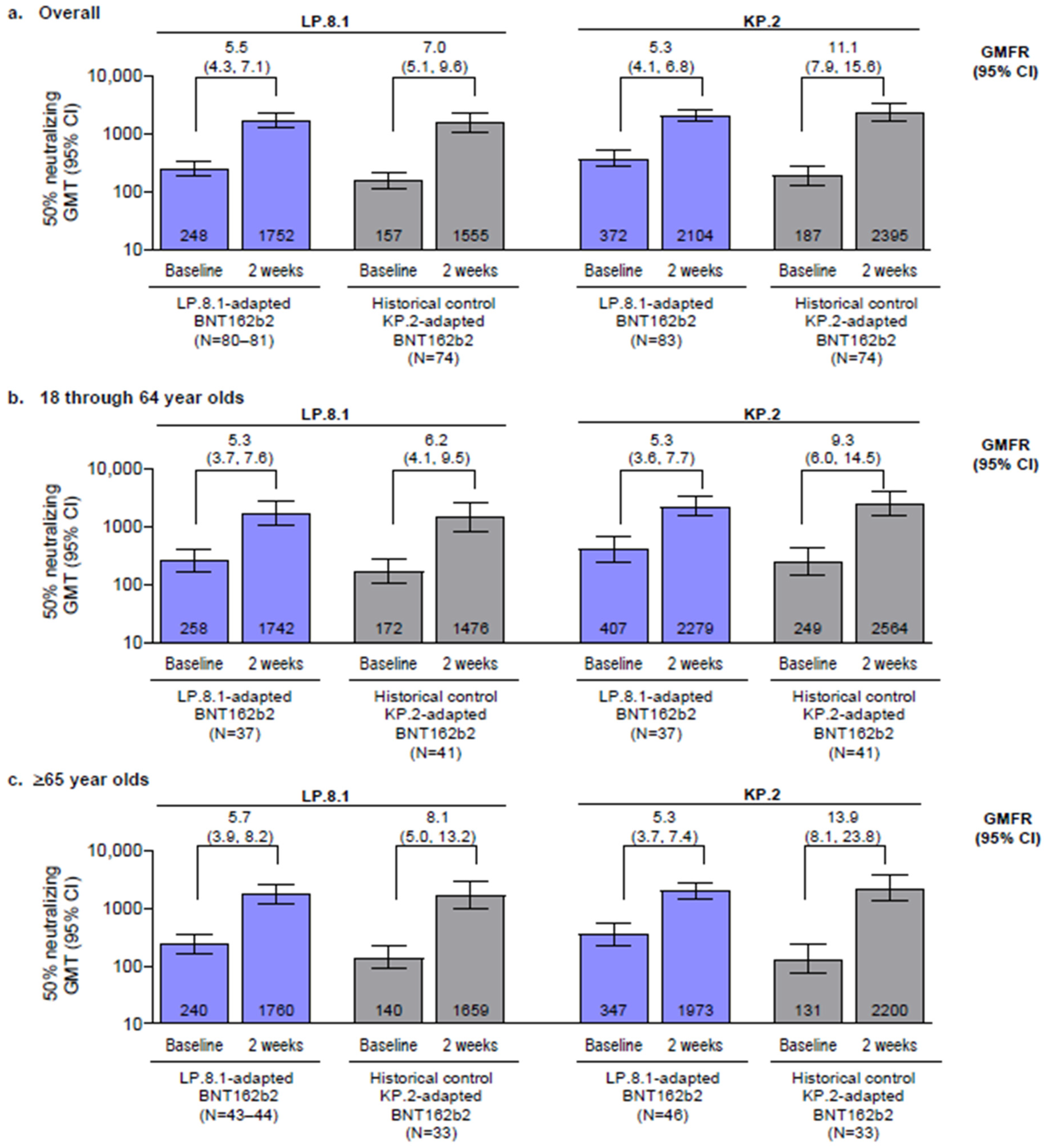
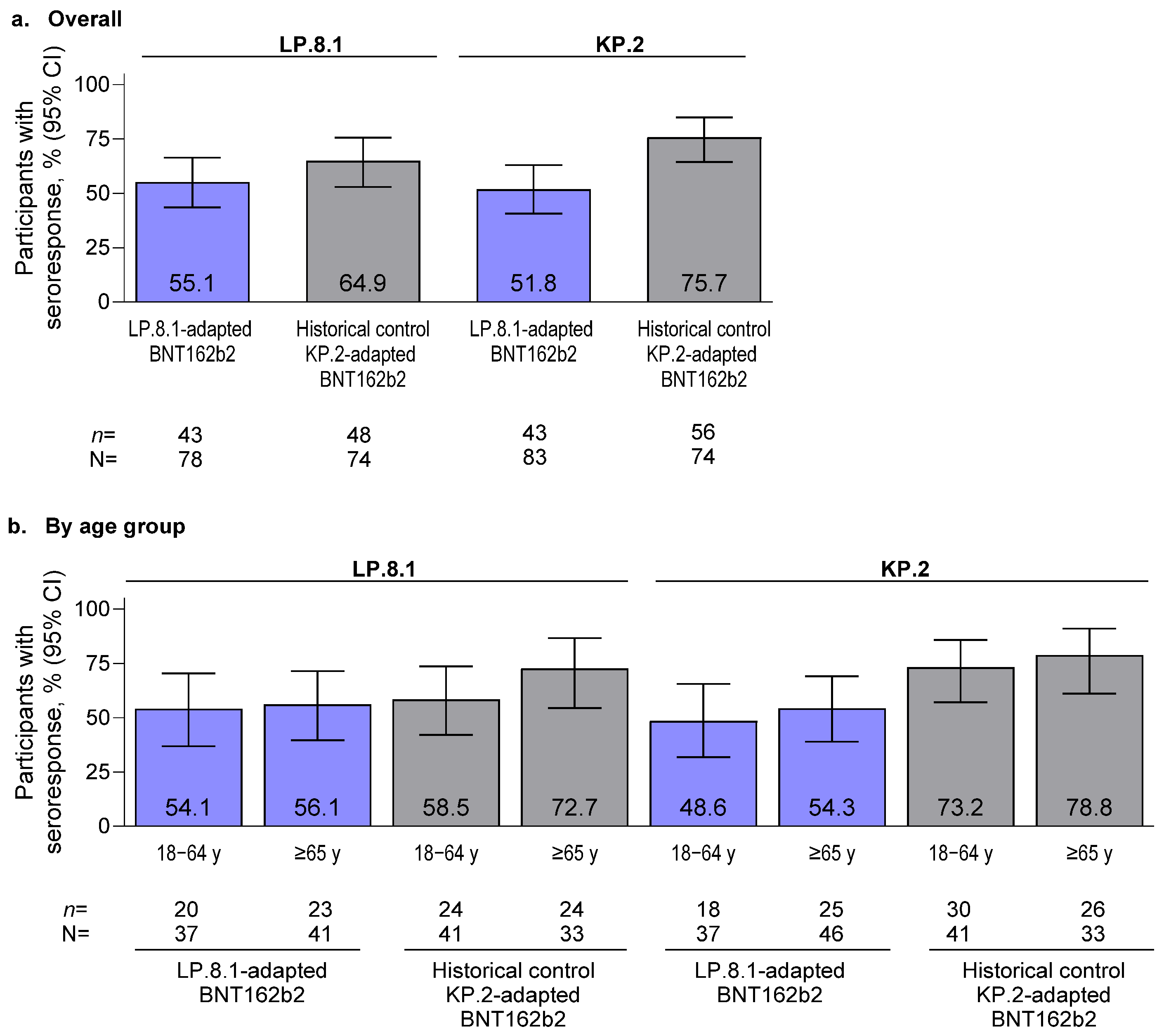
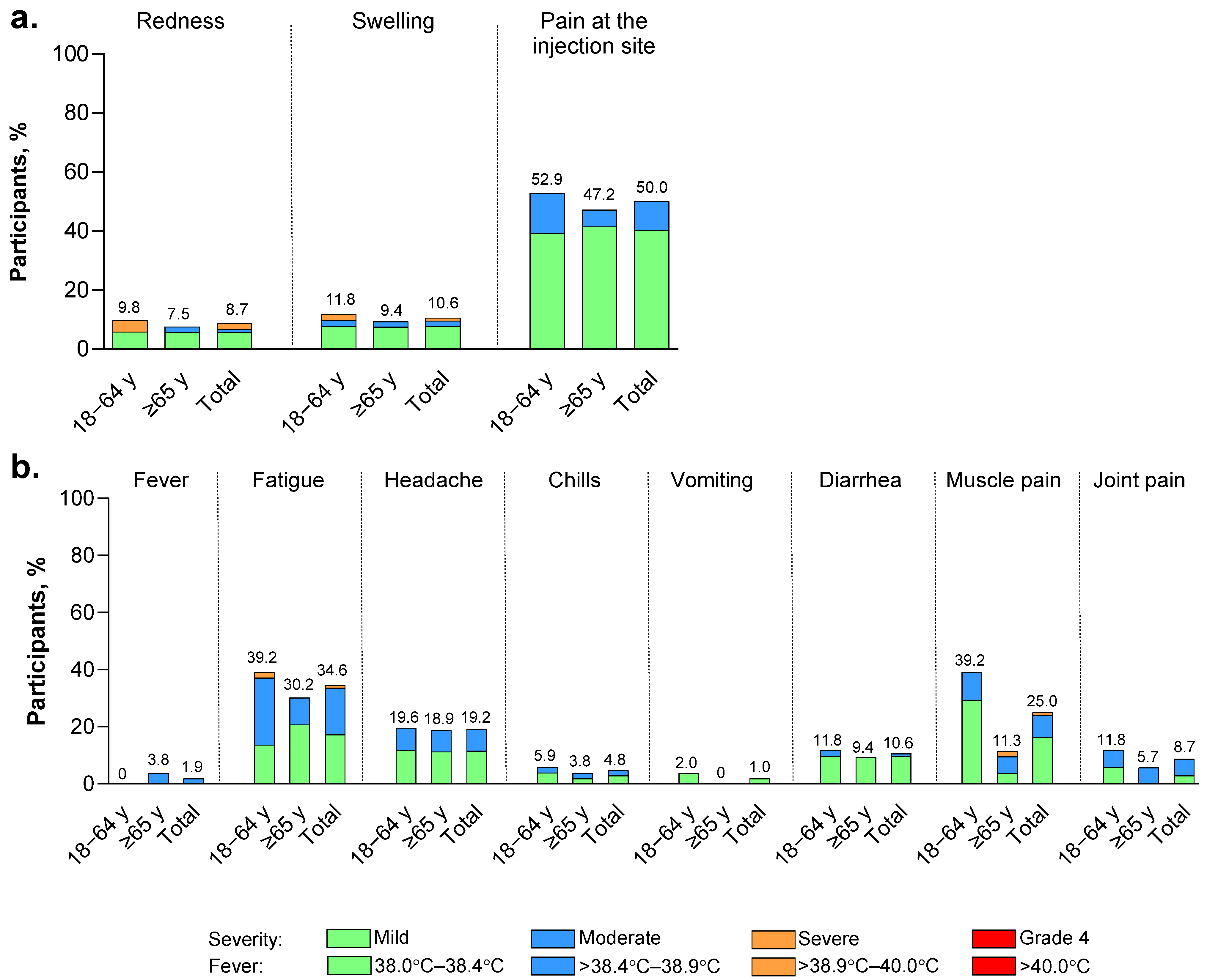
A Study to Investigate the Safety and Immunogenicity of Monovalent Omicron LP.8.1-Adapted BNT162b2 COVID-19 Vaccine in Adults ≥ 65 Years of Age and High-Risk Adults 18–64 Years of Age (Preliminary Results)
 , ,
, ,
Abstract
1. Introduction
2. Materials and Methods
2.1. Study Design
2.2. Intervention, Endpoints, and Assessments
2.3. Statistics
3. Results
3.1. Study Conduct and Participants
3.2. Immunogenicity
3.3. Safety
4. Discussion
5. Conclusions
Supplementary Materials
Author Contributions
Funding
Institutional Review Board Statement
Informed Consent Statement
Data Availability Statement
Acknowledgments
Conflicts of Interest
Abbreviations
| AE | Adverse event |
| AESI | Adverse event of special interest |
| FDA | Food and Drug Administration |
| GMFR | Geometric mean fold rise |
| GMT | Geometric mean titer |
| LLOQ | Lower limit of quantitation |
| N-binding | SARS-CoV-2 nucleoprotein-binding |
| NAAT | Nucleic acid amplification test |
| SAE | Serious adverse event |
| VE | Vaccine effectiveness |
References
- Centers for Disease Control and Prevention. COVID-19. Underlying Conditions and the Higher Risk for Severe COVID-19. Available online: https://www.cdc.gov/covid/hcp/clinical-care/underlying-conditions.html (accessed on 25 November 2024).
- Centers for Disease Control and Prevention (CDC). COVID 19. About COVID-19. Last Updated 13 June 2024. Available online: https://www.cdc.gov/covid/about/index.html (accessed on 25 November 2024).
- World Health Organization. Strategic and Operational Plan for Coronavirus Disease Threat Managment. Available online: https://cdn.who.int/media/docs/default-source/documents/epp/grt/draft_strategic-and-operational-plan-for-coronavirus-disease-threat-management.pdf?sfvrsn=30954d0d_4&download=true (accessed on 20 August 2025).
- Xiang, Y.; Zhang, R.; Qiu, J.; So, H.C. Increased risk of hospitalization for various disorders after COVID-19 infection: A cohort study of the UK biobank spanning over a hundred disease categories. J. Microbiol. Immunol. Infect. 2025, 58, 304–317. [Google Scholar] [CrossRef]
- Williamson, E.J.; Walker, A.J.; Bhaskaran, K.; Bacon, S.; Bates, C.; Morton, C.E.; Curtis, H.J.; Mehrkar, A.; Evans, D.; Inglesby, P.; et al. Factors associated with COVID-19-related death using OpenSAFELY. Nature 2020, 584, 430–436. [Google Scholar] [CrossRef]
- Cummins, L.; Ebyarimpa, I.; Cheetham, N.; Tzortziou Brown, V.; Brennan, K.; Panovska-Griffiths, J. Factors associated with COVID-19 related hospitalisation, critical care admission and mortality using linked primary and secondary care data. Influenza Other Respir. Viruses 2021, 15, 577–588. [Google Scholar] [CrossRef] [PubMed]
- Markov, P.V.; Ghafari, M.; Beer, M.; Lythgoe, K.; Simmonds, P.; Stilianakis, N.I.; Katzourakis, A. The evolution of SARS-CoV-2. Nat. Rev. Microbiol. 2023, 21, 361–379. [Google Scholar] [CrossRef] [PubMed]
- Le, T.P.; Abell, I.; Conway, E.; Campbell, P.T.; Hogan, A.B.; Lydeamore, M.J.; McVernon, J.; Mueller, I.; Walker, C.R.; Baker, C.M. Modelling the impact of hybrid immunity on future COVID-19 epidemic waves. BMC Infect. Dis. 2024, 24, 407. [Google Scholar] [CrossRef]
- Willett, B.J.; Grove, J.; MacLean, O.A.; Wilkie, C.; De Lorenzo, G.; Furnon, W.; Cantoni, D.; Scott, S.; Logan, N.; Ashraf, S.; et al. SARS-CoV-2 Omicron is an immune escape variant with an altered cell entry pathway. Nat. Microbiol. 2022, 7, 1161–1179. [Google Scholar] [CrossRef]
- Jacobs, J.L.; Haidar, G.; Mellors, J.W. COVID-19: Challenges of viral variants. Annu. Rev. Med. 2023, 74, 31–53. [Google Scholar] [CrossRef]
- Diya, O.; Gayed, J.; Lowry, F.S.; Ma, H.; Bangad, V.; Mensa, F.; Zou, J.; Xie, X.; Hu, Y.; Cutler, M.; et al. A phase 2/3 trial to investigate the safety and immunogenicity of monovalent Omicron JN.1-adapted BNT162b2 COVID-19 vaccine in adults ≥18 years old. Vaccine 2025, 52, 126869. [Google Scholar] [CrossRef]
- Mesle, M.M.I.; Brown, J.; Mook, P.; Katz, M.A.; Hagan, J.; Pastore, R.; Benka, B.; Redlberger-Fritz, M.; Bossuyt, N.; Stouten, V.; et al. Estimated number of lives directly saved by COVID-19 vaccination programmes in the WHO European Region from December, 2020, to March, 2023: A retrospective surveillance study. Lancet Respir. Med. 2024, 12, 714–727. [Google Scholar] [CrossRef]
- Semenzato, L.; Le Vu, S.; Botton, J.; Bertrand, M.; Jabagi, M.-J.; Drouin, J.; Cuenot, F.; Olié, V.; Dray-Spira, R.; Weill, A.; et al. COVID-19 mRNA vaccination and 4-year all-cause mortality among adults aged 18 to 59 years in France. JAMA Network Open 2025, 8, e2546822. [Google Scholar] [CrossRef] [PubMed]
- Liu, B.; Stepien, S.; Dobbins, T.; Gidding, H.; Henry, D.; Korda, R.; Mills, L.; Pearson, S.A.; Pratt, N.; Vajdic, C.M.; et al. Effectiveness of COVID-19 vaccination against COVID-19 specific and all-cause mortality in older Australians: A population based study. Lancet Reg. Health West. Pac. 2023, 40, 100928. [Google Scholar] [CrossRef] [PubMed]
- Ioannidis, J.P.A.; Pezzullo, A.M.; Cristiano, A.; Boccia, S. Global estimates of lives and life-years saved by COVID-19 vaccination during 2020–2024. JAMA Health Forum 2025, 6, e252223. [Google Scholar] [CrossRef]
- Anderer, S. COVID-19 vaccines averted 2.5 million deaths, mostly among older adults. JAMA 2025, 334, 942. [Google Scholar] [CrossRef]
- US Food and Drug Administration. COMIRNATY® (COVID-19 Vaccine, mRNA) Package Insert. Available online: https://www.fda.gov/vaccines-blood-biologics/comirnaty (accessed on 26 November 2024).
- Sahin, U.; Muik, A.; Vogler, I.; Derhovanessian, E.; Kranz, L.M.; Vormehr, M.; Quandt, J.; Bidmon, N.; Ulges, A.; Baum, A.; et al. BNT162b2 vaccine induces neutralizing antibodies and poly-specific T cells in humans. Nature 2021, 595, 572–577. [Google Scholar] [CrossRef]
- Bar-On, Y.M.; Goldberg, Y.; Mandel, M.; Bodenheimer, O.; Amir, O.; Freedman, L.; Alroy-Preis, S.; Ash, N.; Huppert, A.; Milo, R. Protection by a fourth dose of BNT162b2 against Omicron in Israel. N. Engl. J. Med. 2022, 386, 1712–1720. [Google Scholar] [CrossRef]
- Collie, S.; Nayager, J.; Bamford, L.; Bekker, L.G.; Zylstra, M.; Gray, G. Effectiveness and durability of the BNT162b2 vaccine against Omicron sublineages in South Africa. N. Engl. J. Med. 2022, 387, 1332–1333. [Google Scholar] [CrossRef] [PubMed]
- US Food and Drug Administration. Coronavirus (COVID-19) Update: FDA Authorizes Moderna and Pfizer-BioNTech Bivalent COVID-19 Vaccines for Use as a Booster Dose in Younger Age Groups. Available online: https://web.archive.org/web/20221130214837/https://www.fda.gov/news-events/press-announcements/coronavirus-covid-19-update-fda-authorizes-moderna-and-pfizer-biontech-bivalent-covid-19-vaccines (accessed on 26 November 2024).
- European Medicines Agency. Assessment Report: Comirnaty. Available online: https://www.ema.europa.eu/en/documents/variation-report/comirnaty-h-c-005735-ii-0140-epar-assessment-report-variation_en.pdf (accessed on 18 November 2025).
- US Food and Drug Administration. COVID-19 Vaccines (2025–2026 Formula) for Use in the United States Beginning in Fall 2025. Available online: https://www.fda.gov/vaccines-blood-biologics/industry-biologics/covid-19-vaccines-2025-2026-formula-use-united-states-beginning-fall-2025 (accessed on 1 July 2025).
- European Medicines Agency. EMA Confirms Its Recommendation to Update the Antigenic Composition of Authorised COVID-19 Vaccines for 2024–2025. Available online: https://www.ema.europa.eu/en/documents/other/ema-confirms-its-recommendation-update-antigenic-composition-authorised-covid-19-vaccines-2024-2025_en.pdf (accessed on 18 November 2025).
- Link-Gelles, R.; Chickery, S.; Webber, A.; Ong, T.C.; Rowley, E.A.K.; DeSilva, M.B.; Dascomb, K.; Irving, S.A.; Klein, N.P.; Grannis, S.J.; et al. Interim estimates of 2024–2025 COVID-19 vaccine effectiveness among adults aged ≥18 years—VISION and IVY Networks, September 2024-January 2025. MMWR Morb. Mortal. Wkly Rep. 2025, 74, 73–82. [Google Scholar] [CrossRef]
- Pather, S.; Muik, A.; Rizzi, R.; Mensa, F. Clinical development of variant-adapted BNT162b2 COVID-19 vaccines: The early Omicron era. Expert. Rev. Vaccines 2023, 22, 650–661. [Google Scholar] [CrossRef]
- US Food and Drug Administration. FDA Approves and Authorizes Updated mRNA COVID-19 Vaccines to Better Protect Against Currently Circulating Variants. Available online: https://www.fda.gov/news-events/press-announcements/fda-approves-and-authorizes-updated-mrna-covid-19-vaccines-better-protect-against-currently (accessed on 1 October 2024).
- Chen, L.; Kaku, Y.; Okumura, K.; Uriu, K.; Zhu, Y.; Ito, J.; Sato, K. Virological characteristics of the SARS-CoV-2 LP.8.1 variant. Lancet Infect. Dis. 2025, 25, e193. [Google Scholar] [CrossRef]
- Abbad, A.; Lerman, B.; Ehrenhaus, J.; Monahan, B.; Singh, G.; Wilson, A.; Slamanig, S.; Aracena, A.; Lyttle, N.; Nardulli, J.; et al. Antibody responses to SARS-CoV-2 variants LP.8.1, LF.7.1, NB.1.8.1, XFG and BA.3.2 following KP.2 monovalent mRNA vaccination. medRxiv 2025. [Google Scholar] [CrossRef] [PubMed]
- Jian, F.; Wang, J.; Yisimayi, A.; Song, W.; Xu, Y.; Chen, X.; Niu, X.; Yang, S.; Yu, Y.; Wang, P.; et al. Evolving antibody response to SARS-CoV-2 antigenic shift from XBB to JN.1. Nature 2025, 637, 921–929. [Google Scholar] [CrossRef] [PubMed]
- GISAID. Tracking of hCoV-19 Variants. Available online: https://gisaid.org/hcov19-variants/ (accessed on 2 October 2025).
- Khoury, D.S.; Docken, S.S.; Subbarao, K.; Kent, S.J.; Davenport, M.P.; Cromer, D. Predicting the efficacy of variant-modified COVID-19 vaccine boosters. Nat. Med. 2023, 29, 574–578. [Google Scholar] [CrossRef]
- European Medicines Agency. EMA Recommendation to Update the Antigenic Composition of Authorised COVID-19 Vaccines for 2025–2026. Available online: https://www.ema.europa.eu/en/documents/other/ema-recommendation-update-antigenic-composition-authorised-covid-19-vaccines-2025-2026_en.pdf (accessed on 18 November 2025).
- König, S.; Vaskyte, U.; Boesing, M.; Lüthi-Corridori, G.; Leuppi, J.D. The role of comorbidities in COVID-19 severity. Viruses 2025, 17, 957. [Google Scholar] [CrossRef]
- Dryden-Peterson, S.; Kim, A.; Caniglia, E.C.; Joyce, M.R.; Rubins, D.; Kim, A.Y.; Fangman, J.; Baden, L.R.; Woolley, A.E. Severe outcomes of COVID-19 among adults with increased risk conditions: A population-based observational study. PLoS ONE 2025, 20, e0316529. [Google Scholar] [CrossRef]
- Zhang, J.; Hou, C.; Chen, W.; Hu, Y.; Xu, S.; Liu, H.; Yang, Y.; Valdimarsdóttir, U.A.; Fang, F.; Song, H. Comorbidity patterns associated with severe COVID-19 outcomes: A cohort study based on the UK Biobank. PLoS ONE 2025, 20, e0329701. [Google Scholar] [CrossRef]
- Abodunrin, O.R.; Olagunju, M.T.; Huang, X.; Wang, J.; Hu, Z.; Shen, C. Regional risk factors associated with adverse outcomes of COVID-19 infection among the older adult: A systematic review and meta-analysis. J. Infect. Public Health 2025, 18, 102632. [Google Scholar] [CrossRef]
- Centers for Disease Control and Prevention (CDC). Underlying Conditions and the Higher Risk for Severe COVID-19. Available online: https://www.cdc.gov/covid/hcp/clinical-care/underlying-conditions.html?CDC_AAref_Val=https://www.cdc.gov/coronavirus/2019-ncov/hcp/clinical-care/underlyingconditions.html (accessed on 16 April 2025).
- Winokur, P.; Gayed, J.; Fitz-Patrick, D.; Thomas, S.J.; Diya, O.; Lockhart, S.; Xu, X.; Zhang, Y.; Bangad, V.; Schwartz, H.I.; et al. Bivalent Omicron BA.1-adapted BNT162b2 booster in adults older than 55 years. N. Engl. J. Med. 2023, 388, 214–227. [Google Scholar] [CrossRef]
- Walsh, E.E.; Frenck, R.W., Jr.; Falsey, A.R.; Kitchin, N.; Absalon, J.; Gurtman, A.; Lockhart, S.; Neuzil, K.; Mulligan, M.J.; Bailey, R.; et al. Safety and immunogenicity of two RNA-based Covid-19 vaccine candidates. N. Engl. J. Med. 2020, 383, 2439–2450. [Google Scholar] [CrossRef]
- Diya, O.; Gayed, J.; Lowry, F.S.; Ma, H.; Bangad, V.; Mensa, F.; Zou, J.; Xie, X.; Hu, Y.; Cutler, M.; et al. Safety and immunogenicity of monovalent Omicron KP.2-adapted BNT162b2 COVID-19 vaccine in adults: Single-arm substudy from a phase 2/3 trial. Infect. Dis. Ther. 2025, 14, 1973–1987. [Google Scholar] [CrossRef] [PubMed]
- US Food and Drug Administration. Guidance for Industry: Toxicity Grading Scale for Healthy Adult and Adolescent Volunteers Enrolled in Preventive Vaccine Clinical Trials. Available online: https://www.fda.gov/media/73679/download (accessed on 22 April 2025).
- Gayed, J.; Bangad, V.; Xu, X.; Mensa, F.; Cutler, M.; Türeci, Ö.; Şahin, U.; Modjarrad, K.; Swanson, K.A.; Anderson, A.S.; et al. Immunogenicity of the monovalent Omicron XBB.1.5-adapted BNT162b2 COVID-19 vaccine against XBB.1.5, BA.2.86, and JN.1 sublineages: A phase 2/3 trial. Vaccines 2024, 12, 734. [Google Scholar] [CrossRef] [PubMed]
- Appaneal, H.J.; Lopes, V.V.; Puzniak, L.; Zasowski, E.J.; Jodar, L.; McLaughlin, J.M.; Caffrey, A.R. Early effectiveness of the BNT162b2 KP.2 vaccine against COVID-19 in the US Veterans Affairs Healthcare System. medRxiv 2024. [Google Scholar] [CrossRef] [PubMed]
- Hansen, C.H.; Lassauniere, R.; Rasmussen, M.; Moustsen-Helms, I.R.; Valentiner-Branth, P. Effectiveness of the BNT162b2 and mRNA-1273 JN.1-adapted vaccines against COVID-19-associated hospitalisation and death: A Danish, nationwide, register-based, cohort study. Lancet Infect. Dis. 2025, 25, 1293–1302. [Google Scholar] [CrossRef] [PubMed]
- World Health Organization. WHO TAG-VE Risk Evaluation for SARS-CoV-2 Variant Under Monitoring: XFG; WHO: Geneva, Switzerland, 2025. [Google Scholar]
- COMIRNATY (COVID-19 vaccine mRNA). Full Prescribing Information; Pfizer: New York, NY, USA, 2025.
- Prasad, V.; Makary, M.A. An Evidence-Based Approach to Covid-19 Vaccination. N. Engl. J. Med. 2025, 392, 2484–2486. [Google Scholar] [CrossRef] [PubMed]



| LP.8.1-Adapted BNT162b2 Vaccine | |||
|---|---|---|---|
| Characteristic | 18–64 Years of Age (N = 51) | ≥65 Years of Age (N = 53) | Total (N = 104) |
| Sex, n (%) | |||
| Male | 17 (33.3) | 30 (56.6) | 47 (45.2) |
| Female | 34 (66.7) | 23 (43.4) | 57 (54.8) |
| Race, n (%) | |||
| White | 40 (78.4) | 45 (84.9) | 85 (81.7) |
| Black | 5 (9.8) | 3 (5.7) | 8 (7.7) |
| Asian | 4 (7.8) | 3 (5.7) | 7 (6.7) |
| Other/unknown/not reported | 2 (3.9) | 2 (3.8) | 4 (3.8) |
| Ethnicity, n (%) | |||
| Hispanic/Latino | 18 (35.3) | 14 (26.4) | 32 (30.8) |
| Non-Hispanic/non-Latino | 33 (64.7) | 39 (73.6) | 72 (69.2) |
| Age at vaccination, years | |||
| Mean (SD) | 49.2 (13.24) | 72.3 (4.49) | 61.0 (15.17) |
| Median (range) | 54.0 (23, 64) | 73.0 (65, 83) | 65.0 (23, 83) |
| 18–49 years, n (%) | 19 (37.3) | 0 | 19 (18.3) |
| 50–64 years, n (%) | 32 (62.7) | 0 | 32 (30.8) |
| 65–74 years, n (%) | 0 | 35 (66.0) | 35 (33.7) |
| ≥75 years, n (%) | 0 | 18 (34.0) | 18 (17.3) |
| Baseline SARS-CoV-2 status, n (%) | |||
| Positive a | 48 (94.1) | 45 (84.9) | 93 (89.4) |
| Medical history of COVID-19 | 22 (43.1) | 18 (34.0) | 40 (38.5) |
| Positive N-binding | 46 (90.2) | 42 (79.2) | 88 (84.6) |
| Positive NAAT | 1 (2.0) | 2 (3.8) | 3 (2.9) |
| Negative b | 3 (5.9) | 8 (15.1) | 11 (10.6) |
| Time from last dose of COVID-19 vaccine (received before the study) to the study vaccination, months c | |||
| Mean (SD) | 15.1 (12.70) | 12.3 (8.93) | 13.7 (10.98) |
| Median (range) | 10.0 (6.3, 55.9) | 9.6 (6.5, 50.2) | 9.7 (6.3, 55.9) |
| 6 to <12 months | 39 (76.5) | 46 (86.8) | 85 (81.7) |
| ≥12 months | 12 (23.5) | 7 (13.2) | 19 (18.3) |
| Body mass index d, n (%) | |||
| Underweight (<18.5 kg/m2) | 1 (2.0) | 1 (1.9) | 2 (1.9) |
| Normal weight (18.5–24.9 kg/m2) | 8 (15.7) | 12 (22.6) | 20 (19.2) |
| Overweight (25.0–29.9 kg/m2) | 12 (23.5) | 23 (43.4) | 35 (33.7) |
| Obese (≥30.0 kg/m2) | 30 (58.8) | 17 (32.1) | 47 (45.2) |
| LP.8.1-Adapted BNT162b2 Vaccine | |||
|---|---|---|---|
| 18–64 Years of Age (N = 51) n (%) | ≥65 Years of Age (N = 53) n (%) | Total (N = 104) n (%) | |
| Any AE | 5 (9.8) | 0 | 5 (4.8) |
| Related a | 0 | 0 | 0 |
| Severe | 0 | 0 | 0 |
| Life-threatening | 0 | 0 | 0 |
| Any SAE | 0 | 0 | 0 |
| Any nonserious AE | 5 (9.8) | 0 | 5 (4.8) |
| Related a | 0 | 0 | 0 |
| Severe | 0 | 0 | 0 |
| Life-threatening | 0 | 0 | 0 |
| Any immediate AE b | 0 | 0 | 0 |
| Any AE leading to withdrawal | 0 | 0 | 0 |
| Any AE of special interest c | 0 | 0 | 0 |
| AE leading to death | 0 | 0 | 0 |
Disclaimer/Publisher’s Note: The statements, opinions and data contained in all publications are solely those of the individual author(s) and contributor(s) and not of MDPI and/or the editor(s). MDPI and/or the editor(s) disclaim responsibility for any injury to people or property resulting from any ideas, methods, instructions or products referred to in the content. |
© 2026 by the authors. Licensee MDPI, Basel, Switzerland. This article is an open access article distributed under the terms and conditions of the Creative Commons Attribution (CC BY) license.
Share and Cite
Dadhe, R.; Gayed, J.; Iqbal, M.; Solan, R.; Wu, H.; Ma, H.; Xu, X.; Mensa, F.J.; Belanger, T.; Cooper, D.; et al. A Study to Investigate the Safety and Immunogenicity of Monovalent Omicron LP.8.1-Adapted BNT162b2 COVID-19 Vaccine in Adults ≥ 65 Years of Age and High-Risk Adults 18–64 Years of Age (Preliminary Results). Vaccines 2026, 14, 350. https://doi.org/10.3390/vaccines14040350
Dadhe R, Gayed J, Iqbal M, Solan R, Wu H, Ma H, Xu X, Mensa FJ, Belanger T, Cooper D, et al. A Study to Investigate the Safety and Immunogenicity of Monovalent Omicron LP.8.1-Adapted BNT162b2 COVID-19 Vaccine in Adults ≥ 65 Years of Age and High-Risk Adults 18–64 Years of Age (Preliminary Results). Vaccines. 2026; 14(4):350. https://doi.org/10.3390/vaccines14040350
Chicago/Turabian StyleDadhe, Rucha, Juleen Gayed, Muneeb Iqbal, Rohit Solan, Han Wu, Hua Ma, Xia Xu, Federico J. Mensa, Todd Belanger, David Cooper, and et al. 2026. "A Study to Investigate the Safety and Immunogenicity of Monovalent Omicron LP.8.1-Adapted BNT162b2 COVID-19 Vaccine in Adults ≥ 65 Years of Age and High-Risk Adults 18–64 Years of Age (Preliminary Results)" Vaccines 14, no. 4: 350. https://doi.org/10.3390/vaccines14040350
APA StyleDadhe, R., Gayed, J., Iqbal, M., Solan, R., Wu, H., Ma, H., Xu, X., Mensa, F. J., Belanger, T., Cooper, D., Mogg, R., Anderson, A. S., Türeci, Ö., Şahin, U., Allen, P. S., Modjarrad, K., Gurtman, A., & Lindert, K. (2026). A Study to Investigate the Safety and Immunogenicity of Monovalent Omicron LP.8.1-Adapted BNT162b2 COVID-19 Vaccine in Adults ≥ 65 Years of Age and High-Risk Adults 18–64 Years of Age (Preliminary Results). Vaccines, 14(4), 350. https://doi.org/10.3390/vaccines14040350