
The Bacterial Swiss Army Knife: ExPEC Utilizes Multiple Resistance Mechanisms to Counteract Host Immune Responses

 , ,
, ,
Abstract
1. Introduction
2. Extraintestinal Pathogenic E. coli Disease
3. Main Host Defense Strategies Against Bacterial Infection
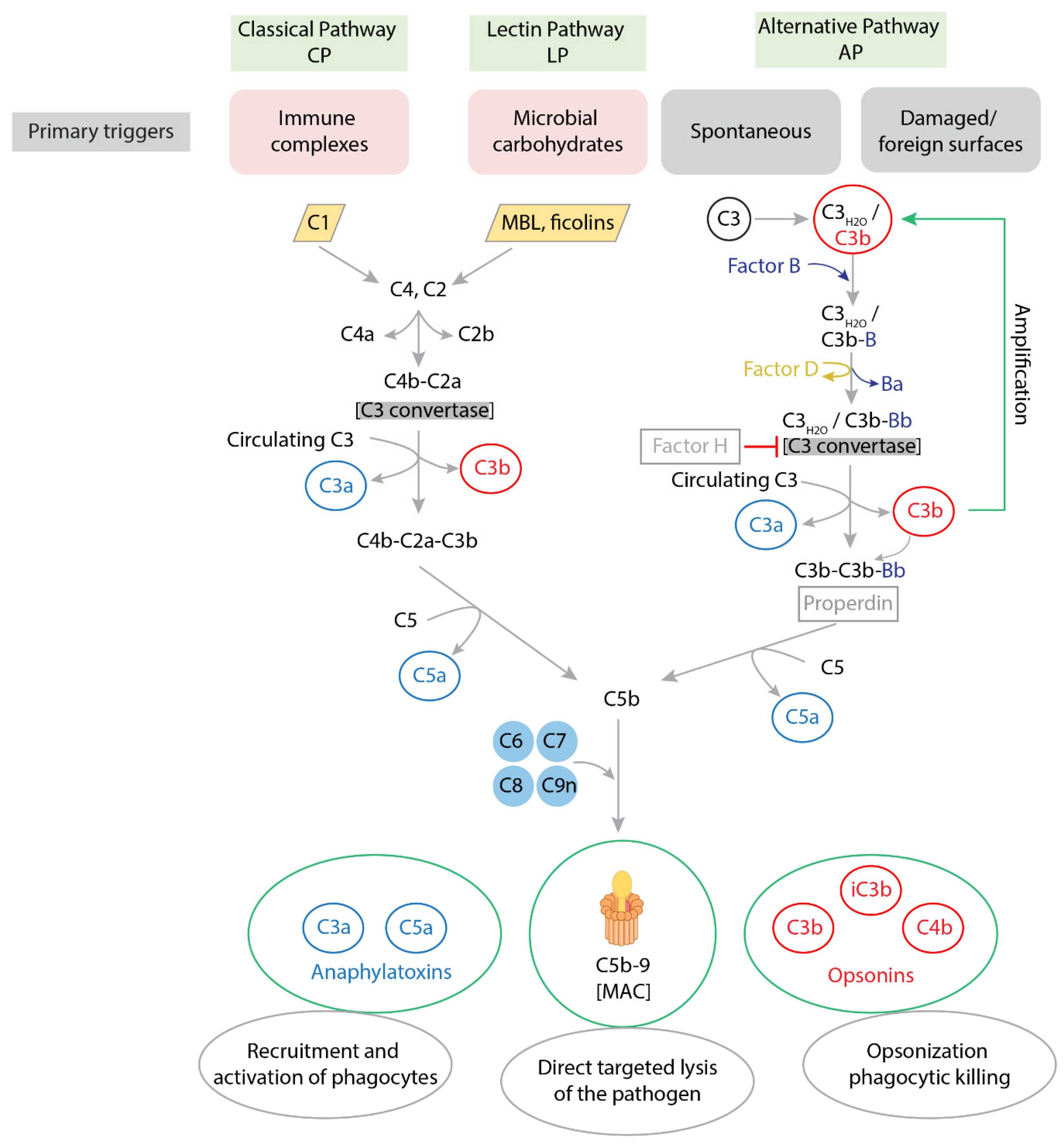
3.1. Complement

3.2. Antimicrobial Peptides
3.3. Neutrophils
3.4. Antibodies
4. Major ExPEC Factors Thwarting the Host’s First-Line Immune Responses
4.1. Surface and Extracellular Matrix Polysaccharides
4.2. Proteins Located in the Outer Membrane and Periplasm
4.3. Secreted and Periplasmic Toxins and Proteases
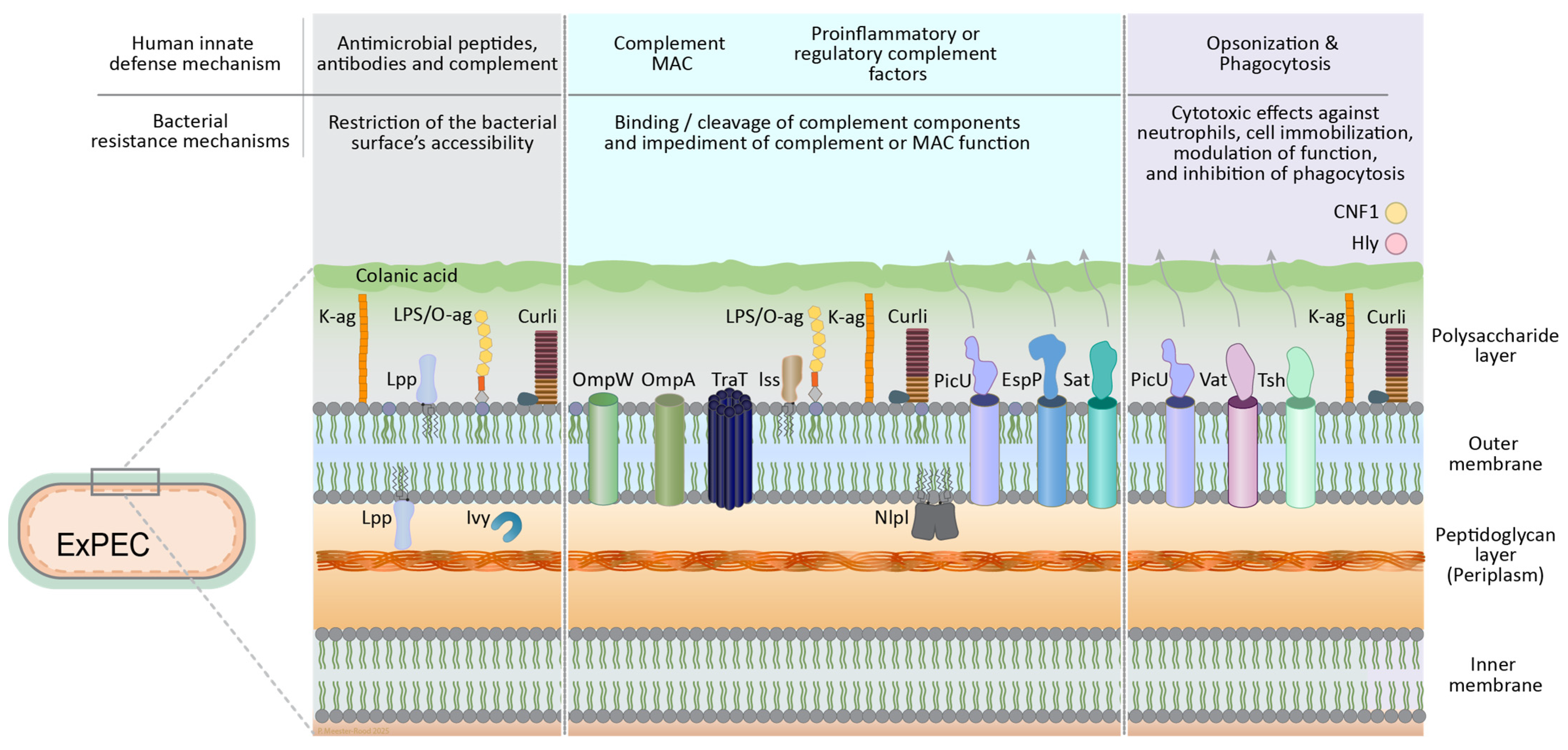
5. Bacterial Mechanisms to Counteract Host Defense Strategies
5.1. Factors Impeding the Complement System
5.1.1. Serum Resistance
5.1.2. Factor H Binding
5.1.3. AP/CP Disruption
5.1.4. MAC Inactivation
5.2. Factors Restricting Access to the Bacterial Surface, Thereby Preventing Effective Recognition by Antibodies, AMPs, and Complement
5.3. Factors Resisting Neutrophil- or Cell-Mediated Killing
5.4. Factors Involved in Molecular Mimicry and Immune Cell Inhibition
5.5. Factors Supporting Membrane Integrity, the Interplay of Envelope Components in Resistance and Regulatory Networks
6. Conclusions
Author Contributions
Funding
Data Availability Statement
Acknowledgments
Conflicts of Interest
References
- Kaper, J.B.; Nataro, J.P.; Mobley, H.L. Pathogenic Escherichia coli. Nat. Rev. Microbiol. 2004, 2, 123–140. [Google Scholar] [CrossRef]
- Lozupone, C.A.; Stombaugh, J.I.; Gordon, J.I.; Jansson, J.K.; Knight, R. Diversity, stability and resilience of the human gut microbiota. Nature 2012, 489, 220–230. [Google Scholar] [CrossRef]
- Tenaillon, O.; Skurnik, D.; Picard, B.; Denamur, E. The population genetics of commensal Escherichia coli. Nat. Rev. Microbiol. 2010, 8, 207–217. [Google Scholar] [CrossRef]
- Geurtsen, J.; de Been, M.; Weerdenburg, E.; Zomer, A.; McNally, A.; Poolman, J. Genomics and pathotypes of the many faces of Escherichia coli. FEMS Microbiol. Rev. 2022, 46, fuac031. [Google Scholar] [CrossRef]
- Fleming, A. The Bactericidal Power of Human Blood and some Methods of Altering It. Proc. R. Soc. Med. 1928, 21, 859–868. [Google Scholar] [CrossRef]
- Taylor, P.W. Bactericidal and bacteriolytic activity of serum against gram-negative bacteria. Microbiol. Rev. 1983, 47, 46–83. [Google Scholar] [CrossRef]
- Shepherd, F.R.; McLaren, J.E. T Cell Immunity to Bacterial Pathogens: Mechanisms of Immune Control and Bacterial Evasion. Int. J. Mol. Sci. 2020, 21, 6144. [Google Scholar] [CrossRef] [PubMed]
- Lai, J.; Zhu, Y.; Tang, L.; Lin, X. Epidemiology and antimicrobial susceptibility of invasive Escherichia coli infection in neonates from 2012 to 2019 in Xiamen, China. BMC Infect. Dis. 2021, 21, 295. [Google Scholar] [CrossRef] [PubMed]
- Cailes, B.; Kortsalioudaki, C.; Buttery, J.; Pattnayak, S.; Greenough, A.; Matthes, J.; Bedford Russell, A.; Kennea, N.; Heath, P.T.; neon, I.N.n. Epidemiology of UK neonatal infections: The neonIN infection surveillance network. Arch. Dis. Child. Fetal Neonatal Ed. 2018, 103, F547–F553. [Google Scholar] [CrossRef] [PubMed]
- Page, J.M.; Bardsley, T.; Thorsten, V.; Allshouse, A.A.; Varner, M.W.; Debbink, M.P.; Dudley, D.J.; Saade, G.R.; Goldenberg, R.L.; Stoll, B.; et al. Stillbirth Associated with Infection in a Diverse U.S. Cohort. Obstet. Gynecol. 2019, 134, 1187–1196. [Google Scholar] [CrossRef]
- Poolman, J.T.; Wacker, M. Extraintestinal Pathogenic Escherichia coli, a Common Human Pathogen: Challenges for Vaccine Development and Progress in the Field. J. Infect. Dis. 2016, 213, 6–13. [Google Scholar] [CrossRef] [PubMed]
- Sarowska, J.; Futoma-Koloch, B.; Jama-Kmiecik, A.; Frej-Madrzak, M.; Ksiazczyk, M.; Bugla-Ploskonska, G.; Choroszy-Krol, I. Virulence factors, prevalence and potential transmission of extraintestinal pathogenic Escherichia coli isolated from different sources: Recent reports. Gut Pathog. 2019, 11, 10. [Google Scholar] [CrossRef]
- Chang, Y.T.; Coombs, G.; Ling, T.; Balaji, V.; Rodrigues, C.; Mikamo, H.; Kim, M.J.; Rajasekaram, D.G.; Mendoza, M.; Tan, T.Y.; et al. Epidemiology and trends in the antibiotic susceptibilities of Gram-negative bacilli isolated from patients with intra-abdominal infections in the Asia-Pacific region, 2010–2013. Int. J. Antimicrob. Agents 2017, 49, 734–739. [Google Scholar] [CrossRef]
- Ponce-de-Leon, A.; Rodriguez-Noriega, E.; Morfin-Otero, R.; Cornejo-Juarez, D.P.; Tinoco, J.C.; Martinez-Gamboa, A.; Gaona-Tapia, C.J.; Guerrero-Almeida, M.L.; Martin-Onraet, A.; Vallejo Cervantes, J.L.; et al. Antimicrobial susceptibility of gram-negative bacilli isolated from intra-abdominal and urinary-tract infections in Mexico from 2009 to 2015: Results from the Study for Monitoring Antimicrobial Resistance Trends (SMART). PLoS ONE 2018, 13, e0198621. [Google Scholar] [CrossRef]
- Sartelli, M.; Catena, F.; Ansaloni, L.; Coccolini, F.; Corbella, D.; Moore, E.E.; Malangoni, M.; Velmahos, G.; Coimbra, R.; Koike, K.; et al. Complicated intra-abdominal infections worldwide: The definitive data of the CIAOW Study. World J. Emerg. Surg. 2014, 9, 37. [Google Scholar] [CrossRef]
- Yoon, Y.K.; Kim, J.; Moon, C.; Lee, M.S.; Hur, J.; Lee, H.; Kim, S.W. Antimicrobial Susceptibility of Microorganisms Isolated from Patients with Intraabdominal Infection in Korea: A Multicenter Study. J. Korean Med. Sci. 2019, 34, e309. [Google Scholar] [CrossRef]
- Zhang, H.; Yang, Q.; Liao, K.; Ni, Y.; Yu, Y.; Hu, B.; Sun, Z.; Huang, W.; Wang, Y.; Wu, A.; et al. Update of incidence and antimicrobial susceptibility trends of Escherichia coli and Klebsiella pneumoniae isolates from Chinese intra-abdominal infection patients. BMC Infect. Dis. 2017, 17, 776. [Google Scholar] [CrossRef] [PubMed]
- Martinez-Medina, M.; Mora, A.; Blanco, M.; Lopez, C.; Alonso, M.P.; Bonacorsi, S.; Nicolas-Chanoine, M.H.; Darfeuille-Michaud, A.; Garcia-Gil, J.; Blanco, J. Similarity and divergence among adherent-invasive Escherichia coli and extraintestinal pathogenic E. coli strains. J. Clin. Microbiol. 2009, 47, 3968–3979. [Google Scholar] [CrossRef] [PubMed]
- Mirsepasi-Lauridsen, H.C.; Vallance, B.A.; Krogfelt, K.A.; Petersen, A.M. Escherichia coli Pathobionts Associated with Inflammatory Bowel Disease. Clin. Microbiol. Rev. 2019, 32, e00060-18. [Google Scholar] [CrossRef]
- Nash, J.H.; Villegas, A.; Kropinski, A.M.; Aguilar-Valenzuela, R.; Konczy, P.; Mascarenhas, M.; Ziebell, K.; Torres, A.G.; Karmali, M.A.; Coombes, B.K. Genome sequence of adherent-invasive Escherichia coli and comparative genomic analysis with other E. coli pathotypes. BMC Genom. 2010, 11, 667. [Google Scholar] [CrossRef]
- La Combe, B.; Clermont, O.; Messika, J.; Eveillard, M.; Kouatchet, A.; Lasocki, S.; Corvec, S.; Lakhal, K.; Billard-Pomares, T.; Fernandes, R.; et al. Pneumonia-Specific Escherichia coli with Distinct Phylogenetic and Virulence Profiles, France, 2012–2014. Emerg. Infect. Dis. 2019, 25, 710–718. [Google Scholar] [CrossRef]
- Moet, G.J.; Jones, R.N.; Biedenbach, D.J.; Stilwell, M.G.; Fritsche, T.R. Contemporary causes of skin and soft tissue infections in North America, Latin America, and Europe: Report from the SENTRY Antimicrobial Surveillance Program (1998–2004). Diagn. Microbiol. Infect. Dis. 2007, 57, 7–13. [Google Scholar] [CrossRef]
- Bonten, M.; Johnson, J.R.; van den Biggelaar, A.H.J.; Georgalis, L.; Geurtsen, J.; de Palacios, P.I.; Gravenstein, S.; Verstraeten, T.; Hermans, P.; Poolman, J.T. Epidemiology of Escherichia coli Bacteremia: A Systematic Literature Review. Clin. Infect. Dis. Off. Publ. Infect. Dis. Soc. Am. 2021, 72, 1211–1219. [Google Scholar] [CrossRef] [PubMed]
- Ohmagari, N.; Choi, W.S.; Tang, H.J.; Atanasov, P.; Jiang, X.; Hernandez Pastor, L.; Nakayama, Y.; Chiang, J.; Lim, K.; Nievera, M.C. Targeted literature review of the burden of extraintestinal pathogenic Escherichia coli among elderly patients in Asia Pacific regions. J. Med. Econ. 2023, 26, 168–178. [Google Scholar] [CrossRef] [PubMed]
- Stoll, B.J.; Puopolo, K.M.; Hansen, N.I.; Sanchez, P.J.; Bell, E.F.; Carlo, W.A.; Cotten, C.M.; D’Angio, C.T.; Kazzi, S.N.J.; Poindexter, B.B.; et al. Early-Onset Neonatal Sepsis 2015 to 2017, the Rise of Escherichia coli, and the Need for Novel Prevention Strategies. JAMA Pediatr 2020, 174, e200593. [Google Scholar] [CrossRef]
- Rhee, C.; Kadri, S.S.; Dekker, J.P.; Danner, R.L.; Chen, H.C.; Fram, D.; Zhang, F.; Wang, R.; Klompas, M. Prevalence of Antibiotic-Resistant Pathogens in Culture-Proven Sepsis and Outcomes Associated with Inadequate and Broad-Spectrum Empiric Antibiotic Use. JAMA Netw. Open 2020, 3, e202899. [Google Scholar] [CrossRef] [PubMed]
- Oordt-Speets, A.M.; Bolijn, R.; van Hoorn, R.C.; Bhavsar, A.; Kyaw, M.H. Global etiology of bacterial meningitis: A systematic review and meta-analysis. PLoS ONE 2018, 13, e0198772. [Google Scholar] [CrossRef]
- Wang, C.Y.; Xu, H.M.; Tian, J.; Hong, S.Q.; Liu, G.; Wang, S.X.; Gao, F.; Liu, J.; Liu, F.R.; Yu, H.; et al. A multicenter epidemiological study of acute bacterial meningitis in children. Chin. J. Pediatr. 2022, 60, 1045–1053. [Google Scholar] [CrossRef]
- Wong, C.H.; Duque, J.R.; Wong, J.S.C.; Chan, C.V.; Lam, C.S.I.; Fu, Y.M.; Cheong, K.N.; Chua, G.T.; Lee, P.P.; Ip, P.; et al. Epidemiology and Trends of Infective Meningitis in Neonates and Infants Less than 3 Months Old in Hong Kong. Int. J. Infect. Dis. 2021, 111, 288–294. [Google Scholar] [CrossRef]
- Liu, Y.; Zhu, M.; Fu, X.; Cai, J.; Chen, S.; Lin, Y.; Jiang, N.; Chen, S.; Lin, Z. Escherichia coli Causing Neonatal Meningitis During 2001-2020: A Study in Eastern China. Int. J. Gen. Med. 2021, 14, 3007–3016. [Google Scholar] [CrossRef]
- Okike, I.O.; Johnson, A.P.; Henderson, K.L.; Blackburn, R.M.; Muller-Pebody, B.; Ladhani, S.N.; Anthony, M.; Ninis, N.; Heath, P.T.; neoMen Study, G. Incidence, etiology, and outcome of bacterial meningitis in infants aged <90 days in the United kingdom and Republic of Ireland: Prospective, enhanced, national population-based surveillance. Clin. Infect. Dis. Off. Publ. Infect. Dis. Soc. Am. 2014, 59, e150–e157. [Google Scholar] [CrossRef]
- Spurbeck, R.R.; Dinh, P.C., Jr.; Walk, S.T.; Stapleton, A.E.; Hooton, T.M.; Nolan, L.K.; Kim, K.S.; Johnson, J.R.; Mobley, H.L. Escherichia coli isolates that carry vat, fyuA, chuA, and yfcV efficiently colonize the urinary tract. Infect. Immun. 2012, 80, 4115–4122. [Google Scholar] [CrossRef]
- Nhu, N.T.K.; Rahman, M.A.; Goh, K.G.K.; Kim, S.J.; Phan, M.D.; Peters, K.M.; Alvarez-Fraga, L.; Hancock, S.J.; Ravi, C.; Kidd, T.J.; et al. A convergent evolutionary pathway attenuating cellulose production drives enhanced virulence of some bacteria. Nat. Commun. 2024, 15, 1441. [Google Scholar] [CrossRef] [PubMed]
- Kocsis, B.; Gulyas, D.; Szabo, D. Emergence and Dissemination of Extraintestinal Pathogenic High-Risk International Clones of Escherichia coli. Life 2022, 12, 2077. [Google Scholar] [CrossRef]
- DebRoy, C.; Fratamico, P.M.; Yan, X.; Baranzoni, G.; Liu, Y.; Needleman, D.S.; Tebbs, R.; O’Connell, C.D.; Allred, A.; Swimley, M.; et al. Comparison of O-Antigen Gene Clusters of All O-Serogroups of Escherichia coli and Proposal for Adopting a New Nomenclature for O-Typing. PLoS ONE 2016, 11, e0147434. [Google Scholar] [CrossRef]
- Iguchi, A.; Iyoda, S.; Kikuchi, T.; Ogura, Y.; Katsura, K.; Ohnishi, M.; Hayashi, T.; Thomson, N.R. A complete view of the genetic diversity of the Escherichia coli O-antigen biosynthesis gene cluster. DNA Res. Int. J. Rapid Publ. Rep. Genes Genomes 2015, 22, 101–107. [Google Scholar] [CrossRef] [PubMed]
- Liu, B.; Furevi, A.; Perepelov, A.V.; Guo, X.; Cao, H.; Wang, Q.; Reeves, P.R.; Knirel, Y.A.; Wang, L.; Widmalm, G. Structure and genetics of Escherichia coli O antigens. FEMS Microbiol. Rev. 2020, 44, 655–683. [Google Scholar] [CrossRef]
- Orskov, I.; Orskov, F.; Jann, B.; Jann, K. Serology, chemistry, and genetics of O and K antigens of Escherichia coli. Bacteriol. Rev. 1977, 41, 667–710. [Google Scholar] [CrossRef]
- Wang, L.; Rothemund, D.; Curd, H.; Reeves, P.R. Species-wide variation in the Escherichia coli flagellin (H-antigen) gene. J. Bacteriol. 2003, 185, 2936–2943. [Google Scholar] [CrossRef]
- Whitfield, C.; Roberts, I.S. Structure, assembly and regulation of expression of capsules in Escherichia coli. Mol. Microbiol. 1999, 31, 1307–1319. [Google Scholar] [CrossRef]
- Weerdenburg, E.; Davies, T.; Morrow, B.; Zomer, A.L.; Hermans, P.; Go, O.; Spiessens, B.; van den Hoven, T.; van Geet, G.; Aitabi, M.; et al. Global Distribution of O Serotypes and Antibiotic Resistance in Extraintestinal Pathogenic Escherichia coli Collected From the Blood of Patients with Bacteremia Across Multiple Surveillance Studies. Clin. Infect. Dis. Off. Publ. Infect. Dis. Soc. Am. 2023, 76, e1236–e1243. [Google Scholar] [CrossRef] [PubMed]
- Fierro, C.A.; Sarnecki, M.; Doua, J.; Spiessens, B.; Go, O.; Davies, T.A.; van den Dobbelsteen, G.; Poolman, J.; Abbanat, D.; Haazen, W. Safety, Reactogenicity, Immunogenicity, and Dose Selection of 10-Valent Extraintestinal Pathogenic Escherichia coli Bioconjugate Vaccine (VAC52416) in Adults Aged 60-85 Years in a Randomized, Multicenter, Interventional, First-in-Human, Phase 1/2a Study. Open Forum Infect. Dis. 2023, 10, ofad417. [Google Scholar] [CrossRef]
- Kim, K.S.; Itabashi, H.; Gemski, P.; Sadoff, J.; Warren, R.L.; Cross, A.S. The K1 capsule is the critical determinant in the development of Escherichia coli meningitis in the rat. J. Clin. Investig. 1992, 90, 897–905. [Google Scholar] [CrossRef] [PubMed]
- Nhu, N.T.K.; Phan, M.D.; Hancock, S.J.; Peters, K.M.; Alvarez-Fraga, L.; Forde, B.M.; Andersen, S.B.; Miliya, T.; Harris, P.N.A.; Beatson, S.A.; et al. High-risk Escherichia coli clones that cause neonatal meningitis and association with recrudescent infection. eLife 2024, 12, RP91853. [Google Scholar] [CrossRef]
- Arredondo-Alonso, S.; Blundell-Hunter, G.; Fu, Z.; Gladstone, R.A.; Fillol-Salom, A.; Loraine, J.; Cloutman-Green, E.; Johnsen, P.J.; Samuelsen, O.; Pontinen, A.K.; et al. Evolutionary and functional history of the Escherichia coli K1 capsule. Nat. Commun. 2023, 14, 3294. [Google Scholar] [CrossRef]
- Kirkby, N.S.; Lundberg, M.H.; Harrington, L.S.; Leadbeater, P.D.; Milne, G.L.; Potter, C.M.; Al-Yamani, M.; Adeyemi, O.; Warner, T.D.; Mitchell, J.A. Cyclooxygenase-1, not cyclooxygenase-2, is responsible for physiological production of prostacyclin in the cardiovascular system. Proc. Natl. Acad. Sci. USA 2012, 109, 17597–17602. [Google Scholar] [CrossRef]
- Bjanes, E.; Nizet, V. More than a Pore: Nonlytic Antimicrobial Functions of Complement and Bacterial Strategies for Evasion. Microbiol. Mol. Biol. Rev. 2021, 85, e00177-20. [Google Scholar] [CrossRef]
- Krzyzewska-Dudek, E.; Kotimaa, J.; Kapczynska, K.; Rybka, J.; Meri, S. Lipopolysaccharides and outer membrane proteins as main structures involved in complement evasion strategies of non-typhoidal Salmonella strains. Mol. Immunol. 2022, 150, 67–77. [Google Scholar] [CrossRef]
- Mellors, J.; Tipton, T.; Longet, S.; Carroll, M. Viral Evasion of the Complement System and Its Importance for Vaccines and Therapeutics. Front. Immunol. 2020, 11, 1450. [Google Scholar] [CrossRef]
- Ruest, M.K.; Dennis, J.J. The Exploration of Complement-Resistance Mechanisms of Pathogenic Gram-Negative Bacteria to Support the Development of Novel Therapeutics. Pathogens 2022, 11, 931. [Google Scholar] [CrossRef] [PubMed]
- Gil, E.; Noursadeghi, M.; Brown, J.S. Streptococcus pneumoniae interactions with the complement system. Front. Cell. Infect. Microbiol. 2022, 12, 929483. [Google Scholar] [CrossRef]
- Wibroe, P.P.; Helvig, S.Y.; Moein Moghimi, S. The Role of Complement in Antibody Therapy for Infectious Diseases. Microbiol. Spectr. 2014, 2, 63–74. [Google Scholar] [CrossRef] [PubMed]
- van Lookeren Campagne, M.; Wiesmann, C.; Brown, E.J. Macrophage complement receptors and pathogen clearance. Cell. Microbiol. 2007, 9, 2095–2102. [Google Scholar] [CrossRef] [PubMed]
- Li, K.; Underhill, D.M. C-Type Lectin Receptors in Phagocytosis. Curr. Top. Microbiol. Immunol. 2020, 429, 1–18. [Google Scholar] [CrossRef]
- Miajlovic, H.; Smith, S.G. Bacterial self-defence: How Escherichia coli evades serum killing. FEMS Microbiol. Lett. 2014, 354, 1–9. [Google Scholar] [CrossRef]
- Noris, M.; Remuzzi, G. Overview of complement activation and regulation. Semin. Nephrol. 2013, 33, 479–492. [Google Scholar] [CrossRef]
- Ricklin, D.; Hajishengallis, G.; Yang, K.; Lambris, J.D. Complement: A key system for immune surveillance and homeostasis. Nat. Immunol. 2010, 11, 785–797. [Google Scholar] [CrossRef] [PubMed]
- Walport, M.J. Complement. First of two parts. N. Engl. J. Med. 2001, 344, 1058–1066. [Google Scholar] [CrossRef]
- Sjöholm, A.G.; Jönsson, G.; Braconier, J.H.; Sturfelt, G.; Truedsson, L. Complement deficiency and disease: An update. Mol. Immunol. 2006, 43, 78–85. [Google Scholar] [CrossRef]
- Tedesco, F. Inherited complement deficiencies and bacterial infections. Vaccine 2008, 26, I3–I8. [Google Scholar] [CrossRef]
- Sullivan, K.E. The yin and the yang of early classical pathway complement disorders. Clin. Exp. Immunol. 2022, 209, 151–160. [Google Scholar] [CrossRef]
- Shields, A.M.; Pagnamenta, A.T.; Pollard, A.J.; Taylor, J.C.; Allroggen, H.; Patel, S.Y. Classical and Non-classical Presentations of Complement Factor I Deficiency: Two Contrasting Cases Diagnosed via Genetic and Genomic Methods. Front. Immunol. 2019, 10, 1150. [Google Scholar] [CrossRef]
- Audemard-Verger, A.; Descloux, E.; Ponard, D.; Deroux, A.; Fantin, B.; Fieschi, C.; John, M.; Bouldouyre, A.; Karkowsi, L.; Moulis, G.; et al. Infections Revealing Complement Deficiency in Adults: A French Nationwide Study Enrolling 41 Patients. Medicine 2016, 95, e3548. [Google Scholar] [CrossRef]
- Lewis, L.A.; Ram, S. Meningococcal disease and the complement system. Virulence 2014, 5, 98–126. [Google Scholar] [CrossRef]
- El Sissy, C.; Rosain, J.; Vieira-Martins, P.; Bordereau, P.; Gruber, A.; Devriese, M.; de Pontual, L.; Taha, M.K.; Fieschi, C.; Picard, C.; et al. Clinical and Genetic Spectrum of a Large Cohort with Total and Sub-total Complement Deficiencies. Front. Immunol. 2019, 10, 1936. [Google Scholar] [CrossRef] [PubMed]
- Pettigrew, H.D.; Teuber, S.S.; Gershwin, M.E. Clinical significance of complement deficiencies. Ann. N. Y. Acad. Sci. 2009, 1173, 108–123. [Google Scholar] [CrossRef] [PubMed]
- Reis, S.E.; Falcao, D.A.; Isaac, L. Clinical aspects and molecular basis of primary deficiencies of complement component C3 and its regulatory proteins factor I and factor H. Scand. J. Immunol. 2006, 63, 155–168. [Google Scholar] [CrossRef]
- Taylor, P.W.; Kroll, H.P. Interaction of human complement proteins with serum-sensitive and serum-resistant strains of Escherichia coli. Mol. Immunol. 1984, 21, 609–620. [Google Scholar] [CrossRef]
- Doorduijn, D.J.; Lukassen, M.V.; van ‘t Wout, M.F.L.; Franc, V.; Ruyken, M.; Bardoel, B.W.; Heck, A.J.R.; Rooijakkers, S.H.M. Soluble MAC is primarily released from MAC-resistant bacteria that potently convert complement component C5. eLife 2022, 11, e77503. [Google Scholar] [CrossRef]
- Doorduijn, D.J.; Heesterbeek, D.A.C.; Ruyken, M.; de Haas, C.J.C.; Stapels, D.A.C.; Aerts, P.C.; Rooijakkers, S.H.M.; Bardoel, B.W. Polymerization of C9 enhances bacterial cell envelope damage and killing by membrane attack complex pores. PLoS Pathog. 2021, 17, e1010051. [Google Scholar] [CrossRef]
- Merle, N.S.; Church, S.E.; Fremeaux-Bacchi, V.; Roumenina, L.T. Complement System Part I—Molecular Mechanisms of Activation and Regulation. Front. Immunol. 2015, 6, 262. [Google Scholar] [CrossRef]
- Blyth, G.A.D.; Connors, L.; Fodor, C.; Cobo, E.R. The Network of Colonic Host Defense Peptides as an Innate Immune Defense Against Enteropathogenic Bacteria. Front. Immunol. 2020, 11, 965. [Google Scholar] [CrossRef]
- Hancock, R.E.; Haney, E.F.; Gill, E.E. The immunology of host defence peptides: Beyond antimicrobial activity. Nat. Rev. Immunol. 2016, 16, 321–334. [Google Scholar] [CrossRef]
- Kagan, B.L.; Selsted, M.E.; Ganz, T.; Lehrer, R.I. Antimicrobial defensin peptides form voltage-dependent ion-permeable channels in planar lipid bilayer membranes. Proc. Natl. Acad. Sci. USA 1990, 87, 210–214. [Google Scholar] [CrossRef]
- de Leeuw, E.; Li, C.; Zeng, P.; Li, C.; Diepeveen-de Buin, M.; Lu, W.Y.; Breukink, E.; Lu, W. Functional interaction of human neutrophil peptide-1 with the cell wall precursor lipid II. FEBS Lett. 2010, 584, 1543–1548. [Google Scholar] [CrossRef]
- Kudryashova, E.; Quintyn, R.; Seveau, S.; Lu, W.; Wysocki, V.H.; Kudryashov, D.S. Human defensins facilitate local unfolding of thermodynamically unstable regions of bacterial protein toxins. Immunity 2014, 41, 709–721. [Google Scholar] [CrossRef] [PubMed]
- Segal, A.W. How neutrophils kill microbes. Annu. Rev. Immunol. 2005, 23, 197–223. [Google Scholar] [CrossRef] [PubMed]
- Andrews, T.; Sullivan, K.E. Infections in patients with inherited defects in phagocytic function. Clin. Microbiol. Rev. 2003, 16, 597–621. [Google Scholar] [CrossRef]
- Rotulo, G.A.; Plat, G.; Beaupain, B.; Blanche, S.; Moushous, D.; Sicre de Fontbrune, F.; Leblanc, T.; Renard, C.; Barlogis, V.; Vigue, M.G.; et al. Recurrent bacterial infections, but not fungal infections, characterise patients with ELANE-related neutropenia: A French Severe Chronic Neutropenia Registry study. Br. J. Haematol. 2021, 194, 908–920. [Google Scholar] [CrossRef]
- von Baum, H.; Marre, R. Antimicrobial resistance of Escherichia coli and therapeutic implications. Int. J. Med. Microbiol. 2005, 295, 503–511. [Google Scholar] [CrossRef] [PubMed]
- Kern, W.V.; Markus, A.; Andriof, E. Bacteremia due to fluoroquinolone-resistant Escherichia coli in two immunocompromised patients. Eur. J. Clin. Microbiol. Infect. Dis. 1994, 13, 161–165. [Google Scholar] [CrossRef] [PubMed]
- Kern, W.V.; Klose, K.; Jellen-Ritter, A.S.; Oethinger, M.; Bohnert, J.; Kern, P.; Reuter, S.; von Baum, H.; Marre, R. Fluoroquinolone resistance of Escherichia coli at a cancer center: Epidemiologic evolution and effects of discontinuing prophylactic fluoroquinolone use in neutropenic patients with leukemia. Eur. J. Clin. Microbiol. Infect. Dis. 2005, 24, 111–118. [Google Scholar] [CrossRef]
- Yoo, J.H.; Huh, D.H.; Choi, J.H.; Shin, W.S.; Kang, M.W.; Kim, C.C.; Kim, D.J. Molecular epidemiological analysis of quinolone-resistant Escherichia coli causing bacteremia in neutropenic patients with leukemia in Korea. Clin. Infect. Dis. Off. Publ. Infect. Dis. Soc. Am. 1997, 25, 1385–1391. [Google Scholar] [CrossRef][Green Version]
- Carratala, J.; Fernandez-Sevilla, A.; Tubau, F.; Callis, M.; Gudiol, F. Emergence of quinolone-resistant Escherichia coli bacteremia in neutropenic patients with cancer who have received prophylactic norfloxacin. Clin. Infect. Dis. Off. Publ. Infect. Dis. Soc. Am. 1995, 20, 557–560, discussion 561–553. [Google Scholar] [CrossRef]
- Abughali, N.; Berger, M.; Tosi, M.F. Deficient total cell content of CR3 (CD11b) in neonatal neutrophils. Blood 1994, 83, 1086–1092. [Google Scholar] [CrossRef]
- Levy, O.; Martin, S.; Eichenwald, E.; Ganz, T.; Valore, E.; Carroll, S.F.; Lee, K.; Goldmann, D.; Thorne, G.M. Impaired innate immunity in the newborn: Newborn neutrophils are deficient in bactericidal/permeability-increasing protein. Pediatrics 1999, 104, 1327–1333. [Google Scholar] [CrossRef] [PubMed]
- Lawrence, S.M.; Corriden, R.; Nizet, V. Age-Appropriate Functions and Dysfunctions of the Neonatal Neutrophil. Front. Pediatr. 2017, 5, 23. [Google Scholar] [CrossRef]
- Erdman, S.H.; Christensen, R.D.; Bradley, P.P.; Rothstein, G. Supply and release of storage neutrophils. A developmental study. Biol. Neonate 1982, 41, 132–137. [Google Scholar] [CrossRef] [PubMed]
- Stoll, B.J.; Hansen, N.I.; Sanchez, P.J.; Faix, R.G.; Poindexter, B.B.; Van Meurs, K.P.; Bizzarro, M.J.; Goldberg, R.N.; Frantz, I.D., 3rd; Hale, E.C.; et al. Early onset neonatal sepsis: The burden of group B Streptococcal and E. coli disease continues. Pediatrics 2011, 127, 817–826. [Google Scholar] [CrossRef]
- Tortorella, C.; Stella, I.; Piazzolla, G.; Simone, O.; Cappiello, V.; Antonaci, S. Role of defective ERK phosphorylation in the impaired GM-CSF-induced oxidative response of neutrophils in elderly humans. Mech. Ageing Dev. 2004, 125, 539–546. [Google Scholar] [CrossRef]
- Fulop, T.; Larbi, A.; Douziech, N.; Fortin, C.; Guerard, K.P.; Lesur, O.; Khalil, A.; Dupuis, G. Signal transduction and functional changes in neutrophils with aging. Aging Cell 2004, 3, 217–226. [Google Scholar] [CrossRef]
- Braga, P.C.; Sala, M.T.; Dal Sasso, M.; Pecile, A.; Annoni, G.; Vergani, C. Age-associated differences in neutrophil oxidative burst (chemiluminescence). Exp. Gerontol. 1998, 33, 477–484. [Google Scholar] [CrossRef]
- Hazeldine, J.; Harris, P.; Chapple, I.L.; Grant, M.; Greenwood, H.; Livesey, A.; Sapey, E.; Lord, J.M. Impaired neutrophil extracellular trap formation: A novel defect in the innate immune system of aged individuals. Aging Cell 2014, 13, 690–698. [Google Scholar] [CrossRef]
- Sapey, E.; Greenwood, H.; Walton, G.; Mann, E.; Love, A.; Aaronson, N.; Insall, R.H.; Stockley, R.A.; Lord, J.M. Phosphoinositide 3-kinase inhibition restores neutrophil accuracy in the elderly: Toward targeted treatments for immunosenescence. Blood 2014, 123, 239–248. [Google Scholar] [CrossRef] [PubMed]
- Simell, B.; Vuorela, A.; Ekstrom, N.; Palmu, A.; Reunanen, A.; Meri, S.; Kayhty, H.; Vakevainen, M. Aging reduces the functionality of anti-pneumococcal antibodies and the killing of Streptococcus pneumoniae by neutrophil phagocytosis. Vaccine 2011, 29, 1929–1934. [Google Scholar] [CrossRef]
- Forthal, D.N. Functions of Antibodies. Microbiol. Spectr. 2014, 2, AID-0019-2014. [Google Scholar] [CrossRef] [PubMed]
- Muts, R.M.; den Boer, M.A.; Bardoel, B.W.; Aerts, P.C.; de Haas, C.J.C.; Heck, A.J.R.; Rooijakkers, S.H.M.; Heesterbeek, D.A.C. Artificial surface labelling of Escherichia coli with StrepTagII antigen to study how monoclonal antibodies drive complement-mediated killing. Sci. Rep. 2023, 13, 18836. [Google Scholar] [CrossRef] [PubMed]
- Wohner, M.; Nimmerjahn, F. Cytotoxic IgG: Mechanisms, functions, and applications. Immunity 2025, 58, 1378–1395. [Google Scholar] [CrossRef]
- Janeway, C.A., Jr.; Travers, P.; Walport, M.; Shlomchik, M.J. Immunobiology: The Immune System in Health and Disease, 5th ed.; Garland Science: New York, NY, USA, 2001. [Google Scholar]
- Schroten, H.; Stapper, C.; Plogmann, R.; Kohler, H.; Hacker, J.; Hanisch, F.G. Fab-independent antiadhesion effects of secretory immunoglobulin A on S-fimbriated Escherichia coli are mediated by sialyloligosaccharides. Infect. Immun. 1998, 66, 3971–3973. [Google Scholar] [CrossRef]
- Wold, A.E.; Mestecky, J.; Tomana, M.; Kobata, A.; Ohbayashi, H.; Endo, T.; Eden, C.S. Secretory immunoglobulin A carries oligosaccharide receptors for Escherichia coli type 1 fimbrial lectin. Infect. Immun. 1990, 58, 3073–3077. [Google Scholar] [CrossRef]
- Roos, A.; Bouwman, L.H.; van Gijlswijk-Janssen, D.J.; Faber-Krol, M.C.; Stahl, G.L.; Daha, M.R. Human IgA activates the complement system via the mannan-binding lectin pathway. J. Immunol. 2001, 167, 2861–2868. [Google Scholar] [CrossRef] [PubMed]
- Stephan, J.L.; Vlekova, V.; Le Deist, F.; Blanche, S.; Donadieu, J.; De Saint-Basile, G.; Durandy, A.; Griscelli, C.; Fischer, A. Severe combined immunodeficiency: A retrospective single-center study of clinical presentation and outcome in 117 patients. J. Pediatr. 1993, 123, 564–572. [Google Scholar] [CrossRef]
- Buckley, R.H.; Schiff, R.I.; Schiff, S.E.; Markert, M.L.; Williams, L.W.; Harville, T.O.; Roberts, J.L.; Puck, J.M. Human severe combined immunodeficiency: Genetic, phenotypic, and functional diversity in one hundred eight infants. J. Pediatr. 1997, 130, 378–387. [Google Scholar] [CrossRef]
- Demirdag, Y.Y.; Gupta, S. Update on Infections in Primary Antibody Deficiencies. Front. Immunol. 2021, 12, 634181. [Google Scholar] [CrossRef]
- Raetz, C.R.; Whitfield, C. Lipopolysaccharide endotoxins. Annu. Rev. Biochem. 2002, 71, 635–700. [Google Scholar] [CrossRef]
- Stevenson, G.; Neal, B.; Liu, D.; Hobbs, M.; Packer, N.H.; Batley, M.; Redmond, J.W.; Lindquist, L.; Reeves, P. Structure of the O antigen of Escherichia coli K-12 and the sequence of its rfb gene cluster. J. Bacteriol. 1994, 176, 4144–4156. [Google Scholar] [CrossRef]
- Stenutz, R.; Weintraub, A.; Widmalm, G. The structures of Escherichia coli O-polysaccharide antigens. FEMS Microbiol. Rev. 2006, 30, 382–403. [Google Scholar] [CrossRef]
- Kauffmann, F. The serology of the coli group. J. Immunol. 1947, 57, 71–100. [Google Scholar] [CrossRef] [PubMed]
- Whitfield, C. Biosynthesis and assembly of capsular polysaccharides in Escherichia coli. Annu. Rev. Biochem. 2006, 75, 39–68. [Google Scholar] [CrossRef] [PubMed]
- Cross, A.S.; Gemski, P.; Sadoff, J.C.; Orskov, F.; Orskov, I. The importance of the K1 capsule in invasive infections caused by Escherichia coli. J. Infect. Dis. 1984, 149, 184–193. [Google Scholar] [CrossRef]
- Korhonen, T.K.; Valtonen, M.V.; Parkkinen, J.; Vaisanen-Rhen, V.; Finne, J.; Orskov, F.; Orskov, I.; Svenson, S.B.; Makela, P.H. Serotypes, hemolysin production, and receptor recognition of Escherichia coli strains associated with neonatal sepsis and meningitis. Infect. Immun. 1985, 48, 486–491. [Google Scholar] [CrossRef]
- Grant, W.D.; Sutherland, I.W.; Wilkinson, J.F. Exopolysaccharide colanic acid and its occurrence in the Enterobacteriaceae. J. Bacteriol. 1969, 100, 1187–1193. [Google Scholar] [CrossRef]
- Hanna, A.; Berg, M.; Stout, V.; Razatos, A. Role of capsular colanic acid in adhesion of uropathogenic Escherichia coli. Appl. Environ. Microbiol. 2003, 69, 4474–4481. [Google Scholar] [CrossRef] [PubMed]
- Whang, H.Y.; Neter, E. Production of common enterobacterial antigen by members of the family Enterobacteriaceae. Experientia 1973, 29, 96–97. [Google Scholar] [CrossRef]
- Dell, A.; Oates, J.; Lugowski, C.; Romanowska, E.; Kenne, L.; Lindberg, B. The enterobacterial common-antigen, a cyclic polysaccharide. Carbohydr. Res. 1984, 133, 95–104. [Google Scholar] [CrossRef]
- Keseler, I.M.; Collado-Vides, J.; Santos-Zavaleta, A.; Peralta-Gil, M.; Gama-Castro, S.; Muñiz-Rascado, L.; Bonavides-Martinez, C.; Paley, S.; Krummenacker, M.; Altman, T.; et al. EcoCyc: A comprehensive database of Escherichia coli biology. Nucleic Acids Res. 2011, 39, D583–D590. [Google Scholar] [CrossRef]
- Cowles, C.E.; Li, Y.; Semmelhack, M.F.; Cristea, I.M.; Silhavy, T.J. The free and bound forms of Lpp occupy distinct subcellular locations in Escherichia coli. Mol. Microbiol. 2011, 79, 1168–1181. [Google Scholar] [CrossRef]
- Phan, M.D.; Peters, K.M.; Sarkar, S.; Lukowski, S.W.; Allsopp, L.P.; Gomes Moriel, D.; Achard, M.E.; Totsika, M.; Marshall, V.M.; Upton, M.; et al. The serum resistome of a globally disseminated multidrug resistant uropathogenic Escherichia coli clone. PLoS Genet. 2013, 9, e1003834. [Google Scholar] [CrossRef]
- Achtman, M.; Kennedy, N.; Skurray, R. Cell--cell interactions in conjugating Escherichia coli: Role of traT protein in surface exclusion. Proc. Natl. Acad. Sci. USA 1977, 74, 5104–5108. [Google Scholar] [CrossRef] [PubMed]
- Bunduki, G.K.; Heinz, E.; Phiri, V.S.; Noah, P.; Feasey, N.; Musaya, J. Virulence factors and antimicrobial resistance of uropathogenic Escherichia coli (UPEC) isolated from urinary tract infections: A systematic review and meta-analysis. BMC Infect. Dis. 2021, 21, 753. [Google Scholar] [CrossRef] [PubMed]
- Johnson, T.J.; Wannemuehler, Y.M.; Nolan, L.K. Evolution of the iss gene in Escherichia coli. Appl. Environ. Microbiol. 2008, 74, 2360–2369. [Google Scholar] [CrossRef]
- Banzhaf, M.; Yau, H.C.; Verheul, J.; Lodge, A.; Kritikos, G.; Mateus, A.; Cordier, B.; Hov, A.K.; Stein, F.; Wartel, M.; et al. Outer membrane lipoprotein NlpI scaffolds peptidoglycan hydrolases within multi-enzyme complexes in Escherichia coli. EMBO J. 2020, 39, e102246. [Google Scholar] [CrossRef]
- Luna-Pineda, V.M.; Moreno-Fierros, L.; Cázares-Domínguez, V.; Ilhuicatzi-Alvarado, D.; Ochoa, S.A.; Cruz-Córdova, A.; Valencia-Mayoral, P.; Rodríguez-Leviz, A.; Xicohtencatl-Cortes, J. Curli of Uropathogenic Escherichia coli Enhance Urinary Tract Colonization as a Fitness Factor. Front. Microbiol. 2019, 10, 2063. [Google Scholar] [CrossRef]
- Klein, R.D.; Shu, Q.; Cusumano, Z.T.; Nagamatsu, K.; Gualberto, N.C.; Lynch, A.J.L.; Wu, C.; Wang, W.; Jain, N.; Pinkner, J.S.; et al. Structure-Function Analysis of the Curli Accessory Protein CsgE Defines Surfaces Essential for Coordinating Amyloid Fiber Formation. mBio 2018, 9, e01349-18. [Google Scholar] [CrossRef]
- Wang, Y. The function of OmpA in Escherichia coli. Biochem. Biophys. Res. Commun. 2002, 292, 396–401. [Google Scholar] [CrossRef] [PubMed]
- Sun, Y.; Xu, B.; Zhuge, X.; Tang, F.; Wang, X.; Gong, Q.; Chen, R.; Xue, F.; Dai, J. Factor H Is Bound by Outer Membrane-Displayed Carbohydrate Metabolism Enzymes of Extraintestinal Pathogenic Escherichia coli and Contributes to Opsonophagocytosis Resistance in Bacteria. Front. Cell. Infect. Microbiol. 2020, 10, 592906. [Google Scholar] [CrossRef] [PubMed]
- Monchois, V.; Abergel, C.; Sturgis, J.; Jeudy, S.; Claverie, J.M. Escherichia coli ykfE ORFan gene encodes a potent inhibitor of C-type lysozyme. J. Biol. Chem. 2001, 276, 18437–18441. [Google Scholar] [CrossRef]
- Callewaert, L.; Aertsen, A.; Deckers, D.; Vanoirbeek, K.G.; Vanderkelen, L.; Van Herreweghe, J.M.; Masschalck, B.; Nakimbugwe, D.; Robben, J.; Michiels, C.W. A new family of lysozyme inhibitors contributing to lysozyme tolerance in gram-negative bacteria. PLoS Pathog. 2008, 4, e1000019. [Google Scholar] [CrossRef]
- Vanderkelen, L.; Van Herreweghe, J.M.; Vanoirbeek, K.G.; Baggerman, G.; Myrnes, B.; Declerck, P.J.; Nilsen, I.W.; Michiels, C.W.; Callewaert, L. Identification of a bacterial inhibitor against g-type lysozyme. Cell. Mol. Life Sci. 2011, 68, 1053–1064. [Google Scholar] [CrossRef] [PubMed]
- Bao, Y.; Zhang, H.; Huang, X.; Ma, J.; Logue, C.M.; Nolan, L.K.; Li, G. O-specific polysaccharide confers lysozyme resistance to extraintestinal pathogenic Escherichia coli. Virulence 2018, 9, 666–680. [Google Scholar] [CrossRef]
- Nagamatsu, K.; Hannan, T.J.; Guest, R.L.; Kostakioti, M.; Hadjifrangiskou, M.; Binkley, J.; Dodson, K.; Raivio, T.L.; Hultgren, S.J. Dysregulation of Escherichia coli alpha-hemolysin expression alters the course of acute and persistent urinary tract infection. Proc. Natl. Acad. Sci. USA 2015, 112, E871–E880. [Google Scholar] [CrossRef]
- Smith, M.A.; Weingarten, R.A.; Russo, L.M.; Ventura, C.L.; O’Brien, A.D. Antibodies against hemolysin and cytotoxic necrotizing factor type 1 (CNF1) reduce bladder inflammation in a mouse model of urinary tract infection with toxigenic uropathogenic Escherichia coli. Infect. Immun. 2015, 83, 1661–1673. [Google Scholar] [CrossRef]
- Kerényi, M.; Allison, H.E.; Bátai, I.; Sonnevend, A.; Emödy, L.; Plaveczky, N.; Pál, T. Occurrence of hlyA and sheA genes in extraintestinal Escherichia coli strains. J. Clin. Microbiol. 2005, 43, 2965–2968. [Google Scholar] [CrossRef] [PubMed]
- Opal, S.M.; Cross, A.S.; Gemski, P.; Lyhte, L.W. Aerobactin and alpha-hemolysin as virulence determinants in Escherichia coli isolated from human blood, urine, and stool. J. Infect. Dis. 1990, 161, 794–796. [Google Scholar] [CrossRef]
- Pokharel, P.; Habouria, H.; Bessaiah, H.; Dozois, C.M. Serine Protease Autotransporters of the Enterobacteriaceae (SPATEs): Out and About and Chopping It Up. Microorganisms 2019, 7, 594. [Google Scholar] [CrossRef]
- Welch, R.A. Uropathogenic Escherichia coli-Associated Exotoxins. Microbiol. Spectr. 2016, 4, 10.1128. [Google Scholar] [CrossRef]
- Ruiz-Perez, F.; Nataro, J.P. Bacterial serine proteases secreted by the autotransporter pathway: Classification, specificity, and role in virulence. Cell. Mol. Life Sci. 2014, 71, 745–770. [Google Scholar] [CrossRef] [PubMed]
- Guyer, D.M.; Radulovic, S.; Jones, F.E.; Mobley, H.L. Sat, the secreted autotransporter toxin of uropathogenic Escherichia coli, is a vacuolating cytotoxin for bladder and kidney epithelial cells. Infect. Immun. 2002, 70, 4539–4546. [Google Scholar] [CrossRef]
- Vieira, P.C.G.; Espinoza-Culupu, A.O.; Nepomuceno, R.; Alves, M.R.; Lebrun, I.; Elias, W.P.; Ruiz, R.C. Secreted autotransporter toxin (Sat) induces cell damage during enteroaggregative Escherichia coli infection. PLoS ONE 2020, 15, e0228959. [Google Scholar] [CrossRef] [PubMed]
- Guyer, D.M.; Henderson, I.R.; Nataro, J.P.; Mobley, H.L. Identification of sat, an autotransporter toxin produced by uropathogenic Escherichia coli. Mol. Microbiol. 2000, 38, 53–66. [Google Scholar] [CrossRef]
- Freire, C.A.; Santos, A.C.M.; Pignatari, A.C.; Silva, R.M.; Elias, W.P. Serine protease autotransporters of Enterobacteriaceae (SPATEs) are largely distributed among Escherichia coli isolated from the bloodstream. Braz. J. Microbiol. 2020, 51, 447–454. [Google Scholar] [CrossRef] [PubMed]
- Parreira, V.R.; Gyles, C.L. A novel pathogenicity island integrated adjacent to the thrW tRNA gene of avian pathogenic Escherichia coli encodes a vacuolating autotransporter toxin. Infect. Immun. 2003, 71, 5087–5096. [Google Scholar] [CrossRef] [PubMed]
- Dezfulian, H.; Batisson, I.; Fairbrother, J.M.; Lau, P.C.; Nassar, A.; Szatmari, G.; Harel, J. Presence and characterization of extraintestinal pathogenic Escherichia coli virulence genes in F165-positive E. coli strains isolated from diseased calves and pigs. J. Clin. Microbiol. 2003, 41, 1375–1385. [Google Scholar] [CrossRef]
- Mandomando, I.; Vubil, D.; Boisen, N.; Quinto, L.; Ruiz, J.; Sigauque, B.; Nhampossa, T.; Garrine, M.; Massora, S.; Aide, P.; et al. Escherichia coli ST131 clones harbouring AggR and AAF/V fimbriae causing bacteremia in Mozambican children: Emergence of new variant of fimH27 subclone. PLoS Negl. Trop. Dis. 2020, 14, e0008274. [Google Scholar] [CrossRef]
- Dozois, C.M.; Dho-Moulin, M.; Brée, A.; Fairbrother, J.M.; Desautels, C.; Curtiss, R., 3rd. Relationship between the Tsh autotransporter and pathogenicity of avian Escherichia coli and localization and analysis of the Tsh genetic region. Infect. Immun. 2000, 68, 4145–4154. [Google Scholar] [CrossRef] [PubMed]
- Heimer, S.R.; Rasko, D.A.; Lockatell, C.V.; Johnson, D.E.; Mobley, H.L. Autotransporter genes pic and tsh are associated with Escherichia coli strains that cause acute pyelonephritis and are expressed during urinary tract infection. Infect. Immun. 2004, 72, 593–597. [Google Scholar] [CrossRef]
- Singh, S.K.; Parveen, S.; SaiSree, L.; Reddy, M. Regulated proteolysis of a cross-link-specific peptidoglycan hydrolase contributes to bacterial morphogenesis. Proc. Natl. Acad. Sci. USA 2015, 112, 10956–10961. [Google Scholar] [CrossRef]
- Jeon, W.J.; Cho, H. A Cell Wall Hydrolase MepH Is Negatively Regulated by Proteolysis Involving Prc and NlpI in Escherichia coli. Front. Microbiol. 2022, 13, 878049. [Google Scholar] [CrossRef]
- Huang, W.C.; Lin, C.Y.; Hashimoto, M.; Wu, J.J.; Wang, M.C.; Lin, W.H.; Chen, C.S.; Teng, C.H. The role of the bacterial protease Prc in the uropathogenesis of extraintestinal pathogenic Escherichia coli. J. Biomed. Sci. 2020, 27, 14. [Google Scholar] [CrossRef]
- Andrade, F.B.; Abreu, A.G.; Nunes, K.O.; Gomes, T.A.T.; Piazza, R.M.F.; Elias, W.P. Distribution of serine protease autotransporters of Enterobacteriaceae in typical and atypical enteroaggregative Escherichia coli. Infect. Genet. Evol. 2017, 50, 83–86. [Google Scholar] [CrossRef]
- Parham, N.J.; Srinivasan, U.; Desvaux, M.; Foxman, B.; Marrs, C.F.; Henderson, I.R. PicU, a second serine protease autotransporter of uropathogenic Escherichia coli. FEMS Microbiol. Lett. 2004, 230, 73–83. [Google Scholar] [CrossRef]
- Miajlovic, H.; Cooke, N.M.; Moran, G.P.; Rogers, T.R.; Smith, S.G. Response of extraintestinal pathogenic Escherichia coli to human serum reveals a protective role for Rcs-regulated exopolysaccharide colanic acid. Infect. Immun. 2014, 82, 298–305. [Google Scholar] [CrossRef]
- Vermeulen, C.; Cross, A.; Byrne, W.R.; Zollinger, W. Quantitative relationship between capsular content and killing of K1-encapsulated Escherichia coli. Infect. Immun. 1988, 56, 2723–2730. [Google Scholar] [CrossRef]
- Buckles, E.L.; Wang, X.; Lane, M.C.; Lockatell, C.V.; Johnson, D.E.; Rasko, D.A.; Mobley, H.L.; Donnenberg, M.S. Role of the K2 capsule in Escherichia coli urinary tract infection and serum resistance. J. Infect. Dis. 2009, 199, 1689–1697. [Google Scholar] [CrossRef] [PubMed]
- Kazatchkine, M.D.; Fearon, D.T.; Austen, K.F. Human alternative complement pathway: Membrane-associated sialic acid regulates the competition between B and beta1 H for cell-bound C3b. J. Immunol. 1979, 122, 75–81. [Google Scholar] [CrossRef] [PubMed]
- Fearon, D.T. Regulation by membrane sialic acid of beta1H-dependent decay-dissociation of amplification C3 convertase of the alternative complement pathway. Proc. Natl. Acad. Sci. USA 1978, 75, 1971–1975. [Google Scholar] [CrossRef]
- Ram, S.; Sharma, A.K.; Simpson, S.D.; Gulati, S.; McQuillen, D.P.; Pangburn, M.K.; Rice, P.A. A novel sialic acid binding site on factor H mediates serum resistance of sialylated Neisseria gonorrhoeae. J. Exp. Med. 1998, 187, 743–752. [Google Scholar] [CrossRef]
- Meri, S.; Pangburn, M.K. Regulation of alternative pathway complement activation by glycosaminoglycans: Specificity of the polyanion binding site on factor H. Biochem. Biophys. Res. Commun. 1994, 198, 52–59. [Google Scholar] [CrossRef] [PubMed]
- An, H.; Qian, C.; Huang, Y.; Li, J.; Tian, X.; Feng, J.; Hu, J.; Fang, Y.; Jiao, F.; Zeng, Y.; et al. Functional vulnerability of liver macrophages to capsules defines virulence of blood-borne bacteria. J. Exp. Med. 2022, 219, e20212032. [Google Scholar] [CrossRef]
- Cress, B.F.; Englaender, J.A.; He, W.; Kasper, D.; Linhardt, R.J.; Koffas, M.A. Masquerading microbial pathogens: Capsular polysaccharides mimic host-tissue molecules. FEMS Microbiol. Rev. 2014, 38, 660–697. [Google Scholar] [CrossRef]
- Sansano, M., Jr.; Reynard, A.M.; Cunningham, R.K. Inhibition of serum bactericidal reaction by lipopolysaccharide. Infect. Immun. 1985, 48, 759–762. [Google Scholar] [CrossRef]
- Wells, T.J.; Whitters, D.; Sevastsyanovich, Y.R.; Heath, J.N.; Pravin, J.; Goodall, M.; Browning, D.F.; O’Shea, M.K.; Cranston, A.; De Soyza, A.; et al. Increased severity of respiratory infections associated with elevated anti-LPS IgG2 which inhibits serum bactericidal killing. J. Exp. Med. 2014, 211, 1893–1904. [Google Scholar] [CrossRef]
- Coggon, C.F.; Jiang, A.; Goh, K.G.K.; Henderson, I.R.; Schembri, M.A.; Wells, T.J. A Novel Method of Serum Resistance by Escherichia coli That Causes Urosepsis. MBio 2018, 9, e00920-18. [Google Scholar] [CrossRef]
- Tian, X.; Manat, G.; Gasiorowski, E.; Auger, R.; Hicham, S.; Mengin-Lecreulx, D.; Boneca, I.G.; Touzé, T. LpxT-Dependent Phosphorylation of Lipid A in Escherichia coli Increases Resistance to Deoxycholate and Enhances Gut Colonization. Front. Microbiol. 2021, 12, 676596. [Google Scholar] [CrossRef]
- Pham, A.; Ledger, E.L.; Coggon, C.F.; Henderson, I.R.; Reid, D.W.; Bell, S.C.; Smith, D.J.; Wells, T.J. Anti-LPS IgA and IgG Can Inhibit Serum Killing of Pseudomonas aeruginosa in Patients with Cystic Fibrosis. Infect. Immun. 2021, 89, e0041221. [Google Scholar] [CrossRef]
- Biesecker, S.G.; Nicastro, L.K.; Wilson, R.P.; Tükel, Ç. The Functional Amyloid Curli Protects Escherichia coli against Complement-Mediated Bactericidal Activity. Biomolecules 2018, 8, 5. [Google Scholar] [CrossRef]
- Roilides, E.; Simitsopoulou, M.; Katragkou, A.; Walsh, T.J. How Biofilms Evade Host Defenses. Microbiol. Spectr. 2015, 3, 287–300. [Google Scholar] [CrossRef]
- Jesaitis, A.J.; Franklin, M.J.; Berglund, D.; Sasaki, M.; Lord, C.I.; Bleazard, J.B.; Duffy, J.E.; Beyenal, H.; Lewandowski, Z. Compromised host defense on Pseudomonas aeruginosa biofilms: Characterization of neutrophil and biofilm interactions. J. Immunol. 2003, 171, 4329–4339. [Google Scholar] [CrossRef] [PubMed]
- Kai-Larsen, Y.; Lüthje, P.; Chromek, M.; Peters, V.; Wang, X.; Holm, A.; Kádas, L.; Hedlund, K.-O.; Johansson, J.; Chapman, M.R.; et al. Uropathogenic Escherichia coli modulates immune responses and its curli fimbriae interact with the antimicrobial peptide LL-37. PLoS Pathog. 2010, 6, e1001010. [Google Scholar] [CrossRef] [PubMed]
- Binns, M.M.; Mayden, J.; Levine, R.P. Further characterization of complement resistance conferred on Escherichia coli by the plasmid genes traT of R100 and iss of ColV, I-K94. Infect. Immun. 1982, 35, 654–659. [Google Scholar] [CrossRef] [PubMed]
- Biran, D.; Sura, T.; Otto, A.; Yair, Y.; Becher, D.; Ron, E.Z. Surviving Serum: The Escherichia coli iss Gene of Extraintestinal Pathogenic E. coli Is Required for the Synthesis of Group 4 Capsule. Infect. Immun. 2021, 89, e0031621. [Google Scholar] [CrossRef]
- Diao, J.; Bouwman, C.; Yan, D.; Kang, J.; Katakam, A.K.; Liu, P.; Pantua, H.; Abbas, A.R.; Nickerson, N.N.; Austin, C.; et al. Peptidoglycan Association of Murein Lipoprotein Is Required for KpsD-Dependent Group 2 Capsular Polysaccharide Expression and Serum Resistance in a Uropathogenic Escherichia coli Isolate. mBio 2017, 8, e00603-17. [Google Scholar] [CrossRef]
- Zhang, X.W.; An, M.X.; Huang, Z.K.; Ma, L.; Zhao, D.; Yang, Z.; Shi, J.X.; Liu, D.X.; Li, Q.; Wu, A.H.; et al. Lpp of Escherichia coli K1 inhibits host ROS production to counteract neutrophil-mediated elimination. Redox Biol. 2023, 59, 102588. [Google Scholar] [CrossRef]
- Tseng, Y.T.; Wang, S.W.; Kim, K.S.; Wang, Y.H.; Yao, Y.; Chen, C.C.; Chiang, C.W.; Hsieh, P.C.; Teng, C.H. NlpI facilitates deposition of C4bp on Escherichia coli by blocking classical complement-mediated killing, which results in high-level bacteremia. Infect. Immun. 2012, 80, 3669–3678. [Google Scholar] [CrossRef]
- Prasadarao, N.V.; Blom, A.M.; Villoutreix, B.O.; Linsangan, L.C. A novel interaction of outer membrane protein A with C4b binding protein mediates serum resistance of Escherichia coli K1. J. Immunol. 2002, 169, 6352–6360. [Google Scholar] [CrossRef] [PubMed]
- Wooster, D.G.; Maruvada, R.; Blom, A.M.; Prasadarao, N.V. Logarithmic phase Escherichia coli K1 efficiently avoids serum killing by promoting C4bp-mediated C3b and C4b degradation. Immunology 2006, 117, 482–493. [Google Scholar] [CrossRef]
- Li, W.; Wen, L.; Li, C.; Chen, R.; Ye, Z.; Zhao, J.; Pan, J. Contribution of the outer membrane protein OmpW in Escherichia coli to complement resistance from binding to factor H. Microb. Pathog. 2016, 98, 57–62. [Google Scholar] [CrossRef] [PubMed]
- Moll, A.; Manning, P.A.; Timmis, K.N. Plasmid-determined resistance to serum bactericidal activity: A major outer membrane protein, the traT gene product, is responsible for plasmid-specified serum resistance in Escherichia coli. Infect. Immun. 1980, 28, 359–367. [Google Scholar] [CrossRef]
- Aguero, M.E.; Aron, L.; DeLuca, A.G.; Timmis, K.N.; Cabello, F.C. A plasmid-encoded outer membrane protein, TraT, enhances resistance of Escherichia coli to phagocytosis. Infect. Immun. 1984, 46, 740–746. [Google Scholar] [CrossRef]
- Pramoonjago, P.; Kaneko, M.; Kinoshita, T.; Ohtsubo, E.; Takeda, J.; Hong, K.S.; Inagi, R.; Inoue, K. Role of TraT protein, an anticomplementary protein produced in Escherichia coli by R100 factor, in serum resistance. J. Immunol. 1992, 148, 827–836. [Google Scholar] [CrossRef] [PubMed]
- Sukupolvi, S.; O’Connor, D. Amino acid alterations in a hydrophobic region of the TraT protein of R6-5 increase the outer membrane permeability of enteric bacteria. Mol. Gen. Genet. 1987, 210, 178–180. [Google Scholar] [CrossRef] [PubMed]
- Rippere-Lampe, K.E.; O’Brien, A.D.; Conran, R.; Lockman, H.A. Mutation of the gene encoding cytotoxic necrotizing factor type 1 (cnf(1)) attenuates the virulence of uropathogenic Escherichia coli. Infect. Immun. 2001, 69, 3954–3964. [Google Scholar] [CrossRef]
- Davis, J.M.; Rasmussen, S.B.; O’Brien, A.D. Cytotoxic necrotizing factor type 1 production by uropathogenic Escherichia coli modulates polymorphonuclear leukocyte function. Infect. Immun. 2005, 73, 5301–5310. [Google Scholar] [CrossRef]
- Hofman, P.; Le Negrate, G.; Mograbi, B.; Hofman, V.; Brest, P.; Alliana-Schmid, A.; Flatau, G.; Boquet, P.; Rossi, B. Escherichia coli cytotoxic necrotizing factor-1 (CNF-1) increases the adherence to epithelia and the oxidative burst of human polymorphonuclear leukocytes but decreases bacteria phagocytosis. J. Leukoc. Biol. 2000, 68, 522–528. [Google Scholar] [CrossRef]
- Freire, C.A.; Silva, R.M.; Ruiz, R.C.; Pimenta, D.C.; Bryant, J.A.; Henderson, I.R.; Barbosa, A.S.; Elias, W.P. Secreted Autotransporter Toxin (Sat) Mediates Innate Immune System Evasion. Front. Immunol. 2022, 13, 844878. [Google Scholar] [CrossRef]
- Hughes, C.; Phillips, R.; Roberts, A.P. Serum resistance among Escherichia coli strains causing urinary tract infection in relation to O type and the carriage of hemolysin, colicin, and antibiotic resistance determinants. Infect. Immun. 1982, 35, 270–275. [Google Scholar] [CrossRef] [PubMed]
- Orth, D.; Ehrlenbach, S.; Brockmeyer, J.; Khan, A.B.; Huber, G.; Karch, H.; Sarg, B.; Lindner, H.; Wurzner, R. EspP, a serine protease of enterohemorrhagic Escherichia coli, impairs complement activation by cleaving complement factors C3/C3b and C5. Infect. Immun. 2010, 78, 4294–4301. [Google Scholar] [CrossRef]
- Brunder, W.; Schmidt, H.; Karch, H. EspP, a novel extracellular serine protease of enterohaemorrhagic Escherichia coli O157:H7 cleaves human coagulation factor V. Mol. Microbiol. 1997, 24, 767–778. [Google Scholar] [CrossRef]
- Correa, G.B.; Freire, C.A.; Dibo, M.; Huerta-Cantillo, J.; Navarro-Garcia, F.; Barbosa, A.S.; Elias, W.P.; Moraes, C.T.P. Plasmid-encoded toxin of Escherichia coli cleaves complement system proteins and inhibits complement-mediated lysis in vitro. Front. Cell Infect. Microbiol. 2024, 14, 1327241. [Google Scholar] [CrossRef]
- Abreu, A.G.; Fraga, T.R.; Granados Martinez, A.P.; Kondo, M.Y.; Juliano, M.A.; Juliano, L.; Navarro-Garcia, F.; Isaac, L.; Barbosa, A.S.; Elias, W.P. The Serine Protease Pic From Enteroaggregative Escherichia coli Mediates Immune Evasion by the Direct Cleavage of Complement Proteins. J. Infect. Dis. 2015, 212, 106–115. [Google Scholar] [CrossRef] [PubMed]
- Ruiz-Perez, F.; Wahid, R.; Faherty, C.S.; Kolappaswamy, K.; Rodriguez, L.; Santiago, A.; Murphy, E.; Cross, A.; Sztein, M.B.; Nataro, J.P. Serine protease autotransporters from Shigella flexneri and pathogenic Escherichia coli target a broad range of leukocyte glycoproteins. Proc. Natl. Acad. Sci. USA 2011, 108, 12881–12886. [Google Scholar] [CrossRef]
- Wang, C.Y.; Wang, S.W.; Huang, W.C.; Kim, K.S.; Chang, N.S.; Wang, Y.H.; Wu, M.H.; Teng, C.H. Prc contributes to Escherichia coli evasion of classical complement-mediated serum killing. Infect. Immun. 2012, 80, 3399–3409. [Google Scholar] [CrossRef]
- Pan, X.; Chen, R.; Zhang, Y.; Zhu, Y.; Zhao, J.; Yao, H.; Ma, J. Porcine extraintestinal pathogenic Escherichia coli delivers two serine protease autotransporters coordinately optimizing the bloodstream infection. Front. Cell. Infect. Microbiol. 2023, 13, 1138801. [Google Scholar] [CrossRef]
- Rhodius, V.A.; Suh, W.C.; Nonaka, G.; West, J.; Gross, C.A. Conserved and variable functions of the sigmaE stress response in related genomes. PLoS Biol. 2006, 4, e2. [Google Scholar] [CrossRef]
- Vogt, S.L.; Raivio, T.L. Just scratching the surface: An expanding view of the Cpx envelope stress response. FEMS Microbiol. Lett. 2012, 326, 2–11. [Google Scholar] [CrossRef]
- Bury-Moné, S.; Nomane, Y.; Reymond, N.; Barbet, R.; Jacquet, E.; Imbeaud, S.; Jacq, A.; Bouloc, P. Global analysis of extracytoplasmic stress signaling in Escherichia coli. PLoS Genet. 2009, 5, e1000651. [Google Scholar] [CrossRef] [PubMed]
- Totsika, M.; Beatson, S.A.; Sarkar, S.; Phan, M.D.; Petty, N.K.; Bachmann, N.; Szubert, M.; Sidjabat, H.E.; Paterson, D.L.; Upton, M.; et al. Insights into a multidrug resistant Escherichia coli pathogen of the globally disseminated ST131 lineage: Genome analysis and virulence mechanisms. PLoS ONE 2011, 6, e26578. [Google Scholar] [CrossRef]
- Ma, J.; An, C.; Jiang, F.; Yao, H.; Logue, C.; Nolan, L.K.; Li, G. Extraintestinal pathogenic Escherichia coli increase extracytoplasmic polysaccharide biosynthesis for serum resistance in response to bloodstream signals. Mol. Microbiol. 2018, 110, 689–706. [Google Scholar] [CrossRef]
- Abreu, A.G.; Barbosa, A.S. How Escherichia coli Circumvent Complement-Mediated Killing. Front. Immunol. 2017, 8, 452. [Google Scholar] [CrossRef] [PubMed]
- Allen, P.M.; Roberts, I.; Boulnois, G.J.; Saunders, J.R.; Hart, C.A. Contribution of capsular polysaccharide and surface properties to virulence of Escherichia coli K1. Infect. Immun. 1987, 55, 2662–2668. [Google Scholar] [CrossRef] [PubMed]
- Leying, H.; Suerbaum, S.; Kroll, H.P.; Stahl, D.; Opferkuch, W. The capsular polysaccharide is a major determinant of serum resistance in K-1-positive blood culture isolates of Escherichia coli. Infect. Immun. 1990, 58, 222–227. [Google Scholar] [CrossRef]
- Mellata, M.; Dho-Moulin, M.; Dozois, C.M.; Curtiss, R., 3rd; Brown, P.K.; Arne, P.; Bree, A.; Desautels, C.; Fairbrother, J.M. Role of virulence factors in resistance of avian pathogenic Escherichia coli to serum and in pathogenicity. Infect. Immun. 2003, 71, 536–540. [Google Scholar] [CrossRef]
- Russo, T.A.; Moffitt, M.C.; Hammer, C.H.; Frank, M.M. TnphoA-mediated disruption of K54 capsular polysaccharide genes in Escherichia coli confers serum sensitivity. Infect. Immun. 1993, 61, 3578–3582. [Google Scholar] [CrossRef]
- David Prince, R.J.; Bogati, R.; Lytle, T.; Silva, A.C.; LeBaron, R.A.; Sorge, T.; Olson, M.A.; Wilson, E.; Erickson, D.L. Genetic control of Group 3 (K96) capsule synthesis and complement resistance in an extraintestinal pathogenic Escherichia coli ST69 strain. bioRxiv 2025. [Google Scholar] [CrossRef]
- Schneider, G.; Dobrindt, U.; Brüggemann, H.; Nagy, G.; Janke, B.; Blum-Oehler, G.; Buchrieser, C.; Gottschalk, G.; Emödy, L.; Hacker, J. The pathogenicity island-associated K15 capsule determinant exhibits a novel genetic structure and correlates with virulence in uropathogenic Escherichia coli strain 536. Infect. Immun. 2004, 72, 5993–6001. [Google Scholar] [CrossRef]
- Opal, S.; Cross, A.; Gemski, P. K antigen and serum sensitivity of rough Escherichia coli. Infect. Immun. 1982, 37, 956–960. [Google Scholar] [CrossRef] [PubMed]
- Yang, J.; Ma, W.; Wu, Y.; Zhou, H.; Song, S.; Cao, Y.; Wang, C.; Liu, X.; Ren, J.; Duan, J.; et al. O-Acetylation of Capsular Polysialic Acid Enables Escherichia coli K1 Escaping from Siglec-Mediated Innate Immunity and Lysosomal Degradation of E. coli-Containing Vacuoles in Macrophage-Like Cells. Microbiol. Spectr. 2021, 9, e0039921. [Google Scholar] [CrossRef]
- Biran, D.; Rosenshine, I.; Ron, E.Z. Escherichia coli O-antigen capsule (group 4) is essential for serum resistance. Res. Microbiol. 2020, 171, 99–101. [Google Scholar] [CrossRef]
- McGarry, N.; Smith, S.G.J. Role for RTX-family toxin HlyA of extraintestinal pathogenic Escherichia coli in serum resistance. FEMS Microbes 2025, 6, xtaf009. [Google Scholar] [CrossRef]
- Russo, T.A.; Sharma, G.; Weiss, J.; Brown, C. The construction and characterization of colanic acid deficient mutants in an extraintestinal isolate of Escherichia coli (O4/K54/H5). Microb. Pathog. 1995, 18, 269–278. [Google Scholar] [CrossRef] [PubMed]
- Burns, S.M.; Hull, S.I. Comparison of loss of serum resistance by defined lipopolysaccharide mutants and an acapsular mutant of uropathogenic Escherichia coli O75:K5. Infect. Immun. 1998, 66, 4244–4253. [Google Scholar] [CrossRef]
- Sarkar, S.; Ulett, G.C.; Totsika, M.; Phan, M.D.; Schembri, M.A. Role of capsule and O antigen in the virulence of uropathogenic Escherichia coli. PLoS ONE 2014, 9, e94786. [Google Scholar] [CrossRef]
- Lambris, J.D.; Ricklin, D.; Geisbrecht, B.V. Complement evasion by human pathogens. Nat. Rev. Microbiol. 2008, 6, 132–142. [Google Scholar] [CrossRef]
- Wu, X.B.; Tian, L.H.; Zou, H.J.; Wang, C.Y.; Yu, Z.Q.; Tang, C.H.; Zhao, F.K.; Pan, J.Y. Outer membrane protein OmpW of Escherichia coli is required for resistance to phagocytosis. Res. Microbiol. 2013, 164, 848–855. [Google Scholar] [CrossRef]
- Blau, K.; Portnoi, M.; Shagan, M.; Kaganovich, A.; Rom, S.; Kafka, D.; Chalifa Caspi, V.; Porgador, A.; Givon-Lavi, N.; Gershoni, J.M.; et al. Flamingo cadherin: A putative host receptor for Streptococcus pneumoniae. J. Infect. Dis. 2007, 195, 1828–1837. [Google Scholar] [CrossRef]
- Tunio, S.A.; Oldfield, N.J.; Berry, A.; Ala’Aldeen, D.A.; Wooldridge, K.G.; Turner, D.P. The moonlighting protein fructose-1, 6-bisphosphate aldolase of Neisseria meningitidis: Surface localization and role in host cell adhesion. Mol. Microbiol. 2010, 76, 605–615. [Google Scholar] [CrossRef] [PubMed]
- Trouw, L.A.; Nielsen, H.M.; Minthon, L.; Londos, E.; Landberg, G.; Veerhuis, R.; Janciauskiene, S.; Blom, A.M. C4b-binding protein in Alzheimer’s disease: Binding to Abeta1-42 and to dead cells. Mol. Immunol. 2008, 45, 3649–3660. [Google Scholar] [CrossRef]
- Dutra, I.L.; Araujo, L.G.; Assuncao, R.G.; Lima, Y.A.; Nascimento, J.R.; Vale, A.A.M.; Alves, P.C.S.; Trovao, L.O.; Santos, A.C.M.; Silva, R.M.; et al. Pic-Producing Escherichia coli Induces High Production of Proinflammatory Mediators by the Host Leading to Death by Sepsis. Int. J. Mol. Sci. 2020, 21, 2068. [Google Scholar] [CrossRef]
- Johnson, J.R. Virulence factors in Escherichia coli urinary tract infection. Clin. Microbiol. Rev. 1991, 4, 80–128. [Google Scholar] [CrossRef] [PubMed]
- Zhao, F.; Yang, H.; Bi, D.; Khaledi, A.; Qiao, M. A systematic review and meta-analysis of antibiotic resistance patterns, and the correlation between biofilm formation with virulence factors in uropathogenic E. coli isolated from urinary tract infections. Microb. Pathog. 2020, 144, 104196. [Google Scholar] [CrossRef] [PubMed]
- Allman, D.; Wilmore, J.R.; Gaudette, B.T. The continuing story of T-cell independent antibodies. Immunol. Rev. 2019, 288, 128–135. [Google Scholar] [CrossRef]
- Naini, A.; Bartetzko, M.P.; Sanapala, S.R.; Broecker, F.; Wirtz, V.; Lisboa, M.P.; Parameswarappa, S.G.; Knopp, D.; Przygodda, J.; Hakelberg, M.; et al. Semisynthetic Glycoconjugate Vaccine Candidates against Escherichia coli O25B Induce Functional IgG Antibodies in Mice. JACS Au 2022, 2, 2135–2151. [Google Scholar] [CrossRef] [PubMed]
- Chorro, L.; Li, Z.; Chu, L.; Singh, S.; Gu, J.; Kim, J.H.; Dutta, K.; Pan, R.; Kodali, S.; Ndreu, D.; et al. Preclinical Immunogenicity and Efficacy of Optimized O25b O-Antigen Glycoconjugates To Prevent MDR ST131 E. coli Infections. Infect. Immun. 2022, 90, e0002222. [Google Scholar] [CrossRef]
- Cross, A.; Artenstein, A.; Que, J.; Fredeking, T.; Furer, E.; Sadoff, J.C.; Cryz, S.J., Jr. Safety and immunogenicity of a polyvalent Escherichia coli vaccine in human volunteers. J. Infect. Dis. 1994, 170, 834–840. [Google Scholar] [CrossRef]
- Cryz, S.J., Jr.; Cross, A.S.; Sadoff, J.C.; Wegmann, A.; Que, J.U.; Fürer, E. Safety and immunogenicity of Escherichia coli O18 O-specific polysaccharide (O-PS)-toxin A and O-PS-cholera toxin conjugate vaccines in humans. J. Infect. Dis. 1991, 163, 1040–1045. [Google Scholar] [CrossRef] [PubMed]
- Frenck, R.W., Jr.; Ervin, J.; Chu, L.; Abbanat, D.; Spiessens, B.; Go, O.; Haazen, W.; van den Dobbelsteen, G.; Poolman, J.; Thoelen, S.; et al. Safety and immunogenicity of a vaccine for extra-intestinal pathogenic Escherichia coli (ESTELLA): A phase 2 randomised controlled trial. Lancet Infect. Dis. 2019, 19, 631–640. [Google Scholar] [CrossRef] [PubMed]
- Huttner, A.; Hatz, C.; van den Dobbelsteen, G.; Abbanat, D.; Hornacek, A.; Frolich, R.; Dreyer, A.M.; Martin, P.; Davies, T.; Fae, K.; et al. Safety, immunogenicity, and preliminary clinical efficacy of a vaccine against extraintestinal pathogenic Escherichia coli in women with a history of recurrent urinary tract infection: A randomised, single-blind, placebo-controlled phase 1b trial. Lancet Infect. Dis. 2017, 17, 528–537. [Google Scholar] [CrossRef]
- Inoue, M.; Ogawa, T.; Tamura, H.; Hagiwara, Y.; Saito, Y.; Abbanat, D.; van den Dobbelsteen, G.; Hermans, P.; Thoelen, S.; Poolman, J.; et al. Safety, tolerability and immunogenicity of the ExPEC4V (JNJ-63871860) vaccine for prevention of invasive extraintestinal pathogenic Escherichia coli disease: A phase 1, randomized, double-blind, placebo-controlled study in healthy Japanese participants. Hum. Vaccin. Immunother. 2018, 14, 2150–2157. [Google Scholar] [CrossRef]
- Randomized, Double-Blind, Placebo-Controlled, Multicenter Phase 3 Study to Assess the Efficacy, Safety and Immunogenicity of Vaccination with ExPEC9V in the Prevention of Invasive Extraintestinal Pathogenic Escherichia coli Disease in Adults Aged 60 Years and Older with a History of Urinary Tract Infection in the Past 2 Years. 2021. Available online: https://clinicaltrials.gov/study/NCT04899336 (accessed on 27 November 2025).
- Pluschke, G.; Achtman, M. Antibodies to O-antigen of lipopolysaccharide are protective against neonatal infection with Escherichia coli K1. Infect. Immun. 1985, 49, 365–370. [Google Scholar] [CrossRef]
- Szijarto, V.; Guachalla, L.M.; Visram, Z.C.; Hartl, K.; Varga, C.; Mirkina, I.; Zmajkovic, J.; Badarau, A.; Zauner, G.; Pleban, C.; et al. Bactericidal monoclonal antibodies specific to the lipopolysaccharide O antigen from multidrug-resistant Escherichia coli clone ST131-O25b:H4 elicit protection in mice. Antimicrob. Agents Chemother. 2015, 59, 3109–3116. [Google Scholar] [CrossRef]
- Torres, V.V.L.; Coggon, C.F.; Wells, T.J. Antibody-Dependent Enhancement of Bacterial Disease: Prevalence, Mechanisms, and Treatment. Infect. Immun. 2021, 89, e00054-21. [Google Scholar] [CrossRef]
- Pham, A.; Tan, K.K.Y.; Ledger, E.L.; Smith, D.J.; Reid, D.W.; Burr, L.; Chambers, D.C.; Wells, T.J. Cloaking antibodies are prevalent in Burkholderia cepacia complex infection and their removal restores serum killing. Front. Cell Infect. Microbiol. 2024, 14, 1426773. [Google Scholar] [CrossRef]
- Thomassin, J.L.; Lee, M.J.; Brannon, J.R.; Sheppard, D.C.; Gruenheid, S.; Le Moual, H. Both group 4 capsule and lipopolysaccharide O-antigen contribute to enteropathogenic Escherichia coli resistance to human α-defensin 5. PLoS ONE 2013, 8, e82475. [Google Scholar] [CrossRef]
- Spencer, J.D.; Schwaderer, A.L.; Dirosario, J.D.; McHugh, K.M.; McGillivary, G.; Justice, S.S.; Carpenter, A.R.; Baker, P.B.; Harder, J.; Hains, D.S. Ribonuclease 7 is a potent antimicrobial peptide within the human urinary tract. Kidney Int. 2011, 80, 174–180. [Google Scholar] [CrossRef] [PubMed]
- Spencer, J.D.; Schwaderer, A.L.; Wang, H.; Bartz, J.; Kline, J.; Eichler, T.; DeSouza, K.R.; Sims-Lucas, S.; Baker, P.; Hains, D.S. Ribonuclease 7, an antimicrobial peptide upregulated during infection, contributes to microbial defense of the human urinary tract. Kidney Int. 2013, 83, 615–625. [Google Scholar] [CrossRef] [PubMed]
- Torrent, M.; Badia, M.; Moussaoui, M.; Sanchez, D.; Nogues, M.V.; Boix, E. Comparison of human RNase 3 and RNase 7 bactericidal action at the Gram-negative and Gram-positive bacterial cell wall. FEBS J. 2010, 277, 1713–1725. [Google Scholar] [CrossRef] [PubMed]
- Becknell, B.; Spencer, J.D. A Review of Ribonuclease 7’s Structure, Regulation, and Contributions to Host Defense. Int. J. Mol. Sci. 2016, 17, 423. [Google Scholar] [CrossRef]
- Chang, T.W.; Lin, Y.M.; Wang, C.F.; Liao, Y.D. Outer membrane lipoprotein Lpp is Gram-negative bacterial cell surface receptor for cationic antimicrobial peptides. J. Biol. Chem. 2012, 287, 418–428. [Google Scholar] [CrossRef]
- Henderson, I.R.; Czeczulin, J.; Eslava, C.; Noriega, F.; Nataro, J.P. Characterization of pic, a secreted protease of Shigella flexneri and enteroaggregative Escherichia coli. Infect. Immun. 1999, 67, 5587–5596. [Google Scholar] [CrossRef]
- Bhakdi, S.; Mackman, N.; Nicaud, J.M.; Holland, I.B. Escherichia coli hemolysin may damage target cell membranes by generating transmembrane pores. Infect. Immun. 1986, 52, 63–69. [Google Scholar] [CrossRef]
- Russo, T.A.; Davidson, B.A.; Genagon, S.A.; Warholic, N.M.; Macdonald, U.; Pawlicki, P.D.; Beanan, J.M.; Olson, R.; Holm, B.A.; Knight, P.R., 3rd. E. coli virulence factor hemolysin induces neutrophil apoptosis and necrosis/lysis in vitro and necrosis/lysis and lung injury in a rat pneumonia model. Am. J. Physiol. Lung Cell. Mol. Physiol. 2005, 289, L207–L216. [Google Scholar] [CrossRef]
- Burns, S.M.; Hull, S.I. Loss of resistance to ingestion and phagocytic killing by O– and K– mutants of a uropathogenic Escherichia coli O75:K5 strain. Infect. Immun. 1999, 67, 3757–3762. [Google Scholar] [CrossRef]
- Van Dijk, W.C.; Verbrugh, H.A.; van der Tol, M.E.; Peters, R.; Verhoef, J. Role of Escherichia coli K capsular antigens during complement activation, C3 fixation, and opsonization. Infect. Immun. 1979, 25, 603–609. [Google Scholar] [CrossRef]
- Duan, S.; Paulson, J.C. Siglecs as Immune Cell Checkpoints in Disease. Annu. Rev. Immunol. 2020, 38, 365–395. [Google Scholar] [CrossRef]
- Crocker, P.R.; Paulson, J.C.; Varki, A. Siglecs and their roles in the immune system. Nat. Rev. Immunol. 2007, 7, 255–266. [Google Scholar] [CrossRef]
- Kuttel, M.M.; Berti, F.; Ravenscroft, N. Molecular modeling provides insights into the loading of sialic acid-containing antigens onto CRM197: The role of chain flexibility in conjugation efficiency and glycoconjugate architecture. Glycoconj. J. 2021, 38, 411–419. [Google Scholar] [CrossRef]
- McDonald, N.D.; Boyd, E.F. Structural and Biosynthetic Diversity of Nonulosonic Acids (NulOs) That Decorate Surface Structures in Bacteria. Trends Microbiol. 2021, 29, 142–157. [Google Scholar] [CrossRef] [PubMed]
- Makela, P.H.; Mayer, H. Enterobacterial common antigen. Bacteriol. Rev. 1976, 40, 591–632. [Google Scholar] [CrossRef] [PubMed]
- Mitchell, A.M.; Srikumar, T.; Silhavy, T.J. Cyclic Enterobacterial Common Antigen Maintains the Outer Membrane Permeability Barrier of Escherichia coli in a Manner Controlled by YhdP. mBio 2018, 9, e01321-18. [Google Scholar] [CrossRef] [PubMed]
- Mayer, C.; Borges, A.; Flament-Simon, S.C.; Simoes, M. Quorum sensing architecture network in Escherichia coli virulence and pathogenesis. FEMS Microbiol. Rev. 2023, 47, fuad031. [Google Scholar] [CrossRef]
- MacRitchie, D.M.; Buelow, D.R.; Price, N.L.; Raivio, T.L. Two-component signaling and gram negative envelope stress response systems. Adv. Exp. Med. Biol. 2008, 631, 80–110. [Google Scholar] [CrossRef]
- Hardie, K.R.; Heurlier, K. Establishing bacterial communities by ‘word of mouth’: LuxS and autoinducer 2 in biofilm development. Nat. Rev. Microbiol. 2008, 6, 635–643. [Google Scholar] [CrossRef]
- Daneman, N.; Fridman, D.; Johnstone, J.; Langford, B.J.; Lee, S.M.; MacFadden, D.M.; Mponponsuo, K.; Patel, S.N.; Schwartz, K.L.; Brown, K.A. Antimicrobial resistance and mortality following E. coli bacteremia. eClinicalMedicine 2023, 56, 101781. [Google Scholar] [CrossRef]
- GBD 2021 Antimicrobial Resistance Collaborators. Global burden of bacterial antimicrobial resistance 1990–2021: A systematic analysis with forecasts to 2050. Lancet 2024, 404, 1199–1226. [Google Scholar] [CrossRef] [PubMed]
- Antimicrobial Resistance, C. Global burden of bacterial antimicrobial resistance in 2019: A systematic analysis. Lancet 2022, 399, 629–655. [Google Scholar] [CrossRef]
- Durao, P.; Guleresi, D.; Proenca, J.; Gordo, I. Enhanced Survival of Rifampin- and Streptomycin-Resistant Escherichia coli Inside Macrophages. Antimicrob. Agents Chemother. 2016, 60, 4324–4332. [Google Scholar] [CrossRef] [PubMed][Green Version]
- Qiu, L.; Chirman, D.; Clark, J.R.; Xing, Y.; Hernandez Santos, H.; Vaughan, E.E.; Maresso, A.W. Vaccines against extraintestinal pathogenic Escherichia coli (ExPEC): Progress and challenges. Gut Microbes 2024, 16, 2359691. [Google Scholar] [CrossRef]
- Vitiello, A.; Rezza, G.; Silenzi, A.; Salzano, A.; Alise, M.; Boccellino, M.R.; Ponzo, A.; Zovi, A.; Sabbatucci, M. Therapeutic Strategies to Combat Increasing Rates of Multidrug Resistant Pathogens. Pharm. Res. 2024, 41, 1557–1571. [Google Scholar] [CrossRef] [PubMed]


| Factor | Mechanism(s) of Resistance | References | |||
|---|---|---|---|---|---|
| Impediment of Complement System | Restriction of Access to Bacterial Surface | Resistance Against Cell-Mediated Killing | Other | ||
| Surface and extracellular matrix polysaccharides | |||||
| Colanic acid (M-antigen) | Serum resistance | Prevents access to bacterial cell envelope | [153] | ||
| ECA | Serum resistance | Capsule integrity | [119] | ||
| K capsule (K-antigen) | Serum resistance Downregulates complement activation Increases interaction factor H (regulator of AP) with C3b | Provides a steric barrier to prevent deposition of complement factors | Resistance to phagocytosis Downregulates opsonization | Possible molecular mimicry to prevent pathogen recognition Bind to SIGLECs, negative regulation of immune cells Capsule integrity | [154,155,156,157,158,159,160,161] |
| LPS and O-antigen | Serum resistance Impairs C9 polymerization and MAC insertion into the membrane | Recruits cloaking antibodies Protects from AMP | Cell envelope integrity | [70,131,162,163,164,165,166] | |
| Outer membrane and periplasmic proteins | |||||
| Carbohydrate metabolism enzymes AckA, FbaA, FrdA, LDH, LpdA, Pdh, PpsA | Bind factor H (regulator of AP) | [127] | |||
| Curli | Binds C1q and inhibits CP Barrier to MAC integration | Physical barrier to prevent access to bacterial surface AMP resistance (cathelicidin LL-37) | Immobilize neutrophils | [167,168,169,170] | |
| Iss | Serum resistance May inhibit MAC insertion | Governs production of O-antigen | [171,172] | ||
| Lpp | Prevents complement-mediated lysis and clearance | Inhibits reactive oxygen species in neutrophils | Cell envelope integrity | [173,174] | |
| Nlpl | Facilitates interaction between C4bp and OmpA to inhibit CP activation | Cell envelope integrity | [119,123,175] | ||
| OmpA | Binds C4bp and inhibits complement activation via the CP | [176,177] | |||
| OmpW | Binds factor H (regulator of AP) | [178] | |||
| Periplasmic lysozyme inhibitors Ivy, MliC, PliG | Inhibit the AMP lysozyme | [128,129,130] | |||
| TraT | Serum resistance Inhibits the formation of the C5b6 complex | Cell envelope integrity | [171,179,180,181,182] | ||
| Toxins and proteases | |||||
| CNF1 toxin | Decreases the ability of neutrophils to phagocytize bacteria | [183,184,185] | |||
| HlyA toxin | Serum resistance | Formation of membrane pores causes neutrophil apoptosis or lysis | [186,187] | ||
| SPATE class I cytotoxins | |||||
| EspP | Protease acts on complement factors C3, C3b, and C5 | [144,188,189] | |||
| Pet | Cleavage of complement proteins C3, C5 and C9 | [190] | |||
| Sat | Cleavage of complement proteins | [186] | |||
| SPATE class II immunomodulators | |||||
| Pic or PicU | Cleavage of complement proteins C2, C3, C3b, C4, and C4b | Digests O-linked glycoproteins on the surface of neutrophils and lymphocytes | [191,192] | ||
| Prc (Tsp) | Evasion of CP | [193] | |||
| Tsh | Targets surface glycoproteins on neutrophils | [192,194] | |||
| Vat | Targets surface glycoproteins on neutrophils | [194] | |||
| Transcriptional regulators | |||||
| Cpx, σE | Capsule integrity in response to envelope stress | [195,196] | |||
| Rcs | Induces production of colanic acid in response to envelope stress | [197] | |||
Disclaimer/Publisher’s Note: The statements, opinions and data contained in all publications are solely those of the individual author(s) and contributor(s) and not of MDPI and/or the editor(s). MDPI and/or the editor(s) disclaim responsibility for any injury to people or property resulting from any ideas, methods, instructions or products referred to in the content. |
© 2025 by the authors. Licensee MDPI, Basel, Switzerland. This article is an open access article distributed under the terms and conditions of the Creative Commons Attribution (CC BY) license.
Share and Cite
Weerdenburg, E.; King, S.; Lübbers, J.; Hovingh, E.; Davies, T.; Geurtsen, J.; van den Dobbelsteen, G.; Poolman, J. The Bacterial Swiss Army Knife: ExPEC Utilizes Multiple Resistance Mechanisms to Counteract Host Immune Responses. Vaccines 2026, 14, 51. https://doi.org/10.3390/vaccines14010051
Weerdenburg E, King S, Lübbers J, Hovingh E, Davies T, Geurtsen J, van den Dobbelsteen G, Poolman J. The Bacterial Swiss Army Knife: ExPEC Utilizes Multiple Resistance Mechanisms to Counteract Host Immune Responses. Vaccines. 2026; 14(1):51. https://doi.org/10.3390/vaccines14010051
Chicago/Turabian StyleWeerdenburg, Eveline, Susan King, Joyce Lübbers, Elise Hovingh, Todd Davies, Jeroen Geurtsen, Germie van den Dobbelsteen, and Jan Poolman. 2026. "The Bacterial Swiss Army Knife: ExPEC Utilizes Multiple Resistance Mechanisms to Counteract Host Immune Responses" Vaccines 14, no. 1: 51. https://doi.org/10.3390/vaccines14010051
APA StyleWeerdenburg, E., King, S., Lübbers, J., Hovingh, E., Davies, T., Geurtsen, J., van den Dobbelsteen, G., & Poolman, J. (2026). The Bacterial Swiss Army Knife: ExPEC Utilizes Multiple Resistance Mechanisms to Counteract Host Immune Responses. Vaccines, 14(1), 51. https://doi.org/10.3390/vaccines14010051