Review

Vaccination Strategies Against Hepatic Diseases: A Scoping Review

by
Zahra Beyzaei
1,*,
Bita Geramizadeh
1,2,
Sara Karimzadeh
3 and
Ralf Weiskirchen
4,*
1
Transplant Research Center, Shiraz University of Medical Sciences, Shiraz 7193711351, Iran
2
Department of Pathology, Medical School of Shiraz University, Shiraz University of Medical Sciences, Shiraz 7193711351, Iran
3
Shiraz Medical School Library, Shiraz University of Medical Sciences, Shiraz 7193711114, Iran
4
Institute of Molecular Pathobiochemistry, Experimental Gene Therapy and Clinical Chemistry (IFMPEGKC) RWTH University Hospital Aachen, D-52074 Aachen, Germany
*
Authors to whom correspondence should be addressed.
Vaccines 2026, 14(1), 49; https://doi.org/10.3390/vaccines14010049
Submission received: 4 December 2025 / Revised: 27 December 2025 / Accepted: 29 December 2025 / Published: 31 December 2025
(This article belongs to the Special Issue Vaccination and Public Health in the 21st Century)

Abstract

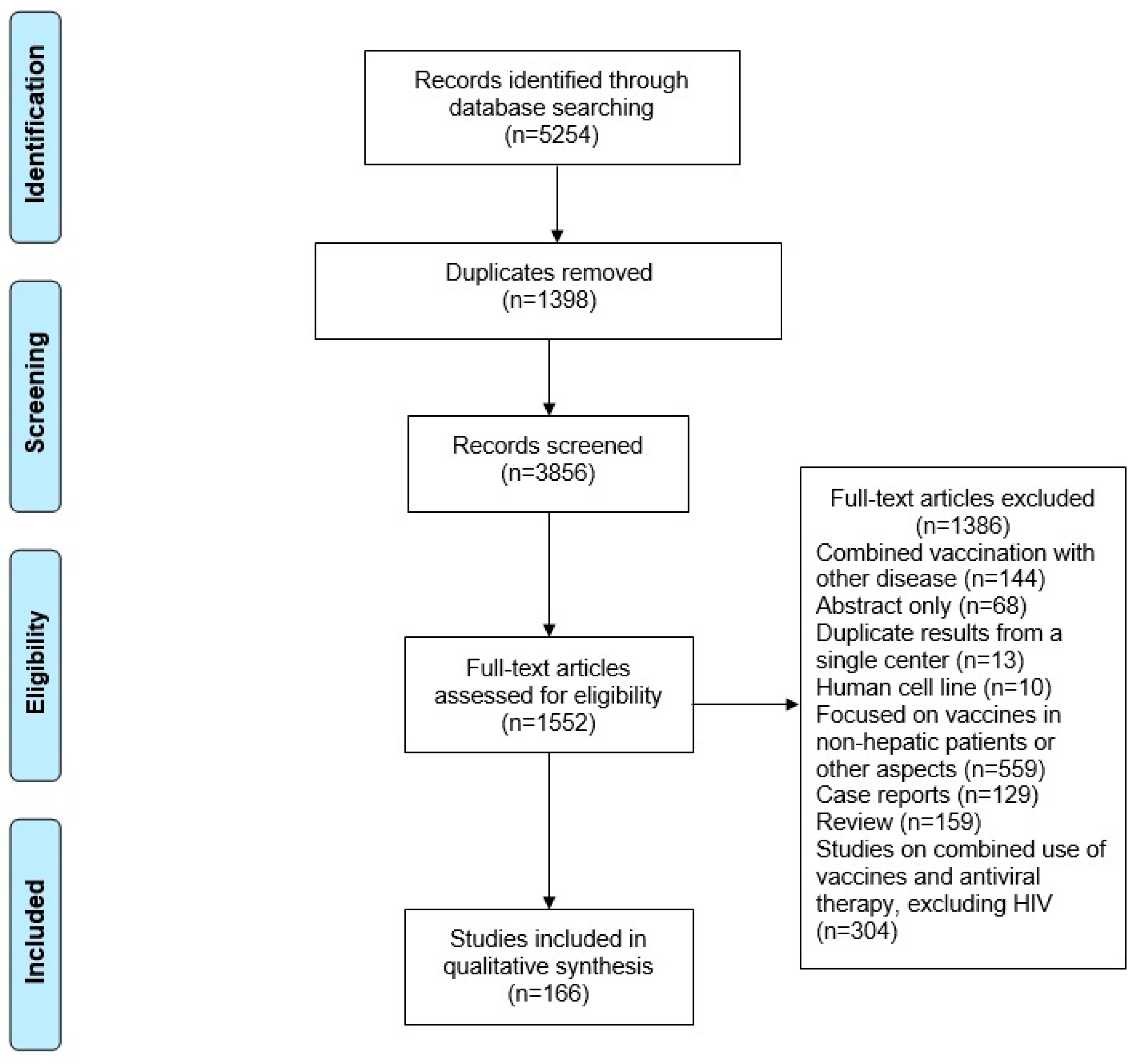
Background/Objectives: Viral hepatitis remains a significant global cause of chronic liver disease, highlighting the importance of effective vaccination strategies. This review assesses recent evidence on vaccine safety and effectiveness. Methods: A comprehensive search of PubMed, Embase, Web of Science, and Scopus identified English-language studies published from January 2000 to September 2025. Eligible studies evaluated vaccination for hepatitis A, B, C, or E, as well as vaccine responses in individuals with chronic liver disease or HIV infection. Of 5254 records screened, 166 studies met the inclusion criteria. Results: Hepatitis A vaccines demonstrated excellent safety, 95–100% short-term seroprotection, and durable immunity for both inactivated and live-attenuated formulations, with population-level reductions in disease incidence. Hepatitis B vaccines showed consistently strong immunogenicity across age groups, with over 90% seroprotection from recombinant and CpG-adjuvanted formulations. Effective prevention of mother-to-child transmission required maternal antiviral therapy, timely birth-dose vaccination, hepatitis B immunoglobulin (HBIG) administration, and post-vaccination serologic testing. Long-term data demonstrated immune persistence for up to 35 years and significant reductions in liver cancer following neonatal HBV vaccination. Limited studies in hepatitis C populations showed impaired responses, partially improved with higher or booster doses. Hepatitis E vaccines showed excellent safety and over 99% seroconversion. In non-viral liver disease and post-transplant populations, vaccine responses were reduced but remained clinically meaningful, especially with adjuvanted or higher-dose HBV vaccines. Among HIV-infected individuals, HAV vaccination was generally effective, while enhanced HBV regimens markedly improved seroprotection. Conclusions: Hepatitis A, B, and E vaccines are safe, immunogenic, and effective, with neonatal hepatitis B vaccination critical for preventing maternal transmission. No licensed HCV vaccine exists, and therapeutic HCV vaccines show limited efficacy. Optimized and targeted vaccination strategies are needed for individuals with chronic liver disease, HIV infection, HCV infection, transplant recipients, and other immunocompromised populations to maximize public health impact.

1. Introduction

Vaccination remains one of the most effective interventions in global health, serving as a cornerstone for the prevention and control of infectious diseases [1]. By stimulating adaptive immunity and providing herd protection, vaccines have significantly decreased the global burden of many viral infections, leading to substantial improvements in life expectancy and quality of life. However, liver-related infectious diseases continue to have a disproportionate impact on health and the economy, especially in low- and middle-income regions with limited access to preventive measures and healthcare infrastructure [2].
Hepatic diseases encompass a wide range of disorders, with viral hepatitis being a primary cause of chronic liver disease, cirrhosis, and hepatocellular carcinoma (HCC) [2,3]. Viral hepatitis remains a significant global health threat and a major contributor to mortality worldwide. The five main hepatotropic viruses, hepatitis A virus (HAV), hepatitis B virus (HBV), hepatitis C virus (HCV), hepatitis D virus (HDV), and hepatitis E virus (HEV), vary in their transmission modes, geographic distribution, viral structure, clinical outcomes, likelihood of inducing liver-related complications, and response to available treatments. The global prevalence of viral hepatitis remains high and is increasing over time. Viral hepatitis can lead to liver inflammation, which may progress to fibrosis, cirrhosis, and HCC over time. Chronic infections with HBV and HCV are associated with an increased risk of cancer, primarily due to the ongoing inflammatory response they cause in the liver [4].
The World Health Organization estimates that approximately 354 million individuals are chronically infected with hepatitis B or C viruses, resulting in more than 1.1 million deaths annually [5]. While the introduction of hepatitis A and B vaccines has led to remarkable declines in infection rates and liver-related complications in many regions, persistent challenges, such as incomplete vaccine coverage, emerging viral genotypes, and the absence of effective vaccines for hepatitis C, and limited availability of hepatitis E vaccines, continue to hinder global elimination goals [6,7]. In addition, vaccine hesitancy, socioeconomic disparities, and limited public health infrastructure further compromise the success of immunization programs targeting hepatic pathogens. Notably, hepatitis B vaccination also provides indirect protection against HDV, highlighting the broader benefits of universal HBV immunization.
Against this background, vaccination strategies aimed at hepatic diseases deserve renewed attention as a crucial component of liver disease prevention and global health policy. Advances in molecular immunology, vector-based platforms, and mRNA technology are opening up new avenues for hepatic vaccine research, promising broader protection and improved efficacy [8,9].
This scoping review aims to offer a comprehensive assessment of vaccination strategies targeting hepatic diseases, with a focus on their immunological mechanisms, effectiveness, and impact on the burden of liver disease. By incorporating current evidence from clinical and epidemiological studies, this review aims to highlight the essential role of vaccination in hepatology and to pinpoint challenges and opportunities for optimizing vaccine-based interventions in reducing hepatic morbidity and mortality.

2. Materials and Methods

This scoping review synthesizes current evidence on vaccination strategies among patients with hepatic diseases, with the primary aim of mapping the extent, characteristics, and nature of the available literature rather than evaluating comparative effectiveness or clinical superiority. No formal hypothesis testing or quantitative synthesis was planned or conducted. The reporting of this review followed the guidelines of the Preferred Reporting Items for Systematic Reviews and Meta-Analyses extension for Scoping Reviews (PRISMA-ScR) [10]. In accordance with scoping review methodology, no formal risk-of-bias assessment, quality appraisal, or certainty grading (e.g., GRADE) was performed. The review protocol was registered in PROSPERO (registration no. CRD420251249151). A completed PRISMA checklist is provided in the Supplementary Materials (Table S1).
A thorough literature search was conducted on PubMed, Embase, Web of Science, Scopus, and ClinicalTrials.gov to identify English-language studies published from January 2000 to September 2025. A medical librarian with expertise in systematic searching (SK) developed the search strategy using a combination of subject headings and keywords. The search included relevant keywords and Medical Subject Headings (MeSH) related to: “Liver Diseases,” “Viral Hepatitis,” “Hepatitis A,” “Hepatitis B,” “Hepatitis C,” “Alcoholic Liver Disease*,” “Alcoholic Fatty Liver,” “Alcoholic Hepatitis,” “Alcoholic Liver Cirrhosis,” “Fibrosis,” “Non-alcoholic Fatty Liver Disease,” “Liver Failure,” “Liver Neoplasms,” “Hepatocellular Carcinoma*” AND “Vaccination Methods,” “Hepatitis A Vaccines,” “Hepatitis B Vaccines,” “Hepatitis C Vaccines,” “Hepatitis E Vaccines,” “Viral Hepatitis Vaccines.” All search strategies are available in the Supplementary Materials (Table S2).
Studies were included if they primarily evaluated the immunogenicity, safety, or effectiveness of hepatitis vaccines in human populations, including individuals with hepatic diseases or related risk conditions. Studies assessing vaccines in people living with HIV (PLWH) were included when the effects of vaccination could be reasonably assessed independently of concurrent antiviral therapy. Exclusion criteria included: 1. Antiviral therapy as the primary intervention without a focus on hepatitis vaccination; 2. Non-English studies; 3. Studies not reporting primary or secondary data (e.g., editorials, opinion pieces, and review articles); 4. Studies focused on vaccines in populations other than patients with hepatic diseases; 5. Non-human studies, case reports, and conference abstracts.
Data were obtained from a single dataset in the original study if multiple centers were reported; however, when multiple datasets were presented, only one complete and non-overlapping dataset was extracted to avoid duplication. We requested the full text from the corresponding author, and studies for which no response was received were excluded from the review.
All references were managed using EndNote (version 20.4.1). Duplicate records were identified and excluded, leaving the remaining articles to be screened based on their title and abstract. Full-text evaluation was then conducted to determine their eligibility. Subsequently, the reference lists of all included studies were reviewed to identify any additional relevant publications. Four investigators (ZB, BG, SK, RW) screened the studies after an initial team meeting to discuss the purpose of the review and define inclusion and exclusion criteria. Two authors (ZB, RW) screened the full texts, and any disagreements in screening were resolved through consensus discussion.

3. Results

In total, 166 studies were identified, all published between 2000 and 2025 (Figure 1). Of these, 33 focused on Hepatitis A vaccination, 64 on Hepatitis B vaccination, five on Hepatitis C vaccination, five on Hepatitis E vaccination, 18 on vaccination for non-viral hepatitis, and 41 on hepatitis vaccination in patients with HIV. The studies included in this review were conducted across multiple global regions. The largest proportion originated from China (50 studies, 28%), followed by Europe (35 studies, 20%) and the United States (19 studies, 11%). The remaining studies were distributed across other parts of Africa, Asia, and South America. Fifty-seven publications (34%) employed a randomized controlled trial (RCT) design, 51 (31%) used a cohort design, and 25 (15%) reported cross-sectional data. Seventeen studies (10%) were observational, and the remaining 15 (10%) used other study designs.

3.1. Vaccines for Viral Hepatitis A

A total of 33 studies [11,12,13,14,15,16,17,18,19,20,21,22,23,24,25,26,27,28,29,30,31,32,33,34,35,36,37,38,39,40,41,42,43] from Asia, Europe, North and South America were identified, including RCTs, cohort studies, cross-sectional analyses, and national observational cohorts. These studies included 27,893 participants across all age groups, from infants to adults, and encompassed diverse populations, including unique high-risk groups such as Alaska Native communities. The vaccine formulations evaluated included both inactivated hepatitis A vaccines (HAVac), such as Healive®, Havrix®, Avaxim™, Havisure™, and HAVpur Junior, as well as live-attenuated HAV vaccines (HAV-L) (Table S3).

3.1.1. Safety of Hepatitis A Vaccines

Across the included studies, HAVac was generally reported to have a favorable safety profiles across different populations, vaccine formulations, and study designs. The most commonly reported local adverse events were injection-site pain, swelling, and erythema, but these reactions were generally mild and temporary [14,15,16]. Systemic symptoms like headache, low-grade fever, and fatigue occurred infrequently and at similar rates across various vaccines, including Healive®, Havrix®, Avaxim™, Havisure™, HAVpur Junior, and HAPIBEV™ [12,15,30,34,40,42]. Importantly, no RCTs or observational studies reported any serious adverse events related to the vaccines. A study that assessed the coadministration of the HAVac with the tetravalent dengue vaccine TAK-003 also found no safety concerns or increased reactogenicity [13]. National surveillance studies from Turkey and Panama have shown significant decreases in hepatitis A hospitalizations without an increase in vaccine-related complications. Therefore, these data demonstrate that HAVac is safe for diverse populations, with a consistent and favorable tolerability profile.

3.1.2. Immunogenicity and Short-Term Response to Hepatitis A Vaccination

Short-term immunogenicity outcomes were reported in multiple studies across all vaccine formulations and age groups, with most studies describing seroconversion and seroprotection rates between 95% and 100% after one or two doses [14,15,16,17,18,19]. Randomized trials comparing Healive®, Havrix®, Avaxim™, and other regional formulations like Havisure™, HAVpur Junior, and HAPIBEV™ were primarily designed as non-inferiority studies. Individual studies reported non-inferiority between products, with some studies describing significantly higher geometric mean concentrations (GMC) or titers in groups receiving Healive® or Avaxim™ [28,30,31,32,33]. Live-attenuated vaccines achieved similarly high seroprotection rates. However, several studies noted that their early antibody titers were sometimes lower than those induced by inactivated vaccines [18,19,24,30,34,38]. Single-dose universal vaccination programs, as reported in studies conducted in Brazil and China, described strong serologic responses in young children, with seropositivity rates surpassing 90% [25,26,30,36]. The included studies reported high short-term immunogenicity outcomes following both inactivated HAVac and live-attenuated HAVac, with heterogeneity in study design, populations, and outcome measures.

3.1.3. Long-Term Protection and Antibody Persistence Following Hepatitis A Vaccination

Long-term follow-up studies have shown persistent immunity after HAV vaccination. Ramaswamy et al., [17], Mosites et al., [23], and Spradling et al., [33] reported that protective anti-HAV antibody levels remained for 10–25 years, with models predicting persistence for ≥30 years in most participants. Theeten et al., [35] demonstrated that adults who received a two-dose inactivated HAVac remained largely seropositive for 20 years, with models predicting ≥95% persistence at 30 years, confirming the durable immunogenicity of the inactivated HAVac. Live-attenuated vaccines also showed exceptional stability, maintaining high seroprotection 15–17 years after a single childhood dose and showing strong anamnestic responses upon booster challenge [18]. Studies have reported the persistence of HAV-specific memory B and T cells many years after vaccination, suggesting the presence of immune memory even in cases where circulating antibody levels declined. In addition, levels of cytokines such as interleukin (IL)-6, IL-10, tumor necrosis factor (TNF), and interferon gamma (IFN-γ) were shown to increase following vaccination [24,36]. Together, these studies describe long-term immunological responses following both inactivated and live-attenuated HAV vaccination, as reported over extended follow-up periods.

3.1.4. Comparative Performance Across Hepatitis A Vaccine Types

Across multiple trials, studies have reported that all HAVac are associated with high immunogenicity outcomes. Some studies have described differences in antibody concentrations or stability between formulations. Inactivated vaccines like Healive® and Avaxim™ were reported in some studies to have higher antibody concentrations than Havrix®, while high seroprotection rates were described for all evaluated vaccines [16,20,30,42]. Newly developed or locally manufactured vaccines, such as Havisure™, HAPIBEV™, and HAVpur Junior, consistently demonstrate non-inferiority to established products, with comparable safety and immunogenicity profiles [14,15,40]. Live-attenuated vaccines, while sometimes resulting in lower early antibody titers, show excellent long-term persistence, often matching or surpassing the duration of immunity seen with inactivated vaccines [30,34]. Population-level analyses from Turkey and Panama further emphasize the real-world impact of HAVac, showing significant decreases in hepatitis A incidence and hospitalization after nationwide implementation [22,37]. Therefore, available evidence suggests that HAVacs are effective, with inactivated vaccines generally associated with early immunogenic responses and live-attenuated vaccines demonstrating sustained immune persistence over long-term follow-up.

3.2. Vaccines for Viral Hepatitis B

Hepatitis B vaccines (HBVacs) have been extensively evaluated in diverse populations, including healthy adults, children, high-risk groups, and pregnant women. A total of 64 studies [44,45,46,47,48,49,50,51,52,53,54,55,56,57,58,59,60,61,62,63,64,65,66,67,68,69,70,71,72,73,74,75,76,77,78,79,80,81,82,83,84,85,86,87,88,89,90,91,92,93,94,95,96,97,98,99,100,101,102,103,104,105,106,107] conducted in Asia, Europe, and North and South America were identified. These studies comprised RCTs, cohort studies, cross-sectional analyses, and national observational cohorts, including more than 250,000 participants spanning all age groups from infants to adults and representing a wide range of demographic and clinical settings. Globally, recombinant HBsAg-based vaccines, administered alone or with HBIG in perinatal settings, remain the standard of care. Various formulations, including single-antigen (1A-HBV), three-antigen (3A-HBV), alum-adjuvanted vaccines, and CpG-adjuvanted vaccines (e.g., Heplisav-B), induce robust seroprotection across diverse populations, as summarized in Tables S4 and S5.

3.2.1. Safety of Hepatitis B Vaccines

HBVacs have demonstrated an excellent safety profile across various populations. Adverse events are typically mild, consisting of transient local or systemic reactions, with serious adverse events being rare [64,88,90]. Safety remains consistent among adults, adolescents, neonates, and immunocompromised groups, including pregnant women [49,59]. Both conventional and novel formulations, such as CpG-adjuvanted vaccines, are well-tolerated and suitable for widespread immunization programs.

3.2.2. Immunogenicity and Short-Term Hepatitis B Vaccine Response

HBV vaccines have been reported to rapidly induce protective anti-HBs antibodies. Seroconversion rates after standard 3-dose schedules (0–1–6 months) typically exceed 95% in infants and children, and 90–100% in healthy adults [44,45,63,64]. CpG-adjuvanted vaccines (Heplisav-B) demonstrate slightly faster and higher antibody responses in adults with low baseline anti-HBs [45]. Booster doses in non-responders reliably induce protective immunity, with seroconversion rates of at least 80% [66,76,107]. The study further demonstrated immune persistence and booster efficacy in children across different pre-booster anti-HBs strata. Children with pre-booster anti-HBs concentrations of 1–<10 mIU/mL exhibited significantly stronger and more stable responses compared with those who had lower baseline titers (p < 0.001). Notably, robust antibody persistence was maintained for up to eight years following the booster dose [67]. Multiple studies reported seroconversion rates exceeding 90% in healthy adults and children [44,45,46,63,65,89,91,94,98,107]. In neonates born to HBsAg-positive mothers, combination prophylaxis with HBVac and HBIG effectively prevents mother-to-child transmission (PMTCT), even with high maternal viral loads [49,52,58,68,78]. Zhang et al. [81] reported an assessment of risk factors associated with hepatitis B breakthrough infection (HBBI) following vaccination, with particular focus on antibody response patterns. The overall HBBI rate was 5.36%, with the highest incidence observed among individuals aged 18–29 years (7.33%). Breakthrough infections varied significantly by township and correlated with differences in anti-HBs responses. Notably, hyporesponsiveness to the HepB vaccine was identified as an independent predictor of HBBI. These findings underscore the importance of monitoring young adults for potential new HBV infections. Zhou et al. highlighted the immunological complexity underlying therapeutic HBV vaccination. In their RCTs of 93 chronic hepatitis B patients, individual cytokine or chemokine levels did not reliably predict hepatitis B e-Antigen (HBeAg) seroconversion after administration of the HBsAg–HBIG therapeutic vaccine (YIC). However, multivariate analysis of 14 cytokines/chemokines, particularly IL-10, IL-33, and macrophage inflammatory protein-1α (MIP-1α), offered improved discriminatory capacity (sensitivity 0.59, specificity 0.80), suggesting potential utility of composite biomarker panels for optimizing candidate selection in therapeutic vaccination [80].
In an RCT by Lian et al., involving 303 treatment-naïve HBeAg-positive chronic hepatitis B patients across nine liver centers in China, the efficacy and safety of a combination therapy including pegylated INF-α-2b, tenofovir disoproxil fumarate (TDF), granulocyte-macrophage colony-stimulating factor (GM-CSF), and HBVac were evaluated against standard treatments. HBsAg seroconversion at week 48 was observed in 3.0% of patients in the experimental group, compared to 1.03% in the TDF plus pegylated INF-α group and 1.19% in the IFN-alone group, with no statistically significant differences (p = 0.629). The decline in HBsAg levels was greater in both the experimental and TDF plus peg-IFN groups compared with IFN alone (p = 0.008 and 0.006, respectively), but there was no significant difference between the experimental and TDF plus peg-IFN groups (p = 0.619). Adverse events were similar across groups, with a lower incidence of neutropenia in the experimental group. Therefore, the combination therapy did not demonstrate superiority over TDF plus peg-IFN [53].

3.2.3. Long-Term Protection and Antibody Persistence Following Hepatitis B Vaccination

Long-term follow-up studies show stable protection, often lasting 20–35 years. While circulating anti-HBs titers decrease, immune memory through B and T cells remains robust [55,75,102]. Breakthrough infections are rare and mostly asymptomatic, with rapid anamnestic responses observed after booster doses. Optimal scheduling and timely post-vaccination serologic testing (PVST) improve early detection of non-responders and ensure ongoing protection [57,62]. Vaccination triggers coordinated humoral and cellular responses, including increased levels of IL-6, IL-10, TNF-α, and IFN-γ, supporting short-term antibody production and immune memory establishment [44,51,75,76,87].
In a long-term RCT by Cao et al., 82,866 participants followed from infancy received HBVac at birth, 1 month, and 6 months. After 37 years of follow-up, vaccinated individuals had a significantly lower incidence of HCC compared to unvaccinated controls (Hazard Ratio (HR) 0.28; 95% Confidence Interval (CI) 0.11–0.70; p = 0.007). Importantly, the observed reduction in liver cancer incidence was attributable to a decrease in HBV-related HCC, consistent with the etiologic role of chronic hepatitis B infection in hepatocarcinogenesis. No protective effect was reported for HCC arising from non-viral causes. The efficacy of neonatal HBVac was 72% for preventing HBV-related HCC, 70% against liver cancer-related deaths, and 64% against deaths from liver disease, demonstrating strong and sustained long-term protection [54]. Neonatal vaccination also markedly reduced the incidence of primary HBV-related liver cancer (84%, 95% CI 23–97%), mortality from severe end-stage liver disease (70%, 95% CI 15–89%), and infant fulminant hepatitis (69%, 95% CI 34–85%). In contrast, catch-up vaccination at 10–14 years showed substantially lower effectiveness (21% vs. 72% for neonatal vaccination). Among children born to HBsAg-positive mothers, an adolescent booster dose (10–14 years) further reduced HBsAg prevalence (HR 0.68; 95% CI 0.47–0.97). Therefore, these findings underscore the critical importance of universal neonatal hepatitis B vaccination and targeted adolescent boosting in high-risk populations for the prevention of HBV-associated HCC [106].
Long-term follow-up studies have shown that despite a decrease in anti-HBs levels over the years, immune memory remains strong. In a study by Bruce et al., it was reported that 35 years after primary vaccination, 47.3% of participants still had protective anti-HBs levels, and a booster shot was able to restore seroprotection in most individuals with low titers [55]. Similarly, adolescents and adults who were vaccinated in infancy or childhood displayed robust anamnestic responses when challenged, indicating the stability of their immune memory [61,102].

3.2.4. Prevention of HBV Mother-to-Child Transmission

Extensive evidence from diverse geographical regions supports the effectiveness of hepatitis B immunoprophylaxis strategies in PMTCT and improving post-vaccination immune responses. In a randomized comparative study from China, Wang et al. evaluated 331 mother–infant pairs and demonstrated that PMTCT rates did not differ significantly between infants receiving 100 IU versus 200 IU of HBIG in combination with HBVacs (p > 0.05). A high maternal HBV DNA level remained the main risk factor for immunoprophylaxis failure. Therefore, a single 100 IU HBIG dose combined with HepB vaccination was sufficient and more cost-efficient [49]. Similar findings were reported in a large Nigerian cohort by Ndububa et al., who screened 10,866 pregnant women, of whom 395 had chronic HBV infection. 376 mother–infant pairs completed follow-up. Among infants receiving HepB alone or HepB plus HBIG, alongside antiviral therapy for high-risk mothers, all infants tested HBsAg-negative at nine months, demonstrating complete prevention of PMTCT. Maternal HBV prevalence was 3.64%, and only 5.2% were HBeAg-positive [52]. In an observational study by Zhou et al., in China, 2120 HBsAg-positive mother–infant pairs were evaluated for PVST to prevent mother-to-child HBV transmission. The PVST participation rate was 67.1%. Among infants, 0.77% were HBsAg-positive, 96.8% were anti-HBs-positive, and 2.4% were both negative. Of the double-negative infants, 93.3% achieved antibody positivity after revaccination. Higher maternal education, older maternal age, and local residence were associated with greater PVST follow-up. These results indicate that PVST and timely revaccination effectively enhance protection against HBV infection in infants [57]. In a feasibility study in the Democratic Republic of the Congo, Thompson et al., enrolled 90 pregnant women through an HIV PMTCT program. Among 88 live-born infants, 68% received a birth-dose HBVacs, with 77% vaccinated within 24 h. Coverage was higher at study facilities compared with outside facilities, and no adverse events were reported. At 24 weeks, all tested infants were HBsAg-negative, demonstrating complete prevention of PMTCT [59]. Similarly, Miyakawa et al. in Vietnam followed 1339 children from 1987 mother–child pairs after universal vaccination introduction. 1.9% of children were HBsAg-positive at two years, with 28.3% infection among children of HBeAg-positive mothers despite full vaccination. Risk factors for infection or low antibody levels included low maternal body mass index (BMI) and incomplete HepB dosing, though the overall infection rate in children remained low [60]. Therefore, these studies suggest that birth-dose vaccination, PVST, and timely revaccination are associated with reduced rates of HBV PMTCT, with maternal and programmatic factors influencing reported outcomes.
The effect of vaccine dose on PMTCT outcomes was investigated in a multicenter cohort study by Zhang et al., which included 955 infants born to HBsAg-positive mothers. Although increasing the HepB dose from 10 µg to 20 µg did not significantly reduce MTCT, the higher dose enhanced immunogenicity, resulting in more infants with high anti-HBs titers (≥1000 IU/L) and fewer low responders, especially among those born to mothers with HBV DNA < 5 log10 IU/mL [58]. Wei et al. compared 100 IU versus 200 IU HBIG in 1177 infants born to HBsAg-positive mothers. PMTCT rates at seven and twelve months remained low and statistically similar between the groups (1.5% vs. 1.9%), while anti-HBs seropositivity exceeded 97% in both cohorts, supporting the adequacy of the 100 IU dose when combined with the standard HepB vaccine series [84]. Lu et al. assessed neonates born to HBsAg-positive/HBeAg-negative mothers and found PMTCT rates of 0.1% among those receiving vaccine + HBIG and 0.0% in infants receiving vaccine alone. Both groups achieved anti-HBs response rates over 97%, and vaccine-only recipients had higher geometric mean titers (GMT) at seven and twelve months. No cases of horizontal HBV transmission were detected, indicating that the vaccine alone is sufficient in mothers who are HBeAg-negative [97].

3.2.5. Comparative Performance Across Hepatitis B Vaccine Types

Comparative studies have highlighted differences in immunogenicity among HBV vaccine formulations. Recipients of 3A-HBV achieve higher and more persistent seroprotection compared to 1A-HBV [46]. CpG-adjuvanted vaccines (Heplisav-B) provide stronger antibody responses than standard alum-adjuvanted vaccines, especially in adults with low pre-existing anti-HBs titers [45]. Increasing the dose in neonates (10 μg vs. 20 μg) improves antibody response and reduces occult HBV infection [58,68]. In an RCT in Bangladesh, Chowdhury et al. evaluated the immunogenicity and safety of a locally produced Hepa-B vaccine compared with Engerix-B in 158 healthy adults following a three-dose schedule (0, 1, and 6 months) [63]. Seroconversion rates were 98.7% for Hepa-B and 100% for Engerix-B, with GMT ratios exceeding the 0.5 non-inferiority margin at all time points. These results demonstrate that Hepa-B is non-inferior to Engerix-B in both immunogenicity and safety [63]. Standard recombinant HBV vaccines remain effective in most populations, with boosters reserved for high-risk groups or non-responders [98,107].

3.2.6. Vaccine Dose and Schedule

Across multiple studies, the dose and schedule of HBVacs were reported to be associated with differences in immunogenicity, seroprotection, and long-term antibody persistence in both infants and adults. In children, seroconversion and antibody titers consistently increased with each vaccine dose. Chai et al. reported that a full 3-dose HepB series achieved 100% seropositivity 11–90 days post-vaccination, with antibody levels remaining above protective thresholds for one year [48]. Qiu et al. demonstrated that a 10 µg vaccine dose yielded the highest post-booster seropositivity and GMT, with stronger pre-booster anti-HBs associated with longer-lasting responses [67]. Higher doses (20 µg) were particularly effective in high-risk infants born to HBsAg-positive mothers, improving antibody levels at seven and 12 months and reducing occult HBV infection compared with 10 µg doses [58,68]. Birth-dose administration was crucial for prevention, with Dhouib et al. showing that vaccination at birth achieved 99.4% efficacy in preventing HBV infection compared with 77% for a first dose at 3 months [71]. Preterm infants and infants with low birth weight also achieved protective antibody levels with 3–4 dose schedules [94]. PVST and revaccination further improved protection in infants who initially failed to mount a sufficient response [57,62]. For infants at high risk due to maternal HBsAg positivity or high viral load, combining the hepatitis B vaccine with HBIG prevented MTCT effectively, with 100 IU doses generally sufficient [49,52,84]. In infants, higher vaccine doses (20 µg) increased high antibody responses and reduced low-response rates, although PMTCT rates were similar between 10 µg and 20 µg doses [58,68].
In adults, some studies reported that higher antigen doses and alternative schedules were associated with higher seroconversion rates and antibody titers. Two studies reported 98.7–100% seroconversion with a 3-dose schedule (0, 1, 6 months), and a GMC rise from 413.6 to 6799.9 mIU/mL between months three and seven [63,64]. Shortened two-dose schedules were also reported to be effective, showing higher seroprotection compared to standard three-dose vaccines in adults, including those with comorbidities [89]. High-dose boosters (30–60 µg) in non-responders produced seroconversion rates of 83–92% and robust geometric mean titers [66,107].

3.3. Vaccines for Viral Hepatitis C

Five studies conducted in Asia, Europe, Africa and South America were identified [108,109,110,111,112]. All of these studies were RCTs and included 616 adult participants (Table S6).
In three studies evaluating HBV or HCV vaccines in chronic HCV patients, vaccine responsiveness was generally lower than in healthy controls. Yan et al. reported that only 56.6% of chronic hepatitis C (CHC) patients maintained protective anti-HBs titers five years after the standard three-dose HBV vaccination, compared to 70.8% in healthy controls. Booster doses restored immunity in both groups [108]. Similarly, Medeiros et al. found that non-cirrhotic HCV patients had lower seroprotection rates than controls, regardless of whether a standard (20 µg) or double (40 µg) HBVac dose was used, and a fourth booster improved seroconversion among initial non-responders [109]. Abd El-Wahab et al. observed that hyporesponsiveness persisted even after successful HCV treatment with direct-acting antivirals (DAAs), particularly in patients with isolated anti-HBc positivity, with only 5.1% achieving protective anti-HBs levels [110]. Beyond prophylactic HBV vaccination, therapeutic HCV vaccines were evaluated in combination with antiviral therapy.
Two studies investigated the immunogenicity and clinical effects of HCV vaccines in patients with CHC. Colombatto et al. showed that the E1E2-MF59 vaccine enhanced humoral and cellular responses and improved viral clearance when combined with Peg-IFNα2a and ribavirin [111]. Likewise, Weiland et al. demonstrated that a DNA-based HCV vaccine induced robust NS3-specific T-cell responses and transient HCV RNA reductions, with some patients achieving sustained virologic response after subsequent standard therapy [112]. Therefore, these findings indicate that CHC infection is associated with impaired vaccine responsiveness, which can be partially overcome with booster doses or combined immunotherapeutic strategies. It should be noted that current treatment standards using DAAs differ significantly from the regimens used in these earlier studies.

3.4. Vaccines for Viral Hepatitis E

Five studies involving 117,199 participants from Poland and China were identified [113,114,115,116,117], consisting of one cross-sectional study and four RCTs (Table S7).
The cross-sectional study by Grzegorzewska et al. reported 76 hemodialysis patients and found that prior exposure to HEV did not reduce responsiveness to the HBV vaccine. INF-λ3 levels were positively correlated with anti-HBs titers among vaccine responders [113]. Chen et al. studied 126 healthy adults and showed that an accelerated HBV vaccination schedule (0, 7, and 21 days) was immunologically non-inferior to the standard schedule, providing a safe and rapid option for urgent immunization [114]. Su et al., presented long-term immunological insights from a RCT of 4273 adults, revealing a steady decline in naturally acquired anti-HEV immunoglobulin G (IgG) levels among placebo recipients, from a GMC of 0.55 World Health Organization units (WU)/mL at baseline to 0.27 WU/mL at 67 months, with 17% becoming seronegative by month 67 [115]. Modeling indicated that 50% of naturally infected individuals would lose detectable antibodies within 14.5 years. In contrast, vaccine recipients experienced a 16–46-fold increase in antibody levels by month seven, with over 99% remaining seropositive at month 67. Antibody decline after month 19 was gradual and similar across groups receiving different doses. Power-law modeling suggested that immunity induced by the vaccine would remain detectable for at least 30 years, with 82.1–99.4% of vaccines predicted to remain seropositive at that time, demonstrating significantly more durable protection than natural infection [115]. Similarly, Cao et al., studied 120 adults and found that a new HEV vaccine was safe and well-tolerated across all tested doses, leading to the selection of the 30-µg formulation for further development. Solicited local reactions within seven days were lower in vaccine groups (6.7–30%) than in controls (40%, p = 0.027), while systemic reactions and lab abnormalities were mild or moderate, with no vaccine-related serious adverse events reported. [116]. The study by Zhang et al. confirmed 86.8% vaccine efficacy over 4.5 years and showed that the HEV vaccine provided lasting immunity with a safety profile similar to the HBV vaccine control. A total of 60 HEV cases were identified: seven in the vaccine group (0.3 cases per 10,000 person-years) and 53 in the control group (2.1 cases per 10,000 person-years), resulting in a vaccine efficacy of 86.8% (95% CI: 71–94). Among initially seronegative participants, 87% retained anti-HEV antibodies for at least 4.5 years. Adverse event frequencies were comparable between groups, indicating a favorable safety profile. Immunogenicity and efficacy data demonstrated that the HEV vaccine induced long-lasting immunity and consistent protection over 4.5 years [117]. Based on these studies, HEV vaccination has been associated with favorable safety profiles, measurable immunogenic responses, and sustained protection across the populations studied.

3.5. Hepatitis Vaccines in Human Non-Viral Liver Diseases

Eighteen studies [118,119,120,121,122,123,124,125,126,127,128,129,130,131,132,133,134,135] conducted across North America, Europe, Asia, and Australia evaluated HAVacs and HBVacs in patients with non-viral hepatology conditions, including chronic liver disease (CLD), cirrhosis, non-alcoholic fatty liver disease (NAFLD), end-stage liver disease (ESLD), and liver transplant (LT) recipients. These studies included RCTs, cohort studies, cross-sectional analyses, and other observational cohorts, with a total of 74,784 participants spanning all age groups, from infants to adults. The evidence shows that vaccine immunogenicity is reduced in advanced liver disease, particularly in cirrhosis and post-transplant settings—yet meaningful protection can still be achieved, especially with optimized dosing strategies or adjuvanted formulations (Table S8).

3.5.1. Hepatitis B Vaccines in Human Non-Viral Liver Diseases

Across multiple studies, HBVacs in non-viral liver disease patients were associated with variable immunogenicity strongly influenced by disease stage, transplant status, and host factors.
In CLD and cirrhosis patients, Horta et al., evaluated vaccine-induced immunity by measuring anti-HBs titers at two months, six months, and 12 months following completion of the vaccination schedule [118]. At two months, the overall serologic response rate was 76.8%, with higher response rates observed in the FENDRIX® group (83.7%) compared with the HBVAXPRO® 40 group (72.4%). Anti-HBs levels declined progressively over time, with overall response rates decreasing to 72.8% at six months and 59.7% at 12 months, indicating a gradual decline in immunity. In a U.S. cohort, Amjad et al. reported significantly higher seroprotection rates with Heplisav-B (63%) compared with Engerix-B (45%) [119]. Heplisav-B was associated with a 2.7-fold higher rate of achieving protective anti-HBs titers in patients with CLD, indicating superior immunogenicity. The study also reported that the two-dose Heplisav-B regimen achieved higher seroprotection than the standard three-dose Engerix-B schedule [119]. In cirrhotic patients, Wigg et al., found limited benefit from high-dose accelerated HBV schedules, though high-dose boosting modestly improved responses among initial non-responders [120]. In an RCT of 56 cirrhotic patients awaiting LT, Bagheri Lankarani et al. reported on the use of adjunctive G-CSF with a double-dose HBV vaccination regimen (40 µg at weeks 0, 4, and 8) to assess immunogenicity [125]. The study found no significant differences in post-vaccination anti-HBs titers between the G-CSF and placebo groups (p > 0.05). Although the G-CSF group demonstrated a more rapid initial increase in antibody levels, overall seroprotection was not improved, indicating that G-CSF did not confer a meaningful immunologic advantage [125].
Among LT recipients, several studies have highlighted significant variability in response. Post-transplant immune recovery was often incomplete, with response rates ranging from 11% to 27% in the study by Arslan et al., and up to 25% in the study by Lu et al. [124,132]. Although response rates were low, some responders were able to safely discontinue HBIG and antiviral therapy without experiencing reinfection [121]. In contrast, observational studies by Takaki et al. and Bienzle et al. demonstrated that selected patients, especially those with stronger donor immunity or those receiving adjuvanted vaccines, achieved robust anti-HBs titers, enabling successful HBIG withdrawal [126,129]. According to Wang et al., maintaining anti-HBs levels > 100 IU/L post-transplant prevented de novo HBV infection (DNHB), and achieving > 1000 IU/L pre-transplant predicted sustained post-transplant protection [122]. Additionally, pediatric studies demonstrated good immunogenicity (85–90%) despite immunosuppression, particularly in recipients of anti-HBc-negative grafts [128,131].
In NAFLD, HBV vaccine responses were generally preserved. Seniuta et al. reported that although NAFLD children had slightly higher rates of subprotective titers after the primary series (32% vs. 19% in controls, p = 0.07), all NAFLD patients mounted an effective response to a booster dose [123]. After boosting, NAFLD children achieved a GMC of 239 IU/L (median 313 IU/L; range 19–1000), compared with a GMC of 148 IU/L (median 686 IU/L; range 1–1000) in controls, of whom 10 out of 13 responded. These findings suggest that NAFLD does not impair booster responsiveness.

3.5.2. Hepatitis A Vaccines in Human Non-Viral Liver Diseases

Studies have reported that HAVac is associated with higher immunogenicity compared to HBVac in liver disease populations, although immunogenicity appeared reduced in advanced disease stages. In a study by Wigg et al., involving cirrhotic adults, it was found that high-dose accelerated HAV vaccination resulted in stronger early immune responses than standard dosing [120]. This led to a clinically significant improvement (15%) in immunogenicity, faster protection onset, and minimal additional cost.
In both pediatric and adult CLD populations, HAV vaccination has shown overall effectiveness, although the response varies depending on disease severity. Ferreira et al. observed robust immunogenicity in children with CLD, with 76% seroconversion after the first dose and 97% after the second dose, despite lower GMTs compared to controls, and with a favorable safety profile [127]. Similarly, Smallwood et al., found that many adult ESLD patients developed measurable antibody responses, although at lower rates than the 97% seroconversion observed in healthy individuals, supporting the recommendation to vaccinate those with CLD before transplantation [130]. Arguedas et al., also demonstrated the impact of disease stage, with compensated patients showing significantly higher seroconversion rates (71.4% after the first dose; 98% after the second) than those with decompensated cirrhosis (37.1% and 65.7%, respectively). Child-Pugh class was found to predict immunologic response, emphasizing the importance of vaccinating prior to decompensation [134].
Studies have reported reduced immunogenicity in the LT setting. Arslan et al., reported very low seroconversion rates (8–26%) among HAV-seronegative post-transplant recipients, compared to 97% in healthy controls. Only three out of 37 patients (8%) seroconverted at one month, increasing to five out of 26 (19%) at six months and six out of 23 (26%) at seven months. Responders had higher total white blood cell and lymphocyte counts and were further from transplant compared to non-responders. None of the unvaccinated patients seroconverted during follow-up. Seroconversion rates in orthotopic liver transplant (OLT) recipients were lower than those in healthy individuals (p = 0.001) or pre-OLT patients with CLD (p = 0.001). The HAVac was reported to be well tolerated by all patients [133].

3.6. Hepatitis Vaccines in Humans with HIV

Forty-one studies, which included 117,143 participants from North America, Europe, Asia, and Africa, were identified [136,137,138,139,140,141,142,143,144,145,146,147,148,149,150,151,152,153,154,155,156,157,158,159,160,161,162,163,164,165,166,167,168,169,170,171,172,173,174,175,176]. The most common study design was cohort studies (14 studies; equal 34%), followed by RCTs (14 studies; equal 34%), and cross-sectional studies (6 studies; 14.6%). The populations studied included PLWH, HIV-exposed but uninfected children, and healthy controls. Vaccines evaluated included HAV and HBV formulations, in various forms such as standard, high-dose, intradermal, double-dose, adjuvanted, and combination schedules. Considerable heterogeneity was observed in sample size, immunologic status, use of antiretroviral therapy (ART) or highly active antiretroviral therapy (HAART), and vaccine dosing regimens. These differences were taken into account when interpreting immunogenicity outcomes (Table S9).

3.6.1. Immunogenicity and Durability of Hepatitis A Vaccination in PLWH

Primary Vaccine Response
Multiple cohort studies have reported high seroconversion rates after two- or three-dose HAV schedules among PLWH on stable ART, although some studies have noted slightly lower responses compared to HIV-negative controls [138,139]. Recent data has shown nearly complete seroconversion at eight months in adults living with HIV (97%), similar to healthy controls (100%) [136]. Previous RCTs reported higher GMT with three-dose schedules, but the differences in seroconversion were described as small. Non-smoking status and viral suppression were consistently linked to better responses [168]. According to Loutan et al., seroconversion (≥20 mIU/mL) in HIV-positive individuals reached 63.6% at month 1 and 91.7% at month 13. Booster doses significantly increased the GMC from 25.5 to 659.2 mIU/mL. The vaccine showed a favorable safety and tolerability profiles and elicited strong immunogenicity. Although initial antibody responses in the HIV-positive group were lower than in healthy adults (93.8–100%), booster vaccination effectively enhanced immunity [170].
Long-Term Protection and Antibody Persistence
Studies reported that the stability of vaccine-induced immunity generally remains high, although some studies have noted that it could be influenced by immunologic factors. A large Taiwanese cohort maintained long-term serprotection in 90–97% of individuals at 60 months, with higher peak titers and slower decay predicting persistence [139]. In contrast, a Spanish cohort highlighted a clinically relevant decrease: approximately 20% of vaccinated PLWH failed to maintain protective titers, and a small proportion experienced delayed HAV infection, particularly among men who have sex with men (MSM) during community outbreaks [138]. These findings underscore the need for periodic monitoring in individuals with historical nonresponse, higher BMI, low nadir CD4 counts, or detectable HIV RNA at vaccination.
Revaccination and Response to Boosting
Revaccination consistently resulted in rapid and high serologic recovery. In a matched case–control study, patients who were revaccinated achieved up to 98% seroresponse by week 48, surpassing non-revaccinated controls. Booster doses also improved responses in earlier trials, confirming that most individuals with declining antibodies retain immunologic memory [137,142,151].

3.6.2. Immunogenicity and Effectiveness of Hepatitis B Vaccination in PLWH

Responses to Standard-Dose Vaccination
Across studies, seroprotection after the standard 3-dose HBV vaccination was reported to be lower in PLWH compared to HIV-uninfected individuals. Response rates typically ranged from 30% to 60% [137,142,143,144,145,146,147,148,150,158,159]. Predictors of nonresponse included lower CD4 counts, detectable HIV RNA, male sex, immune activation, and viremia [141,152,154,155,156]. Children and adolescents living with HIV also showed reduced responses, but ART-mediated viral suppression consistently improved seroconversion rates [137,140,141,144,146,154,157,159,176]. This improvement was not observed in participants receiving HAART [163,164,167,171].
High-Dose and Intensified Regimens
Studies have reported that high-dose or intensified multi-dose HBV vaccination schedules are associated with higher antibody responses in PLWH. Several trials have shown higher seroconversion rates and a greater proportion of individuals achieving anti-HBs titers greater than 100 mIU/mL with double doses (40 µg) or four-dose regimens [142,143,144,145]. High-dose schedules have been shown to increase seroprotection by 20–30% and produce more durable responses [142,143]. Four-dose or double-dose strategies have been particularly effective in individuals with isolated anti-HBc, low baseline CD4 counts, or prior vaccine nonresponse. However, some studies have shown that double-dose revaccination does not provide a significant advantage over the standard dose and does not significantly improve the response rate [153,159].
Novel Adjuvanted and Intradermal Vaccines
Recent multicountry randomized trials demonstrated the superiority of CpG-adjuvanted HBV vaccines [137]. In adults with prior HBV vaccine failure, seroprotection exceeded 93% with two-dose and 99% with three-dose CpG regimens, significantly outperforming alum-based comparators. Antibody titers frequently surpassed 1000 mIU/mL, with rapid seroprotection by week 12. Intradermal vaccination also demonstrated promising efficacy in small cohorts, achieving universal seroconversion among PLWH with prior nonresponse [140,173].
Revaccination in Prior Non-Responders
Studies have reported that revaccination success rates were high when intensified schedules were used [160,169]. Across studies, 70–90% of initial non-responders ultimately achieved seroprotection following additional double-dose or multi-dose regimens [137,158,160,169,174]. Predictors of successful revaccination included higher CD4 counts, suppressed HIV RNA, and shorter intervals between the primary series and revaccination.

3.6.3. Determinants of Vaccine Response Across Studies

Across HAVac and HBVac, multiple studies identified predictors of immunogenicity. Higher CD4 counts and viral suppression at the time of vaccination strongly correlate with improved immunogenicity [137,140,141,144,146,154,157,159,163,164,167,171,176]. Younger age, non-smoking status, and the absence of metabolic comorbidities were associated with more robust responses [149,154,168]. Prior vaccine nonresponse does not preclude later success, especially when adjuvanted or high-dose HBV schedules were used [137,142]. HIV-related immune activation, including elevated CD8+/CD38+/HLA-DR+ T cells or impaired memory B-cell function, has been linked to weaker HBV responses [155,156,166]. These findings support an individualized approach to vaccination, particularly in patients with immunologic vulnerability.

3.6.4. Safety and Tolerability

Across all the studies included, vaccines for HAV and HBV (standard, high-dose, intradermal, or adjuvanted) were well tolerated. Adverse events were generally mild and localized. No study identified consistent serious adverse events related to the vaccine, and no clinically meaningful impact on HIV viral load or CD4 count was observed [139,140,141,157,158].

4. Discussion

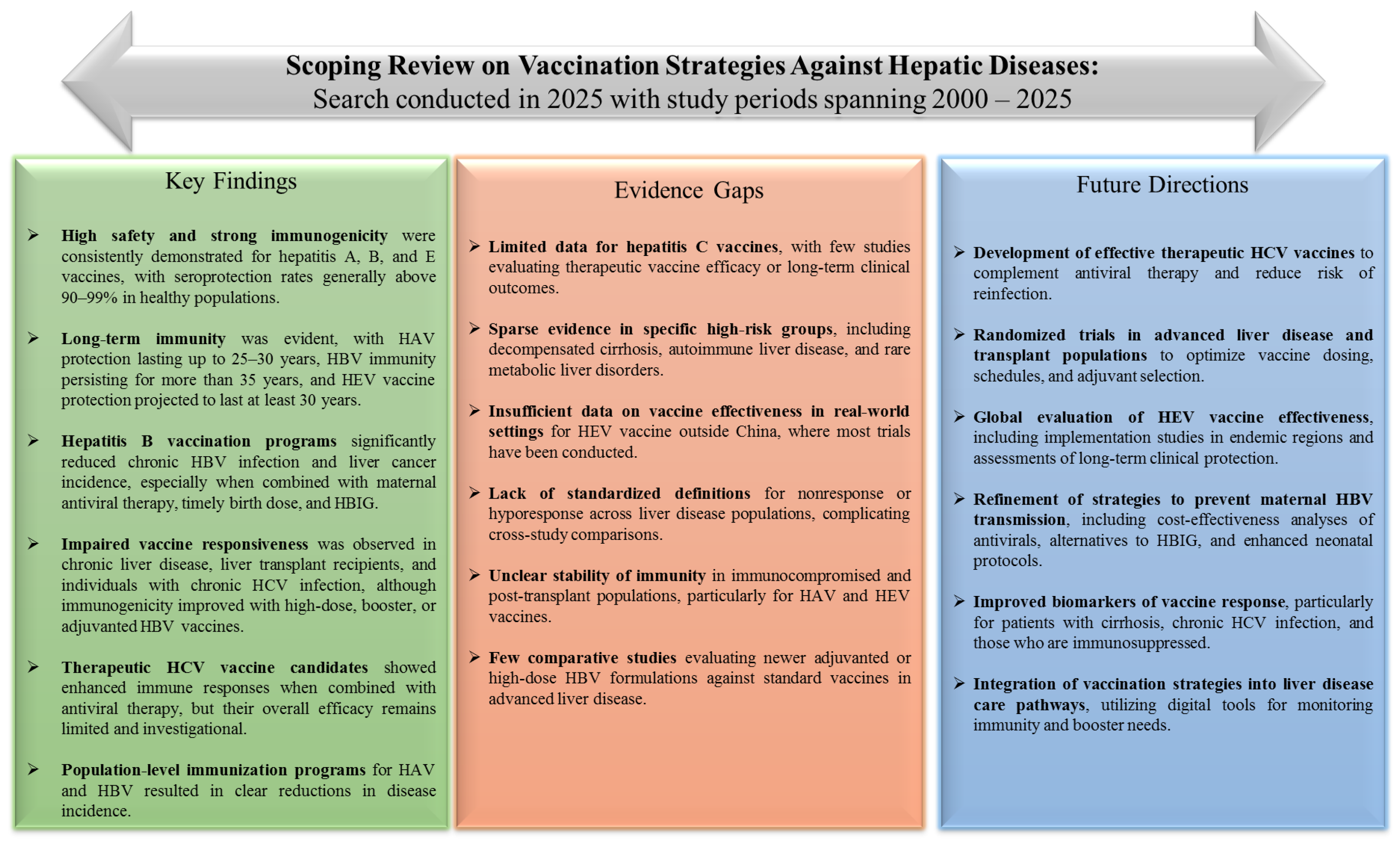
This scoping review offers a comprehensive overview of global evidence on hepatitis A–E vaccines across various populations, clinical settings, and geographic regions. Among 166 studies published between 2000 and 2025, vaccines consistently showed strong safety and immunogenicity. However, vaccine response varied depending on underlying liver disease, immunosuppression, HIV infection, and chronic viral co-infections, highlighting public health benefits and identifying gaps that could influence future vaccine policies (Figure 2).

4.1. Global Availability and Study Heterogeneity

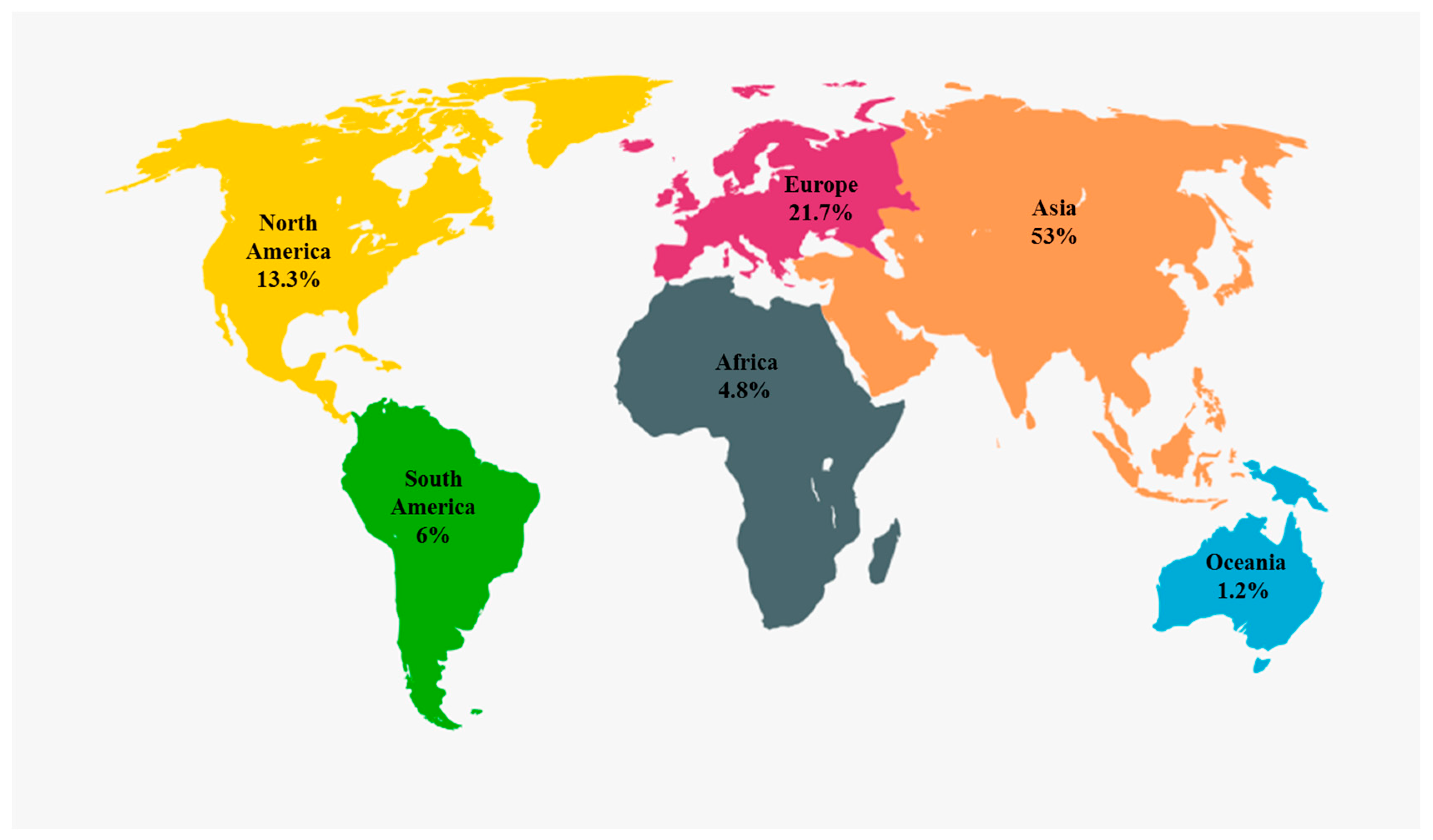
The studies included in this review were geographically diverse, with the largest contributions from China, Europe, and the United States (Figure 3). However, data from Africa and other HBV-endemic regions remain underrepresented, despite bearing a substantial global burden of chronic hepatitis B infection. The heterogeneity of study designs, including RCTs, cohort analyses, and large population-based surveillance studies, provides a multidimensional understanding of vaccine performance in real-world and experimental settings. This geographic imbalance is particularly relevant given the marked regional variation in HBV genotype distribution, with genotypes B and C predominating in East Asia, genotype D in Europe and the Mediterranean region, and genotypes A and E being most prevalent in Africa. Importantly, the wide range of populations examined, from neonates to elderly adults, and from healthy individuals to transplant recipients, enables a robust comparison of vaccine responsiveness across various levels of baseline immune competency. Future studies from underrepresented regions, particularly Africa, are needed to assess vaccine effectiveness across diverse HBV genotypes and enhance the global generalizability of current findings.

4.2. Hepatitis A Vaccines

Hepatitis A affects an estimated 1.4 million people each year. The prevalence of the disease differs widely across regions and is closely linked to socioeconomic conditions and access to safe water [4]. In low-income countries with inadequate sanitation, nearly all individuals show seropositivity for HAV IgG, as most children are exposed to the virus at a very young age, often experiencing few or no symptoms. However, wealthier countries such as the United States have much lower rates of HAV IgG seropositivity. Travel to endemic regions and close contact with infected individuals remain the primary risk factors for contracting HAV. Since the HAVac was introduced in 1996, the incidence of new infections in the U.S. has dropped by more than 90%, even though overall vaccination coverage remains modest [177].
In our study, involving over 27,000 participants, both inactivated and live-attenuated HAVacs demonstrated excellent safety and consistent long-term immunogenicity. Seroprotection rates typically exceeded 95%. Adverse events were uniformly mild, consistent with the established safety profile of HAVacs. These findings reinforce the suitability of HAV vaccination across age groups and support its use in high-risk populations.
The non-inferiority of locally manufactured vaccines (e.g., Havisure™, HAVpur Junior, HAPIBEV™) relative to well-established global products indicates strong reliability of region-specific HAVac programs and suggests that local production may be a viable strategy to reduce cost barriers in low-resource settings [15,40].
Long-term follow-up studies, some lasting more than two decades, offer compelling evidence of persistent protective immunity from both inactivated and live-attenuated HAVac [34,35]. While antibody titers decrease over time, strong immune responses remain robust, indicating that immune memory persists even in individuals with lower sub-protective antibody levels. Decreases in HAV hospitalizations at population level in countries with universal vaccination programs, such as Turkey and Panama, further illustrate the real-world effectiveness of these vaccines [22,37].
Although some formulations, such as Healive® or Avaxim™, generated higher antibody levels, these variations did not lead to clinically significant differences in protection. This aligns with the World Health Organization (WHO) stance that all licensed HAVacs offer similar benefits [178].

4.3. Hepatitis B Vaccines

By 2006, approximately two billion people had been infected with HBV, with around 360 million living with chronic HBV infection worldwide [4]. Most chronic cases are in regions where the virus is endemic. Effective prevention is possible through HBV vaccination, which has been available since the 1980s. Through its nationwide newborn vaccination program, Thailand has markedly reduced HBV incidence and associated liver complications, serving as a prominent example of successful HBV control [179].
A main finding of our study is that included studies reported persistent immunogenicity of hepatitis B vaccines across more than 250,000 participants worldwide. Across age groups, standard 3-dose schedules yield over 90% seroconversion, with CpG-adjuvanted vaccines (Heplisav-B) conferring superior early antibody responses. Immune memory persists for at least 20–35 years, even when circulating antibodies decline, as evidenced by rapid anamnestic responses to boosters.
Despite the availability of effective vaccines, over 1.5 million new HBV infections occur each year, leading to more than 820,000 deaths annually from liver cirrhosis and HCC. Vaccination against hepatitis B remains a cornerstone of public health strategies for HCC prevention and is critical to the global effort to eliminate HBV. The WHO aims for 90% vaccine coverage to achieve elimination by 2030, yet current global birth-dose coverage remains low, at just 42% [180]. The 37-year follow-up study in China provides some of the strongest evidence that HBVac reduces the risk of liver cancer. This confirms the long-hypothesized link between neonatal vaccination, decreased chronic HBV infection, and long-term cancer prevention [54]. These findings have significant implications for global health, especially in regions where HBV is prevalent.
The available evidence suggests that birth-dose vaccination, combined with HBIG when indicated, serves as the cornerstone of PMTCT. Multiple studies have demonstrated near-complete prevention of infant HBV infection, even in areas with high maternal viral load, when timely vaccination and appropriate prophylaxis were administered [50,57,58,77]. Notably, findings from Africa suggest that integrating HBV birth-dose immunization within existing HIV PMTCT infrastructures may be an effective implementation strategy [52]. These findings highlight that maternal viral load, rather than HBIG dose, is the primary predictor of transmission risk, and that optimized vaccine schedules and immunological monitoring may further improve outcomes. Despite the high overall efficacy of PMTCT interventions, residual risk remains for infants of highly viremic, HBeAg-positive mothers, underscoring the importance of maternal antiviral therapy, PVST, and revaccination for infants with suboptimal early responses.
Studies have reported differences in immunogenicity across HBVac formulations. Studies report that 3A-HBV and CpG-adjuvanted vaccines elicit higher antibody titers than single-antigen alum-adjuvanted products [46,181]. Higher antigen doses in neonates improved antibody responses, although PMTCT rates did not differ significantly. Shortened vaccine schedules and high-dose boosters were effective in adults and non-responders, supporting flexible immunization strategies tailored to risk profiles.
Although there is currently no vaccine specifically targeting HDV, HBVac provides indirect immunoprotection against HDV infection, as HDV requires HBV for its replication and assembly. By preventing HBV infection, neonatal and catch-up HBV vaccination effectively reduces the risk of HDV co-infection, especially in high-risk populations [182]. Several studies have shown that populations with high HBV vaccination coverage exhibit substantially lower prevalence of HDV infection, underscoring the public health importance of HBV immunization not only for hepatitis B control but also as a preventive measure against HDV [183,184]. These findings highlight the broader benefits of universal HBV vaccination programs in mitigating both HBV- and HDV-related liver disease.
Our findings directly align with the WHO viral hepatitis elimination goals for 2030, which prioritize a 90% reduction in new infections and a 65% reduction in hepatitis-related mortality [180]. The strong and stable immunogenicity of HBVac, particularly when administered as a timely birth dose, underscores vaccination as the cornerstone of elimination efforts. However, persistently low global birth-dose coverage and reduced vaccine responsiveness in high-risk populations, including PLWH, transplant recipients, and patients with advanced liver disease, represent key barriers to achieving these targets [5]. Addressing these gaps through expanded vaccine access, optimized dosing strategies, and integration of hepatitis vaccination into maternal–child health and HIV programs will be critical to accelerating progress toward elimination.
To maximize impact in low- and middle-income countries, vaccination strategies should prioritize scalable, cost-effective approaches. Key measures include strengthening timely hepatitis B birth-dose delivery through integration with existing maternal–child health and HIV prevention services, expanding the use of affordable locally manufactured vaccines, and adopting simplified or accelerated dosing schedules to improve completion rates. Community-based outreach, task-shifting to trained non-physician health workers, and targeted vaccination of high-risk groups may further enhance coverage in hard-to-reach populations. In parallel, enhancing cold-chain infrastructure, surveillance, and post-vaccination monitoring is essential to ensure durable protection and support global hepatitis elimination.

4.4. Hepatitis C and E Vaccines

The HCV affects an estimated 3% of the global population, totaling nearly 200 million cases worldwide, with significant geographic variation in prevalence. Acute HCV infection is typically asymptomatic, and fulminant cases are extremely rare and only sporadically reported. The lack of early symptoms has hindered the identification of patients for large-scale studies, making it challenging to fully understand the early phase of infection. HCV usually progresses silently to chronic infection and often remains asymptomatic for years, with clinical manifestations typically appearing only after advanced fibrosis or cirrhosis develops, which may overlap with other liver diseases [185]. Evidence regarding vaccination strategies for HCV remains scarce. While there is no licensed HCV vaccine available, the reviewed studies offer valuable insights into vaccine responsiveness among HCV-infected individuals. CHC has been associated with impaired HBV vaccine responsiveness, even after viral clearance with direct-acting antivirals, suggesting persistent immune dysregulation in HCV-cured individuals. This supports the need for modified dosing schedules or adjuvanted vaccines in this group. Therapeutic HCV vaccine candidates, when combined with antiviral therapy, have generated virus-specific cellular responses and modest improvements in viral clearance [111,112]. However, efficacy remains limited, as these vaccines are still in early investigational stages.
HEV is estimated to cause over 20 million acute infections annually, resulting in approximately 3.4 million symptomatic cases and 70,000 deaths each year. Although reported cases in developed countries are relatively rare, this is likely due to underdiagnosis and the generally self-limiting nature of the infection [186]. HEV is the leading cause of enterically transmitted hepatitis worldwide, responsible for over half of all acute hepatitis cases in endemic regions such as India and China. Currently, there is no specific antiviral treatment for hepatitis E, making the development of an effective vaccine the most practical strategy for preventing and controlling HEV infections. The HEV 239 vaccine has demonstrated high efficacy, strong immunogenicity, and excellent long-term antibody persistence, surpassing natural infection in terms of immune durability [115]. Modeling studies suggest immunity may last for over 30 years, with over 80–99% of recipients remaining seropositive. These findings underscore the potential benefits of integrating HEV vaccination into public health programs, particularly for high-risk populations in Asia and Africa.

4.5. Vaccination in Non-Viral Liver Disease

HBV infection is known to cause liver disease progression through multiple pathways, ultimately increasing the risk of malignant transformation. Chronic HBV infection can lead to significant liver fibrosis and may advance to cirrhosis, a major predisposing factor for HCC. Moreover, HBV has direct oncogenic effects that can promote the development of HCC even in individuals without cirrhosis. For patients with cirrhosis, preventing new HBV infections is essential, as such infections can worsen liver function or trigger serious complications [3,122]. Therefore, the literature suggests that HBV and HAV vaccination is particularly relevant for individuals with chronic liver disease, given reports of more severe clinical outcomes following these viral infections in this population [119].
In LT patients, appropriate vaccination remains essential. Several studies highlight that recipients of living-donor liver transplants, in particular, should receive HBV vaccination. Among OLT recipients, favorable vaccine responses have been observed, involving both humoral and cellular immune activation [126]. Patients undergoing OLT for acute HBV infection are considered strong candidates for immunization. In addition, chronic HBV carriers who receive grafts from unrelated donors with high anti-HBs antibody levels may also respond well to HBV vaccination. Evidence suggests that vaccine-induced immunity in these patients can generate robust HBV-specific antibody production as well as measurable cellular immune responses in vitro [124].
Our results highlight variability in vaccine responsiveness across non-viral liver diseases. Immunogenicity declines progressively with worsening liver function, with cirrhosis and post-transplant states demonstrating the lowest seroconversion rates. Adjuvanted vaccines such as Heplisav-B and FENDRIX® consistently outperformed standard formulations, and high-dose or accelerated schedules improved outcomes modestly [118,119]. These findings underscore a key principle: hepatitis vaccination should be administered early in the course of liver disease, ideally before decompensation or transplantation. Children with NAFLD demonstrated preserved booster responsiveness, indicating that metabolic liver disease alone does not preclude effective immunization [123].
HBV vaccination remains immunogenic in non-viral liver disease, though responses decrease substantially with cirrhosis and following liver transplantation. Higher-dose regimens, adjuvanted vaccines, and pre-transplant immunization improve outcomes.

4.6. Vaccination in People with HIV

Viral hepatitis is common among PLWH and contributes to long-term liver morbidity [136]. Therefore, active immunization against HBV and HAV is strongly recommended in this population. However, evidence regarding the optimal vaccination strategy for individuals who fail to respond to the standard initial vaccination remains limited. While HBV vaccination is advised for all HIV-positive individuals, the conventional dosing schedule often results in suboptimal immune responses [137]. Alternative approaches, such as higher-dose formulations or extended dosing schedules, have been explored, but outcomes have varied across studies.
Evidence from our study, which included 41 studies, indicates that HIV infection impairs both HAVac and HBVac responsiveness, especially in individuals with low CD4 counts, detectable viral loads, or coinfections [139,140,141,142]. Higher vaccine doses, adjuvanted formulations, and multi-dose booster strategies improve immunogenicity. Importantly, improved responses were seen alongside virologic control, emphasizing the importance of coordinated vaccination and HIV treatment strategies. Recently Schnyder et al., reported that both 2-dose and 3-dose regimens of the HepBCpG vaccine achieved superior seroprotection compared to three doses of HepB-alum vaccine among PLWH who had not responded to prior hepatitis B vaccination [137].
The evidence indicates the following: 1. HAV appears to be effective and generally durable in PLWH, although immunity may wane in a subset, necessitating monitoring in high-risk groups. 2. Standard HBV vaccination may be insufficient for many PLWH, while high-dose, 4-dose, intradermal, and CpG-adjuvanted regimens significantly improve seroprotection. 3. Revaccination strategies are reported to enhance immune responses, particularly when tailored to immunologic status. 4. Effective immunologic control of HIV is consistently reported as a key factor influencing vaccine responsiveness.

4.7. Strengths, Limitations, and Future Directions

A major strength of this review is the comprehensive synthesis of data across populations and contexts, supplemented by long-term follow-up evidence rarely available for other vaccine-preventable diseases. However, heterogeneity in assays, dosing strategies, follow-up durations, and population characteristics limits direct comparability and statistical data analysis. An important limitation is the disproportionate emphasis on HAV and HBV relative to HCV and HEV. This imbalance reflects the current state of vaccine development and implementation, as effective vaccines are widely available for HAV and HBV, whereas no licensed HCV vaccine exists and HEV vaccines are approved only in limited geographic regions, resulting in fewer long-term and population-based studies. Data gaps remain for hepatitis D vaccination, HEV vaccine use in pregnancy, and long-term immune outcomes in immunocompromised hosts such as transplant recipients and PLWH. Future research should prioritize: standardized serologic thresholds and assay harmonization; evaluation of adjuvanted vaccines in high-risk groups; long-term HEV vaccine performance outside East Asia; and integration of hepatitis vaccination into broader maternal–child health and chronic disease programs.

5. Conclusions

Across hepatitis A, B, and E, this scoping review suggests that the vaccines currently available are generally safe and immunogenic and are associated with substantial population-level protection. In contrast, while multiple candidate vaccines for HCV have been investigated, no licensed prophylactic HCV vaccine is currently available, and the therapeutic vaccine approaches identified in this review have shown limited and variable efficacy to date.
The strongest and most consistent evidence supports universal neonatal hepatitis B vaccination, particularly for the PMTCT, which remains a cornerstone of global HBV control and HCC prevention. While these findings reinforce well-established principles, this review integrates long-term efficacy data across diverse populations and clinical contexts, highlighting persistent gaps in vaccine responsiveness among individuals with cirrhosis, transplant recipients, chronic HCV infection, and PLWH. These observations underscore the need for early-life immunization, optimized dosing strategies, and tailored vaccination approaches in immunocompromised populations. Therefore, this synthesis emphasizes that maximizing the public health impact of hepatitis vaccination will depend not only on vaccine efficacy but also on equitable implementation, targeted policy interventions, and continued innovation to address underserved populations and unmet clinical needs.

Supplementary Materials

The following supporting information can be downloaded at https://www.mdpi.com/article/10.3390/vaccines14010049/s1, Table S1: Prisma checklist; Table S2: Search strategy in databases; Table S3: Summary of articles reporting characteristics of hepatitis A vaccines in humans, published between 2000 and 2025; Table S4: Summary of hepatitis B vaccines in studies reporting seroconversion rates (2000–2025); Table S5: Summary of studies evaluating hepatitis B virus vaccination, serologic response, and immune outcomes, published between 2000 and 2025; Table S6: Summary of hepatitis B vaccination studies and therapeutic hepatitis C vaccine candidates in individuals with chronic HCV infection, published between 2000 and 2025; Table S7: Summary of hepatitis B vaccination studies and hepatitis E vaccine studies in individuals exposed to or infected with HEV, published between 2000 and 2025; Table S8: Summary of articles reporting characteristics of hepatitis vaccines in human’s non-viral hepatology disease, published between 2000 and 2025; Table S9: Summary of articles reporting characteristics of hepatitis vaccines in humans with HIV, published between 2000 and 2025.

Author Contributions

Conceptualization, Z.B. and R.W.; methodology, Z.B.; software, Z.B.; validation, Z.B., B.G. and R.W.; formal analysis, Z.B.; investigation, Z.B.; resources, Z.B.; data curation, Z.B. and S.K.; writing—original draft preparation, Z.B.; writing—review and editing, B.G. and R.W.; visualization, Z.B. and R.W.; supervision, R.W.; project administration, R.W.; funding acquisition, R.W. All authors have read and agreed to the published version of the manuscript.

Funding

This research received no external funding.

Institutional Review Board Statement

Not applicable.

Informed Consent Statement

Not applicable.

Data Availability Statement

All data will be made available upon request from the corresponding author.

Conflicts of Interest

The authors declare no conflicts of interest.

Abbreviations

The following abbreviations are used in this manuscript:
AEsAdverse events
ALFAcute liver failure
ARTAntiretroviral therapy
BMIBody mass index
CHCChronic hepatitis C
CIConfidence interval
CLDChronic liver disease
DAAsDirect-acting antivirals
DNHBde novo HBV infection
ESLDEnd-stage liver disease
HAARTHighly active antiretroviral therapy
HAVHepatitis A virus
HAVacHepatitis A vaccines
HAV-LLive-attenuated HAV vaccines
HBBIHepatitis B breakthrough infection
HBVHepatitis B virus
HBsAgHepatitis B surface antigen
HBsAb/anti-HBsHepatitis B surface antibody
HbeAgHepatitis B e antigen
HBIGHepatitis B immunoglobulin
HBVacHepatitis B vaccine
HCCHepatocellular carcinoma
HCVHepatitis C virus
HEVHepatitis E virus
HIVHuman immunodeficiency virus
HRHazard ratio
IFN-γInterferon gamma
IgGImmunoglobulin G
ILInterleukin
GM-CSFGranulocyte–macrophage colony-stimulating factor
GMCGeometric mean concentration
GMTGeometric mean titer
LDLTLiving donor liver transplant
LTLiver transplant
MIP-1αMacrophage inflammatory protein-1α
NAFLDNon-alcoholic fatty liver disease
OLTOrthotopic liver transplant
PLWHPeople living with HIV
PMTCTPrevention of mother-to-child transmission
PVSTPost-vaccination serologic testing
RCT(s)Randomized controlled trial(s)
TDFTenofovir disoproxil fumarate
TNFTumor necrosis factor
WHOWorld Health Organization

References

  1. Marjani, A.; Alavian, S.M.; Nassiri Toosi, M.; Alavian, S.H.; Abazari, M.F.; Khamseh, A.; Jazayeri, S.M. Hepatitis B virus infection after immunization: How serious it is? An updated review. Clin. Exp. Med. 2025, 25, 113. [Google Scholar] [CrossRef]
  2. Zamor, P.J.; deLemos, A.S.; Russo, M.W. Viral hepatitis and hepatocellular carcinoma: Etiology and management. J. Gastrointest. Oncol. 2017, 8, 229–242. [Google Scholar] [CrossRef] [PubMed]
  3. Farbod, Y.; Kankouni, H.; Moini, M.; Fung, S. Hepatitis B-Induced Hepatocellular Carcinoma: Understanding Viral Carcinogenesis and Disease Management. J. Clin. Med. 2025, 14, 2505. [Google Scholar] [CrossRef]
  4. Odenwald, M.A.; Paul, S. Viral hepatitis: Past, present, and future. World J. Gastroenterol. 2022, 28, 1405–1429. [Google Scholar] [CrossRef]
  5. World Health Organization. Global Progress Report on HIV, Viral Hepatitis and Sexually Transmitted Infections, 2021: Accountability for the Global Health Sector Strategies 2016–2021: Actions for Impact; World Health Organization: Geneva, Switzerland, 2021; ISBN 978-92-4-002707-7. [Google Scholar]
  6. Kosinska, A.D.; Bauer, T.; Protzer, U. Therapeutic vaccination for chronic hepatitis B. Curr. Opin. Virol. 2017, 23, 75–81. [Google Scholar] [CrossRef] [PubMed]
  7. Kalafateli, M.; Buzzetti, E.; Thorburn, D.; Davidson, B.R.; Tsochatzis, E.; Gurusamy, K.S. Pharmacological interventions for acute hepatitis C infection: An attempted network meta-analysis. Cochrane Database Syst. Rev. 2017, 2017, CD011644. [Google Scholar] [CrossRef]
  8. Albadr, R.J.; Sameer, H.N.; Athab, Z.H.; Adil, M.; Yaseen, A.; Allela, O.Q.B. Recent Advances in mRNA-Based Vaccines Against Several Hepatitis Viruses. Biol. Proced. Online 2025, 27, 20. [Google Scholar] [CrossRef] [PubMed]
  9. Mironova, M.; Ghany, M.G. Hepatitis B Vaccine: Four Decades on. Vaccines 2024, 12, 439. [Google Scholar] [CrossRef]
  10. Tricco, A.C.; Lillie, E.; Zarin, W.; O’Brien, K.K.; Colquhoun, H.; Levac, D.; Moher, D.; Peters, M.D.J.; Horsley, T.; Weeks, L.; et al. PRISMA Extension for Scoping Reviews (PRISMA-ScR): Checklist and Explanation. Ann. Intern. Med. 2018, 169, 467–473. [Google Scholar] [CrossRef]
  11. Wu, L.; Yang, S.; Huang, Z.; Liu, J.; Guo, X.; Bai, Q.; Sun, X. Safety of concomitant administration of inactivated hepatitis A vaccine with other vaccines in children under 16 years old in post-marketing surveillance. Vaccine 2023, 41, 2412–2417. [Google Scholar] [CrossRef]
  12. Wang, X.; Xu, W.; Hu, Y.; Yao, H.; Xu, L.; Ma, M.; Zhang, Y.; Wang, Y. Immunogenicity persistence of hepatitis A vaccines Healive® and Havrix® among children:15 years follow-up and long-term prediction. Hum. Vaccines Immunother. 2023, 19, 2227549. [Google Scholar] [CrossRef] [PubMed]
  13. Tricou, V.; Eyre, S.; Ramjee, M.; Collini, P.; Mojares, Z.; Loeliger, E.; Mandaric, S.; Rauscher, M.; Brose, M.; Lefevre, I.; et al. A randomized phase 3 trial of the immunogenicity and safety of coadministration of a live-attenuated tetravalent dengue vaccine (TAK-003) and an inactivated hepatitis a (HAV) virus vaccine in a dengue non-endemic country. Vaccine 2023, 41, 1398–1407. [Google Scholar] [CrossRef]
  14. Susarla, S.K.; Gupta, M.; Uttam, K.G.; Palkar, S.; Dhongade, A.R.; Siva Ram Prasad, K.; Rajapantula, V.; Ravi, M.D.; Pradeep, N.; Satish, M.; et al. Immunogenicity and safety of HavisureTM vaccine developed by Human Biologicals Institute in healthy subjects of 12 months to 49 years of age: A phase II/III, randomized, single blind, non-inferiority study. Vaccine 2023, 41, 6215–6220. [Google Scholar] [CrossRef]
  15. Thuluva, S.; Matur, R.; Tsa, K.; Gv, S.R. A single blind randomized phase 3 study to evaluate safety and immunogenicity of inactivated hepatitis A vaccine (HAPIBEVTM) in 1–15 years-old healthy hepatitis A vaccine-naïve children. Vaccine 2021, 39, 7166–7174. [Google Scholar] [CrossRef] [PubMed]
  16. Susarla, S.K.; Palkar, S.; Sv, P.S.; Diwan, A.; Barsode, S.; Satish, M.; Rajashakar, B.C.; Sandhya, G.; Lingala, R.; Sahoo, D.P. Safety and immunogenicity of inactivated hepatitis-A vaccine developed by Human Biologicals Institute in two age groups of healthy subjects: A phase I open label study. Vaccine 2021, 39, 2088–2093. [Google Scholar] [CrossRef]
  17. Ramaswamy, M.; Bruden, D.; Nolen, L.D.; Mosites, E.; Snowball, M.; Nelson, N.P.; Bruce, M.; McMahon, B.J. Hepatitis A vaccine immunogenicity 25 years after vaccination in Alaska. J. Med. Virol. 2021, 93, 3991–3994. [Google Scholar] [CrossRef]
  18. Chen, Y.; Zhao, Y.L.; Hao, Z.Y.; Zhang, X.J.; Ma, J.C.; Zhang, Z.Y.; Zhang, Y.H.; Zhao, G.; Qiu, C.; Kilgore, P.E.; et al. Long-term persistence of anti-HAV antibody conferred by a single dose of live-attenuated hepatitis A vaccine: Results from 17-year follow-up. J. Viral Hepat. 2021, 28, 1751–1755. [Google Scholar] [CrossRef]
  19. Bhave, S.; Sapru, A.; Bavdekar, A.; Jain, R.; Debnath, K.; Kapatkar, V. Long term Immunogenicity of Single Dose of Live Attenuated Hepatitis A Vaccine in Indian Children—Results of 15-Year Follow-up. Indian Pediatr. 2021, 58, 749–752. [Google Scholar] [CrossRef]
  20. Wang, Y.; Qi, Y.; Xu, W.; Hu, Y.; Wang, L.; Yu, Y.; Jiang, Z.; Xia, J.; Zeng, G.; Wang, Y. Immunogenicity persistence in children of hepatitis A vaccines Healive® and Havrix®: 11 years follow-up and long-term prediction. Hum. Vaccines Immunother. 2020, 16, 2559–2564. [Google Scholar] [CrossRef]
  21. Shi, N.; Rasuli, A.; Thollot, Y. Safety of two doses of an inactivated hepatitis a vaccine given 6 months apart in healthy toddlers, children, and adolescents aged 12 months to 15 years in China: A phase IV study. Hum. Vaccines Immunother. 2019, 15, 748–754. [Google Scholar] [CrossRef] [PubMed]
  22. Kanik-Yüksek, S.; Tezer, H.; Parlakay, A.; Gülhan, B.; Kara, A.; Çiftçi, E.; Tapısız, A.; Çelik, M.; Özdemir, H.; Aykaç, K.; et al. Impact of the mandatory Hepatitis A immunization program: Before and after the vaccine in Ankara, Central of Turkey. Turk. J. Pediatr. 2019, 61, 677–685. [Google Scholar] [CrossRef] [PubMed]
  23. Mosites, E.; Gounder, P.; Snowball, M.; Morris, J.; Spradling, P.; Nelson, N.; Bulkow, L.; Bruce, M.; McMahon, B. Hepatitis A vaccine immune response 22 years after vaccination. J. Med. Virol. 2018, 90, 1418–1422. [Google Scholar] [CrossRef]
  24. Chen, Y.; Zhou, C.L.; Zhang, X.J.; Hao, Z.Y.; Zhang, Y.H.; Wang, S.M.; Ma, J.C.; Zhao, G.; Qiu, C.; Zhao, Y.L.; et al. Immune memory at 17-years of follow-up of a single dose of live attenuated hepatitis A vaccine. Vaccine 2018, 36, 114–121. [Google Scholar] [CrossRef]
  25. Brito, W.I.; Alves-Junior, E.R.; Oliveira, R.M.; Souto, F.J.D. Initial evaluation of universal immunization with a single dose against hepatitis A virus in Central Brazil. Braz. J. Infect. Dis. 2018, 22, 166–170. [Google Scholar] [CrossRef]
  26. Zhang, Z.; Zhu, X.; Hu, Y.; Liang, M.; Sun, J.; Song, Y.; Yang, Q.; Ji, H.; Zeng, G.; Song, L.; et al. Five-year antibody persistence in children after one dose of inactivated or live attenuated hepatitis A vaccine. Hum. Vaccines Immunother. 2017, 13, 1314–1319. [Google Scholar] [CrossRef]
  27. Plumb, I.D.; Bulkow, L.R.; Bruce, M.G.; Hennessy, T.W.; Morris, J.; Rudolph, K.; Spradling, P.; Snowball, M.; McMahon, B.J. Persistence of antibody to Hepatitis A virus 20 years after receipt of Hepatitis A vaccine in Alaska. J. Viral Hepat. 2017, 24, 608–612. [Google Scholar] [CrossRef]
  28. Fukushima, S.; Kiyohara, T.; Ishii, K.; Nakano, T.; Hamada, A. Immunogenicity of aluminum-adsorbed hepatitis A vaccine (Havrix®) administered as a third dose after primary doses of Japanese aluminum-free hepatitis A vaccine (Aimmugen®) for Japanese travelers to endemic countries. Vaccine 2017, 35, 6412–6415. [Google Scholar] [CrossRef] [PubMed]
  29. Espul, C.; Benedetti, L.; Linares, M.; Cuello, H.; Lo Castro, I.; Thollot, Y.; Rasuli, A. Seven-year follow-up of the immune response after one or 2 doses of inactivated hepatitis A vaccine given at 1 year of age in the Mendoza Province of Argentina. Hum. Vaccines Immunother. 2017, 13, 2707–2712. [Google Scholar] [CrossRef] [PubMed]
  30. Zhang, X.; An, J.; Tu, A.; Liang, X.; Cui, F.; Zheng, H.; Tang, Y.; Liu, J.; Wang, X.; Zhang, N.; et al. Comparison of immune persistence among inactivated and live attenuated hepatitis a vaccines 2 years after a single dose. Hum. Vaccines Immunother. 2016, 12, 2322–2326. [Google Scholar] [CrossRef]
  31. Yu, C.; Song, Y.; Qi, Y.; Li, C.; Jiang, Z.; Li, C.; Zhang, W.; Wang, L.; Xia, J. Comparison of immunogenicity and persistence between inactivated hepatitis A vaccine Healive® and Havrix® among children: A 5-year follow-up study. Hum. Vaccines Immunother. 2016, 12, 2595–2602. [Google Scholar] [CrossRef]
  32. Yoon, S.H.; Kim, H.W.; Ahn, J.G.; Kim, I.T.; Kim, J.H.; Kong, K.A.; Kim, K.H. Reappraisal of the Immunogenicity and Safety of Three Hepatitis A Vaccines in Adolescents. J. Korean Med. Sci. 2016, 31, 73–79. [Google Scholar] [CrossRef]
  33. Spradling, P.R.; Bulkow, L.R.; Negus, S.E.; Homan, C.; Bruce, M.G.; McMahon, B.J. Persistence of seropositivity among persons vaccinated for hepatitis A during infancy by maternal antibody status: 15-year follow-up. Hepatology 2016, 63, 703–711. [Google Scholar] [CrossRef]
  34. Ma, F.; Yang, J.; Kang, G.; Sun, Q.; Lu, P.; Zhao, Y.; Wang, Z.; Luo, J.; Wang, Z. Comparison of the safety and immunogenicity of live attenuated and inactivated hepatitis A vaccine in healthy Chinese children aged 18 months to 16 years: Results from a randomized, parallel controlled, phase IV study. Clin. Microbiol. Infect. 2016, 22, 811.e9–811.e15. [Google Scholar] [CrossRef]
  35. Theeten, H.; van Herck, K.; van der Meeren, O.; Crasta, P.D.; Van-Damme, P.; Hens, N. Long-term antibody persistence after vaccination with a 2-dose Havrix™ (inactivated hepatitis A vaccine): 20 years of observed data, and long-term model-based predictions. Vaccine 2015, 33, 5723–5727. [Google Scholar] [CrossRef] [PubMed]
  36. Melgaço, J.G.; Morgado, L.N.; Santiago, M.A.; de Oliveira, J.M.D.; Lewis-Ximenez, L.L.; Hasselmann, B.; Gonçalves Cruz, O.G.; Pinto, M.A.; Vitral, C.L. A single dose of inactivated hepatitis A vaccine promotes HAV-specific memory cellular response similar to that induced by a natural infection. Vaccine 2015, 33, 3813–3820. [Google Scholar] [CrossRef]
  37. Estripeaut, D.; Contreras, R.; Tinajeros, O.; Castrejón, M.M.; Shafi, F.; Ortega-Barria, E.; DeAntonio, R. Impact of Hepatitis A vaccination with a two-dose schedule in Panama: Results of epidemiological surveillance and time trend analysis. Vaccine 2015, 33, 3200–3207. [Google Scholar] [CrossRef] [PubMed]
  38. Bhave, S.; Sapru, A.; Bavdekar, A.; Kapatkar, V.; Mane, A. Long-term immunogenicity of single dose of live attenuated hepatitis A vaccine in Indian children. Indian Pediatr. 2015, 52, 687–690. [Google Scholar] [CrossRef]
  39. Lim, J.; Song, Y.J.; Park, W.S.; Sohn, H.; Lee, M.S.; Shin, D.H.; Kim, C.B.; Kim, H.; Oh, G.J.; Ki, M. The immunogenicity of a single dose of hepatitis A virus vaccines (Havrix® and Epaxal®) in Korean young adults. Yonsei Med. J. 2014, 55, 126–131. [Google Scholar] [CrossRef] [PubMed]
  40. Jain, H.; Kumavat, V.; Singh, T.; Versteilen, A.; Sarnecki, M. Immunogenicity and safety of a pediatric dose of a virosomal hepatitis A vaccine in healthy children in India. Hum. Vaccines Immunother. 2014, 10, 2089–2097. [Google Scholar] [CrossRef]
  41. Raczniak, G.A.; Thomas, T.K.; Bulkow, L.R.; Negus, S.E.; Zanis, C.L.; Bruce, M.G.; Spradling, P.R.; Teshale, E.H.; McMahon, B.J. Duration of protection against hepatitis A for the current two-dose vaccine compared to a three-dose vaccine schedule in children. Vaccine 2013, 31, 2152–2155. [Google Scholar] [CrossRef]
  42. Li, R.C.; Li, Y.; Yi, N.; Huang, L.; Wan, Z.; Zhang, Y.; Rasuli, A. An open, prospective, randomized study comparing the immunogenicity and safety of two inactivated hepatitis A pediatric vaccines in toddlers, children and adolescents in China. Pediatr. Infect. Dis. J. 2013, 32, e77–e81. [Google Scholar] [CrossRef]
  43. Lolekha, S.; Pratuangtham, S.; Punpanich, W.; Bowonkiratikachorn, P.; Chimabutra, K.; Weber, F. Immunogenicity and safety of two doses of a paediatric hepatitis A vaccine in thai children: Comparison of three vaccination schedules. J. Trop. Pediatr. 2003, 49, 333–339. [Google Scholar] [CrossRef]
  44. Yang, T.W.; Sun, L.N.; Zhang, T.; Pan, Y.R.; Li, J.; Li, Y.Y.; Han, Z.Y.; Sun, W.B.; Yao, X.S.; He, X.Y. Dynamics of HBsAb persistence and associated BCR IgG-H CDR3 repertoire features in ultra-high versus extremely low responders to HBV vaccination. Front. Immunol. 2025, 16, 1587553. [Google Scholar] [CrossRef]
  45. Williams, A.L.; Newman, R.S. Heplisav-B vs Standard Hepatitis B Vaccine Booster for Health Care Workers. Ann. Fam. Med. 2025, 23, 162–164. [Google Scholar] [CrossRef] [PubMed]
  46. Vesikari, T.; Langley, J.M.; Spaans, J.N.; Petrov, I.; Popovic, V.; Yassin-Rajkumar, B.; Anderson, D.E.; Diaz-Mitoma, F. The persistence of seroprotective levels of antibodies after vaccination with PreHevbrio, a 3-antigen hepatitis B vaccine. Vaccine 2023, 41, 3584–3588. [Google Scholar] [CrossRef] [PubMed]
  47. Furuta, R.A.; Yasui, T.; Minamitani, T.; Akiba, H.; Toyoda, C.; Tobita, R.; Yasui, K.; Aminaka, R.; Masaki, M.; Satake, M. Development of a recombinant hepatitis B immunoglobulin derived from B cells collected from healthy individuals administered with hepatitis B virus vaccines: A feasibility study. Transfusion 2023, 63, 1204–1214. [Google Scholar] [CrossRef]
  48. Chai, Y.; Tang, J.; Su, Y.; Xuan, K.; Xu, L.; Hao, J.; Lu, Z.; Wang, B.; Chen, X.; Luo, X.; et al. Hepatitis B antibody levels after different doses of hepatitis B vaccination: A retrospective study based on hospitalized children. Epidemiol. Infect. 2023, 151, e186. [Google Scholar] [CrossRef]
  49. Wang, H.; Fang, J.W.; Gu, Z.W.; Song, D.J.; Chen, Y.; Chen, G.D.; Zhao, B.; Sun, C.; Ma, Y.; Wang, K.X.; et al. Application of hepatitis B immunoglobulin in prevention of mother-to-child transmission of chronic hepatitis B in HBsAg- and HBeAg-positive mother. J. Obstet. Gynaecol. 2022, 42, 877–882. [Google Scholar] [CrossRef]
  50. Song, Y.; Zhang, X.; Liu, M.; Zhai, X.; Liu, J.; Li, Y.; Li, L.; Xiao, Y.; Duan, Z.; Jiang, J.; et al. A booster hepatitis B vaccine for children with maternal HBsAg positivity before 2 years of age could effectively prevent vaccine breakthrough infections. BMC Infect. Dis. 2022, 22, 863. [Google Scholar] [CrossRef]
  51. Peng, J.; Yao, X.; Yuan, C.; Liu, X.; Xia, R.; He, J.; Li, R.; Yao, Y. The Investigation of Hepatitis B Vaccine Immune Responses in Occult Hepatitis B Virus-Infected Patients. Front. Immunol. 2022, 13, 903685. [Google Scholar] [CrossRef] [PubMed]
  52. Ndububa, D.; Kuti, O.; Awowole, I.; Adekanle, O.; Ijarotimi, O.; Makinde, O.; Adeyemi, A.; Anyabolu, C.; Ijadunola, M. Prospective cohort study of prevention of mother to child transmission of hepatitis B infection and 9 months follow-up of hepatitis B-exposed infants at Ile-Ife, Nigeria. BMJ Open 2022, 12, e063482. [Google Scholar] [CrossRef] [PubMed]
  53. Lian, J.; Kuang, W.; Jia, H.; Lu, Y.; Zhang, X.; Ye, C.; Gu, J.; Lv, Y.; Yu, J.; Zhang, Y.; et al. Pegylated interferon-α-2b combined with tenofovir disoproxil fumarate, granulocyte-macrophage colony-stimulating factor, and hepatitis B vaccine treatment for naïve HBeAg-positive chronic hepatitis B patients: A prospective, multicenter, randomized controlled study. J. Med. Virol. 2022, 94, 5475–5483. [Google Scholar] [CrossRef] [PubMed]
  54. Cao, M.; Fan, J.; Lu, L.; Fan, C.; Wang, Y.; Chen, T.; Zhang, S.; Yu, Y.; Xia, C.; Lu, J.; et al. Long term outcome of prevention of liver cancer by hepatitis B vaccine: Results from an RCT with 37 years. Cancer Lett. 2022, 536, 215652. [Google Scholar] [CrossRef]
  55. Bruce, M.G.; Bruden, D.; Hurlburt, D.; Morris, J.; Bressler, S.; Thompson, G.; Lecy, D.; Rudolph, K.; Bulkow, L.; Hennessy, T.; et al. Protection and antibody levels 35 years after primary series with hepatitis B vaccine and response to a booster dose. Hepatology 2022, 76, 1180–1189. [Google Scholar] [CrossRef]
  56. Zhu, X.; Wang, J.; Wang, M.; Du, L.Y.; Ji, Y.L.; Zhang, X.; Tang, H. The positive rates of hepatitis B surface antibody in youth after booster vaccination: A 4-year follow-up study with large sample. Biosci. Rep. 2021, 41, BSR20210182. [Google Scholar] [CrossRef]
  57. Zhou, Y.; Lu, Z.; He, H.; Yan, R.; Deng, X.; Tang, X.; Zhu, Y.; Xu, X. Influencing factors and necessity of post-vaccination serologic testing follow-up for HBsAg-positive mothers and their infants: A 5-year prospective study in Zhejiang Province, China (2016–2020). J. Viral Hepat. 2021, 28, 1413–1421. [Google Scholar] [CrossRef] [PubMed]
  58. Zhang, X.; Zou, H.; Chen, Y.; Zhang, H.; Tian, R.; Meng, J.; Zhu, Y.; Guo, H.; Dai, E.; Zhu, B.; et al. The effects of increased dose of hepatitis B vaccine on mother-to-child transmission and immune response for infants born to mothers with chronic hepatitis B infection: A prospective, multicenter, large-sample cohort study. BMC Med. 2021, 19, 148. [Google Scholar] [CrossRef]
  59. Thompson, P.; Morgan, C.E.; Ngimbi, P.; Mwandagalirwa, K.; Ravelomanana, N.L.R.; Tabala, M.; Fathy, M.; Kawende, B.; Muwonga, J.; Misingi, P.; et al. Arresting vertical transmission of hepatitis B virus (AVERT-HBV) in pregnant women and their neonates in the Democratic Republic of the Congo: A feasibility study. Lancet Glob. Health 2021, 9, e1600–e1609. [Google Scholar] [CrossRef]
  60. Miyakawa, M.; Yoshida, L.M.; Nguyen, H.T.; Takahashi, K.; Le, T.H.; Yasunami, M.; Ariyoshi, K.; Dang, D.A.; Moriuchi, H. Hepatitis B virus infection among pregnant mothers and children after the introduction of the universal vaccination program in Central Vietnam. Sci. Rep. 2021, 11, 8676. [Google Scholar] [CrossRef] [PubMed]
  61. Li, J.; Meng, F.; Zheng, J.; Liang, Q.; Li, H.; Li, J.; Zhang, L.; Gan, J.; Zhu, F. Immune persistence induced by three doses of 60 μg hepatitis B vaccine in non-responders following standard primary vaccination in Chinese adults. Hum. Vaccines Immunother. 2021, 17, 2762–2767. [Google Scholar] [CrossRef]
  62. Huang, H.; Zhang, X.; Luo, Y.; Chen, J.; Feng, J.; Dai, Y.; Hu, Y.; Zhou, Y.H. The optimal interval for post-vaccination serological test in infants born to mothers with positive hepatitis B surface antigen. Hum. Vaccines Immunother. 2021, 17, 5585–5589. [Google Scholar] [CrossRef] [PubMed]
  63. Chowdhury, F.; Akter, A.; Rahman Bhuiyan, T.; Tauheed, I.; Ahmed, T.; Ahmmed, F.; Ahmed, F.; Karim, M.; Mainul Ahasan, M.; Rahman Mia, M.; et al. A non-inferiority trial comparing two recombinant vaccines (Hepa-B vs. Engerix-B) for hepatitis B among adults in Dhaka, Bangladesh. Vaccine 2021, 39, 6385–6390. [Google Scholar] [CrossRef]
  64. Atsmon, J.; Machluf, N.; Yayon-Gur, V.; Sabbah, C.; Spaans, J.N.; Yassin-Rajkumar, B.; Anderson, D.E.; Popovic, V.; Diaz-Mitoma, F. Rapid and high seroprotection rates achieved with a tri-antigenic Hepatitis B vaccine in healthy young adults: Results from a Phase IV study. Vaccine 2021, 39, 1328–1332. [Google Scholar] [CrossRef]
  65. Ren, W.; Ren, J.; Wu, Z.; Shen, L.; Shan, H.; Dai, X.; Li, J.; Liu, Y.; Qiu, Y.; Yao, J.; et al. Long-term persistence of anti-HBs after hepatitis B vaccination among adults: 8-year results. Hum. Vaccines Immunother. 2020, 16, 687–692. [Google Scholar] [CrossRef]
  66. Raven, S.F.H.; Hoebe, C.; Vossen, A.; Visser, L.G.; Hautvast, J.L.A.; Roukens, A.H.E.; van Steenbergen, J.E. Serological response to three alternative series of hepatitis B revaccination (Fendrix, Twinrix, and HBVaxPro-40) in healthy non-responders: A multicentre, open-label, randomised, controlled, superiority trial. Lancet Infect. Dis. 2020, 20, 92–101. [Google Scholar] [CrossRef]
  67. Qiu, Y.; Ren, J.J.; Wu, Z.K.; Shen, L.Z.; Shan, H.; Dai, X.W.; Li, J.; Liu, Y.; Ren, W.; Yao, J.; et al. Strategies for hepatitis B booster vaccination among children: An 8-year prospective cohort study. Hum. Vaccines Immunother. 2020, 16, 2822–2830. [Google Scholar] [CrossRef] [PubMed]
  68. Li, A.Y.; Liu, Z.; Song, Y.; Xiao, Y.; Jiang, J.; Li, L.; Zhai, X.; Liu, J.; Duan, Z.; Ding, F.; et al. Reduction of the occurrence of occult HBV infection in infants by increasing the dose of hepatitis B vaccine: A large prospective cohort study. Emerg. Microbes Infect. 2020, 9, 1881–1891. [Google Scholar] [CrossRef]
  69. Insulander, M.; Lindh, G.; Stenkvist, J.; Samuelson, A.; Fischler, B. Long-term follow-up of a vaccination program for infants born to HBsAg-positive mothers in Stockholm County, Sweden. Vaccine 2020, 38, 790–793. [Google Scholar] [CrossRef] [PubMed]
  70. Ford, J.S.; Marianelli, L.G.; Frassone, N.; Debes, J.D. Hepatitis B screening in an argentine ED: Increasing vaccination in a resource-limited setting. Am. J. Emerg. Med. 2020, 38, 296–299. [Google Scholar] [CrossRef]
  71. Dhouib, W.; Kacem, M.; Bennasrallah, C.; Ben Fredj, M.; Abroug, H.; Zemni, I.; Chelly, S.; Maalel, I.; Samia, G.S.; Belguith Sriha, A. Hepatitis B birth vaccination, cohort study, Tunisia 2000–2017. Libyan J. Med. 2020, 15, 1809223. [Google Scholar] [CrossRef]
  72. Cabezas, C.; Trujillo, O.; Balbuena, J.; Peceros, F.M.; Terrazas, M.; Suárez, M.; Marin, L.; Apac, J.; Ramírez-Soto, M.C. Decrease in the prevalence of hepatitis B and D virus infections in an endemic area in Peru 23 years after the introduction of the first pilot vaccination program against hepatitis B. PLoS ONE 2020, 15, e0236993. [Google Scholar] [CrossRef]
  73. Zhao, Y.L.; Han, B.H.; Zhang, X.J.; Pan, L.L.; Zhou, H.S.; Gao, Z.; Hao, Z.Y.; Wu, Z.W.; Ma, T.L.; Wang, F.; et al. Immune persistence 17 to 20 years after primary vaccination with recombination hepatitis B vaccine (CHO) and the effect of booster dose vaccination. BMC Infect. Dis. 2019, 19, 482. [Google Scholar] [CrossRef]
  74. Van Mulder, T.J.S.; Withanage, K.; Beyers, K.C.L.; Vankerckhoven, V.V.J.; Theeten, H.; Van Damme, P. Immunogenicity and safety of intradermal delivery of hepatitis B booster vaccine using the novel drug delivery device VAX-ID™. Vaccine 2019, 37, 581–586. [Google Scholar] [CrossRef] [PubMed]
  75. Van Damme, P.; Dionne, M.; Leroux-Roels, G.; Van Der Meeren, O.; Di Paolo, E.; Salaun, B.; Surya Kiran, P.; Folschweiller, N. Persistence of HBsAg-specific antibodies and immune memory two to three decades after hepatitis B vaccination in adults. J. Viral Hepat. 2019, 26, 1066–1075. [Google Scholar] [CrossRef] [PubMed]
  76. Tfifha, M.; Kacem, S.; Ben Rejeb, M.; Naija, S.; Boujaafar, N.; Abroug, S.; Trabelsi, A. Evaluation of antibody persistence after a four-dose primary hepatitis B vaccination and anamnestic immune response in children under 6 years. J. Med. Microbiol. 2019, 68, 1686–1693. [Google Scholar] [CrossRef] [PubMed]
  77. Lu, J.; Yan, B.; Liu, J.; Wu, W.; Feng, Y.; Xu, A.; Zhang, L. Comparison of anti-HBs persistence after hepatitis B vaccination on two-dose schedule and three-dose schedule among adults: Results from a 12-year follow up study in China. Hum. Vaccines Immunother. 2019, 15, 1171–1176. [Google Scholar] [CrossRef]
  78. Lee, L.Y.; Chan, S.M.; Ong, C.; Aw, M.M.; Wong, F.; Saw, S.; Lee, G.H.; Thoon, K.C.; Phua, K.B. Comparing monovalent and combination hepatitis B vaccine outcomes in children delivered by mothers with chronic hepatitis B. J. Paediatr. Child Health 2019, 55, 327–332. [Google Scholar] [CrossRef]
  79. Giao, H.; Quang Vinh, B.; Huynh Tam Lang, N.; Le An, P. Parents’ Attitude about Hepatitis B Disease and Practice of Hepatitis B Vaccination among Children in Ho Chi Minh City, Vietnam. BioMed Res. Int. 2019, 2019, 9323814. [Google Scholar] [CrossRef]
  80. Zhou, X.; Geng, S.; Zhang, S.; Zhao, W.; Zhao, G.; Wen, Y.; Wang, X.; Wang, B. Biomarkers distinguish HBeAg seroconverted from non-converted individuals in chronic hepatitis B patients treated with a therapeutic vaccine. Cytokine 2018, 106, 176–181. [Google Scholar] [CrossRef]
  81. Zhang, L.; Yan, B.; Lv, J.; Liu, J.; Wu, W.; Feng, Y.; Xu, A. Antibody response to hepatitis B vaccine is independently associated with hepatitis B breakthrough infection among adults: Results from a three-year follow-up study in China. Vaccine 2018, 36, 2207–2212. [Google Scholar] [CrossRef]
  82. Wu, Z.; Yao, J.; Bao, H.; Chen, Y.; Lu, S.; Li, J.; Yang, L.; Jiang, Z.; Ren, J.; Xu, K.J.; et al. The effects of booster vaccination of hepatitis B vaccine on children 5-15 years after primary immunization: A 5-year follow-up study. Hum. Vaccines Immunother. 2018, 14, 1251–1256. [Google Scholar] [CrossRef]
  83. Weinberger, B.; Haks, M.C.; de Paus, R.A.; Ottenhoff, T.H.M.; Bauer, T.; Grubeck-Loebenstein, B. Impaired Immune Response to Primary but Not to Booster Vaccination Against Hepatitis B in Older Adults. Front. Immunol. 2018, 9, 1035. [Google Scholar] [CrossRef]
  84. Wei, K.P.; Zhu, F.C.; Liu, J.X.; Yan, L.; Lu, Y.; Zhai, X.J.; Chang, Z.J.; Zeng, Y.; Li, J.; Zhuang, H. The efficacy of two different dosages of hepatitis B immunoglobulin combined with hepatitis B vaccine in preventing mother-to-child transmission of hepatitis B virus: A prospective cohort study. Vaccine 2018, 36, 256–263. [Google Scholar] [CrossRef]
  85. Wang, Z.Z.; Gao, Y.H.; Wang, P.; Wei, L.; Xie, C.P.; Yang, Z.X.; Lan, J.; Fang, Z.L.; Zeng, Y.; Yan, L.; et al. Comparison of immunogenicity between hepatitis B vaccines with different dosages and schedules among healthy young adults in China: A 2-year follow-up study. Hum. Vaccines Immunother. 2018, 14, 1475–1482. [Google Scholar] [CrossRef]
  86. Saffar, H.; Khalilian, A.R.; Saffar, M.J.; Ajami, A. Long-term Protection Against the Hepatitis B Virus Detected Through an Early Response to a Booster Dose Injection. Indian Pediatr. 2018, 55, 45–47. [Google Scholar] [CrossRef] [PubMed]
  87. Pronocitro, C.; Mulyani, N.S.; Ghufron, A.A.; Hazazi, Y.H.; Ardianto, B.; Heriyanto, D.S. Efficacy of Hepatitis B Vaccination among Children in Special Region of Yogyakarta, Indonesia: Evaluation of Humoral and Cellular Immunity. Kobe J. Med. Sci. 2018, 63, E92–E98. [Google Scholar]
  88. Kishino, H.; Takahashi, K.; Sawata, M.; Tanaka, Y. Immunogenicity, safety, and tolerability of a recombinant hepatitis B vaccine manufactured by a modified process in healthy young Japanese adults. Hum. Vaccines Immunother. 2018, 14, 1773–1778. [Google Scholar] [CrossRef] [PubMed]
  89. Jackson, S.; Lentino, J.; Kopp, J.; Murray, L.; Ellison, W.; Rhee, M.; Shockey, G.; Akella, L.; Erby, K.; Heyward, W.L.; et al. Immunogenicity of a two-dose investigational hepatitis B vaccine, HBsAg-1018, using a toll-like receptor 9 agonist adjuvant compared with a licensed hepatitis B vaccine in adults. Vaccine 2018, 36, 668–674. [Google Scholar] [CrossRef]
  90. Hyer, R.; McGuire, D.K.; Xing, B.; Jackson, S.; Janssen, R.S. Safety of a two-dose investigational hepatitis B vaccine, HBsAg-1018, using a toll-like receptor 9 agonist adjuvant in adults. Vaccine 2018, 36, 2604–2611. [Google Scholar] [CrossRef] [PubMed]
  91. Zhu, F.; Deckx, H.; Roten, R.; Michiels, B.; Sarnecki, M. Comparative Efficacy, Safety and Immunogenicity of Hepavax-Gene TF and Engerix-B Recombinant Hepatitis B Vaccines in Neonates in China. Pediatr. Infect. Dis. J. 2017, 36, 94–101. [Google Scholar] [CrossRef]
  92. Wang, J.; He, Y.; Jin, D.; Liu, J.; Zheng, J.; Yuan, N.; Bai, Y.; Yan, T.; Yang, Y.; Liu, Y.; et al. No response to hepatitis B vaccine in infants born to HBsAg(+) mothers is associated to the transplacental transfer of HBsAg. Infect. Dis. 2017, 49, 576–583. [Google Scholar] [CrossRef]
  93. Verso, M.G.; Lo Cascio, N.; Noto Laddeca, E.; Amodio, E.; Currieri, M.; Giammanco, G.; Ferraro, D.; De Grazia, S.; Picciotto, D. Predictors of Hepatitis B Surface Antigen Titers two decades after vaccination in a cohort of students and post-graduates of the Medical School at the University of Palermo, Italy. Ann. Agric. Environ. Med. AAEM 2017, 24, 303–306. [Google Scholar] [CrossRef] [PubMed]
  94. Tan, C.X.; Chan, S.M.; Lee, L.Y.; Ong, C.; Phua, K.B.; Aw, M.M.; Saw, S.; Lee, G.H.; Wong, F.; Thoon, K.C. Serologic Responses After Hepatitis B Vaccination in Preterm Infants Born to Hepatitis B Surface Antigen-Positive Mothers: Singapore Experience. Pediatr. Infect. Dis. J. 2017, 36, e208–e210. [Google Scholar] [CrossRef]
  95. Tai, C.S.; Wu, J.F.; Chen, H.L.; Ni, Y.H.; Hsu, H.Y.; Chang, M.H. The Impact of Hepatitis B Vaccine Failure on Long-term Natural Course of Chronic Hepatitis B Virus Infection in Hepatitis B e Antigen-Seropositive Children. J. Infect. Dis. 2017, 216, 662–669. [Google Scholar] [CrossRef]
  96. Pinto, M.; Dawar, M.; Krajden, M.; Naus, M.; Scheifele, D.W. Will Infant Hepatitis B Vaccination Protect Into Adulthood?: Extended Canadian Experience After a 2-, 4- and 6-month Immunization Schedule. Pediatr. Infect. Dis. J. 2017, 36, 609–615. [Google Scholar] [CrossRef] [PubMed]
  97. Lu, Y.; Liang, X.F.; Wang, F.Z.; Yan, L.; Li, R.C.; Li, Y.P.; Zhu, F.C.; Zhai, X.J.; Li, J.; Zhuang, H. Hepatitis B vaccine alone may be enough for preventing hepatitis B virus transmission in neonates of HBsAg (+)/HBeAg (−) mothers. Vaccine 2017, 35, 40–45. [Google Scholar] [CrossRef]
  98. Lu, S.; Ren, J.; Li, Q.; Jiang, Z.; Chen, Y.; Xu, K.; Ruan, B.; Yang, S.; Xie, T.; Yang, L.; et al. Effects of hepatitis B vaccine boosters on anti-HBs-negative children after primary immunization. Hum. Vaccines Immunother. 2017, 13, 903–908. [Google Scholar] [CrossRef]
  99. Lee, K.H.; Shim, K.S.; Lim, I.S.; Chae, S.A.; Yun, S.W.; Lee, N.M.; Choi, Y.B.; Yi, D.Y. Changes in hepatitis B virus antibody titers over time among children: A single center study from 2012 to 2015 in an urban of South Korea. BMC Pediatr. 2017, 17, 164. [Google Scholar] [CrossRef]
  100. Huynh, C.; Minuk, G.Y.; Uhanova, J.; Baikie, M.; Wong, T.; Osiowy, C. Serological and molecular epidemiological outcomes after two decades of universal infant hepatitis B virus (HBV) vaccination in Nunavut, Canada. Vaccine 2017, 35, 4515–4522. [Google Scholar] [CrossRef] [PubMed]
  101. Wang, H.; Cai, B.; Rao, D.; Liu, M.; Li, Y.; Liang, X.; Cui, F.; Zhang, G.; Wang, F.; Pang, X.; et al. Rapid immunization effects of a new type of 60 μg hepatitis B vaccine compared with traditional 20 μg hepatitis B vaccines in adults. Hum. Vaccines Immunother. 2016, 12, 2921–2926. [Google Scholar] [CrossRef]
  102. Van Der Meeren, O.; Behre, U.; Crasta, P. Immunity to hepatitis B persists in adolescents 15-16 years of age vaccinated in infancy with three doses of hepatitis B vaccine. Vaccine 2016, 34, 2745–2749. [Google Scholar] [CrossRef] [PubMed]
  103. Klushkina, V.V.; Kyuregyan, K.K.; Kozhanova, T.V.; Popova, O.E.; Dubrovina, P.G.; Isaeva, O.V.; Gordeychuk, I.V.; Mikhailov, M.I. Impact of universal hepatitis B vaccination on prevalence, infection-associated morbidity and mortality, and circulation of immune escape variants in Russia. PLoS ONE 2016, 11, e0157161. [Google Scholar] [CrossRef] [PubMed]
  104. Katoonizadeh, A.; Sharafkhah, M.; Ostovaneh, M.R.; Norouzi, A.; Khoshbakht, N.; Mohamadkhani, A.; Eslami, L.; Gharravi, A.; Shayanrad, A.; Khoshnia, M.; et al. Immune responses to hepatitis B immunization 10–18 years after primary vaccination: A population-based cohort study. J. Viral Hepat. 2016, 23, 805–811. [Google Scholar] [CrossRef]
  105. Hsu, H.Y.; Chang, M.H.; Ni, Y.H.; Chiang, C.L.; Wu, J.F.; Chen, H.L. Universal infant immunization and occult hepatitis B virus infection in children and adolescents: A population-based study. Hepatology 2015, 61, 1183–1191. [Google Scholar] [CrossRef]
  106. Qu, C.; Chen, T.; Fan, C.; Zhan, Q.; Wang, Y.; Lu, J.; Lu, L.L.; Ni, Z.; Huang, F.; Yao, H.; et al. Efficacy of Neonatal HBV Vaccination on Liver Cancer and Other Liver Diseases over 30-Year Follow-up of the Qidong Hepatitis B Intervention Study: A Cluster Randomized Controlled Trial. PLoS Med. 2014, 11, e1001774. [Google Scholar] [CrossRef]
  107. Pan, H.X.; Zeng, Y.; Song, X.F.; Zhang, Y.J.; Xu, K.; Liang, Z.L.; Zhu, F.C. Immune response to hepatitis B vaccine with high antigen content in non-responders after standard primary vaccination in Chinese adults. Vaccine 2014, 32, 3706–3712. [Google Scholar] [CrossRef] [PubMed]
  108. Yan, B.; Lu, J.; Jia, L.; Feng, Y.; Wang, J.; Meng, X.; Liang, X.; Wang, F.; Wan, Y.; Xu, A.; et al. Impaired long-term anti-HBs responses in choronic hepatitis C patients: Results from a five-year follow-up study with healthy control. Hum. Vaccines Immunother. 2023, 19, 2168432. [Google Scholar] [CrossRef]
  109. Medeiros, R.P.; Terrault, N.A.; Mazo, D.F.; Oliveira, C.P.; Dodge, J.; Zitelli, P.M.; Lopes, M.H.; Carrilho, F.J.; Pessoa, M.G. Impaired anti-HBV vaccine response in non-cirrhotic chronic HCV is not overcome by double dose regimen: Randomized control trial. Ann. Hepatol. 2023, 28, 100891. [Google Scholar] [CrossRef]
  110. Abd El-Wahab, E.W.; Metwally, M.; Lotfy, N. Effectiveness of hepatitis B vaccination in chronic HCV patients after successful generic direct acting antiviral therapy: Significance of isolated hepatitis B core antibodies. Trop. Med. Int. Health TMIH 2021, 26, 882–894. [Google Scholar] [CrossRef]
  111. Colombatto, P.; Brunetto, M.R.; Maina, A.M.; Romagnoli, V.; Almasio, P.; Rumi, M.G.; Ascione, A.; Pinzello, G.; Mondelli, M.; Muratori, L.; et al. HCV E1E2-MF59 vaccine in chronic hepatitis C patients treated with PEG-IFNα2a and Ribavirin: A randomized controlled trial. J. Viral Hepat. 2014, 21, 458–465. [Google Scholar] [CrossRef]
  112. Weiland, O.; Ahlén, G.; Diepolder, H.; Jung, M.C.; Levander, S.; Fons, M.; Mathiesen, I.; Sardesai, N.Y.; Vahlne, A.; Frelin, L.; et al. Therapeutic DNA vaccination using in vivo electroporation followed by standard of care therapy in patients with genotype 1 chronic hepatitis C. Mol. Ther. 2013, 21, 1796–1805. [Google Scholar] [CrossRef] [PubMed]
  113. Grzegorzewska, A.E.; Świderska, M.K.; Winnicka, H.; Niepolski, L.; Bura, M.; Łagiedo-Żelazowska, M.; Jagodziński, P.P. Circulating interferon-λ3 and post-vaccination antibodies against the surface antigen of hepatitis B virus in hemodialysis patients exposed to hepatitis E virus. Cytokine 2019, 123, 154766. [Google Scholar] [CrossRef] [PubMed]
  114. Chen, Z.; Lin, S.; Duan, J.; Luo, Y.; Wang, S.; Gan, Z.; Yi, H.; Wu, T.; Huang, S.; Zhang, Q.; et al. Immunogenicity and safety of an accelerated hepatitis E vaccination schedule in healthy adults: A randomized, controlled, open-label, phase IV trial. Clin. Microbiol. Infect. 2019, 25, 1133–1139. [Google Scholar] [CrossRef] [PubMed]
  115. Su, Y.Y.; Huang, S.J.; Guo, M.; Zhao, J.; Yu, H.; He, W.G.; Jiang, H.M.; Wang, Y.J.; Zhang, X.F.; Cai, J.P.; et al. Persistence of antibodies acquired by natural hepatitis E virus infection and effects of vaccination. Clin. Microbiol. Infect. 2017, 23, 336.e1–336.e4. [Google Scholar] [CrossRef]
  116. Cao, Y.F.; Tao, H.; Hu, Y.M.; Shi, C.B.; Wu, X.; Liang, Q.; Chi, C.P.; Li, L.; Liang, Z.L.; Meng, J.H.; et al. A phase 1 randomized open-label clinical study to evaluate the safety and tolerability of a novel recombinant hepatitis E vaccine. Vaccine 2017, 35, 5073–5080. [Google Scholar] [CrossRef]
  117. Zhang, J.; Zhang, X.F.; Huang, S.J.; Wu, T.; Hu, Y.M.; Wang, Z.Z.; Wang, H.; Jiang, H.M.; Wang, Y.J.; Yan, Q.; et al. Long-term efficacy of a hepatitis E vaccine. N. Engl. J. Med. 2015, 372, 914–922. [Google Scholar] [CrossRef]
  118. Horta, D.; Forné, M.; Agustí, A.; Raga, A.; Martín-Cardona, A.; Hernández-Soto, J.M.; Ruiz-Ramírez, P.; Esteve-Comas, M. Efficacy of Hepatitis B Virus Vaccines HBVaxpro40© and Fendrix© in Patients with Chronic Liver Disease in Clinical Practice. Vaccines 2022, 10, 1323. [Google Scholar] [CrossRef]
  119. Amjad, W.; Alukal, J.; Zhang, T.; Maheshwari, A.; Thuluvath, P.J. Two-Dose Hepatitis B Vaccine (Heplisav-B) Results in Better Seroconversion Than Three-Dose Vaccine (Engerix-B) in Chronic Liver Disease. Dig. Dis. Sci. 2021, 66, 2101–2106. [Google Scholar] [CrossRef]
  120. Wigg, A.J.; Wundke, R.; McCormick, R.; Muller, K.R.; Ramachandran, J.; Narayana, S.K.; Woodman, R.J. Efficacy of High-Dose, Rapid, Hepatitis A and B Vaccination Schedules in Patients with Cirrhosis. Clin. Gastroenterol. Hepatol. 2019, 17, 1210–1212.e1. [Google Scholar] [CrossRef]
  121. Duan, B.W.; Tian, L.T.; Lin, D.D.; Zhang, J.; Guo, Q.L.; Wu, J.S.; Zeng, D.B.; Lu, S.C. Long-term consequences of stopping HBIG and/or nucleotide analogues in liver transplant recipients administered hepatitis B vaccination to prevent HBV reinfection. J. Viral Hepat. 2019, 26, 85–89. [Google Scholar] [CrossRef]
  122. Wang, S.H.; Loh, P.Y.; Lin, T.L.; Lin, L.M.; Li, W.F.; Lin, Y.H.; Lin, C.C.; Chen, C.L. Active immunization for prevention of De novo hepatitis B virus infection after adult living donor liver transplantation with a hepatitis B core antigen-positive graft. Liver Transplant. 2017, 23, 1266–1272. [Google Scholar] [CrossRef] [PubMed]
  123. Seniuta, J.; Miskiewicz, K.; Szenborn, L. Good response to the primary course and booster dose of hepatitis B vaccine in children with non-alcoholic fatty liver disease. Dig. Liver Dis. 2017, 49, 105. [Google Scholar] [CrossRef] [PubMed]
  124. Lu, S.C.; Jiang, T.; Lai, W.; Liu, Y.; Zhang, J.; Zeng, D.B.; Li, C.Y.; Wang, M.L.; Lin, D.D.; Zhu, Y.; et al. Reestablishment of active immunity against HBV graft reinfection after liver transplantation for HBV-related end stage liver disease. J. Immunol. Res. 2014, 2014, 764234. [Google Scholar] [CrossRef] [PubMed]
  125. Bagheri Lankarani, K.; Talebzadeh, M.; Eshraghian, A.; Malek-hosseini, S.A. Granulocyte colony stimulating factor adjuvant role on the immunological response to Hepatitis B vaccine in patients with cirrhosis: A double blind randomized placebo controlled trial. Hepat. Mon. 2014, 14, e15447. [Google Scholar] [CrossRef]
  126. Takaki, A.; Yagi, T.; Yasunaka, T.; Sadamori, H.; Shinoura, S.; Umeda, Y.; Yoshida, R.; Sato, D.; Nobuoka, D.; Utsumi, M.; et al. Which patients respond best to hepatitis B vaccination after a hepatitis B virus-related liver transplantation? J. Gastroenterol. 2013, 48, 1373–1383. [Google Scholar] [CrossRef]
  127. Ferreira, C.T.; da Silveira, T.R.; Vieira, S.M.; Taniguchi, A.; Pereira-Lima, J. Immunogenicity and safety of hepatitis A vaccine in children with chronic liver disease. J. Pediatr. Gastroenterol. Nutr. 2003, 37, 258–261. [Google Scholar] [CrossRef]
  128. Chang, S.H.; Suh, K.S.; Yi, N.J.; Choi, S.H.; Lee, H.J.; Seo, J.K.; Lee, K.U. Active immunization against de novo hepatitis B virus infection in pediatric patients after liver transplantation. Hepatology 2003, 37, 1329–1334. [Google Scholar] [CrossRef]
  129. Bienzle, U.; Günther, M.; Neuhaus, R.; Vandepapeliere, P.; Vollmar, J.; Lun, A.; Neuhaus, P. Immunization with an adjuvant hepatitis B vaccine after liver transplantation for hepatitis B-related disease. Hepatology 2003, 38, 811–819. [Google Scholar] [CrossRef]
  130. Smallwood, G.A.; Coloura, C.T.; Martínez, E.; Stieber, A.C.; Heffron, T.G. Can patients awaiting liver transplantation elicit an immune response to the hepatitis A vaccine? Transplant. Proc. 2002, 34, 3289–3290. [Google Scholar] [CrossRef]
  131. Duca, P.; Del Pont, J.M.; D’Agostino, D. Successful immune response to a recombinant hepatitis B vaccine in children after liver transplantation. J. Pediatr. Gastroenterol. Nutr. 2001, 32, 168–170. [Google Scholar] [CrossRef]
  132. Arslan, M.; Wiesner, R.H.; Sievers, C.; Egan, K.; Zein, N.N. Double-dose accelerated hepatitis B vaccine in patients with end-stage liver disease. Liver Transplant. 2001, 7, 314–320. [Google Scholar] [CrossRef]
  133. Arslan, M.; Wiesner, R.H.; Poterucha, J.J.; Zein, N.N. Safety and efficacy of hepatitis A vaccination in liver transplantation recipients. Transplantation 2001, 72, 272–276. [Google Scholar] [CrossRef]
  134. Arguedas, M.R.; Johnson, A.; Eloubeidi, M.A.; Fallon, M.B. Immunogenicity of hepatitis A vaccination in decompensated cirrhotic patients. Hepatology 2001, 34, 28–31. [Google Scholar] [CrossRef]
  135. Domínguez, M.; Bárcena, R.; García, M.; López-Sanroman, A.; Nuño, J. Vaccination against hepatitis B virus in cirrhotic patients on liver transplant waiting list. Liver Transplant. 2000, 6, 440–442. [Google Scholar] [CrossRef] [PubMed]
  136. Schnyder, J.L.; Garcia Garrido, H.M.; Tanck, M.W.; Maurer, I.; Harskamp, A.M.; Kootstra, N.; Grobusch, M.P.; Goorhuis, A. Hepatitis a vaccine immunogenicity and boostability in adults receiving immunosuppressive therapy and adults living with HIV: A prospective single-centre cohort study. J. Travel Med. 2025, 32, taae125. [Google Scholar] [CrossRef] [PubMed]
  137. Marks, K.M.; Kang, M.; Umbleja, T.; Cox, A.; Vigil, K.J.; Ta, N.T.; Omoz-Oarhe, A.; Perazzo, H.; Kosgei, J.; Hatlen, T.; et al. HepB-CpG vs HepB-Alum Vaccine in People with HIV and Prior Vaccine Nonresponse: The BEe-HIVe Randomized Clinical Trial. JAMA 2025, 333, 295–306. [Google Scholar] [CrossRef]
  138. Fernandez-Fuertes, M.; Macias, J.; Corma-Gomez, A.; Salazar-Gonzalez, A.; Gonzalez-Serna, A.; Rincon, P.; Arriaza-Estevez, M.J.; Fuentes-Lopez, A.; Real, L.M.; Pineda, J.A. Low rate of vaccination and risk of incident hepatitis A among HIV-infected men who have sex with men in Seville, Southern Spain. Enfermedades Infecc. Microbiol. Clin. (Engl. Ed.) 2024, 42, 251–256. [Google Scholar] [CrossRef]
  139. Lin, K.Y.; Sun, H.Y.; Huang, Y.S.; Liu, W.D.; Hsieh, S.M.; Huang, S.H.; Chen, G.J.; Hung, C.C. Durability of serologic responses to inactivated hepatitis A virus vaccination among people living with HIV following acute hepatitis A outbreak: A 5-year follow-up study. Emerg. Microbes Infect. 2023, 12, 2239946. [Google Scholar] [CrossRef]
  140. Yoshimura, Y.; Sasaki, H.; Miyata, N.; Tachikawa, N. Intradermal Hepatitis B Vaccination in Non-responder People Living with Human Immunodeficiency Virus in Japan. Jpn. J. Infect. Dis. 2022, 75, 519–522. [Google Scholar] [CrossRef]
  141. Thitipatarakorn, S.; Chinbunchorn, T.; Peelay, J.; Seekaew, P.; Amatavete, S.; Sangsai, M.; Pankam, T.; Avihingsanon, A.; Avery, M.; Phanuphak, P.; et al. Prevalence and the associated factors of hepatitis B and hepatitis C viral infections among HIV-positive individuals in same-day antiretroviral therapy initiation program in Bangkok, Thailand. BMC Public Health 2022, 22, 144. [Google Scholar] [CrossRef] [PubMed]
  142. Feng, Y.; Chen, Z.; Xie, R.; Yao, T.; Wu, Y.; Yang, F.; Yuan, C.; Nie, X.; Wang, F.; Liang, X.; et al. Immunogenicity and safety of 4 intramuscular standard-dose and high-dose hepatitis B vaccine in people living with HIV: A randomized, parallel-controlled trial. Expert Rev. Vaccines 2022, 21, 861–868. [Google Scholar] [CrossRef] [PubMed]
  143. Vargas, J.I.; Jensen, D.; Martínez, F.; Sarmiento, V.; Peirano, F.; Acuña, P.; Provoste, F.; Bustos, V.; Cornejo, F.; Fuster, A.; et al. Comparative Efficacy of a High-Dose vs Standard-Dose Hepatitis B Revaccination Schedule Among Patients with HIV: A Randomized Clinical Trial. JAMA Netw. Open 2021, 4, e2120929. [Google Scholar] [CrossRef]
  144. Jain, P.; Dewan, P.; Gomber, S.; Kashyap, B.; Raizada, A. Three vs Four Dose Schedule of Double Strength Recombinant Hepatitis-B Vaccine in HIV-infected Children: A Randomized Controlled Trial. Indian Pediatr. 2021, 58, 224–228. [Google Scholar] [CrossRef]
  145. Feng, Y.; Yao, T.; Chang, Y.; Gao, L.; Shao, Z.; Dong, S.; Wu, Y.; Shi, X.; Shi, J.; Feng, D.; et al. Immunogenicity and persistence of high-dose recombinant hepatitis B vaccine in adults infected with human immunodeficiency virus in China: A randomized, double-blind, parallel controlled trial. Vaccine 2021, 39, 3582–3589. [Google Scholar] [CrossRef]
  146. Laksananun, N.; Praparattanapan, J.; Kotarathititum, W.; Supparatpinyo, K.; Chaiwarith, R. Immunogenicity and safety of 4 vs. 3 standard doses of HBV vaccination in HIV-infected adults with isolated anti-HBc antibody. AIDS Res. Ther. 2019, 16, 10. [Google Scholar] [CrossRef] [PubMed]
  147. Chaiwarith, R.; Praparattanapan, J.; Kotarathititum, W.; Wipasa, J.; Chaiklang, K.; Supparatpinyo, K. Higher rate of long-term serologic response of four double doses vs. standard doses of hepatitis B vaccination in HIV-infected adults: 4-year follow-up of a randomised controlled trial. AIDS Res. Ther. 2019, 16, 33. [Google Scholar] [CrossRef] [PubMed]
  148. Mancinelli, S.; Pirillo, M.F.; Liotta, G.; Andreotti, M.; Mphwere, R.; Amici, R.; Marazzi, M.C.; Vella, S.; Palombi, L.; Giuliano, M. Antibody response to hepatitis B vaccine in HIV-exposed infants in Malawi and correlation with HBV infection acquisition. J. Med. Virol. 2018, 90, 1172–1176. [Google Scholar] [CrossRef]
  149. Lin, K.Y.; Hsieh, S.M.; Sun, H.Y.; Lo, Y.C.; Sheng, W.H.; Chuang, Y.C.; Cheng, A.; Pan, S.C.; Chen, G.J.; Hung, C.C.; et al. Serologic responses and effectiveness of hepatitis A vaccination among human immunodeficiency virus-positive individuals during the outbreak of acute hepatitis A. Hepatology 2018, 68, 22–31. [Google Scholar] [CrossRef] [PubMed]
  150. Kourkounti, S.; Retsas, T.; Paparizos, V.; Tsimpidakis, A.; Kapsimali, V.; Rigopoulos, D. Evaluation of a convenient vaccination schedule against hepatitis B in HIV-patients with undetectable HIV viral load. Vaccine 2018, 36, 1533–1536. [Google Scholar] [CrossRef]
  151. Chen, G.J.; Sun, H.Y.; Lin, K.Y.; Cheng, A.; Huang, Y.C.; Hsieh, S.M.; Sheng, W.H.; Liu, W.C.; Hung, C.C.; Chang, S.C. Serological responses to revaccination with hepatitis A virus (HAV) vaccines among HIV-positive individuals whose anti-HAV antibody waned after primary vaccination. Liver Int. 2018, 38, 1198–1205. [Google Scholar] [CrossRef]
  152. Chawansuntati, K.; Chaiklang, K.; Chaiwarith, R.; Praparattanapan, J.; Supparatpinyo, K.; Wipasa, J. Hepatitis B Vaccination Induced TNF-α- and IL-2-Producing T Cell Responses in HIV- Healthy Individuals Higher than in HIV+ Individuals Who Received the Same Vaccination Regimen. J. Immunol. Res. 2018, 2018, 8350862. [Google Scholar] [CrossRef]
  153. Siddiqui, S.A.; Maurya, M.; Singh, D.K.; Srivastava, A.; Rai, R. Double Dose Versus Standard Dose Hepatitis B Vaccine in HIV-infected Children: A Randomized Controlled Trial. Indian Pediatr. 2017, 54, 1017–1020. [Google Scholar] [CrossRef]
  154. Bekele, Y.; Yibeltal, D.; Bobosha, K.; Andargie, T.E.; Lemma, M.; Gebre, M.; Mekonnen, E.; Habtewold, A.; Nilsson, A.; Aseffa, A.; et al. T follicular helper cells and antibody response to Hepatitis B virus vaccine in HIV-1 infected children receiving ART. Sci. Rep. 2017, 7, 8956. [Google Scholar] [CrossRef] [PubMed]
  155. Piroth, L.; Launay, O.; Michel, M.L.; Bourredjem, A.; Miailhes, P.; Ajana, F.; Chirouze, C.; Zucman, D.; Wendling, M.J.; Nazzal, D.; et al. Vaccination Against Hepatitis B Virus (HBV) in HIV-1-Infected Patients with Isolated Anti-HBV Core Antibody: The ANRS HB EP03 CISOVAC Prospective Study. J. Infect. Dis. 2016, 213, 1735–1742. [Google Scholar] [CrossRef] [PubMed]
  156. Fuster, F.; Vargas, J.I.; Jensen, D.; Sarmiento, V.; Acuña, P.; Peirano, F.; Fuster, F.; Arab, J.P.; Martínez, F. CD4/CD8 ratio as a predictor of the response to HBV vaccination in HIV-positive patients: A prospective cohort study. Vaccine 2016, 34, 1889–1895. [Google Scholar] [CrossRef]
  157. Bose, D.; Chandra, J.; Dutta, R.; Jais, M.; Ray, S.; Gupta, R.A.; Seth, A.; Kumar, P. Immune Response to Double Dose Hepatitis-B Vaccine using Four Dose Schedule in HIV Infected Children. Indian J. Pediatr. 2016, 83, 772–776. [Google Scholar] [CrossRef] [PubMed]
  158. Rey, D.; Piroth, L.; Wendling, M.J.; Miailhes, P.; Michel, M.L.; Dufour, C.; Haour, G.; Sogni, P.; Rohel, A.; Ajana, F.; et al. Safety and immunogenicity of double-dose versus standard-dose hepatitis B revaccination in non-responding adults with HIV-1 (ANRS HB04 B-BOOST): A multicentre, open-label, randomised controlled trial. Lancet Infect. Dis. 2015, 15, 1283–1291. [Google Scholar] [CrossRef]
  159. Mutwa, P.R.; Boer, K.R.; Rusine, J.B.; Muganga, N.; Tuyishimire, D.; Reiss, P.; Lange, J.M.; Geelen, S.P. Hepatitis B virus prevalence and vaccine response in HIV-infected children and adolescents on combination antiretroviral therapy in Kigali, Rwanda. Pediatr. Infect. Dis. J. 2013, 32, 246–251. [Google Scholar] [CrossRef]
  160. Irungu, E.; Mugo, N.; Ngure, K.; Njuguna, R.; Celum, C.; Farquhar, C.; Dhanireddy, S.; Baeten, J.M. Immune response to hepatitis B virus vaccination among HIV-1 infected and uninfected adults in Kenya. J. Infect. Dis. 2013, 207, 402–410. [Google Scholar] [CrossRef]
  161. Potsch, D.V.; Camacho, L.A.; Tuboi, S.; Villar, L.M.; Miguel, J.C.; Ginuíno, C.; Silva, E.F.; Mendonça, R.M.; Moreira, R.B.; Barroso, P.F. Vaccination against hepatitis B with 4-double doses increases response rates and antibodies titers in HIV-infected adults. Vaccine 2012, 30, 5973–5977. [Google Scholar] [CrossRef]
  162. Launay, O.; van der Vliet, D.; Rosenberg, A.R.; Michel, M.L.; Piroth, L.; Rey, D.; Colin de Verdière, N.; Slama, L.; Martin, K.; Lortholary, O.; et al. Safety and immunogenicity of 4 intramuscular double doses and 4 intradermal low doses vs standard hepatitis B vaccine regimen in adults with HIV-1: A randomized controlled trial. JAMA 2011, 305, 1432–1440. [Google Scholar] [CrossRef] [PubMed]
  163. Landrum, M.L.; Hullsiek, K.H.; Chun, H.M.; Crum-Cianflone, N.F.; Ganesan, A.; Weintrob, A.C.; Barthel, R.V.; O’Connell, R.J.; Agan, B.K. The timing of hepatitis B virus (HBV) immunization relative to human immunodeficiency virus (HIV) diagnosis and the risk of HBV infection following HIV diagnosis. Am. J. Epidemiol. 2011, 173, 84–93. [Google Scholar] [CrossRef] [PubMed]
  164. Flynn, P.M.; Cunningham, C.K.; Rudy, B.; Wilson, C.M.; Kapogiannis, B.; Worrell, C.; Bethel, J.; Monte, D.; Bojan, K. Hepatitis B vaccination in HIV-infected youth: A randomized trial of three regimens. J. Acquir. Immune Defic. Syndr. 2011, 56, 325–332. [Google Scholar] [CrossRef]
  165. de Vries-Sluijs, T.E.; Hansen, B.E.; van Doornum, G.J.; Kauffmann, R.H.; Leyten, E.M.; Mudrikova, T.; Brinkman, K.; den Hollander, J.G.; Kroon, F.P.; Janssen, H.L.; et al. A randomized controlled study of accelerated versus standard hepatitis B vaccination in HIV-positive patients. J. Infect. Dis. 2011, 203, 984–991. [Google Scholar] [CrossRef]
  166. Mehta, N.; Cunningham, C.K.; Flynn, P.; Pepe, J.; Obaro, S.; Kapogiannis, B.G.; Bethel, J.; Luzuriaga, K. Impaired generation of hepatitis B virus-specific memory B cells in HIV infected individuals following vaccination. Vaccine 2010, 28, 3672–3678. [Google Scholar] [CrossRef]
  167. Abzug, M.J.; Warshaw, M.; Rosenblatt, H.M.; Levin, M.J.; Nachman, S.A.; Pelton, S.I.; Borkowsky, W.; Fenton, T. Immunogenicity and immunologic memory after hepatitis B virus booster vaccination in HIV-infected children receiving highly active antiretroviral therapy. J. Infect. Dis. 2009, 200, 935–946. [Google Scholar] [CrossRef]
  168. Launay, O.; Grabar, S.; Gordien, E.; Desaint, C.; Jegou, D.; Abad, S.; Girard, P.M.; Bélarbi, L.; Guérin, C.; Dimet, J.; et al. Immunological efficacy of a three-dose schedule of hepatitis A vaccine in HIV-infected adults: HEPAVAC study. J. Acquir. Immune Defic. Syndr. 2008, 49, 272–275. [Google Scholar] [CrossRef]
  169. de Vries-Sluijs, T.E.; Hansen, B.E.; van Doornum, G.J.; Springeling, T.; Evertsz, N.M.; de Man, R.A.; van der Ende, M.E. A prospective open study of the efficacy of high-dose recombinant hepatitis B rechallenge vaccination in HIV-infected patients. J. Infect. Dis. 2008, 197, 292–294. [Google Scholar] [CrossRef]
  170. Loutan, L.; Bovier, P.; Herzog, C. Immunogenicity and safety of a virosomal hepatitis A vaccine in HIV-positive patients. Vaccine 2007, 25, 6310–6312. [Google Scholar] [CrossRef] [PubMed]
  171. Cornejo-Juárez, P.; Volkow-Fernández, P.; Escobedo-López, K.; Vilar-Compte, D.; Ruìz-Palacios, G.M.; Soto-Ramírez, L.E. Randomized controlled trial of hepatitis B virus vaccine in HIV-1-infected patients comparing two different doses. AIDS Res. Ther. 2006, 3, 9. [Google Scholar] [CrossRef]
  172. Gandhi, R.T.; Wurcel, A.; Lee, H.; McGovern, B.; Shopis, J.; Geary, M.; Sivamurthy, R.; Sax, P.E.; Ukomadu, C. Response to hepatitis B vaccine in HIV-1-positive subjects who test positive for isolated antibody to hepatitis B core antigen: Implications for hepatitis B vaccine strategies. J. Infect. Dis. 2005, 191, 1435–1441. [Google Scholar] [CrossRef]
  173. Ristola, M.A.; Vuola, J.M.; Valle, M.; von Reyn, C.F. Antibody responses to intradermal recombinant hepatitis B immunization among HIV-positive subjects. Vaccine 2004, 23, 205–209. [Google Scholar] [CrossRef]
  174. Alaei, K.; Mansouri, D.; Alaei, A. The response to hepatitis B virus vaccine in HIV-infected patients. Arch. Iran. Med. 2003, 6, 269–272. [Google Scholar]
  175. Wilson, C.M.; Ellenberg, J.H.; Sawyer, M.K.; Belzer, M.; Crowley-Nowick, P.A.; Puga, A.; Futterman, D.C.; Peralta, L. Serologic response to hepatitis B vaccine in HIV infected and high-risk HIV uninfected adolescents in the REACH cohort. J. Adolesc. Health 2001, 29, 123–129. [Google Scholar] [CrossRef] [PubMed]
  176. Rey, D.; Krantz, V.; Partisani, M.; Schmitt, M.P.; Meyer, P.; Libbrecht, E.; Wendling, M.J.; Vetter, D.; Nicolle, M.; Kempf-Durepaire, G.; et al. Increasing the number of hepatitis B vaccine injections augments anti-HBs response rate in HIV-infected patients. Effects on HIV-1 viral load. Vaccine 2000, 18, 1161–1165. [Google Scholar] [CrossRef]
  177. Garcia Garrido, H.M.; Veurink, A.M.; Leeflang, M.; Spijker, R.; Goorhuis, A.; Grobusch, M.P. Hepatitis A vaccine immunogenicity in patients using immunosuppressive drugs: A systematic review and meta-analysis. Travel Med. Infect. Dis. 2019, 32, 101479. [Google Scholar] [CrossRef]
  178. Stuurman, A.L.; Marano, C.; Bunge, E.M.; De Moerlooze, L.; Shouval, D. Impact of universal mass vaccination with monovalent inactivated hepatitis A vaccines–A systematic review. Hum. Vaccines Immunother. 2017, 13, 724–736. [Google Scholar] [CrossRef]
  179. Poovorawan, Y.; Inma, P.; Nilyanimit, P.; Kanokudom, S.; Jullapetch, C. Lessons from Thailand’s successful prevention of mother-to-child hepatitis B transmission: Advancing toward elimination by 2030. Asian Pac. J. Allergy Immunol. 2025, 43, 1–9. [Google Scholar] [CrossRef] [PubMed]
  180. Flores, J.E.; Thompson, A.J.; Ryan, M.; Howell, J. The Global Impact of Hepatitis B Vaccination on Hepatocellular Carcinoma. Vaccines 2022, 10, 793. [Google Scholar] [CrossRef]
  181. Vesikari, T.; Langley, J.M.; Popovic, V.; Diaz-Mitoma, F. PreHevbrio: The first approved 3-antigen hepatitis B vaccine. Expert Rev. Vaccines 2023, 22, 1041–1054. [Google Scholar] [CrossRef]
  182. Negro, F.; Lok, A.S. Hepatitis D: A Review. JAMA 2023, 330, 2376–2387. [Google Scholar] [CrossRef] [PubMed]
  183. Lin, H.H.; Lee, S.S.; Yu, M.L.; Chang, T.T.; Su, C.W.; Hu, B.S.; Chen, Y.S.; Huang, C.K.; Lai, C.H.; Lin, J.N.; et al. Changing hepatitis D virus epidemiology in a hepatitis B virus endemic area with a national vaccination program. Hepatology 2015, 61, 1870–1879. [Google Scholar] [CrossRef]
  184. Braga, W.S.M.; Da Costa Castilho, M.; Borges, F.G.; Di Tommaso Leão, J.R.; De Souza Martinho, A.C.; Rodrigues, I.S.; De Azevedo, E.P.; De Barros, G.M., Jr.; Paraná, R. Hepatitis D virus infection in the western brazilian amazon—Far from a vanishing disease. Rev. Soc. Bras. Med. Trop. 2012, 45, 691–695. [Google Scholar] [CrossRef]
  185. Zingaretti, C.; De Francesco, R.; Abrignani, S. Why is it so difficult to develop a hepatitis C virus preventive vaccine? Clin. Microbiol. Infect. 2014, 20, 103–109. [Google Scholar] [CrossRef] [PubMed]
  186. Cao, Y.; Bing, Z.; Guan, S.; Zhang, Z.; Wang, X. Development of new hepatitis E vaccines. Hum. Vaccines Immunother. 2018, 14, 2254–2262. [Google Scholar] [CrossRef] [PubMed]
Figure 1. Flow diagram showing the study selection process for the scoping review.
Vaccines 14 00049 g001
Figure 2. Summary of findings from the scoping review on hepatitis vaccination.
Vaccines 14 00049 g002
Figure 3. Geographical distribution of the included studies.
Vaccines 14 00049 g003
Disclaimer/Publisher’s Note: The statements, opinions and data contained in all publications are solely those of the individual author(s) and contributor(s) and not of MDPI and/or the editor(s). MDPI and/or the editor(s) disclaim responsibility for any injury to people or property resulting from any ideas, methods, instructions or products referred to in the content.