Review

Polyphenols from Byproducts: Their Applications and Health Effects

1
Department of Molecular Biology and Genetics, Çanakkale Onsekiz Mart University, Çanakkale 17000, Türkiye
2
European Institute for Membranes (IEM), UMR-5635, University of Montpellier, ENSCM, CNRS, Place Eugène Bataillon, CEDEX 5, F-34095 Montpellier, France
*
Authors to whom correspondence should be addressed.
Antioxidants 2026, 15(1), 87; https://doi.org/10.3390/antiox15010087

Submission received: 14 October 2025 / Revised: 22 December 2025 / Accepted: 7 January 2026 / Published: 9 January 2026

Abstract

Plant byproducts represent a valuable and underutilized source of bioactive compounds. Among these, phenolic compounds have attracted growing interest from the agricultural, cosmetic, and food industries due to their diverse biological activities. These naturally occurring compounds are derived from various plant species, and they exhibit strong antioxidant, antimicrobial, and antiviral properties. Their yield, as well as quality and bioavailability, has improved with more recent advancements within green extraction, as well as purification and characterization techniques. Several phenolic compounds exhibit strong antiviral and antioxidant activities, which are highlighting their value as bioactive compounds. It is essential to evaluate extraction methods for high-yield phenolic compounds from plant byproducts so that they can contribute to the circular bioeconomy, reduction in environmental waste, and development of biomedical and food industrial applications. Their physicochemical characteristics and potential applications may lead to a determination by contributing to promising fields through expanded in vitro, in vivo, and in silico experiments. This review summarizes current research on the extraction, recovery, and applications of phenolic compounds derived from plant byproducts, providing new insights into their sustainable utilization and bioactive potential.
Keywords: agricultural biomass; sustainability; secondary metabolites; antiviral; antimicrobial; antioxidant; eco-friendly; green method agricultural biomass; sustainability; secondary metabolites; antiviral; antimicrobial; antioxidant; eco-friendly; green method
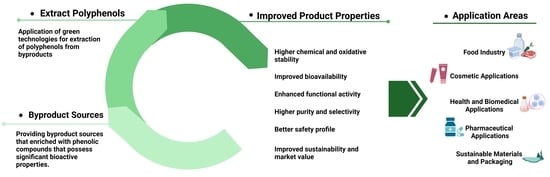
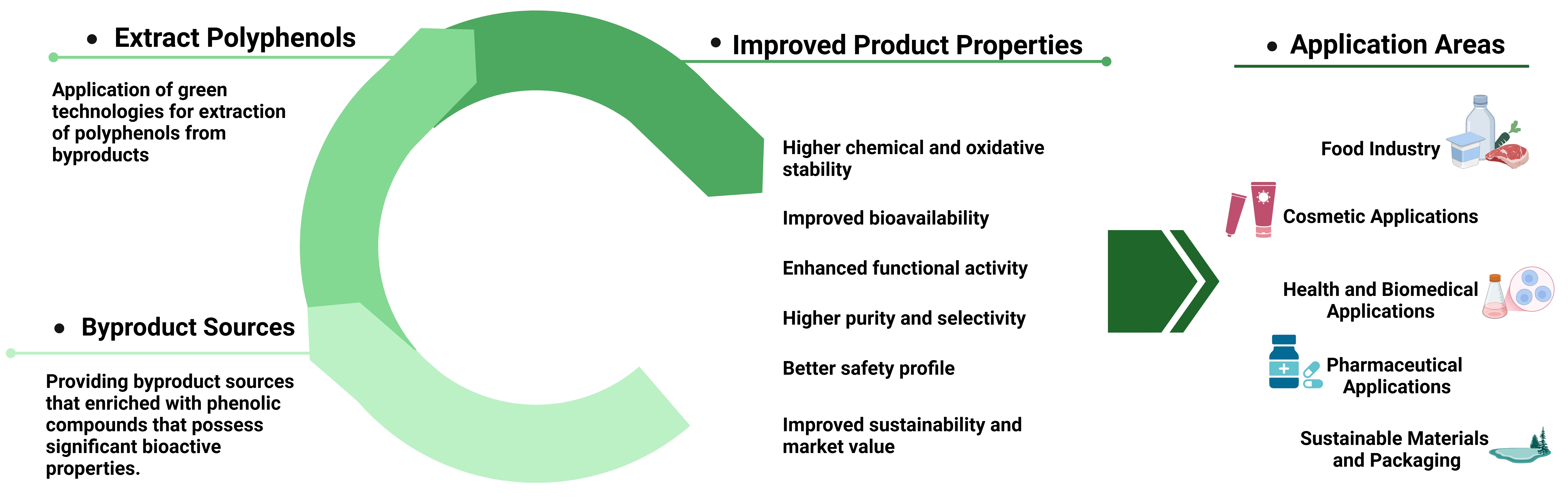
Graphical Abstract