Mapping the Evidence on Oral Health Interventions and Cognitive Status in Alzheimer’s Disease: A Scoping Review

 , ,
, ,  , and
, and
Highlights
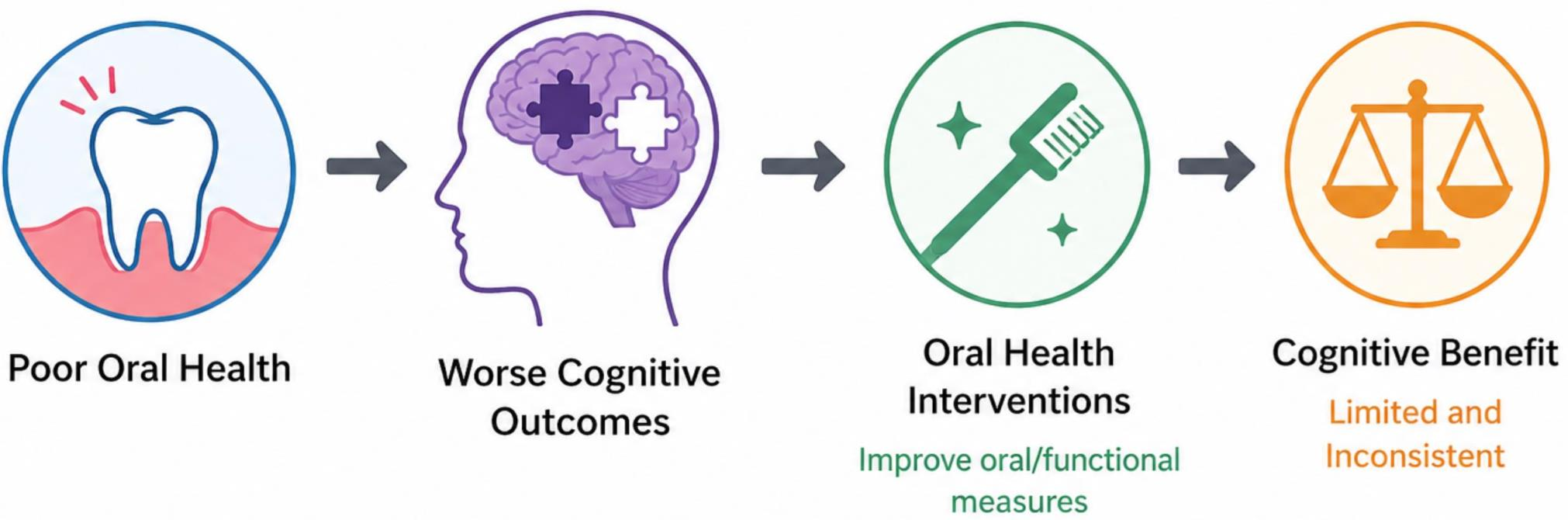
- Evidence consistently links oral health status with cognitive outcomes in Alzheimer’s disease.
- Interventional studies are limited and do not provide clear evidence of cognitive improvement.
- Current evidence is insufficient to establish oral health as a causal or therapeutic target for improving cognition.
- Future research should integrate standardized cognitive measures with mechanistic outcomes to clarify pathways.
Abstract
1. Introduction
2. Methods
2.1. Study Design and Framework
2.2. Eligibility Criteria
2.3. Information Sources and Search Strategy
2.4. Study Selection
2.5. Data Extraction
2.6. Data Syntheses
3. Results
3.1. Study Selection and Characteristics
3.2. Oral Health Interventions and Exposures
3.3. Cognitive Outcomes
3.4. Oral Health Outcomes
3.5. Mechanistic Outcomes
3.6. Implementation Factors
4. Discussion
4.1. Principal Findings
4.2. Critical Appraisal of Interventional Evidence
4.3. Interpretation of Observational Evidence
4.4. Mechanistic Integration: Bridging Biology and Clinical Evidence
4.5. Implementation and Health System Considerations
4.6. Strengths and Limitations of the Evidence Base
4.7. Research Priorities and Testable Hypotheses
4.8. Implications for Practice and Policy
5. Conclusions
Author Contributions
Funding
Institutional Review Board Statement
Informed Consent Statement
Data Availability Statement
Acknowledgments
Conflicts of Interest
References
- Rostagno, A.A. Pathogenesis of Alzheimer’s disease. Int. J. Mol. Sci. 2023, 24, 107. [Google Scholar] [CrossRef]
- Liu, X.-X.; Jiao, B.; Liao, X.-X.; Guo, L.-N.; Yuan, Z.-H.; Wang, X.; Xiao, X.-W.; Zhang, X.-Y.; Tang, B.-S.; Shen, L. Analysis of salivary microbiome in patients with Alzheimer’s disease. J. Alzheimer’s Dis. 2019, 72, 633–640. [Google Scholar] [CrossRef]
- Leira, Y.; Domínguez, C.; Seoane, J.; Seoane-Romero, J.; Pías-Peleteiro, J.M.; Takkouche, B.; Blanco, J.; Aldrey, J.M. Is periodontal disease associated with Alzheimer’s disease? A systematic review with meta-analysis. Neuroepidemiology 2017, 48, 21–31. [Google Scholar] [CrossRef] [PubMed]
- Chen, C.K.; Wu, Y.T.; Chang, Y.C. Association between chronic periodontitis and the risk of Alzheimer’s disease: A retrospective, population-based, matched cohort study. Alzheimer’s Res. Ther. 2017, 9, 56. [Google Scholar] [CrossRef]
- Dominy, S.S.; Lynch, C.; Ermini, F.; Benedyk, M.; Marczyk, A.; Konradi, A.; Nguyen, M.; Haditsch, U.; Raha, D.; Griffin, C.; et al. Porphyromonas gingivalis in Alzheimer’s disease brains: Evidence for disease causation and treatment with small-molecule inhibitors. Sci. Adv. 2019, 5, eaau3333. [Google Scholar] [CrossRef]
- Aragón, F.; Zea-Sevilla, M.A.; Montero, J.; Sancho, P.; Corral, R.; Tejedor, C.; Frades-Payo, B.; Paredes-Gallardo, V.; Albaladejo, A. Oral health in Alzheimer’s disease: A multicenter case-control study. Clin. Oral Investig. 2018, 22, 3061–3070. [Google Scholar] [CrossRef]
- Matsubara, C.; Shirobe, M.; Furuya, J.; Watanabe, Y.; Motokawa, K.; Edahiro, A.; Ohara, Y.; Awata, S.; Kim, H.; Fujiwara, Y.; et al. Effect of oral health intervention on cognitive decline in community-dwelling older adults: A randomized controlled trial. Arch. Gerontol. Geriatr. 2021, 92, 104267. [Google Scholar] [CrossRef] [PubMed]
- Guo, H.; Wang, Z.; Chu, C.H.; Chan, A.K.Y.; Lo, E.C.M.; Jiang, C.M. Effects of oral health interventions on cognition of people with dementia: A systematic review with meta-analysis. BMC Oral Health 2024, 24, 1030. [Google Scholar] [CrossRef]
- Hernández-Vásquez, A.; Barrenechea-Pulache, A.; Aguirre-Ipenza, R.; Comandé, D.; Azañedo, D. Interventions to improve the oral hygiene of individuals with Alzheimer’s disease: A systematic review. Dent. J. 2022, 10, 92. [Google Scholar] [CrossRef]
- Aida, J.; Kiuchi, S.; Shirai, K.; Peres, M.A.; Matsuyama, Y. Oral health and dementia: Causal inference and theoretical mechanisms. J. Dent. Res. 2026, 105, 42–50. [Google Scholar] [CrossRef] [PubMed]
- Arksey, H.; O’Malley, L. Scoping studies: Towards a methodological framework. Int. J. Soc. Res. Methodol. 2005, 8, 19–32. [Google Scholar] [CrossRef]
- Tricco, A.C.; Lillie, E.; Zarin, W.; O’Brien, K.K.; Colquhoun, H.; Levac, D.; Moher, D.; Peters, M.D.J.; Horsley, T.; Weeks, L.; et al. PRISMA extension for scoping reviews (PRISMA-ScR): Checklist and explanation. Ann. Intern. Med. 2018, 169, 467–473. [Google Scholar] [CrossRef]
- Kulkarni, M.S.; Miller, B.C.; Mahani, M.; Mhaskar, R.; Tsalatsanis, A.; Jain, S.; Yadav, H. Poor oral health linked with higher risk of Alzheimer’s disease. Brain Sci. 2023, 13, 1555. [Google Scholar] [CrossRef]
- Sherbaf, R.A.; Kaposvári, G.M.; Nagy, K.; Pakáski, M.; Gajdács, M.; Matusovits, D.; Baráth, Z. Oral health status and factors associated with oral health in patients with Alzheimer’s disease: A matched case-control observational study. J. Clin. Med. 2025, 14, 1412. [Google Scholar] [CrossRef]
- Campos, C.H.; Ribeiro, G.R.; Rodrigues Garcia, R.C.M. Mastication and oral health-related quality of life in removable denture wearers with Alzheimer disease. J. Prosthet. Dent. 2018, 119, 764–768. [Google Scholar] [CrossRef] [PubMed]
- Chen, L.; Cao, H.; Wu, X.; Xu, X.; Ji, X.; Wang, B.; Zhang, P.; Li, H. Effects of oral health intervention strategies on cognition and microbiota alterations in patients with mild Alzheimer’s disease: A randomized controlled trial. Geriatr. Nurs. 2022, 48, 103–110. [Google Scholar] [CrossRef] [PubMed]
- Frota, B.M.D.; Holanda, S.N.; Sousa, F.B.; Alves, A.P.N.N. Evaluation of oral conditions in patients with neurodegenerative diseases treated in geriatric centers. Rev. Gaucha Odontol. 2016, 64, 17–23. [Google Scholar] [CrossRef]
- Laugisch, O.; Johnen, A.; Buergin, W.; Eick, S.; Ehmke, B.; Duning, T.; Sculean, A. Oral and periodontal health in patients with Alzheimer’s disease and other forms of dementia: A cross-sectional pilot study. Oral Health Prev. Dent. 2021, 19, 255–261. [Google Scholar] [CrossRef]
- Shirobe, M.; Edahiro, A.; Motokawa, K.; Morishita, S.; Ohara, Y.; Motohashi, Y.; Iwasaki, M.; Watanabe, Y.; Hirano, H. Association between dementia severity and oral hygiene management issues in older adults with Alzheimer’s disease: A cross-sectional study. Int. J. Environ. Res. Public Health 2023, 20, 3841. [Google Scholar] [CrossRef]
- Wu, S.-Y.; Wu, C.-Y.; Lin, Y.-S.; Lin, C.-S.; Lee, W.-J.; He, S.-J.; Lin, G.-H.; Huang, H.-Y.; Fuh, J.-L. Oral health variables associated with factors across the Alzheimer’s disease continuum: From subjective cognitive decline to dementia. J. Dent. 2025, 160, 105862. [Google Scholar] [CrossRef]
- Yang, B.; Tao, B.; Yin, Q.; Chai, Z.; Xu, L.; Zhao, Q.; Wang, J. Associations between oral health status, perceived stress, and neuropsychiatric symptoms among community individuals with Alzheimer’s disease: A mediation analysis. Front. Aging Neurosci. 2021, 13, 801209. [Google Scholar] [CrossRef]
- Yi, Y.; Lee, C.H.; Shin, H.S.; Shin, S. Oral diseases as emerging risk factors for alzheimer’s disease: A scoping review. Jpn. Dent. Sci. Rev. 2025, 61, 292–300. [Google Scholar] [CrossRef]
- Felicetti, A.; Azzolino, D.; Piro, P.P.; Lopes, G.C.D.; Rezaeinezhad, N.; Lovero, R.; Bocchio-Chiavetto, L.; Colella, M.; Passarelli, P.C. The oral-brain axis in alzheimer’s disease: From microbial dysbiosis to neurodegeneration. Microorganisms 2025, 13, 2741. [Google Scholar] [CrossRef]


| Inclusion Criteria | Exclusion Criteria |
|---|---|
| Peer-reviewed primary research articles | Review articles (systematic reviews, meta-analyses, scoping reviews, and narrative reviews) |
| Studies published between January 2015 and August 2025 | Editorials, commentaries, letters to the editor, and opinion pieces |
| Studies involving adults diagnosed with AD using clinical or research criteria (e.g., DSM-5, NINCDS–ADRDA, ICD-based diagnoses) | Conference abstracts or proceedings without full-text articles |
| Studies evaluating oral health interventions (e.g., oral hygiene programs, periodontal therapy, prosthodontic rehabilitation, oral health education) or examining oral health-related exposures or conditions (e.g., periodontal disease, tooth loss, denture status, masticatory function, oral microbiome) | Studies not focused on AD or not reporting AD-specific data |
| Studies reporting cognitive outcomes, dementia-related measures (e.g., staging or severity), or oral/biological outcomes relevant to AD | Studies not published in English |
| All study designs, including randomized controlled trials, nonrandomized trials, cohort studies, case–control studies, and cross-sectional studies | Non-human (animal or in vitro) studies |
| Full-text articles available | Studies with insufficient data for extraction |
| Database (Date of Search) | Search Strategy | Number of Records Found |
|---|---|---|
| PubMed (8 June 2025) | ((“oral intervention”[tiab]) OR (“oral hygiene”[tiab]) OR (“Oral health”[Title/Abstract]) OR (“dental care”[tiab]) OR (“dental intervention”[tiab]) OR (“dental hygiene”[tiab]) OR (“periodontal therapy”[tiab]) OR (Periodontal treatment[Title/Abstract]) OR (Periodontal intervention[Title/Abstract])) AND ((“Alzheimer Disease”[Mesh]) OR (“alzheimer”[tiab]) OR (“AD”[tiab])) | 261 |
| Scopus (8 June 2025) | (TITLE-ABS-KEY (“Oral intervention” OR “Oral hygiene” OR “Oral Health” OR “Dental care” OR “Dental Intervention” OR “Dental hygiene” OR “Periodontal therapy” OR “Periodontal treatment” OR “Periodontal intervention”)) AND (TITLE-ABS-KEY (“Alzheimer Disease” OR “alzheimer” OR “AD”)) | 411 |
| Web of Science (8 June 2025) | AB = (((“oral intervention”) OR (“oral hygiene”) OR (“Oral health”) OR (“dental care”) OR (“dental intervention”) OR (“dental hygiene”) OR (“periodontal therapy”) OR (“Periodontal treatment”) OR (“Periodontal intervention”)) AND ((“Alzheimer Disease”) OR (“alzheimer”) OR (“AD”))) | 177 |
| Author (Year) | Country | Study Design | Setting and Population | Sample Size | AD Criteria/Stage | Oral Health Variables | Cognitive Measures | Key Findings |
|---|---|---|---|---|---|---|---|---|
| * Aragon (2018) [6] | Spain | Case–control study | Alzheimer Center Reina Sofía and State Reference Center; adults aged ~60–99 years | 106 | Mild to Severe | DMFT/DMFS, CPI, salivary flow, prostheses, oral hygiene | FAST, CDR, GDS | AD patients had fewer teeth, worse periodontal status, lower salivary flow, and higher candidiasis prevalence than controls. |
| Campos (2018) [15] | Brazil | Nonrandomized clinical trial | Piracicaba Dental School; adults (mean age ~75 years) | 32 | Mild | Denture rehabilitation, masticatory efficiency, salivary flow | MMSE, CDR | Prosthodontic rehabilitation improved masticatory efficiency and oral health-related quality of life. |
| Chen (2022) [16] | China | Randomized control trial | Long-term care center; adults ≥60 years | 66 | Mild | BOHSE, oral microbiota | MMSE, NPI, NHAS, ADCS-ADL | After 24 weeks, the intervention group demonstrated significantly improved BOHSE, MMSE, NPI, NHAS, and ADCS-ADL scores (p < 0.05) and healthier oral microbiota composition. |
| Frota (2016) [17] | Brazil | Cross-sectional observational study | Geriatric centers; adults aged 57–91 years | 90 | Mild to Severe | Caries, periodontal disease, denture status, denture stomatitis | MMSE used diagnostically | 54.2% of AD patients had periodontal disease, and 34.2% had caries; denture stomatitis was significantly higher in the dementia group (p = 0.0213). |
| †* Kulkarni (2023) [13] | United States | Retrospective cohort study | TriNetX database; adults ≥60 years with poor oral health versus normal oral health evaluated for subsequent AD risk using matched cohorts | 31,418,814 normal oral health cohort; 1,232,751 poor oral health cohort | Not reported | Tooth loss, periodontal disease, caries, gingivitis | ICD-coded AD diagnosis | Poor oral health was associated with >2-fold increased AD risk (RR 2.363; 95% CI 2.326–2.401); tooth-loss-related disease showed the highest risk (RR 3.186; 95% CI 3.007–3.376). |
| †* Laugisch (2021) [18] | Germany | Cross-sectional case–control study | University of Münster memory clinic; adults aged 30–65 years with AD and other dementia subtypes | 40 | Mild to Moderate | CAL, PPD, BOP, plaque, radiographic bone loss | MMSE, CSF biomarkers | Periodontitis was identified in all participants; no significant periodontal differences were found between AD and non-AD dementia groups. |
| †* Liu (2019) [2] | China | Matched case–control study | Xiangya Hospital; adults with AD and cognitively healthy controls (mean age ~64 years) | 78 (39 AD, 39 controls) | Mild to Severe | Salivary microbiome diversity and composition | MMSE, CDR, ADL | AD patients demonstrated lower microbial diversity and altered salivary taxa; no bacteria were associated with disease severity. |
| Sherbaf (2025) [14] | Hungary | Cross-sectional observational study | University of Szeged; adults aged 66–97 years | 81 | Mild to Moderate | Plaque index, probing depth, attachment loss | MMSE | Worse periodontal parameters were associated with AD severity. |
| Shirobe (2023) [19] | Japan | Cross-sectional observational Study | Long-term care facilities; adults ≥65 years | 397 | All stages | Oral hygiene dependence, plaque accumulation, rinsing/gargling ability | FAST | Advanced FAST stages were associated with refusal of oral care, oral hygiene dependence, and plaque accumulation. |
| Wu (2025) [20] | Taiwan | Cross-sectional observational Study | Taipei Veterans General Hospital; adults aged 60–82 years | 81 | Mild to Moderate | Tooth loss, Eichner index, DMFT, masticatory performance | MMSE, MoCA | Tooth loss and reduced occlusal support were associated with worse cognitive status and lower MoCA scores. |
| † Yang (2021) [21] | China | Cross-sectional observational study | Chongqing Medical University communities; adults aged 65–90 years | 106 | AD, MCI, SCD groups | DMFT, plaque index, attachment loss, GOHAI, salivary microbiota | NPI, MMSE, CDR | Plaque index, attachment loss, and oral health stressors were associated with neuropsychiatric symptoms; perceived stress mediated these relationships. |
| Author (Year) | Oral Health Exposure or Intervention | Oral Outcomes | Cognitive or Dementia-Related Measures | Key Findings |
|---|---|---|---|---|
| Aragon (2018) [6] | Oral health assessment | Tooth loss, periodontal disease, candidiasis, low salivary flow | FAST, CDR, GDS | AD associated with significantly poorer oral health than controls |
| Campos (2018) [15] | Prosthodontic rehabilitation | Improved mastication and oral quality of life | MMSE, CDR | Denture rehabilitation improved oral function in mild AD |
| Chen (2022) [16] | Structured oral health intervention | Improved BOHSE and microbiota profile | MMSE, NPI, ADCS-ADL | Oral health intervention associated with slower cognitive and functional decline |
| Frota (2016) [17] | Oral examination and prosthesis assessment | High prevalence of periodontal disease, caries, maladaptive dentures | MMSE diagnostic classification | Dementia patients demonstrated poorer prosthetic and oral conditions |
| Kulkarni (2023) [13] | Poor oral health cohort comparison | Periodontal disease, tooth loss, caries | ICD-coded AD diagnosis | Poor oral health associated with increased AD risk |
| Laugisch (2021) [18] | Periodontal assessment | Universal periodontitis across dementia cohorts | MMSE, CSF biomarkers | Periodontal disease prevalent in both AD and non-AD dementia |
| Liu (2019) [2] | Salivary microbiome profiling | Reduced diversity and altered taxa | MMSE, CDR, ADL | Altered oral microbiome associated with AD status |
| Sherbaf (2025) [14] | Periodontal evaluation | Increased plaque, probing depth, attachment loss | MMSE | Poorer periodontal status associated with AD severity |
| Shirobe (2023) [19] | Oral hygiene function assessment | Plaque accumulation, oral care dependence | FAST staging | More severe dementia associated with greater oral hygiene impairment |
| Wu (2025) [20] | Dental and occlusal assessment | Tooth loss, impaired mastication, reduced occlusal support | MMSE, MoCA | Reduced occlusal support associated with worse cognition |
| Yang (2022) [21] | Oral health stressor evaluation | Poor oral hygiene, attachment loss, dysbiosis | NPI, perceived stress | Oral stressors directly and indirectly associated with neuropsychiatric symptoms |
| Author (Year) | Mechanistic or Implementation Domain | Key Findings | Clinical Implications |
|---|---|---|---|
| Aragon (2018) [6] | Caregiver-supported oral hygiene | Oral hygiene worsened with disease progression | Early preventive dental care may be beneficial |
| Campos (2018) [15] | Prosthodontic feasibility | Denture rehabilitation tolerated in mild AD | Oral rehabilitation was feasible in selected patients |
| Chen (2022) [16] | Caregiver-supported intervention | Structured oral care was feasible in long-term care | Multicomponent oral care programs may support cognition |
| Frota (2016) [17] | Access to dental care and prosthetic maintenance | High prevalence of maladaptive dentures | Need for regular prosthetic monitoring in dementia |
| Kulkarni (2023) [13] | Population-level epidemiology | Large-scale EHR data supported an oral-systemic association | Supports oral health as a potential modifiable AD risk factor |
| Laugisch (2021) [18] | Systemic inflammation and periodontitis | Periodontal inflammation common across dementia groups | Reinforces the inflammatory mouth–brain axis hypothesis |
| Liu (2019) [2] | Oral microbiome dysbiosis | Altered microbial diversity and taxa in AD | Supports microbiome contribution to AD pathophysiology |
| Sherbaf (2025) [14] | Oral hygiene maintenance barriers | Behavioral resistance and hygiene difficulties common | Caregiver training may improve oral care adherence |
| Shirobe (2023) [19] | Functional dependence in oral care | Refusal of care and oral hygiene dependence increased with FAST stage | Oral hygiene strategies should be tailored to dementia severity |
| Wu (2025) [20] | Functional oral decline | Mastication and occlusal support linked to cognition | Functional oral rehabilitation may warrant further study |
| Yang (2022) [21] | Stress-mediated oral–brain pathway | Perceived stress mediates oral health and neuropsychiatric symptom relationships | Oral health may influence behavioral symptoms through psychosocial mechanisms |
Disclaimer/Publisher’s Note: The statements, opinions and data contained in all publications are solely those of the individual author(s) and contributor(s) and not of MDPI and/or the editor(s). MDPI and/or the editor(s) disclaim responsibility for any injury to people or property resulting from any ideas, methods, instructions or products referred to in the content. |
© 2026 by the authors. Licensee MDPI, Basel, Switzerland. This article is an open access article distributed under the terms and conditions of the Creative Commons Attribution (CC BY) license.
Share and Cite
Hung, M.; Chriss, H.; Nelson, M.; O’Callaghan, J.; Ward, C.; Parry, A.; Marx, J.; Lipsky, M.S. Mapping the Evidence on Oral Health Interventions and Cognitive Status in Alzheimer’s Disease: A Scoping Review. Brain Sci. 2026, 16, 615. https://doi.org/10.3390/brainsci16060615
Hung M, Chriss H, Nelson M, O’Callaghan J, Ward C, Parry A, Marx J, Lipsky MS. Mapping the Evidence on Oral Health Interventions and Cognitive Status in Alzheimer’s Disease: A Scoping Review. Brain Sciences. 2026; 16(6):615. https://doi.org/10.3390/brainsci16060615
Chicago/Turabian StyleHung, Man, Hanna Chriss, Megan Nelson, Janaki O’Callaghan, Corban Ward, Alicia Parry, Jacob Marx, and Martin S. Lipsky. 2026. "Mapping the Evidence on Oral Health Interventions and Cognitive Status in Alzheimer’s Disease: A Scoping Review" Brain Sciences 16, no. 6: 615. https://doi.org/10.3390/brainsci16060615
APA StyleHung, M., Chriss, H., Nelson, M., O’Callaghan, J., Ward, C., Parry, A., Marx, J., & Lipsky, M. S. (2026). Mapping the Evidence on Oral Health Interventions and Cognitive Status in Alzheimer’s Disease: A Scoping Review. Brain Sciences, 16(6), 615. https://doi.org/10.3390/brainsci16060615