Seasonal Changes in Psychomotor Abilities of Male Handball Players

 ,
,  ,
,  ,
,  ,
,  and
and 
Highlights
- Full-season competition leads to a significant reduction in reaction times for choice reaction, hand–eye coordination, and spatial orientation tests among professional handball players.
- While reaction speed improves, motor abilities parameters tend to deteriorate after the season, evidenced by increased movement time in simple and choice reaction tasks.
- The findings suggest that seasonal fatigue and training adaptations create a unique psychomotor profile that requires monitoring to balance improved cognitive processing with declining motor execution.
- Position-specific differences in psychomotor evolution throughout the season indicate a need for individualized training and recovery strategies to maintain peak performance across all court roles.
Abstract
1. Introduction
2. Materials and Methods
2.1. Body Composition
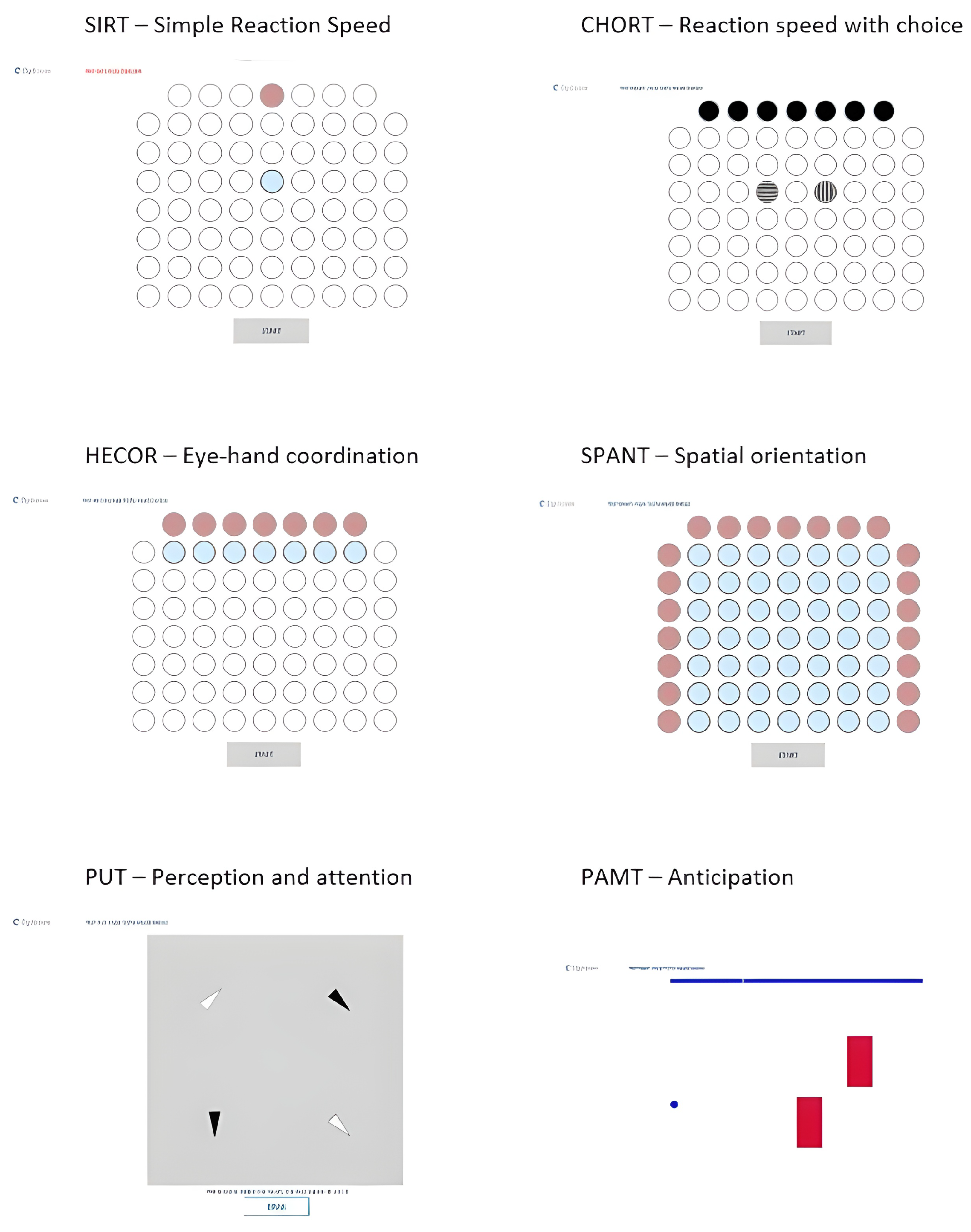
2.2. Psychomotor Abilities Assessment
- (a)
- Simple reaction speed (SIRT)—The test assessed the speed of response to a visual stimulus. The task was to move the index finger from the “START” field to the response field (blue dot) as quickly as possible after the appearance of the visual stimulus (red dot). The reaction field and the visual stimulus were in the same location throughout the test. After reacting as quickly as possible to the visual stimulus, the finger returned to the “START” field and waited for the next stimulus. The reaction time and movement time were analyzed. The reaction time (RT) was the time from the appearance of the visual stimulus until the “START” field was released. The movement time (MT) indicates the time from releasing the “START” field to clicking the reaction field.
- (b)
- Reaction speed with choice (CHORT)—The test assessed the speed and adequacy of responses to visual stimuli. The test consisted of responding appropriately to a given stimulus. Vertical, horizontal, or diagonal lines appeared in the black fields at the top of the screen. In the middle of the screen were response fields (vertical and horizontal lines). When a visual stimulus (vertical or horizontal lines) appeared, the subject moved their finger from the “START” field to the appropriate response field as quickly as possible. When diagonal lines appeared, the subject had to remain unresponsive. The number of correct answers, reaction time, and movement time were analyzed.
- (c)
- Eye–hand coordination (HECOR)—The test assessed eye–hand coordination by analyzing reaction speed to stimuli. At the top of the screen were bright red fields in which a visual stimulus (dark red dot) appeared at random, and the subject had to react as quickly as possible by moving their finger from the “START” field to the appropriate reaction field located below the visual stimulus. The reaction time and movement time were analyzed.
- (d)
- Spatial orientation (SPANT)—The test assessed eye–hand coordination using spatial information. On the sides of the screen, there were bright red fields on which two visual stimuli appeared simultaneously. One visual stimulus appeared at the top of the screen, while the other appeared on the left side of the screen. The task of the test subject was to move their finger from the “START” field to the reaction field, which is the intersection of the two visual stimuli. The number of correct answers, reaction time, and movement time were analyzed.
- (e)
- Perception and attention (PUT)—The test assessed visual attention. White and black triangles appeared on the screen, which could be arranged vertically, horizontally, or diagonally. The task of the test subject was to identify and select the vertical black triangle as quickly as possible. If there was no such triangle on the board, the participant selected the “NONE” field. Each response should be made as quickly as possible. The test took into account reaction speed (PUT n and PUT k). PUT n referred to the reaction speed when a vertical black triangle was on the board, while PUT k referred to the reaction speed when the indicated figure was not present and the “NONE” button was selected. In addition, the number of correct answers (cr) was analyzed.
- (f)
- Anticipation (PAMT)—The test assessed movement prediction in a complex and dynamic situation. The task was to move the ball to the other side of the monitor to avoid colliding with two red rectangles that were moving up and down. The ball moved in a straight line horizontally, and its speed was visible on the upper blue bar. When the participant decided that there would be no collision at a given moment, they clicked on the ball, which then began to move to the other side of the screen. The number of correct answers (cr) was taken into account for the analysis.
2.3. Statistical Analysis
3. Results
4. Discussion
5. Conclusions
Author Contributions
Funding
Institutional Review Board Statement
Informed Consent Statement
Data Availability Statement
Acknowledgments
Conflicts of Interest
References
- Śliż, M.; Przednowek, K.H.; Kapuściński, P.; Dziadek, B.; Godek, Ł.; Warchoł, K.; Zieliński, J.; Przednowek, K. Characteristics of the level of psychomotor abilities of female handball players. BMC Sport. Sci. Med. Rehabil. 2022, 14, 83. [Google Scholar] [CrossRef] [Scilit]
- Baker, J.; Cote, J.; Abernethy, B. Sport-specific practice and the development of expert decision-making in team ball sports. J. Appl. Sport Psychol. 2003, 15, 12–25. [Google Scholar] [CrossRef] [Scilit]
- Massuça, L.M.; Fragoso, I.; Teles, J. Attributes of top elite team-handball players. J. Strength Cond. Res. 2014, 28, 178–186. [Google Scholar] [CrossRef] [Scilit]
- Chelly, M.S.; Hermassi, S.; Aouadi, R.; Shephard, R.J. Effects of 8-week in-season plyometric training on upper and lower limb performance of elite adolescent handball players. J. Strength Cond. Res. 2014, 28, 1401–1410. [Google Scholar] [CrossRef] [Scilit]
- Memmert, D.; König, S. The Mental Game: Cognitive Training, Creativity, and Game Intelligence in Handball; Meyer & Meyer Sport: Aachen, Germany, 2024. [Google Scholar]
- Dorak, F.; Yildiz, L.; Canpolat, A.M.; Yüzbasioglu, Y.; Vurgun, N. A Comparison of the Tactical Game Approach and the Direct Teaching Models in the Teaching of Handball: Cognitive-Psychomotor Field and Game Performance. World J. Educ. 2018, 8, 76–85. [Google Scholar] [CrossRef] [Scilit]
- Malacko, J.; Stanković, V. Interaction of motor and cognitive abilities of elite handball players. Sport Sci. 2011, 4, 65–69. [Google Scholar]
- Silva, J.M. Psychological aspects in the training and performance of team handball athletes. In The Sport Psychologists Handbook: A Guide for Sport-Specific Performance Enhancement; John Wiley & Sons Inc.: Hoboken, NJ, USA, 2006; pp. 211–243. [Google Scholar]
- Liefeith, A.K. The Role of General Motor Ability and Agility in Sport Performance. Ph.D. Thesis, University of Central Lancashire, Preston, UK, 2019. [Google Scholar]
- Przednowek, K.; Śliż, M.; Lenik, J.; Dziadek, B.; Cieszkowski, S.; Lenik, P.; Kopeć, D.; Wardak, K.; Przednowek, K.H. Psychomotor abilities of professional handball players. Int. J. Environ. Res. Public Health 2019, 16, 1909. [Google Scholar] [CrossRef] [Scilit] [PubMed]
- Lisenchuk, G.; Zhigadlo, G.; Tyshchenko, V.; Odynets, T.; Omelianenko, H.; Pyptiuk, P.; Bessarabova, O.; Galchenko, L.; Dyadechko, I. Assess psychomotor, sensory-perceptual functions in team-sport games. J. Phys. Educ. Sport 2019, 19, 1205–1212. [Google Scholar]
- Krawczyk, P.; Bodasinski, S.; Bodasinska, A.; Słupczynski, B. Level of psychomotor abilities in handball goalkeepers. Balt. J. Health Phys. Act. 2018, 10, 7. [Google Scholar] [CrossRef] [Scilit]
- Krawczyk, K.; Słowak, M. Selected Parameters of Anaerobic capacity among players in various positions on the Polish Superleague Handball Team CAPACITY. J. Kinesiol. Exerc. Sci. 2018, 28, 63–68. [Google Scholar] [CrossRef] [Scilit]
- Muntianu, V.A.; Abalașei, B.A.; Nichifor, F.; Dumitru, I.M. The correlation between psychological characteristics and psychomotor abilities of junior handball players. Children 2022, 9, 767. [Google Scholar] [CrossRef] [Scilit]
- Bresciani, G.; Cuevas, M.J.; Garatachea, N.; Molinero, O.; Almar, M.; De Paz, J.A.; Márquez, S.; González-Gallego, J. Monitoring biological and psychological measures throughout an entire season in male handball players. Eur. J. Sport Sci. 2010, 10, 377–384. [Google Scholar] [CrossRef] [Scilit]
- Horoszkiewicz, K. Contemporary Approaches to Assessing Psychomotor Efficiency: A Study in Sports Psychology and Transportation. Adv. Cogn. Psychol. 2024, 20, 275–286. [Google Scholar] [CrossRef] [Scilit]
- Ökrös, C.; Kőnig-Görögh, D.; Gyömbér, N. Coping Strategies of Elite Hungarian Junior Handball Players. Acta Med. Sociol. 2020, 11, 5. [Google Scholar] [CrossRef] [Scilit]
- Kiss, B.; Balogh, L. A study of key cognitive skills in handball using the Vienna test system. J. Phys. Educ. Sport 2019, 19, 733–741. [Google Scholar]
- Tarnowski, A.; Gęga, M.; Górecka, J.; Szostok, K.; Szostok, T. TEST2DRIVE: Podręcznik Użytkownika; Wydawnictwo “Kolumb”: Siemianowice Śląskie, Poland, 2016. [Google Scholar]
- Martinho, D.V.; Clemente, F.M.; Ángel-Gomez, M.; Rebelo, A.; Field, A.; Santos, C.C.; Gouveia, É.R.; Afonso, J.; Sarmento, H. Physical, Physiological, Technical and Tactical Responses According to the Playing Position in Male Basketball: A Systematic Scoping Review. J. Hum. Kinet. 2025, 96, 5. [Google Scholar] [CrossRef] [Scilit]
- Asar, S.; Ezabadi, R.R.; Baghini, A.S.; Maleksabet, N. The Relationship Between Reaction Time, Eye-Hand Coordination with Visual Field in Elite Tennis Tennis Players. Asian J. Sport. Med. 2022, 13, e115787. [Google Scholar] [CrossRef] [Scilit]
- Huzarska-Rynasiewicz, I.; Martinho, D.V.; Marques, A.; de Maio Nascimento, M.; Gouveia, É.R.; Ihle, A.; Przednowek, K. Psychomotor and Basic Cognitive Abilities in Professional Athletes: A Systematic Review. J. Hum. Kinet. 2025, 100, 259. [Google Scholar] [CrossRef] [Scilit]
- Stanković, M.; Katanić, B.; Govindasamy, K.; Badau, A.; Badau, D.; Masanovic, B.; Bojić, I. Seasonal changes in body composition, jump, sprint, and agility performance among elite female handball players. Appl. Sci. 2025, 15, 5846. [Google Scholar] [CrossRef] [Scilit]
- Ahmedov, F.; Gardašević, N.; Norboyev, K.; Umarov, K. Differences of Duration of the Fight Depending on the Stage of the Judo Competition. Int. J. Hum. Mov. Sport. Sci. 2020, 8, 380–383. [Google Scholar] [CrossRef] [Scilit]
- Prasomsri, J.; Thueman, B.; Yuenyong, P.; Thongnoon, C.; Khophongphaibun, N.; Ariyawatcharin, S. Effectiveness of motor imagery on sports performance in football players: A randomised control trial. Hong Kong Physiother. J. 2024, 44, 29–37. [Google Scholar] [CrossRef] [Scilit] [PubMed]
- Śliż, M.; Paśko, W.; Dziadek, B.; Godek, Ł.; Bliźniak, K.; Gouveia, É.R.; Przednowek, K. The influence of selected anthropometric parameters on psychomotor abilities among professional Rugby Union players. BMC Sport. Sci. Med. Rehabil. 2023, 15, 125. [Google Scholar] [CrossRef] [Scilit] [PubMed]
- González-Fernández, F.T.; Silva, A.F.; Rodriguez, A.C.; Onetti-Onetti, W.; Clemente, F.M. Effects of 8 weeks pre-season training on physical fitness, heart rate variability and cognition in women soccer players. Heliyon 2024, 10, e24955. [Google Scholar] [CrossRef] [Scilit] [PubMed]
- Mancini, N.; Di Padova, M.; Polito, R.; Mancini, S.; Dipace, A.; Basta, A.; Colella, D.; Limone, P.; Messina, G.; Monda, M.; et al. The Impact of Perception–Action Training Devices on Quickness and Reaction Time in Female Volleyball Players. J. Funct. Morphol. Kinesiol. 2024, 9, 147. [Google Scholar] [CrossRef] [Scilit]
- Lachowicz, M.; Zurek, G.; Serweta-Pawlik, A.; Jamro, D. Level Up! Assessing the Impact of Short and Long-term Virtual Reality Training on E-Athletes’ Reaction Time and Eye-Hand Coordination. In Proceedings of the 2023 ACM Symposium on Spatial User Interaction, Sydney, Australia, 13–15 October 2023; pp. 1–3. [Google Scholar]
- Chueh, T.Y.; Huang, C.J.; Hsieh, S.S.; Chen, K.F.; Chang, Y.K.; Hung, T.M. Sports training enhances visuo-spatial cognition regardless of open-closed typology. PeerJ 2017, 5, e3336. [Google Scholar] [CrossRef] [Scilit]
- Williams, A.M.; Jackson, R. Anticipation in sport: Fifty years on, what have we learned and what research still needs to be undertaken? Psychol. Sport Exerc. 2019, 42, 16–24. [Google Scholar] [CrossRef] [Scilit]
- Malcolm, R.; Cooper, S.; Folland, J.P.; Tyler, C.J.; Sunderland, C. The influence of a competitive field hockey match on cognitive function. Front. Hum. Neurosci. 2022, 16, 829924. [Google Scholar] [CrossRef] [Scilit]
- Wu, K.C.; Lin, H.C.; Cheng, Z.Y.; Chang, C.H.; Chang, J.N.; Tai, H.L.; Liu, S.I. The Effect of Perceptual-Cognitive Skills in College Elite Athletes: An Analysis of Differences Across Competitive Levels. Sports 2025, 13, 141. [Google Scholar] [CrossRef] [Scilit]
- Klocek, O. Psychomotor determinants of children’s sports talent for team sports: A case study of mini-volleyball athletes. J. Kinesiol. Exerc. Sci. 2023, 33, 11–17. [Google Scholar] [CrossRef] [Scilit]
- Póvoas, S.C.; Seabra, A.F.; Ascensão, A.A.; Magalhães, J.; Soares, J.M.; Rebelo, A.N. Physical and physiological demands of elite team handball. J. Strength Cond. Res. 2012, 26, 3365–3375. [Google Scholar] [CrossRef] [Scilit]
- Font, R.; Karcher, C.; Reche, X.; Carmona, G.; Tremps, V.; Irurtia, A. Monitoring external load in elite male handball players depending on playing positions. Biol. Sport 2021, 38, 475–481. [Google Scholar] [CrossRef] [Scilit] [PubMed]
- Hinz, M.; Lehmann, N.; Musculus, L. Elite players invest additional time for making better embodied choices. Front. Psychol. 2022, 13, 873474. [Google Scholar] [CrossRef] [Scilit] [PubMed]
- Nicolosi, S.; Quinto, A.; Lipoma, M.; Sgrò, F. Situational analysis and tactical decision-making in elite handball players. Appl. Sci. 2023, 13, 8920. [Google Scholar] [CrossRef] [Scilit]
- García-Sánchez, C.; Navarro, R.M.; Mon-López, D.; Nieto-Acevedo, R.; Cañadas-García, E.; de la Rubia, A. Do all matches require the same effort? Influence of contextual factors on physical demands during official female handball competitions. Biol. Sport 2024, 41, 145–154. [Google Scholar] [CrossRef] [Scilit]
- Martins, F.; Śliż, M.; França, C.; Sarmento, H.; Gouveia, É.R.; Campos, P.; Lopes, H.; Przednowek, K. Characterizing Psychomotor Abilities of Male Handball Players of Different Age Categories. J. Hum. Kinet. 2025, 100, 281–291. [Google Scholar] [CrossRef] [Scilit]
- Manchado, C.; Tortosa Martínez, J.; Pueo, B.; Cortell Tormo, J.M.; Vila, H.; Ferragut, C.; Sánchez Sánchez, F.; Busquier, S.; Amat, S.; Chirosa Ríos, L.J. High-performance handball player’s time-motion analysis by playing positions. Int. J. Environ. Res. Public Health 2020, 17, 6768. [Google Scholar] [CrossRef] [Scilit]
- Manchado, C.; Pueo, B.; Chirosa-Rios, L.J.; Tortosa-Martínez, J. Time–motion analysis by playing positions of male handball players during the European Championship 2020. Int. J. Environ. Res. Public Health 2021, 18, 2787. [Google Scholar] [CrossRef] [Scilit]
- Bortnik, L.; Bruce-Low, S.; Burger, J.; Alexander, J.; Harper, D.; Morgans, R.; Carling, C.; McDaid, K.; Rhodes, D. Physical match demands across different playing positions during transitional play and high-pressure activities in elite soccer. Biol. Sport 2024, 41, 73–82. [Google Scholar] [CrossRef] [Scilit]
- Sansone, P.; Tessitore, A.; Lukonaitiene, I.; Paulauskas, H.; Tschan, H.; Conte, D. Technical-tactical profile, perceived exertion, mental demands and enjoyment of different tactical tasks and training regimes in basketball small-sided games. Biol. Sport 2020, 37, 15–23. [Google Scholar] [CrossRef] [Scilit]
- Sarmento, H.; Martinho, D.V.; Gouveia, É.R.; Afonso, J.; Chmura, P.; Field, A.; Savedra, N.O.; Oliveira, R.; Praça, G.; Silva, R.; et al. The influence of playing position on physical, physiological, and technical demands in adult male soccer matches: A systematic scoping review with evidence gap map. Sport. Med. 2024, 54, 2841–2864. [Google Scholar] [CrossRef] [Scilit]


| Pivot Player | Center Player | Wing Player | All | |
|---|---|---|---|---|
| n | 15 | 38 | 24 | 77 |
| Training seniority | 11.0 ± 6.7 | 9.7 ± 5.7 | 9.8 ± 5.9 | 10.0 ± 5.9 |
| Age | 27.2 ± 5.9 | 25.3 ± 4.8 | 25.1 ± 5.5 | 25.6 ± 5.2 |
| Body height (cm) | 192.5 ± 8.5 | 191.5 ± 5.8 | 182.8 ± 4.1 | 189.0 ± 7.2 |
| Body mass (kg) | 108.0 ± 10.6 | 93.0 ± 10.6 | 83.9 ± 5.2 | 93.1 ± 12.4 |
| BMI (kg/m2) | 29.2 ± 2.4 | 25.4 ± 2.2 | 25.2 ± 1.5 | 26.1 ± 2.6 |
| Variable | B | A | D | p | r | ||||
|---|---|---|---|---|---|---|---|---|---|
| Q1 | Me | Q3 | Q1 | Me | Q3 | (B-A) | |||
| SIRT RT (ms) | 325 | 343 | 364 | 318 | 335 | 355 | 8 | 0.063 | 0.24 |
| SIRT MT (ms) | 161 | 180 | 201 | 167 | 195 | 227 | −15 | 0.003 * | −0.40 |
| CHORT RT (ms) | 639 | 682 | 721 | 603 | 637 | 691 | 45 | 0.001 * | 0.44 |
| CHORT MT (ms) | 173 | 200 | 227 | 190 | 219 | 250 | −19 | 0.005 * | −0.37 |
| CHORT cr (%) | 92 | 96 | 100 | 92 | 96 | 100 | 0 | 0.989 | 0.00 |
| HECOR RT (ms) | 386 | 410 | 438 | 377 | 395 | 416 | 15 | 0.002 * | 0.42 |
| HECOR MT (ms) | 204 | 228 | 257 | 224 | 247 | 273 | −19 | 0.011 * | −0.33 |
| SPANT RT (ms) | 557 | 585 | 674 | 507 | 569 | 641 | 16 | 0.003 * | 0.39 |
| SPANT MT (ms) | 205 | 234 | 256 | 207 | 240 | 267 | −6 | 0.380 | −0.12 |
| SPANT cr (%) | 90 | 95 | 100 | 90 | 95 | 100 | 0 | 0.032 * | −0.34 |
| PUT n (ms) | 1679 | 1926 | 2144 | 1559 | 1741 | 2028 | 185 | 0.002 * | 0.42 |
| PUT k (ms) | 1189 | 1246 | 1347 | 1113 | 1204 | 1323 | 42 | 0.025 * | 0.29 |
| PUT cr (%) | 94 | 96 | 98 | 94 | 96 | 98 | 0 | 0.593 | −0.08 |
| PAMT cr (%) | 78 | 83 | 89 | 78 | 83 | 89 | 0 | 0.583 | −0.08 |
| Variable | Pivot Player | Center Player | Wing Player | p-h | |||||||||
|---|---|---|---|---|---|---|---|---|---|---|---|---|---|
| Me ± IQR | r | Me ± IQR | r | Me ± IQR | r | ||||||||
| SIRT RT (ms) | B | 346 ± 43 | 0.426 | 0.24 | 332 ± 44 | 0.489 | 0.15 | 356 ± 35 | 0.013 * | 0.57 | 0.087 | 0.06 | |
| A | 347 ± 50 | 334 ± 23 | 327 ± 51 | 0.158 | 0.05 | ||||||||
| SIRT MT (ms) | B | 190 ± 57 | 0.107 | −0.48 | 178 ± 48 | 0.049 * | −0.42 | 179 ± 38 | 0.103 | −0.38 | 0.436 | 0.02 | |
| A | 221 ± 46 | 190 ± 61 | 191 ± 53 | 0.206 | 0.04 | ||||||||
| CHORT RT (ms) | B | 689 ± 66 | 0.018 * | 0.70 | 657 ± 99 | 0.517 | 0.14 | 693 ± 68 | 0.003 * | 0.70 | 0.069 | 0.07 | |
| A | 644 ± 46 | 638 ± 128 | 625 ± 72 | 0.467 | 0.02 | ||||||||
| CHORT MT (ms) | B | 221 ± 61 | 0.379 | −0.27 | 195 ± 37 | 0.010 * | −0.55 | 195 ± 56 | 0.153 | −0.34 | 0.153 | 0.05 | |
| A | 220 ± 58 | 212 ± 70 | 220 ± 46 | 0.545 | 0.02 | ||||||||
| CHORT cr (%) | B | 100 ± 8 | 0.308 | −0.40 | 96 ± 8 | 0.631 | −0.12 | 98 ± 6 | 0.029 * | 0.66 | 0.606 | 0.01 | |
| A | 100 ± 4 | 98 ± 4 | 94 ± 12 | 0.020 * | 0.10 | P-W * | |||||||
| HECOR RT (ms) | B | 429 ± 46 | 0.182 | 0.40 | 393 ± 55 | 0.603 | 0.11 | 414 ± 40 | 0.002 * | 0.74 | 0.198 | 0.04 | |
| A | 409 ± 31 | 396 ± 39 | 383 ± 41 | 0.167 | 0.05 | ||||||||
| HECOR MT (ms) | B | 243 ± 41 | 0.820 | −0.08 | 220 ± 39 | 0.021 * | −0.49 | 234 ± 71 | 0.241 | −0.28 | 0.119 | 0.06 | |
| A | 251 ± 53 | 242 ± 46 | 245 ± 54 | 0.795 | 0.01 | ||||||||
| SPANT RT (ms) | B | 641 ± 190 | 0.007 * | 0.77 | 585 ± 106 | 0.068 | 0.39 | 584 ± 109 | 0.297 | 0.25 | 0.437 | 0.02 | |
| A | 597 ± 128 | 544 ± 115 | 566 ± 192 | 0.348 | 0.03 | ||||||||
| SPANT MT (ms) | B | 238 ± 80 | 0.169 | −0.42 | 228 ± 45 | 0.100 | −0.35 | 236 ± 52 | 0.764 | −0.07 | 0.558 | 0.02 | |
| A | 239 ± 69 | 240 ± 55 | 236 ± 58 | 0.576 | 0.02 | ||||||||
| SPANT cr (%) | B | 95 ± 25 | 0.107 | −0.67 | 95 ± 10 | 0.420 | −0.21 | 95 ± 12 | 0.438 | −0.22 | 0.442 | 0.02 | |
| A | 95 ± 10 | 95 ± 5 | 95 ± 10 | 0.729 | 0.01 | ||||||||
| PUT n (ms) | B | 2192 ± 826 | 0.095 | 0.50 | 1858 ± 351 | 0.256 | 0.25 | 1963 ± 329 | 0.012 * | 0.59 | 0.053 | 0.08 | |
| A | 1870 ± 752 | 1698 ± 481 | 1733 ± 409 | 0.150 | 0.05 | ||||||||
| PUT k (ms) | B | 1283 ± 282 | 0.182 | 0.40 | 1245 ± 158 | 0.658 | 0.10 | 1241 ± 181 | 0.077 | 0.42 | 0.482 | 0.02 | |
| A | 1239 ± 247 | 1150 ± 232 | 1207 ± 200 | 0.523 | 0.02 | ||||||||
| PUT cr (%) | B | 96 ± 2 | 0.406 | −0.26 | 96 ± 4 | 0.925 | 0.03 | 97 ± 4 | 0.748 | 0.10 | 0.614 | 0.01 | |
| A | 98 ± 8 | 96 ± 2 | 96 ± 4 | 0.468 | 0.02 | ||||||||
| PAMT cr (%) | B | 78 ± 11 | 0.176 | −0.42 | 89 ± 11 | 0.646 | −0.11 | 89 ± 8 | 0.168 | 0.36 | 0.024 * | 0.10 | P-W * |
| A | 83 ± 11 | 83 ± 14 | 83 ± 14 | 0.550 | 0.02 | ||||||||
| B | A | ||||
|---|---|---|---|---|---|
| Variable | Training Experience | Super League Playing | Variable | Training Experience | Super League Playing |
| Experience | Experience | ||||
| SIRT RT (ms) | −0.07 | 0.11 | SIRT RT (ms) | −0.10 | −0.01 |
| SIRT MT (ms) | 0.16 | 0.28 * | SIRT MT (ms) | 0.27 * | 0.17 |
| CHORT RT (ms) | 0.01 | −0.01 | CHORT RT (ms) | −0.09 | 0.08 |
| CHORT MT (ms) | 0.17 | 0.23 * | CHORT MT (ms) | 0.15 | 0.07 |
| CHORT cr (%) | −0.05 | −0.03 | CHORT cr (%) | −0.03 | 0.06 |
| HECOR RT (ms) | 0.03 | 0.05 | HECOR RT (ms) | −0.14 | −0.03 |
| HECOR MT (ms) | 0.20 | 0.26 * | HECOR MT (ms) | 0.26 * | 0.10 |
| SPANT RT (ms) | 0.01 | 0.12 | SPANT RT (ms) | −0.16 | 0.01 |
| SPANT MT (ms) | 0.06 | 0.01 | SPANT MT (ms) | 0.12 | −0.02 |
| SPANT cr (%) | 0.14 | −0.06 | SPANT cr (%) | 0.06 | −0.12 |
| PUT n (ms) | 0.05 | 0.19 | PUT n (ms) | −0.05 | −0.03 |
| PUT k (ms) | 0.03 | 0.10 | PUT k (ms) | −0.10 | −0.17 |
| PUT cr (%) | 0.08 | 0.13 | PUT cr (%) | 0.14 | 0.15 |
| PAMT cr (%) | −0.04 | −0.17 | PAMT cr (%) | 0.16 | 0.19 |
Disclaimer/Publisher’s Note: The statements, opinions and data contained in all publications are solely those of the individual author(s) and contributor(s) and not of MDPI and/or the editor(s). MDPI and/or the editor(s) disclaim responsibility for any injury to people or property resulting from any ideas, methods, instructions or products referred to in the content. |
© 2026 by the authors. Licensee MDPI, Basel, Switzerland. This article is an open access article distributed under the terms and conditions of the Creative Commons Attribution (CC BY) license.
Share and Cite
Śliż, M.; Paśko, W.; Martins, F.; Krupa, R.; Gouveia, É.R.; Sarmento, H.; Przednowek, K. Seasonal Changes in Psychomotor Abilities of Male Handball Players. Brain Sci. 2026, 16, 338. https://doi.org/10.3390/brainsci16030338
Śliż M, Paśko W, Martins F, Krupa R, Gouveia ÉR, Sarmento H, Przednowek K. Seasonal Changes in Psychomotor Abilities of Male Handball Players. Brain Sciences. 2026; 16(3):338. https://doi.org/10.3390/brainsci16030338
Chicago/Turabian StyleŚliż, Maciej, Wojciech Paśko, Francisco Martins, Rafał Krupa, Élvio Rubio Gouveia, Hugo Sarmento, and Krzysztof Przednowek. 2026. "Seasonal Changes in Psychomotor Abilities of Male Handball Players" Brain Sciences 16, no. 3: 338. https://doi.org/10.3390/brainsci16030338
APA StyleŚliż, M., Paśko, W., Martins, F., Krupa, R., Gouveia, É. R., Sarmento, H., & Przednowek, K. (2026). Seasonal Changes in Psychomotor Abilities of Male Handball Players. Brain Sciences, 16(3), 338. https://doi.org/10.3390/brainsci16030338