Article

Understanding Adherence to Duloxetine in Psychiatric Practice: A Cross-Sectional Evaluation of Clinicians’ Experience

by
Cielo García-Montero
1,2,*,
Óscar Fraile-Martínez
1,2,
Juan Pablo Chart-Pascual
3,4,5,
Luis Gutiérrez-Rojas
6,7,
Miguel Ángel Alvarez-Mon
1,2,8,9,
Melchor Alvarez-Mon
1,2,10 and
Miguel Ángel Ortega
1,2
1
Department of Medicine and Medical Specialities, Faculty of Medicine and Health Sciences, Network Biomedical Research Center for Liver and Digestive Diseases (CIBEREHD), University of Alcalá, 28801 Alcala de Henares, Spain
2
Ramón y Cajal Institute of Sanitary Research (IRYCIS), 28034 Madrid, Spain
3
Psychiatry Department, Osakidetza Basque Health Service, Araba University Hospital, 01009 Vitoria-Gasteiz, Spain
4
Bioaraba Research Institute, 01009 Vitoria-Gasteiz, Spain
5
University of the Basque Country UPV/EHU, 01006 Vitoria-Gasteiz, Spain
6
Psychiatry Service, Hospital Universitario San Cecilio, 18016 Granada, Spain
7
Department of Psychiatry and CTS-549 Research Group, Institute of Neurosciences, University of Granada, 18071 Granada, Spain
8
Centro de Investigación en Red de Salud Mental (CIBERSAM), 28029 Madrid, Spain
9
Department of Psychiatry and Mental Health, University Hospital Infanta Leonor, 28031 Madrid, Spain
10
Immune System Diseases-Rheumatology and Internal Medicine Service, University Hospital Príncipe de Asturias, 28805 Alcala de Henares, Spain
*
Author to whom correspondence should be addressed.
Brain Sci. 2026, 16(2), 157; https://doi.org/10.3390/brainsci16020157

Submission received: 10 December 2025 / Revised: 28 January 2026 / Accepted: 29 January 2026 / Published: 29 January 2026
(This article belongs to the Special Issue Pharmacy and Mental Health)

Abstract

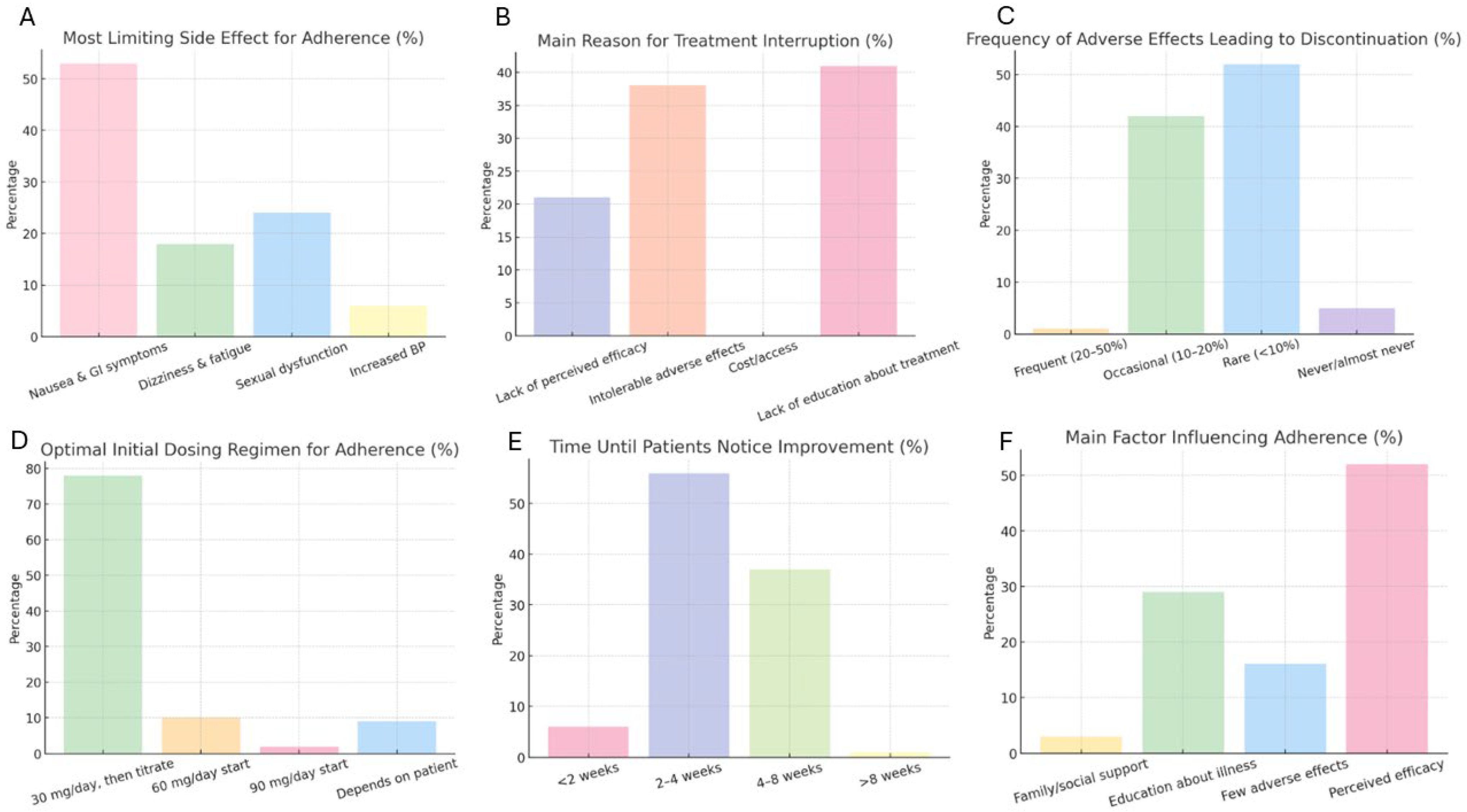
Objectives: The present study aimed to explore psychiatrists’ perceptions of duloxetine in routine clinical practice, focusing on its efficacy, tolerability, and treatment adherence in major depressive disorder (MDD) and generalized anxiety disorder (GAD). Methods: A structured questionnaire was administered to 97 psychiatrists from different regions of Spain. The survey covered demographic and professional data, prescription frequency, perceived clinical efficacy, tolerability, dosing patterns, and factors influencing adherence. Results: Overall, duloxetine was perceived as an effective treatment for both MDD and GAD, particularly in patients with somatic symptoms or comorbid anxiety. Tolerability was also positively rated, with nausea and fatigue identified as the adverse effects most commonly associated with reduced adherence. In addition, patient education and close follow-up were identified as the most effective strategies to improve adherence, whereas digital tools were considered promising but underused. Compared with other antidepressants, duloxetine was viewed as having a favorable balance between efficacy and tolerability, with similar or slightly higher adherence rates. Conclusions: These findings reflect a positive clinical appraisal of duloxetine among psychiatrists, highlighting its role as a versatile therapeutic option for affective and anxiety disorders, within the context of routine clinical practice in Spain, provided that appropriate adherence-support strategies are implemented.
Keywords: duloxetine; adherence; major depressive disorder; anxiety; clinical psychiatry; patient satisfaction; antidepressants; serotonin and norepinephrine reuptake inhibitors (SNRIs) duloxetine; adherence; major depressive disorder; anxiety; clinical psychiatry; patient satisfaction; antidepressants; serotonin and norepinephrine reuptake inhibitors (SNRIs)