1. Introduction
We are all experienced searchers. We have searched for our keys, an important note on the desk or even a familiar person in a crowd. Searching is so central that it is even assumed that visual search is the most prevalent task our visual system has to engage in [
1]. We have to search because we simply lack the capacity to identify our entire environment at once [
1]. While early visual search experiments were presented on a tachistoscope [
2], an overwhelming majority of visual search studies nowadays have been conducted using computer screens [
3]. These all make use of peripheral response mechanisms that do not involve direct interaction with the search targets. In these computerized experiments, research often relies on simple static stimuli in extremely simplified search paradigms [
2] that hardly resemble everyday search situations. In day-to-day life, however, we search at a different time scale, that is, seconds or even minutes, rather than milliseconds, search targets are less well defined [
4] and search takes place in far more complex spatial arrangements and is interactive (i.e., involves grasping, head or body movements). As such, there are certainly shortcomings in transferring knowledge from computer-based visual search studies to real-world search behavior. The need to employ more naturalistic paradigms has recently been recognized in experimental psychology in general [
5,
6,
7,
8,
9]. The fundamental discrepancy between classical laboratory research and real-world search behavior has been identified and can be addressed by two general approaches: (1) investigating real-world behavior and simplifying paradigms afterwards (cognitive ethology, [
7]) and (2) extending classical visual search research by, for example, the employment of naturalistic scenes [
10].
At the core of cognitive ethology is the philosophy that in order to study real-world behavior, researchers ought to first observe the behavior of interest in everyday, real-world settings and only subsequently impose small restrictions on the tasks or environment in order to isolate cognitive processes that are common across situations. Since its suggestion in 2008, there have only been a few visual search investigations in a largely uncontrolled environment [
11,
12,
13,
14,
15,
16]. For example, Riggs and colleagues [
14] investigated how people search in a natural open terrain task. Participants had to search for coins in a grassland environment and report which side of the coin was facing up. They found that the search strategy is an important determinant of success in real-world search, which is typically not observed in simple search tasks, possibly because in such tasks, the search only takes some hundreds of milliseconds and search targets are salient. In another study [
15] in which participant dyads searched for hidden objects in an indoor scene, the authors found that locations that were investigated once were almost never revisited (a finding confirming earlier real-world research [
17]), quite unlike in artificial searches [
12].
In classical computerized studies using simple search displays, targets and distractors can typically be differentiated without much effort by comparison in only one visual dimension, like color, shape or orientation (feature searches). For example, the search target is a diamond while all the distractors are squares. This type of search is considered to be fast because the target is very prominent and pops out among the distractors [
2,
18]. All items in the search scene can be scanned in parallel. This implies that response times to these types of visual scenes do not increase when the set size increases (i.e., more items are in the search display). In a slightly more complex search, the target differs from the distractors by a conjunction of two or more basic features (feature conjunction search). For example, the distractors are either large squares or small triangles, while the search target is the only large triangle. In this case, the target does not pop out among the distractors and attention is required to guide the search serially through the display to find the conjunction of features that define the target. This crucial manipulation of the set size and its differential effect on the search slope between (most) features and feature conjunction searches are some of the most prominent and replicated effects in the visual search literature [
1,
2,
18], but they can only be replicated in a real-world setting if objects are easily separable and there is reliable control over the scene’s set size.
In an effort to bring classical visual search research closer to the real world, researchers have recently employed natural scenes in computerized searches, presented as static pictures [
10,
19,
20,
21]. For example, Neider and colleagues [
21] asked participants to look for tanks and helicopters in quasi-natural scenes of outdoor environments (sky above grasslands with trees) and found that search efficiency increased when more trees were added. This is a surprising finding considering search efficiency typically quickly decreases in classical visual searches (or remains unaffected in very simple pop-out searches) [
2,
18]. The authors interpret their results by discussing the traditional conceptualization of “set sizes” (i.e., the number of objects relevant to the search) and their applicability to naturalistic scenes. How do we know what an object is? Is a tree a single object? Or is each separate branch an object? Or each leaf? This uncertainty means that we cannot reliably estimate the number of separate items in the scene [
22,
23]. This is a problem as search efficiency is typically (but not always [
24]) investigated by looking at the search slope (search time per item) when the set size increases [
18].
Another criticism of visual search research in naturalistic scenes is that it is based on static picture viewing [
25]. This does not compare well with the dynamic and (inter)active nature of vision in the real world [
5]. The interaction between (visual) attention and physical actions (e.g., hand movements) makes up one of the most important facets of our everyday life, but cannot be investigated in an ecologically valid manner by utilizing predominantly static images. However, this is crucial, as actions or even mere action intentions can modulate perception, the so-called action–perception transfer (APT; [
26]), which has since been confirmed in various domains (for a review, see [
27]). One study found that eye movements differ in an only-looking task compared to a looking-and-tapping task [
28], indicating that interacting with objects might change basic visual search processes. In another study, participants had to either point and look at a target or grasp the target [
29]. The authors found that participants executed fewer saccades to wrongly oriented (i.e., distracting) objects in the grasping condition compared to the pointing condition, while saccadic latencies remained similar. This suggests that specific action intentions (i.e., grasping) can enhance visual processing, at least for action-relevant features, like orientation. However, Solman and colleagues [
30,
31] conducted interactive (computerized) search studies, in which participants had to manipulate and visually identify targets that were arranged on a virtual “pile”. They found that some targets were manipulated but not identified and had to be revisited. They concluded that perception not necessarily directs action but rather acts as a more general supervisory system. In particular, they postulate that processes involved in “perception for action” and “perception for identification” may operate independently even when tight coordination would be beneficial.
The aim of the present study is to explore how we could potentially bridge the gap between classical visual search research and novel real-world search by introducing a flexible, adaptive paradigm that offers enough standardization for comparisons with classical research while providing flexibility in terms of how complex the search task and environment can be realized. Therefore, we conducted an interactive search, in which the search targets not only have to be found but also moved (i.e., grasping movements have to be prepared), situated in the real world using simple objects to maximize the comparability with classical computerized visual search studies. In order to maximize the number of trials while accounting for the pragmatics of needing to manually prepare the search spaces, a foraging-type design in which targets are present in all search spaces and multiple targets need to be found in the same search space was deemed most appropriate (c.f. [
32,
33] for similar computerized designs). We specifically focused on how the variation in set sizes influences response times in feature conjunction searches in an interactive real-world setting (Experiment 1) and how this (optimized) setting can reveal systematic differences between feature and feature conjunction searches (Experiment 2). The overarching goal was to provide a bridging paradigm that can be approached from both sides of the “lab-to-everyday-search” scale: classical visual search researchers trying to generalize findings to the real world as well as cognitive ethologists wishing to impose restrictions on everyday search.
3. Experiment 2
In Experiment 2, we assessed differences between feature searches and conjunction searches. We chose to investigate two feature dimensions, namely color and size, as well as their feature conjunction because these dimensions are often used in classical laboratory studies. While there seems to be consistent evidence that clear color differences between the search target (e.g., red) and the rest of the objects (e.g., blue) will make the target “pop out” of the search scene, leading to easy searches [
18], it is less clear how large size differences have to be in order to make individual pieces pop out. In an initial piloting with two participants, we found that searching for “2-knob” differences, e.g., pieces with 4 knobs (squares) compared to pieces with 6 knobs (rectangle), was comparably slow in an unordered setting. This is why we thought that color searches would be the easiest type of search, shape searches would be the hardest and conjunction searches would fall in between. Notably, in this setting, a shape difference always goes along with a size difference and cannot be distinguished since there are no “bigger” LEGO
® bricks, which are still similar in all other dimensions. Exploratively, we further investigated potential differences between searches guided by a grid compared to unguided searches. The motivation for this was that, previously, it was found that grid-like structured search spaces may alter (and possibly improve) performance in the search [
36] and a search strategy in general can be beneficial for search performance [
14,
15]. As in Experiment 1, the analyses stress effect sizes and confidence intervals rather than
p-values due to the explorative nature of this investigation.
3.1. Methods
3.1.1. Participants
A total of 37 students participated in this experiment (9 female), aged between 20 and 33 (M = 24, SD = 3.5). All of them had normal or corrected-to-normal vision. Accurate color vision was ensured with a 10-plate Ishihara (1979) color test. They were naïve to the purpose of the study and provided written informed consent. All participants were students from the Bundeswehr University Munich. Again, we assessed the experience participants had with handling the bricks. On a five-point scale with the choices from (1) “I have no experience with handling such bricks” to (5) “I have a lot of experience with handling such bricks”, the participants came to an average of 2.85 (SD = 1.10). Thus, most participants had an average experience handling the bricks and the variance was quite small. The study was conducted in accordance with the Declaration of Helsinki and the ethics committee of the Bundeswehr University Munich.
3.1.2. Stimuli
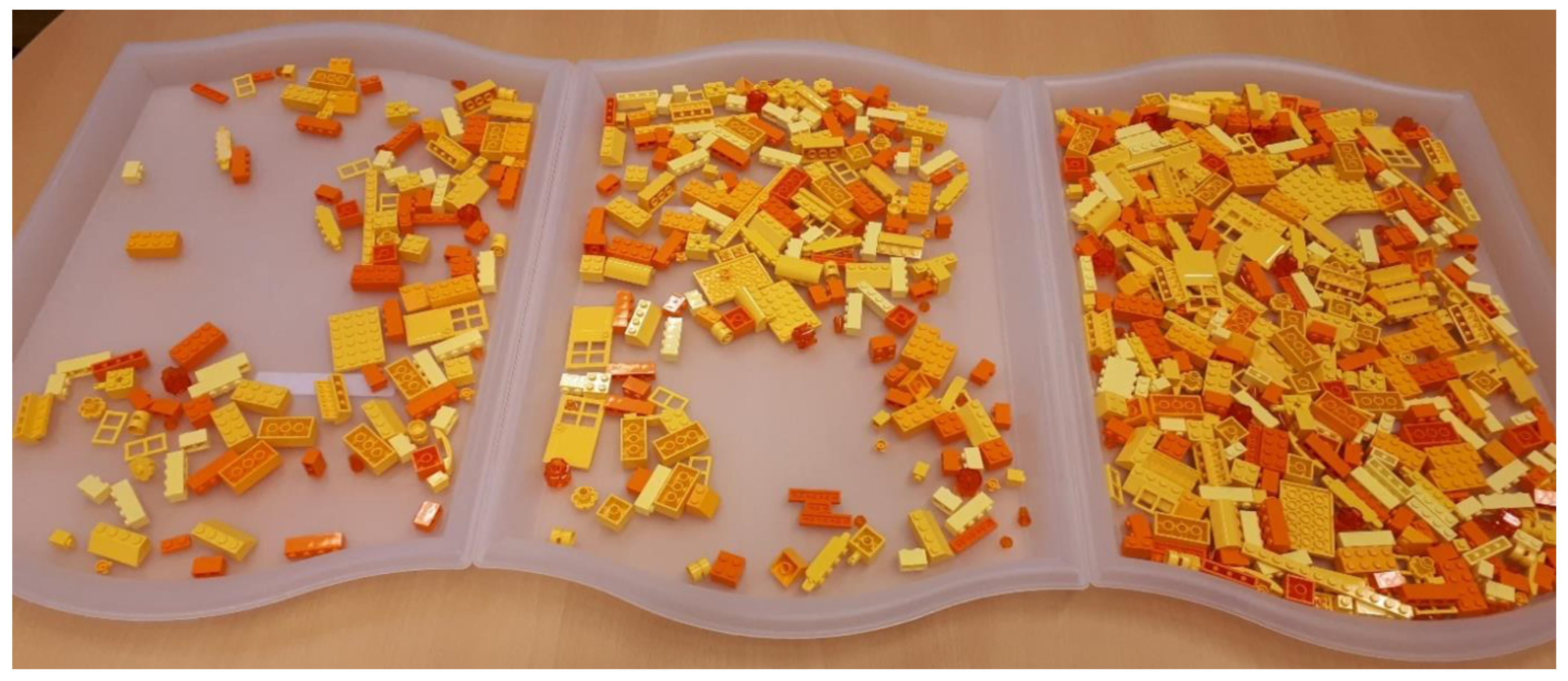
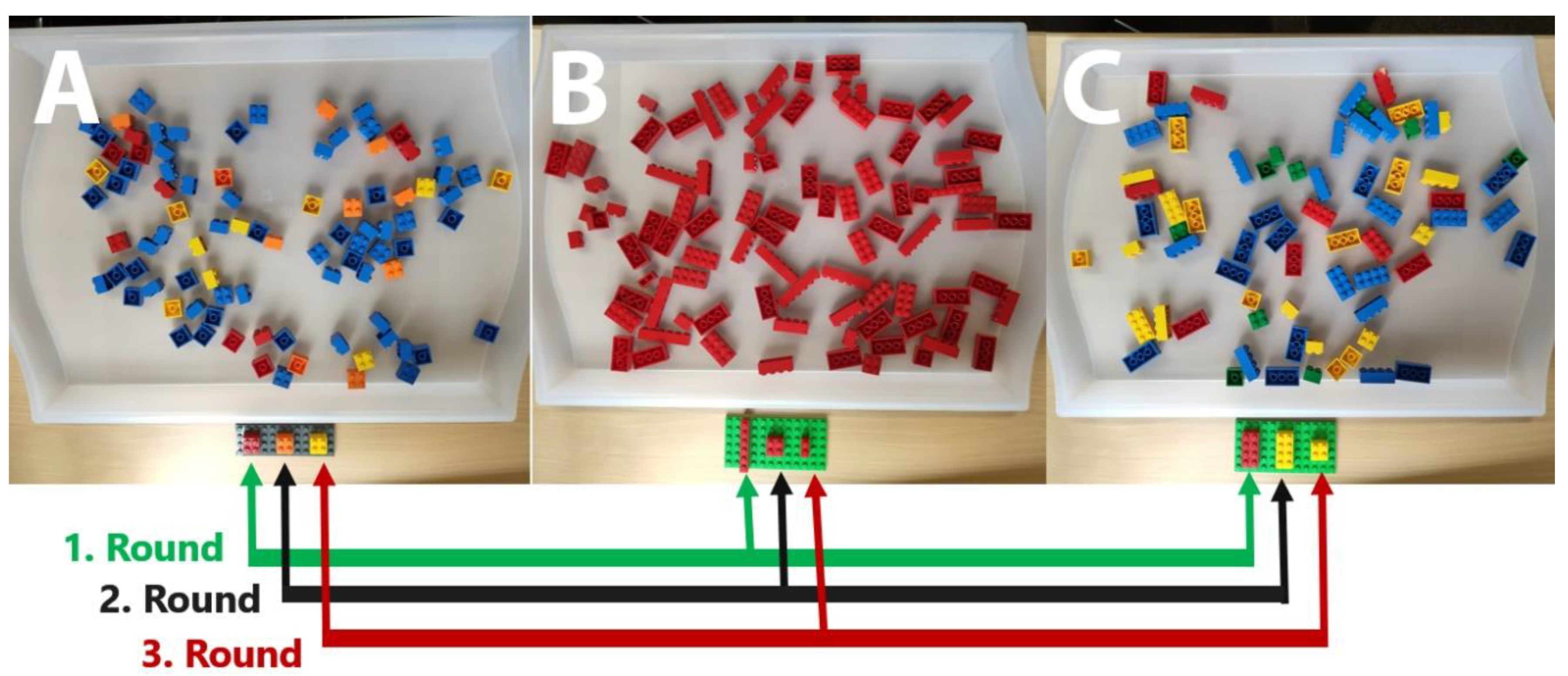
For the study, 20 different search trays were developed, resembling searches in which the search target could be singled out by shape/size or color (5 each) or their conjunction (10). They were presented in a random arrangement with the exception that feature and conjunction searches were always alternating. Each search tray consisted of the same components: a flat, transparent tray measuring 3 × 52 × 35 cm, 30 target objects (3 target types) and a number of 40 to 60 distractors adapted to the type of search (c.f.
Figure 3). Note that by using LEGO
® bricks, it is not possible to change the shape of a brick without also changing its size and vice versa. The differential instances of objects in the shape/size feature condition always represent changes in both dimensions, but will further be called “shape” for simplicity.
3.1.3. Setup and Procedure
To further illustrate the procedure, we uploaded an example video of one of the participants (see Open Practices statement). The search trays were presented on three rows of tables, with seven trays in the first row, six in the second row and seven in the third row. Each search tray was aided by an external plate on which the three targets were plugged so that the participant could see and compare their current target at any time. On the wall in the direction of the test person′s gaze, a photo and the constantly updating number of already found targets per run were displayed with a projector. When a respondent found the ten targets on a tray, a beep sound occurred. The participant always stood at the side of the table where the external plate was located and held a plastic box in their weak hand. This was used to collect the found search targets. The experimenter stood directly opposite them and instructed which target to search for (the participant had to point at it to avoid left–right confusions) and that all targets had to be picked up and placed in the box one by one. For each search, the experimenter only revealed the tray the participant was using. All other trays were hidden under a gray plate. The experimenter gave the signal to begin the search by saying “start” and uncovering the search tray in front of the participant. Response times were measured by the experimenter through clicking a button on a pointing device for each search target. This means the first response time was measured from the “start” signal until the first target item was placed in the box. When the participant had removed the ten targets from the tray, a stop signal sounded. The participant then put the targets back into the tray. The experimenter shuffled all the pieces, covered the tray again and continued with the participant to the next search tray. The participant was instructed to work the trays from the left tray to the right tray in each row and from the front row to the back row. During the first pass, the participant searched for the leftmost targets (or rightmost; counterbalanced) shown on the external plate on all trays. On the second pass, they searched for the middle targets and on the third pass, the remaining left or right target. The search targets and distractors were mixed unsystematically on the trays. In the grid search condition, the trays were prepared with white adhesive tape that divided the search tray in 6 roughly equally sized zones (see
Supplementary Materials).
3.2. Results
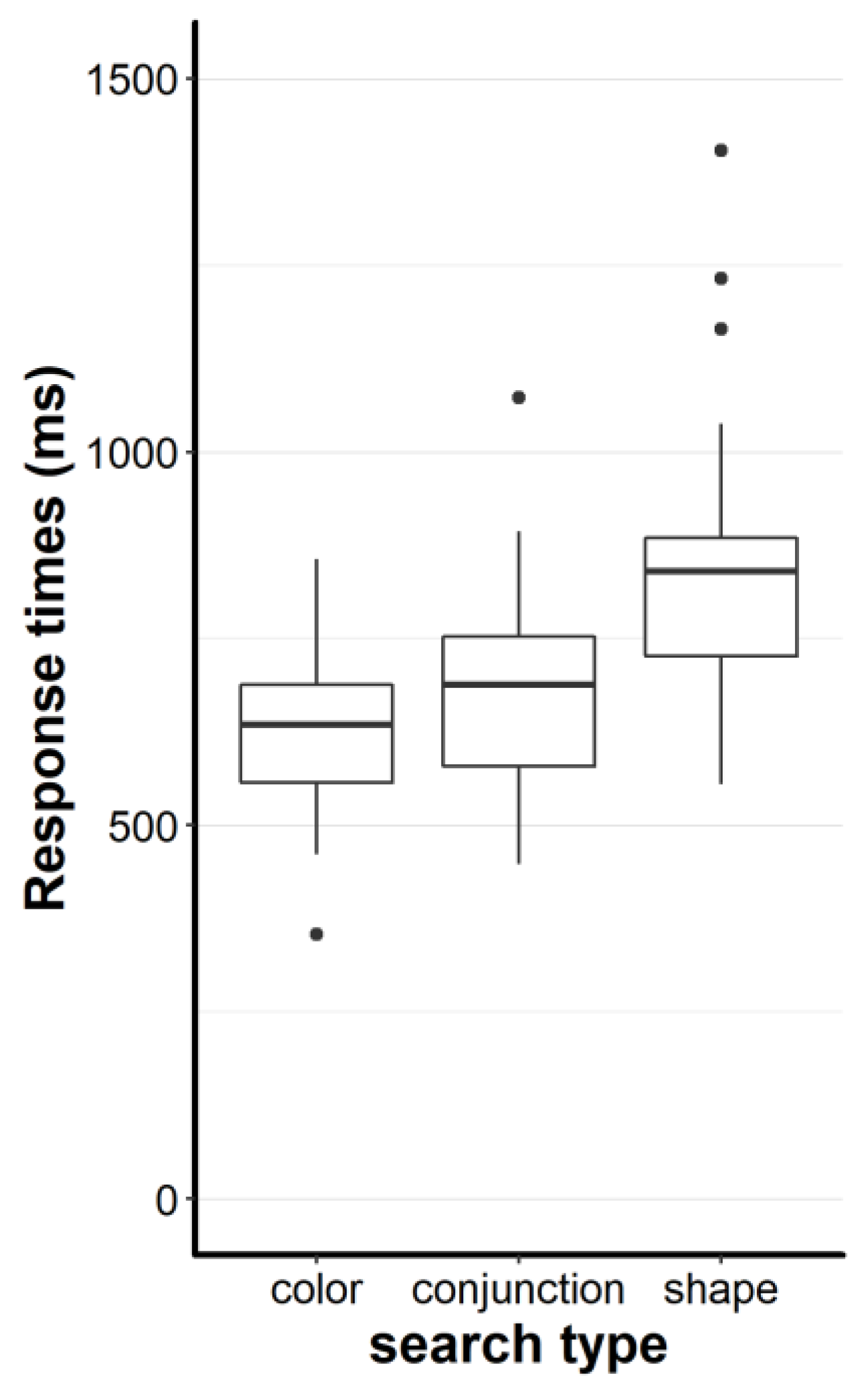
In Experiment 2, we assessed systematic differences between feature and feature conjunction searches in an interactive real-world setting. To investigate this, we first contrasted response times in feature searches vs. feature conjunction searches. As we did not find any differences between grid searches and non-grid searches (p > 0.1), we further report the averages of all searches. We submitted the median response times (RTs) to a repeated measures ANOVA with the factor search type (color, shape, conjunction). The search type main effect was quite large: F, (2, 72) = 121.97,
p < 0.001, η
p2 = 0.77 (c.f.
Figure 4).
Subsequent Welch’s t-tests showed that conjunction searches tended to be slower than color searches, 678 vs. 628 ms: t, (70.12) = 1.8, p = 0.076, dz = 0.42, 95% CI [−5 ms, 105 ms], conjunction searches were generally faster than shape searches, 678 vs. 842 ms: t, (64.78) = −4.5, p < 0.001, dz = 1.05, 95% CI [−237 ms, −91 ms], and color searches were faster than shape searches, 628 vs. 842 ms: t, (58.88) = −6.16, p < 0.001, dz = 1.43, 95% CI [−283 ms, −144 ms]. Effect sizes range from medium to large and one confidence interval includes zero. This indicates that differentiating feature searches from feature conjunction searches needs careful consideration in terms of the chosen feature dimensions and their discriminability.
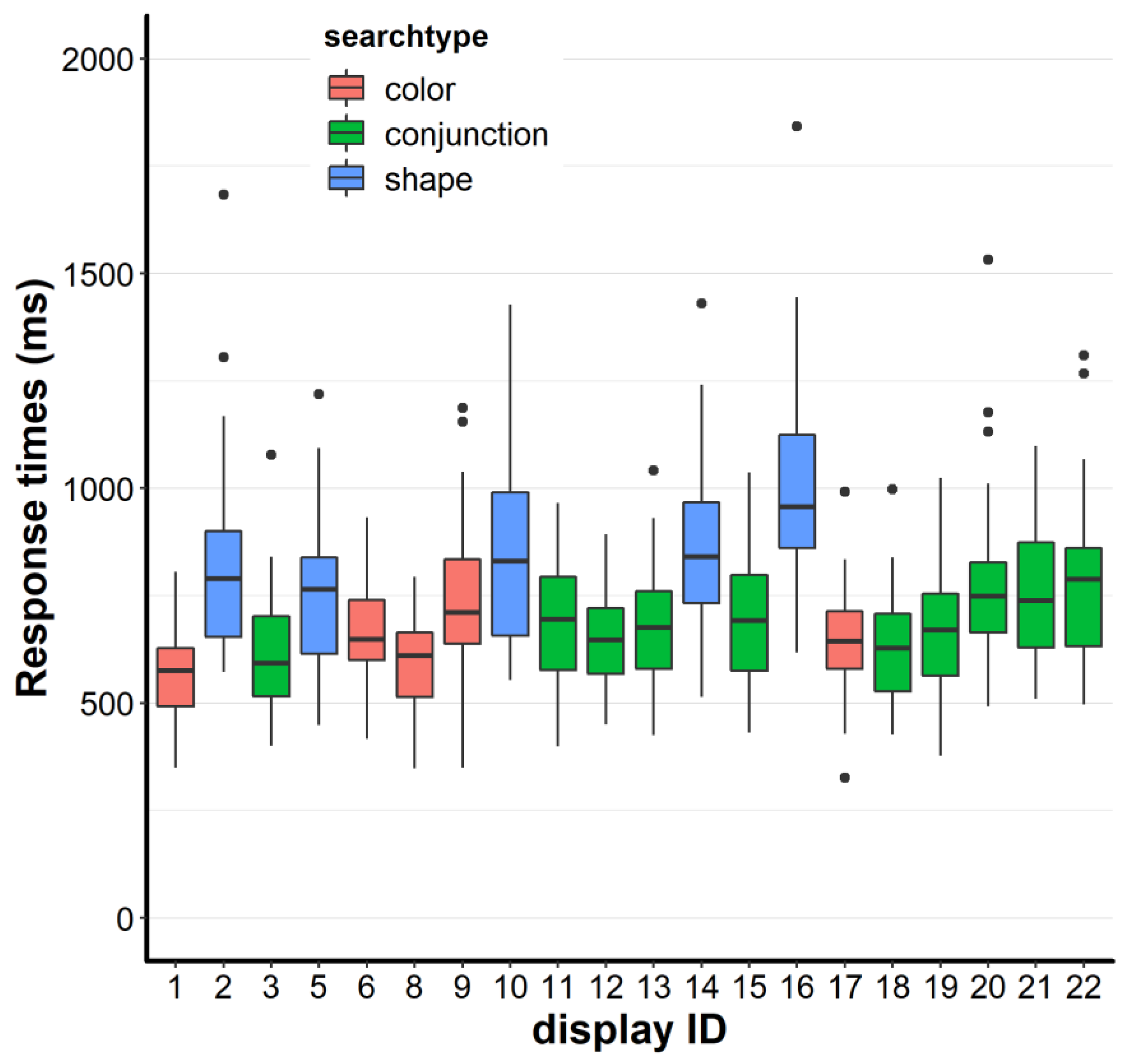
Looking at the individual trays (
Figure 5), one can see that shape searches led to (visually) higher variance. In particular, tray 16 (for a visual, see
Supplementary Materials) seemed to be an unordinary difficult search. In fact, the averaged other shape searches were faster compared to tray 16, 814 vs. 994 ms: t, (68.31) = −3.68,
p < 0.001, d
z = 0.86, 95% CI [−276 ms, −82 ms]). However, upon visual inspection, it seems that search type was the prime determinant of search time as the shape searches were all comparatively rather slow and the color searches were all rather fast. Notably, if tray 16 was left out of the search type comparison, conjunction searches were still faster than shape searches, 678 vs. 814 ms: t, (64.32) = −3.71,
p < 0.001, d
z = 0.86, 95% CI [−210 ms, −63 ms], but the effect size decreased (compared to the original d
z = 1.05).
3.3. Discussion
In the second experiment, we investigated the difference between color, shape and conjunction searches in an interactive real-world setting. In our paradigm, we found that feature searches were fast (color) or slow (shape) depending on the discriminability of the items within each feature dimension, i.e., the differences in stimulus color were quite easily noticeable, while the shape/size changes were harder to identify. The feature conjunction searches were in the middle in terms of response times. This is at odds with the computerized search literature, in which it is typically found that conjunction searches are generally slower than feature searches [
2,
18]. An explanation could be that participants were able select the respective stimulus color in a parallel fashion and the subsequent inefficient shape search was limited to a smaller subset of the original search space. Interestingly, from visual inspection, it seems that there is not too much variance in response times to the individual trays for color searches as well as feature conjunction searches (except for a few outliers).
4. General Discussion
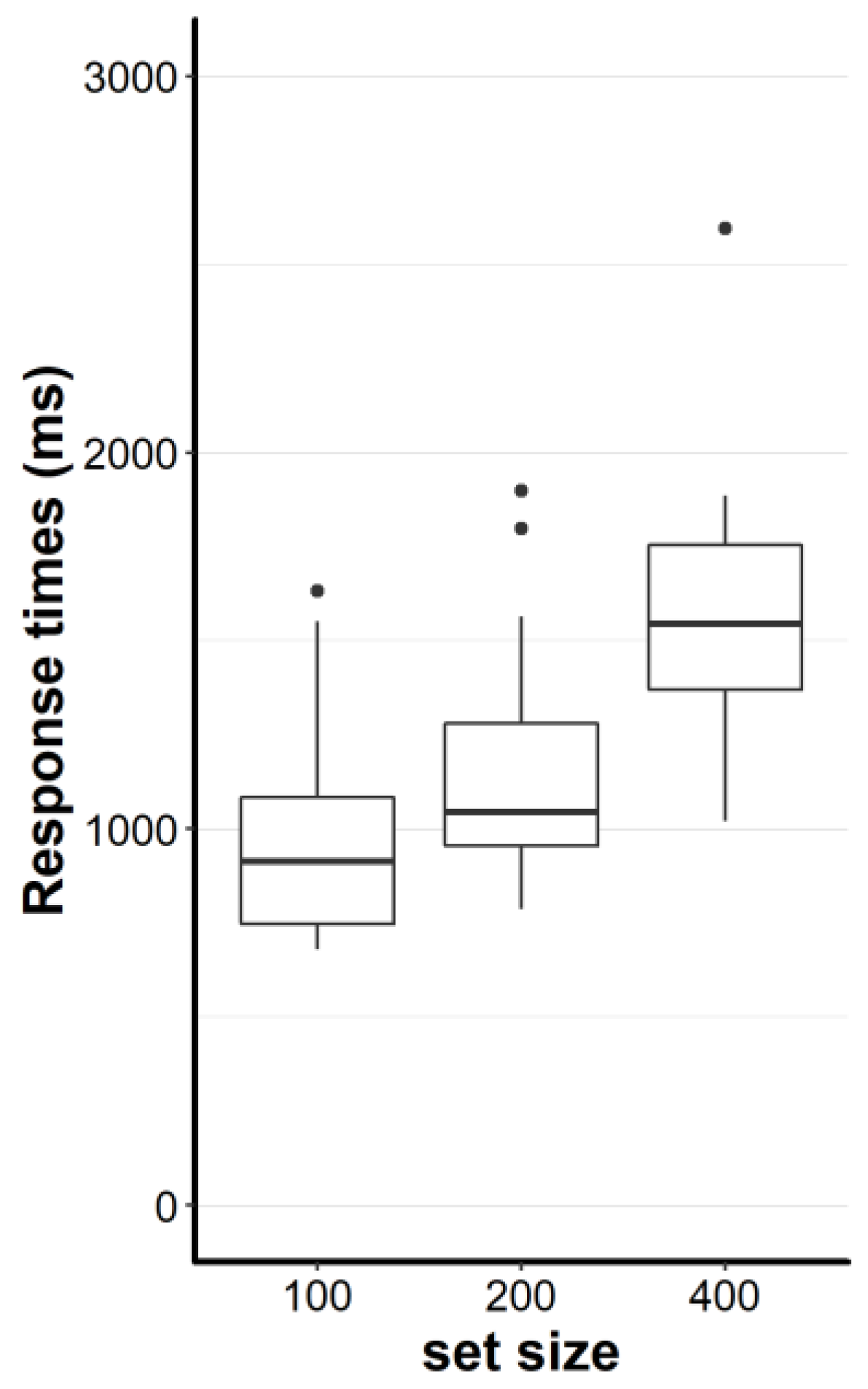
In these experiments, we developed an easy-to-adopt yet standardizable paradigm to investigate common visual search questions incorporating haptic components vital for comparison to applied search tasks in the real world. In the first experiment, we investigated the search efficiency of conjunction searches and were able to show classical linear set size effects: average response times to targets were higher as a function of set size, which is in line with prior laboratory research [
1,
18,
35]. This shows that it is, in principle, possible to generalize set size effects found in classical computerized experiments to the real interactive world.
In the second experiment, we showed that feature searches in the color dimension were faster than conjunction searches. This is theoretically in line with prior computerized studies in the sense that color differences (if large enough) result in a strong bottom-up salience signal [
2,
18] and thereby are a quite prominent attribute guiding the search [
37]. However, shape searches were slower than conjunction searches in the present study. This suggests that, in our paradigm, shape was not a strong attentional guiding attribute. In fact, shape seemed to be so poor at guiding the search that, in conjunction searches, participants seemingly selected all colored target objects first and then performed the apparently much harder shape search on a smaller subset of items, leading to a net RT benefit compared to ordinary shape searches. A reason for this might be that the shape differences were perceived as smaller than the differences in color (c.f.
Figure 3), which might explain why this trend can generally be found for all shape search trays (visual inspection of
Figure 5). Notably, even in computerized experiments, shape searches tend to be slightly slower than color searches, especially with a set size of 30+ items [
38]. It is reasonable to assume that shape differences would lead to similarly easy searches, if the shape differences are only large enough to make the search targets pop out of the search space, for example, if spheres were contrasted with squares. Relatedly, participants might have been able to categorize and verbalize the color differences (e.g., search for blue among yellow and orange) but not the shape differences (shape targets were all somewhat cube-ish). Classical computerized search studies typically relied on clearly distinguishable categories for shape searches as well (e.g., search for a diamond among squares), and while there is evidence that shape information can be beneficial for guiding attention in the search [
39], this is not undoubted [
37] and it could be that shape is only a strong guiding attribute when verbal categories can be established. However, a computerized study investigating attentional dynamics in a color–shape conjunction task found that while color distractors reliably captured attention, while shape distractors did not, although they were defined in a verbalizable category [
40]. Overall, it seems that color is an arguably stronger guiding attribute than shape and our study might have pronounced that difference.
From a data perspective, our response time results can best be compared to the computerized finger-based foraging tasks popularized by Kristjansson et al. [
32,
33]. In these tasks, participants searched for feature or conjunction targets by cancelling the targets through pointing at them on a tablet device. In our study, response times in color feature searches were ~628 ms per target (compared to ~298 ms [
33] and ~315 ms [
32]) and response times in conjunction searches were ~678 ms (compared to ~350 ms [
33] and ~440 ms [
32]). This means, in the computerized foraging tasks, conjunction responses were 1.4 times slower than feature searches (and this is quite typical for computerized search tasks [
1,
2,
18]), while there were no differences found in the present study. This is likely because responses in our shape search condition were particularly slow. It is plausible that the feature conjunction searches (color × shape) were found at medium response times (between fast color and slow shape searches) because participants first singled out all correct colors in parallel, reducing the functional set size [
21] of the search space [
2,
18] (benefitting from the color pop-out effect), and then had to effortfully search through the differently shaped objects (but limiting the inefficient serial search to a subset of the original search space).
A difference to computerized studies remains in the fact that in this interactive unstructured setting, there is more than one “target”—strictly speaking—because the target can be present in almost every imaginable orientation. These orientation changes include the fact that sometimes the “back” of the target might face the observer, so the target cannot be directly identified by its number of knobs. This might be a reason why color is the prominent driver of search times: it is static across all possible target orientations. However, the shape or size of the target, usually identified by the number of knobs, has to be identified by the number of “gaps” instead when the target is laying on its “belly”. It can be argued that a new mental representation of the target is needed to successfully find the “gaps” corresponding to the correct shape of the target, which would mean that for shape searches, participants would have to hold multiple target representations in their visual working memory. There has been a discussion in the search literature whether an observer can hold multiple target templates in their visual working memory at the same time (yes: [
41]; no: [
42]; divergent: [
43]) or whether templates need to be costly “switched”. Therefore, it might be that shape searches are not only slower because of decreased discriminability between target and distractors, but also because multiple target representations have to be effortfully held in visual working memory. Further research might compare similar unstructured settings with more orderly presented targets in this real-world paradigm to further inform this issue.
Currently, our novel paradigm probably resembles lab-based research more closely than true everyday real-world search behavior. However, we argue that it is provides valuable benefits and complements classical research. Using this paradigm might further address the issue of ambiguous set sizes in real-world settings [
22,
23]. It is therefore straightforward to calculate search efficiency in controlled stimulus arrangements. This makes search in the real world comparable to computerized search studies (c.f. 19). Additionally, we introduced an interactive, haptic component to the search that is prevalent in nearly all everyday searches and therefore vital towards a more complete understanding of human search behavior in applied settings.
Overall, the present article provides two studies that aid towards an ecologically valid demonstration of crucial effects in line with the feature integration theory that much of todays’ visual search literature relies upon [
2]. It describes a novel paradigm to investigate visual search effects in an interactive real-world setting and might serve as a “bridge” between classical computerized search and everyday interactive search.