Next Article in Journal
Localised Grey Matter Atrophy in Multiple Sclerosis and Clinically Isolated Syndrome—A Coordinate-Based Meta-Analysis, Meta-Analysis of Networks, and Meta-Regression of Voxel-Based Morphometry Studies
Next Article in Special Issue
Motivated Interpretations of Deceptive Information
Previous Article in Journal
Effect of Treadmill Exercise and Trans-Cinnamaldehyde against d-Galactose- and Aluminum Chloride-Induced Cognitive Dysfunction in Mice
Article

Threatening Facial Expressions Impact Goal-Directed Actions Only if Task-Relevant


1
Department of Clinical and Experimental Sciences, University of Brescia, Viale Europa 11, 25123 Brescia (BS), Italy
2
IRCCS Neuromed, Via Atinense 18, 86077 Pozzilli (IS), Italy
*
Author to whom correspondence should be addressed.
Brain Sci. 2020, 10(11), 794; https://doi.org/10.3390/brainsci10110794

Received: 12 October 2020 / Revised: 24 October 2020 / Accepted: 26 October 2020 / Published: 29 October 2020
(This article belongs to the Special Issue How Emotions Guide Decision-Making: Behavioral and Brain Mechanisms)
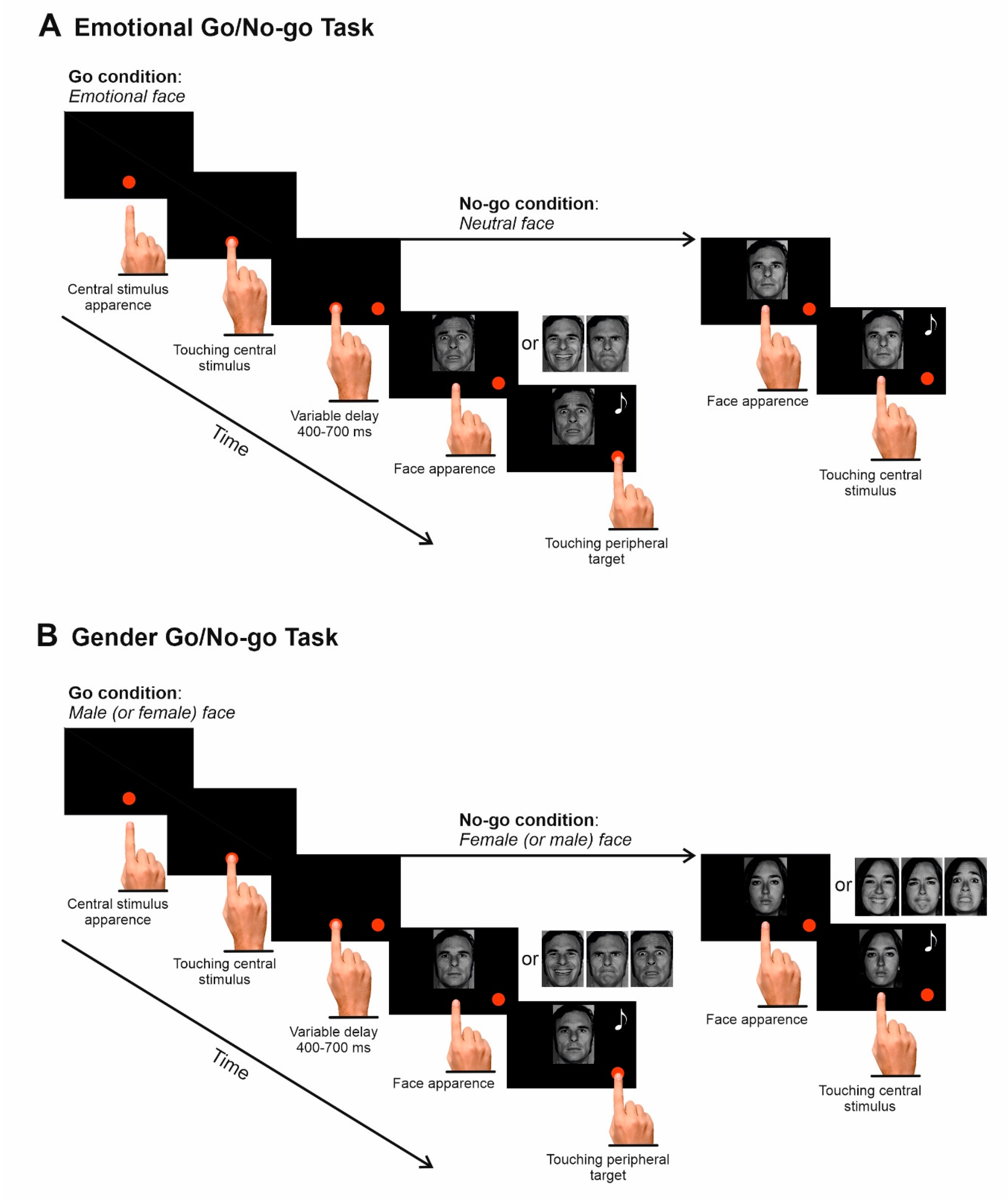
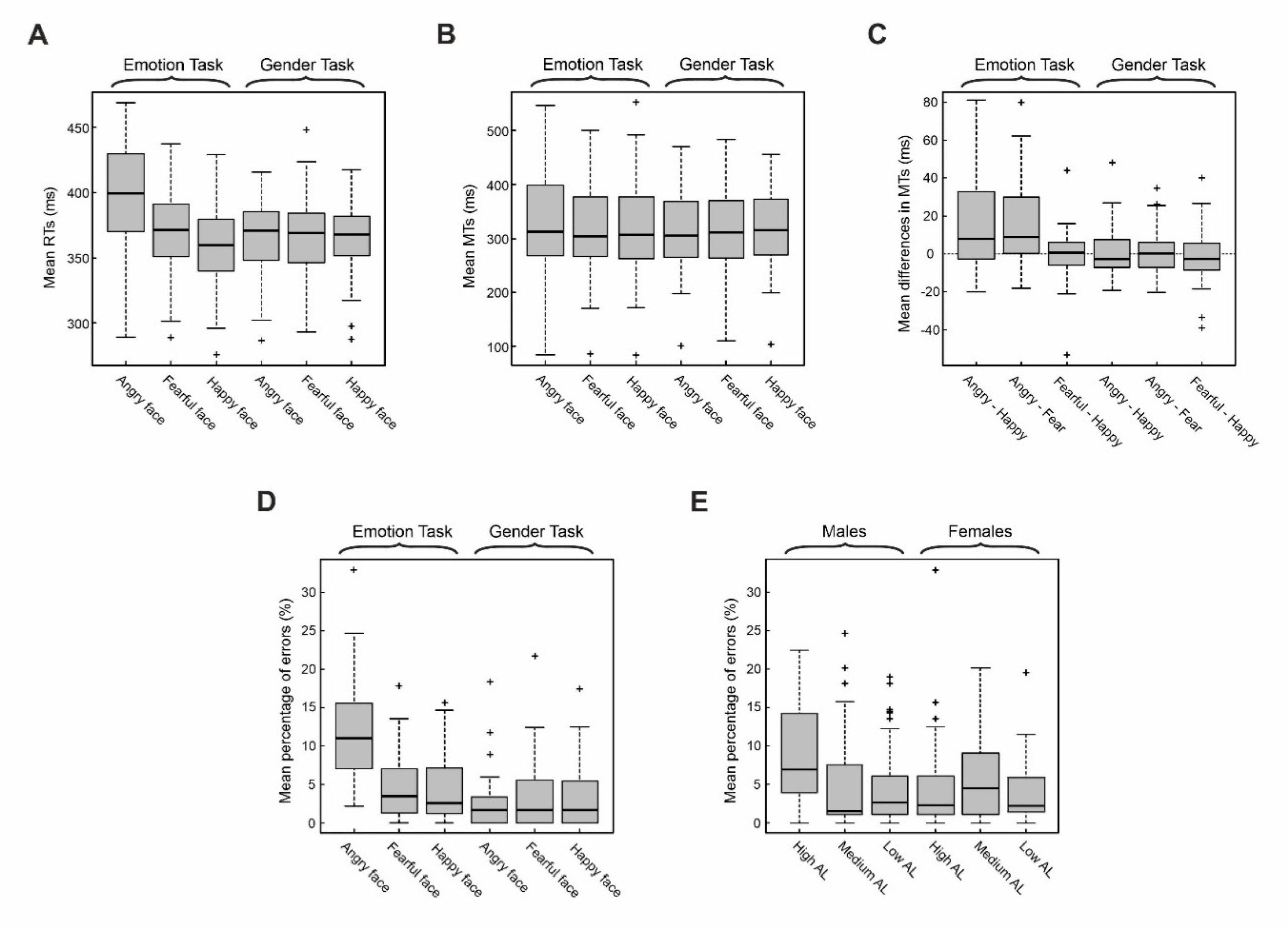
Facial emotional expressions are a salient source of information for nonverbal social interactions. However, their impact on action planning and execution is highly controversial. In this vein, the effect of the two threatening facial expressions, i.e., angry and fearful faces, is still unclear. Frequently, fear and anger are used interchangeably as negative emotions. However, they convey different social signals. Unlike fear, anger indicates a direct threat toward the observer. To provide new evidence on this issue, we exploited a novel design based on two versions of a Go/No-go task. In the emotional version, healthy participants had to perform the same movement for pictures of fearful, angry, or happy faces and withhold it when neutral expressions were presented. The same pictures were shown in the control version, but participants had to move or suppress the movement, according to the actor’s gender. This experimental design allows us to test task relevance’s impact on emotional stimuli without conflating movement planning with target detection and task switching. We found that the emotional content of faces interferes with actions only when task-relevant, i.e., the effect of emotions is context-dependent. We also showed that angry faces qualitatively had the same effect as fearful faces, i.e., both negative emotions decreased response readiness with respect to happy expressions. However, anger has a much greater impact than fear, as it increases both the rates of mistakes and the time of movement execution. We interpreted these results, suggesting that participants have to exploit more cognitive resources to appraise threatening than positive facial expressions, and angry than fearful faces before acting. View Full-Text
Keywords: motor readiness; emotion; facial expressions; decision making; Go/No-go task motor readiness; emotion; facial expressions; decision making; Go/No-go task
Show Figures

Figure 1

MDPI and ACS Style

Mancini, C.; Falciati, L.; Maioli, C.; Mirabella, G. Threatening Facial Expressions Impact Goal-Directed Actions Only if Task-Relevant. Brain Sci. 2020, 10, 794. https://doi.org/10.3390/brainsci10110794
AMA Style

Mancini C, Falciati L, Maioli C, Mirabella G. Threatening Facial Expressions Impact Goal-Directed Actions Only if Task-Relevant. Brain Sciences. 2020; 10(11):794. https://doi.org/10.3390/brainsci10110794
Chicago/Turabian Style

Mancini, Christian, Luca Falciati, Claudio Maioli, and Giovanni Mirabella. 2020. "Threatening Facial Expressions Impact Goal-Directed Actions Only if Task-Relevant" Brain Sciences 10, no. 11: 794. https://doi.org/10.3390/brainsci10110794
Find Other Styles
Note that from the first issue of 2016, MDPI journals use article numbers instead of page numbers. See further details here.

Article Access Map by Country/Region

1
Back to TopTop